

Executive function assessment in the classroom often starts with a vague worry. A sixth grader seems capable in discussion, yet her binder is chaotic, long projects stall, and she rarely starts independent work until the period is half over. Adults call it “lazy” or “disorganized,” but those words do not tell anyone what to do next.
This guide gives you a five-step process for observing executive function skills in a way that leads to real support. You will learn how to choose the skills to look at, plan when to observe, record specific behaviors, find patterns with the student, and turn results into supports you can review. It works for general education teachers, special educators, and the specialists who support them.
Examples are fictional. Adapt to the student’s goals and agreed supports. This is guidance, not a diagnosis.
At a glance
- Classroom observation describes what a student does. It is not a formal evaluation or diagnosis.
- Focus on two or three skill areas at a time, not every skill at once.
- Observe in different settings and at different times of day.
- Record observable behaviors, not labels like “lazy” or “unmotivated.”
- Use the results to choose one or two supports, then review them.
1. Define the skills for your executive function assessment
First, decide what you are looking at. Executive function is a broad term for the mental skills that help people plan, focus, remember instructions, and manage several tasks. Organizations such as the Center on the Developing Child at Harvard University describe these skills as working together, like an air traffic control system for the brain.
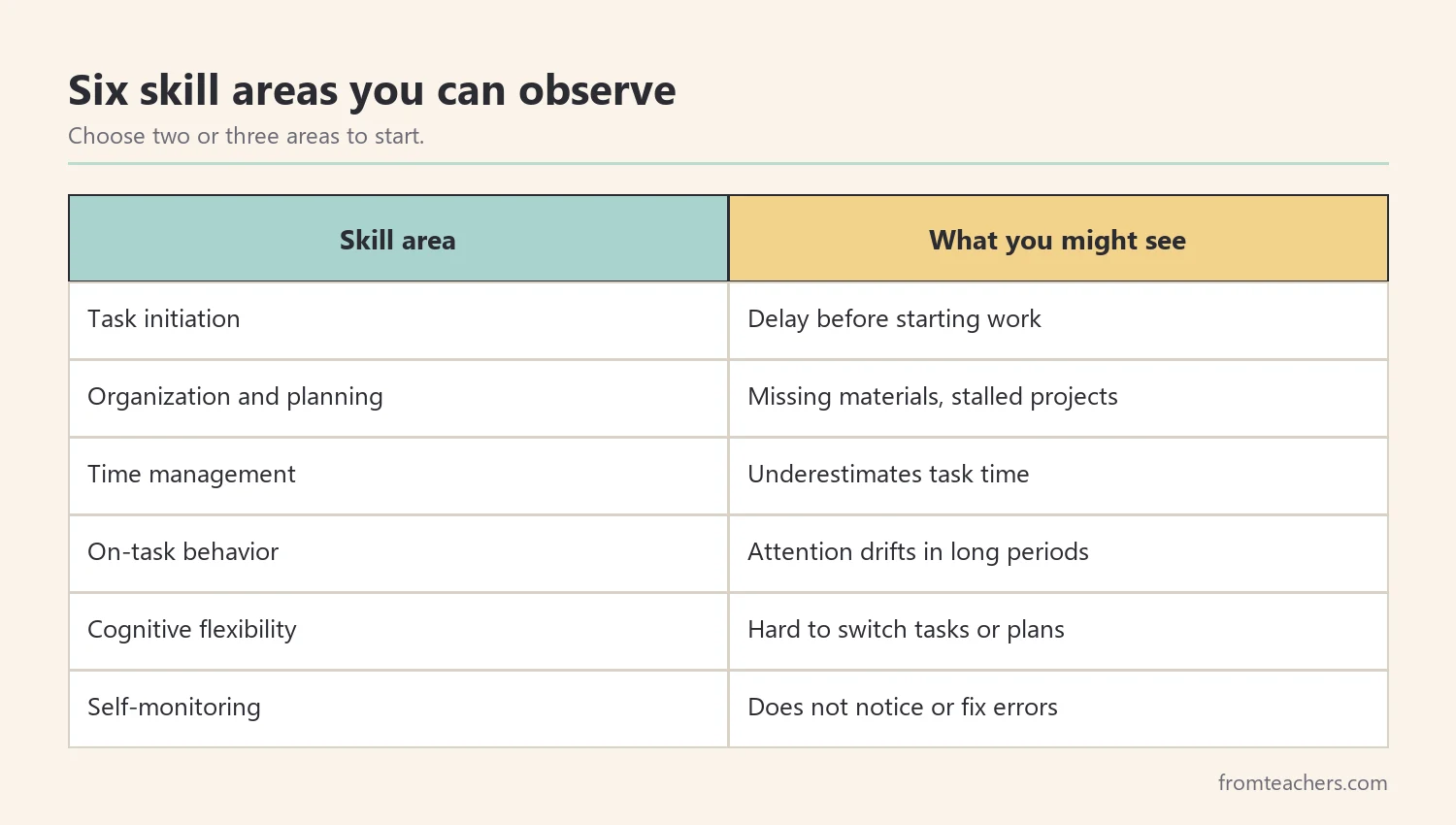
For a classroom executive function assessment, break the topic into areas you can observe. Common areas include task initiation, organization and planning, time management, on-task behavior, cognitive flexibility during transitions, and self-monitoring. Each area shows up in specific, visible behaviors.
Also, write down why each area matters for this student. A short reason, such as “late starts cost about a third of each work period,” keeps the executive function assessment tied to learning rather than to adult frustration. It also helps the family understand why you are observing.
Put this step into practice
Next, pick two or three areas to start. Choose them based on what concerns you most and what gets in the way of learning. Observing everything at once usually produces long notes and no clear direction.
| Skill area | What you might see |
|---|---|
| Task initiation | Delay before starting independent work |
| Organization and planning | Missing materials, unfinished multi-step projects |
| Time management | Underestimates how long tasks take |
| On-task behavior | Attention drifts during long work periods |
| Cognitive flexibility | Difficulty switching tasks or changing plans |
| Self-monitoring | Does not notice or fix errors |
Worked example. Ava is a fictional student in grade 6. Her teacher and the learning specialist agree to start with three areas: task initiation, organization and planning, and time management. They choose these because Ava’s main struggles are late starts, a disorganized binder, and missed project deadlines.
In short, a clear focus keeps the assessment small enough to finish and specific enough to act on.
2. Plan when and where your executive function assessment happens
Next, plan your observations so they show a fair picture. Executive function skills often look different across subjects, times of day, and task types. A student may start math quickly but stall on writing, or manage well in the morning and struggle after lunch.
So, choose at least two or three settings for the executive function assessment. For example, observe one independent work period, one group task, and one transition. Then, set a simple schedule, such as three short observations a week for two weeks. Short, regular observations are easier to keep up than one long session.
In addition, involve other adults. A second observer, such as a special educator or school psychologist, adds a fresh view. Families can also share what homework and routines look like at home, which helps you see whether a pattern appears across settings.
Observation plan checklist
- Two or three skill areas chosen.
- Two or three settings, such as independent work, group work, and transitions.
- A schedule with dates and times.
- Who observes each time.
- One quick question for the family.
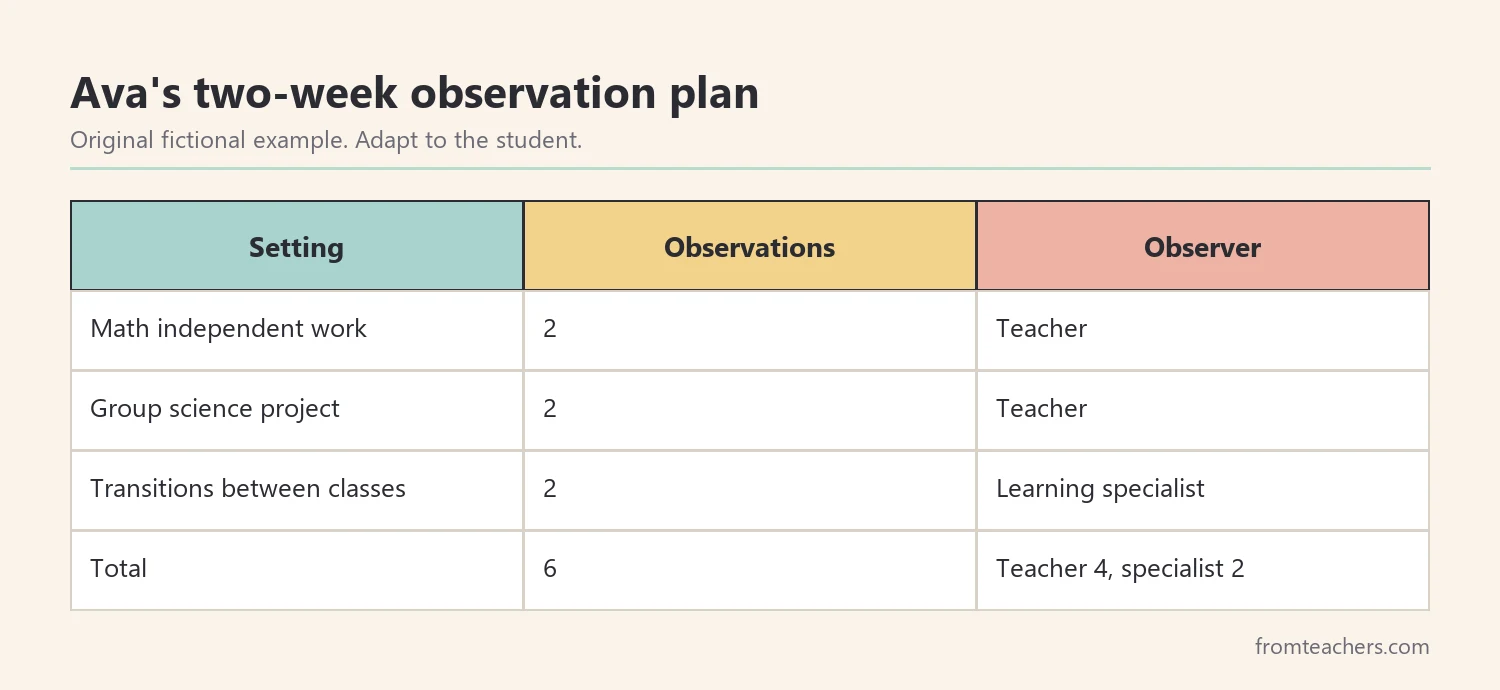
Worked example. Ava’s team plans six observations over two weeks: two during math independent work, two during group science projects, and two during transitions between classes. That gives six observations in all. Her teacher observes four of them and the learning specialist observes two. Ava’s parents agree to share how homework starts at home.
As a result, the executive function assessment will show patterns across settings, not one bad afternoon.
3. Record observable behaviors in an executive function assessment
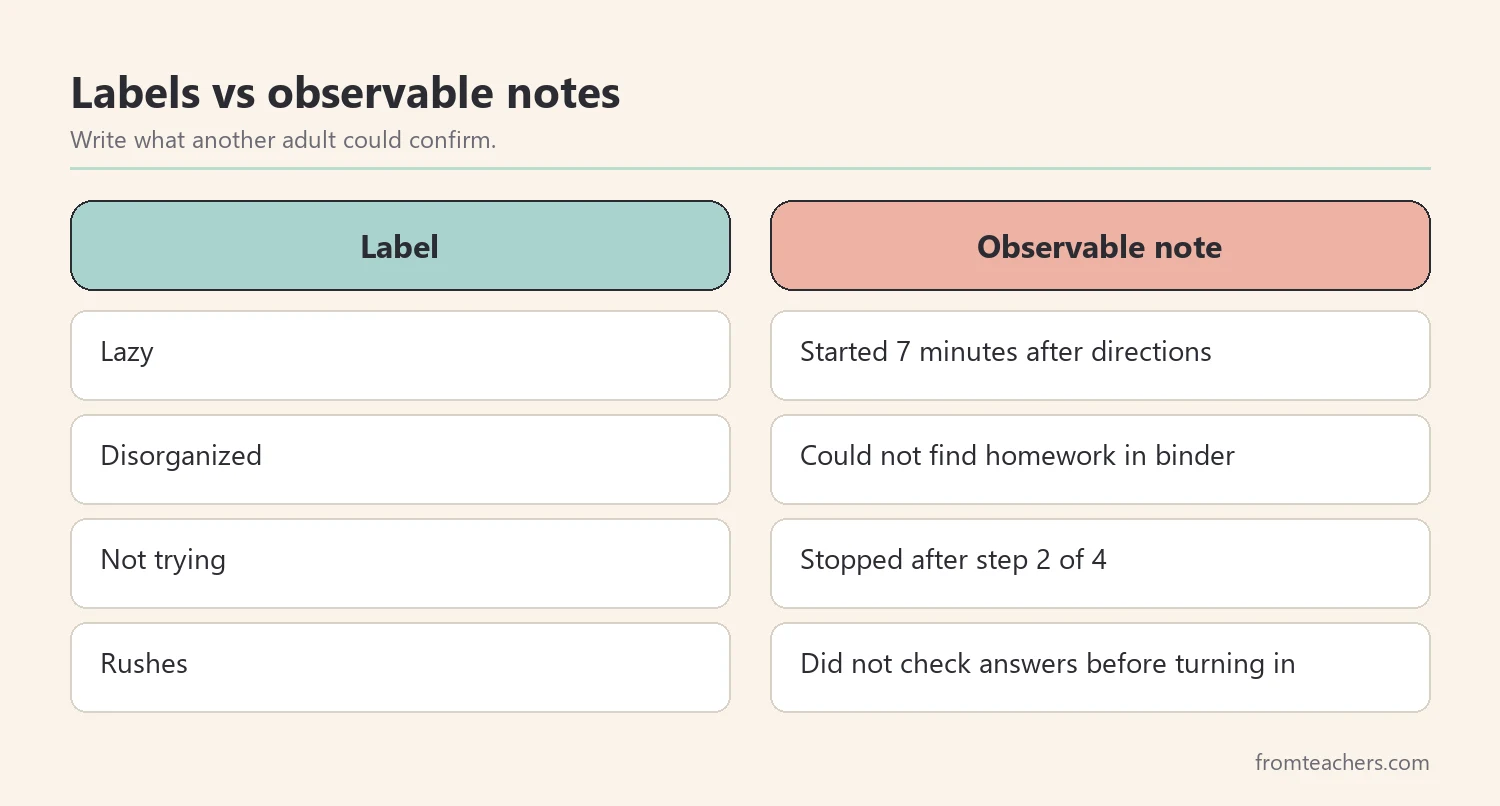
Now, record what you actually see. The most useful notes describe behavior that anyone could observe, in specific terms. “Took 7 minutes to begin after directions” is useful. “Unmotivated” is not, because it is a guess about the reason.
In addition, use a consistent format. A checklist with an area, a list of specific behaviors, and a notes column makes each observation fast and comparable. Then, add the date, time, setting, and observer so the team can see patterns later.
In addition, try to observe at the same point in each lesson, such as the first ten minutes of independent work. When the timing stays the same, differences between sessions are easier to trust. If a session is unusual, such as a fire drill or a substitute, note it so the team can set it aside when looking for patterns.
Also, record what helped. If a visual timer, a checklist, or a quick check-in made a difference, write it down. These notes often point directly to the supports you will try in step 5.
A quick classroom example
For ready-made forms, the Executive Functioning Checklists for Classroom Success include observation forms for self-monitoring, task initiation and completion, cognitive flexibility and transitions, on-task behavior, organization and planning, and time management, each with student, date, observer, and class fields.
| Instead of | Write |
|---|---|
| Lazy | Started 7 minutes after directions |
| Disorganized | Could not find homework in binder |
| Not trying | Stopped after step 2 of 4 |
| Rushes | Did not check answers before turning in |
Worked example. During a math work period, Ava’s teacher notes: “Directions ended at 10:05. Ava started at 10:12. She found her calculator after checking two folders. She finished 6 of 10 problems. A visual timer was on the board.” Each line is a fact another adult could confirm.
In other words, an executive function assessment is only as useful as its notes are specific.
4. Find patterns in the executive function assessment
After the observations, step back and look for patterns. Lay your notes side by side and ask simple questions. When does the difficulty show up most? When does it show up least? What helped?
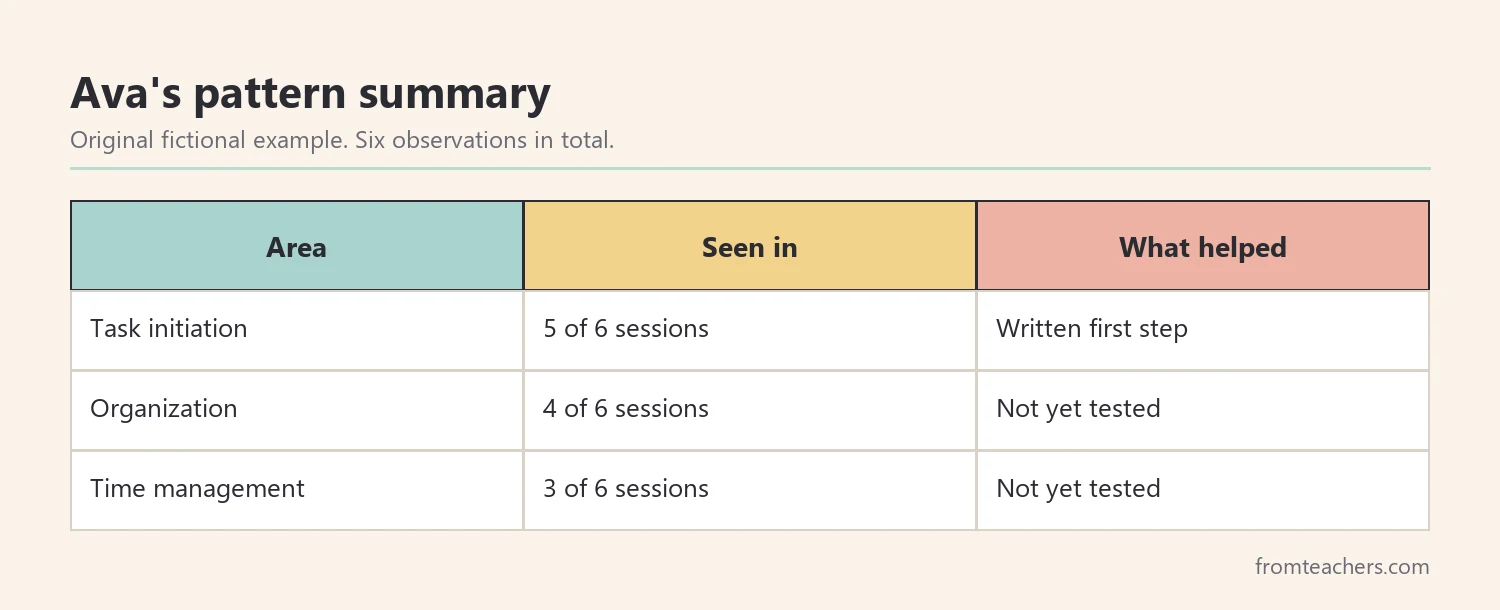
Then, summarize the executive function assessment in a short table. For each skill area, note how often the difficulty appeared, in which settings, and what seemed to help. Keep the summary to one page so the team can read it quickly.
Next, talk with the student. Older students often have useful insight into their own executive function. Ask what makes starting hard, what helps them stay organized, and what they would like to try. Students who help choose a support are more likely to use it.
Also, remember the limits. A classroom executive function assessment shows patterns in school behavior. If concerns are significant or affect many areas, the team may consider a formal evaluation, which is done by qualified professionals with the family’s consent.
Worked example. Ava’s six observations show late starts in 5 of 6 sessions. The one quick start happened when the teacher gave her a written first step. Her binder caused lost time in 4 of 6 sessions, and she left work unfinished in 3 of 6. When asked, Ava says, “I don’t know where to begin, so I wait.” She suggests a sticky note with the first step.
Therefore, the pattern and the student’s own words point to the same support.
5. Turn executive function assessment results into supports
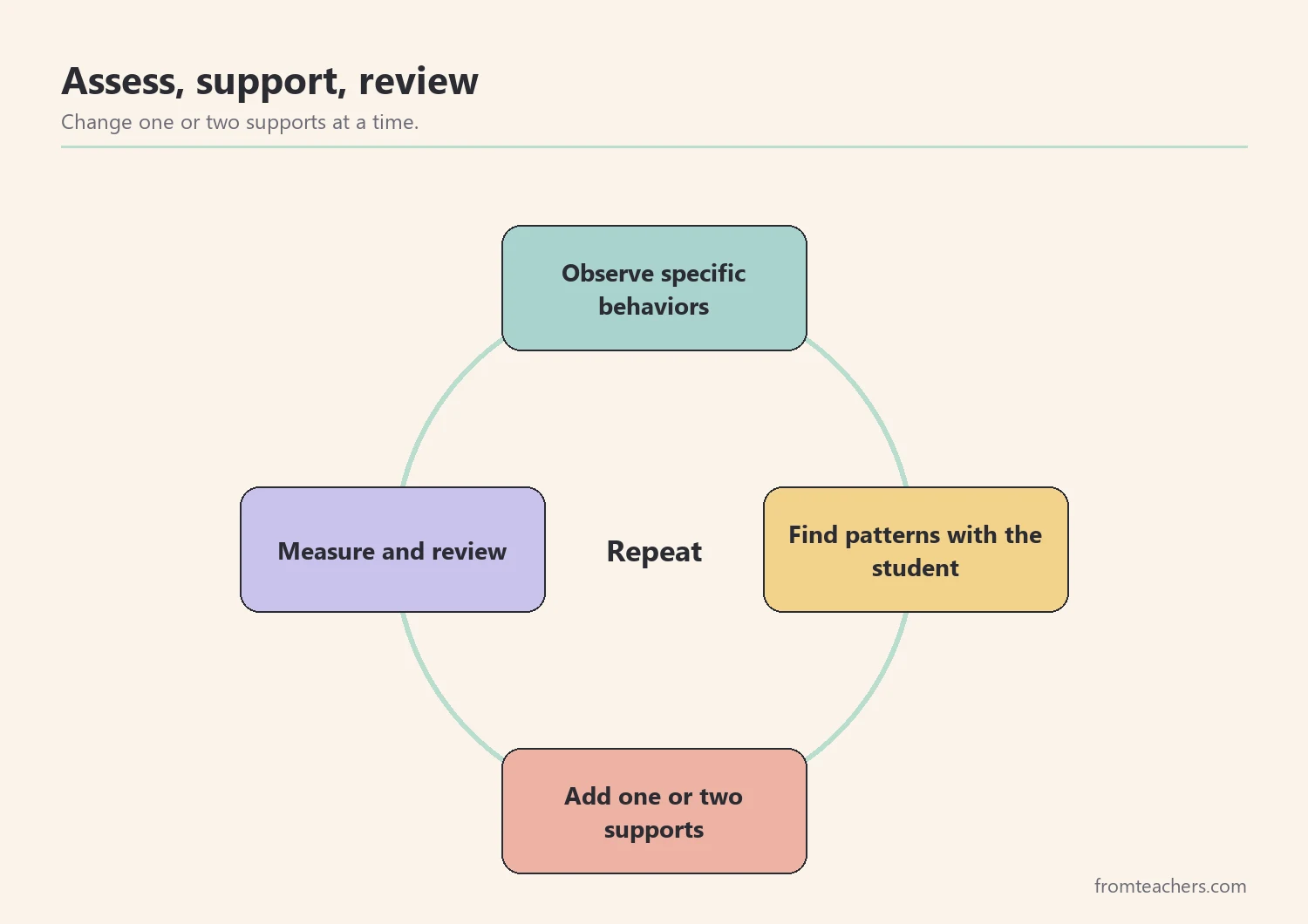
Finally, use what you learned. The goal of an executive function assessment is not a report. It is a better school day for the student. So, choose one or two supports that match the patterns you found.
Match supports to areas. For task initiation, try a written first step or a short start routine. To support organization, try a color-coded binder, a daily folder check, or a materials list. When time management is the problem, try a visual timer, chunked deadlines, or a project calendar. Then, teach the support explicitly, practice it, and fade adult help over time.
Next, measure the same thing you observed at the start of the executive function assessment. If you tracked minutes to start, keep tracking minutes to start. This makes it easy to see whether the support works. Review every three to four weeks with the student, the family, and the team.
| Area | Support to try | What to measure |
|---|---|---|
| Task initiation | Written first step | Minutes to start |
| Organization | Daily folder check | Materials found on first try |
| Time management | Chunked project deadlines | Checkpoints met on time |
Worked example. Ava’s team adds a sticky-note first step for independent work and a two-minute binder check at the end of each day. Over three weeks, her start time drops from about 7 minutes to about 2 minutes. She finds materials on the first try more often. The team keeps both supports and plans to add a project calendar next.
Make it stick
Also, plan how adult help will fade. At first, the teacher might write Ava’s first step for her. Later, Ava can write it herself, and the teacher only checks it. Fading help this way builds independence, which is the real goal of any support.
In the end, an assessment matters when it changes what happens in class.
Common mistakes and how to avoid them
- Observing everything at once. Notes get long and unclear. Fix: start the executive function assessment with two or three skill areas.
- Using labels instead of behaviors. Labels guess at reasons. Fix: write what you see, with times and counts.
- Observing only one setting. One class can mislead. Fix: observe at least two or three settings.
- Skipping the student’s view. You miss useful insight. Fix: ask the student what makes the task hard and what helps.
- Treating observation as diagnosis. It goes beyond what the data shows. Fix: describe patterns and refer to the team for formal evaluation when needed.
- Adding many supports at once. You cannot tell what worked. Fix: add one or two, measure, then adjust.
Questions teachers and parents ask about executive function assessment
Is a classroom executive function assessment the same as a formal evaluation?
No. Classroom observation describes behavior in school settings. A formal evaluation is done by qualified professionals, such as a school psychologist, and follows the school’s evaluation process with family consent.
How long should observations take?
Short, regular observations work well. For example, ten to fifteen minutes, several times over two weeks. Consistency matters more than length.
Can parents use executive function assessment checklists at home?
Yes, simple checklists can help families notice patterns in homework and routines. Share those notes with the school so the team sees the whole picture.
What if the student has an IEP or 504 plan?
Bring your observations to the team. Specific data can help update goals, accommodations, and supports. It also shows whether current supports are working.
How do I explain this to the student?
Keep it positive and practical. Students should hear that an executive function assessment looks for what helps, not for what is wrong with them. For example, “I’m noticing what helps you get started, so we can make work easier.” Then, invite the student to help choose a support.
Related reading: The Power of Data Tracking in Special Education, ADHD in Children: A Guide to Effective Classroom and Home Support, and Accommodations vs Modifications in Special Education: The Difference Explained.
A companion resource for executive function assessment:
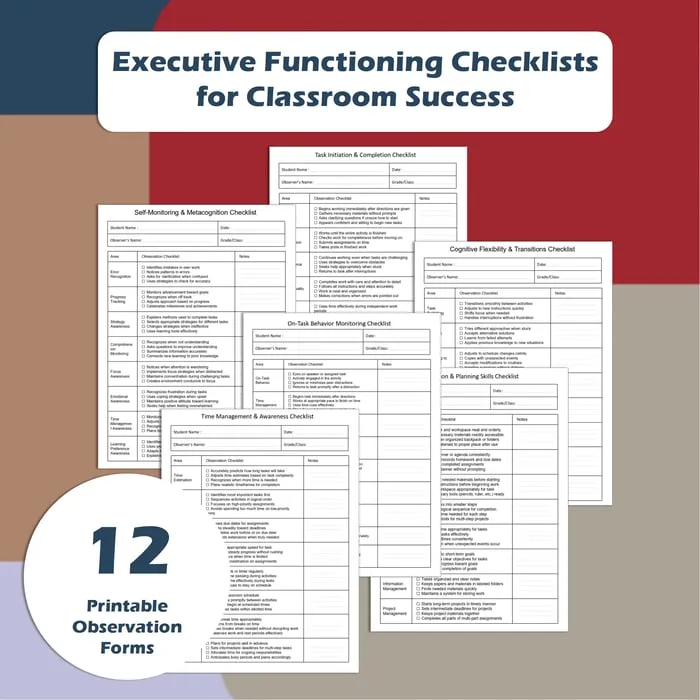
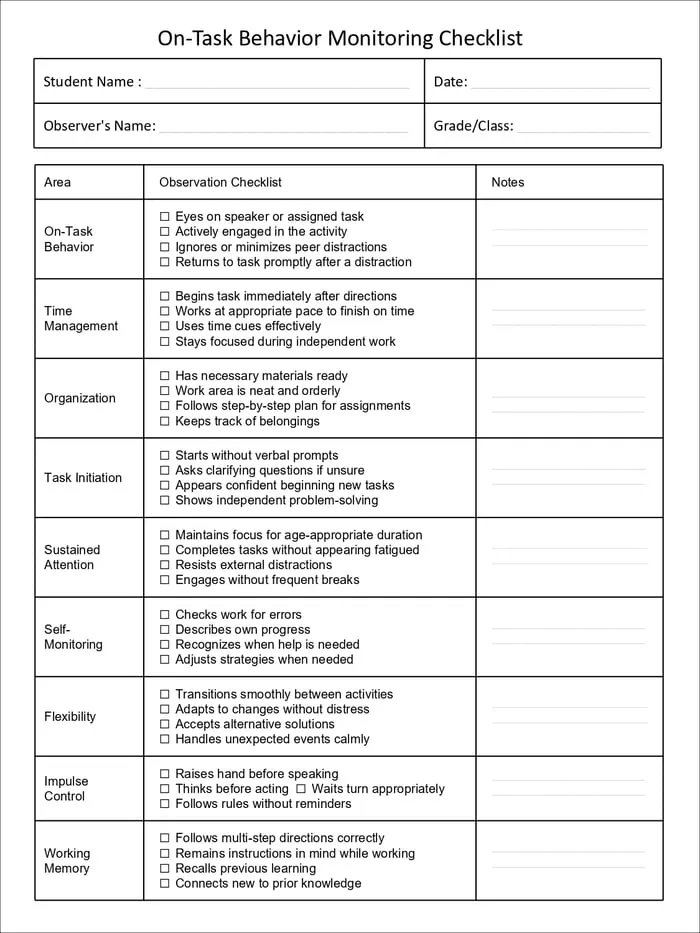
Executive Functioning Checklists for Classroom Success: a 12-page set of printable observation forms covering self-monitoring, task initiation and completion, cognitive flexibility and transitions, on-task behavior, organization and planning, and time management, with fillable student, date, observer, and class fields.
Sources and scope
- Center on the Developing Child, Harvard University: research-based explanations of executive function and how it develops.
- IRIS Center, Vanderbilt University: free modules on classroom behavior, data collection, and evidence-based practices.
- Understood.org: practical articles for families and teachers on executive function and learning differences.
- IDEA, U.S. Department of Education: the law behind special education evaluations and IEPs.
This guide covers classroom observation and everyday supports for executive function skills. It does not cover formal testing, diagnosis, or clinical evaluation, which belong to qualified professionals and the student’s team.
Key takeaways
- An executive function assessment in class starts with two or three clear skill areas.
- Observe across settings and times, with a simple schedule.
- Record specific, observable behaviors and what helped.
- Look for patterns and include the student’s view.
- Choose one or two supports, measure the same thing, and review.






Leave a Comment