

Speaking up about accommodations is a skill, and like any skill, it gets easier with practice. Picture Jordan, a tenth grader with a 504 plan. He has extended time on tests and a copy of class notes, but in chemistry the notes arrive two days late. Jordan says nothing. His grade slips, and nobody on his team knows why.
This list is written for high school students like Jordan, and for the teachers and parents who coach them. It ranks seven ways of speaking up about accommodations, from the lowest-pressure option to the most formal one. Each way includes why it works, how to do it and a short example. By the end, you will have words to use, a simple record to keep and a plan for your next meeting.
Examples are fictional. Adapt to the student’s goals and agreed supports. This is guidance, not a diagnosis or legal advice.
At a glance
- Your accommodations are written for you, so your feedback matters.
- Start with low-pressure ways, such as a written note, before bigger conversations.
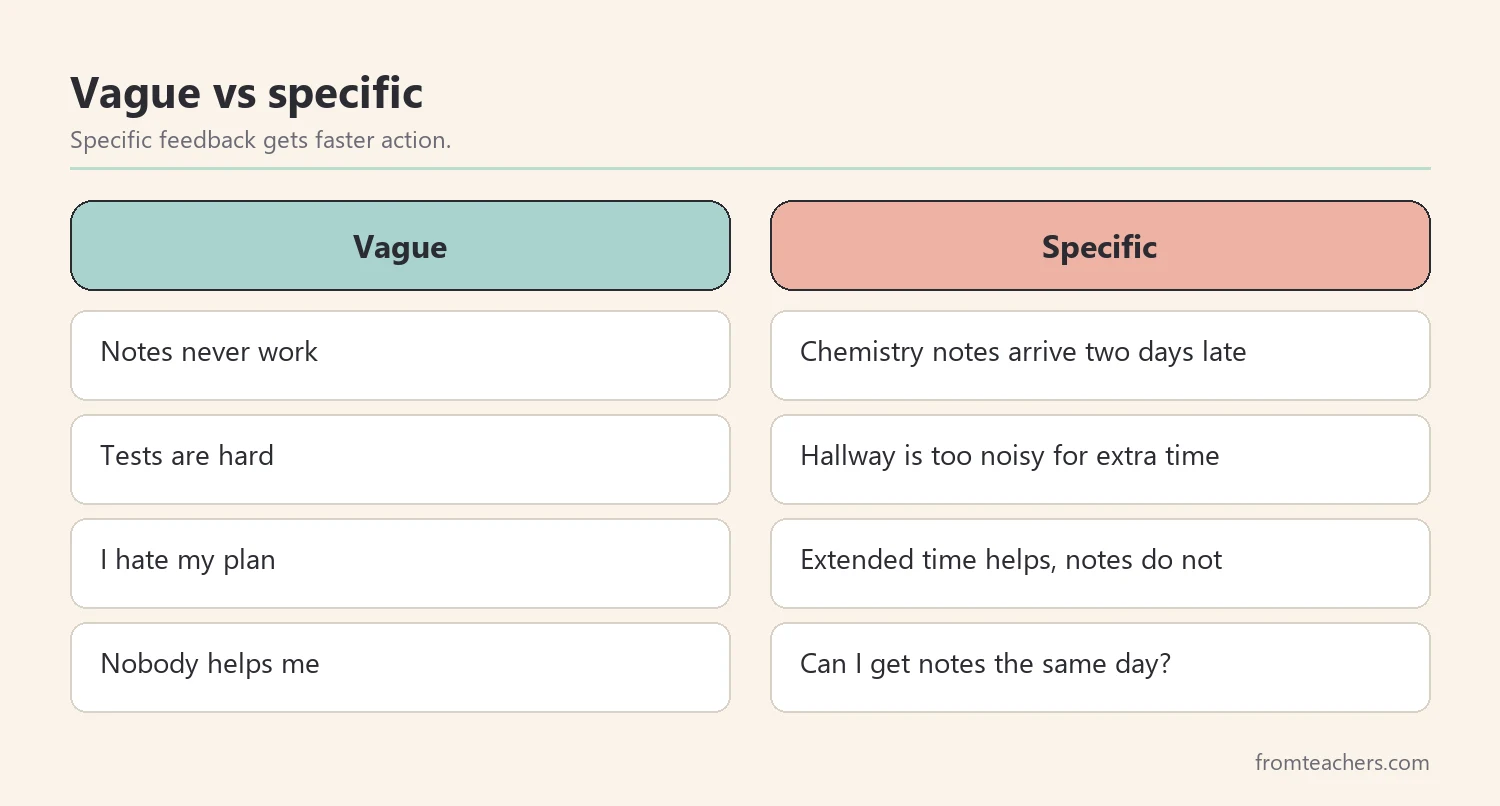
- Short, specific facts work better than general complaints.
- A simple feedback form turns your experience into information your team can use.
- Speaking up about accommodations is a skill that grows with practice.
How this list is ranked
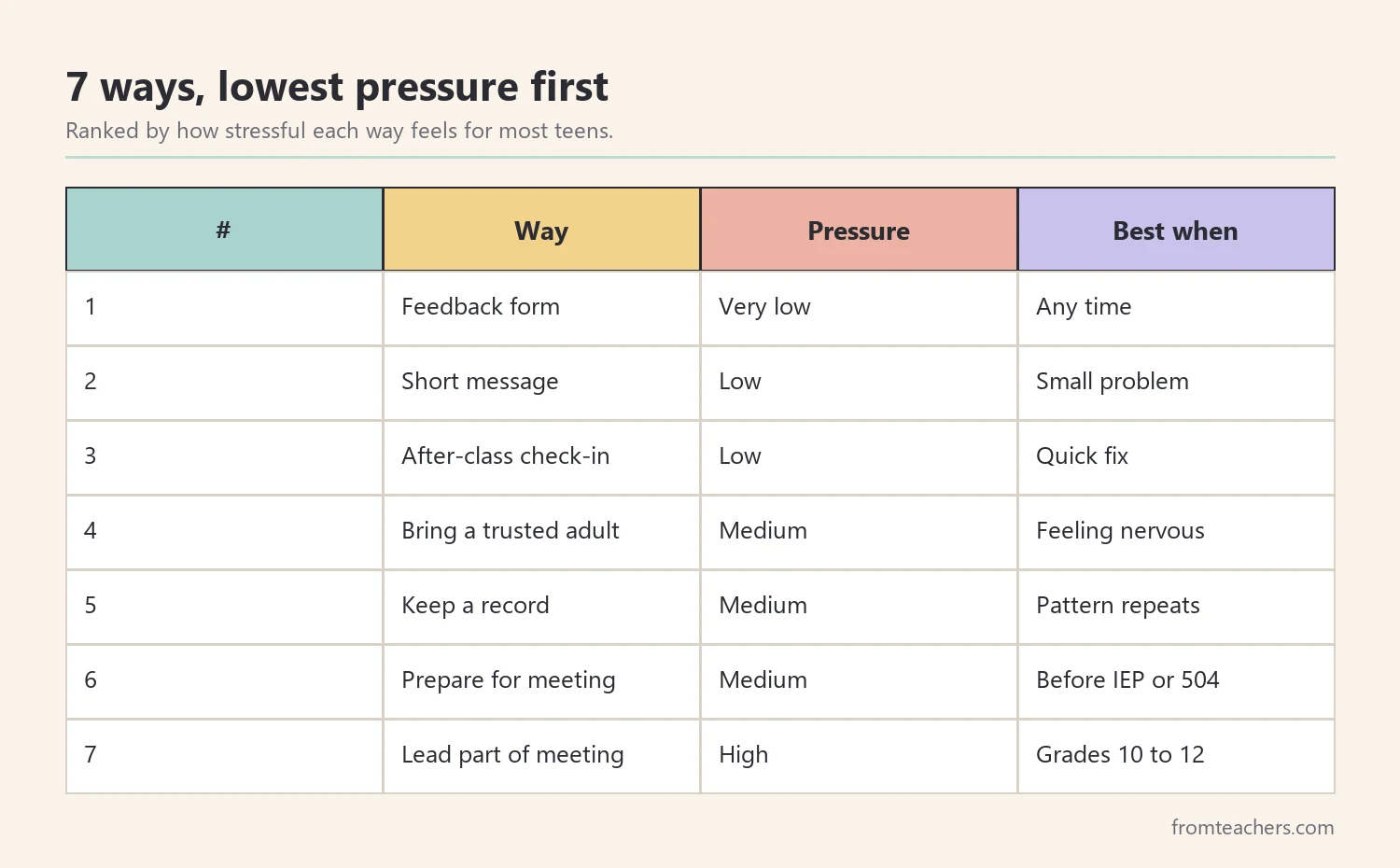
We ranked these seven ways by pressure, from the least stressful to the most formal. Many teens find it hard to talk to a teacher face to face, especially about a disability. So the list starts with options you can use quietly and builds toward speaking at a meeting.
However, we did not rank them by importance. Every way on this list is useful. In fact, most students use several of them over a school year. Figure 1 shows the full list and when each way fits best.
1. Fill in a feedback form
First, the easiest way to start is on paper. A feedback form asks clear questions: which accommodation was used, how well it worked and what got in the way. You answer in a few minutes, without anyone watching.
Why it works: a form gives you a structure. Instead of searching for words, you rate each support and add a short note. As a result, teachers get specific information instead of a vague “it’s not working.”
How to use it: ask your case manager or counselor for a form, or use a ready-made one such as the classroom accommodation feedback form for IEP and 504 plans. Fill it in once per class every few weeks. Then hand it to your case manager or bring it to a meeting.
Example: Jordan rated “copy of class notes” as “Not Effective” in chemistry and wrote: “Notes arrive two days after the lesson.” That one line explained his falling grade better than any conversation could.
| Form question | Jordan’s answer |
|---|---|
| Accommodation used | Copy of class notes |
| Effectiveness | Not effective |
| Challenge | Notes arrive late |
| Suggestion | Notes the same day |
2. Send a short message to the teacher
Next, a short email or a note on a sticky pad is still low pressure. You choose the words, you can rewrite them, and the teacher can read them at a calm moment.
Why it works: writing gives you time to think. Moreover, a written message creates a record, which helps later if the problem continues.
How to use it: keep it to three sentences. Name the accommodation, describe what happened, and ask for one specific change. Avoid blaming language. Speaking up about accommodations works best when it sounds like teamwork.
Example: Jordan wrote: “Hi Ms. Patel, my 504 plan includes a copy of class notes. Lately I get them two days after the lesson, so I miss things for homework. Could I get them the same day?”
3. Use a quick check-in after class
Then there is the one-minute conversation. Waiting until other students leave makes speaking up about accommodations more private and less stressful.
Why it works: many problems have quick fixes. A teacher may simply not know that a support is not happening. Because the talk is short and private, it rarely feels like a confrontation.
How to use it: plan one sentence before class. For example: “Can I talk to you for one minute about my extended time?” Then state the fact and your request. If you feel nervous, bring your feedback form and point to your note.
Example: In history, Jordan’s extended time meant finishing in the hallway, which was noisy. After class he said, “Could I finish tests in the library instead?” The teacher agreed on the spot.
4. Ask a trusted adult to go with you
Sometimes, speaking up about accommodations alone feels like too much. In that case, a trusted adult can help. This may be your case manager, a counselor, a coach or a parent.
Why it works: the adult does not speak for you. Instead, they stand beside you while you speak. Over time, you need less support, which is the goal of self-advocacy.
How to use it: agree beforehand on who says what. You explain the problem, and the adult adds context only if needed. Afterward, ask for feedback on how it went.
Example: Jordan asked his case manager, Mr. Lee, to join a short talk with his math teacher. Jordan explained the problem. Mr. Lee only confirmed what the 504 plan says.
5. Keep your own simple record
In addition, a record makes your voice stronger. Teams make decisions based on information, and you are the person who sees your accommodations every day.
Why it works: notes turn a feeling into facts. Rather than saying “it never works,” you can say “notes were late four times this month.” As a result, the team can act.
How to use it: once a week, write the date, the class, the accommodation and whether it happened. Keep it short. Figure 3 shows how Jordan tracked one month.
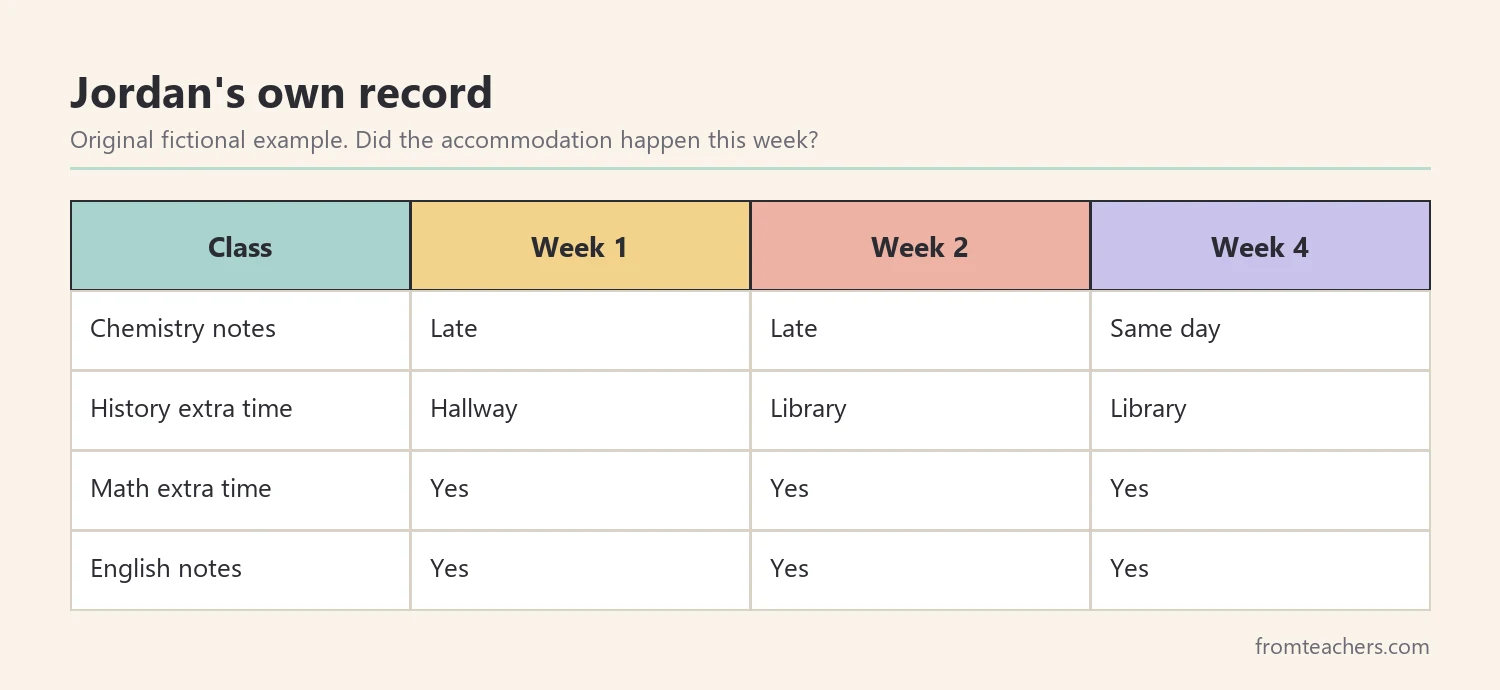
Example: After four weeks, Jordan’s record showed that extended time worked in every class, but notes were late in chemistry most weeks. That pattern pointed to one class, not to the whole plan.
6. Prepare for your IEP or 504 meeting
Next, meetings are the formal place for speaking up about accommodations. Many students attend, and in high school, transition planning makes student input even more important under IDEA.
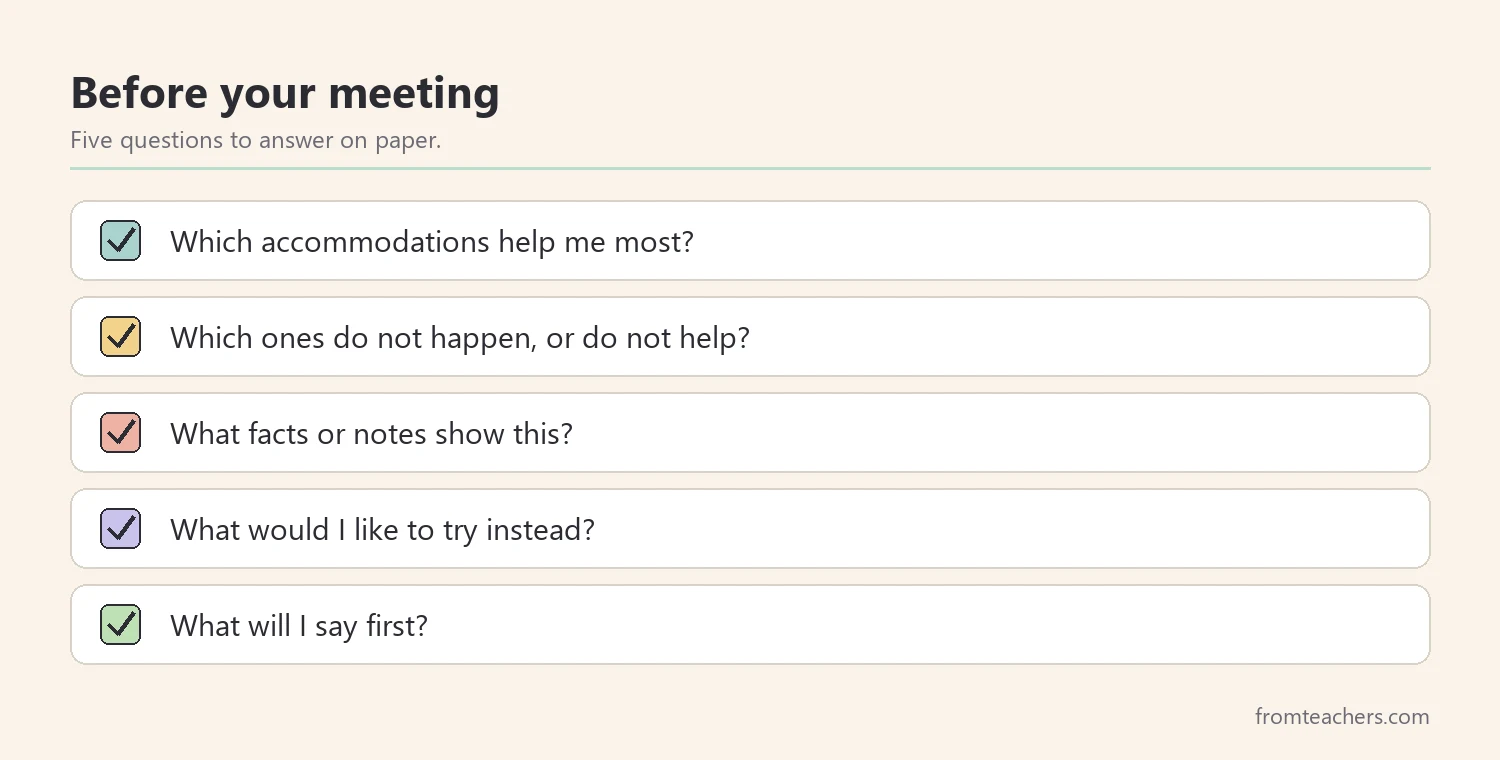
Why it works: preparation lowers anxiety. When you walk in with three points written down, you are much more likely to say them.
How to use it: before the meeting, answer three questions. What works? What does not work? And what would I like to try? Bring your feedback forms and your record. Figure 4 lists the questions to prepare.
Example: Jordan opened his 504 meeting with his three points. The team agreed that chemistry notes would be posted online the same day.
7. Lead part of your meeting
Finally, the most formal way of speaking up about accommodations is leading part of the meeting yourself. Some schools use student-led IEP meetings, especially for older students.
Why it works: leading shows that you understand your needs. Moreover, it builds the skills you will need after high school, where you usually must request accommodations yourself.
How to use it: start small. Introduce yourself, share your strengths and present your feedback on one or two accommodations. Practice with your case manager first.
Example: In grade 11, Jordan presented his own slide with three strengths and his accommodation feedback. His team said it was the clearest meeting they had held.
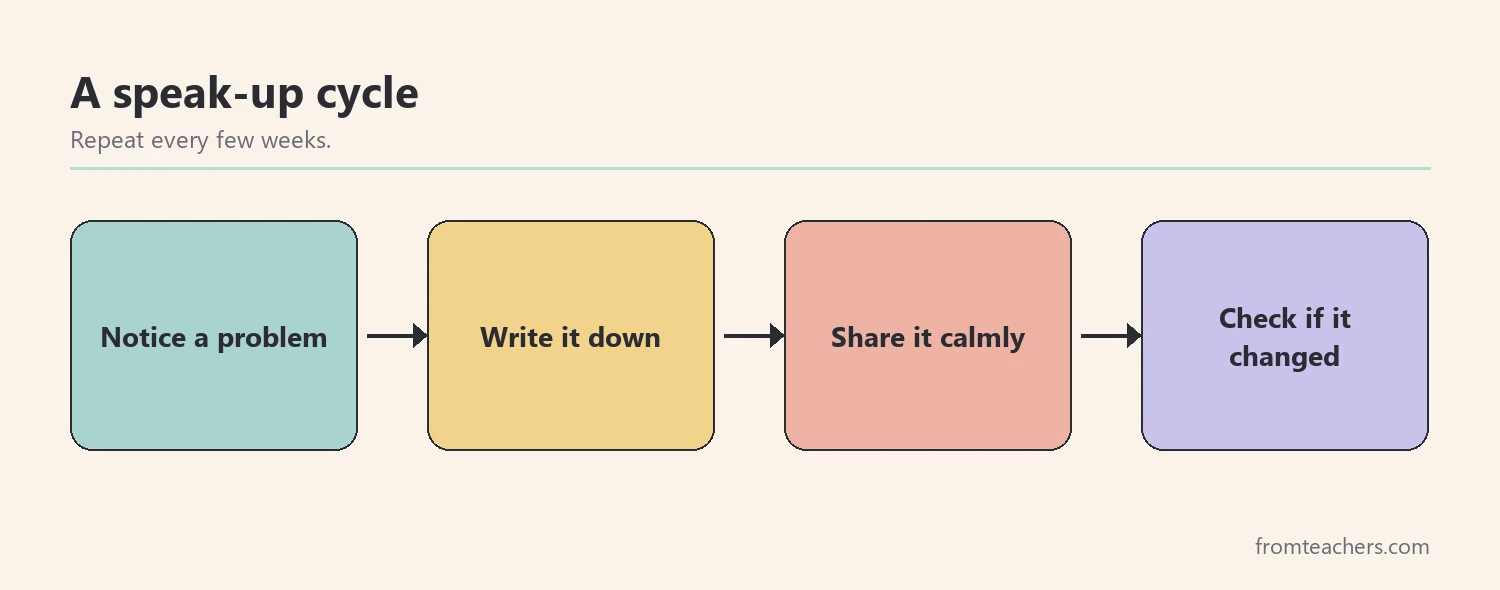
Scripts for speaking up about accommodations
Many teens say the hardest part is the first sentence. Therefore, here are short scripts you can borrow, change and practice. Read them aloud once or twice before you use them. Speaking up about accommodations feels much less awkward when the words are already familiar.
| Situation | What you can say |
|---|---|
| Support not given | “My plan includes extended time. Could I have it for Friday’s quiz?” |
| Support not helping | “Read-aloud is not helping in this class. Could we try something else?” |
| Need privacy | “Could you give me my notes quietly at the end of class?” |
| Follow-up | “Two weeks ago we talked about notes. They still arrive late.” |
Also, notice what these scripts have in common. Each one names the accommodation, states one fact and asks for one change. That simple pattern works for speaking up about accommodations in any class, with any teacher. Furthermore, it keeps the focus on solving a problem, not on blaming anyone.
Parents can help too. At home, role-play the conversation with your teen. Let them play the teacher first, then switch roles. Above all, praise the effort of speaking up about accommodations, not only the result.
Common mistakes and how to avoid them
- Waiting until grades drop. Fix: speak up after the first week a support does not happen.
- Saying “nothing works.” Fix: name one accommodation and one fact.
- Skipping an accommodation and not telling anyone. Fix: explain why you did not use it, because that is useful feedback too.
- Letting adults talk for you every time. Fix: say at least one sentence yourself, then grow from there.
- Not following up. Fix: check in two weeks later to see if the change happened.
Questions students and parents ask about speaking up about accommodations
Will my teacher be upset if I speak up?
Most teachers want to know when something is not working. A polite, specific message usually helps the relationship. If you worry, ask a trusted adult to help.
What if I do not want classmates to know about my accommodations?
You have the right to privacy. Choose private ways, such as a written note or a talk after class. You can also ask that accommodations be given quietly.
Can I ask to stop using an accommodation?
Yes, you can share that a support no longer feels needed. The team decides together, often after trying a change for a few weeks and looking at results.
What if a teacher does not follow my plan?
First, tell the teacher in a calm, specific way. If nothing changes, tell your case manager or parent and share your record.
Does speaking up about accommodations matter after high school?
Yes. In college and at work, you usually need to request accommodations yourself. Practicing now makes that step much easier.
Related reading: Accommodations vs Modifications in Special Education, Transition to Adulthood, and Parent-Teacher Collaboration in Special Education.
You may also need: Accommodations & Modifications Tracker Editable Special Education IEP Forms.
A companion resource for speaking up about accommodations:
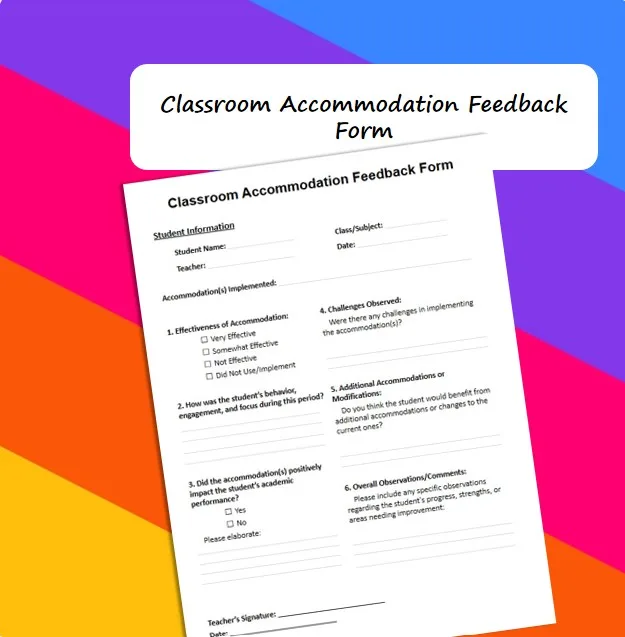
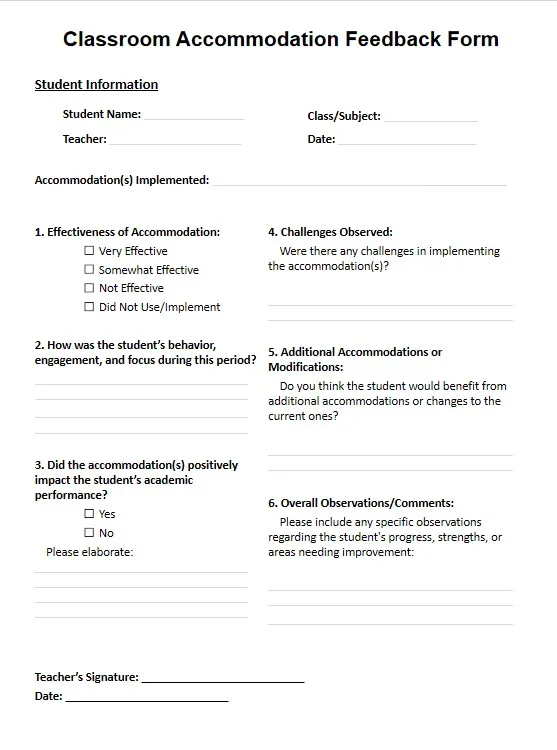
Classroom Accommodation Feedback Form IEP 504 Effectiveness Tracker: a one-page form with student, teacher, date and class fields, accommodations implemented, an effectiveness rating from Very Effective to Not Effective or Did Not Use, questions on engagement and academic impact, challenges observed, suggested additional accommodations and a signature line.
Sources and scope
- Center for Parent Information and Resources: plain-language information on IEPs, 504 plans and transition planning for families and students.
- Understood.org: guidance for families and students on accommodations and self-advocacy.
- IRIS Center: free modules for educators on accommodations and student involvement.
This list covers practical ways for high school students to give feedback on their accommodations. It does not replace the IEP or 504 process, legal advice or the decisions of the student’s team.
Key takeaways
- Speaking up about accommodations can start quietly, with a form or a short note.
- Specific facts get faster results than general complaints.
- A simple record turns your experience into useful information.
- Prepare three points before every IEP or 504 meeting.
- Each small step builds skills you will need after high school.










Leave a Comment