

Math accommodations for middle school can turn a lesson that feels impossible into one a student can actually show what he knows. Picture Carlos, a grade 6 student with an IEP for a math learning disability, during a unit on ratios. He understands the idea when the class discusses it, but a page of mixed problems with long word problems stops him after the second question.
This list is for middle school math teachers, special education co-teachers and case managers. It ranks ten common accommodations from the easiest to set up to the ones that need more planning or staffing. For each, you will see what it is, when it helps and how to track it, so you can bring clear data to the next IEP meeting.
Examples are fictional. Adapt to the student’s goals and agreed supports. This is guidance, not a diagnosis.
At a glance
- Accommodations change how a student learns or shows learning, not what is expected.
- Start with the supports already named in the IEP or 504 plan.
- Easy supports, like a calculator or reduced copying, can begin tomorrow.
- Track which supports were used and how well they worked.
- Bring the data to the team instead of relying on memory.
How we ranked these accommodations
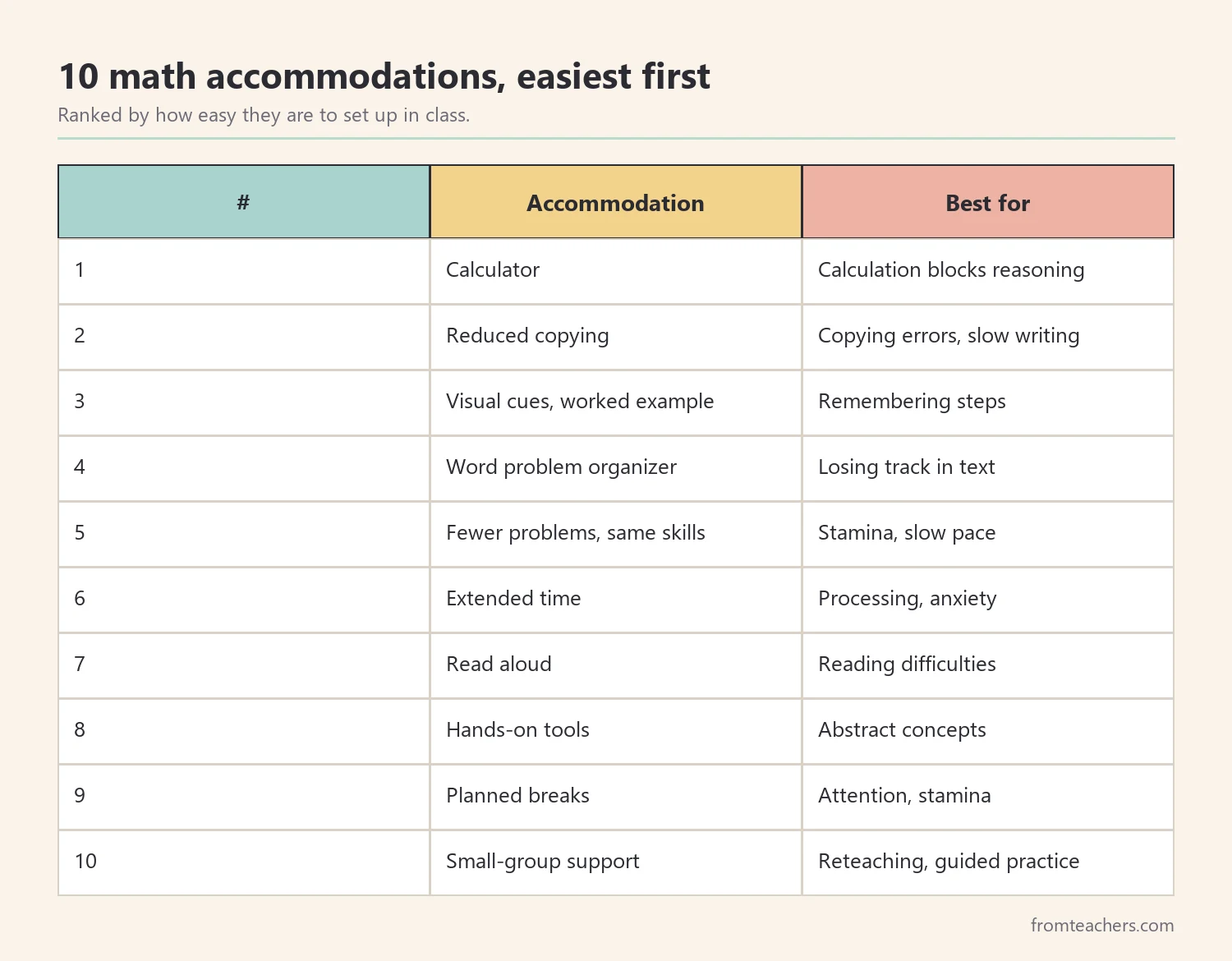
We did not rank these supports by how effective they are, since that depends on each student’s needs. Instead, the order follows one practical criterion: how easy each one is to set up in a typical middle school math class. Accommodation 1 needs only a decision. Accommodation 10 needs extra staff.
In addition, remember the difference between an accommodation and a modification. An accommodation changes how a student learns or shows learning, while a modification changes what the student is expected to learn. This list covers accommodations. Figure 1 shows the ranking.
1. Calculator for computation
A calculator is the simplest of all math accommodations for middle school when the goal is reasoning rather than computation. It lets students focus on ratios, equations or problem solving without getting stuck on arithmetic.
When it helps: for students whose calculation difficulties block access to grade-level concepts.
How to use it: check the IEP for when it applies. Then be clear about tasks where computation fluency itself is being measured.
Example: Carlos used a calculator on ratio word problems. He completed six of eight problems instead of two, and his reasoning showed on the page.
2. Reduced copying from the board
Copying problems from the board takes time and creates errors. For some students, more energy goes into copying than solving.
When it helps: for students with fine motor, visual or attention difficulties.
How to use it: give a printed copy of the problems, or let the student work directly on the worksheet.
Example: Mr. Kim gave Carlos printed warm-ups. Copying errors disappeared, and he started solving within the first minute.
3. Visual cues and worked examples
Next, visual supports such as a worked example at the top of the page, color-coded steps or a formula card can help students remember the process.
When it helps: for students with working memory challenges or who struggle to start.
How to use it: place one fully worked example beside the task. Then highlight each step in the same color as the matching step in the problems.
Example: Carlos kept a ratio table example card on his desk. He used it on most problems in the first week and less often by week three.
4. Graphic organizers for word problems
Word problems combine reading and math, which makes them hard for many students. A simple organizer breaks them into parts: what do I know, what do I need, which operation, answer in a sentence.
When it helps: for students who understand the math but lose track in the text.
How to use it: model the organizer with two problems, then let students use it independently.
Example: With the organizer, Carlos identified the question in most word problems, which he had often missed before.
5. Fewer problems, same skills
Sometimes the length of an assignment, not the content, overwhelms a student. Fewer problems that still cover every skill can show mastery just as well.
When it helps: for students who work slowly or tire quickly. Check that the IEP lists this as an accommodation, since it should keep the same learning target.
How to use it: choose one problem per skill rather than cutting the hardest problems.
Example: Carlos completed ten carefully chosen problems instead of twenty. Every skill was still checked.
6. Extended time
Extended time is one of the most common accommodations. It gives students time to process, check and finish work without rushing.
When it helps: for students with slower processing, reading difficulties or anxiety about timed tasks.
How to use it: plan where the extra time happens, such as during the next class’s warm-up, so the student does not miss new teaching.
Example: Carlos finished quizzes during the first ten minutes of study hall. His scores reflected what he knew, not how fast he worked.

7. Read aloud for word problems
When reading is the barrier, a read aloud lets students show their math thinking. It can be done by an adult, a peer or text-to-speech technology.
When it helps: for students with reading difficulties whose math skills are stronger than their reading.
How to use it: on tests, follow state and district rules for read aloud. In class, text-to-speech tools are often the easiest option.
Example: Carlos used text-to-speech for long word problems. He solved more of them correctly than when reading alone.
8. Hands-on tools and manipulatives
Hands-on tools, such as fraction tiles, algebra tiles or ratio counters, are not only for young children. They can make abstract middle school topics concrete.
When it helps: for students who need to see and move ideas before working symbolically.
How to use it: offer tools to everyone so no one feels singled out. Then gradually move from tools to drawings to numbers.
Example: Carlos used ratio counters for the first lesson and drew them in the second. By the third lesson, he worked with numbers only.
9. Breaks during long tasks
Long math tasks can be exhausting. Short, planned breaks help some students return with more focus.
When it helps: for students with attention, anxiety or stamina difficulties.
How to use it: plan breaks at natural points, such as after each section, and keep them short and predictable.
Example: Carlos took a two-minute stretch break halfway through longer tasks. He finished more often and with fewer errors in the second half.
10. Small-group or one-to-one support
Finally, the support that needs the most planning: working with an adult in a small group or one to one, for instance during a co-taught lesson.
When it helps: for students who need direct reteaching, guided practice or a quieter setting.
How to use it: plan which part of the lesson the small group covers and aim to build independence over time.
Example: The co-teacher met with Carlos and two peers for ten minutes of guided practice twice a week.
Tracking math accommodations for middle school
Accommodations only help the team when someone records which ones were used and how well they worked. A ready-made accommodations and modifications tracker with editable IEP forms keeps this simple. It includes an assignment support table for checking off supports across several assignments and a detailed form with a success rating and notes.
Here is a summary of how often Carlos used each support during four weeks, along with his completion rate.

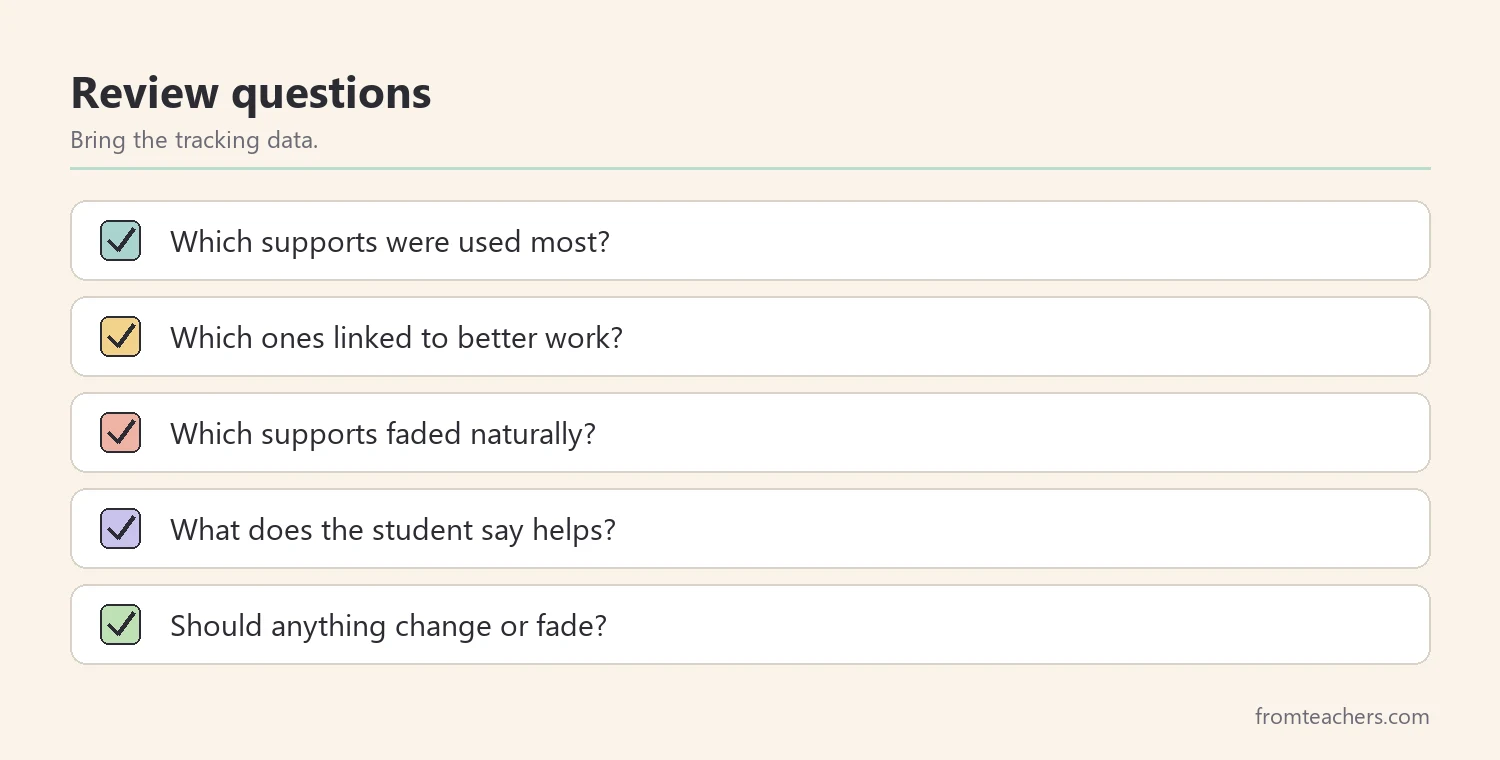
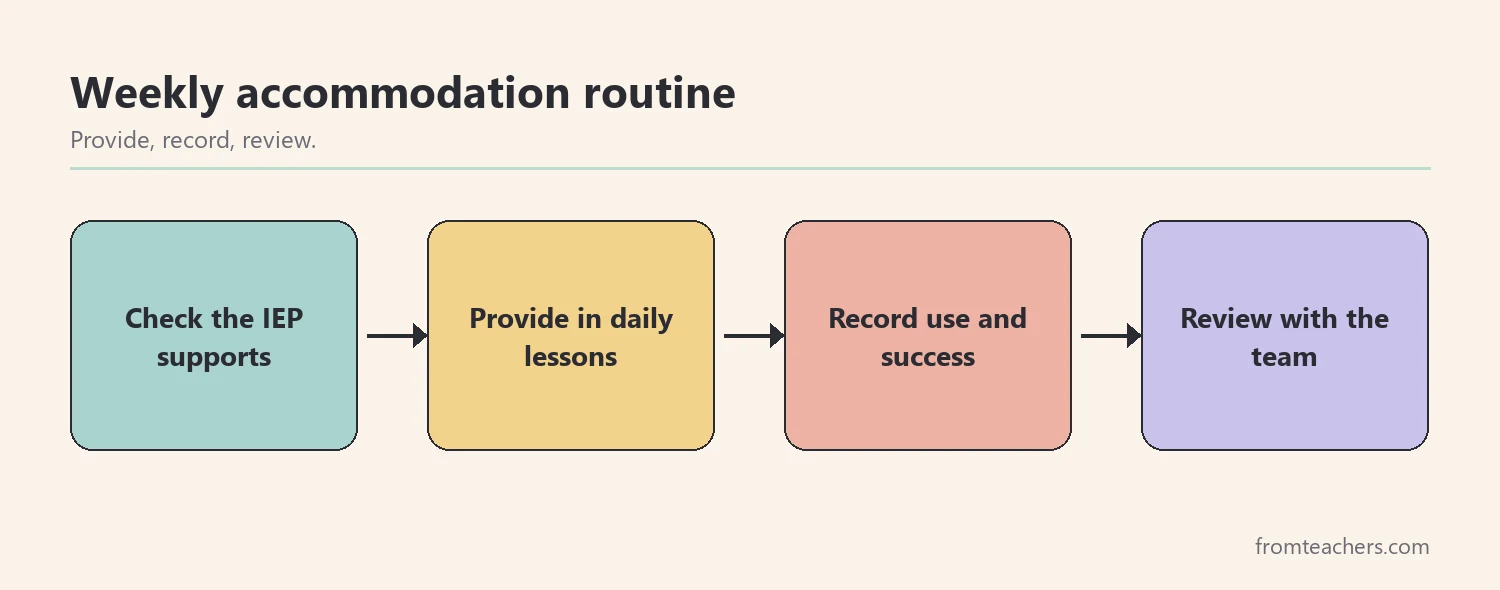
The data showed that the calculator and organizer were used most and linked to higher completion. On the other hand, the formula card faded naturally, which suggested he was learning the process. Figure 4 lists quick questions for the next IEP review, and Figure 5 shows the weekly routine.
Talking with students about their supports
Middle schoolers care a great deal about how they look to their peers. Therefore, a short private conversation about supports often matters as much as the supports themselves. Ask the student which tools feel helpful, which feel awkward and when they would rather not use them.
Also, teach students to request their own supports. A simple phrase such as “Can I use my organizer for this one?” builds self-advocacy, a skill that grows more important in high school. Over time, students who understand their own accommodations can explain them to new teachers.
Finally, share good news with families. A quick note that a calculator or organizer helped on a hard assignment shows parents that the plan is working and invites them to share what they see at home during homework.
Common mistakes and how to avoid them
- Offering accommodations only on tests. Fix: use the same supports during daily lessons, so students know how to use them.
- Confusing accommodations with modifications. Fix: check whether the learning target stays the same.
- Not tracking use. Fix: record which supports were used and how well they worked.
- Making supports visible and awkward. Fix: offer tools to the whole class when possible.
- Never fading supports. Fix: review data and discuss with the team whether a support is still needed.
Questions teachers and parents ask about math accommodations for middle school
Who decides which accommodations a student gets?
The IEP or 504 team, which includes parents, decides. Teachers then provide the agreed accommodations and share data about how they are working.
Can a teacher add an accommodation that is not in the IEP?
Teachers can often offer helpful supports to any student in class. However, accommodations for state tests must follow official rules. Talk with the case manager before making changes for one student.
Will a calculator stop my child from learning math facts?
Not necessarily. A calculator can give access to grade-level reasoning while fact practice continues separately. Ask the team how both goals are covered.
How do I know if an accommodation is working?
Track it. Look at completion, accuracy and the student’s own view over several weeks, then bring the data to the team.
Do middle schoolers resist accommodations?
Some do, especially if supports feel visible. Offering tools to the whole class and talking privately with the student usually helps.
Related reading: Accommodations vs Modifications in Special Education, Special Education Accommodation and Modification Tracker, and The Power of Data Tracking in Special Education.
You may also need: Classroom Accommodation Feedback Form, IEP and 504 effectiveness tracker.
A companion resource for math accommodations for middle school:

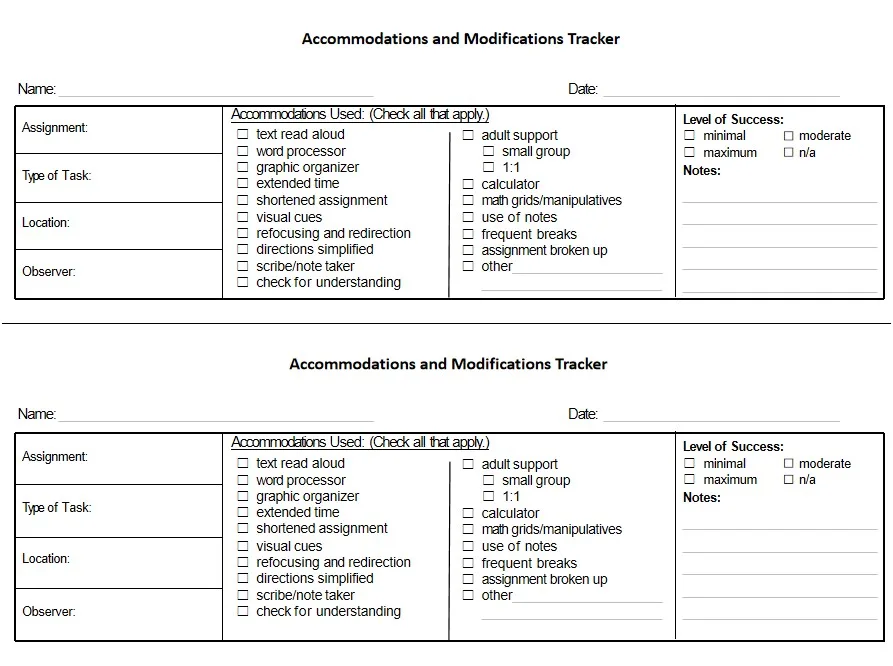
Accommodations & Modifications Tracker Editable Special Education IEP Forms: two editable tracking forms: an assignment support table to check off supports such as read aloud, graphic organizer, extended time, calculator and breaks across several assignments, and a per-assignment tracker with a success rating and notes.
Sources and scope
- IRIS Center: Accommodations module: a free module on instructional and testing accommodations for students with disabilities.
- Understood.org: plain-language articles on math difficulties and classroom accommodations.
- National Council of Teachers of Mathematics: resources on effective and equitable math teaching.
- Center for Parent Information and Resources: information for families on IEPs, accommodations and team decisions.
This list covers common classroom math accommodations for students in grades 6 to 8. It does not decide which accommodations a student should receive. Those decisions belong to the IEP or 504 team, and testing accommodations must follow state and district rules.
Key takeaways
- Math accommodations for middle school change access, not expectations.
- Start with the supports named in the IEP and the easiest ones to set up.
- Use the same supports in daily lessons and on tests where allowed.
- Track which supports were used and how well they worked.
- Review the data with the team and fade supports when ready.







Leave a Comment