

An overstimulating classroom can look like a cheerful one at first glance: bright posters on every wall, hanging decorations, music during centers and a busy carpet full of colors. Picture Ms. Kim’s kindergarten room in October. It is lovely, but by 10:30 every morning, several children are covering their ears, wandering between centers or melting down at the smallest change. One child, Noah, hides under the reading table most days.
This list is for kindergarten and early elementary teachers who want a calmer, more inclusive room. It describes seven signs of an overstimulating classroom, ordered from the easiest to spot to the ones that need closer observation. For each sign, you will find what it looks like, why it matters and a simple change to try. You will also learn how to check your room in fifteen minutes and track whether changes help.
Examples are fictional. Adapt to your students, their agreed supports and your school’s guidance. This is guidance, not a diagnosis.
At a glance
- An overstimulating classroom can affect focus, behavior and comfort for many young children.
- Children with sensory differences, autism or ADHD may feel the effects most.
- Look at walls, sound, light, layout and the pace of the day.
- Small changes, such as clearer walls and a calm corner, often help the whole class.
- Track a few simple measures before and after changes.
How this list is ordered
We ordered these seven signs by how easy they are to spot. The first signs are visible the moment you walk in, such as crowded walls. The later signs, such as behavior patterns at certain times of day, need a few days of observation.
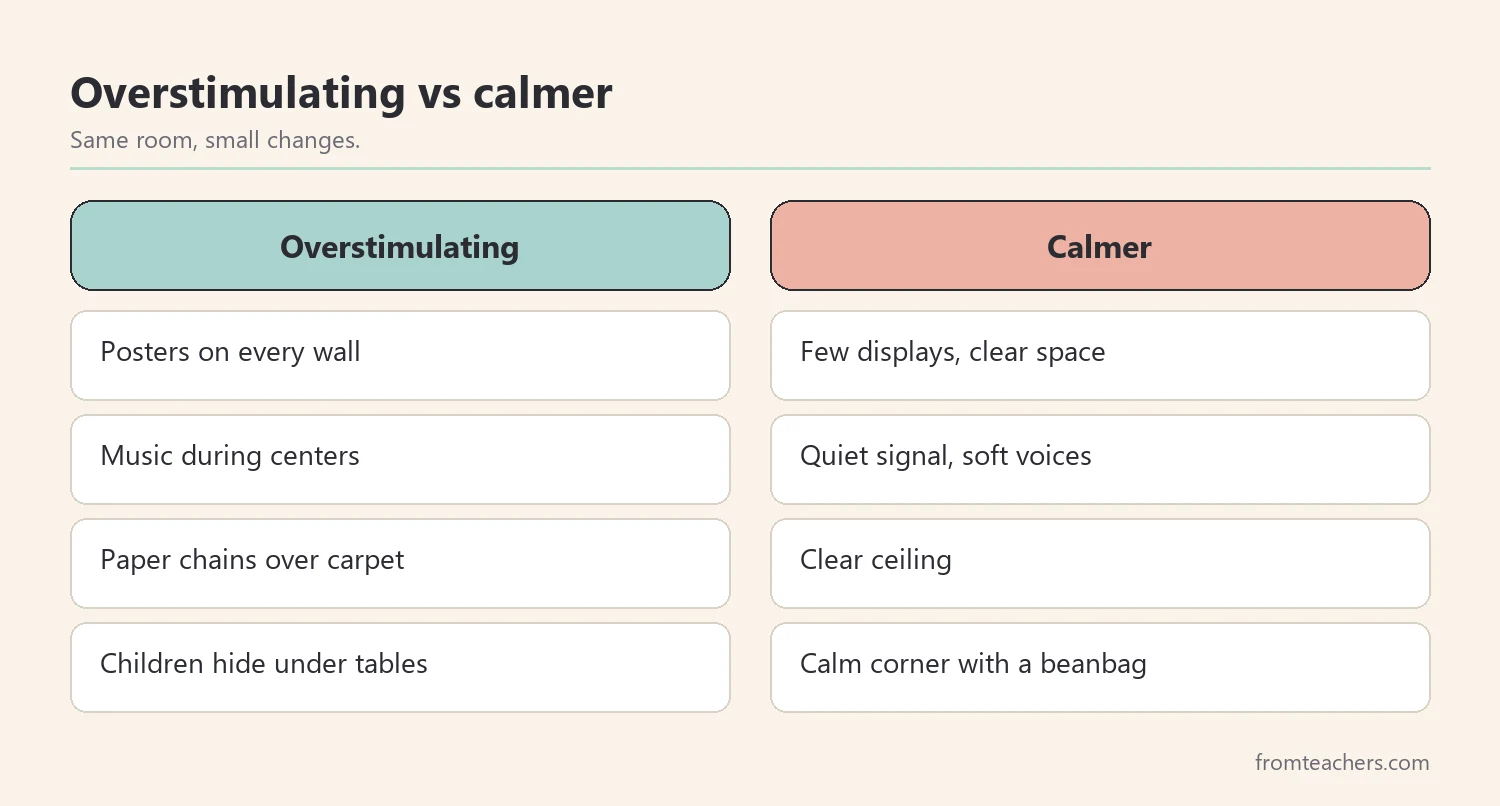
Importantly, the list is not a ranking of seriousness. A busy room is not “bad,” and many children enjoy color and activity. However, when several signs appear together, the room may be working against some learners. The principles of Universal Design for Learning (UDL) encourage designing the environment so more students can access learning from the start. Figure 1 shows the seven signs.

1. Every wall is full
First, look at your walls. In an overstimulating classroom, posters, charts, artwork and decorations cover nearly every surface, sometimes from floor to ceiling.
Why it matters: busy walls compete for attention. Young children may find it harder to find the anchor chart they need when it is surrounded by many other things.
What to try: leave some wall space empty. Keep only displays you actively use, and group them by subject. Rotate student work instead of adding more.
Example: Ms. Kim removed about half of her wall displays and kept a clear space around the alphabet and calendar. Children started pointing to the alphabet chart during writing.
2. Things hang from the ceiling
Next, look up. Hanging decorations, mobiles and paper chains move with air and catch the eye.
Why it matters: movement in the visual field can distract, especially for children who notice small details.
What to try: remove most hanging items, or keep them only in a corner away from the teaching area.
Example: Ms. Kim took down the paper leaves over the carpet. During read-aloud, fewer children looked up and around.
3. Noise stays high all day
Sound is a common cause of an overstimulating classroom. Background music, hard floors, chairs scraping and many voices add up.
Why it matters: some children are very sensitive to sound, and noise can make it harder for everyone to hear directions.
What to try: turn off background music during instruction, add rugs or tennis balls to chair legs, and teach a quiet signal. Offer headphones or ear defenders where agreed.
Example: Ms. Kim stopped playing music during centers. She noticed that her own voice could be quieter, too.
4. Lighting is harsh or flickering
Bright overhead lights, especially flickering or buzzing ones, can bother some children. In contrast, natural light often feels calmer.
Why it matters: some children with sensory differences find bright or flickering light uncomfortable, which can affect mood and focus.
What to try: report flickering lights, use natural light when possible and consider turning off one bank of lights during calm activities, following school rules.
Example: Ms. Kim used daylight and lamps during morning read-aloud. Noah stayed on the carpet longer.
5. There is no calm space
Every child needs a place to reset. In an overstimulating classroom, there may be nowhere to go except hiding under a table.
Why it matters: a planned calm corner gives children a safe, expected way to take a break before they become overwhelmed.
What to try: create a small, low-stimulation corner with a cushion, a few calming items and a simple visual of breathing steps. Teach how and when to use it.
Example: Ms. Kim set up a calm corner with a beanbag and a breathing card. Noah began using it instead of hiding under the table.
6. The layout is crowded
Next, look at how children move. A crowded layout means bumping, waiting and conflict at busy times.
Why it matters: tight spaces add physical and social stimulation. Moreover, unclear pathways can make transitions chaotic.
What to try: create clear walkways, separate noisy and quiet centers, and reduce furniture you do not use. The inclusive classroom design guide on UDL and flexible seating covers physical space, layout and before and after comparisons that make this step easier.
Example: Ms. Kim moved the block center away from the reading area. Fewer arguments happened at center time.
7. Behavior spikes at the same times
Finally, watch patterns. In an overstimulating classroom, meltdowns, wandering and ear covering often rise at the same times, such as after busy transitions or in long, noisy centers.
Why it matters: patterns point to environmental causes, not only individual behavior.
What to try: note the time and setting of hard moments for one or two weeks. Look for clusters, then adjust the environment at those times.
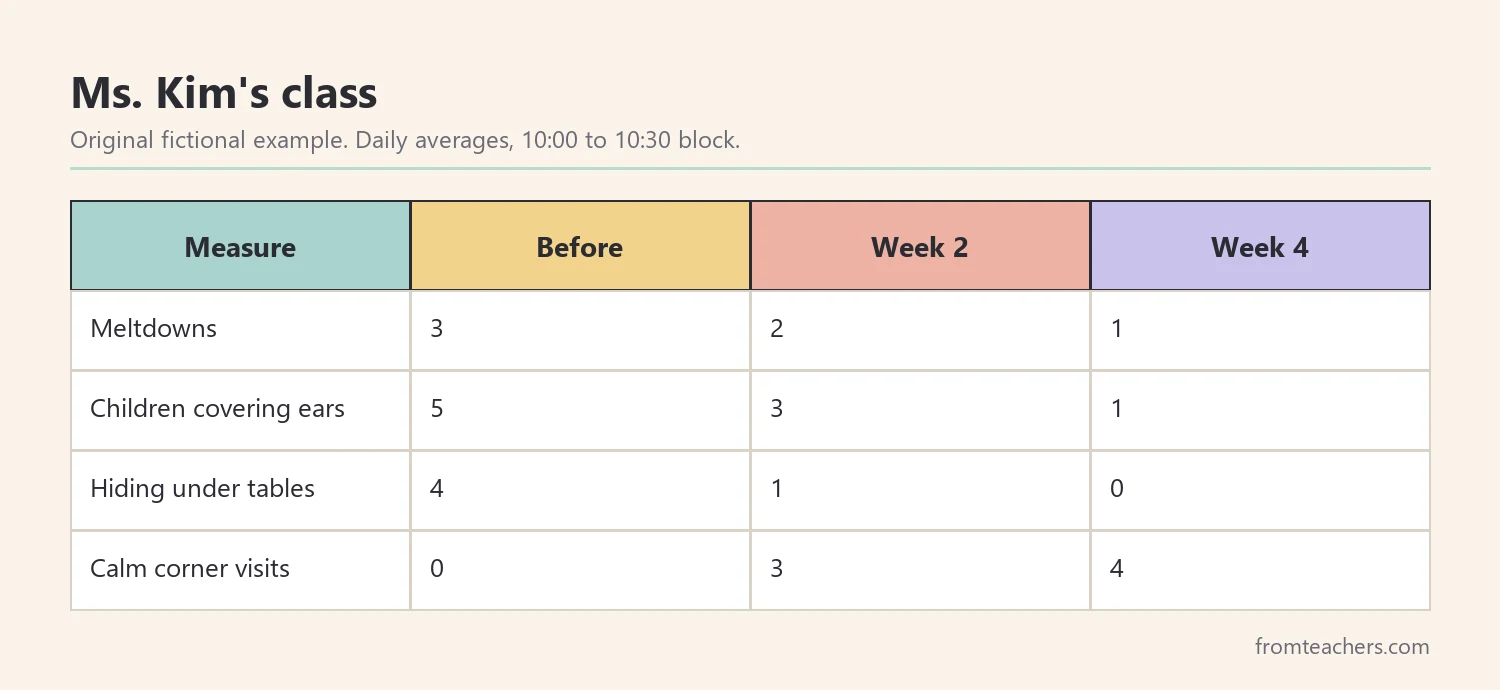
Example: Ms. Kim saw most hard moments during the 10:00 to 10:30 center block. Shorter centers and a quieter signal made a clear difference. Figure 3 shows her notes.
Who feels an overstimulating classroom most
Every child responds differently to the same room. Some children seem to love noise and color, while others shut down quickly. Therefore, it helps to think about which students may need extra support even after the room becomes calmer.
| Child | What you may notice | Extra support |
|---|---|---|
| Sound sensitive | Covers ears, avoids groups | Ear defenders, quiet seat |
| Easily distracted | Looks around, leaves tasks | Seat facing a clear wall |
| Seeks movement | Wanders, crashes into things | Planned movement breaks |
| Anxious | Clings, hides, cries at changes | Visual schedule, calm corner |
For example, Noah was sound sensitive. Even after the music stopped, he still needed ear defenders during assemblies and a seat near the calm corner. Room changes helped him, but individual supports, agreed with his family and the occupational therapist, mattered too.
In other words, fixing an overstimulating classroom is the first layer of support, not the last. It lowers the load for everyone, so individual supports can work better. Talk with your school team when a child still struggles, and share what you have already changed in the room. Your notes on an overstimulating classroom give the team useful information.
A fifteen-minute room check
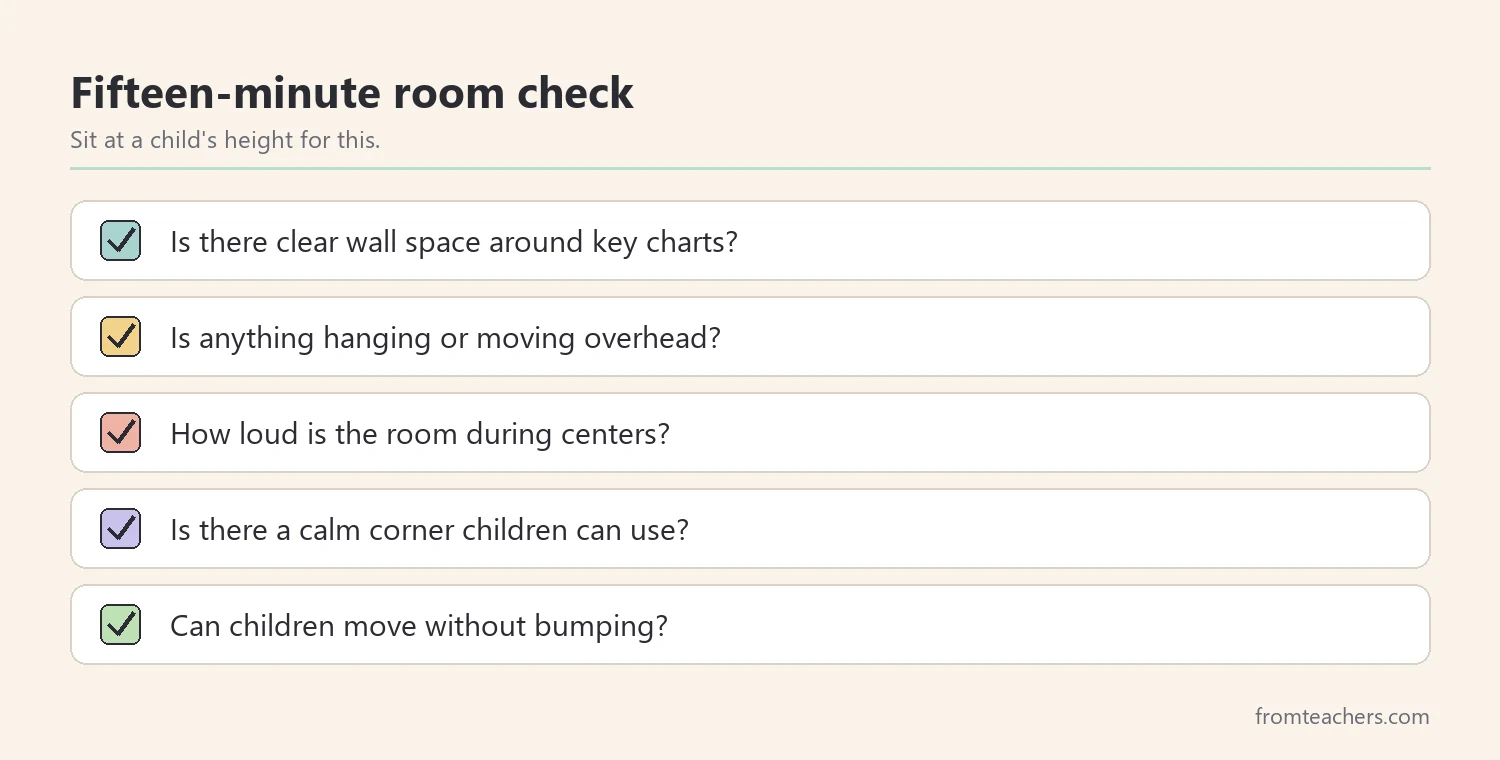
You can check your room quickly. Stand in the doorway, then sit at a child’s height on the carpet and at a table. Children see the room from below, so things look different from there. Figure 4 lists five questions to ask.
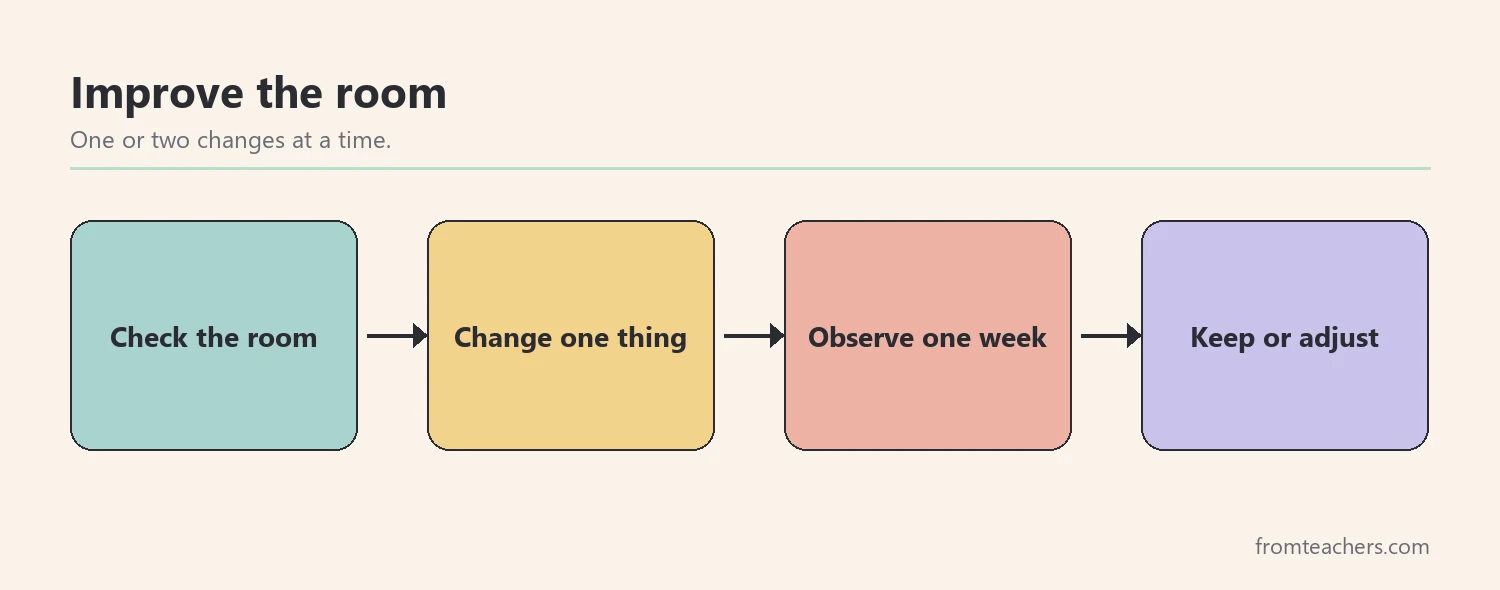
Then, change one or two things at a time and watch for a week. If you change everything at once, you will not know what helped. Figure 5 shows the cycle.
Keeping the room warm and welcoming
Reducing an overstimulating classroom does not mean making it bare or cold. Young children still need color, their own work on display and a room that feels like theirs.
Instead, aim for balance. Use a calm base, such as neutral walls and soft colors, with a few meaningful displays. For example, a single “Our Work” board with rotating student art can be more welcoming than many store-bought posters.
| Keep | Reduce |
|---|---|
| Student work, rotated | Decorations with no purpose |
| A few key anchor charts | Old charts from past units |
| Plants and natural items | Hanging mobiles over the carpet |
| Family photos board | Bright patterned borders everywhere |
Also, involve the children. Ask them what helps them feel calm and what feels “too much.” Even five-year-olds can tell you a lot about an overstimulating classroom when asked simply.
For instance, show two photos of the room, one before and one after a change, and ask which one feels calmer. Children often notice details adults miss, such as a buzzing light or a noisy heater near the carpet.
Common mistakes and how to avoid them
- Removing everything at once. Fix: change one or two things, then observe.
- Blaming individual children only. Fix: look at the environment and the time of day first.
- Making the calm corner a punishment. Fix: teach it as a positive tool for everyone.
- Forgetting the teacher’s voice. Fix: lower your volume and use visual signals.
- Not asking specialists. Fix: talk with the occupational therapist or special education team about individual needs.
Questions teachers ask about an overstimulating classroom
Will a calmer room feel boring to young children?
Usually not. Children still have toys, books and their own work. Many teachers notice that children engage more with materials when walls are calmer.
Do I need to buy new furniture?
No. Most changes, such as removing displays, moving centers and adding a calm corner, cost little or nothing.
How do I know if a child needs more than room changes?
If a child still struggles after the environment improves, talk with families and your school team. An occupational therapist can look at individual sensory needs.
Is an overstimulating classroom only a problem for autistic students?
No. Many children, including those with ADHD, anxiety or no diagnosis at all, can be affected. A calmer room helps the whole class.
How often should I check my room?
A quick check at the start of each term and after big decoration changes, such as holidays, is a practical habit.
Related reading: Managing Sensory Overload in Autism and ADHD, Special Education Strategies, and 5 Teaching Tips for Classroom Focus.
You may also need: Sensory Processing Disorder (SPD) Guide: Strategies for Parents and Teachers.
A companion resource for an overstimulating classroom:
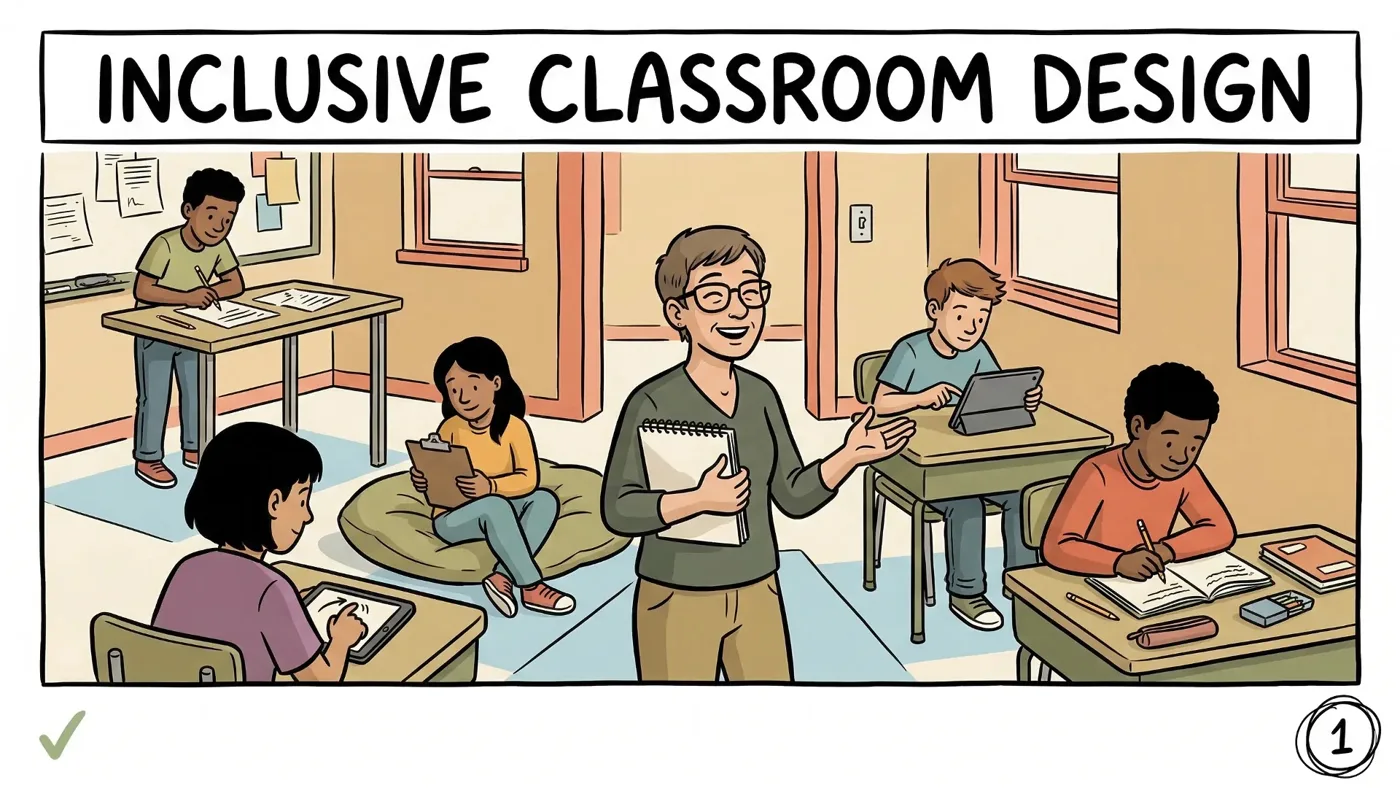

Inclusive Classroom Design Guide: UDL & Flexible Seating: a 53-page comic-style digital guide covering what inclusion means, physical space and layout, visual environment and displays, flexible seating and movement, Universal Design for Learning and building belonging, with before and after comparisons.
Sources and scope
- CAST UDL Guidelines: the framework for Universal Design for Learning, including reducing barriers in the learning environment.
- NAEYC: guidance for early childhood educators on learning environments.
- American Occupational Therapy Association: information on sensory processing and the role of occupational therapy in schools.
- IRIS Center: free modules on classroom environment and behavior.
This list covers practical classroom environment changes for kindergarten and early elementary rooms. It does not replace individual assessment by an occupational therapist or the decisions of a student’s team.
Key takeaways
- An overstimulating classroom shows up in walls, ceilings, sound, light and layout.
- Behavior patterns at the same times often point to the environment.
- A calm corner gives children a safe way to reset.
- Change one or two things at a time and track simple measures.
- Calmer does not mean bare: keep meaningful, child-centered displays.




Leave a Comment