

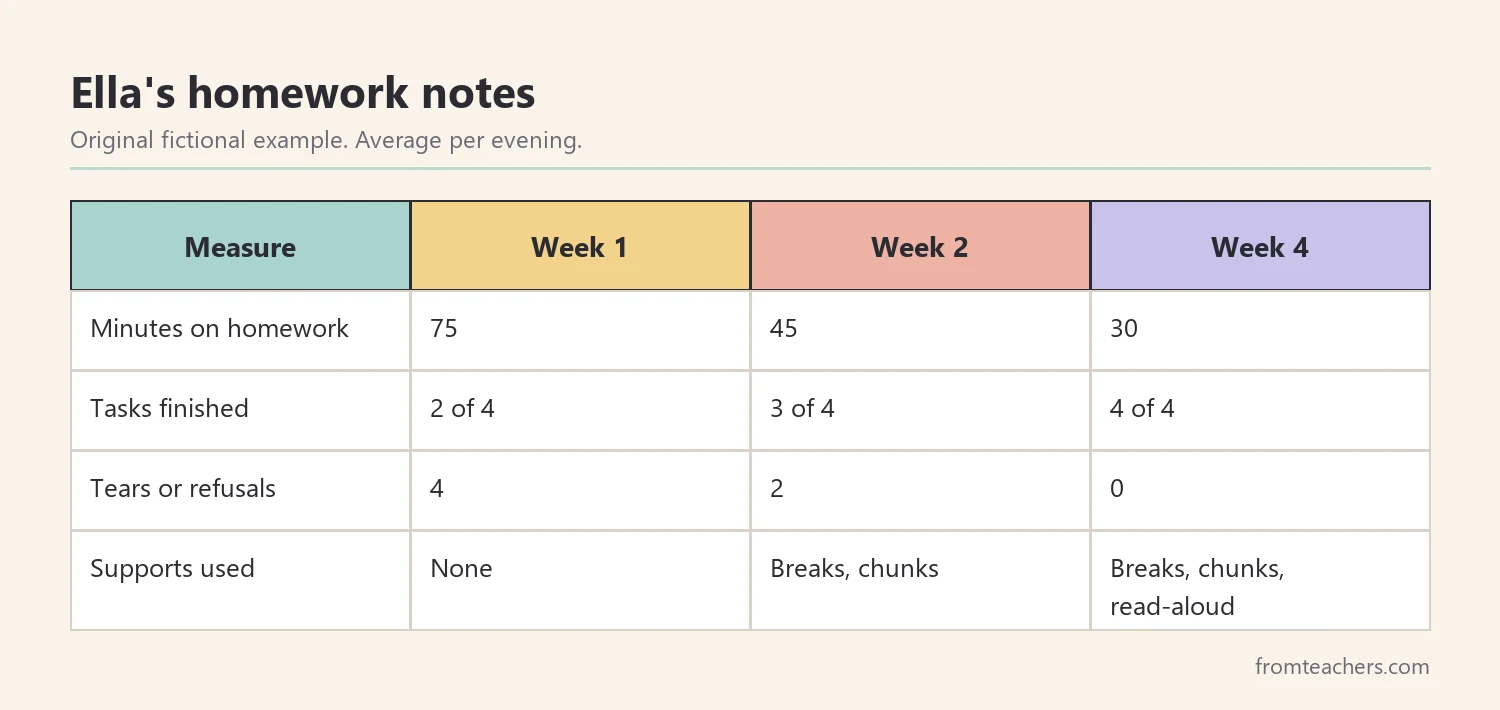
Homework accommodations can turn a two-hour struggle at the kitchen table into twenty focused minutes. Picture Ella, a third grader with a learning disability in reading. Every evening, her worksheet takes far longer than her teacher expects. She cries over the reading questions, her mom ends up reading everything aloud, and nobody at school knows how hard it really is.
This list is for parents of elementary students who receive, or may need, support with homework. It ranks ten common homework accommodations by how easy they are to start at home, from changes you can make tonight to ones you should agree on with the teacher or IEP team. Each item explains what the accommodation is, why it helps and how it worked for Ella. You will also learn how to track which supports actually help, so you can bring clear information to the next meeting.
Examples are fictional. Agree on supports with your child’s teacher and team. This is guidance, not a diagnosis or legal advice.
At a glance
- Homework accommodations change how a child does the work, not what they need to learn.
- Some supports, such as breaks and a quiet space, can start at home tonight.
- Others, such as reduced problems, need the teacher’s agreement.
- Tracking which support was used and how it went shows what really helps.
- Bring your notes to parent-teacher conferences and IEP or 504 meetings.
How this list is ranked
We ranked these ten homework accommodations by how easy they are for a parent to start. The first ones need only a change in routine at home. The middle ones need a quick message to the teacher. Then, the last ones are usually written into an IEP or 504 plan, because they change how work is assigned or graded.
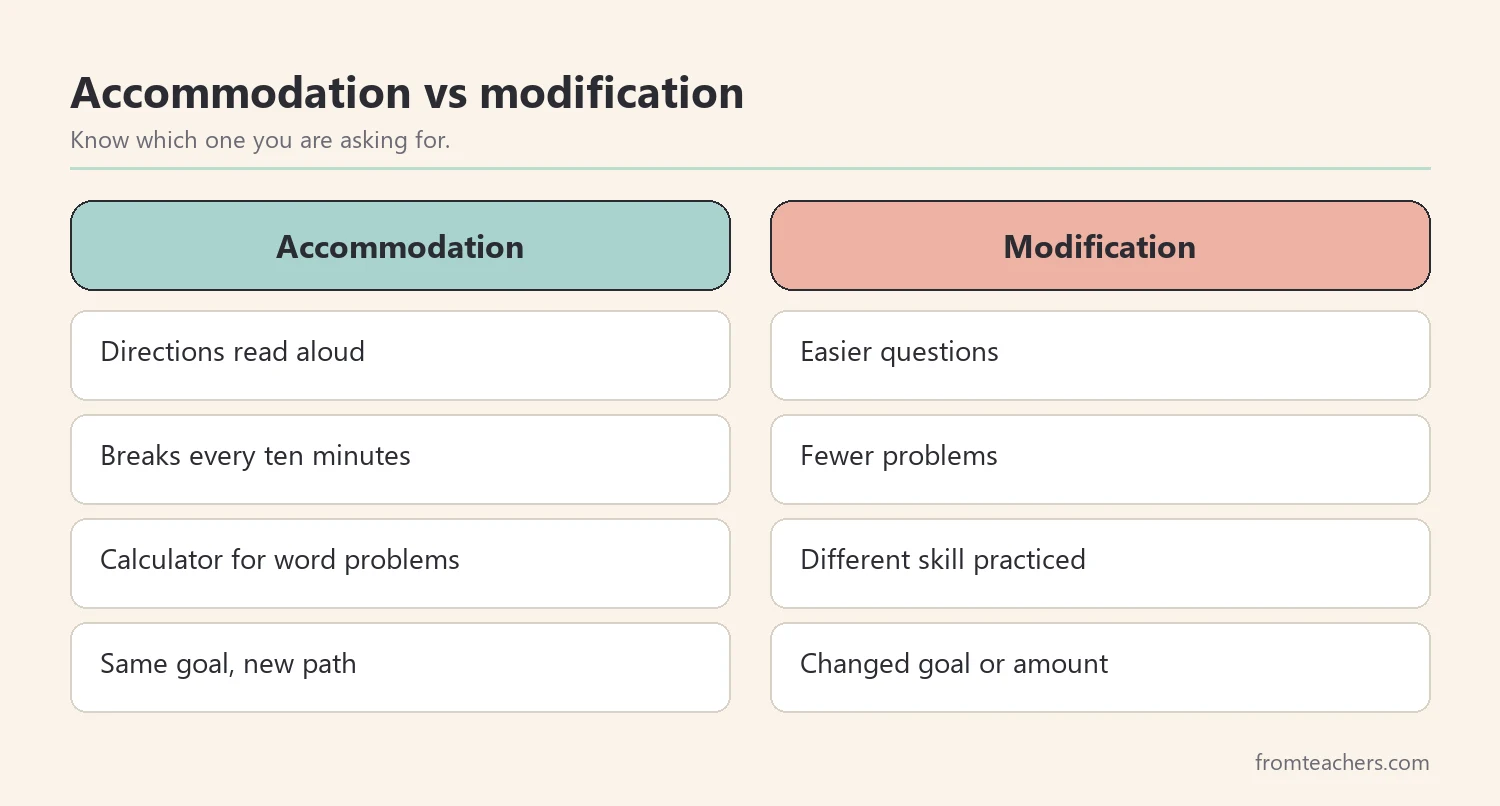
However, this is not a ranking of effectiveness. The best supports depend on your child’s needs. Also, remember the difference between an accommodation and a modification. An accommodation changes how a child learns or shows learning, such as reading aloud. A modification changes what is expected, such as fewer or easier problems. Figure 1 shows all ten.

1. Movement breaks
First, short breaks help many children focus. Sitting for a long time is hard, especially at the end of a school day.
How to use it: work for a set time, such as ten minutes, then take a two-minute break to stretch or walk. Use a timer so the break ends without an argument.
Example: Ella worked in three short blocks with jumping jacks between them. She stayed calmer than during one long session.
2. A quiet, ready workspace
Next, a calm spot with supplies ready removes many small distractions.
How to use it: choose a place away from the TV and siblings. Keep pencils, erasers and paper in a small box so your child does not get up to search.
Example: Ella’s mom set up a corner of the dining table with a supply box. Fewer minutes were lost looking for an eraser.
3. Breaking work into chunks
Long worksheets can look overwhelming. Instead, show only one part at a time.
How to use it: fold the page or cover parts with paper. Check off each chunk when done. This is one of the simplest homework accommodations for children who give up when they see a full page.
Example: Ella folded her math sheet into three parts and checked each one off. She said it felt “smaller.”
4. Reading directions aloud
Children who struggle with reading may not understand what a task asks. Reading the directions aloud lets them show what they know.
How to use it: read the directions, then ask your child to explain them in their own words before starting.
Example: Once her mom read the directions aloud, Ella completed her math problems without help. The challenge was reading, not math.
5. Graphic organizers
For writing and reading tasks, a graphic organizer gives structure. Children can plan their ideas before writing full sentences.
How to use it: ask the teacher for the organizers used in class, so your child sees a familiar format at home.
Example: Ella used a simple beginning, middle and end organizer for her story summary. Her writing was clearer and took less time.
6. Read-aloud or audio for reading passages
When the goal is understanding, not decoding, listening to the text can help. Many families use audio versions or read passages aloud.
How to use it: ask the teacher which assignments are about comprehension and which are reading practice. Read-aloud fits the first, not always the second.
Example: Ella’s teacher agreed that science readings could be read aloud, while her reading practice stayed independent.
7. Calculator or number chart
When a math task focuses on problem solving, a calculator or number chart can remove a barrier for children who struggle with facts.
How to use it: agree with the teacher when it is allowed. On fact practice nights, it may not fit.
Example: Ella used a multiplication chart for word problems. She spent her energy on understanding the problem.
8. Extended time or a time limit
Some children need more time. Others need the opposite: a set time limit so homework does not take the whole evening.
How to use it: agree with the teacher on a maximum time, such as 30 minutes. Your child stops at the limit, and you note how far they got.
Example: Ella’s teacher agreed to a 30-minute limit. Evenings became calmer, and the teacher saw what Ella could do in that time.
9. Reduced number of problems
Doing fewer problems while still practicing the skill is often helpful. Strictly speaking, this is usually a modification, so it should be agreed on by the team.
How to use it: ask for odd-numbered problems only, or the first five of each type.
Example: Ella did half of the math problems. Her accuracy rose, which showed she understood the skill.
Keep in mind that a reduced load should still cover each type of problem. Otherwise, your child may miss practice on a skill the class will need next week. Ask the teacher which problems matter most.
10. Track supports and results
Finally, the most useful step is tracking. Without notes, it is hard to know which homework accommodations help and which do not.
How to use it: for each assignment, check which supports were used and rate how it went. A ready-made form, such as the editable accommodations and modifications tracker for IEP forms, lets you check off supports and add a success rating with notes. Share the results with the teacher every few weeks.
Example: After four weeks, Ella’s notes showed that read-aloud directions and chunking helped most. Figure 3 shows the pattern.
Matching homework accommodations to the challenge
Different children struggle with homework for different reasons. Therefore, the best homework accommodations depend on what gets in the way. Before you ask for supports, watch one or two evenings closely and notice where your child gets stuck.
| What you see | Possible challenge | Supports to try |
|---|---|---|
| Cannot start the task | Understanding directions | Directions read aloud |
| Gives up at a full page | Feeling overwhelmed | Chunking, check-offs |
| Gets up every few minutes | Attention, energy | Breaks, quiet space |
| Knows the answer, cannot write it | Writing | Organizer, saying ideas first |
| Stuck on math facts | Fact recall | Number chart on agreed tasks |
For example, Ella could not start most tasks, yet she solved problems easily once someone read the directions. That observation pointed straight to reading supports, not to fewer problems. In contrast, a child who knows the work but cannot sit still may need breaks and a calmer space instead.
Also, keep in mind that challenges can change during the year. A support that helped in October may not be needed in March. Reviewing homework accommodations every few weeks keeps them matched to your child’s current needs and helps the team decide which ones to keep.
Talking with the teacher about homework accommodations
Teachers often do not see how long homework takes at home. Therefore, a short, friendly message with facts can change a lot. Describe what you see, share what you tried and ask for one or two specific supports.
| Say | Instead of |
|---|---|
| “Math takes her 75 minutes.” | “Homework is too much.” |
| “Read-aloud directions helped.” | “She can’t do it alone.” |
| “Could she do odd problems?” | “Can she skip homework?” |
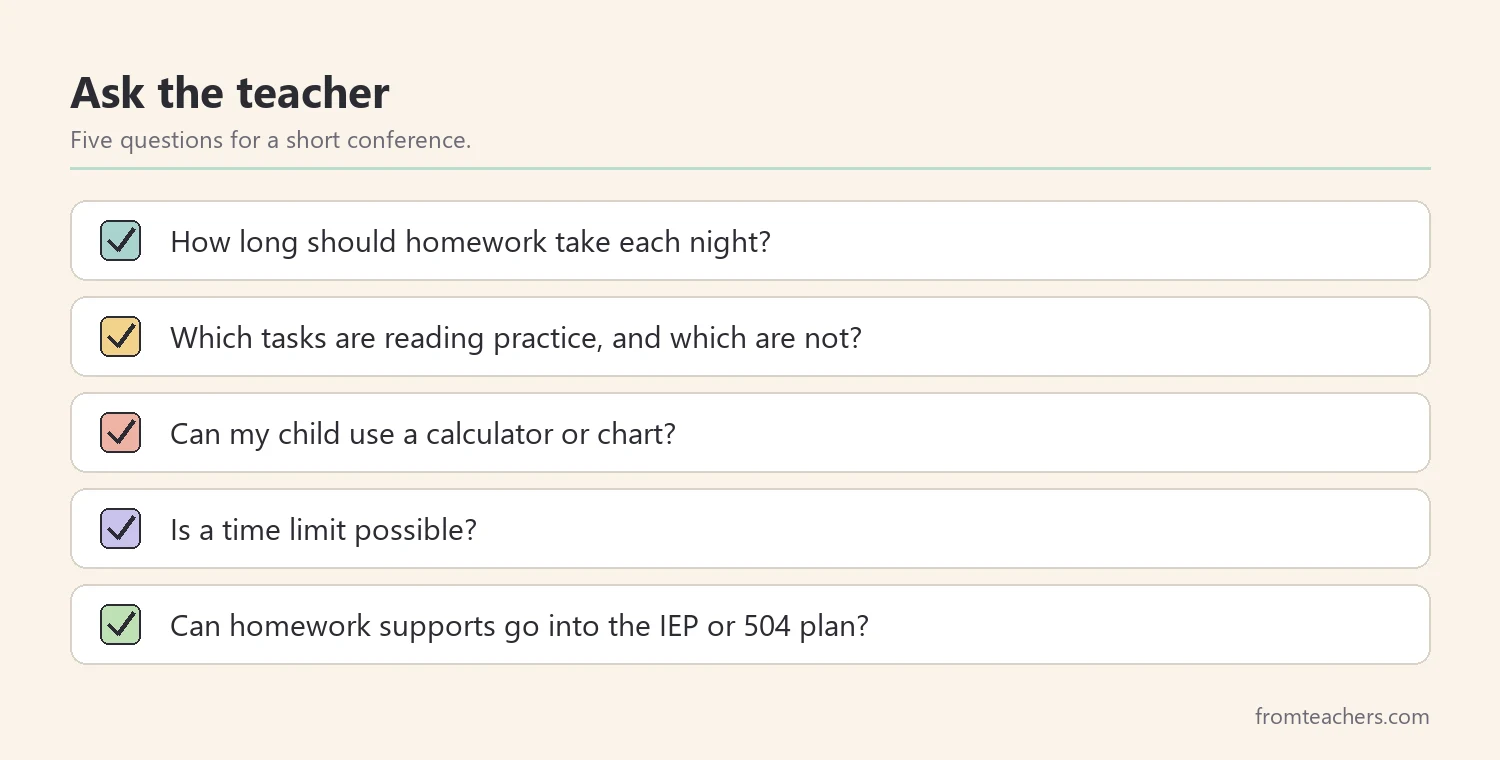
If your child has an IEP or 504 plan, ask whether homework accommodations are included. If they are not, you can ask the team to discuss them at the next meeting. Figure 4 lists questions to bring.
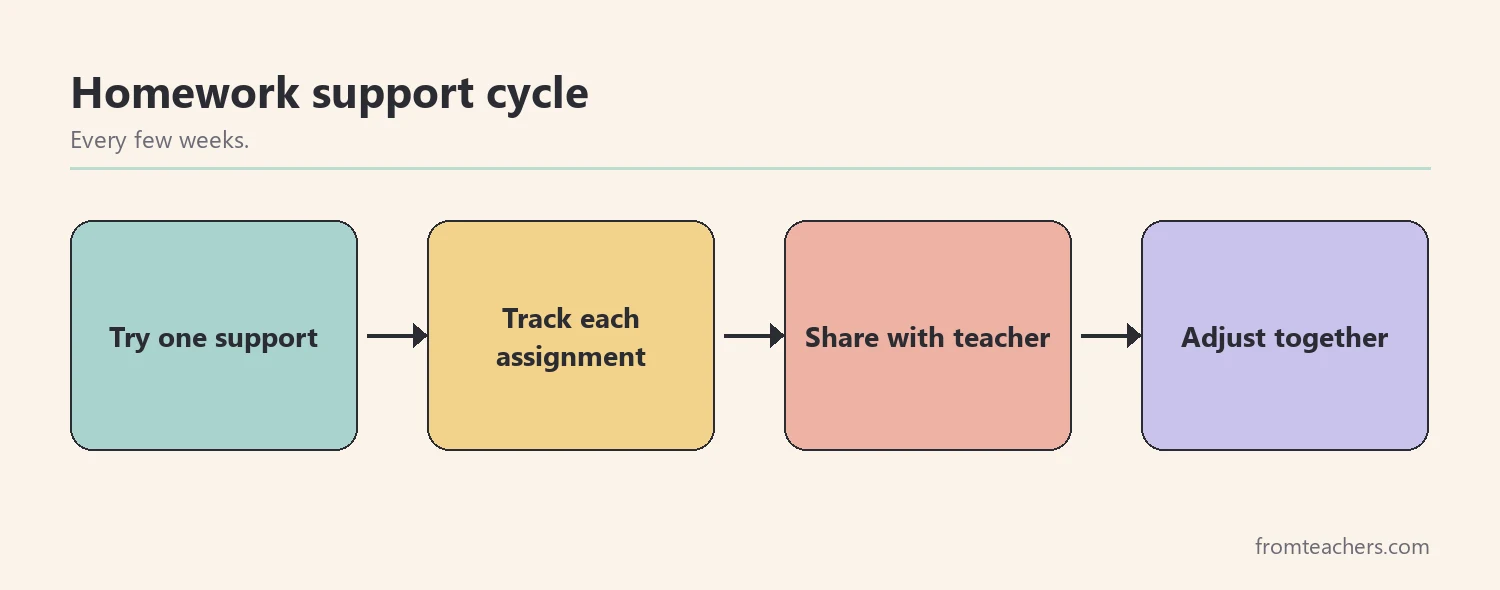
In short, homework support works best as a cycle, as shown in Figure 5: try a support, track it, share it and adjust with the teacher.
Common mistakes and how to avoid them
- Doing the homework for your child. Fix: support the process, but let your child do the thinking.
- Adding many supports at once. Fix: try one or two at a time and track results.
- Not telling the teacher. Fix: share how long homework takes and what helps.
- Confusing accommodations and modifications. Fix: agree on changes to the amount or difficulty with the team.
- Keeping no notes. Fix: use a simple tracker for each assignment.
Questions parents ask about homework accommodations
Can I ask for homework accommodations without an IEP?
Yes. Many teachers will agree to simple supports. A formal plan, such as an IEP or 504 plan, makes them consistent across teachers and years.
How much help is too much?
If you are doing the thinking, it is too much. Help with structure, reading directions and staying on track, but let your child solve problems.
Should homework take as long as it takes?
Not always. A time limit agreed with the teacher can protect evenings and still show what your child can do.
Will homework accommodations make my child dependent?
Accommodations remove barriers so your child can show what they know. The team can review them over time and reduce supports that are no longer needed.
What should I bring to an IEP meeting?
Bring your tracking notes, samples of work and a short list of what helps and what does not.
Related reading: Accommodations vs Modifications in Special Education, Dyslexia Solutions in the Classroom, and Teacher-Parent Communication in Special Education.
You may also need: Classroom Accommodation Feedback Form, IEP and 504 effectiveness tracker.
A companion resource for homework accommodations:
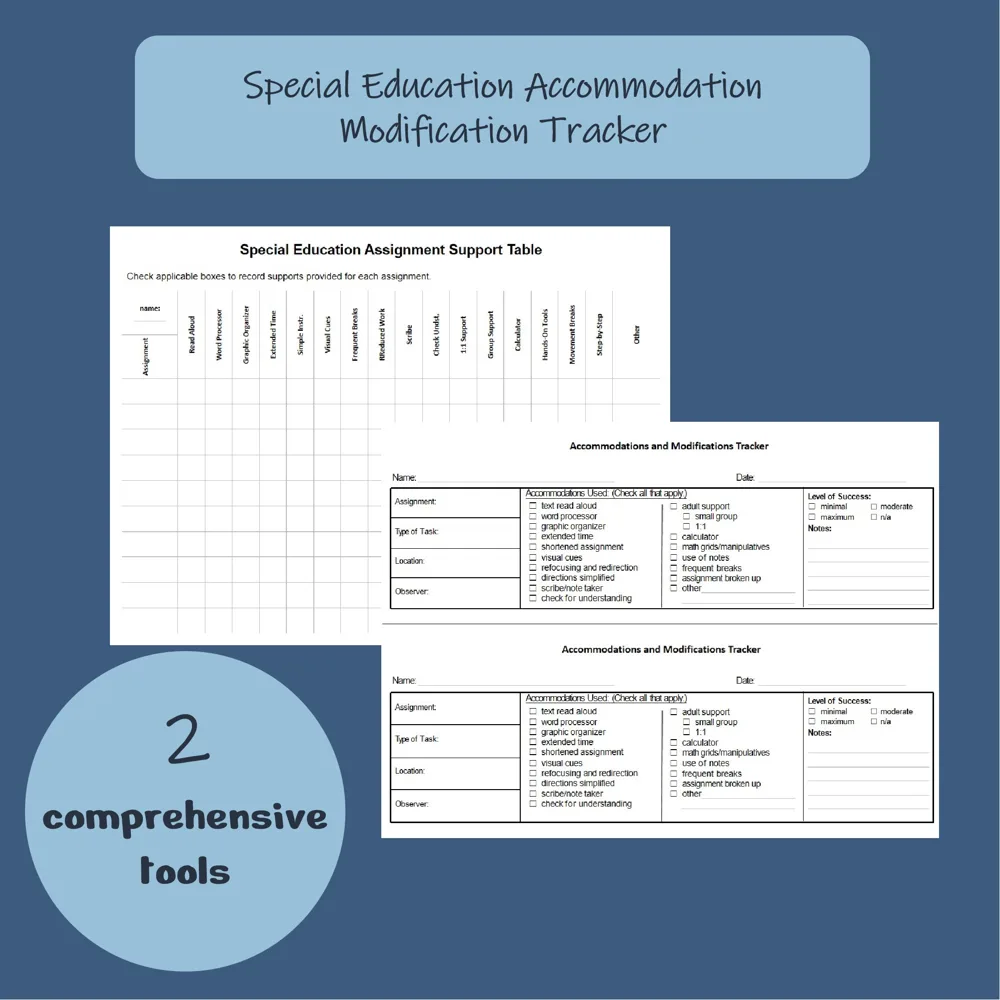
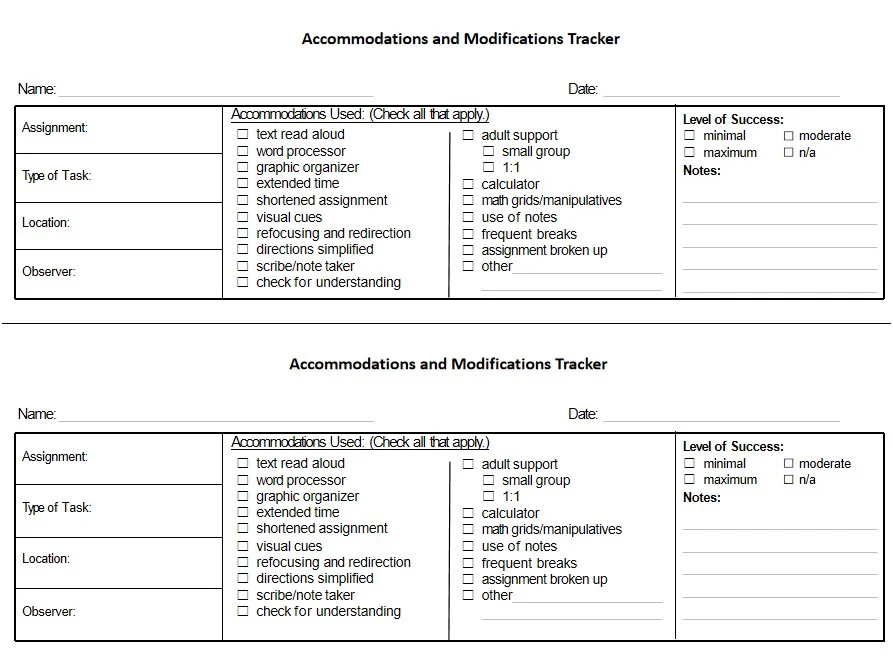
Accommodations & Modifications Tracker Editable Special Education IEP Forms: two editable tracking forms: an assignment support table to check off supports such as read aloud, graphic organizer, extended time, calculator and breaks across several assignments, and a per-assignment tracker with a success rating and notes.
Sources and scope
- Understood.org: guidance for families on accommodations, homework and learning differences.
- Center for Parent Information and Resources: plain-language information on IEPs, 504 plans and accommodations.
- IRIS Center: free modules on accommodations for students with disabilities.
- CAST UDL Guidelines: a framework for reducing barriers to learning.
This list covers common homework supports for elementary students and how parents can track them. It does not replace the IEP or 504 process or the decisions of a child’s team.
Key takeaways
- Homework accommodations change how a child works, not what they learn.
- Start with easy home changes: breaks, a quiet space and chunking.
- Agree on reading, math and time supports with the teacher.
- Treat fewer problems as a modification decided by the team.
- Track supports and results, and share them at meetings.










Leave a Comment