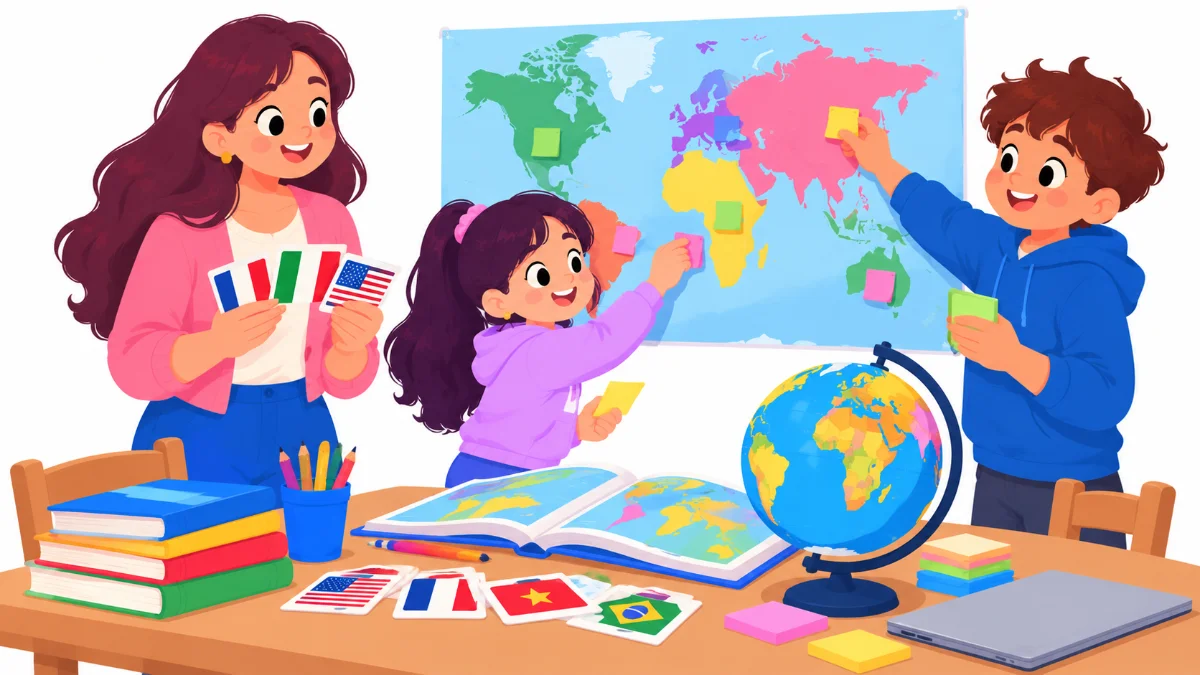

Trying to learn the countries of the world from a plain list rarely works for long. Picture Nora, age 9, and her brother Eli, age 12, homeschooling at the kitchen table. They memorized twenty African countries on Monday and remembered four by Friday. Their mom, Dana, wanted a way to make the names stick without turning geography into a chore.
This list is for homeschool families and parents who support geography at home. It ranks ten ways to learn the countries of the world, from the easiest to start with no materials to ones that take a little more planning. Each idea includes why it helps memory, how to use it with children of different ages, and a quick example from Nora and Eli’s table.
Examples are fictional. Adapt to your children’s ages, interests and learning needs.
At a glance
- Short, frequent sessions help names stick better than one long session.
- Stories, characters and real facts make countries memorable.
- Learning by continent or region keeps the task manageable.
- Quizzing yourself, not only rereading, builds long-term memory.
- Mixed-age siblings can learn together with different goals.
How this list is ranked
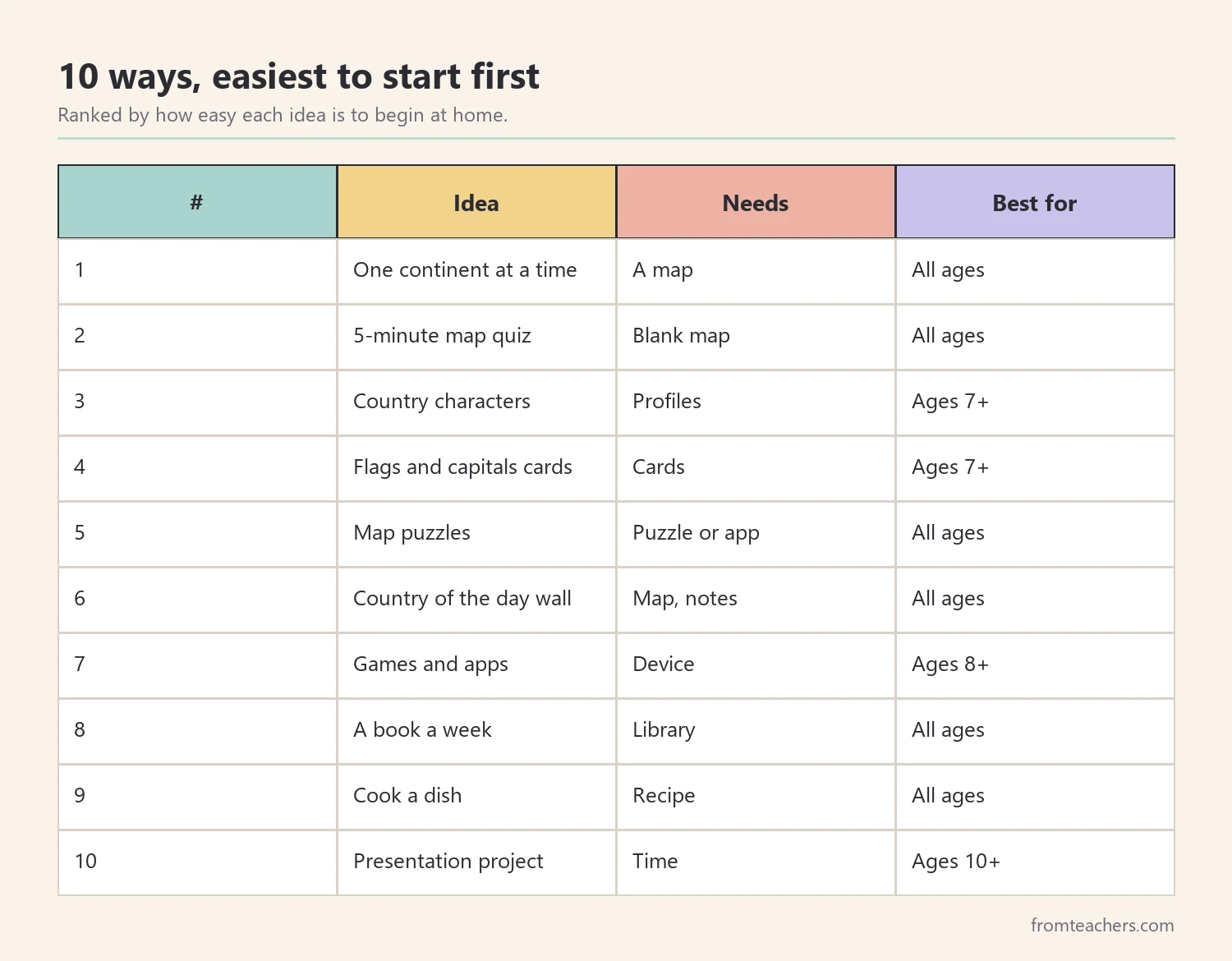
We ranked these ideas by one clear criterion: how easy they are to start at home. The top ideas need nothing but a map or a screen. Ideas lower on the list need some planning, such as cooking or a project. We did not rank them by which works “best,” because that depends on your children.
The figure most often used for the number of countries is 195: the 193 member states of the United Nations plus two observer states, the Holy See and Palestine. That is a lot of names, so the goal is steady progress, not speed. Figure 1 shows all ten ideas at a glance.
1. One continent at a time
First, break the world into chunks. Learning 195 names at once is overwhelming. Learning the countries of one continent, or one region, is a clear and finishable goal.
Why it works: smaller sets are easier to remember, and finishing one continent builds confidence.
How to use it: start with your own continent, then move outward. Younger children can learn five or six countries per region. Older children can aim for the full region.
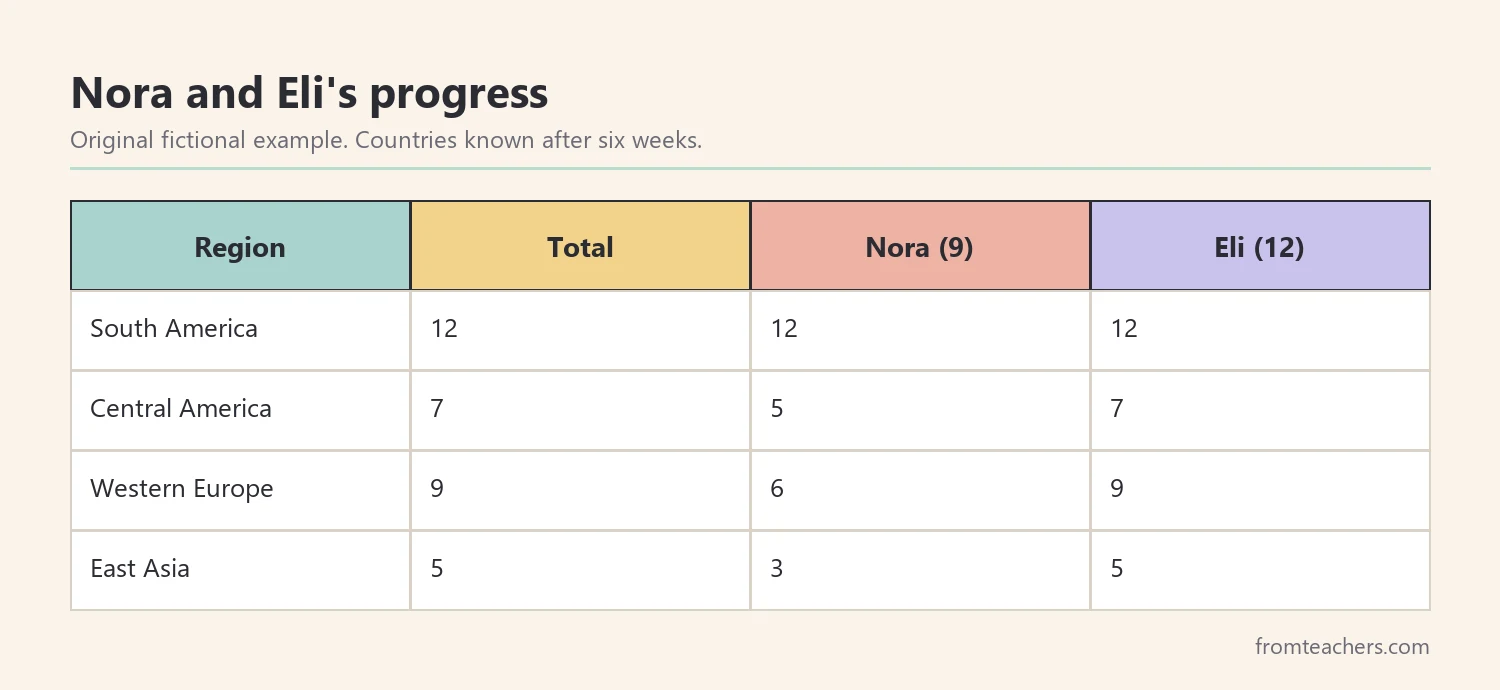
Example: Dana started with South America, which has twelve countries. Both children finished it in two weeks.
2. Five-minute daily map quiz
Next, quiz instead of reread. Point to a country on a blank map and ask its name, or say a name and ask your child to point.
Why it works: trying to recall information strengthens memory more than looking at it again. Short daily quizzes also space the practice over time.
How to use it: keep it to five minutes at the same time each day, such as after breakfast. Mix old countries with new ones.
3. Give every country a character
Countries are easier to remember when they have a personality. A nickname, a job title or a catchphrase turns a name into a character your child can picture.
Why it works: stories and images give the brain more hooks than a plain word.
How to use it: the ready-made option is If Countries Were Humans!, a set of 195 country profiles where each country has a nickname, a job title, a first-person catchphrase and real facts, along with its continent and capital. Children can read one profile a day and then retell it in their own words.
Example: Eli loved Cabo Verde as the “Atlantic Music Island.” He remembered its location because he pictured music drifting off the coast of West Africa.
4. Flags and capitals flashcards
Flashcards are simple and flexible. Put the country on one side and its flag or capital on the other.
Why it works: flashcards support self-testing and can be sorted into “know it” and “still learning” piles.
How to use it: younger children match flags, while older children add capitals. Review the “still learning” pile more often.
Example: Nora made her own flag cards with colored pencils. Drawing each flag helped her remember it.
5. Map puzzles
A physical or digital map puzzle lets children see how countries fit together. Shapes and neighbors become part of the memory.
How to use it: time the puzzle once a week and let children try to beat their own record, not each other’s.
Example: Eli’s first South America puzzle took him six minutes. By week two, he finished in under three, and he could name every neighbor of Brazil without looking. Nora preferred the floor puzzle, because she could walk around it and touch each piece.
6. A “country of the day” wall
Choose one country each day and add it to a world map on the wall with a sticky note or a pin. Write one fact on the note.
Why it works: the map fills up over time, which shows progress and provides daily review just by walking past.
Example: by the end of the month, the kitchen map had thirty notes. The children quizzed each other while waiting for lunch.
7. Geography games and apps
Many map games and quiz apps exist. They add variety and let children practice on their own.
How to use it: choose one app, set a short time limit and check progress weekly. Keep paper practice too, so screen time does not take over.
8. Read about one country a week
Picture books, atlases and nonfiction books bring countries to life. A story set in a real place adds culture, food and daily life to the name.
How to use it: visit the library for a book about each country your family studies. Older children can write a short summary.
9. Cook a dish from the country
Cooking makes geography real. A simple recipe from a country you are studying links taste and smell to the name.
How to use it: pick one dish per continent. Find the country on the map before you start, and talk about its neighbors while you cook.
10. Country presentation project
Finally, let older children become the expert. A short presentation on one country, with a map, a flag, three facts and a “catchphrase,” brings all the skills together.
Why it works: teaching someone else is one of the strongest ways to learn.
Example: Eli presented Japan to the family at dinner. Nora asked so many questions that she chose Japan for her next project too.
A weekly plan to learn the countries of the world
You do not need to use all ten ideas at once. Instead, combine two or three into a simple weekly rhythm. For example, Dana’s family used this plan:
| Day | Activity | Time |
|---|---|---|
| Monday | New region, read three country profiles | 15 min |
| Tuesday to Thursday | Five-minute map quiz and one profile a day | 10 min |
| Friday | Flashcards, puzzle race and wall update | 20 min |
| Weekend | Optional book or recipe | As you like |
Also, track progress simply. A list of regions with the number of countries each child knows is enough. Figure 3 shows how Nora and Eli moved through four regions in six weeks.
In addition, set different goals for different ages. Nora aimed for names and locations, while Eli added capitals and one fact per country. Both learned together, but each felt successful.
Next, return to finished continents every few weeks. Without review, early regions fade while you move on to new ones. A quick “mixed quiz” on Fridays, with one country from each finished region, keeps everything fresh and shows children how much they already know.
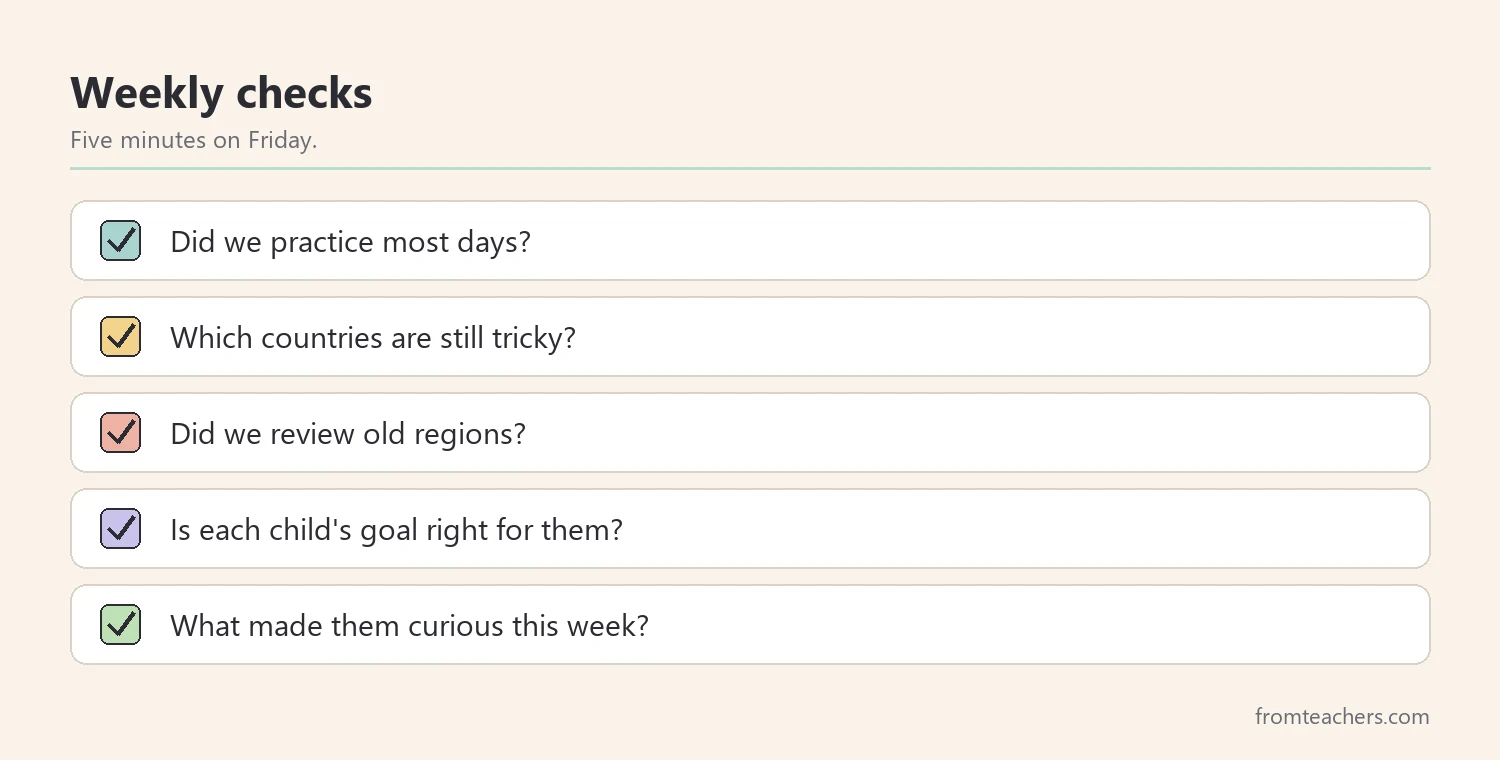
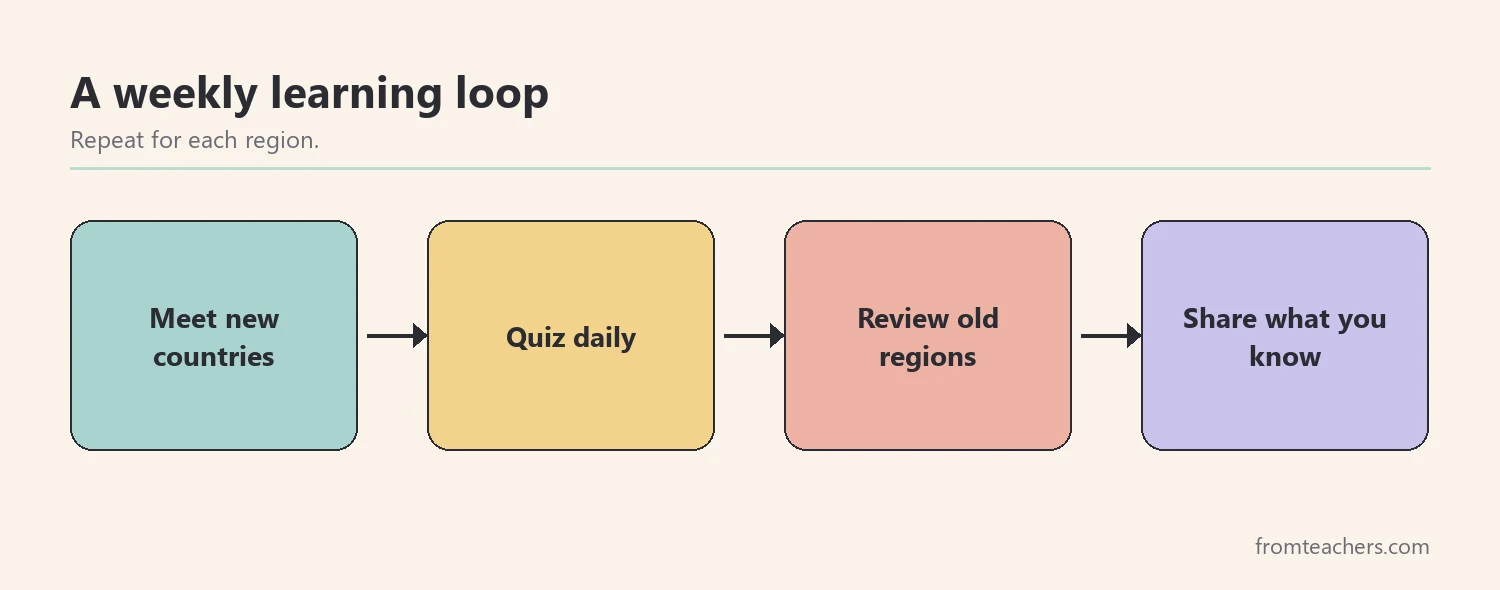
Finally, follow your children’s curiosity. If a country sparks interest, spend an extra day there. Curiosity is a stronger memory tool than any schedule. Figure 4 lists quick checks for keeping the plan on track, and Figure 5 shows the weekly loop.
Adapting for children who learn differently
Many homeschool families teach children with ADHD, dyslexia, autism or other learning differences. The good news is that most ideas on this list adapt easily. However, a few small changes can make a big difference.
- For children who find reading hard: read the country profiles aloud together, or let your child listen first and read second. Focus on maps and pictures before written names.
- For children who need to move: put a large map on the floor and let your child jump to the country you name. Use quiz time as a short movement break.
- For children who like routine: keep the same order every day, such as one profile, one quiz, one wall note. Show the plan on a simple checklist.
- For children with strong interests: link countries to the interest, such as animals, trains or sports teams, and let that lead the order.
For example, Nora finds long text tiring. Dana reads the catchphrase and the nickname aloud, and Nora reads only the country name and capital. As a result, she stays engaged and still practices reading.
Also, keep sessions short for children who tire quickly. Two five-minute sessions often work better than one ten-minute session. Stop while your child still feels successful, so they look forward to the next day.
Common mistakes and how to avoid them
- Trying to learn every country at once. Fix: work one region at a time.
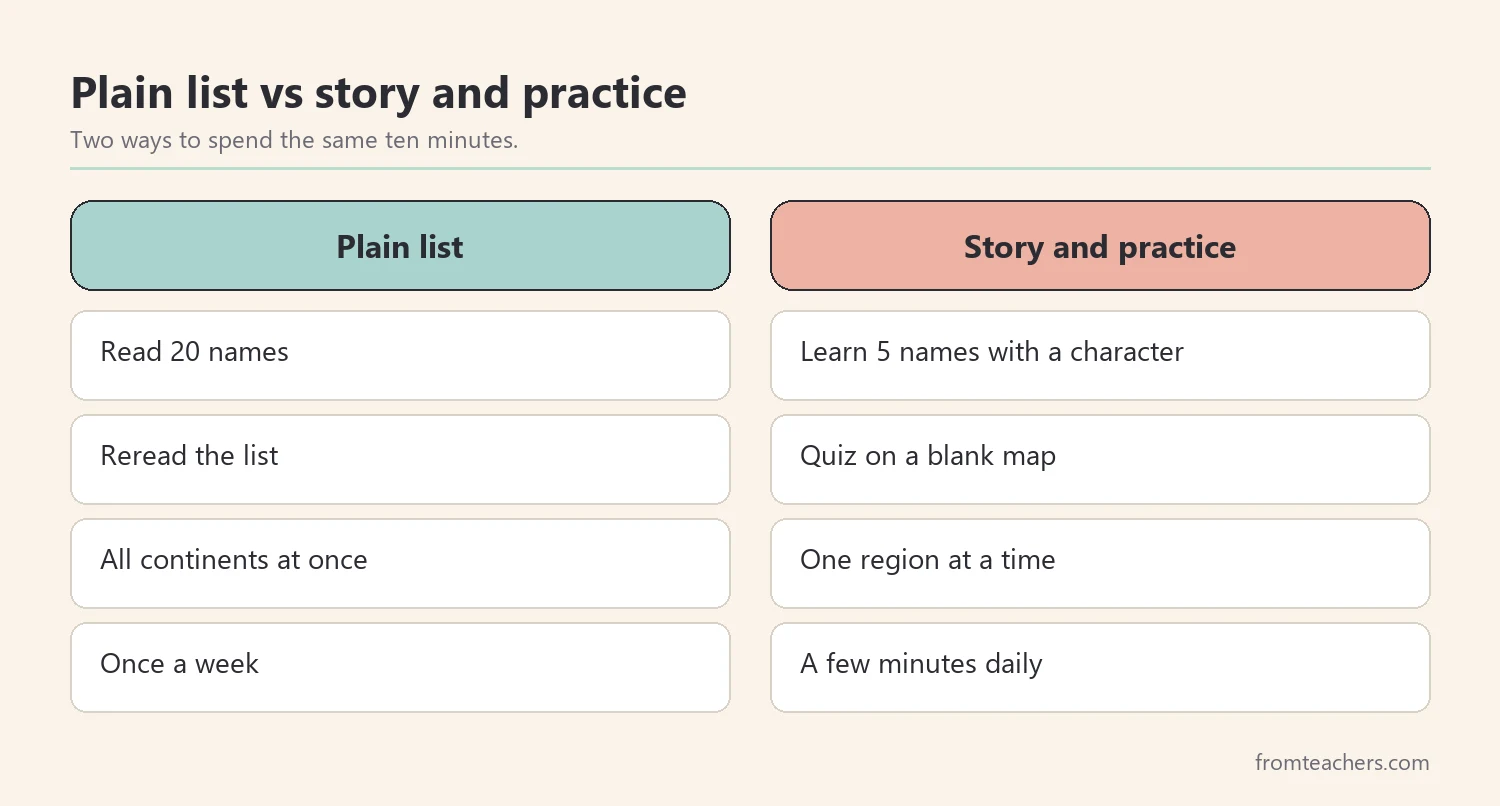
- Only rereading lists. Fix: quiz with blank maps and flashcards.
- Long weekly sessions. Fix: short daily practice works better for most children.
- Skipping review of finished regions. Fix: mix old countries into every quiz.
- Turning it into a competition between siblings. Fix: compare each child to their own past score.
Questions parents ask about how to learn the countries of the world
How many countries are there in the world?
The number most often used is 195, counting the 193 United Nations member states and two observer states. Some lists differ slightly depending on how territories are counted.
What age is best to start?
Young children can start with continents, oceans and a few countries. From around ages 8 to 10, many children enjoy learning full regions and capitals.
How long does it take to learn all of them?
It depends on the child and the time spent. Short daily practice over several months is a realistic goal for many families.
Should we learn capitals at the same time?
For younger children, start with names and locations. Add capitals once a region feels easy.
How do I keep it fun?
Use characters, games, food and stories, and let children choose some of the countries to study.
Related reading: Homeschooling vs Public Schooling: Choosing a Path, Learning Styles and Student Success, and 5 Teaching Tips for Classroom Focus and Learning.
You may also need: World Religions: The Complete Student Guide.
A companion resource to learn the countries of the world:
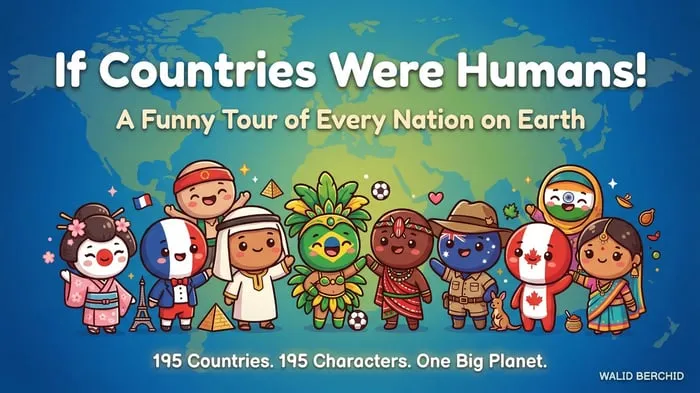
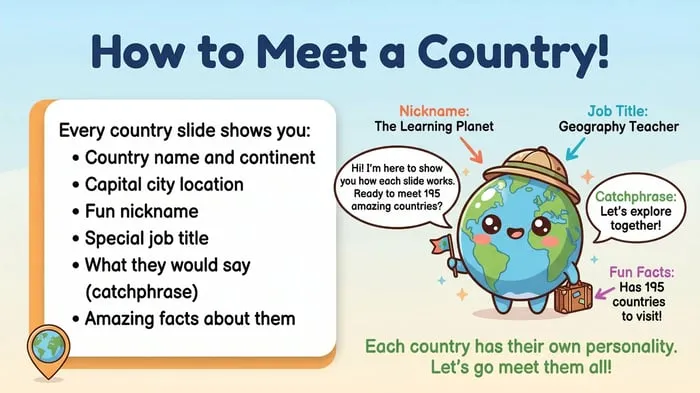
If Countries Were Humans!: 195 country profile slides, each with the country name, continent and capital, a fun nickname and job title, a first-person catchphrase, real facts and a Did You Know section.
Sources and scope
- United Nations: Member States: the official list of UN member states.
- The World Factbook (CIA): basic facts on countries, including capitals and maps.
- National Geographic Education: free geography resources and maps for families and teachers.
- What Works Clearinghouse: practice guides on organizing instruction and study to improve learning.
This list offers home ideas for learning world countries with children of different ages. It is not a full geography curriculum and does not cover physical geography, history or current events in depth.
Key takeaways
- To learn the countries of the world, work one continent or region at a time.
- Short daily quizzes beat long sessions of rereading.
- Characters, stories and real facts make names stick.
- Combine two or three ideas into a simple weekly plan.
- Review finished regions and follow your children’s curiosity.
Leave a Comment