

Observing your child’s classroom can tell you more in forty minutes than a stack of report cards, as long as you know what to look for. Picture Lena, the parent of Sam, a grade 3 student with an IEP for reading and attention. The school agrees to a short visit before the annual meeting. Lena arrives, sits at the back and suddenly wonders what she is supposed to notice.
This list is written for parents and caregivers who have arranged a classroom visit. It gives nine things to look for, ordered from the easiest to notice to the ones that need a little more attention. For each item, you will see why it matters, what to write down and how it looked during Sam’s visit. By the end, you will be able to turn one visit into calm, specific notes that help the whole team.
Examples are fictional. Adapt to the student’s goals and agreed supports. This is guidance, not a diagnosis.
At a glance
- Arrange the visit with the school first and agree on a time and length.
- Watch actions and routines, not only grades or worksheets.
- Write short, factual notes: what you saw, when, and for how long.
- Look for the supports in your child’s IEP and whether they are used.
- Share your notes as questions, not accusations, at the next meeting.
How this list is ordered
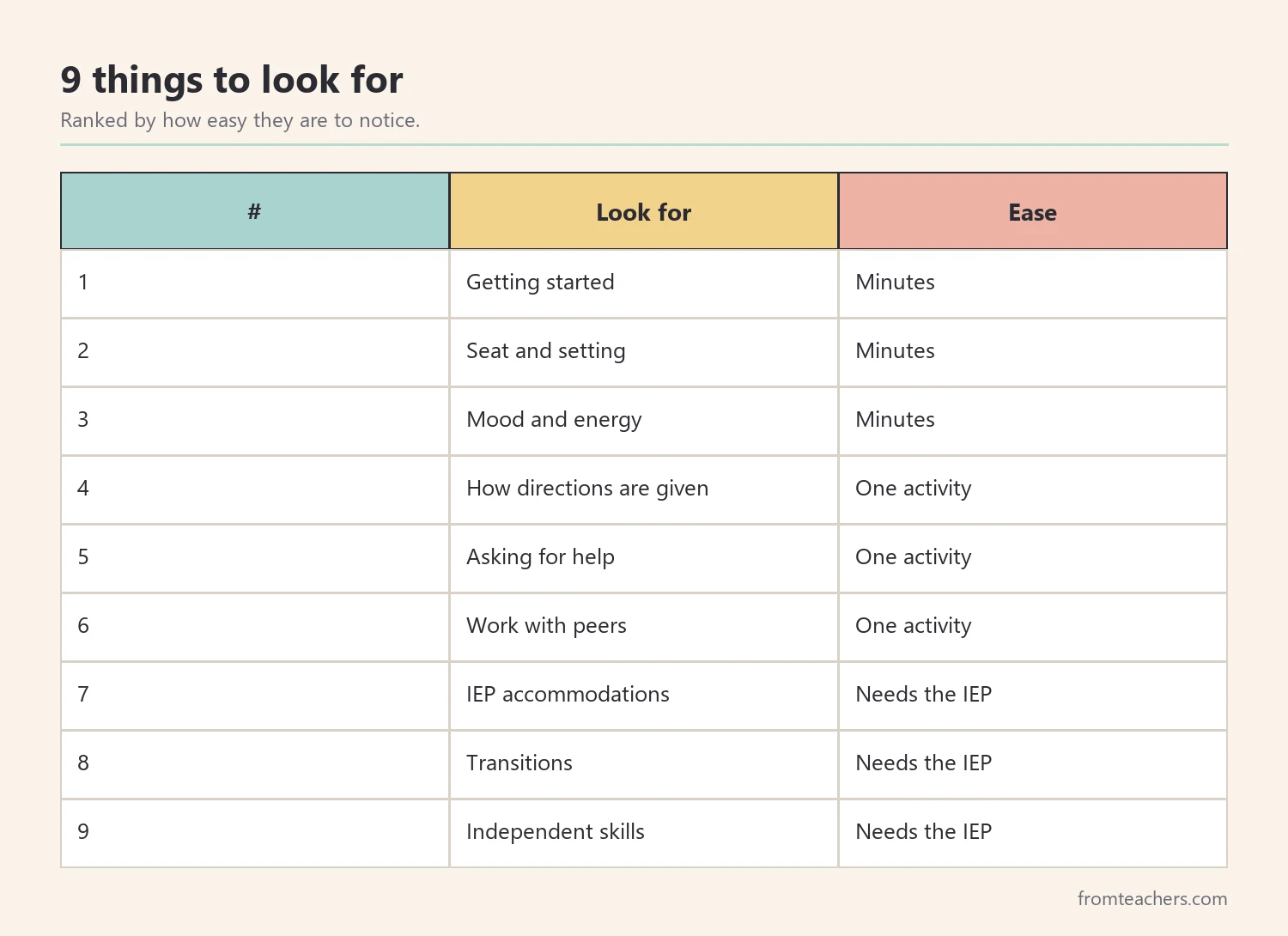
We ranked the nine items by how easy they are to notice from a chair at the back of the room. Items 1 to 3 are visible within minutes. Items 4 to 6 need you to watch one full activity. Finally, items 7 to 9 need you to compare what you see with your child’s IEP.
This order is not about importance. Every item can matter, depending on your child. Instead, the order helps you stay calm and focused, because you start with simple things and build up. Figure 1 shows the full list on one page.
Before you go: set up the visit
First, contact the teacher or case manager and ask about the school’s visitor rules. Many schools ask parents to sign in, keep visits short and avoid talking with other students. In addition, ask which time would show the skills you care about, such as reading group or independent work.
Next, bring a simple form instead of a blank page. A checklist keeps you looking at the same areas the teacher tracks. Lena printed one page from a set of observation forms and added Sam’s IEP goals at the top.
1. How your child starts the day or activity
The first minutes of any activity reveal a lot. When observing your child’s classroom, notice how your child gets started. Does Sam take out his materials, wait for a reminder or look around at others?
Why it matters: starting work is a common challenge for students with attention or learning needs. It is also easy to see from the back of the room.
What to write: the time the direction was given, the time your child started and any prompt the adult gave.
Example: The teacher said “open your reading folder” at 9:05. Sam opened it at 9:07 after a classmate pointed. Lena wrote exactly that, without guessing why.
2. Where your child sits and what is nearby
Next, look at the setting. Seating, noise, windows and the distance to the teacher can all affect focus. Many IEPs include seating accommodations, so this is worth a careful glance.
Why it matters: the room itself can help or hinder learning. A seat near the door or a busy center may pull attention away.
What to write: a quick sketch of the room with your child’s seat, the teacher’s usual spot and any noisy areas.
Example: Sam sat near the pencil sharpener. Lena counted six interruptions there during reading and drew a small map in her notes.
3. How your child’s mood looks across the visit
Similarly, mood and energy are easy to notice. Watch faces, posture and voice, but describe them as actions rather than feelings you cannot see.
Why it matters: regulation affects everything else. A child who seems calm at home may look very different in a busy room, and the reverse can be true too.
What to write: “smiled when partner joined,” “put head on desk for about a minute,” “tapped pencil during spelling.”
Example: Sam looked relaxed during the read-aloud, then tapped his foot and sighed during the worksheet. Lena noted the switch and the time it happened.
4. How the teacher gives directions
Now you are watching a full activity. Notice whether directions are spoken, written, shown, or all three. In addition, see whether your child gets a check-in after directions are given.
Why it matters: many students do better with directions in more than one form. If your child’s IEP lists visual or chunked directions, this is where you see them in action.
What to write: how directions were given and what your child did in the next minute.
Example: Directions were spoken once and written on the board. Sam started after the teacher repeated step one at his desk. Lena wrote “started after a one-to-one repeat.”
5. How your child asks for help
Observing your child’s classroom also shows how your child handles difficulty. Does Sam raise a hand, call out, wait silently or leave the seat? Each response tells the team something different.
Why it matters: asking for help is a key self-advocacy skill. Some children struggle quietly, so adults never notice they are stuck.
What to write: what your child did when stuck, how long it took for help to arrive and what kind of help it was.
Example: Sam sat still for about four minutes on a tricky word. He did not raise his hand. Finally, the aide noticed and helped. Lena wrote this down as a question for the meeting, not a complaint.
6. How your child works with other students
Peer interaction is part of every classroom. Watch partner work, group tasks and the quiet moments in between. For example, notice who your child talks to and how conversations start.
Why it matters: friendships and group work affect motivation. Many teachers track peer interaction as one area of daily observation.
What to write: who started the interaction, how long it lasted and how it ended.
Example: Sam worked well with one partner and laughed at a shared joke. However, he did not join the larger group discussion. Lena noted both.
7. Whether IEP accommodations are visible
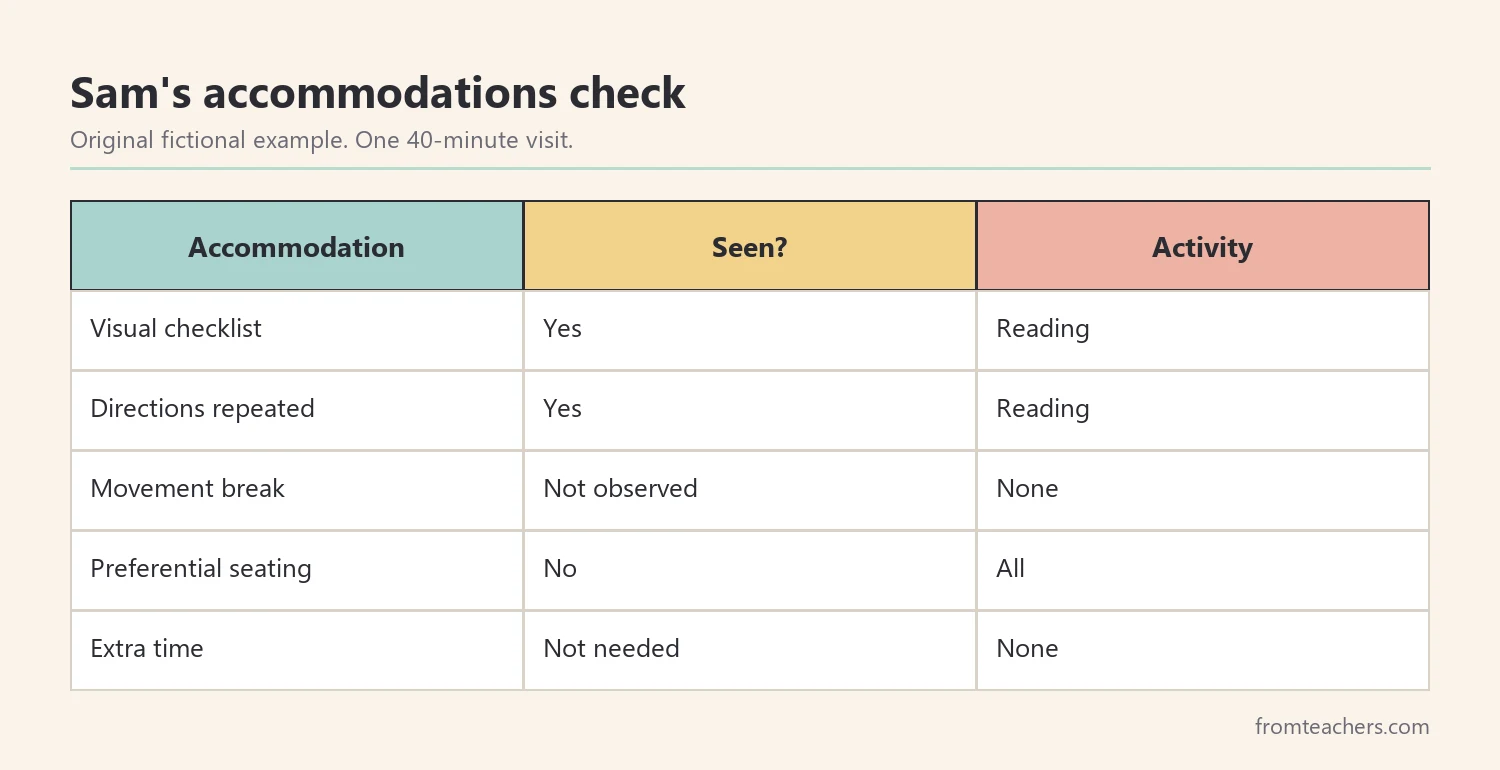
This item needs a little preparation. Before observing your child’s classroom, list the accommodations in the IEP, such as extra time, a quiet space, read-aloud support or movement breaks. Then look for them during the visit.
Why it matters: accommodations only help when they are used. A visit can show whether they fit the real routine or need adjusting.
What to write: each accommodation, whether you saw it, and in which activity. If you did not see one, simply note it as “not observed,” because it may not have been needed during your visit.
Example: Lena saw a visual checklist on Sam’s desk. She did not see a movement break, but the visit only lasted forty minutes. She planned to ask how breaks usually work.
8. How your child moves between activities
Transitions are hard for many children with special education needs. Watch the minutes when one activity ends and another starts.
Why it matters: a lot of learning time can be lost in transitions. In addition, transitions are when stress often shows.
What to write: how the transition was signaled, how long your child took and whether any support helped.
Example: The class used a timer and a song. Sam packed up within the song and sat down for math with everyone else. Lena added this to her “what works” list.
9. What your child does independently
Finally, compare what your child does alone with what needs adult support. This is the hardest item, because it requires watching closely across the whole visit.
Why it matters: IEP goals often focus on increasing independence. A clear picture of independent skills helps the team set realistic next steps.
What to write: one or two tasks done with no help and one or two that needed support, with the type of support used.
Example: Sam wrote the date and copied the word list alone. He needed help to start the reading questions. Lena described both in her notes, using the same words as the teacher’s forms.
Using a set of 12 daily classroom observation checklists makes these notes easier to compare, since each form lists specific areas with simple check boxes and a notes column.
Turning your notes into a useful summary
After the visit, read your notes the same day while the details are fresh. Then group them into three short lists: what worked, what you are unsure about, and questions for the team. Figure 4 shows a quick checklist for this step.
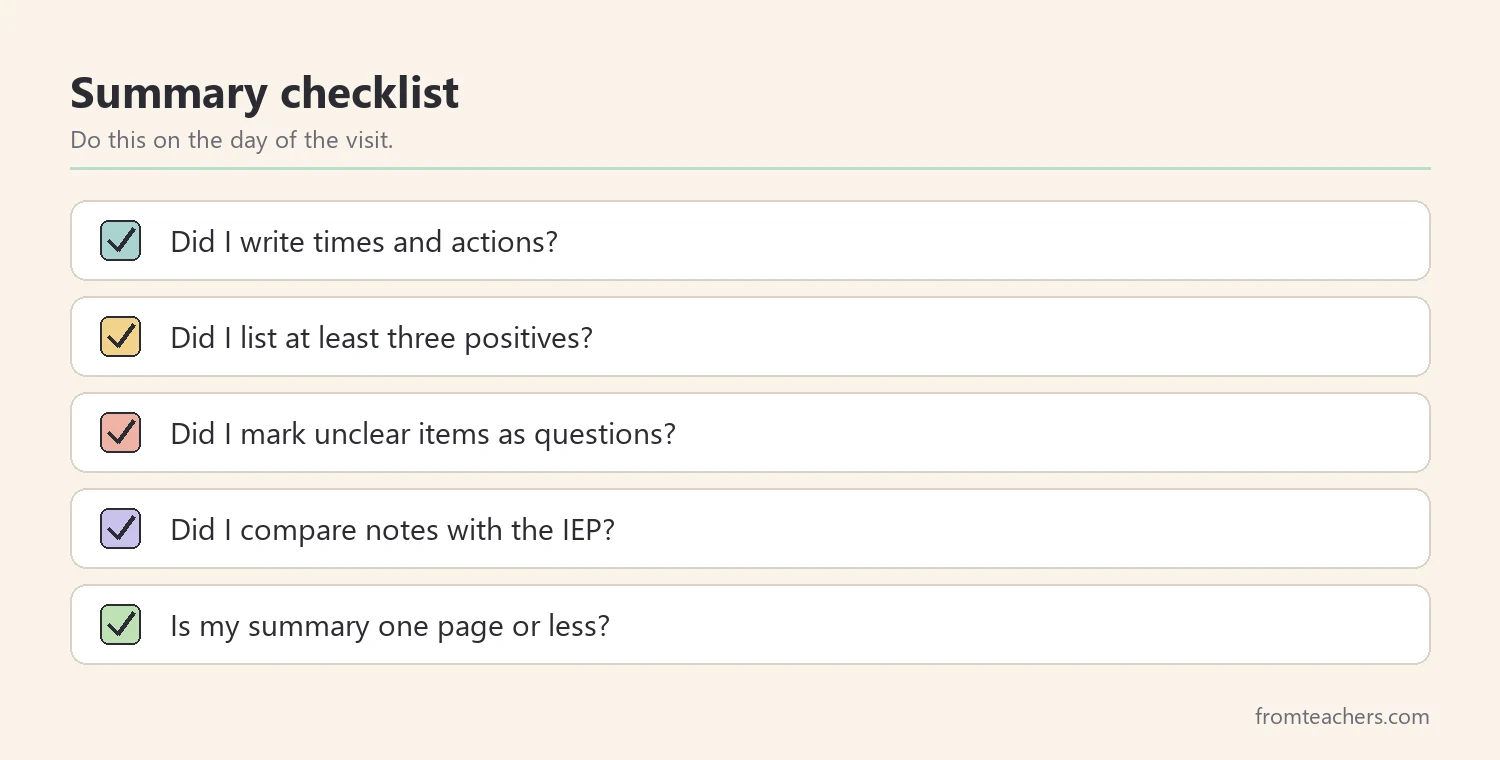
Keep the summary to one page. Teachers often have many families to meet, and a short summary with specific moments is easier to discuss than a long letter. Furthermore, a calm summary invites cooperation, which is exactly what observing your child’s classroom should build.
Lena’s summary looked like this:
| What worked | Unsure | Questions |
|---|---|---|
| Timer and song for transitions | Seat near the sharpener | Could Sam move seats? |
| Visual checklist on desk | Movement breaks | How are breaks offered? |
| Partner reading | Asking for help | Can we teach a help signal? |
A simple four-part plan for your visit
Most families find that a predictable routine makes the visit less stressful. Figure 5 shows a four-part plan you can reuse every time you observe.
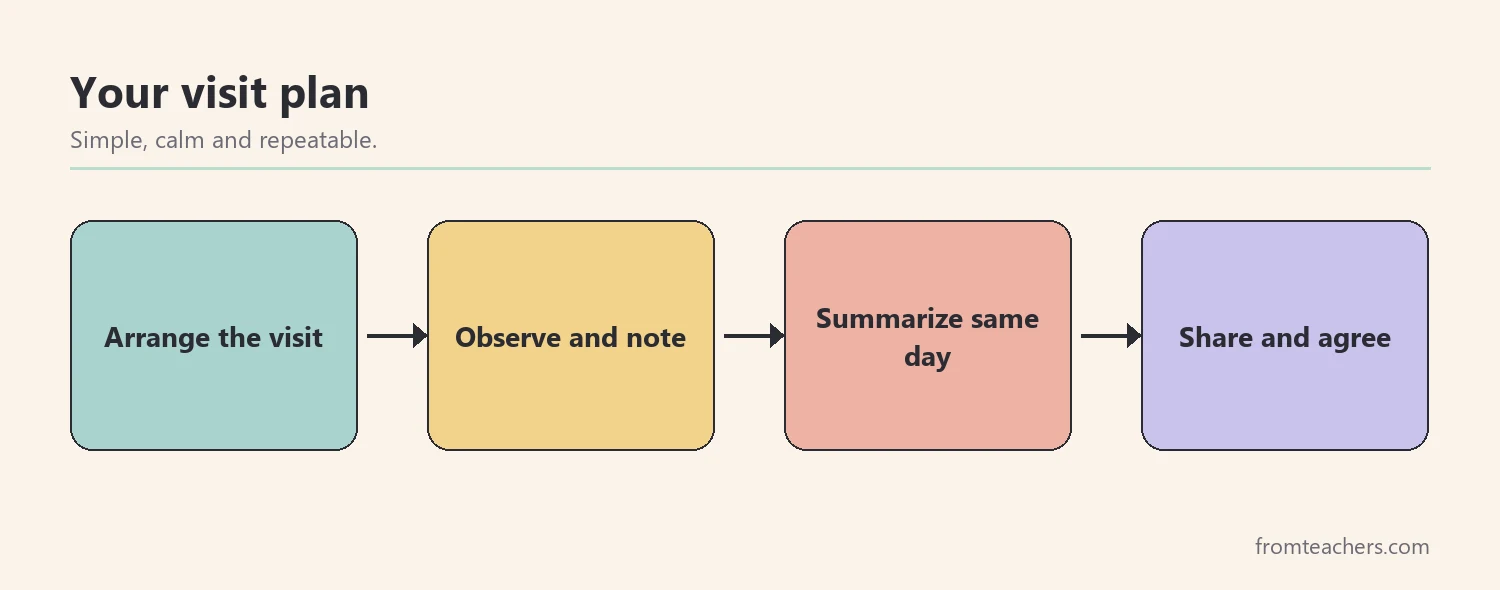
First, agree on the visit with the school. Next, watch and write short, factual notes. Then, summarize the same day. Finally, share the summary at a planned meeting and agree on one next step together.
Common mistakes and how to avoid them
- Arriving without asking. Fix: arrange the visit through the school and follow visitor rules.
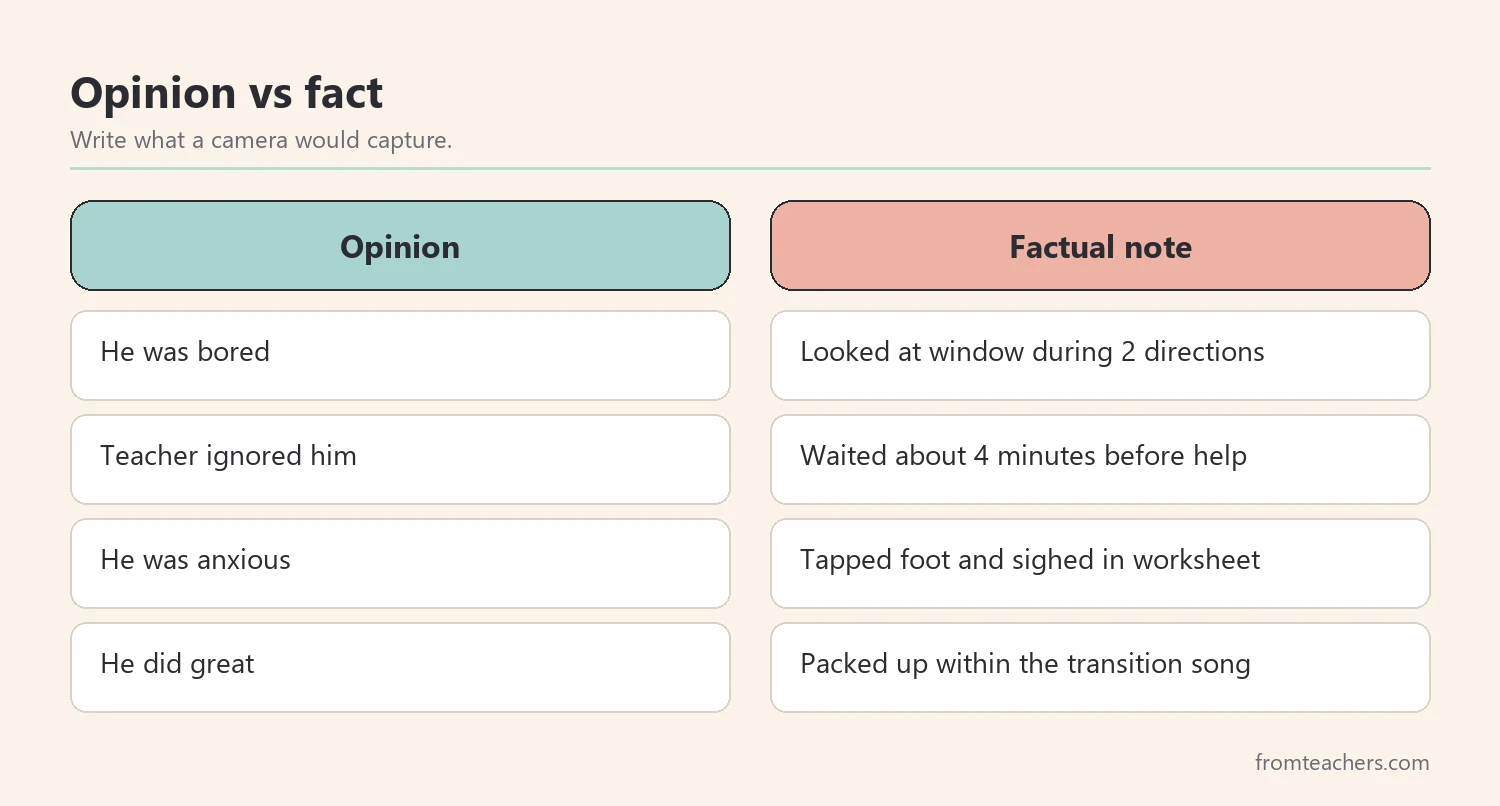
- Writing opinions. Fix: write what a camera would capture, such as actions, words and times.
- Judging from one visit. Fix: treat the visit as one snapshot and ask how a typical day looks.
- Talking with your child during the lesson. Fix: stay quiet and in the background, so the class runs as usual.
- Bringing a long list of complaints. Fix: share three positives, three questions and one request.
Questions parents ask about observing your child’s classroom
Do I have a right to observe my child’s classroom?
Rules differ by state, district and school. Many schools allow parent visits with notice, but they may set limits on time and frequency. Ask the school for its visitor policy and arrange the visit in advance.
How long should a visit last?
Often thirty to sixty minutes is enough to see one or two activities. A shorter, well-timed visit is usually more useful than a long one at a random time.
Should my child know I am coming?
That depends on your child. Some children feel proud, while others get distracted. Talk with the teacher about what would make the visit feel most normal.
What if I see something that worries me?
Write it down factually and ask about it calmly at a planned meeting. If you believe a child is unsafe, tell school staff right away.
Can I share my notes at the IEP meeting?
Yes. Parents are members of the IEP team, and your observations are useful information. Short, specific notes are easiest for the team to use.
Related reading: How Parents and Teachers Can Team Up for Special Education Success, Teacher and Parent Communication in Special Education, and Accommodations vs Modifications in Special Education.
You may also need: Classroom Accommodation Feedback Form for IEP and 504 plans.
A companion resource for observing your child’s classroom:
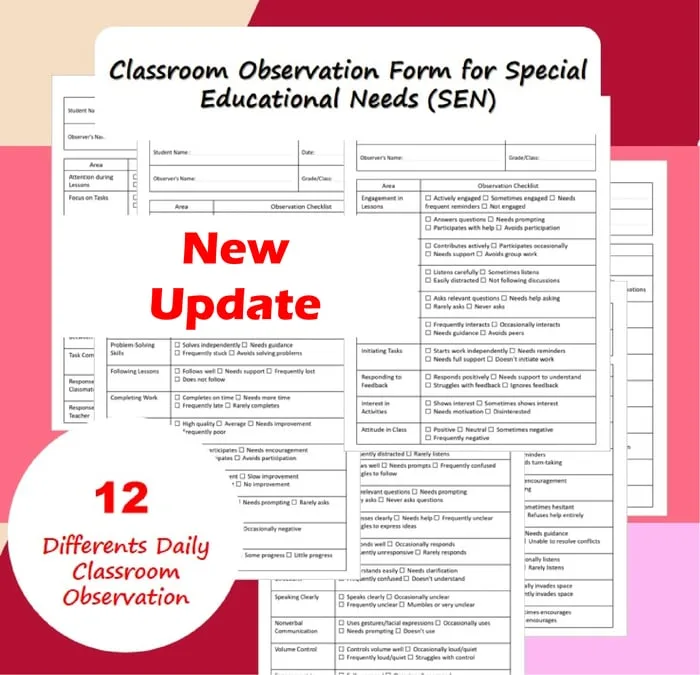
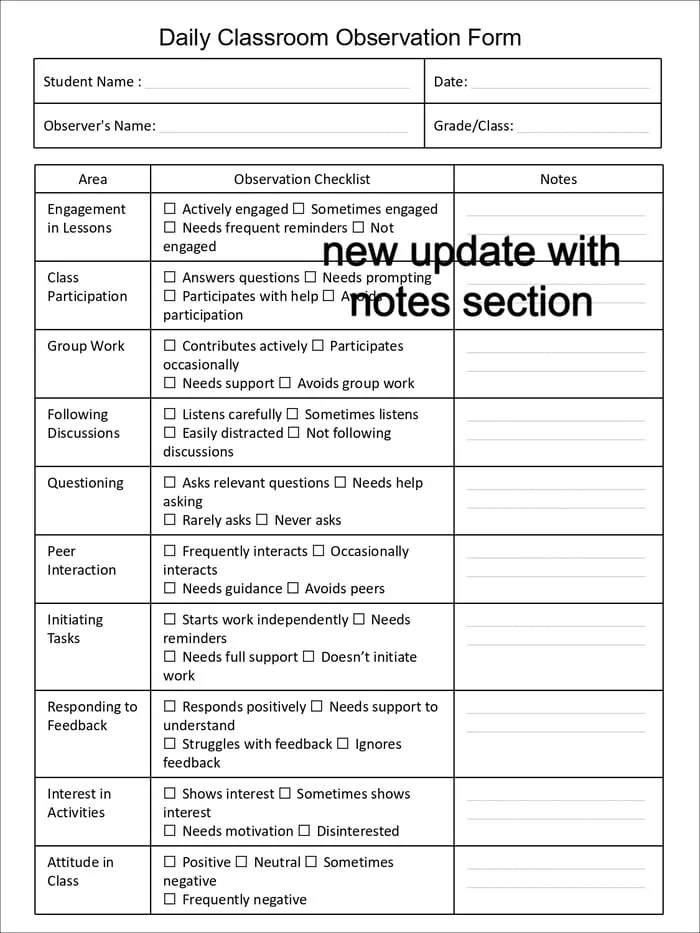
Classroom Observation Forms for Special Education: 12 Daily Checklists: 12 daily observation forms with the same check-box layout, covering engagement, attention, regulation, peer interaction, independence, communication, executive functioning and more, in print-ready PDF and editable PowerPoint versions.
Sources and scope
- Center for Parent Information and Resources: plain-language information for families about IEPs, evaluations and working with schools.
- National Center for Learning Disabilities: information and advocacy resources for families of children with learning disabilities.
- Understood.org: guidance for families on learning and thinking differences and talking with schools.
- IRIS Center, Vanderbilt University: free modules on classroom practices, accommodations and data collection.
This list covers informal classroom visits by parents who have been invited or approved by the school. It does not cover formal evaluations, independent educational evaluations or legal advice, and each school sets its own rules for visitors.
Key takeaways
- Arrange the visit with the school and follow its rules.
- Start with easy things to notice, then watch IEP supports and independence.
- Write factual notes with times, actions and the support used.
- Summarize the same day into what worked, unsure and questions.
- Share your notes as a partner, so observing your child’s classroom builds trust.






Leave a Comment