

A behavior chart for two homes can turn two different sets of rules into one simple message your child understands. Picture Nora, age seven, who spends weekdays with her mom and weekends with her dad. At mom’s house, she earns stickers for brushing her teeth. At dad’s house, nobody mentions teeth, but she gets screen time for tidying up. Nora is confused, and Sunday evenings are tense.
This list is written for separated, divorced or co-parenting families, and for grandparents or step-parents who share the care. It gives seven tips, ordered from the easiest to start to the ones that need a short conversation between adults. For each tip, you will see why it helps, how to do it and how it worked for Nora. As a result, you can build one calm routine that travels with your child.
Examples are fictional. Adapt to the student’s goals and agreed supports. This is guidance, not a diagnosis.
At a glance
- Use the same chart and the same few habits in both homes.
- Let the chart travel with your child, or keep a copy in each home.
- Agree on small, similar rewards so neither home becomes the “fun” one.
- Hand the chart over with one positive comment, not a report card.
- Review it together once a week and change only one thing at a time.
How these tips are ordered
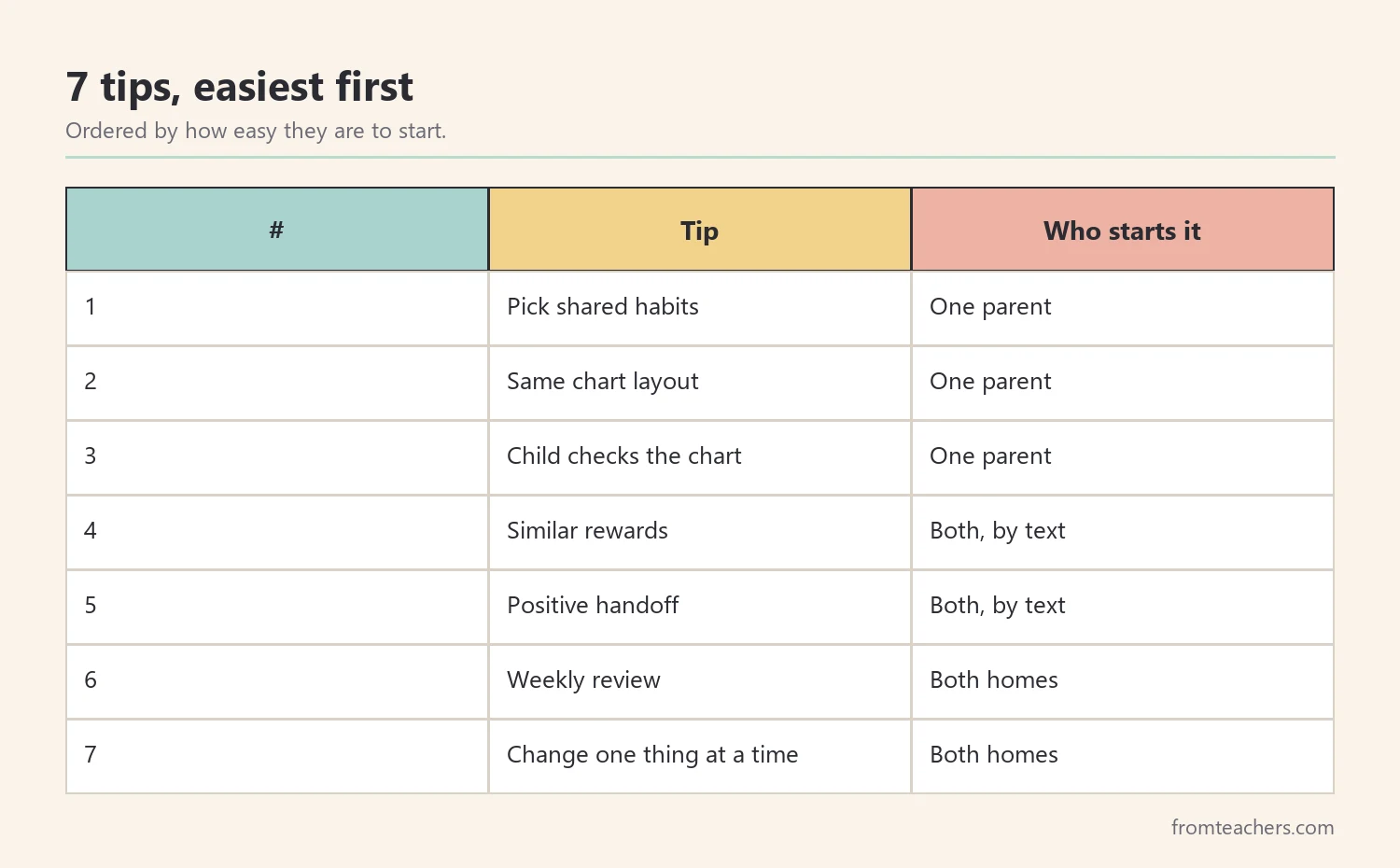
We ordered the tips by how easy they are to start. Tips 1 to 3 can be done by one parent tonight. Tips 4 and 5 need a quick text or call between homes. Finally, tips 6 and 7 work best when both adults agree on a weekly routine.
That order matters, because co-parenting arrangements differ. Some families talk every day, while others prefer short messages. Starting with what you control lowers the pressure. Figure 1 shows all seven tips at a glance.
Why one chart helps children who live in two homes
Children often do better with predictable routines. Moving between homes already brings change: different beds, different meals, different schedules. Consequently, a single shared chart can be one thing that stays the same.
A shared chart also sends a quiet message: both parents notice the same good habits. Even when adults do things differently, the child hears one voice about what matters.
1. Choose a small set of shared habits
Start small. Pick three to five habits that make sense in both homes, such as brushing teeth, putting shoes away, reading, sharing or using kind words.
Why it helps: fewer habits are easier to remember, especially when the setting changes. Shared habits also avoid the feeling that one home has “more rules.”
How to do it: look at the habits on your chart and circle the ones that fit both homes. Leave home-specific chores off for now.
Example: Nora’s mom chose reading, brushing teeth, kind words and listening the first time. All four made sense at dad’s house too.
2. Use the same chart layout in both homes
Next, make the chart look the same everywhere. Print two copies of one design, or let one chart travel in a folder.
Why it helps: the same colors, order and boxes make the routine familiar. Your child does not have to learn a new system each time.
How to do it: an editable weekly behavior chart for kids works well here, because you can type your child’s name, print it twice and use the same Sunday to Saturday grid in both homes.
Example: Nora kept her chart in a clear folder in her backpack. On Friday it went to dad’s house, and on Sunday it came back.
3. Let your child carry or check the chart
Give your child a role. Children often feel proud when they check off a habit themselves or remind the adult.
Why it helps: ownership builds independence. Furthermore, it makes the chart feel like your child’s tool, not a message between parents.
How to do it: keep a pen with the chart and agree on a check-off time, such as after dinner.
Example: Nora checked her boxes after bath time. At dad’s house, she reminded him, “We do the chart now.”
4. Agree on similar, simple rewards
Rewards can easily become a competition between homes. If one parent offers a toy and the other offers praise, the chart loses its meaning.
Why it helps: similar rewards keep the focus on habits, not on which home is more generous. Small, free rewards also keep things fair.
How to do it: send a short message suggesting two or three rewards that work anywhere, such as choosing a story, a family game or extra time at the park.
Example: Nora’s parents agreed that a full week of reading would earn “choose the weekend movie.” It worked at either house.
| Reward idea | Cost | Works in both homes? |
|---|---|---|
| Choose a bedtime story | Free | Yes |
| Pick the family game | Free | Yes |
| Extra park time | Free | Yes |
| Choose the weekend movie | Free | Yes |
5. Hand over the chart with one positive comment
The handoff moment can be stressful. Therefore, keep the chart talk short and positive. Mention one thing that went well, in front of your child.
Why it helps: children notice how parents talk about them during transitions. A positive comment makes the chart feel safe, not like a report card.
How to do it: use one sentence: “She read every night this week.”
Example: At Friday pickup, mom said, “Nora used kind words all week.” Dad smiled and gave Nora a high five. The handoff took ten seconds.
6. Review the week together
Once a week, look at the chart with your child. Notice patterns without blame. For example, some habits may slip on transition days, which is common.
Why it helps: reviewing shows your child that the chart is about progress. It also helps parents see what needs adjusting.
How to do it: sit for five minutes, count the checks and ask your child, “What was easiest? What was hardest?”
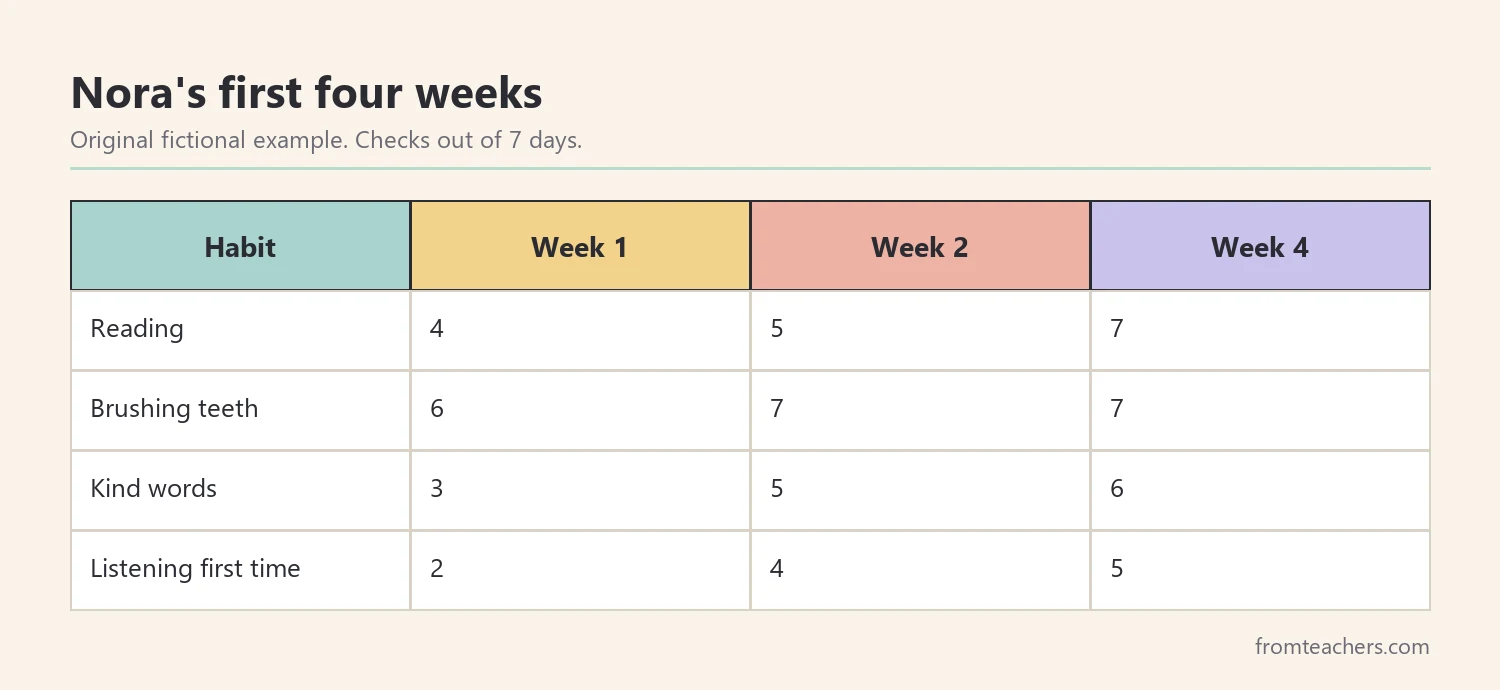
Example: Nora’s chart showed missed reading on Fridays, her moving day. Her parents agreed that Friday reading could be a short audiobook in the car. Figure 3 shows her first four weeks.
7. Change one thing at a time
Finally, adjust slowly. When a habit becomes easy, replace it with a new one. However, change only one habit at a time, and tell the other home first.
Why it helps: small changes keep the routine stable. Coordinated changes keep the behavior chart for two homes the same in both places.
How to do it: send a short message: “Teeth is easy now. Shall we swap it for putting shoes away?”
Example: After a month, Nora’s parents swapped brushing teeth for setting the table. Both homes started on the same Sunday.
Making transition days easier
Transition days are often the hardest part of the week. Your child may be tired, excited or a little sad, and habits can slip. That is normal, so plan for it instead of fighting it.
First, keep the transition day chart lighter. For example, you might agree that only one or two habits count on moving day. Next, pack the chart in the same place every time, such as the front pocket of the backpack, so it never gets lost. Then, use the same short phrase in both homes when it is time to check the boxes, such as “chart time.”
In addition, notice your own tone. Children pick up on adult stress quickly. A calm, cheerful check-in, even after a busy pickup, tells your child that the routine is safe and that both homes are on the same side.
Nora’s parents also added a small ritual: on arrival, Nora showed the chart to the parent she was joining and pointed to her favorite check of the week. It took less than a minute and gave every arrival a positive start.
What to do when the homes disagree
Sometimes adults will not agree on every habit or reward. That is normal. In that case, keep the chart for the habits you do share, and handle the rest separately in each home.
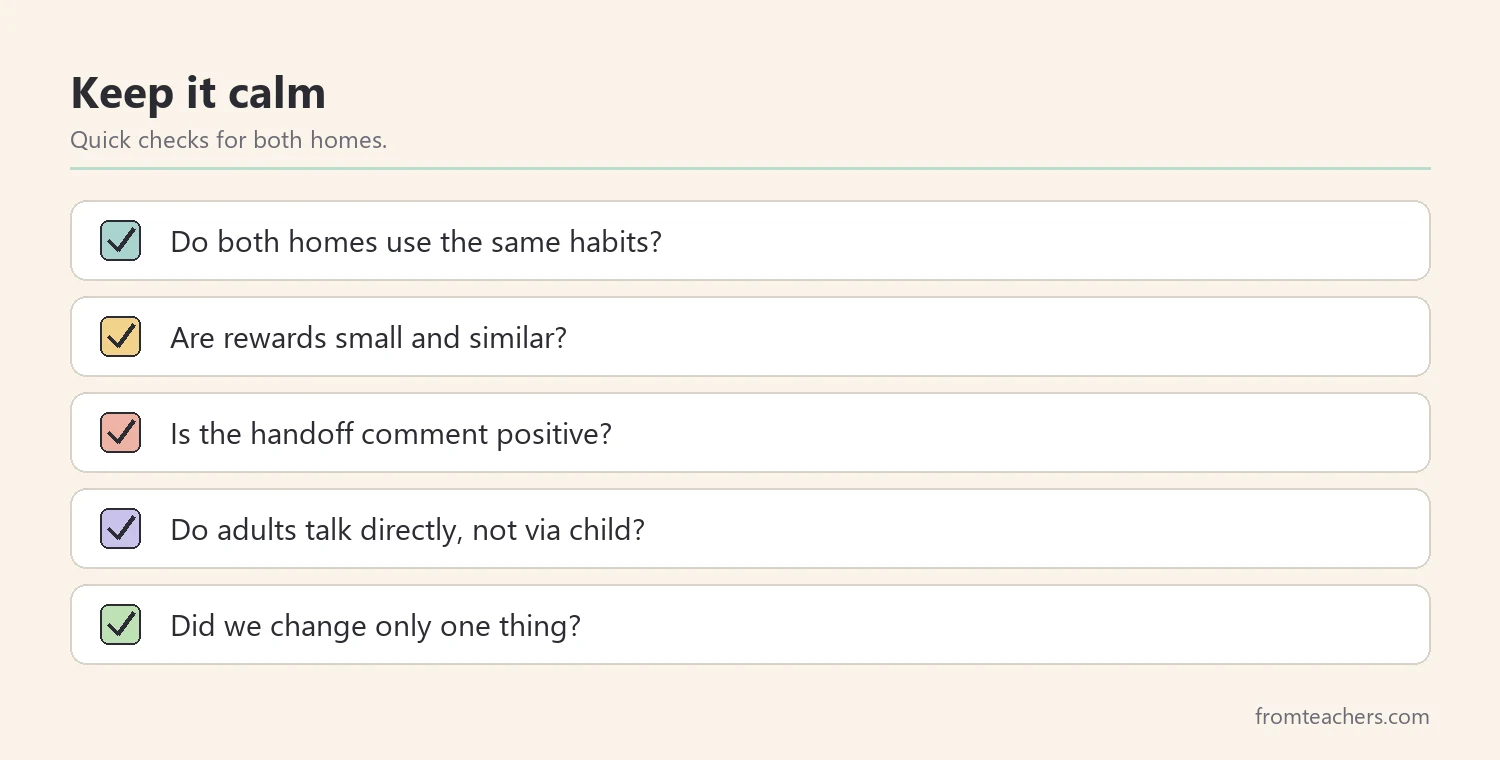
Also, avoid using the chart to send messages to the other parent. Comments like “Dad forgot again” can make a child feel caught in the middle. Instead, talk directly with the other adult, away from your child. Figure 4 lists quick checks to keep things calm.
A simple weekly rhythm
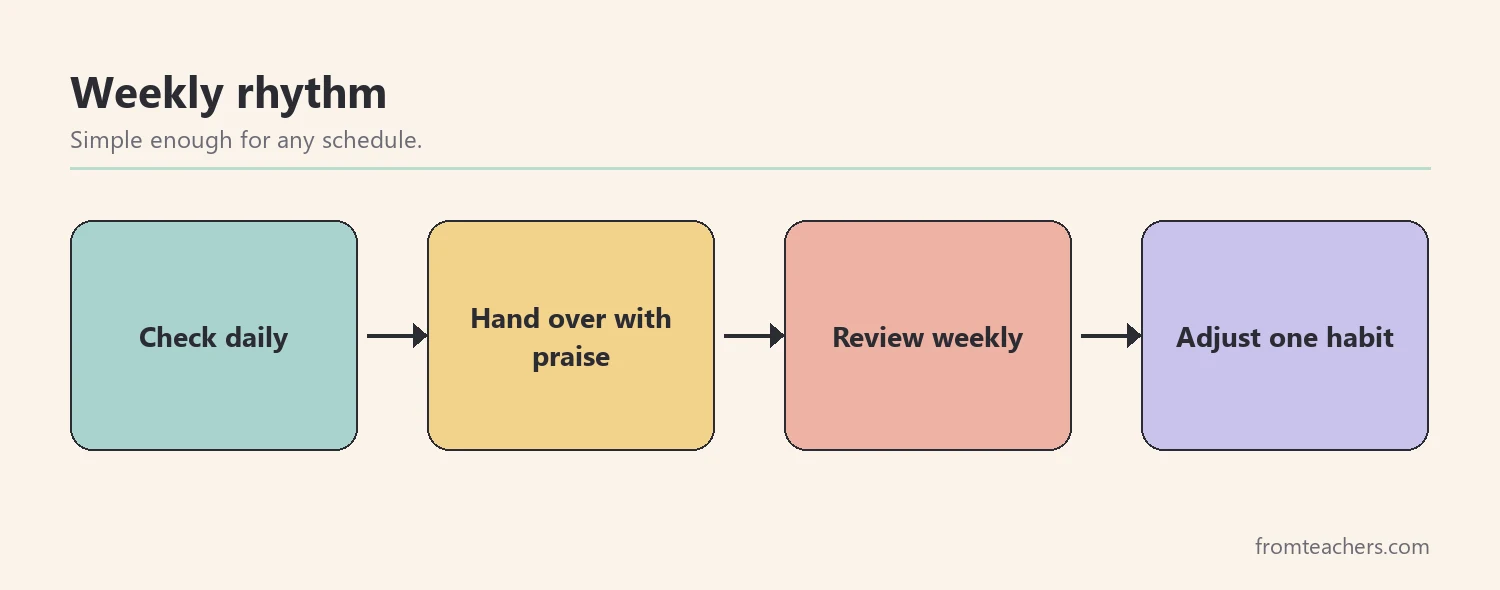
Most families settle into a rhythm that looks like Figure 5. The chart is checked daily, handed over with a positive word, reviewed weekly and adjusted slowly.
Common mistakes and how to avoid them
- Different charts in each home. Fix: use one design and print two copies.
- Too many habits. Fix: start with three to five shared habits.
- Competing rewards. Fix: agree on small, free rewards that work anywhere.
- Using the chart to criticize the other parent. Fix: talk adult to adult, not through the child.
- Taking away earned checks. Fix: keep earned checks; simply try again the next day.
Questions parents ask about a behavior chart for two homes
What if the other parent does not want to use the chart?
You can still use it in your home. Share it once, calmly, and leave the door open. Children can adapt to a chart in one home, even if it is not used in the other.
Should the chart travel or stay?
Either works. A traveling chart keeps one record, while two copies avoid lost paperwork. Choose what fits your schedule.
How old should my child be?
Weekly habit charts are often used with children around ages four to ten. Older children may prefer a simple checklist or planner instead.
What if my child seems upset about moving between homes?
Transitions can bring big feelings. Keep routines predictable and talk with your pediatrician or a counselor if worries continue.
Can grandparents or step-parents use the chart?
Yes. Anyone who regularly cares for your child can use the same chart, as long as they know the shared habits and rewards.
Related reading: Moving Beyond Shame and Behavior Charts, ADHD Children Support Strategies, and Meltdowns vs Tantrums: The Difference.
You may also need: Daily Reflection Journal for students and kids.
A companion resource for a behavior chart for two homes:
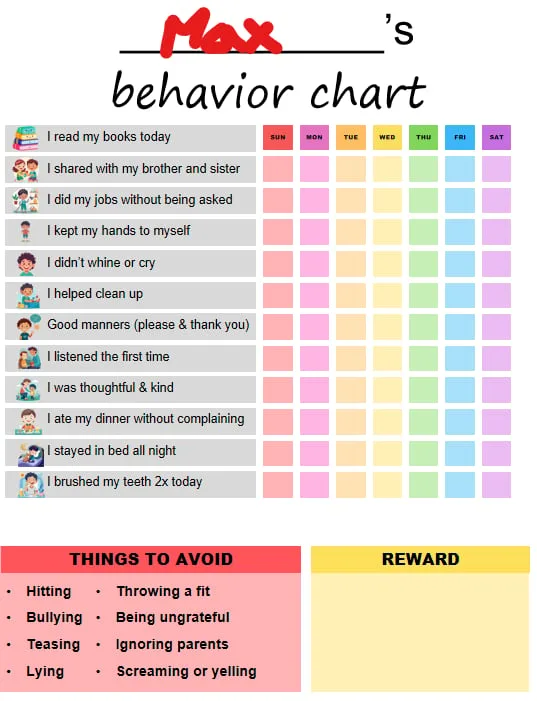
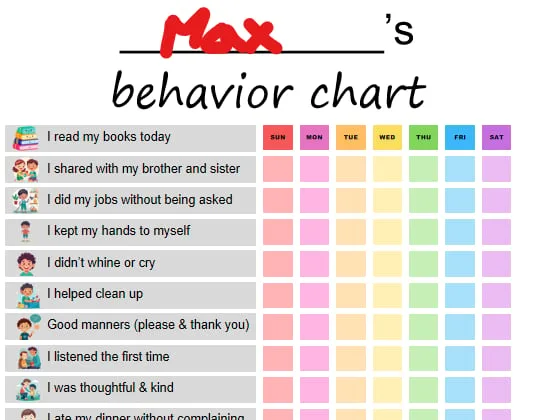
Weekly Behavior Chart for Kids Editable Printable Reward Chart for Home: a one-page editable weekly chart with space for your child’s name, eleven positive daily habits, a Sunday to Saturday grid, a Things to Avoid section and a reward box to celebrate the week.
Sources and scope
- HealthyChildren.org (American Academy of Pediatrics): parenting information, including positive discipline and family changes such as divorce.
- Center on the Developing Child, Harvard University: research summaries on child development, stress and supportive relationships.
- ZERO TO THREE: guidance for families on young children’s behavior and routines.
- Center on PBIS: resources on positive behavior support, including family resources.
This list covers everyday habit charts for children who live in two homes. It does not replace advice from a pediatrician, counselor or family mediator, and it does not address custody or legal questions.
Key takeaways
- A behavior chart for two homes gives your child one clear, familiar routine.
- Start with three to five shared habits and the same chart layout.
- Agree on small, similar rewards so neither home competes.
- Keep handoffs short and positive, and review the chart weekly.
- Change one habit at a time, and tell the other home first.










Leave a Comment