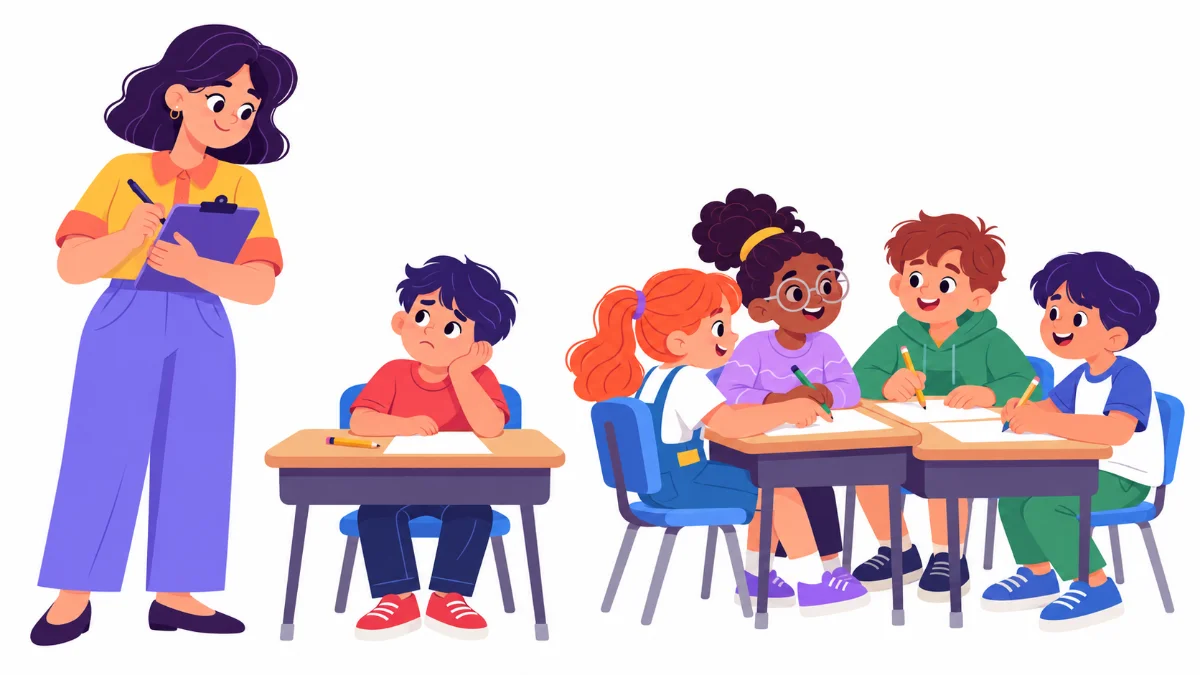

Classroom warning signs are small, repeated patterns that tell you a student may need more support than the lesson currently gives. Picture Leo, a third grader, during a reading block. He sharpens his pencil three times, asks to get water, and turns in a page with only his name on it. Nobody would call that a crisis, yet it happens most days.
This list is for general education teachers who see a student every day and wonder when a pattern is worth sharing. It covers nine classroom warning signs, how to recognize each one, and how to write down what you see so the conversation with your team starts from facts, not impressions.
Examples are fictional. Adapt to the student’s goals and agreed supports. This is guidance, not a diagnosis.
At a glance
- A warning sign is a pattern over time, not one bad day.
- Write what you see and hear, not what you think it means.
- Short, dated notes beat a long memory at a team meeting.
- Look for strengths as carefully as you look for struggles.
- Share early with the family and your support team, and let them decide next steps.
How this list is ordered
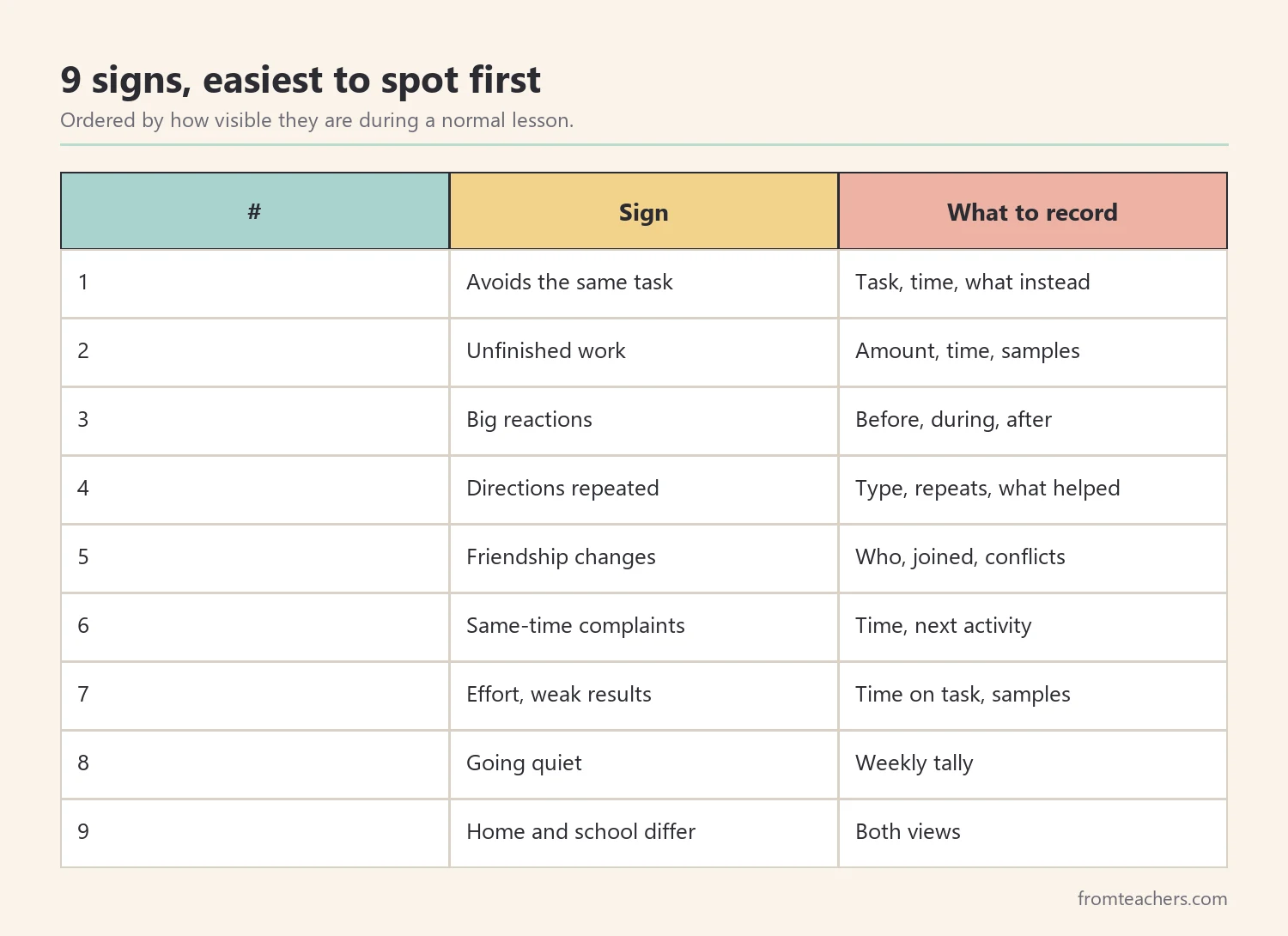
We ordered the nine classroom warning signs from easiest to spot to quietest. The first few are visible to anyone in the room. The last ones are easy to miss, because the student is not disrupting anything. We did not rank them by seriousness, because the same sign can mean very different things for different students.
Also, remember that noticing is not diagnosing. Your job is to describe what happens, when it happens and how often. The school team, the family and, when needed, an evaluation decide what it means. Figure 1 shows the full list with a quick note on what to record.
1. Avoiding the same task again and again
First, watch for repeated avoidance of one type of work. Leo leaves his seat during reading but not during math. That pattern is more useful than “Leo is off task.”
What to record: the task, the time of day and what the student did instead. For example, “Independent reading, 10:15, asked for water twice, started after 6 minutes.”
Why it matters: avoidance tied to one subject can point to a skill gap, while avoidance across the day may point to fatigue, worry or something at home.
2. Work that stays unfinished
Next, look at output. A student who starts but rarely finishes may be struggling with the skill, the amount, the time or the directions. Unfinished work is one of the easiest classroom warning signs to collect, because the evidence is already in your hands.
What to record: how much was finished, how long the student had, and whether help changed the result. Keep two or three work samples with dates.
3. Big reactions to small changes
Then notice reactions to transitions, surprises or corrections. Tears when the schedule changes, a shut-down after a red mark, or a strong reaction to noise are classroom warning signs worth writing down, especially when they repeat.
What to record: what happened just before, what the student did and how long it lasted. This simple before, during and after note is often what the team asks for first.
4. Needing directions repeated
Many students ask “What do we do?” now and then. However, a student who needs directions repeated several times a day, every day, is showing you something. It could be attention, listening, language or memory, and you do not need to know which one to record it.
What to record: the type of direction (spoken, written, multi-step), whether a visual or a model helped, and how many repeats were needed.
Example: Leo followed one-step spoken directions well but missed most two-step directions unless the teacher wrote them on the board. That detail is gold for a team meeting.
5. Changes in friendships and play
Next, look at recess, lunch and group work. A student who used to join games and now stays alone, or who has frequent conflicts with peers, may need support with social skills, confidence or something outside school.
What to record: who the student played or worked with, whether they joined or were invited, and any conflicts. Recording these classroom warning signs over two weeks often shows whether the change is real or a one-time event.
6. Physical complaints at the same time each day
Some students say their stomach hurts or they feel tired at the same point every day. Notice the timing, not just the complaint. A pattern before the same lesson is worth sharing with the family and the school nurse.
What to record: the time, the activity that was about to start and what helped. Do not guess at causes; health questions belong to the family and qualified professionals.
To keep these notes quick and consistent, many teachers use ready-made forms. The 12 daily classroom observation forms for special education include sections for engagement, attention, emotional regulation, peer interaction and communication, each with check boxes and a notes column.
7. Strong effort, weak results
This is one of the quieter classroom warning signs. Some students work hard, stay on task and still do not make progress. Because they do not disrupt anything, they can go unnoticed for a long time.
What to record: time on task, the strategies the student uses, and work samples over several weeks. A short table can show the gap clearly.
| Week | Effort seen | Spelling score |
|---|---|---|
| Week 1 | Worked whole time | 3 of 10 |
| Week 2 | Worked whole time | 4 of 10 |
| Week 3 | Asked for help twice | 3 of 10 |
8. Going quiet
Similarly, a student who stops raising a hand, stops asking questions or avoids eye contact may be struggling with confidence, worry or the content. Quiet students rarely appear on behavior reports, so their classroom warning signs need a deliberate look.
What to record: how often the student speaks in class, answers when called on, or asks for help. A simple tally for one week is enough to start.
9. A gap between home and school stories
Finally, listen for mismatches. A parent says “He loves school and reads every night,” while you see a child who avoids reading. Or the reverse. These gaps are not anyone’s fault, but they deserve a calm conversation.
What to record: what you see at school, in neutral words. Then ask the family what they see at home. Both views together give the team a fuller picture.
Turning classroom warning signs into useful notes
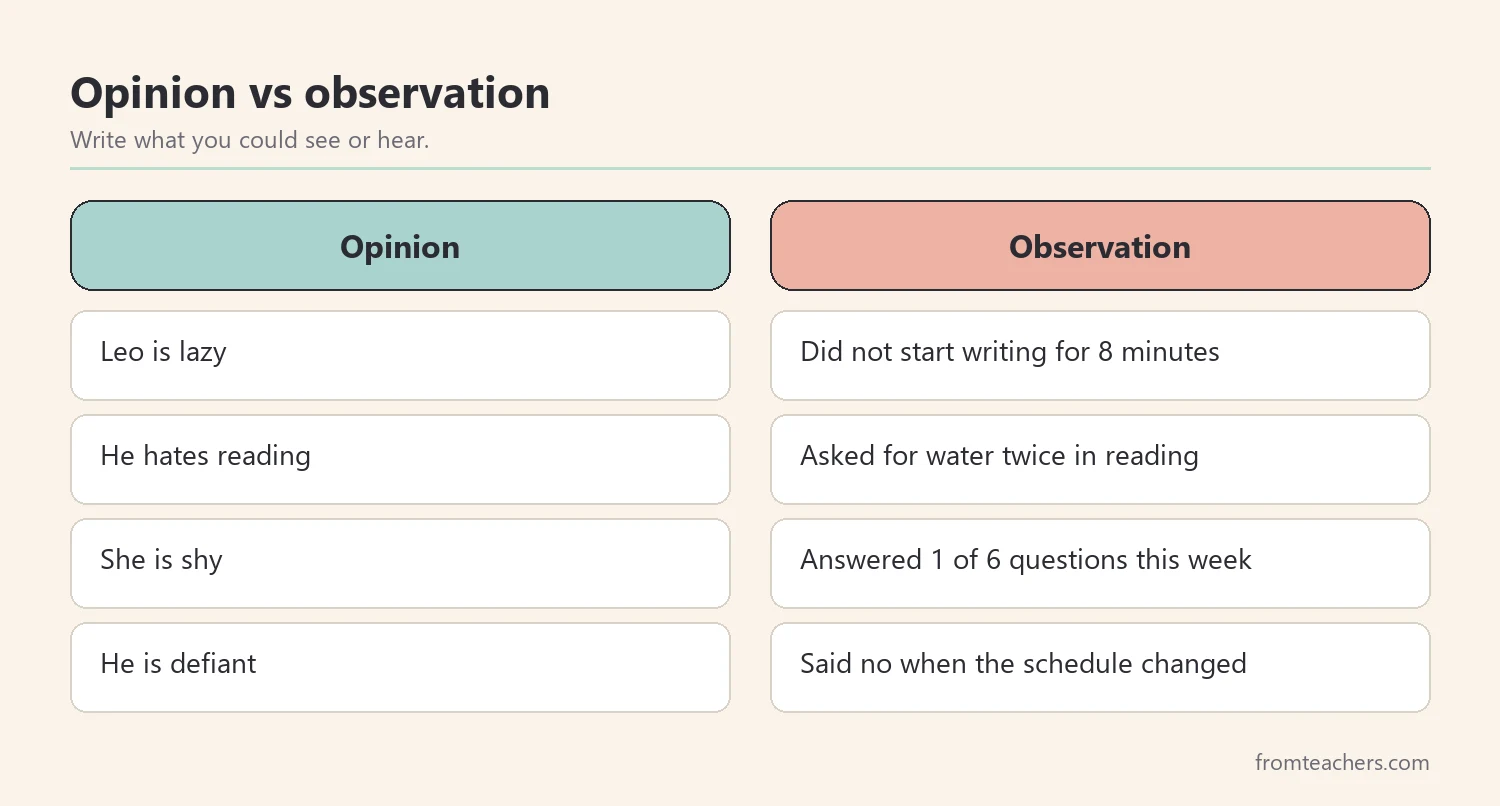
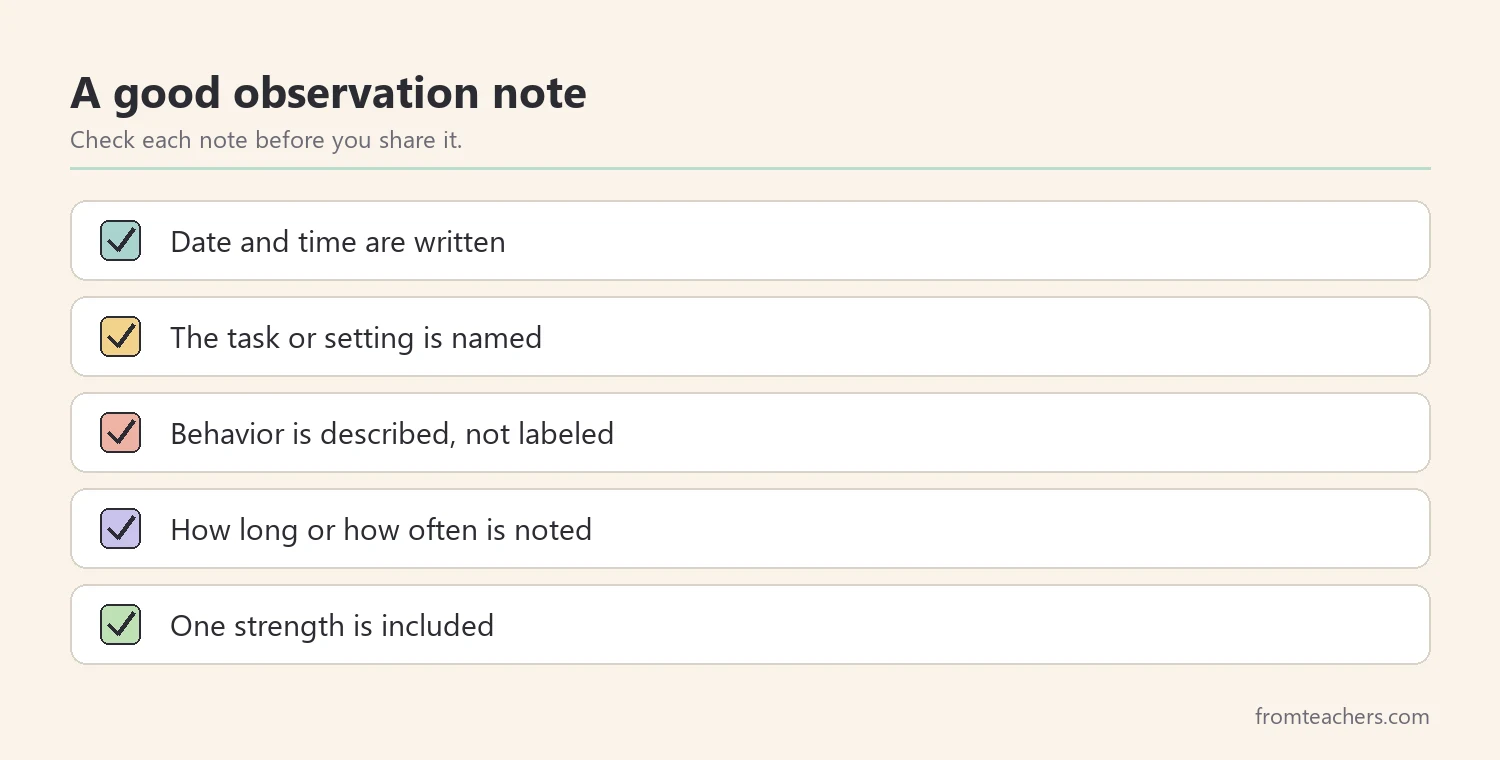
Notes are only helpful when the team can read and trust them. Therefore, describe behavior you could see or hear, add the date and time, and avoid labels. “Did not start the writing task for 8 minutes” is useful. “Lazy” or “defiant” is not.
In addition, keep notes short and regular. Two minutes at the end of a lesson is enough. Over three or four weeks, short notes show patterns that a single long observation can miss. For example, Leo’s teacher, Ms. Carter, noticed that his avoidance was almost always during independent reading and almost never during partner reading.
Next, write down strengths too. Leo was a careful helper during science and explained ideas well out loud. Strengths help the team plan supports that build on what already works.
Then share. Bring your notes to the family and to your school’s support team, whether that is MTSS, a student support team or the special education teacher. The team decides whether to try classroom strategies first, collect more data or discuss an evaluation.
What to do after you notice classroom warning signs
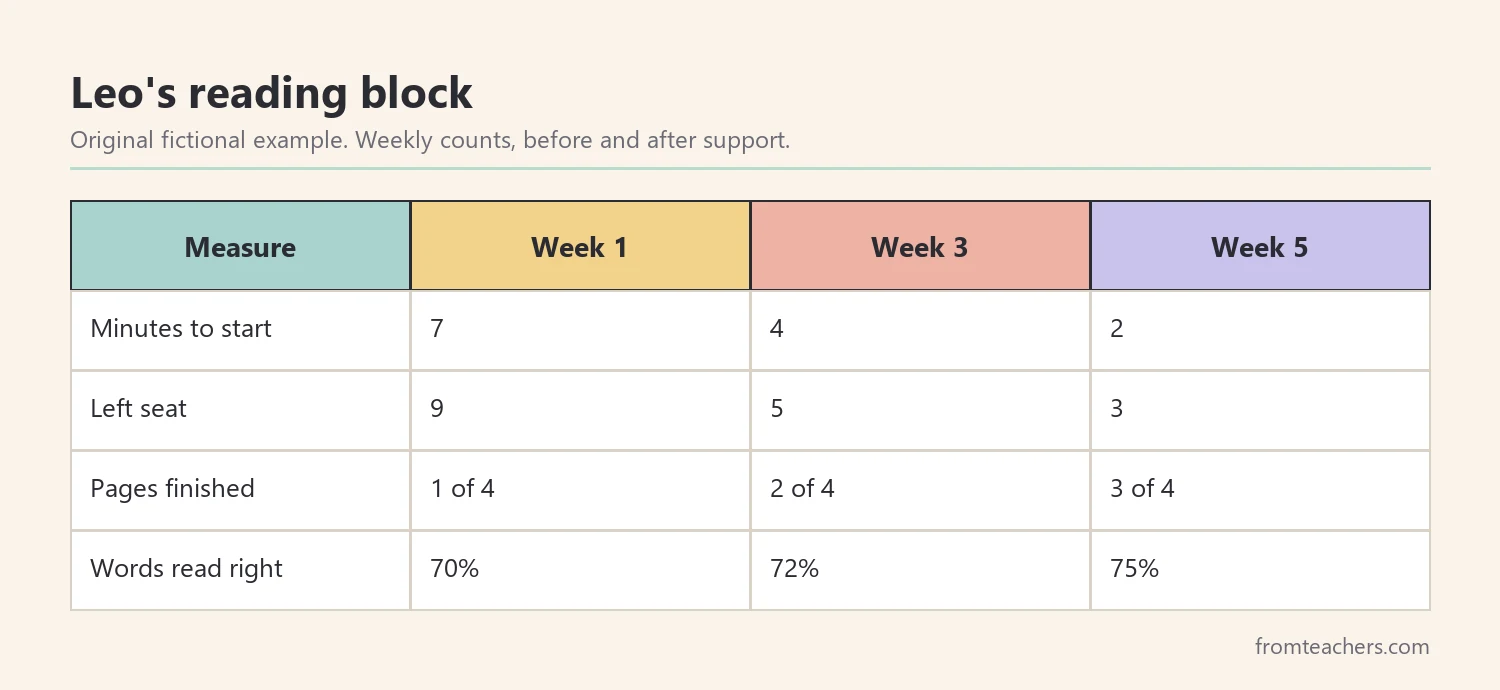
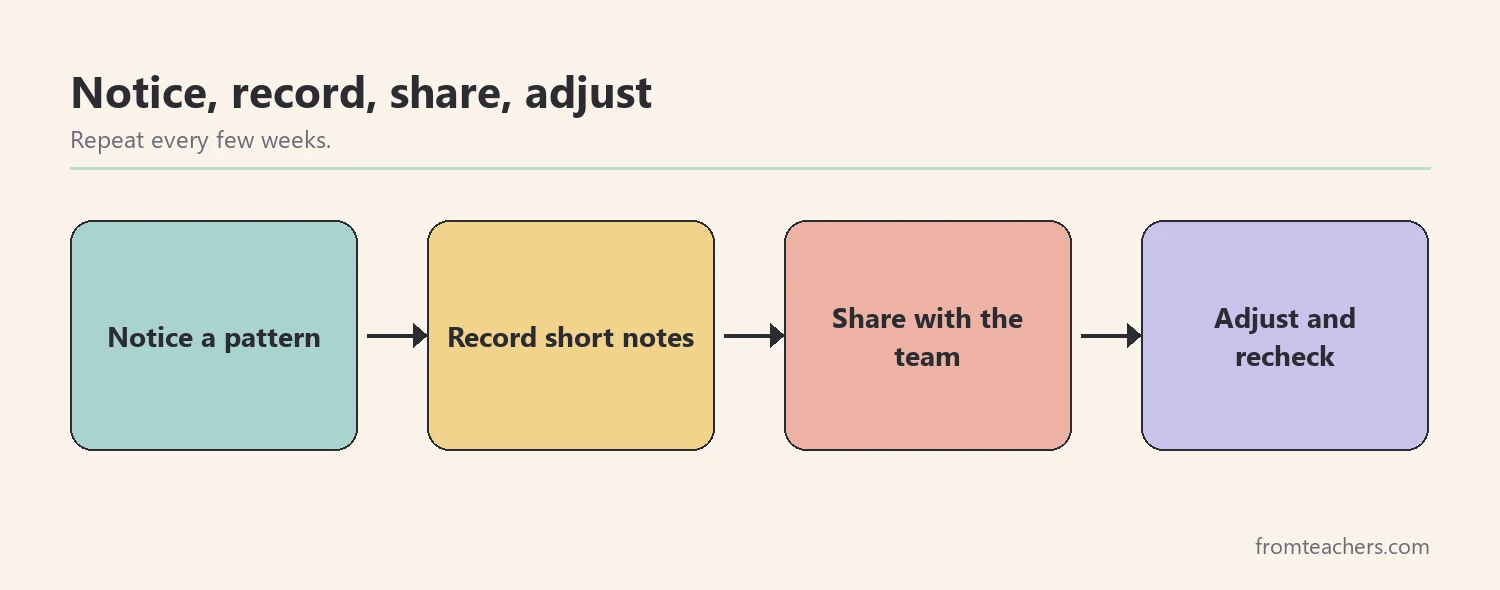
First, try one simple support and record what happens. For Leo, Ms. Carter wrote two-step directions on the board and let him read with a partner twice a week. She kept recording for three weeks.
Next, compare the before and after. Figure 3 shows how Leo’s starts improved, while his reading accuracy still needed attention. That mix is common, and it gave the team a clear question to work on.
Also, talk with the family early. Parents often have context that changes the picture, such as a new sibling, poor sleep or a previous evaluation. Share facts, ask questions and agree on how you will keep in touch.
Finally, keep a simple cycle going. Notice, record, share and adjust. Figure 5 shows the four steps.
How classroom warning signs change with age
Classroom warning signs do not look the same in every grade. In kindergarten and first grade, they often show up as trouble with routines, separation or early letter and number skills. Young children also show stress through their bodies, so watch for tears, clinging or frequent trips to the bathroom.
In upper elementary, the workload grows. As a result, gaps in reading, writing or organization become easier to see, and students start to notice them too. Some cover the gap with jokes, others with silence.
In middle school, classroom warning signs can hide behind missing assignments, a drop in grades or a sudden change in friends. Because students switch teachers, a quick check with colleagues often shows whether the pattern appears in every class or only in one.
Common mistakes and how to avoid them
- Waiting for a big incident. Fix: start recording when a small pattern repeats.
- Writing opinions instead of observations. Fix: describe what you saw and heard.
- Recording only problems. Fix: add one strength to every week of notes.
- Watching only the loud students. Fix: plan a weekly look at quiet students too.
- Keeping notes to yourself. Fix: share with the family and your support team.
Questions teachers ask about classroom warning signs
How long should I watch before sharing?
Two to four weeks of short notes is often enough to show a pattern. However, share right away if you have any safety concern, following your school’s procedures.
Can I say a student might have ADHD or dyslexia?
It is better not to. Describe what you see and let qualified professionals decide what it means. Families may hear a label as a diagnosis.
What if the family disagrees with what I see?
Listen and ask what they notice at home. Different settings bring out different behavior, and both views are useful to the team.
Do I need a special form?
No, but a consistent format helps. A simple check-box form with a notes column keeps classroom warning signs easy to compare from week to week.
What if the signs go away?
That is good news. Keep your notes, because a pattern that returns later is easier to understand with earlier records.
Related reading: The Power of Data Tracking in Special Education, How Parents and Teachers Can Team Up for Special Education Success, and Special Education: A Complete Guide for Parents and Educators.
You may also need: Strategy Planner for Diverse Learners Strengths-Based Observation Form.
A companion resource for classroom warning signs:
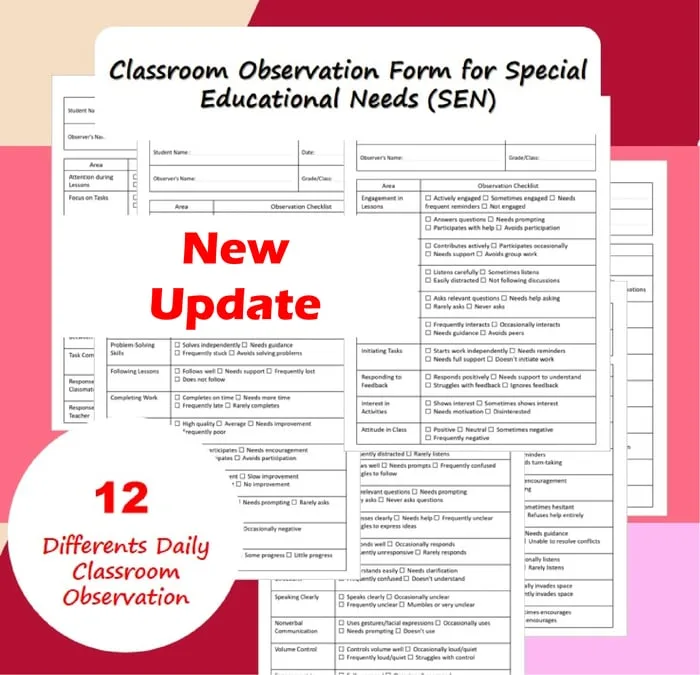
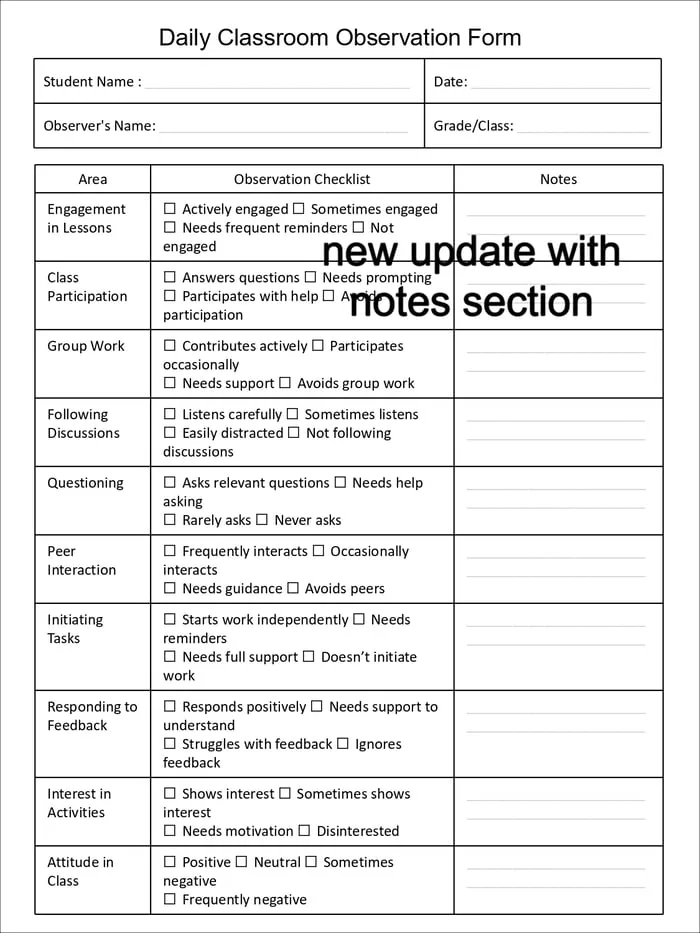
Classroom Observation Form for Special Education (SEN): 12 Daily Checklists: twelve check-box observation forms, in print-ready PDF and editable PowerPoint, covering engagement, attention, regulation, social interaction, independence, communication, academics, motor skills, executive functioning and more, each with a notes column.
Sources and scope
- IRIS Center at Vanderbilt University: free modules on progress monitoring, behavior and instructional supports.
- Center for Parent Information and Resources: plain-language guidance on evaluation, IEPs and school teams.
- Understood: articles for teachers and families on learning and thinking differences.
- Center on PBIS: resources on positive behavior support and data-based decisions in schools.
This list helps general education teachers notice, record and share patterns. It does not diagnose any condition, and it does not replace your school’s referral, MTSS or evaluation process.
Key takeaways
- Classroom warning signs are repeated patterns, not single bad days.
- Record facts with dates: the task, the time, what the student did.
- Watch quiet students as carefully as loud ones.
- Note strengths alongside struggles.
- Share early with the family and your team, and let the team decide next steps.




Leave a Comment