

Accommodation check-in questions give high school teachers a simple way to say whether a support is really helping, instead of answering “fine” when the case manager stops by. Picture Maya, a tenth grader with a 504 plan for ADHD. Her plan lists extended time on tests, preferential seating and chunked assignments. Her chemistry teacher, Mr. Ortiz, teaches 150 students a day and honestly is not sure which of those supports Maya uses.
This list is for high school subject teachers: science, math, English, history and electives. It gives nine questions you can answer at the end of each grading period, ordered from the quickest to answer to the ones that need a few weeks of notes. For each question, you will see why it matters, what a useful answer looks like and how Mr. Ortiz answered it for Maya.
Examples are fictional. Adapt to the student’s goals and agreed supports. This is guidance, not a diagnosis.
At a glance
- A short, regular check-in beats one long conversation at the annual review.
- Start with facts you already know: was the support offered and was it used?
- Describe what you saw, not how you feel about the student.
- Note barriers honestly, including your own time and class size.
- Write answers down so the case manager can compare across classes.
How this list is ordered
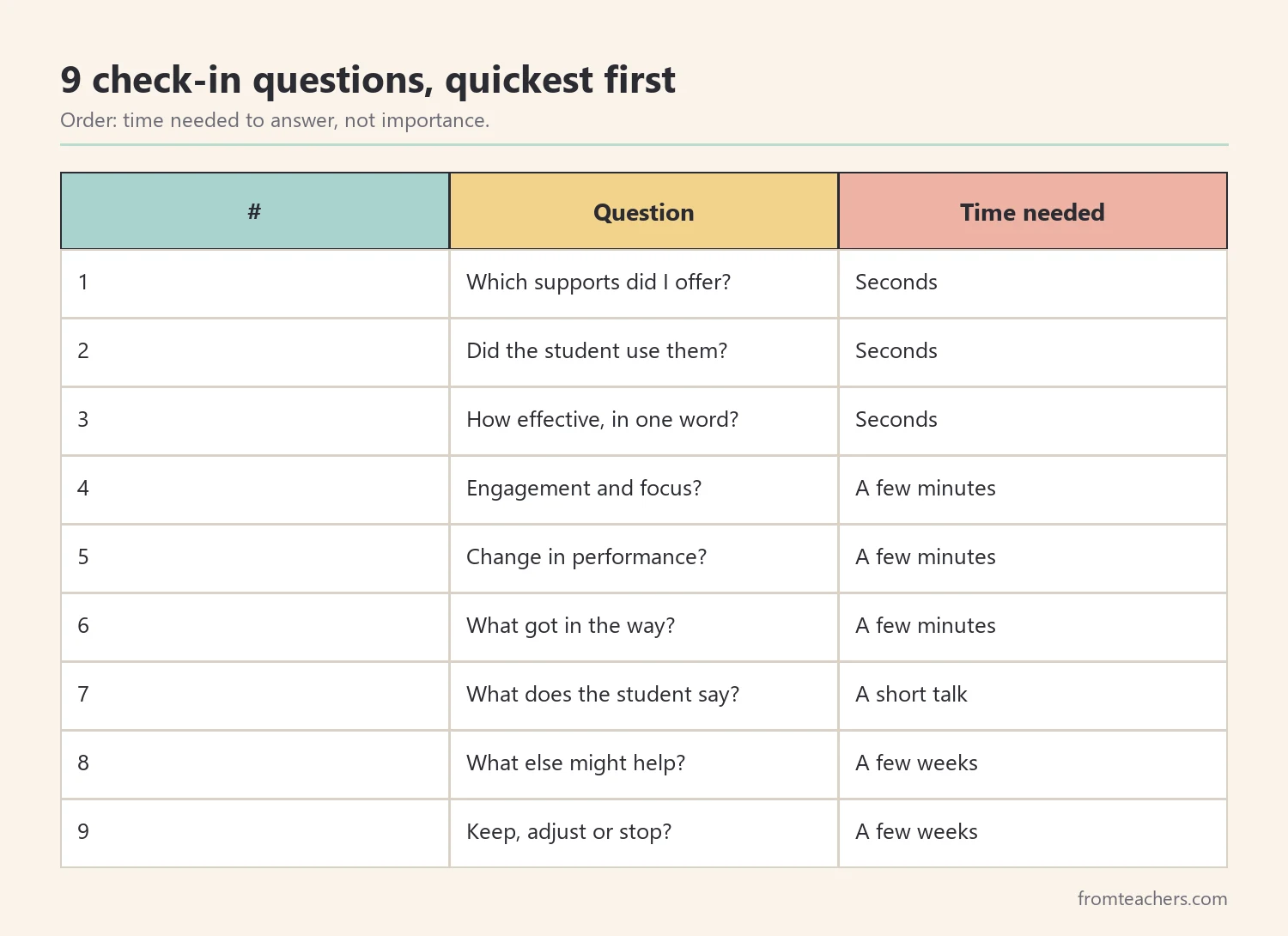
We ordered the nine accommodation check-in questions by how quickly a busy teacher can answer them. The first three take seconds, because you already know the answer. The middle three need a short look at grades, work samples or seating notes. Then, the last three need a few weeks of observation or a conversation with the student.
In other words, the list is not ranked by importance. Every question matters. However, starting with the easy ones means you will actually finish the check-in, even in a week full of labs and grading. Figure 1 shows the full list at a glance.
1. Which accommodations did I actually offer?
First, list what you provided, not what the plan says. Plans often include five or six supports, but a subject teacher may only use two or three in practice. This question is the foundation of every other answer.
Why it matters: the IEP or 504 team cannot judge a support that was never delivered. A gap here is not a failure. Instead, it is useful information.
A useful answer: “Extended time on two unit tests. Chunked lab reports twice. Preferential seating every day.”
Example: Mr. Ortiz realized he had never offered chunked assignments in chemistry, because his lab reports were already split into sections. He wrote that down instead of guessing.
2. Did the student use the accommodation?
Next, separate offering from using. Many teenagers decline supports in front of peers, especially extended time or a separate setting. Therefore, an offered accommodation may still go unused.
Why it matters: if a student never uses a support, the team needs to know why. Sometimes the support is not needed. Other times, the student feels embarrassed or the logistics are hard.
A useful answer: “Offered extended time on both tests. Used it once, declined once.”
Example: Maya used extended time on the first test but stayed with the class on the second. Mr. Ortiz noted both, without judging either choice.
3. How effective was it, in one word?
Then give a quick rating. A simple scale keeps accommodation check-in questions fast and comparable across teachers: very effective, somewhat effective, not effective, or did not use.
Why it matters: when six teachers use the same four ratings, the case manager can spot patterns in minutes. Free-text comments alone are much harder to compare.
A useful answer: “Preferential seating: very effective. Extended time: somewhat effective.”
Example: Mr. Ortiz rated seating near the front as very effective, because Maya started lab tasks faster there than in her old seat by the window.
4. What did I notice about engagement and focus?
This is where the middle group of accommodation check-in questions begins. Look back at a few class periods and describe behavior you can see: starting work, staying on task, asking questions, finishing.
Why it matters: engagement often changes before grades do. As a result, it is an early sign that a support is helping or not.
A useful answer: “Starts warm-ups within two minutes most days. Loses focus during long lectures after about fifteen minutes.”
Example: Mr. Ortiz noticed Maya was most focused during hands-on labs and least focused during note-taking. That detail later helped the team suggest guided notes.
5. Did it change academic performance?
Next, check grades and work samples. Compare assignments with and without the support when you can. Keep the comparison simple and honest.
Why it matters: an accommodation should remove a barrier so the student can show what they know. If scores rise only when the support is used, that is strong practical evidence.
A useful answer: “Test 1 with extended time: 81 percent. Test 2 without: 64 percent, with the last page blank.”
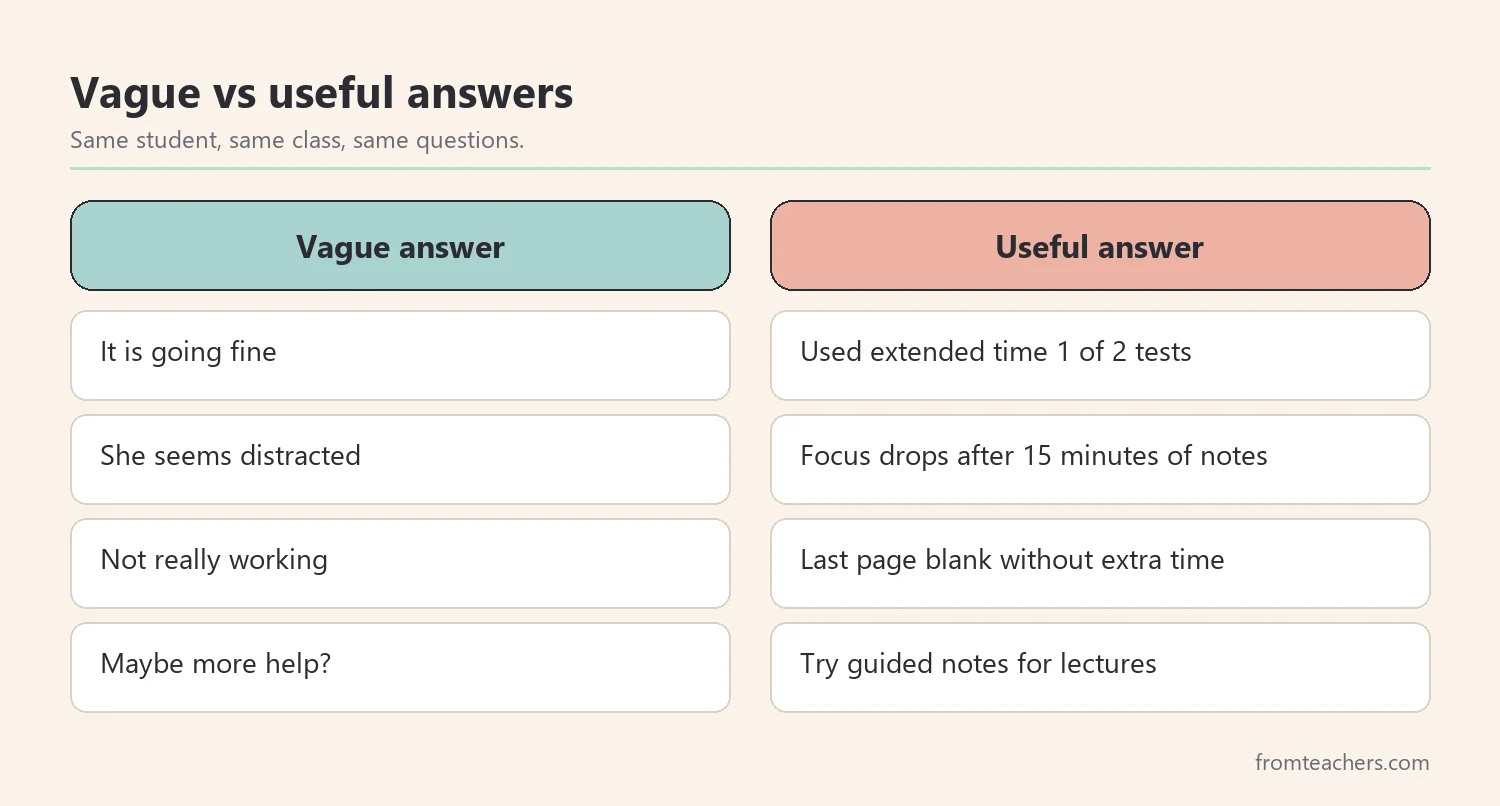
Example: Maya’s blank last page told the story clearly. Mr. Ortiz attached both tests to his notes, and the team discussed why she had declined the extra time. Figure 2 shows how vague and useful answers compare.
6. What got in the way?
Every support has practical barriers. For example, extended time may mean missing the next class, a separate room may need a free adult, and chunked assignments take planning time.
Why it matters: barriers explain many “not effective” ratings. Naming them lets the team fix the logistics instead of dropping a support that could work.
A useful answer: “Extended time means she misses the start of lunch. She said she did not want to eat late.”
Example: When Mr. Ortiz asked, Maya explained the lunch problem in one sentence. The case manager arranged for her to finish tests in the resource room during the next period instead.
7. What does the student say about it?
Now include the student’s voice. Teenagers often know exactly which supports help, and asking them builds self-advocacy. Keep it private and short.
Why it matters: student input makes the IEP or 504 plan more realistic. Also, older students are expected to take a growing role in their own planning.
A useful question to ask: “Which of these supports helps you most in this class, and which one do you skip?”
Example: Maya said seating helped most and that she would use extended time if it did not cost her lunch. Mr. Ortiz wrote down her exact words.
8. What else might help?
This is one of the most valuable accommodation check-in questions, because subject teachers see things the case manager does not. Suggest supports based on what you observed, and keep the suggestion specific to your class.
Why it matters: new ideas often come from the classroom. However, only the team can add or change supports in the plan, so frame it as a suggestion.
A useful answer: “Guided notes for lectures might help, since focus drops after fifteen minutes of notes.”
Example: Mr. Ortiz suggested guided notes. The team discussed it at the next review and added a trial period.
9. Should we keep, adjust or stop it?
Finally, give your recommendation for each support. This last question pulls everything together and makes the check-in easy to act on.
Why it matters: a clear recommendation saves meeting time. The case manager can see at a glance where teachers agree and where they differ.
A useful answer: “Keep seating. Adjust extended time so it does not overlap lunch. Consider guided notes.”
Example: Mr. Ortiz wrote three short lines. Because the history and English teachers had similar notes, the team made changes quickly. To keep these answers in one place, many teachers use a ready-made classroom accommodation feedback form with ratings, engagement notes, challenges and suggestions on one page.
What one grading period of check-ins can show
A single check-in is a snapshot. In contrast, answers collected across several weeks show a trend. Figure 3 shows how Mr. Ortiz’s notes on Maya changed over one grading period. The data is fictional, but the pattern is common: a support that looks weak at first may simply need a logistics fix.
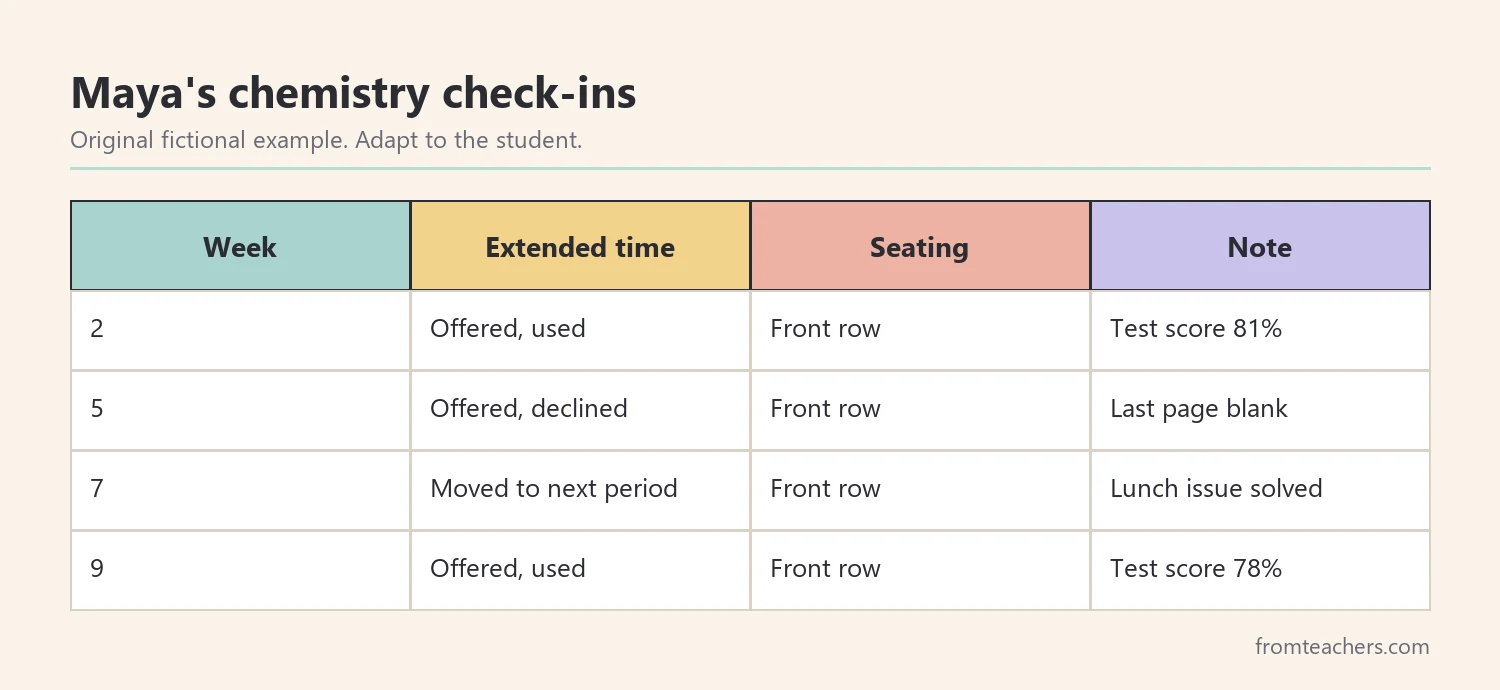
Notice that nothing in the table is an opinion about Maya as a person. Each cell describes what was offered, what happened and what changed. That is what makes notes useful in a meeting.
How to fit check-ins into a busy week
High school teachers have little spare time, so keep the routine light. Many teachers find these habits help:
- Pick a fixed moment. For example, the last Friday of each grading period, during a planning block.
- Keep one page per student. A single sheet is easier to finish than an email thread.
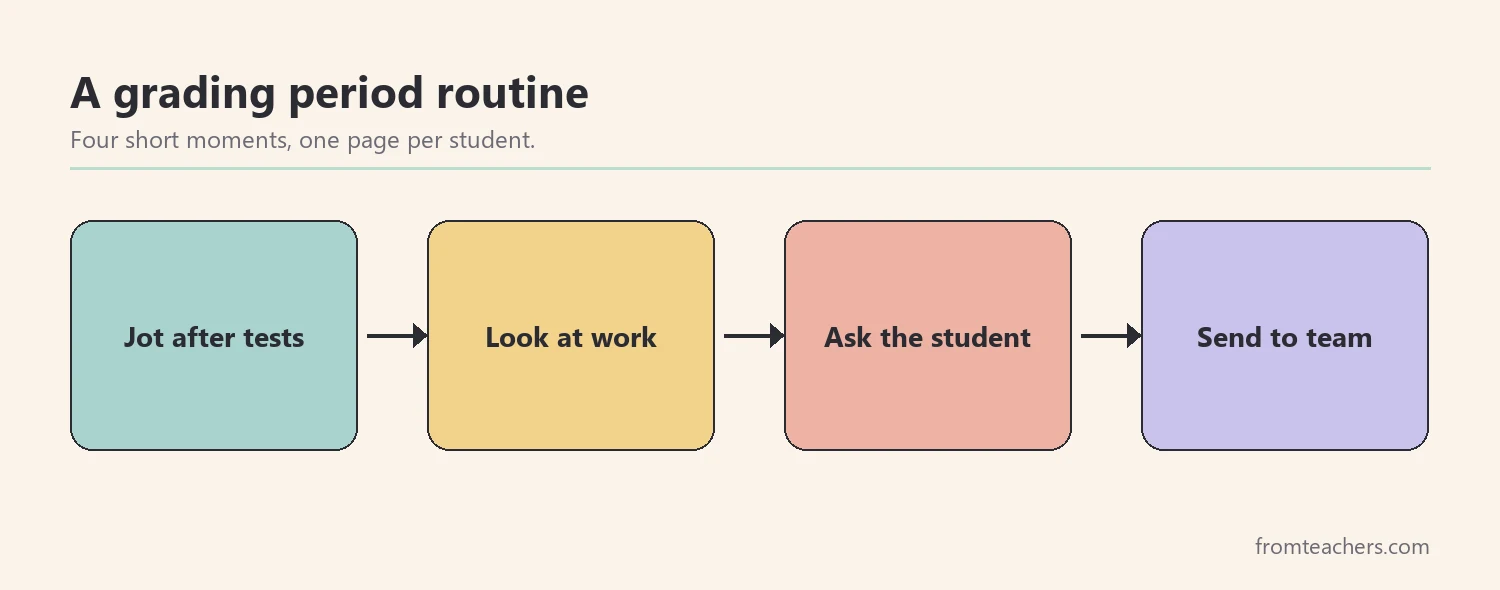
- Write while it is fresh. Jot one line after a test or lab, then finish the form later.
- Share by a deadline. Agree with the case manager when forms are due before each review.
Also, use the same accommodation check-in questions for every student. Consistency makes your notes faster to write and easier for the team to read. Figure 4 shows a simple four-part routine.
| When | Questions to answer | Time needed |
|---|---|---|
| Right after a test | 1, 2, 3 | About 1 minute |
| Mid grading period | 4, 5, 6 | About 5 minutes |
| End of grading period | 7, 8, 9 | About 10 minutes |
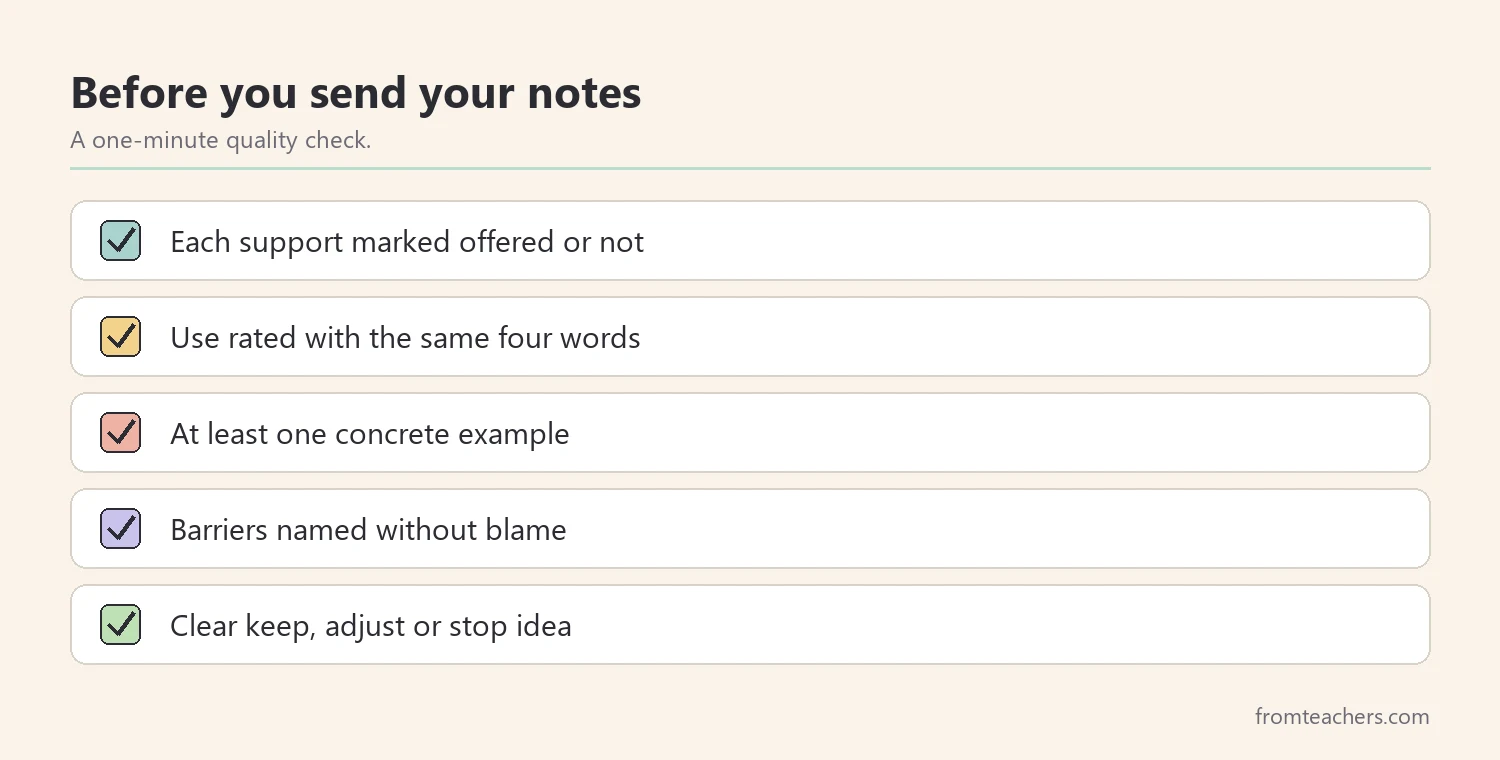
Before sending, run through the five quick checks in Figure 5.
Common mistakes and how to avoid them
- Answering “fine.” Fix: give one fact, such as how often the support was used.
- Rating supports you never offered. Fix: mark them “did not use” and explain why.
- Writing about personality. Fix: describe actions you saw, like “started the lab within two minutes.”
- Skipping the student’s view. Fix: ask one private question each grading period.
- Changing supports on your own. Fix: suggest changes to the team, since the plan is a team decision.
- Waiting for the annual review. Fix: share short notes every grading period.
Questions teachers ask about accommodation check-in questions
How often should I answer accommodation check-in questions?
Many schools ask for feedback once per grading period, and more often for a new plan. Agree on a schedule with the case manager so feedback arrives before meetings.
What if I have 30 students with plans?
Start with the quick questions for everyone and the full set for students who are struggling. A one-page form keeps each student to a few minutes.
Can I stop an accommodation that is not working?
No, not on your own. Accommodations in an IEP or 504 plan must be provided as written. Share your concerns, and the team can review and change the plan.
Should the student see my answers?
That depends on your school’s practice and the team’s approach. Many teams involve older students in reviewing their supports, which builds self-advocacy.
Do parents receive these notes?
Teacher feedback is often shared at IEP or 504 meetings. Write every note as if a parent will read it: factual, respectful and specific.
Related reading: Accommodations vs Modifications in Special Education, Special Education Accommodation and Modification Tracker, and How Teachers Communicate With Parents in Special Education.
You may also need: Accommodations and Modifications Tracker, editable IEP forms.
A companion resource for accommodation check-in questions:
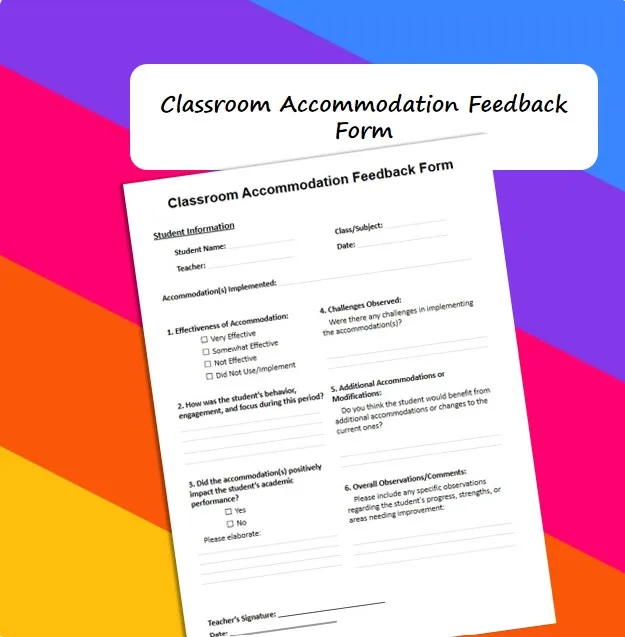
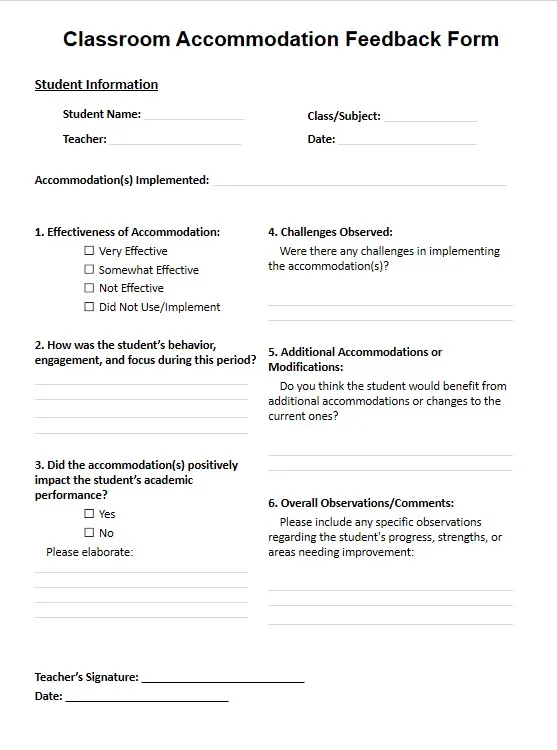
Classroom Accommodation Feedback Form IEP 504 Effectiveness Tracker: a one-page feedback form with fields for the student, teacher, date and class, the accommodations implemented, an effectiveness rating from very effective to did not use, questions on engagement and academic impact, challenges observed, suggested additional supports, comments and a signature line.
Sources and scope
- Center for Parent Information and Resources: plain-language information on IEPs, Section 504 and working with school teams.
- CAST: the organization behind Universal Design for Learning, with guidance on reducing barriers in instruction.
- IRIS Center: free modules on accommodations and on supporting students with disabilities in general education.
- Understood.org: articles for educators and families on accommodations and learning differences.
This list covers informal check-ins that high school subject teachers can use to report how accommodations are going. It does not replace the IEP or 504 team process, legal advice or a formal evaluation.
Key takeaways
- Accommodation check-in questions turn “it’s fine” into useful, comparable feedback.
- Start with what was offered and used, then rate effectiveness.
- Describe engagement, performance and barriers with concrete facts.
- Include the student’s own view, especially in high school.
- Recommend keep, adjust or stop, and let the team decide.










Leave a Comment