

Self-advocacy mistakes are easy to make when you love your child and have fought hard for their supports. Picture Ava, thirteen, who has an IEP for reading. Her mom emails every teacher at the start of each term, checks the online gradebook nightly and calls the school when something goes wrong. Ava’s supports are in place. Yet when a substitute forgets her extended time, Ava says nothing and fails the quiz.
This list is for parents of children with IEPs or 504 plans who want their child to speak up for themselves. It names eight self-advocacy mistakes that caring parents often make, ordered from easiest to fix, with what to do instead and a short example from Ava’s family.
Examples are fictional. Adapt to your child’s age, needs and agreed supports. This is guidance, not legal advice.
At a glance
- Self-advocacy means a child understands their needs and can ask for what helps.
- Parents can step back gradually without stepping away.
- Children need words, practice and safe chances to try.
- Knowing their own accommodations is a key first step.
- Mistakes along the way are part of learning, not proof it does not work.
How this list is ordered
We ordered these eight self-advocacy mistakes by how quickly a parent can change them. The first ones are changes in words and habits at home. Later ones involve the IEP or 504 team and take longer. We did not rank them by importance, because every child and family is different.
Also, self-advocacy grows with age. A seven-year-old can learn to say “I need a break.” A sixteen-year-old can lead part of an IEP meeting. Adjust each idea to your child. Figure 1 shows the full list.
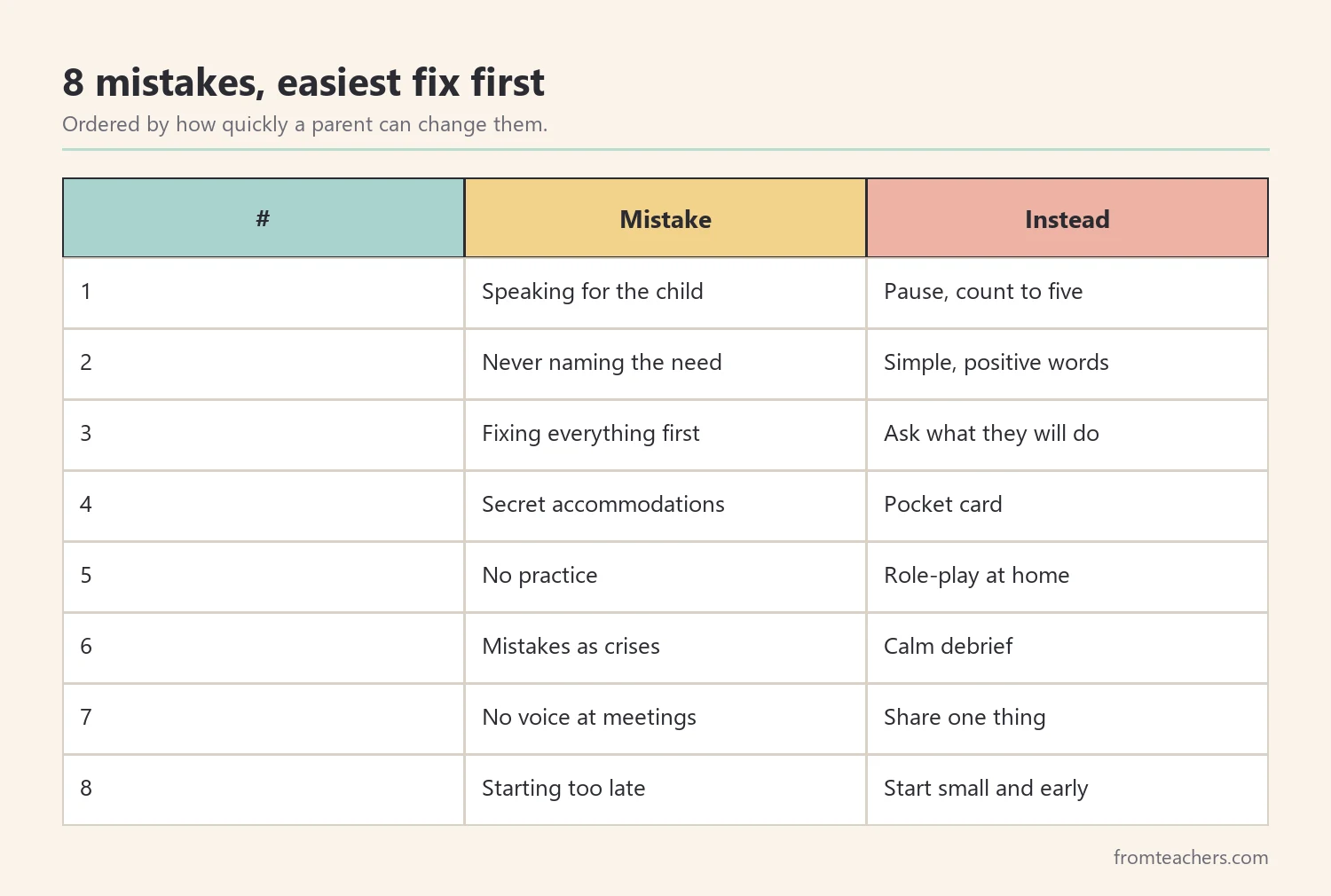
1. Speaking for your child in every conversation
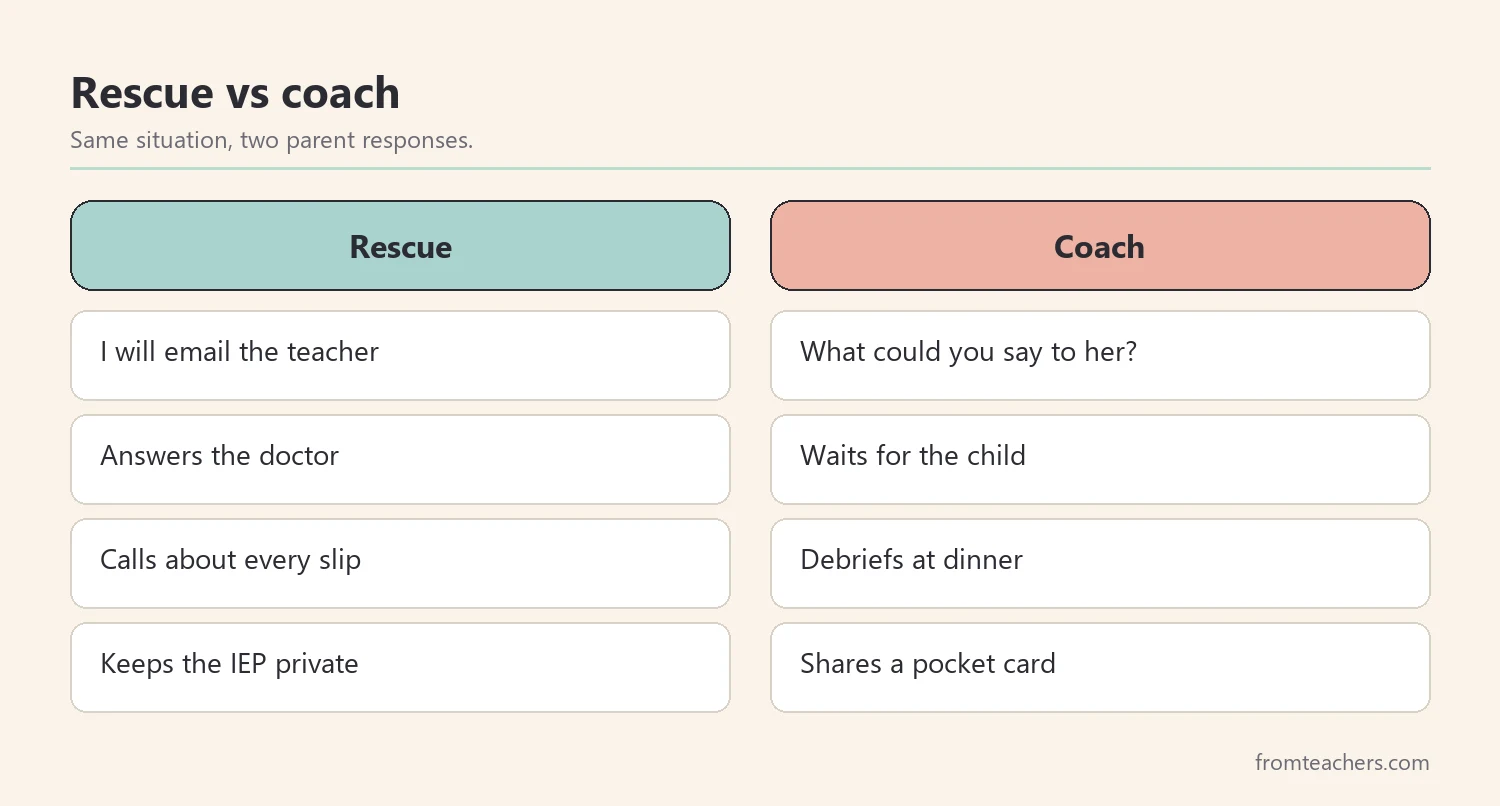
First, the most common of all self-advocacy mistakes: answering when an adult asks your child a question. It is quick and feels helpful, but it teaches the child that someone else will always speak for them.
Instead: pause and look at your child. Count to five. If they need help, offer a starter: “You could tell her about the reading part.”
Example: at a doctor’s visit, Ava’s mom waited. Ava answered two questions herself, quietly but clearly.
2. Never using the word “disability” or the name of the need
Next, many parents avoid naming the condition to protect their child. However, children cannot explain what they need if they do not understand it.
Instead: talk about strengths and challenges in simple, positive language. “Your brain learns to read in a different way, and extra time helps you show what you know.”
3. Fixing every problem before your child notices
Then watch for rescue habits. Emailing the teacher about a missing assignment before your child knows it is missing removes a chance to practice.
Instead: ask, “What do you think you should do?” and let your child try first, with you as backup.
4. Keeping the accommodations a secret
Next, many children do not know what is in their own IEP or 504 plan. Among self-advocacy mistakes, this one has a direct cost: a child cannot ask for extended time if they do not know they have it.
Instead: read the accommodations together in plain words. Make a pocket card with three or four key supports.
| Accommodation | In Ava’s words |
|---|---|
| Extended time on tests | I get extra time on tests |
| Text read aloud | I can ask for questions read aloud |
| Notes provided | I can get a copy of class notes |
| Preferential seating | I sit near the front |
5. Practicing only in the moment
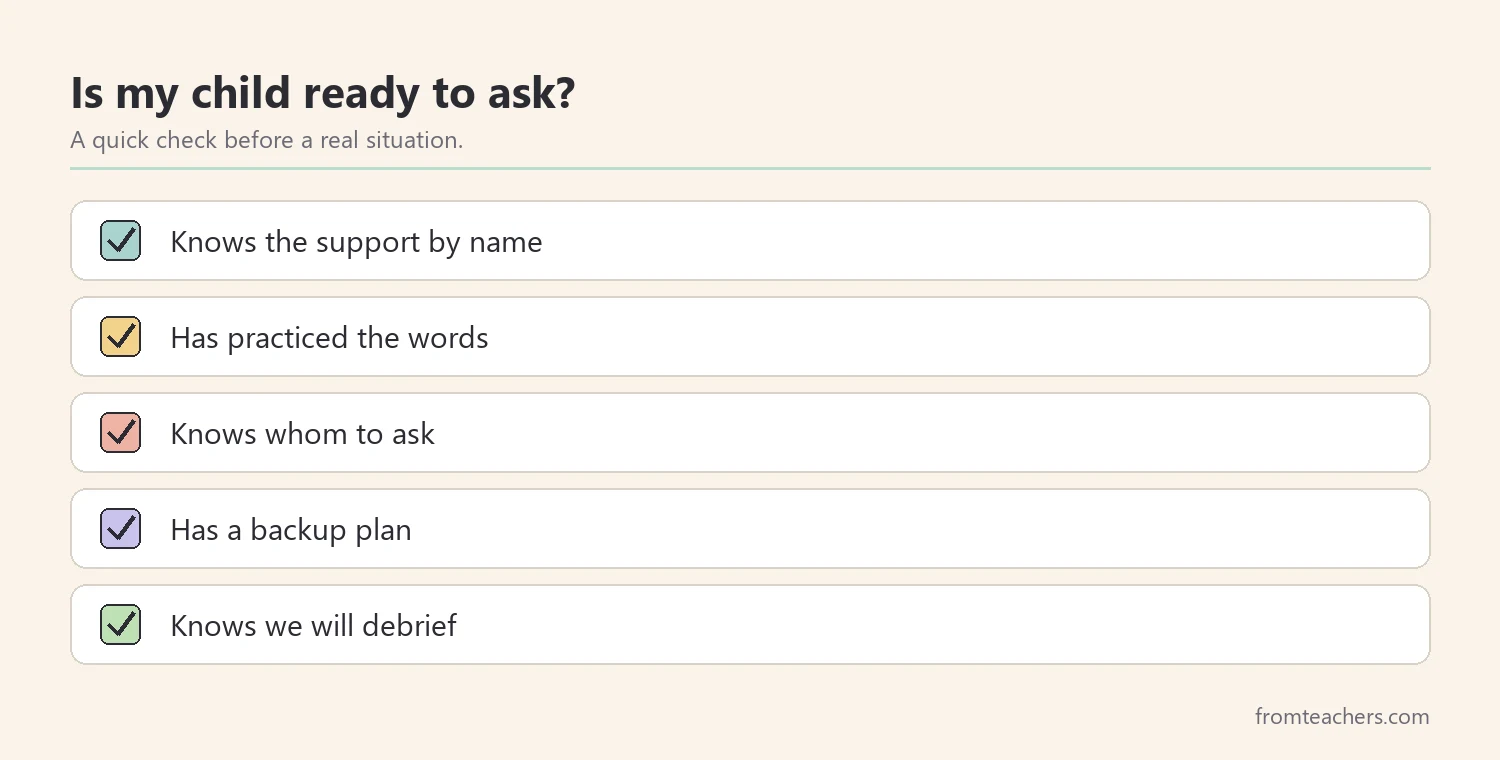
Then think about practice. Asking for help in front of a class is hard. Expecting a child to do it the first time, under pressure, sets them up to freeze.
Instead: role-play at home. Take turns being the teacher and the student. Practice short scripts like “Excuse me, I have extended time on tests.”
Example: Ava and her dad practiced the substitute situation three times at dinner. The next time it happened, she used the exact words.
6. Treating every mistake as a crisis
Next, children will forget, freeze or say the wrong thing. If every slip leads to a parent call to the school, the child learns that self-advocacy is risky.
Instead: debrief calmly. Ask, “What happened? What could you try next time?” Then let them try again.
Structured guides can help you plan these conversations. The self-advocacy skills toolkit for students with disabilities offers twenty short guides, each with an issue, a step-by-step strategy and its purpose, including asking for help without embarrassment and handling difficult conversations with teachers.
7. Leaving your child out of IEP meetings
Then look at the meeting itself. Many children never attend their IEP or 504 meeting, or attend but never speak. This is one of the self-advocacy mistakes that schools and families make together.
Instead: invite your child to share one thing: a strength, a support that helps or a goal. As they grow, they can take on more, and federal law requires that students be invited to IEP meetings when transition planning is discussed.
Example: Ava shared a short list at her spring meeting: “Read-aloud helps me in science. I want to try tests without it in English.”
8. Waiting until high school to start
Finally, the biggest of the self-advocacy mistakes is timing. Some parents plan to teach self-advocacy “when she is older.” Yet the skills take years to grow, and adulthood brings new rules: in college and at work, students usually need to ask for accommodations themselves.
Instead: start small and early. In elementary school, children can name what helps. In middle school, they can ask teachers directly. By high school, they can help write goals and lead parts of meetings.
Why parents fall into self-advocacy mistakes
Most of these self-advocacy mistakes come from love and from experience. Many parents have had to fight for services, and stepping back can feel like giving up ground. Others worry their child will be embarrassed or ignored.
These feelings are valid. However, the goal is not to stop advocating; it is to share the work over time. You remain the safety net. Your child slowly becomes the first voice.
Also, remember that stepping back is gradual. Think of it as moving from “I do, you watch” to “we do together” to “you do, I watch.”
Tracking your child’s progress
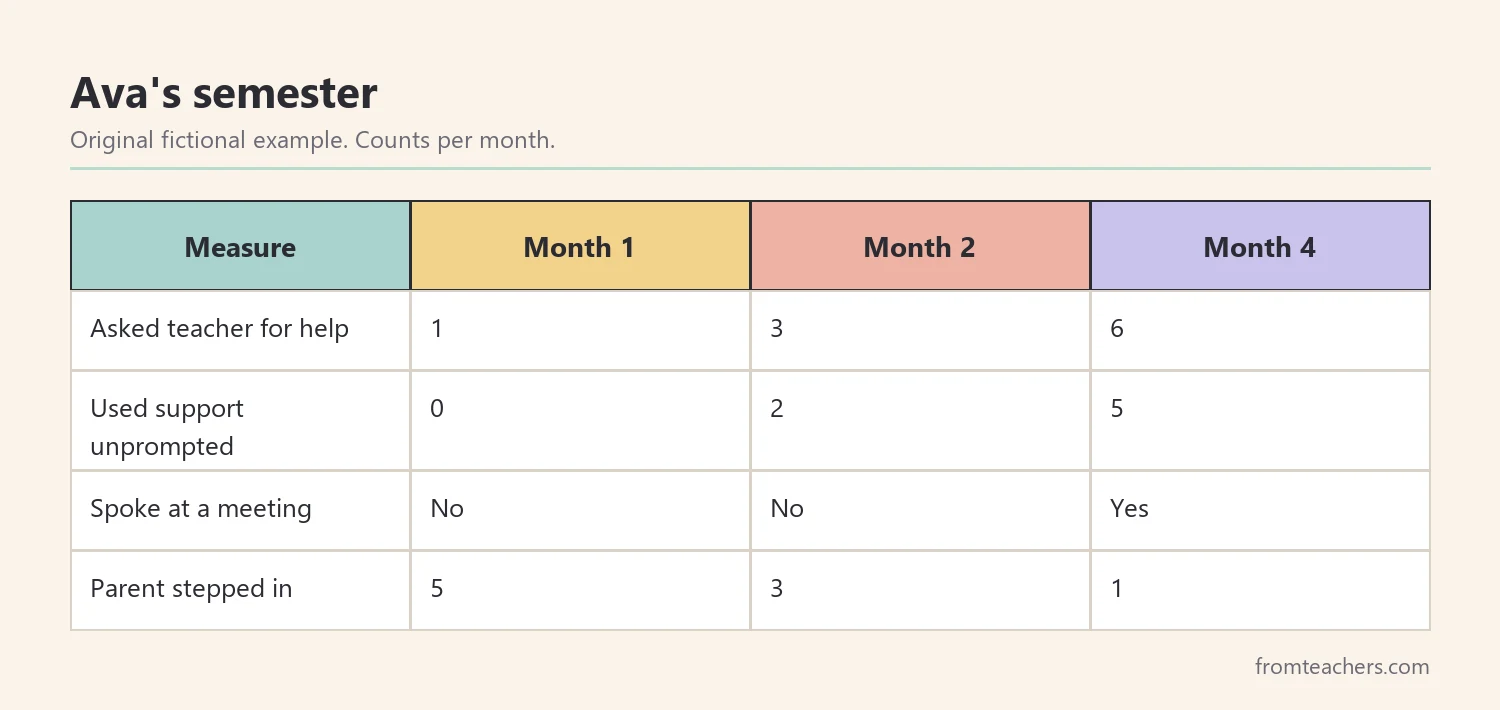
It helps to notice small wins. For example, Ava’s parents tracked four things over a semester: times she asked a teacher for help, times she used an accommodation without a reminder, times she spoke in meetings and times a parent stepped in. Figure 3 shows the change.
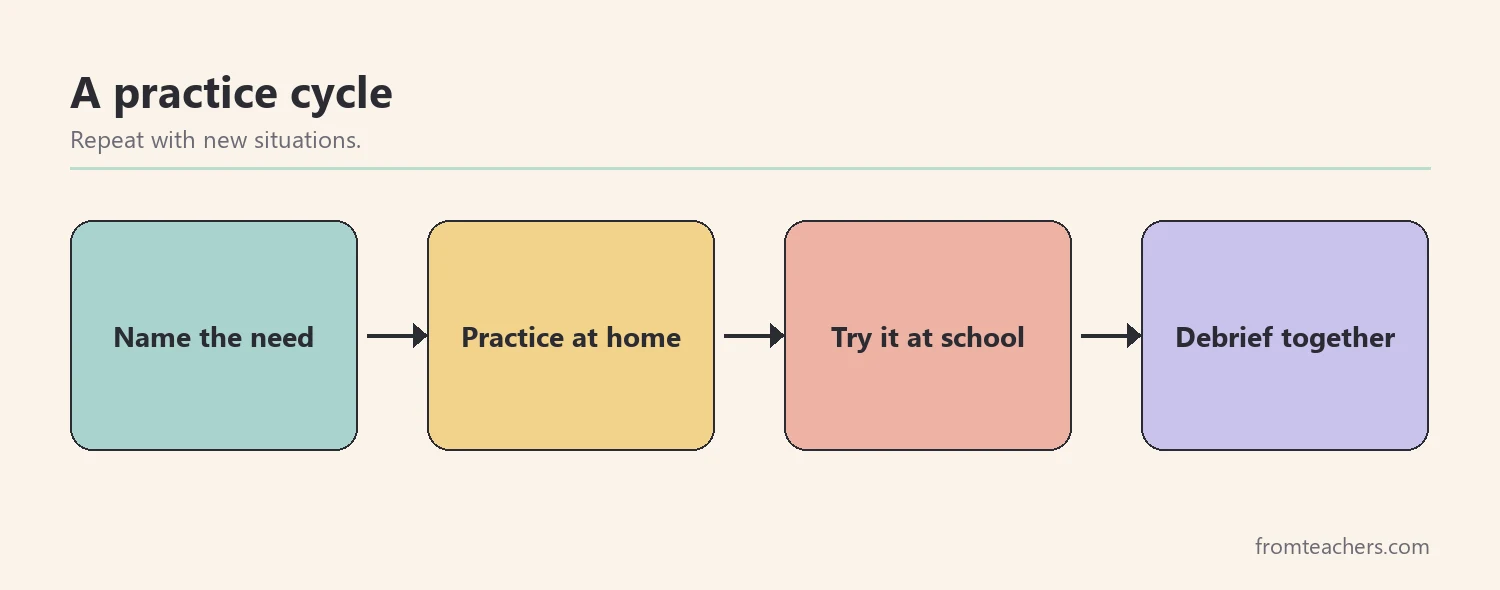
In addition, ask your child how it feels. Some children feel proud; others feel nervous. Both are normal. Celebrate effort, not only results. Figure 5 shows a simple practice cycle.
Self-advocacy mistakes at different ages
In elementary school, self-advocacy mistakes often look like doing everything for the child. Start with simple phrases: “I need a break,” “Can you say that again?” and “I don’t understand.”
In middle school, the mistake is often staying the main contact with every teacher. Let your child email a teacher first, with you copied.
In high school, the mistake is often planning the future without the student. Involve your teen in transition planning, course choices and conversations about rights after graduation, including how accommodations work in college and the workplace.
Siblings, grandparents and other adults
Self-advocacy mistakes are not only a parent habit. Grandparents, older siblings, coaches and family friends often speak for a child too, especially a child they see as shy or vulnerable.
First, share your goal with the people close to your child. A simple message such as “We are helping Ava speak for herself, so please wait and let her answer” is usually enough. Next, model the pause yourself when relatives are around; others tend to copy what they see.
Also, think about activities outside school. A sports coach, a music teacher or a club leader can be a low-pressure audience for first requests. For example, Ava asked her swim coach for written practice plans because she remembers better when she can read them. It was a small request, but it gave her confidence to ask teachers too.
Finally, avoid self-advocacy mistakes in family conversations. Talk with your child, not about them, when they are in the room.
Working with the school team
Teachers and case managers can help a lot. First, tell the team that self-advocacy is a family goal. Next, ask whether it can be written into the IEP as a goal or included in transition planning. Then ask teachers to prompt your child to ask for supports rather than giving them automatically every time.
Also, share what works at home. If your child uses a certain script or a pocket card, teachers can support the same tools at school.
Finally, agree on how you will handle problems. For example, Ava’s family and her case manager agreed that Ava would talk to the teacher first, and her mom would step in only if the issue was not solved within a week.
Common mistakes and how to avoid them
- Stepping back all at once. Fix: hand over one task at a time.
- Using scripts your child would never say. Fix: write scripts in your child’s own words.
- Practicing only before big meetings. Fix: practice small requests every week.
- Praising only success. Fix: praise the attempt, even when it does not work.
- Forgetting to talk about rights. Fix: explain simply what the IEP or 504 plan means.
Questions parents ask about self-advocacy mistakes
At what age should my child start self-advocating?
Many children can start with simple phrases in early elementary school. Skills grow gradually through middle and high school.
What if my child is too anxious to speak up?
Start with low-pressure practice at home and written options, such as a note or email. Talk with the school team about anxiety supports.
Will stepping back hurt my child’s services?
Stepping back from speaking for your child does not mean stepping away from the IEP. You remain a full team member.
Should my child read their IEP?
Many families share a simplified version, focusing on strengths, goals and accommodations, in words the child understands.
How do I know if we are avoiding self-advocacy mistakes?
Look for small signs: your child names a support, asks a teacher for help or speaks in a meeting without being prompted.
Related reading: How Parents and Teachers Can Team Up for Special Education Success, Navigating the Path to Adulthood: Building Essential Life Skills, and Accommodations vs Modifications in Special Education.
You may also need: Understanding IEP Goals: A Guide for Parents & Teachers.
A companion resource for self-advocacy mistakes:
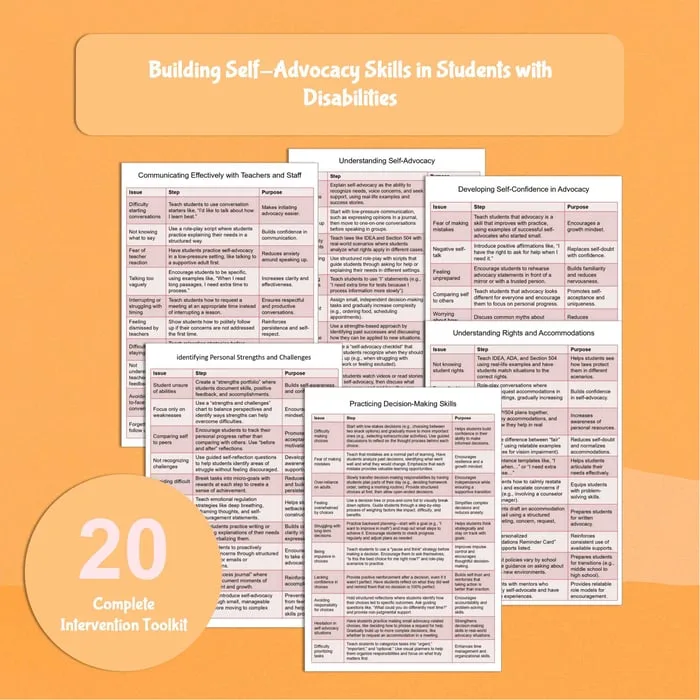
Self-Advocacy Skills for Students with Disabilities: SPED Intervention Toolkit: twenty intervention guides in a simple Issue, Step, Purpose format, covering rights and accommodations, talking with teachers, asking for help without embarrassment, managing anxiety, resolving conflicts, goal setting and advocating for independence.
Sources and scope
- PACER Center: parent training and information on special education, including youth self-advocacy.
- Center for Parent Information and Resources: guidance for families on IEPs, transition planning and student involvement.
- Understood: articles for parents on self-advocacy and learning differences.
- National Center for Learning Disabilities: resources for families and young people with learning disabilities.
This list covers everyday parenting habits that support or limit self-advocacy. It does not give legal advice and does not replace your child’s IEP or 504 team, or your state’s parent training and information center.
Key takeaways
- Most self-advocacy mistakes come from love and protection.
- Pause and let your child answer first.
- Teach your child their accommodations in plain words.
- Role-play requests at home before real situations.
- Invite your child to IEP meetings and grow their role each year.





Leave a Comment