

Paraprofessional observation mistakes are easy to make and easy to fix, yet they quietly decide whether a team’s notes help a student or just fill a folder. Picture a grade 2 classroom at 9:15 on a Monday. Mr. Okafor, a paraprofessional, sits beside Maya during math centers with a clipboard, a pencil and three other students who also need him.
This list is written for paraprofessionals, teaching assistants and the teachers who guide them. It walks through eight common mistakes in the order they usually happen, from before the lesson to the weekly review. For each one, you get a short explanation, a practical fix and an example from Maya’s week, so your next set of notes is clearer, faster and more useful at team meetings.
Examples are fictional. Adapt to the student’s goals and agreed supports. This is guidance, not a diagnosis.
At a glance
- Agree on the goal and the observation time with the teacher before you start.
- Write what you see and hear, not what you think the student feels.
- Use the same words for prompts and the same form as other adults.
- Record during or right after the activity, not at the end of the day.
- Hand in a short weekly summary, then ask what to watch next.
How this list is ordered
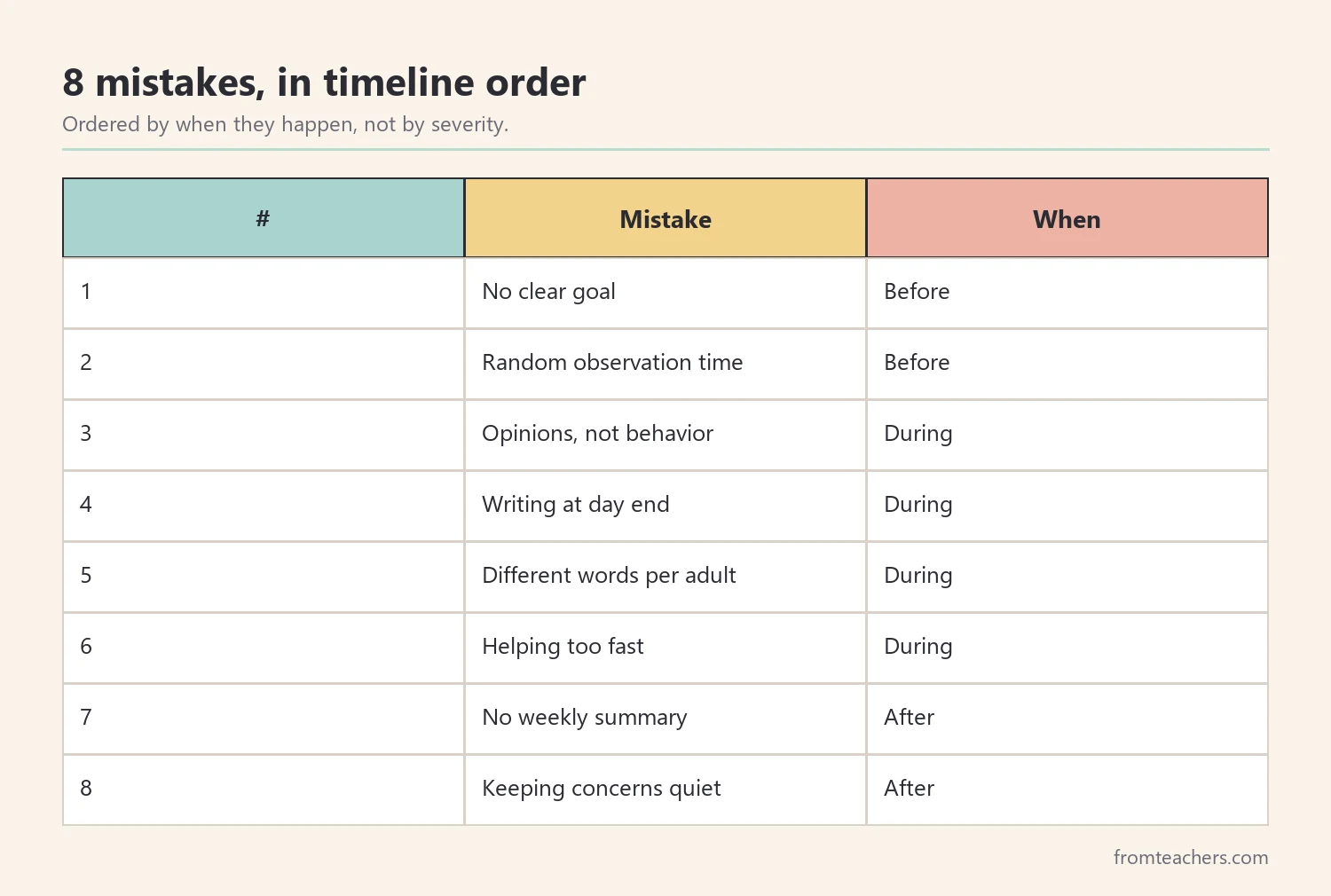
We did not rank these mistakes by how “bad” they are, since every classroom is different. Instead, the list follows the timeline of a normal observation. Mistakes 1 and 2 happen before the lesson. Mistakes 3 to 6 happen while you observe. Finally, mistakes 7 and 8 happen after the lesson, when notes become data.
As a result, you can read the list once as a whole, then come back to the part of the day that feels hardest. Figure 1 gives the full picture on one page.
1. Observing without knowing the goal
The first of the paraprofessional observation mistakes starts before the lesson. Many assistants are handed a clipboard with a simple instruction: “Keep an eye on Maya.” Without a clear goal, you end up writing everything, or nothing useful.
Why it matters: IEP goals name specific skills. If the goal is “starts independent work within two minutes,” notes about handwriting do not help the team measure it.
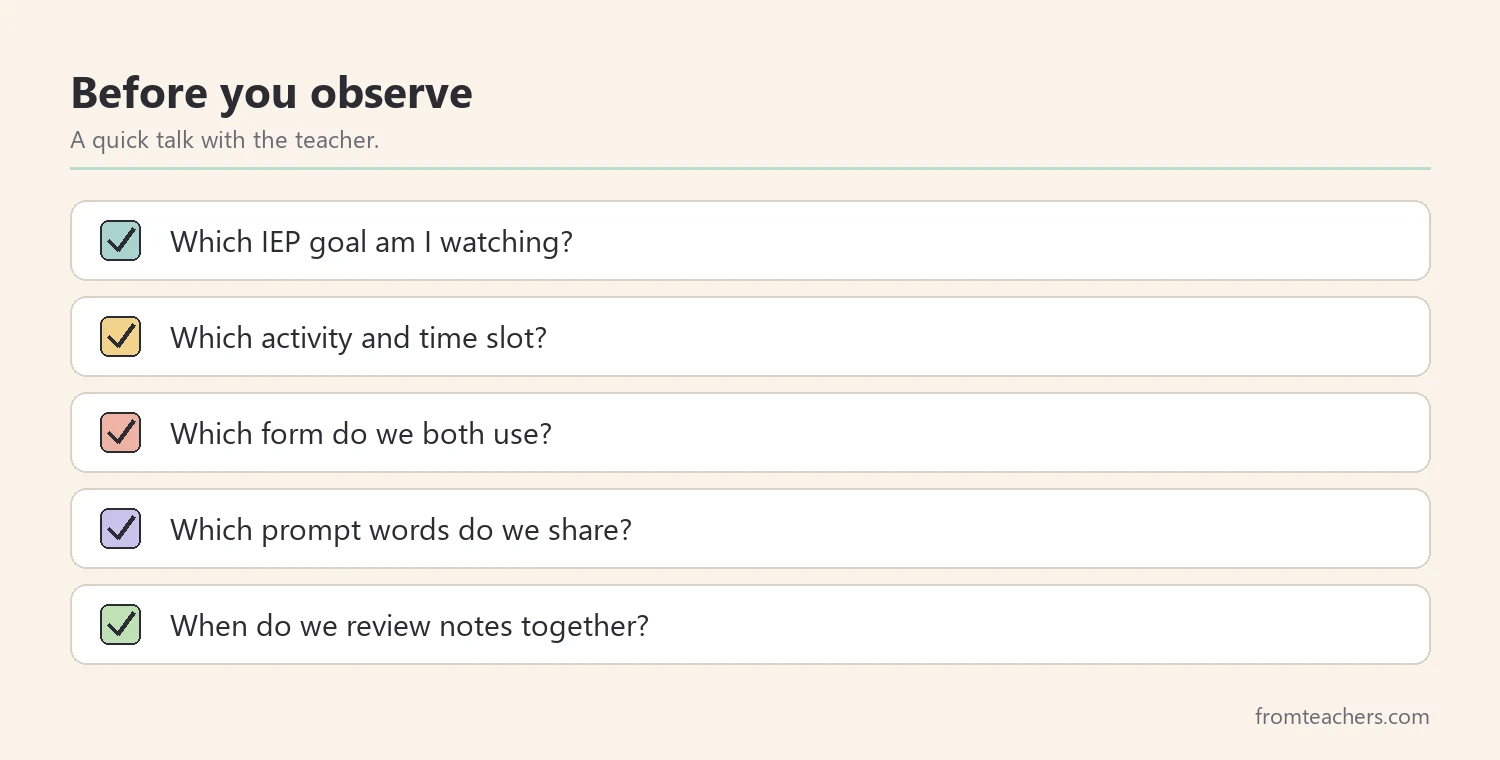
The fix: ask the teacher one question before you begin: “Which goal am I watching today?” Then write that goal in short words at the top of the form. In addition, ask what success looks like in plain terms.
Example: Mr. Okafor learned that Maya’s goal was starting tasks on her own. From then on, he watched the first three minutes of each center closely instead of the whole hour.
2. Choosing a random time to observe
Next, timing matters more than most people expect. A student may look very different during a favorite activity than during a hard one. Similarly, the minutes after recess often look different from the first lesson of the morning.
Why it matters: if Monday’s notes come from art and Wednesday’s from spelling, the team cannot tell whether a change is real or just a different task.
The fix: agree on a fixed slot, such as “math centers, first ten minutes, Monday, Wednesday and Friday.” Keep it the same for at least two weeks. If the schedule changes, write that on the form.
Example: Mr. Okafor and Ms. Patel chose math centers at 9:15. After two weeks, they could compare six records of the same activity at the same time of day.
3. Writing opinions instead of behavior
This is the most common of all paraprofessional observation mistakes. Words like “lazy,” “defiant,” “upset” or “not trying” feel natural in the moment. However, they describe a guess about the student, not what happened.
Why it matters: two adults can disagree about “upset,” but both can agree that a student “put her head on the desk for about a minute.” Behavior can be counted and compared. Opinions cannot.
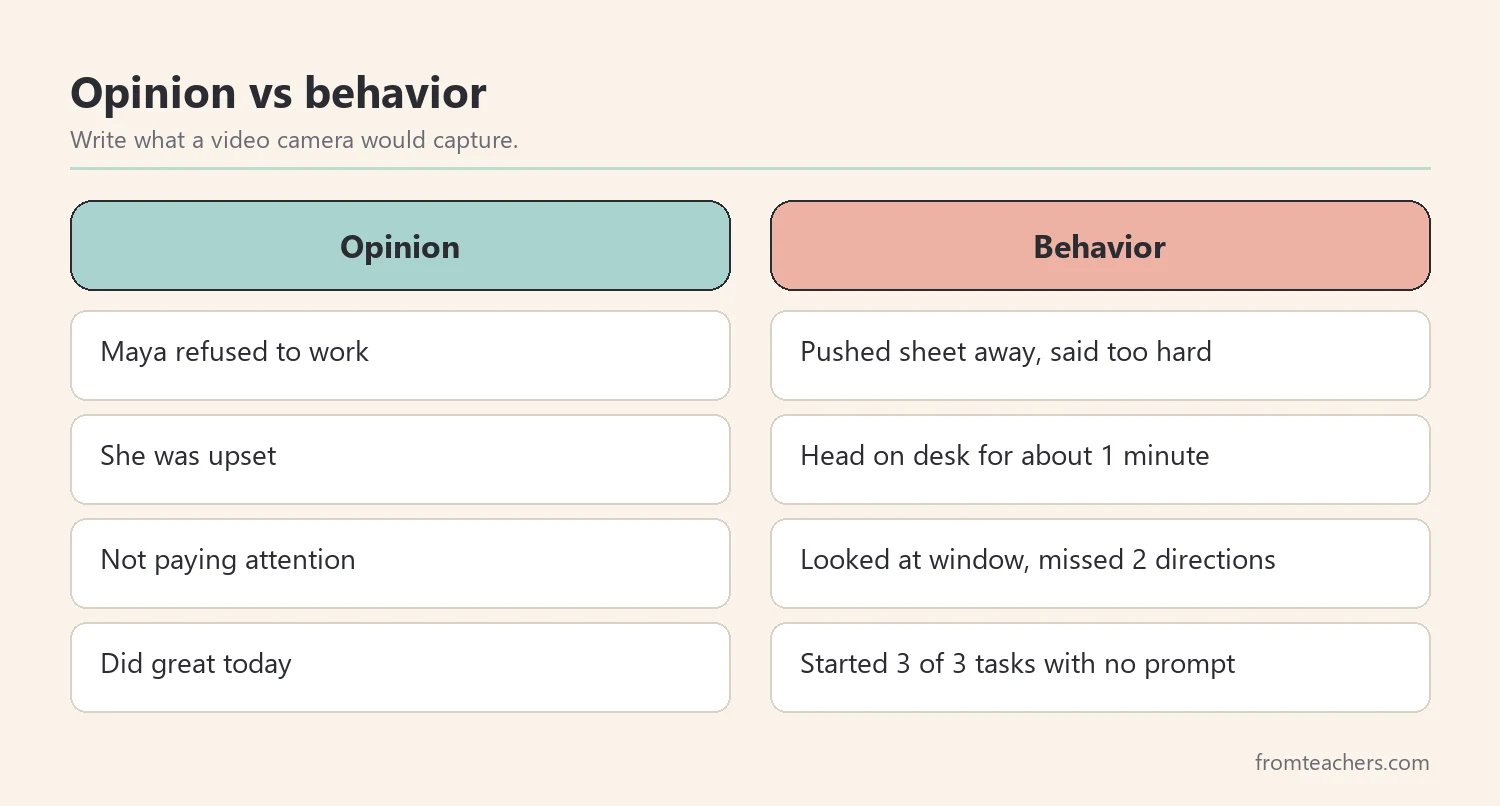
The fix: use the “camera test.” Write only what a video camera would capture: actions, words, and how long something lasted. Figure 2 shows a few quick rewrites you can practice.
Example: On Monday, Mr. Okafor first wrote “Maya refused to work.” He then changed it to “Maya pushed the worksheet away and said ‘too hard’ at 9:17. Started after a choice of two problems.”
4. Waiting until the end of the day to write
Busy paraprofessionals often plan to “fill it in later.” Unfortunately, memory fades fast, especially when you support several students. By 3 p.m., the details of 9:15 have blended with everything else.
Why it matters: late notes tend to be vague and shaped by how the whole day felt. A calm morning followed by a hard afternoon can make the morning seem worse than it was.
The fix: use a check-box form you can complete in real time, then add one short note right after the activity. A ready-made set of 12 daily classroom observation checklists works well here, because each form has ten specific areas with four-option checklists and a notes column, so it can be filled in quickly during a lesson.
Example: Mr. Okafor ticked boxes during the center and added one sentence before moving to the next group. The whole routine took about two minutes.
5. Using different words from other adults
Many students are observed by more than one adult: a teacher, a paraprofessional, sometimes a specialist. If each person uses their own words, the notes do not line up.
Why it matters: “needed help” could mean a quick reminder or full hand-over-hand support. Those are very different levels of independence.
The fix: agree on a short list of prompt words and use the same form. For example, many teams use these four levels.
| Prompt word | What it means |
|---|---|
| Independent | Student started or finished with no help |
| Verbal | Adult gave a spoken reminder |
| Gesture | Adult pointed or showed |
| Physical | Adult guided hands or materials |
Example: Ms. Patel and Mr. Okafor both used these four words for Maya’s task starts. As a result, their notes from different days could sit in one table.
6. Helping so much that there is nothing to observe
This mistake comes from kindness. A paraprofessional sees a student struggling and steps in immediately. Then the form says “completed,” yet the student did not show what she can do alone.
Why it matters: the team may think a skill is stronger than it is. Over time, quick help can also make a student wait for an adult instead of trying first.
The fix: agree with the teacher on a short wait time, often a few seconds, before offering the lightest prompt. Then record which prompt you gave. Safety always comes first, of course, so step in at once if anyone could get hurt.
Example: Mr. Okafor began counting silently to five before saying, “What is your first step?” Maya started on her own more often once she had that short pause.
7. Collecting notes but never summarizing them
Afterward, the forms go into a folder. The folder grows thick. However, nobody looks at it until the IEP meeting, and by then it is too late to adjust anything.
Why it matters: data only helps when it changes a decision. A pattern spotted in week two can save a month of struggle.
The fix: once a week, count two or three things and put them in a small table. Then write one sentence about what changed. Figure 3 shows how Mr. Okafor summarized Maya’s first four weeks.
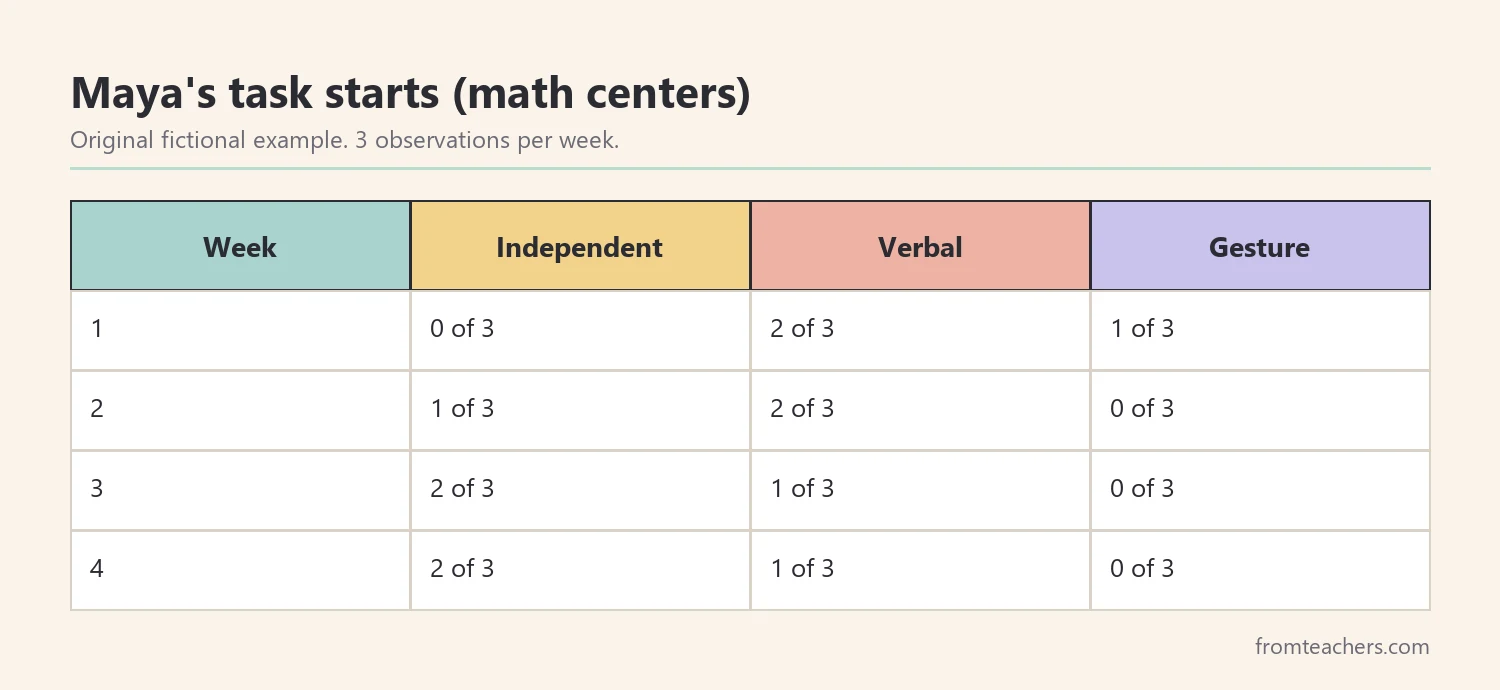
Example: The summary showed that Maya’s independent starts rose after the five-second pause began in week two. Therefore, Ms. Patel kept the pause and planned to try it during reading too.
8. Keeping concerns to yourself
Finally, paraprofessionals often notice things first. They see the student up close, every day. Yet many assistants hesitate to speak up, unsure whether it is their place.
Why it matters: your observations are part of the team’s information. A pattern you notice at lunch or during transitions may explain what happens in class.
The fix: share notes with the teacher on a regular day, not only when there is a problem. Bring your weekly summary, one positive change and one question. Keep student information private and follow your school’s rules about who you share it with.
Example: Mr. Okafor mentioned that Maya seemed to start tasks faster on days she arrived early. Ms. Patel shared this with the family, who confirmed mornings were calmer on those days.
A simple weekly routine that prevents most mistakes
Most paraprofessional observation mistakes disappear when the routine is short and predictable. Figure 5 shows a four-part week that many teams can fit around normal duties.
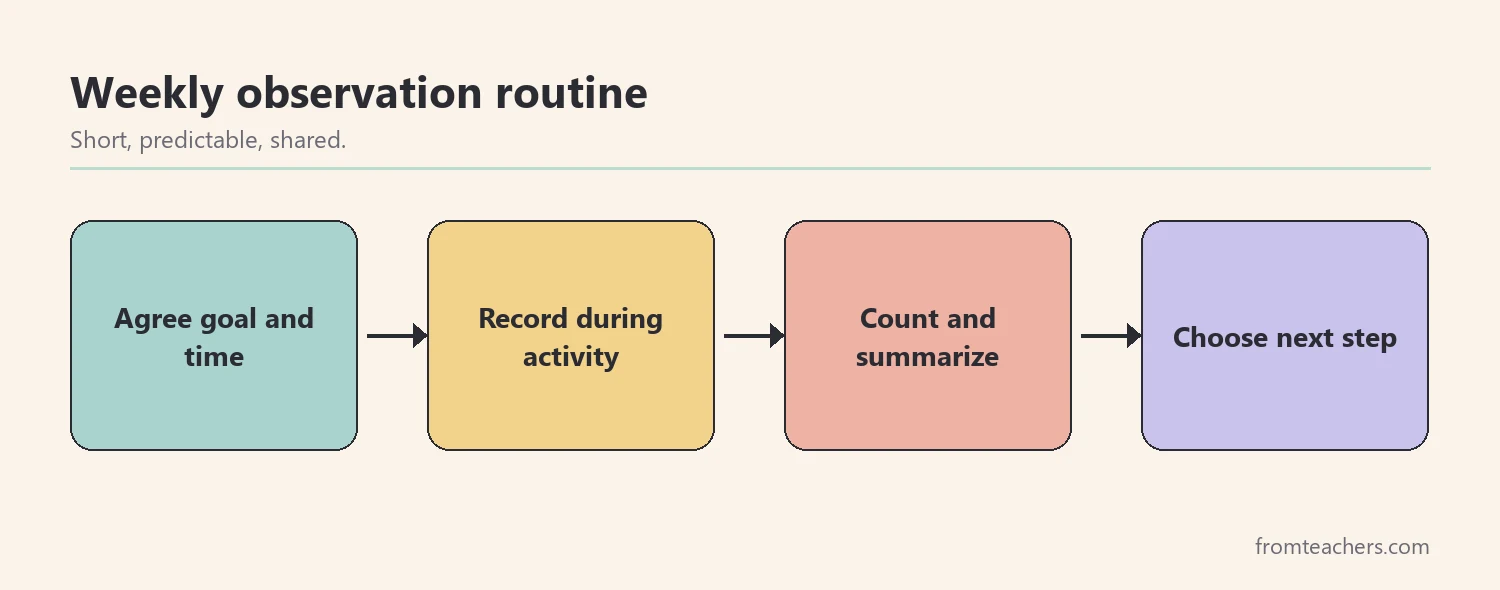
First, the teacher and paraprofessional agree on the goal and the time slot. Next, the assistant records with the same form during the agreed activity. Then, at the end of the week, they count a few simple things together. Finally, they choose one next step and decide what to watch the following week.
Common mistakes teachers make when guiding paraprofessionals
- Handing over a form with no training. Fix: model one observation together and compare notes.
- Asking for too much data. Fix: limit observations to one or two goals at a time.
- Never giving feedback on the notes. Fix: point out one strong note each week so the assistant knows what helps.
- Changing the form every month. Fix: keep one layout so data stays comparable.
Questions teachers and parents ask about paraprofessional observation mistakes
Can paraprofessionals collect data for IEP progress?
In many schools, yes, under the direction of the teacher or case manager. The teacher remains responsible for the IEP and for interpreting the data. Check your district’s policies and job descriptions.
How long should an observation take?
Often only a few minutes per session. A short, focused observation at the same time each day usually gives clearer data than long notes taken at random.
What if I miss a day?
Simply write “not observed” and the reason, such as an assembly or absence. Missing days are normal. Guessing the data afterward is the real problem.
Should parents see the paraprofessional’s notes?
Usually the teacher shares a summary rather than raw forms. Families have rights to their child’s education records, so follow your school’s procedures for record keeping and sharing.
How do I write about behavior respectfully?
Describe actions and the setting, and avoid labels. Also note what went well. A balanced record is more accurate and easier for families to hear.
Related reading: The Power of Data Tracking in Special Education, Addressing Challenges in Special Education, and How Parents and Teachers Can Team Up for Special Education Success.
You may also need: ABC Data Collection Forms for classroom behavior.
A companion resource for paraprofessional observation mistakes:
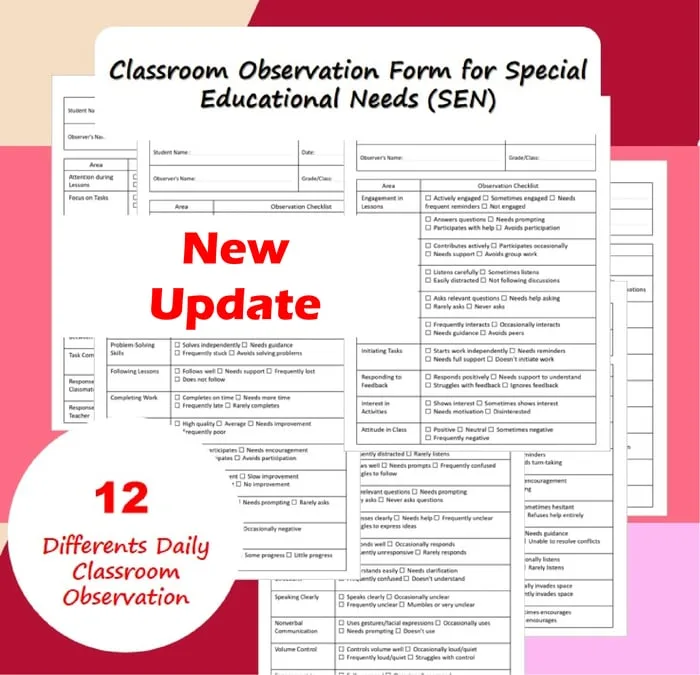
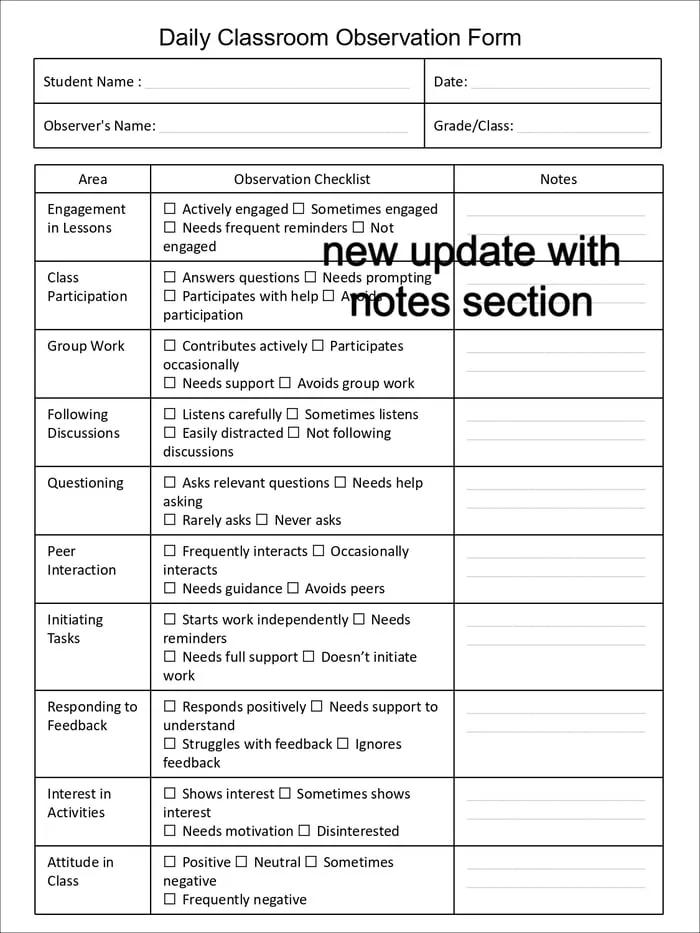
Classroom Observation Form for Special Education (SEN): 12 Daily Checklists: 12 daily observation forms with the same check-box layout, covering engagement, attention, regulation, peer interaction, independence, communication, executive functioning and more, in print-ready PDF and editable PowerPoint versions.
Sources and scope
- IRIS Center, Vanderbilt University: free modules for educators, including work with paraprofessionals and data-based decision making.
- Center for Parent Information and Resources: plain-language information about IEPs, evaluation and team roles.
- Center on PBIS: resources on positive behavior support and using school data well.
- Intervention Central: free tools for classroom behavior and academic monitoring.
This guide covers everyday classroom observation by paraprofessionals working under a teacher’s direction. It does not cover formal evaluations, functional behavior assessments or eligibility decisions, which follow district procedures and qualified professionals.
Key takeaways
- Most paraprofessional observation mistakes come from unclear goals or random timing.
- Write what a camera would capture, not opinions.
- Use shared prompt words and one form across all adults.
- Record in real time and summarize once a week.
- Share what you notice: your view is part of the team’s information.









Leave a Comment