

The best classroom observation forms turn a busy day into notes you can actually use at an IEP meeting. Picture a grade 3 inclusion classroom at 10:40 on a Tuesday. Leo, who has an IEP for attention and self-regulation, has left his seat three times during independent reading, and his teacher is trying to remember whether that also happened yesterday.
This list ranks seven observation forms that special education teachers, co-teachers, and paraprofessionals use most, from the quickest to start with to the more specialized. By the end, you will know which forms to print first, how to fill each one in under two minutes, and how to turn the checks into a clear progress summary.
Examples are fictional. Adapt to the student’s goals and agreed supports. This is guidance, not a diagnosis.
At a glance
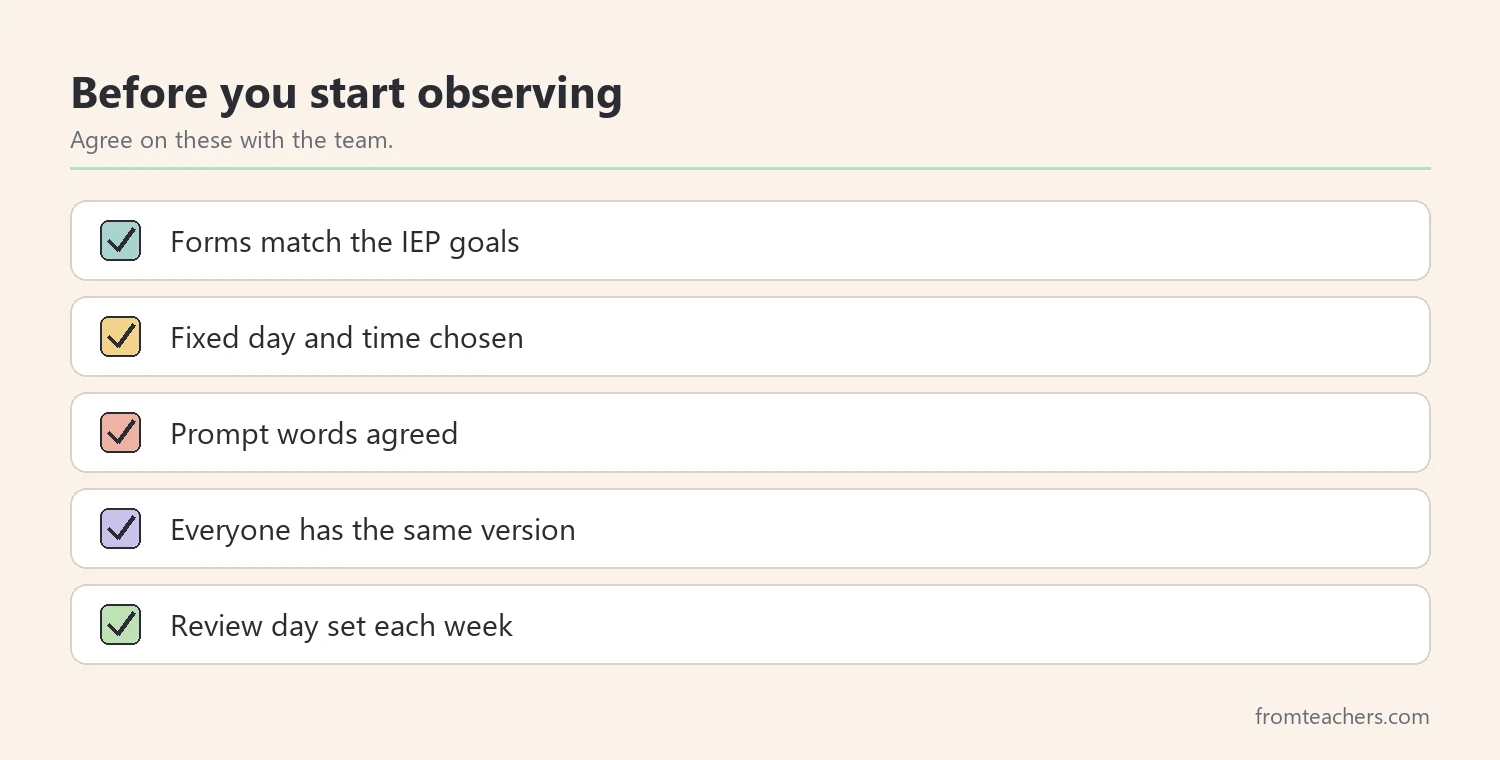
- Pick forms that match the student’s IEP goals, not every form at once.
- A shared layout helps several adults record the same way.
- Observe the same activity at the same time each week.
- Describe what you see and hear, not opinions.
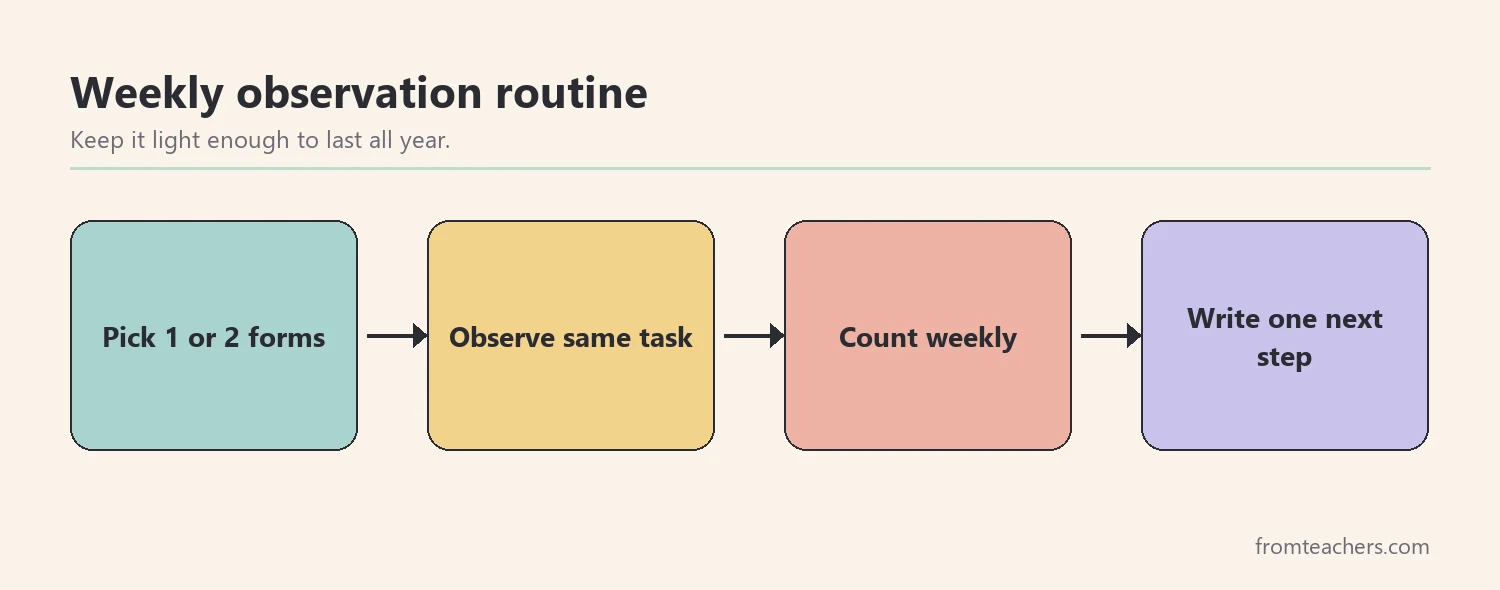
- Summarize weekly: one table, one sentence, one next step.
How we ranked these forms
We did not invent a popularity score. Instead, the order below follows three plain criteria you can check yourself. First, how quickly a busy adult can fill the form in during class. Second, how often the area shows up in common IEP goals, such as attention, regulation, and work completion. Third, how easily the notes turn into a summary for families and the team.
Therefore, the list starts with a ready-made set that covers several areas at once, then moves to single-focus forms. If your student’s IEP names a specific area, jump straight to that item.
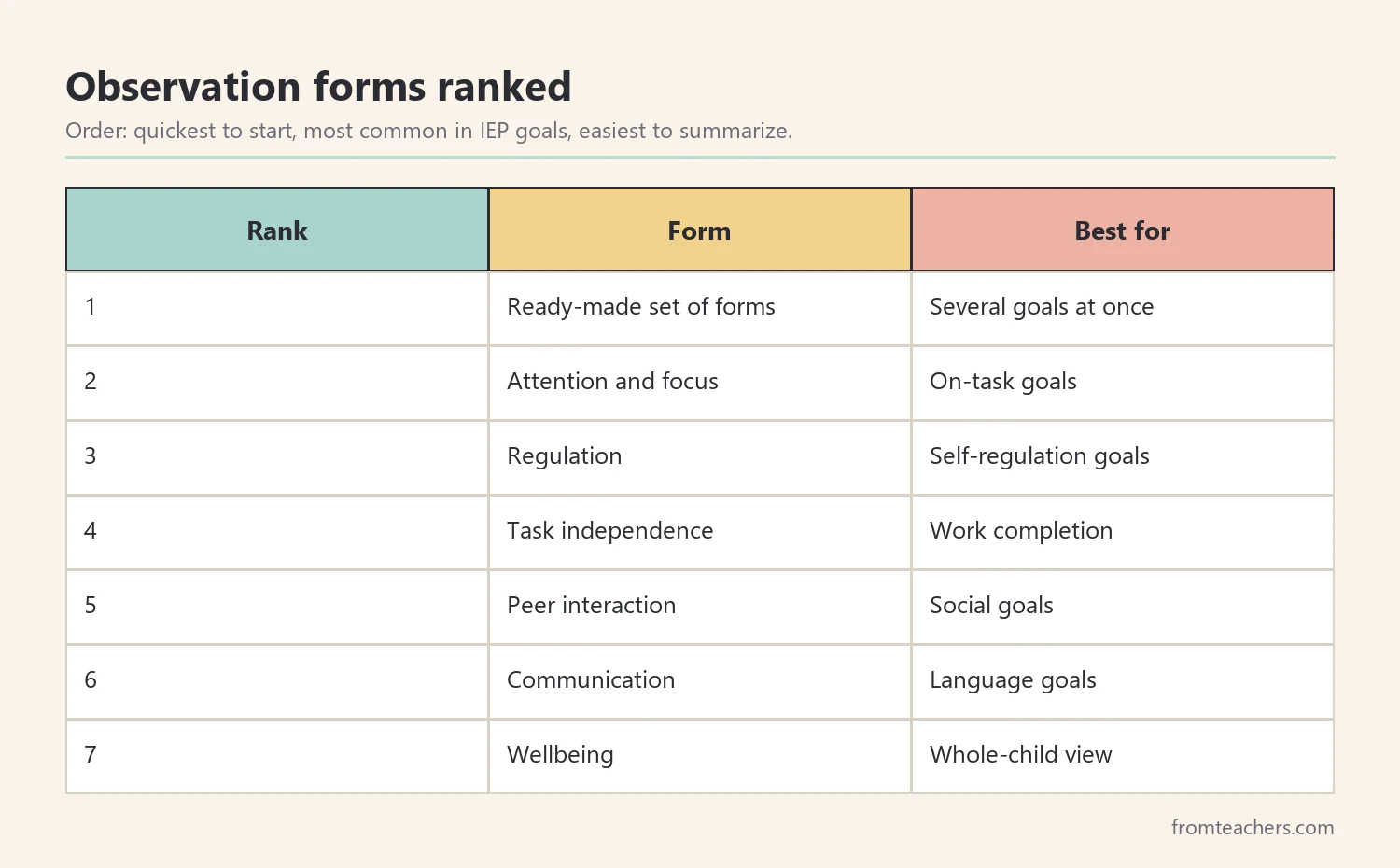
1. A ready-made set of daily observation forms (best overall)
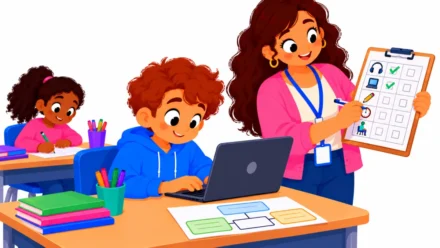
For most teams, the best classroom observation forms are the ones that already share one layout. When every form looks the same, adults stop thinking about the paper and start noticing the student. That consistency matters most when several people observe the same child.
The set of 12 daily classroom observation checklists for special education follows this idea. Each form has the student name, date, observer, and grade at the top, then ten specific areas with four-option checklists and a notes column. The areas include engagement, attention, emotional and behavioral regulation, peer interaction, task independence, and communication. It comes as a print-ready PDF and an editable PowerPoint file, so you can keep the paper version on a clipboard or type into it later.
Why it works: one format, many focus areas, and a fill-in time short enough for a real lesson.
How to use it: choose one or two forms that match the IEP goals. Then pick a fixed time, such as the first ten minutes of independent work, and fill the form in on the same days each week.
Example: Leo’s teacher, Ms. Rivera, chose the attention form and the regulation form. She filled them in on Monday, Wednesday, and Friday during reading block. After two weeks, she had six comparable records instead of scattered sticky notes.
2. Attention and focus form (best for on-task goals)
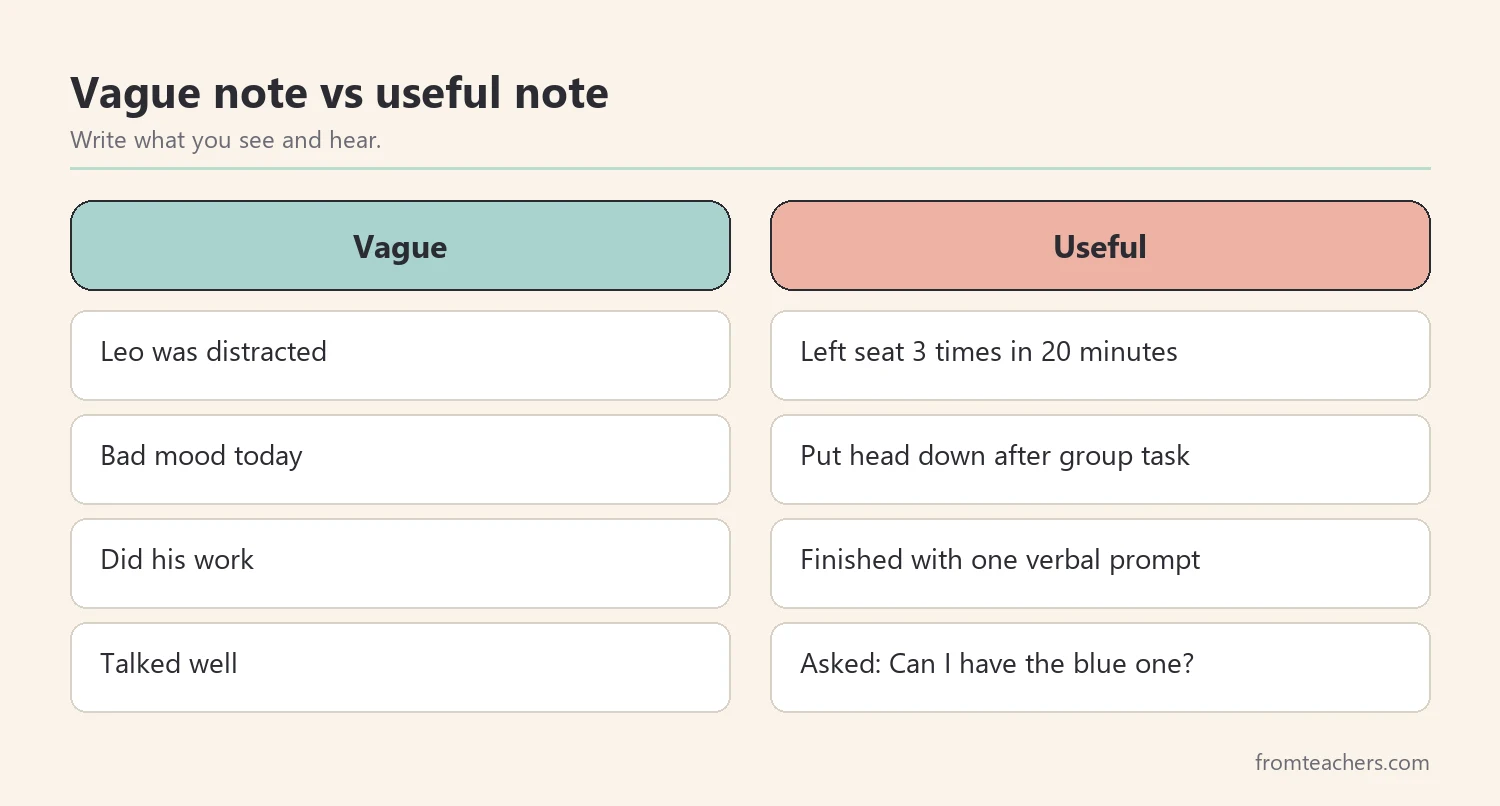
Attention is one of the most common reasons a teacher reaches for an observation form. Still, “Leo was distracted” tells the team very little. A good attention form breaks focus into small, visible behaviors: starting the task, staying with it, returning after an interruption, and following a direction the first time.
Why it works: it replaces a general impression with specific checks that two adults can agree on.
How to use it: observe during the same type of task each time. For example, compare independent reading with independent reading, not reading with art. Otherwise, the task itself changes the picture.
Example: Ms. Rivera noticed that Leo usually started reading on time but stopped after about five minutes. As a result, the team discussed a short check-in at the five-minute mark rather than a new seat.
3. Emotional and behavioral regulation form (best for self-regulation goals)
Regulation forms help you see what happens before and during hard moments. Typical checks include signs of frustration, use of a calming strategy, need for adult support, and time to return to work. Moreover, a notes column lets you write what was happening in the room.
Why it works: patterns appear quickly when you record the same checks every day. For instance, you may see that difficult moments cluster after lunch or during noisy transitions.
How to use it: record what you see, not what you guess. “Pushed paper away, put head down” is more useful than “angry.” Then add one line about the setting.
Example: Leo’s form showed that he used his break card on most days when the class was quiet, but rarely during group work. Consequently, the team practiced using the card during group tasks.
4. Task independence and self-management form (best for work completion)
Many IEP goals are about doing more without an adult. This form looks at how a student starts work, gathers materials, asks for help, and finishes. It is especially useful when a paraprofessional is assigned to a student and the team wants to fade support over time.
Why it works: it shows the level of prompting, not just whether the work got done. A finished worksheet with constant adult help is a different result from a finished worksheet with one reminder.
How to use it: agree on simple prompt words, such as “none,” “verbal,” “gesture,” and “physical help.” Everyone who observes should use the same words.
Example: In week one, Leo needed a verbal prompt to start most tasks. By week four, he started on his own on most observed days, so the team reduced the reminders.
5. Peer and social interaction form (best for social goals)
Social goals are hard to measure from memory. A peer interaction form gives you specific checks: joining a group, taking turns, responding to a classmate, and solving small disagreements. In addition, it reminds you to observe in less structured settings like centers or recess.
Why it works: it captures moments that are easy to miss when you are teaching the whole class.
How to use it: observe during a planned group activity at least once a week. If possible, ask a co-teacher or support adult to fill it in while you teach.
Example: Leo joined partner reading readily but struggled to wait his turn in a four-person group. Therefore, the team started with pairs before moving to larger groups.
6. Communication form (best for language and expression goals)
Communication forms look at how a student asks for help, answers questions, expresses needs, and follows spoken directions. They are useful for students with speech and language goals, and they help classroom staff share what they see with the speech-language pathologist.
Why it works: it gives the SLP classroom examples, not just therapy room examples.
How to use it: write short quotes when you can. “Can I have the blue one?” is clearer than “requested appropriately.”
Example: Ms. Rivera recorded that Leo asked for help with words but often waited until he was already frustrated. As a result, the team practiced asking earlier with a simple script.
7. Emotional wellbeing and confidence form (best for a whole-child view)
Finally, a wellbeing form looks at mood, willingness to try, response to feedback, and signs of confidence. It is less tied to a single IEP goal, yet it often explains the other data. A student who seems tired or discouraged may show more off-task behavior across every form.
Why it works: it reminds the team that behavior and learning sit inside a whole child.
How to use it: fill it in weekly rather than daily, and share positive notes with the family as well as concerns.
Example: Leo’s wellbeing notes showed more willingness to read aloud after he started choosing his own books. That detail helped the family understand the progress at home too.
Turning the best classroom observation forms into data
Checks only help when you look at them together. Once a week, count a few simple things across the forms. Then write one sentence about what changed. Here is how Ms. Rivera summarized Leo’s first four weeks.
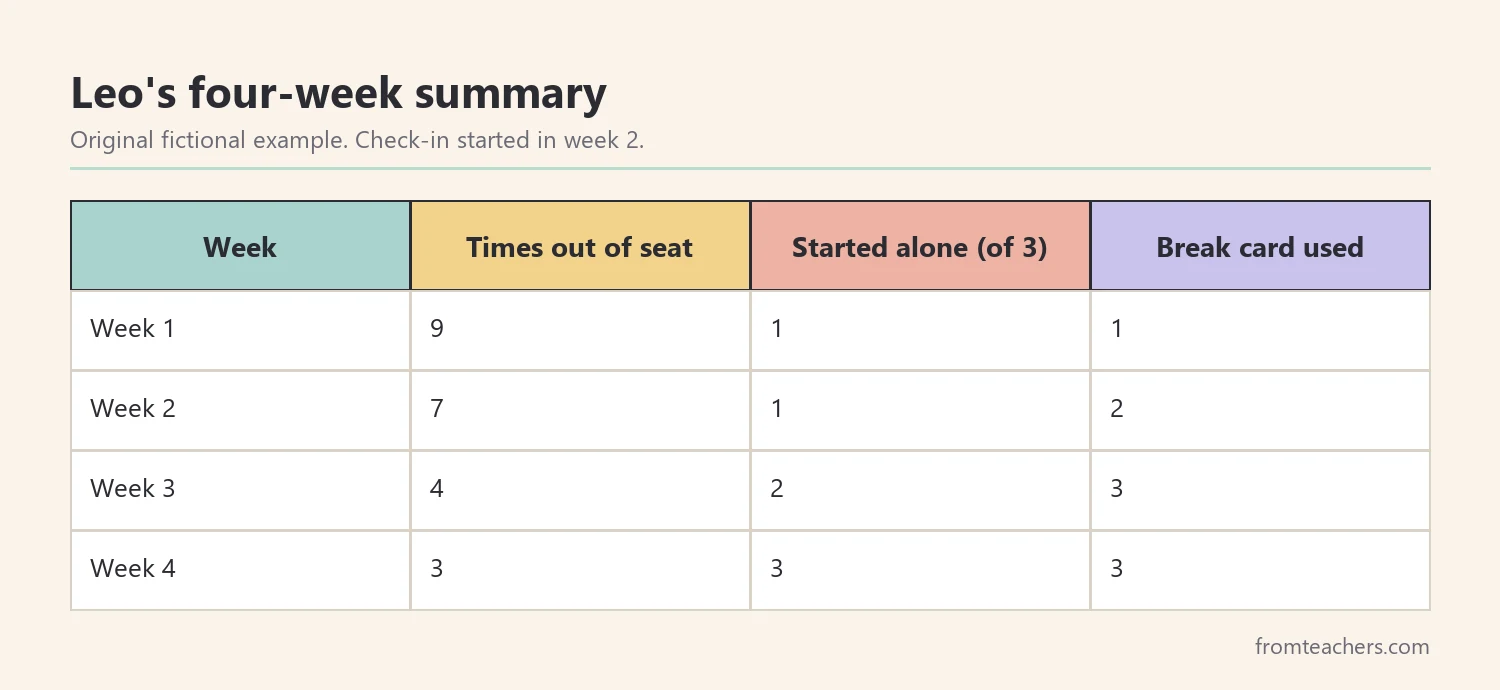
The pattern was easy to see. After the five-minute check-in started in week two, Leo left his seat less often and started more tasks on his own. Consequently, the team kept the check-in and planned to fade it slowly.
Also, keep the summary short. One table, one sentence, and one next step are enough for most progress notes. The four-step routine below keeps the process light.
Common mistakes and how to avoid them
- Observing at random times. Different tasks give different results. Fix: observe the same activity at the same time each week.
- Writing opinions instead of behavior. “Lazy” or “defiant” cannot be checked. Fix: describe what you saw and heard.
- Using too many forms at once. Busy adults stop filling them in. Fix: start with one or two forms tied to IEP goals.
- Letting each adult use different words. Data becomes hard to compare. Fix: agree on prompt levels and rating words first.
- Never reviewing the forms. Data in a folder does not help the student. Fix: review weekly and write one next step.
Questions teachers and parents ask about the best classroom observation forms
How often should I fill in an observation form?
Many teams start with two or three times a week for the same activity. That is often enough to see a pattern without overwhelming staff. Adjust the schedule to the student’s goals and your team’s plan.
Who should complete the forms?
Anyone who works with the student can, including teachers, co-teachers, and paraprofessionals. The key is that everyone uses the same form and the same words. A short training conversation at the start helps.
Can observation forms replace formal assessment?
No. Classroom observation forms describe what happens in daily lessons. Formal evaluations are carried out by qualified professionals and follow your district’s procedures. However, good observation notes give the team useful context.
Should I share the forms with families?
Summaries are usually more helpful than raw forms. Share a short table, one positive change, and one next step. Families can also tell you whether they see similar patterns at home.
What if the data shows no change?
That is useful information too. It may mean the support needs adjusting, the goal needs smaller steps, or the observation time is not the best one. Bring the data to the team and decide together.
Related reading: The Power of Data Tracking in Special Education, How Teachers Communicate With Parents in Special Education, and Special Education Accommodation and Modification Tracker.
You may also need: Classroom Accommodation Feedback Form IEP 504 Effectiveness Tracker.
A companion resource for best classroom observation forms:
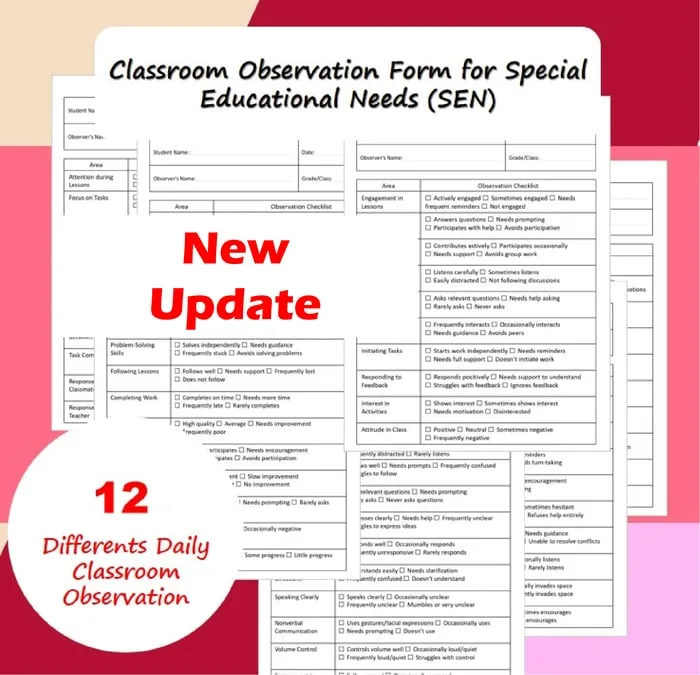
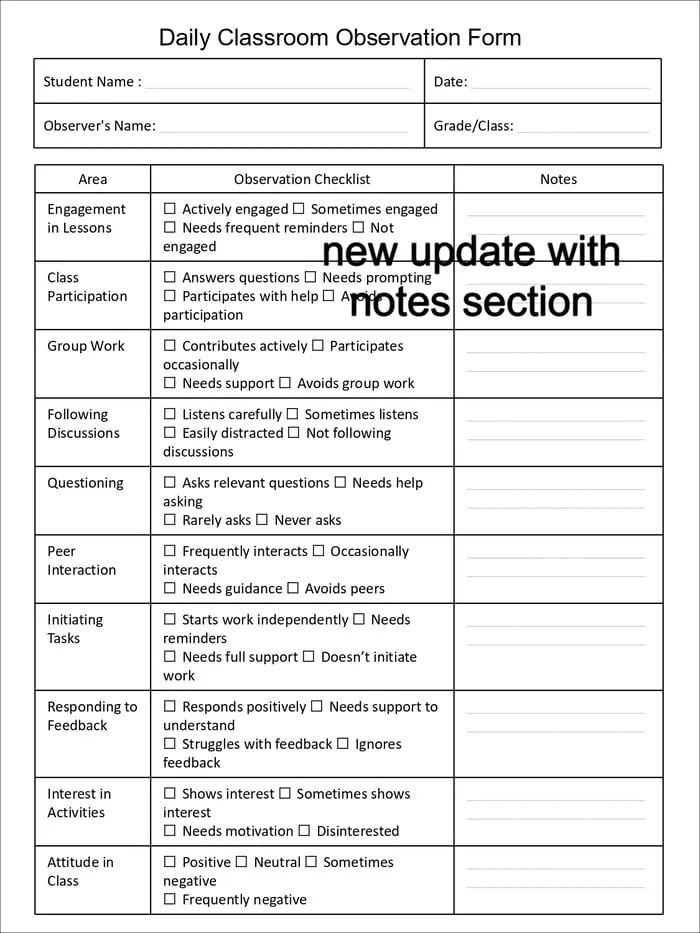
Classroom Observation Form for Special Education (SEN): 12 Daily Checklists: 12 daily observation forms with the same check-box layout, covering engagement, attention, regulation, peer interaction, independence, wellbeing, communication and more, in print-ready PDF and editable PowerPoint versions.
Sources and scope
- IRIS Center, Vanderbilt University: free modules on data-based decision making and progress monitoring for educators.
- Intervention Central: tools and guidance for classroom behavior and academic monitoring.
- Center on PBIS: resources on positive behavior support and using data in schools.
- Center for Parent Information and Resources: plain-language information for families about IEPs and evaluation.
This list covers everyday classroom observation forms for teachers and support staff. It does not cover formal evaluations, eligibility decisions, or clinical assessment, which follow district procedures and qualified professionals.
Key takeaways
- The best classroom observation forms share one simple layout across many focus areas.
- Start with one or two forms that match the student’s IEP goals.
- Observe the same activity at the same time to get comparable notes.
- Describe behavior, not opinions, and agree on shared words.
- Review weekly and turn checks into one sentence and one next step.





Leave a Comment