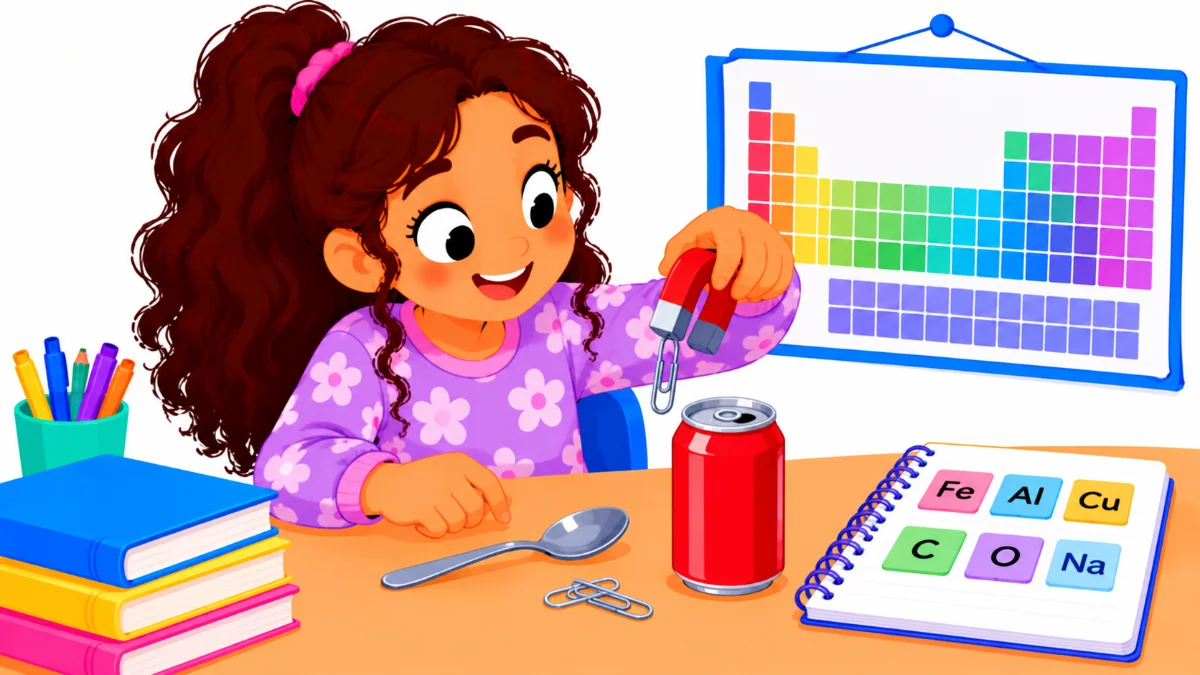

Choosing the elements kids should learn first makes the periodic table feel like a map of their own world instead of a wall of letters. Picture a homeschool kitchen table on a Monday morning. Lina, age 9, looks at a full periodic table poster, sees 118 boxes, and asks, “Do I have to learn all of these?”
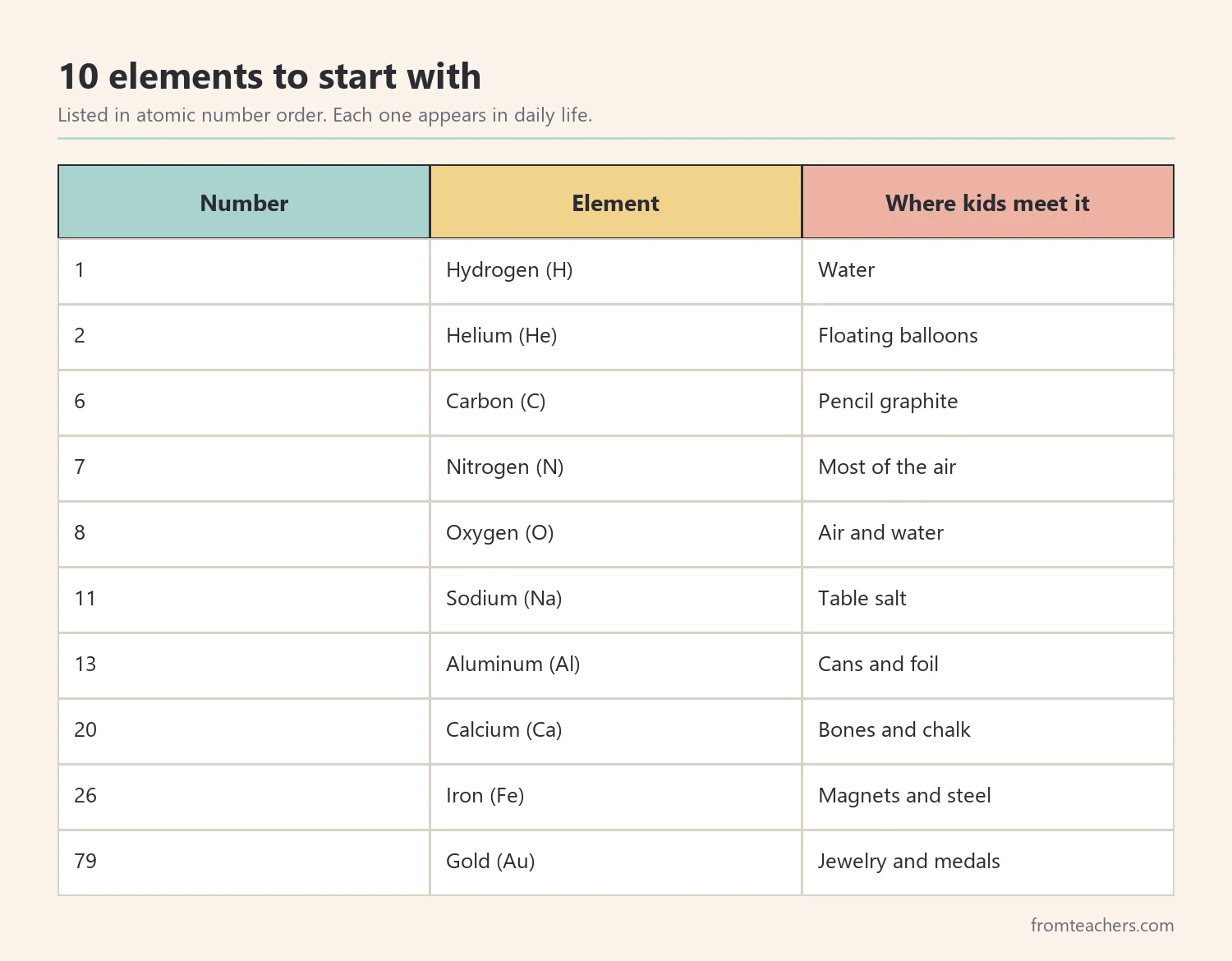
This list picks ten elements children meet in everyday life, from the air they breathe to the coins in their pockets, and presents them in atomic number order. By the end, you will know which elements to start with, one real-life example for each, simple activities, and a gentle way to check what your child remembers.
Examples are fictional. Adapt to your child’s age and interests. Supervise all hands-on activities and never let children handle chemicals unsupervised.
At a glance
- Start with ten elements children can see or touch every day.
- Present them in atomic number order, not a made-up ranking.
- Pair each element with one real example and one short activity.
- Review daily with quick symbol games.
- Keep every activity safe and supervised.
How we chose these ten elements
There is no official list of “first” elements, so we used one clear rule: each element must appear in a child’s daily life in a way they can see or touch, such as water, salt, pencils, cans, or jewelry. We then listed the ten in atomic number order rather than inventing a popularity ranking. That order also helps children notice how the periodic table is organized.
Because each element links to a familiar object, children can keep spotting them long after the lesson ends. In short, these are starting points. Once a child knows these ten, the remaining elements feel much less mysterious.
The ready-made option: one slide per element
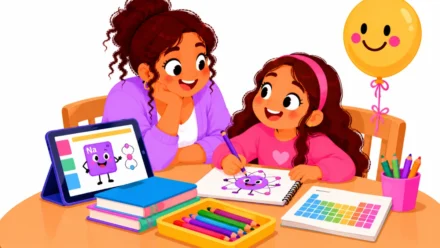
If you want to go beyond ten, the 118 Elements chemistry course for kids walks through every element one at a time. Each of the 118 slides shows the symbol, atomic number, and category, such as nonmetal, noble gas, or lanthanide, plus a short kid-friendly fact and a playful cartoon character.
It works well as a daily “element of the day” routine after your child knows the ten below.
1. Hydrogen (H, atomic number 1)
Where kids meet it: in water. Every water molecule contains two hydrogen atoms and one oxygen atom, which is why water is written H2O.
Fun fact: hydrogen is the lightest element and the most abundant element in the universe. Stars, including our Sun, are mostly hydrogen.
Quick activity: write H2O on a card and build a water molecule with two small and one large ball of clay.
Example: Lina built three water molecules with clay and proudly announced that her glass of water was “full of hydrogen.”
2. Helium (He, atomic number 2)
Where kids meet it: in party balloons that float.
Fun fact: helium is lighter than air, so helium balloons rise. It is a noble gas, which means it rarely reacts with other elements.
Quick activity: compare a helium balloon with a balloon filled by breath. Ask why one floats and one does not.
Example: Lina guessed that her breath balloon was “too heavy.” That opened a short talk about lighter and heavier gases.
3. Carbon (C, atomic number 6)
Where kids meet it: in pencil “lead,” which is actually graphite, a form of carbon. Carbon is also found in all living things.
Fun fact: diamonds and graphite are both made of carbon. The difference is how the atoms are arranged.
Quick activity: draw with a pencil and look at the shiny gray line. Then look at a picture of a diamond and talk about how the same element can look so different.
Example: Lina was amazed that her pencil and a diamond ring were “cousins.”
4. Nitrogen (N, atomic number 7)
Where kids meet it: in the air. Nitrogen makes up about 78 percent of the air we breathe.
Fun fact: plants need nitrogen to grow, which is why many fertilizers contain it.
Quick activity: draw a circle and shade about four fifths of it to show how much of the air is nitrogen.
Example: Lina shaded her “air pie” and was surprised that oxygen was the smaller slice.
5. Oxygen (O, atomic number 8)
Where kids meet it: in every breath and in water.
Fun fact: oxygen makes up about 21 percent of the air. It is also the most abundant element in Earth’s crust by mass, mostly bound up in rocks and minerals.
Quick activity: breathe in slowly and out slowly while naming oxygen and nitrogen, then add oxygen to the clay water molecule from item 1.
Example: Lina connected two elements at once: “Water is hydrogen and oxygen, and air is mostly nitrogen and oxygen.”
6. Sodium (Na, atomic number 11)
Where kids meet it: in table salt, which is sodium chloride.
Fun fact: pure sodium is a soft metal that reacts strongly with water, and chlorine on its own is a toxic gas. Together, they form the safe salt on the dinner table.
Quick activity: look at salt crystals with a magnifying glass. Talk about how combining elements can create something completely different.
Example: Lina thought it was “magic” that two dangerous things made salt. Her parent explained that it is chemistry, not magic.
7. Aluminum (Al, atomic number 13)
Where kids meet it: in soda cans and kitchen foil.
Fun fact: aluminum is the most abundant metal in Earth’s crust. It is light and easy to recycle.
Quick activity: sort recycling and find the aluminum items. Compare the weight of an empty can with a steel food can.
Example: Lina found four cans and a sheet of foil, then made a small poster about recycling aluminum.
8. Calcium (Ca, atomic number 20)
Where kids meet it: in bones, teeth, milk, and chalk.
Fun fact: calcium is a metal, even though we usually meet it in compounds like the ones in bones and seashells.
Quick activity: look at seashells or chalk and talk about calcium compounds in nature.
Example: Lina added “my bones” to her element notebook, with a small drawing of a skeleton.
9. Iron (Fe, atomic number 26)
Where kids meet it: in steel, magnets, nails, and in blood.
Fun fact: iron helps carry oxygen in our blood. Earth’s core is made mostly of iron. Its symbol, Fe, comes from the Latin word “ferrum.”
Quick activity: test which household objects stick to a magnet. Many that stick contain iron.
Example: Lina’s magnet hunt found a fridge door, a paper clip, and a spoon, but not the aluminum can.
10. Gold (Au, atomic number 79)
Where kids meet it: in jewelry, medals, and some electronics.
Fun fact: gold does not rust or tarnish easily, which is one reason ancient gold objects still shine. Its symbol, Au, comes from the Latin “aurum.”
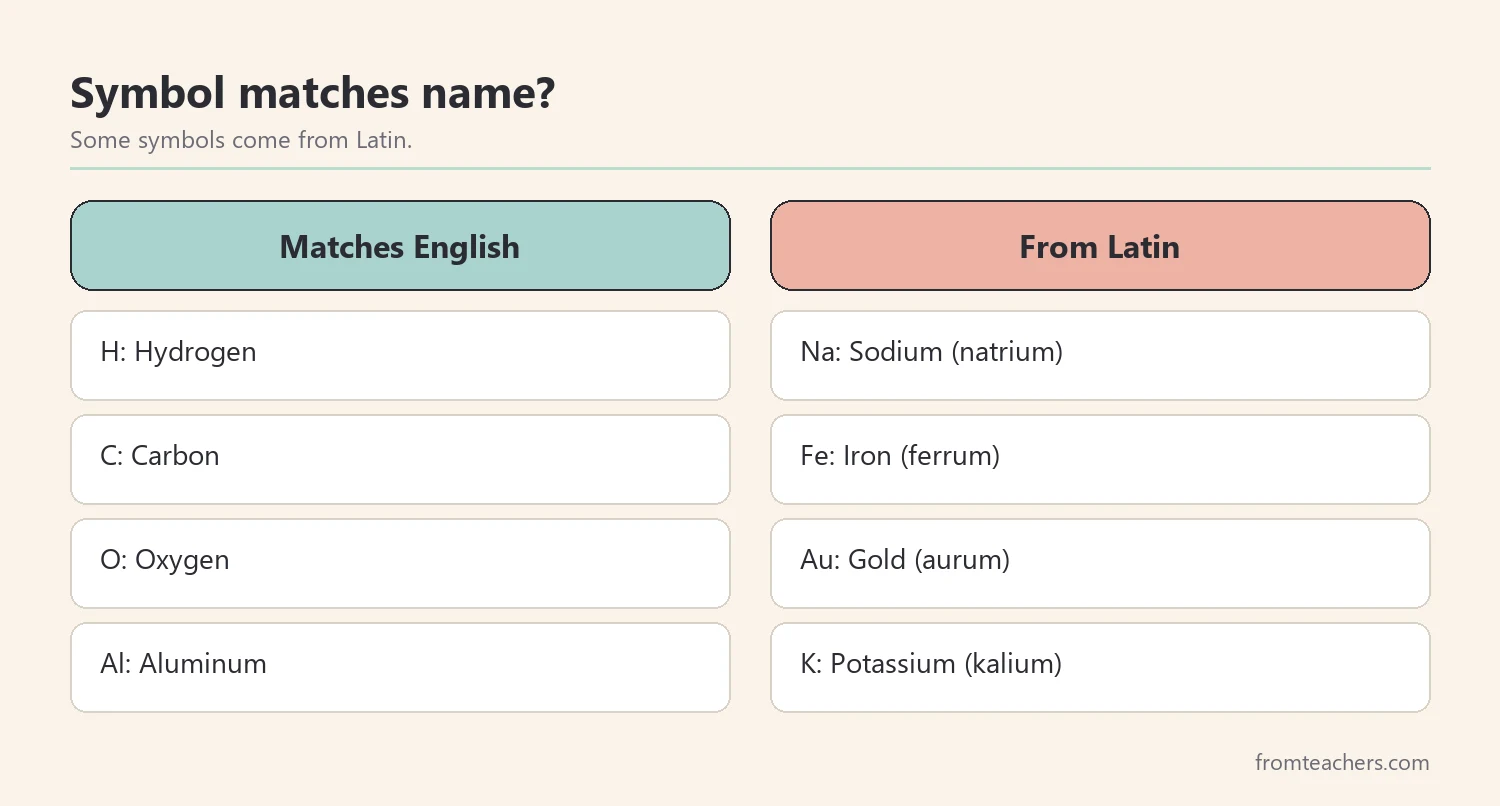
Quick activity: make a “strange symbols” list: Na, Fe, and Au do not match their English names. Ask your child to guess why.
Example: Lina discovered the Latin names and decided Latin was “a secret code for elements.”
Learning the elements kids should learn first, one week at a time
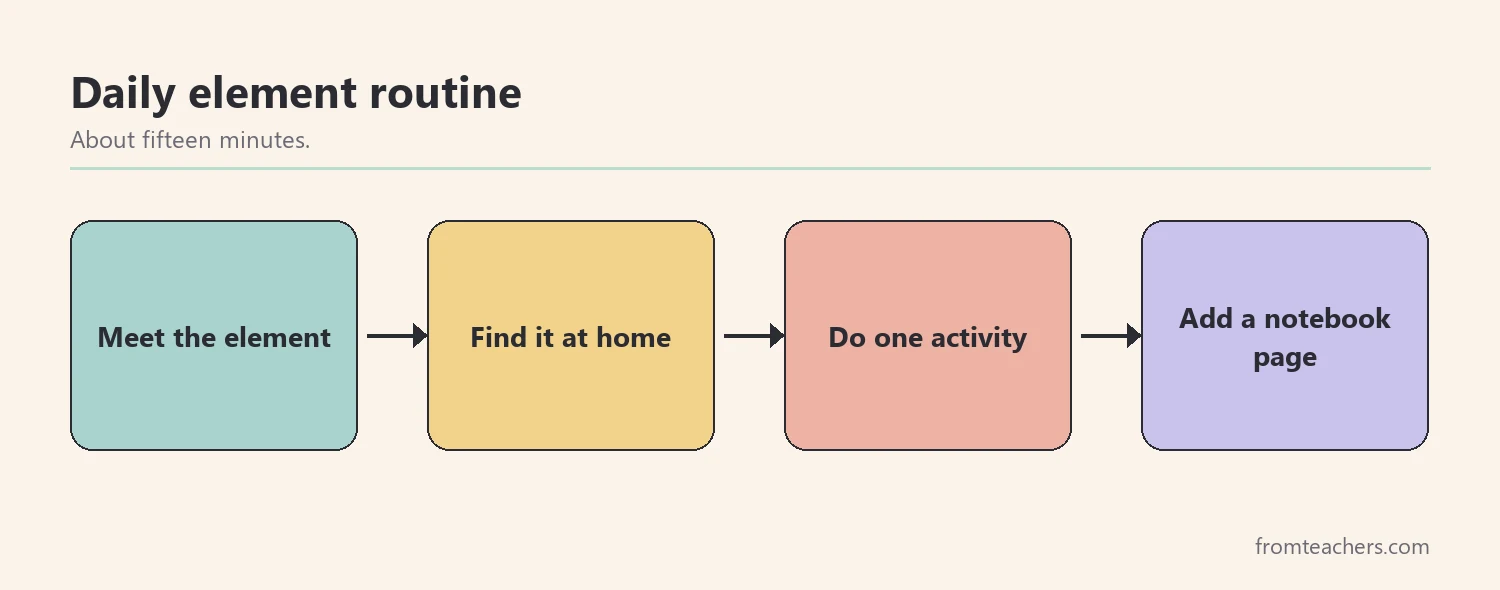
Ten elements fit nicely into a two-week plan: one element a day, five days a week. Each day, introduce the symbol, number, and where we meet it. Then do one short activity and add a page to an element notebook.
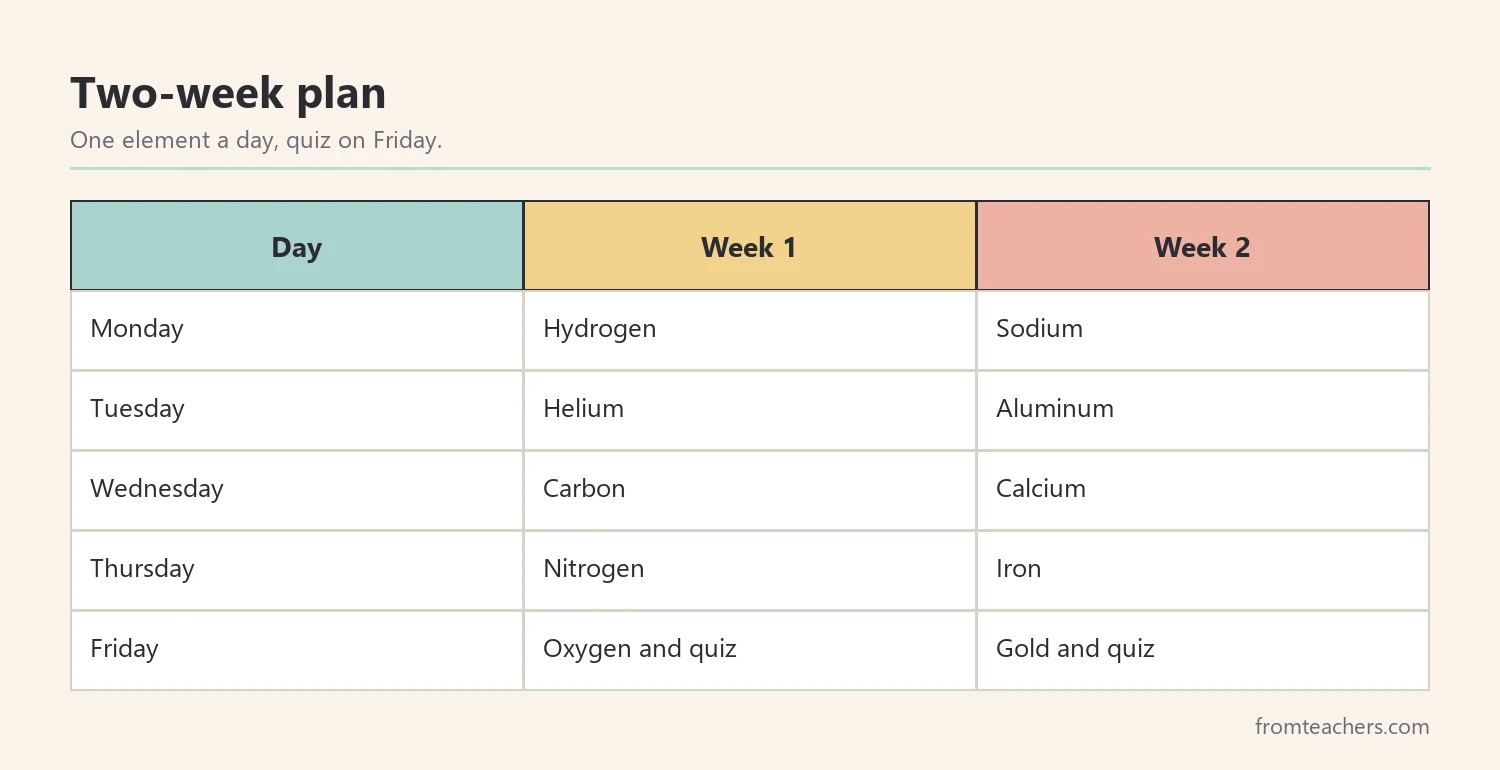
Also, review often. A quick game at the end of each day, such as “I say the symbol, you say the name,” keeps the earlier elements fresh. On Fridays, a short quiz shows what stuck.
Here is how Lina’s Friday quizzes went across her first three weeks, including a review week.
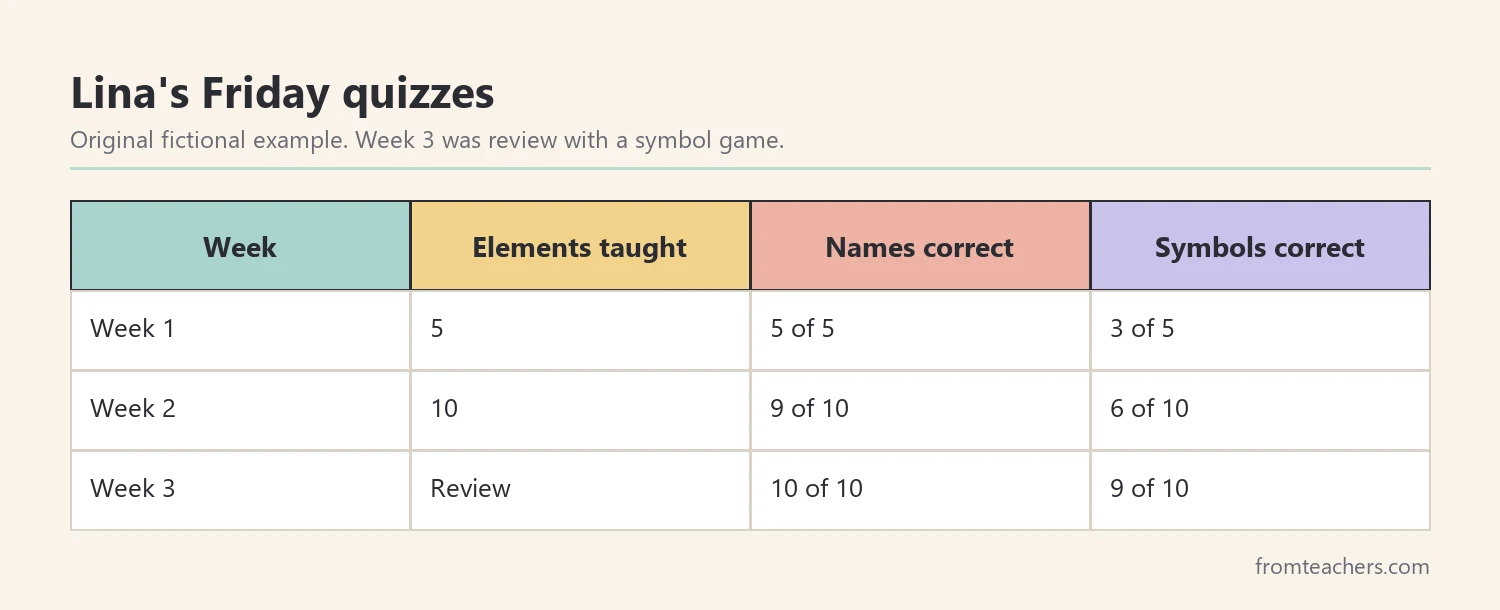
The results were encouraging. Names came first, symbols followed, and the “strange” symbols like Fe and Au took longest, which is common. As a result, her parent added a symbol matching game to week three.
Making the periodic table less scary
Once children know a few elements, show them where those elements sit on the table. Hydrogen and helium are in the top row. Carbon, nitrogen, and oxygen sit next to each other in the second row. Sodium, aluminum, and calcium appear further down, and iron and gold sit in the middle block of metals.
In addition, point out simple patterns. Metals are on the left and in the middle. Nonmetals cluster on the right. Noble gases, like helium, are in the far right column. These patterns help children predict, which is a real scientific skill.
Also, invite questions you cannot answer right away. “Why is gold yellow?” or “Where does helium come from?” are great prompts to look things up together in a trusted reference. Modeling how to find answers is part of science, too.
Moreover, connect elements to stories. Children remember characters better than lists, so cartoon characters, comics, or a simple “element of the day” mascot can make facts stick.
Common mistakes and how to avoid them
- Starting with the whole table. 118 boxes can overwhelm. Fix: start with ten familiar elements.
- Memorizing without meaning. Fix: connect each element to something your child can see or touch.
- Skipping review. Fix: play quick symbol games daily.
- Unsafe experiments. Fix: use safe household observations only, and always supervise.
- Confusing elements and compounds. Fix: explain that water and salt are made of elements joined together.
Questions parents and teachers ask about elements kids should learn first
What age is right for learning elements?
Many children enjoy simple element facts in early elementary school, especially with pictures and stories. Deeper chemistry usually comes later. Follow your child’s curiosity and your curriculum.
Should my child memorize atomic numbers?
It is not necessary at first. Knowing that hydrogen is number 1 and that numbers go up across the table is enough. More detail can come later.
Why do some symbols not match the names?
Some symbols come from Latin names, such as Fe for iron (ferrum), Na for sodium (natrium), and Au for gold (aurum).
What is the difference between an element and a compound?
An element is made of only one kind of atom, such as oxygen. A compound is made of two or more elements joined together, such as water.
How can I make element learning fun?
Use magnets, recycling hunts, clay models, cartoon characters, and quick games. Short, hands-on sessions usually beat long lectures.
Related reading: Homeschooling vs. Public Schooling: Which Path Is Right for Your Child?, Learning Styles Student Success Guide, and 5 Practical Teaching Tips to Boost Classroom Focus and Learning.
You may also need: Dinosaurs: The Complete Student Field Guide.
A companion resource for elements kids should learn first:
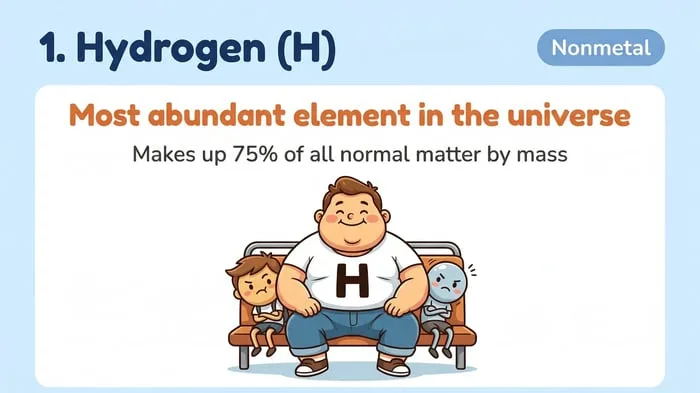
118 Elements: Chemistry for Kids: 118 illustrated slides, one for every element, each showing the symbol, atomic number and category, with a short kid-friendly fact and a playful cartoon character, plus a cover slide.
Sources and scope
- PubChem Periodic Table (NIH): element data including symbols, atomic numbers, and properties.
- Ptable: an interactive periodic table with element properties.
- National Science Teaching Association: resources and guidance for science teachers and families.
This list introduces ten everyday elements for children, with safe observation activities. It does not cover laboratory experiments or handling chemicals, which require proper equipment and supervision.
Key takeaways
- The elements kids should learn first are the ones they can see and touch every day.
- Present them in atomic number order to show how the table is organized.
- Pair each element with one real example and one short activity.
- Review daily with quick games and a short Friday quiz.
- Keep activities safe and supervised.

Leave a Comment