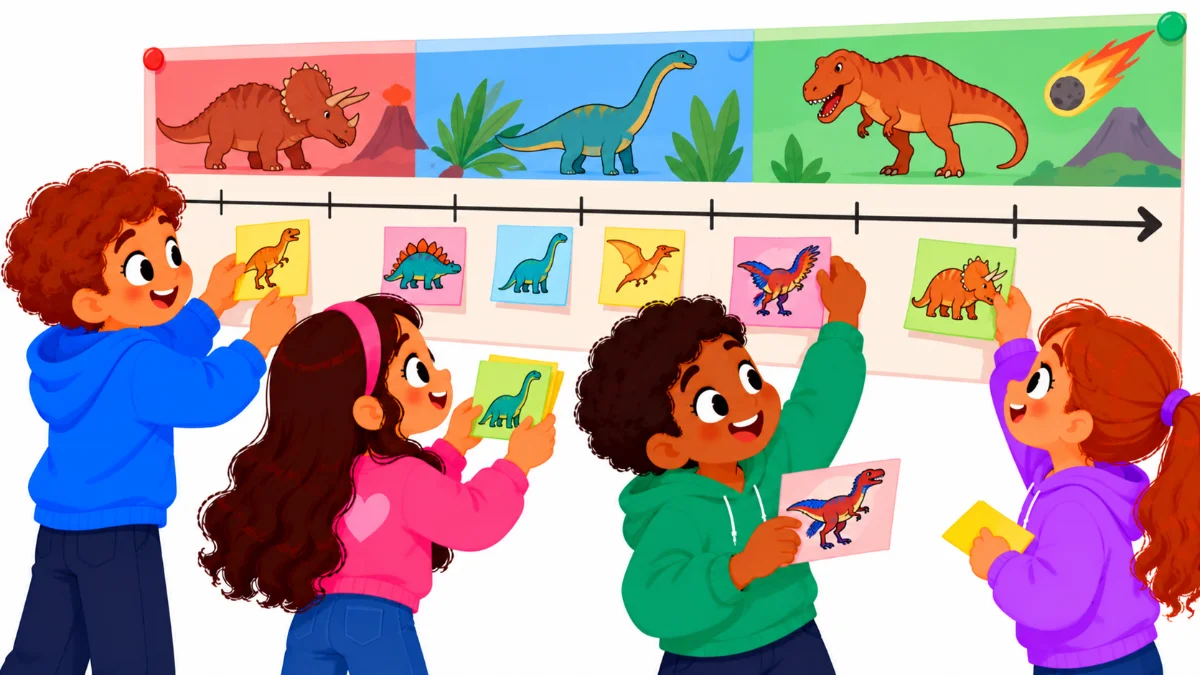

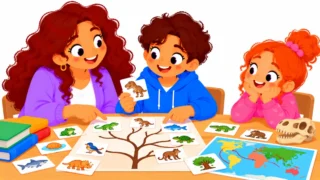
The best dinosaur facts for kids are the ones that surprise them and stay true when they look them up later. Picture a grade 3 classroom during science time. Theo announces that pterodactyls were dinosaurs, his friend insists that T. rex fought Stegosaurus, and the teacher realizes that half of what the class “knows” comes from cartoons.
This list gathers ten accurate dinosaur facts that children love, ordered from the big picture to individual species to the extinction. By the end, you will have a ready set of facts, a simple activity for each one, a myth-busting table, and an easy way to check what children remember.
Examples are fictional. Adapt the depth to the children’s age. Scientific understanding of dinosaurs keeps changing as new fossils are found, so encourage children to check trusted museum sources.
At a glance
- Use a timeline: dinosaurs lived across the Triassic, Jurassic and Cretaceous.
- Birds are living dinosaurs; pterosaurs were not dinosaurs.
- T. rex lived closer in time to us than to Stegosaurus.
- Compare movie dinosaurs with museum reconstructions.
- Teach one fact a day with a short activity.
How we chose and ordered these facts
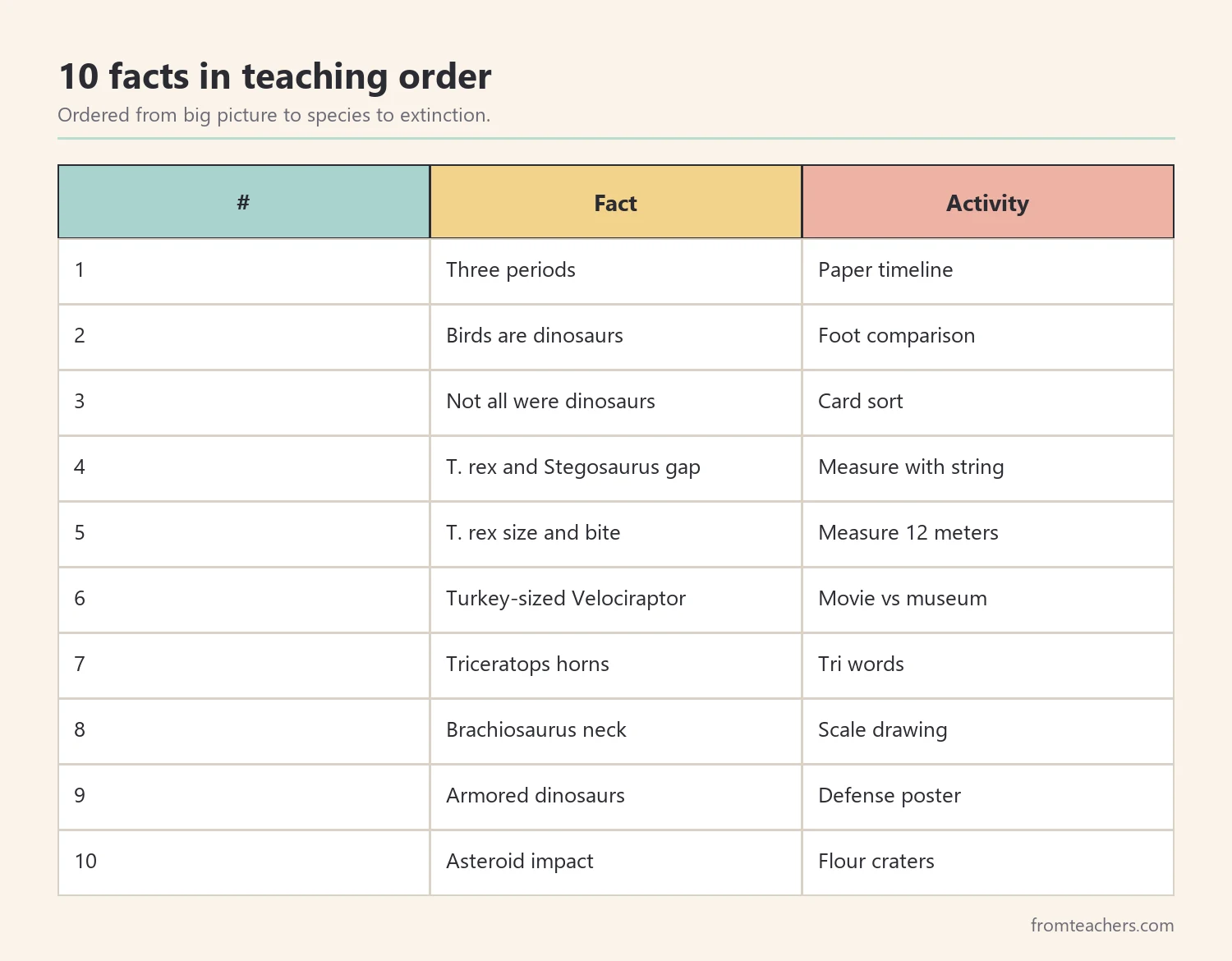
We did not rank these facts by popularity, because there is no reliable way to measure that. Instead, each fact had to meet two criteria: it is widely accepted by museums and paleontologists, and it connects to something children already wonder about. Then we ordered the facts the way a good unit flows: when dinosaurs lived, what they were, famous species, and how their time ended.
As a result, you can teach the list from top to bottom as a two-week mini unit, or pick single facts as warm-ups.
The ready-made option: a complete student field guide
If you want a full illustrated resource, the Dinosaurs: The Complete Student Field Guide has 122 richly illustrated pages. It covers what dinosaurs were, the Triassic, Jurassic, and Cretaceous periods, habitats, ecosystems, and food chains, in-depth profiles of T. rex, Velociraptor, Triceratops, Brachiosaurus, Stegosaurus, and Ankylosaurus with size comparisons, time period, and region, plus fossils, the great extinction, and the link between dinosaurs and birds.
It pairs well with the ten facts below, which follow the same broad path.
1. Dinosaurs lived across three periods
The fact: dinosaurs lived during the Mesozoic Era, which is divided into the Triassic, Jurassic, and Cretaceous periods. Non-bird dinosaurs disappeared about 66 million years ago.
Why kids love it: the huge numbers feel like a mystery to solve.
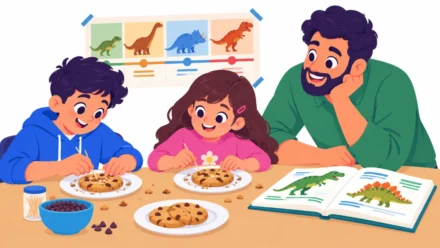
Activity: make a timeline on a long strip of paper. Mark the three periods and add each dinosaur as you learn about it.
Example: Theo’s class stretched a paper timeline along the hallway wall. Every new dinosaur got a sticky note in its period.
2. Birds are living dinosaurs
The fact: scientists consider birds to be living dinosaurs, descended from small meat-eating dinosaurs called theropods.
Why kids love it: it means dinosaurs are not completely gone. A pigeon outside the window is part of the dinosaur family.
Activity: compare a chicken foot photo with a theropod footprint drawing. Ask children what they notice.
Example: Theo shouted, “The school chickens are dinosaurs!” That became the class motto for the week.
3. Not every prehistoric reptile was a dinosaur
The fact: flying pterosaurs, such as Pteranodon, and swimming reptiles, such as plesiosaurs and mosasaurs, lived at the same time as dinosaurs but were not dinosaurs.
Why kids love it: it corrects a very common mix-up, and children enjoy catching adults out.
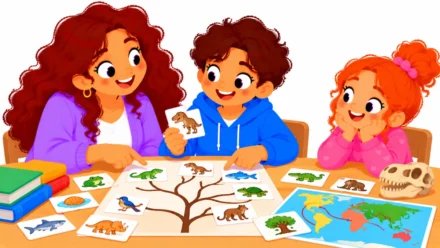
Activity: sort picture cards into “dinosaur” and “not a dinosaur.”
Example: Theo moved his “pterodactyl” card to the “not a dinosaur” pile, a little reluctantly.
4. T. rex lived closer in time to us than to Stegosaurus
The fact: Stegosaurus lived in the Late Jurassic, about 150 million years ago. T. rex lived at the very end of the Cretaceous, about 68 to 66 million years ago. The gap between them is larger than the gap between T. rex and humans.
Why kids love it: it breaks the cartoon image of all dinosaurs living together.
Activity: use the timeline to measure the distances with string.
Example: Theo’s group measured with yarn and was amazed at how far apart the two dinosaurs were.
5. T. rex had a powerful bite
The fact: Tyrannosaurus rex was one of the largest meat-eating dinosaurs, about 12 meters (around 40 feet) long, with large teeth and a very strong bite.
Why kids love it: it is the dinosaur almost every child knows.
Activity: measure 12 meters in the hallway or playground to feel the size.
Example: The class lined up to show the length of a T. rex. It took most of the class.
6. Velociraptor was about the size of a turkey and had feathers
The fact: real Velociraptor was much smaller than in movies, roughly turkey-sized, and fossil evidence shows it had feathers.
Why kids love it: it surprises them, because movies show it as a large, scaly hunter.
Activity: compare a movie image with a museum reconstruction. Discuss why movies change facts.
Example: Theo drew a “real” Velociraptor with feathers and labeled it “fact,” next to a “movie” version labeled “fiction.”
7. Triceratops had three horns and a big frill
The fact: Triceratops was a plant eater with two long horns above its eyes, a shorter horn on its nose, and a large bony frill. It lived at the end of the Cretaceous, at the same time and in the same region as T. rex.
Why kids love it: the name is easy to decode: “tri” means three.
Activity: find other words with “tri,” such as triangle and tricycle.
Example: Theo listed five “tri” words and drew a Triceratops riding a tricycle.
8. Brachiosaurus had a very long neck
The fact: Brachiosaurus was a huge plant-eating sauropod from the Late Jurassic. Its front legs were longer than its back legs, which helped it reach high plants.
Why kids love it: it is one of the tallest dinosaurs children learn about.
Activity: compare its height with the school building using a simple scale drawing.
Example: Theo’s group drew Brachiosaurus next to the school. Its head reached above the roof.
9. Stegosaurus and Ankylosaurus had built-in armor
The fact: Stegosaurus had large plates along its back and spikes on its tail. Ankylosaurus, from the Late Cretaceous, had bony armor and a heavy tail club.
Why kids love it: armor and weapons make great drawings and stories.
Activity: design a “defense” poster comparing the two.
Example: Theo decided Ankylosaurus was “a dinosaur tank,” which is exactly how many museums describe it.
10. An asteroid impact ended the age of non-bird dinosaurs
The fact: most scientists agree that a large asteroid struck Earth about 66 million years ago, near what is now the Yucatan Peninsula in Mexico. The impact, along with other changes, led to the extinction of the non-bird dinosaurs.
Why kids love it: it is dramatic, and it connects back to fact 2: birds survived.
Activity: drop small pebbles into a tray of flour to model craters.
Example: Theo’s crater experiment led to a lively question: “Then how did birds survive?”
Busting dinosaur myths
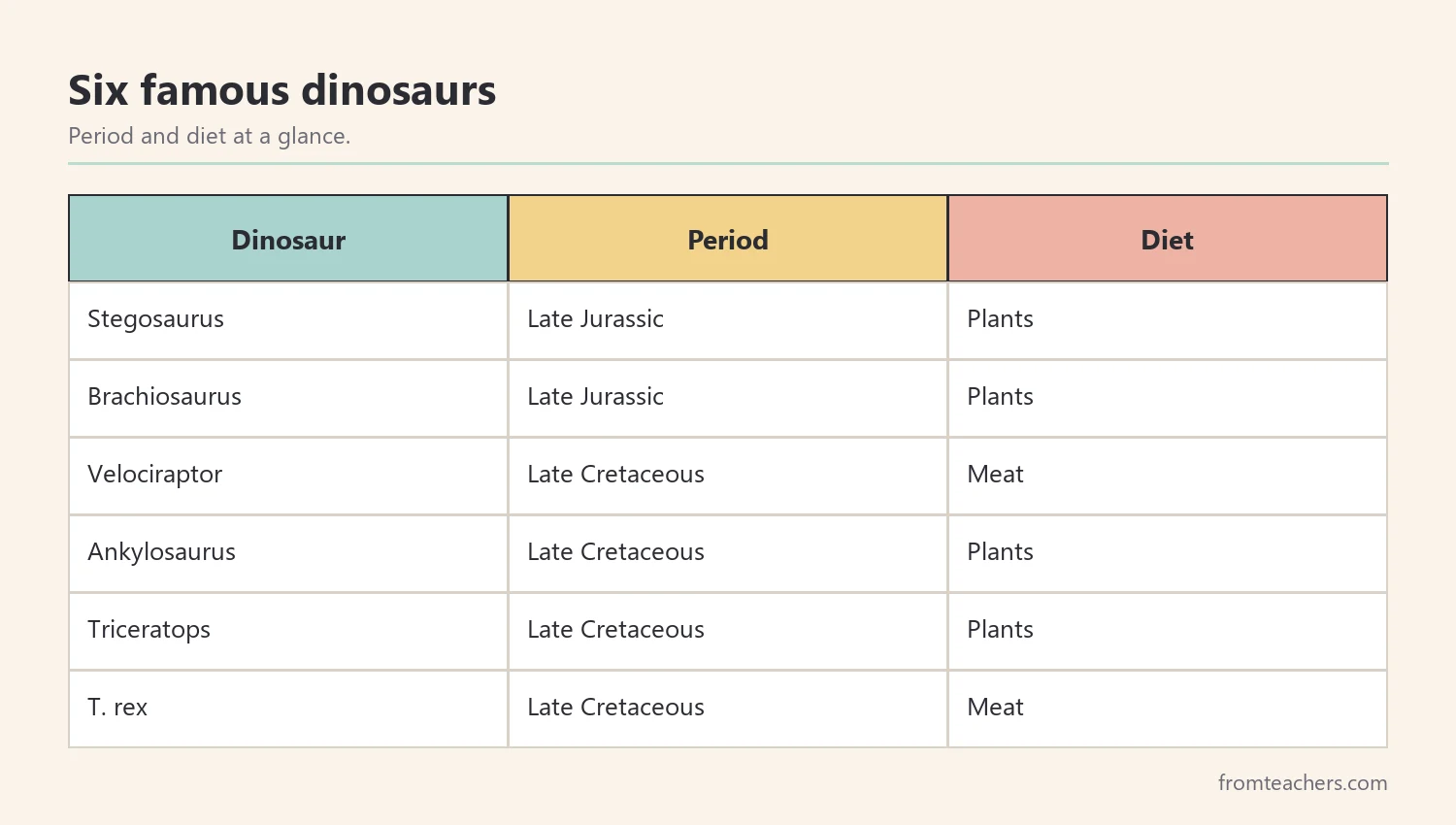
Children often arrive with ideas from movies and toys. A myth-busting table helps them sort fact from fiction, which is also a good lesson in checking sources.
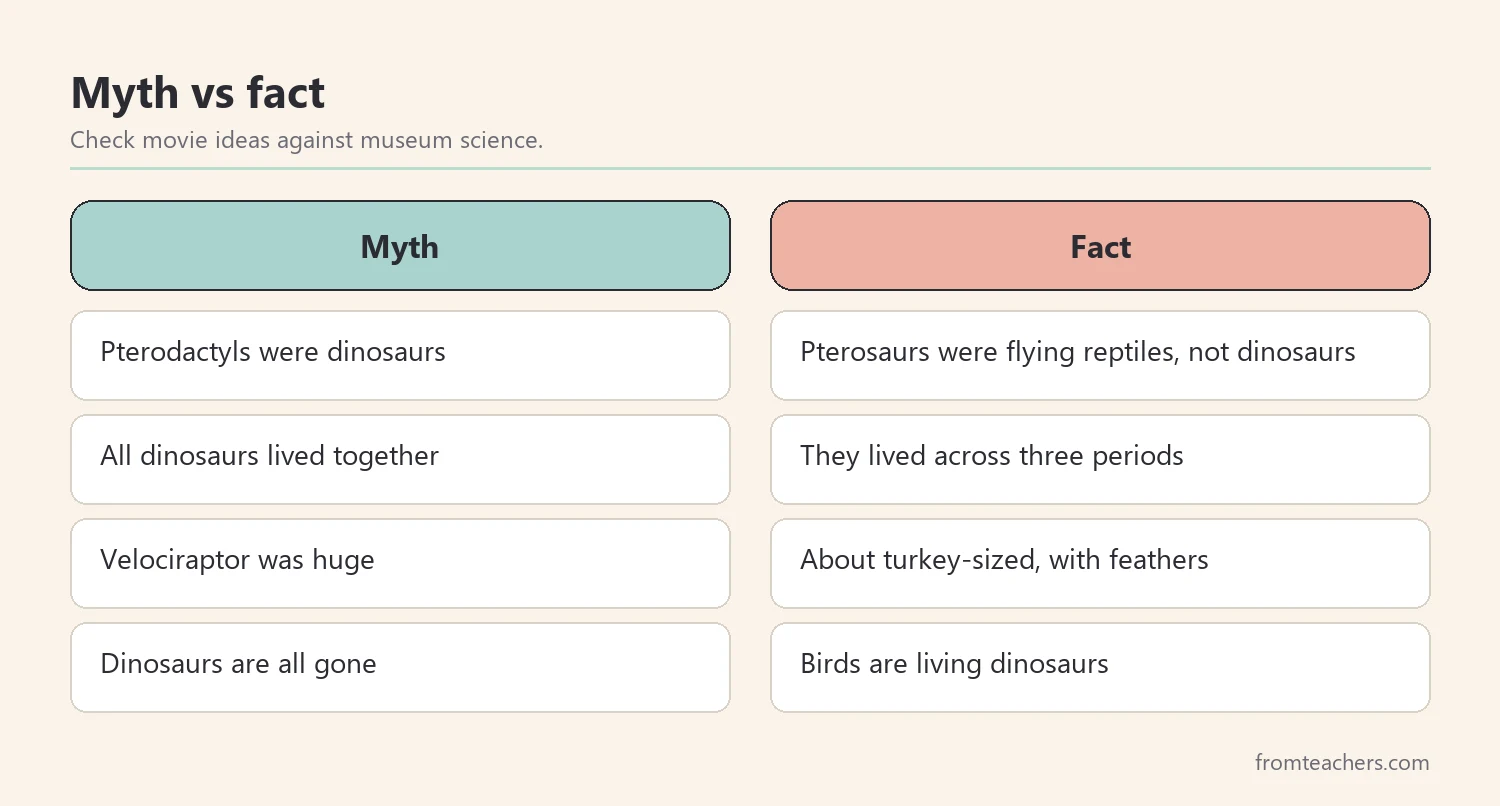
In addition, show children how scientists know these things. Fossils, footprints, and even fossilized eggs and nests are clues. Dinosaur fossils have been found on every continent, including Antarctica, which children often find surprising.
Teaching dinosaur facts for kids in a short unit
Ten facts fit nicely into a two-week unit. Teach one fact a day, add it to the timeline, and finish with a short activity. On Fridays, run a quick quiz or a “fact or fiction” game.
Here is how Theo’s class did on their Friday checks.
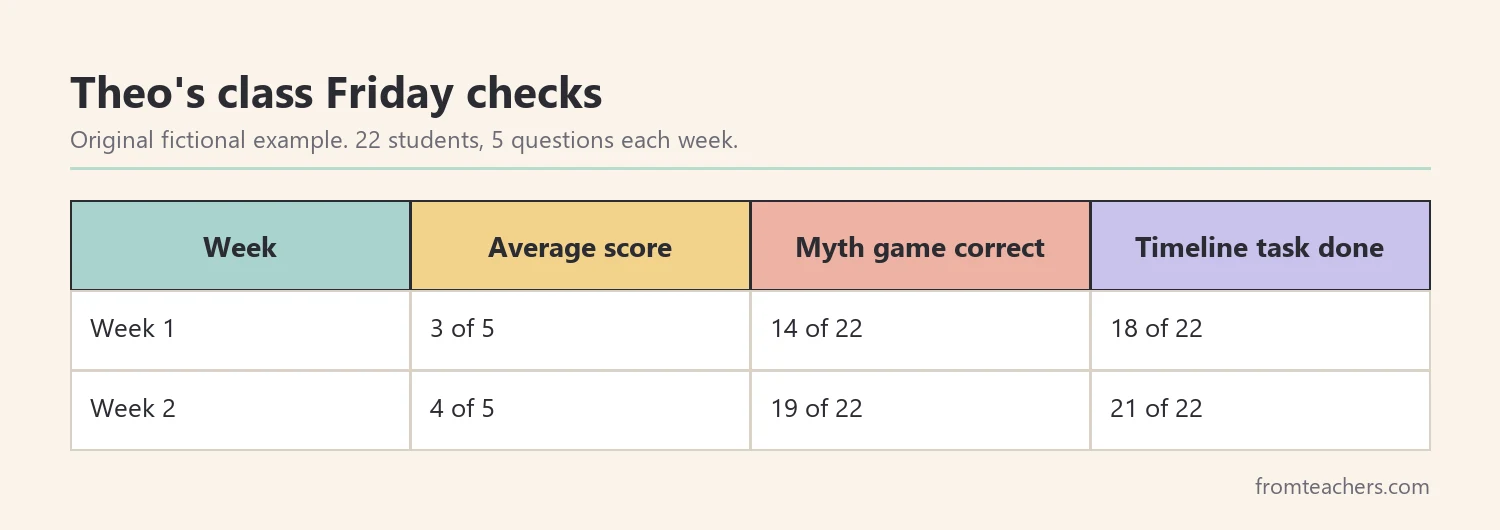
The class improved steadily, and the myth-busting game was the biggest favorite. As a result, the teacher added a short “fact or fiction” warm-up to every science lesson for the rest of the term.
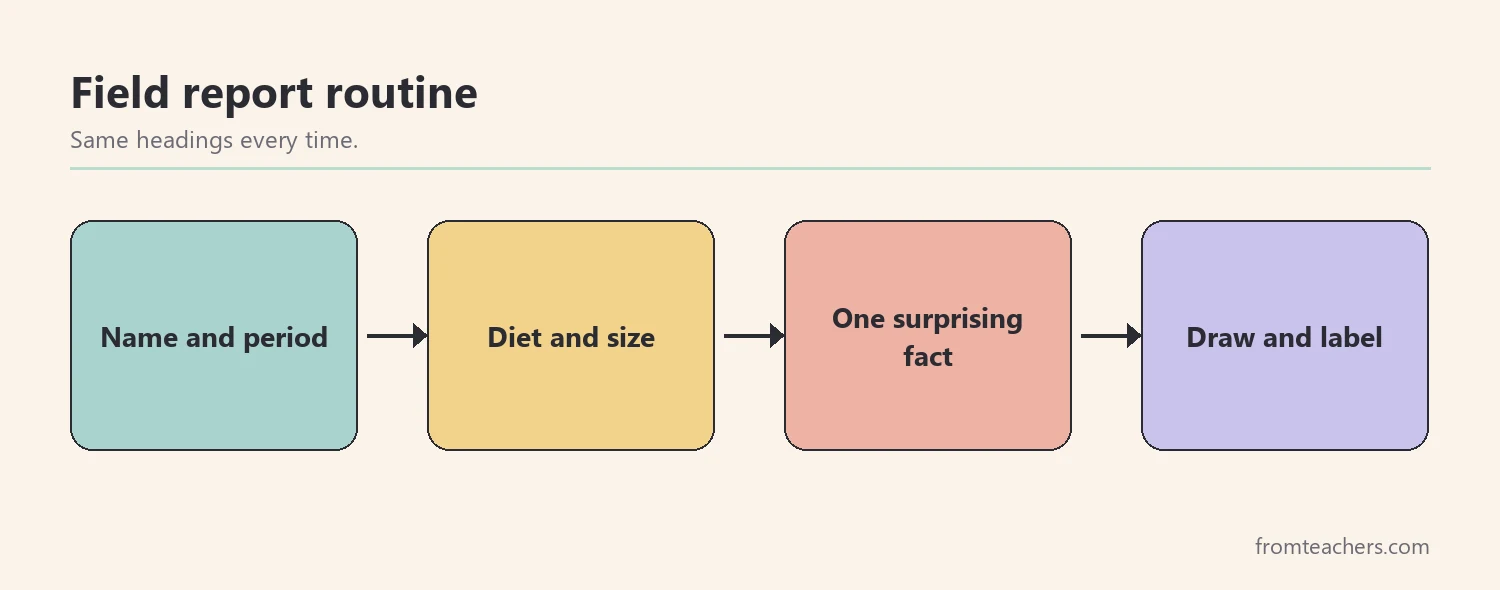
Also, connect the unit to reading and writing. Children can write a short field report about one dinosaur, using the same headings each time: name, period, diet, size, and one surprising fact. This structure helps reluctant writers and makes the facts stick.
For families, the same routine works at home. A museum visit, a library book, or a nature walk to look for birds can each become a “field trip” with a short report afterward. Children who are hesitant to write can dictate their report or record it as a short audio clip, then draw the dinosaur.
Moreover, invite children’s questions. Some will have no answer yet, because paleontologists are still investigating. That is a valuable lesson about how science works.
Common mistakes and how to avoid them
- Mixing up pterosaurs and dinosaurs. Fix: sort picture cards early in the unit.
- Showing all dinosaurs together. Fix: use a timeline from day one.
- Relying on movies. Fix: compare movie images with museum reconstructions.
- Stating uncertain ideas as fact. Fix: use phrases like “scientists think” when evidence is still debated.
- Too many numbers. Fix: use comparisons like “as long as a bus” for younger children.
Questions teachers and parents ask about dinosaur facts for kids
What age are these facts for?
They suit roughly ages 6 to 11. Younger children enjoy the size and myth facts, while older children can handle the timeline and extinction details.
Were all dinosaurs huge?
No. Many dinosaurs were small, some about the size of a chicken. The giants are just the most famous.
Did dinosaurs and people live at the same time?
No. Non-bird dinosaurs died out about 66 million years ago, long before humans appeared. Birds, however, are living dinosaurs.
How do scientists know what color dinosaurs were?
For most dinosaurs, color is unknown. For a few feathered dinosaurs, scientists have studied tiny structures in fossil feathers to suggest colors. It is a good example of how new tools reveal new facts.
Where can children see real fossils?
Natural history museums and some national parks display fossils. Many museums also have online collections children can explore from home.
Related reading: Homeschooling vs. Public Schooling, Learning Styles Student Success Guide, and 5 Practical Teaching Tips to Boost Classroom Focus and Learning.
You may also need: 118 Elements: Chemistry for Kids.
A companion resource for dinosaur facts for kids:
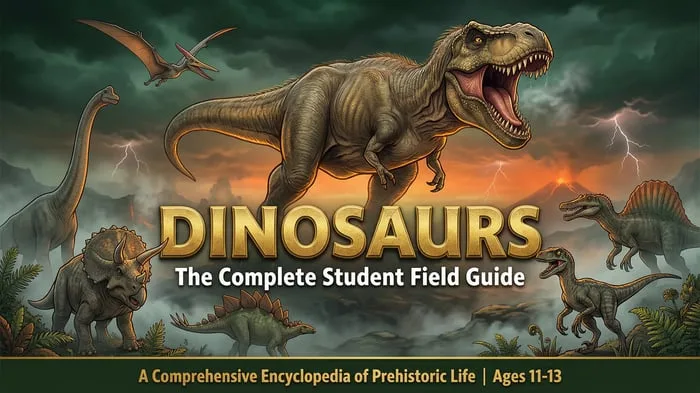
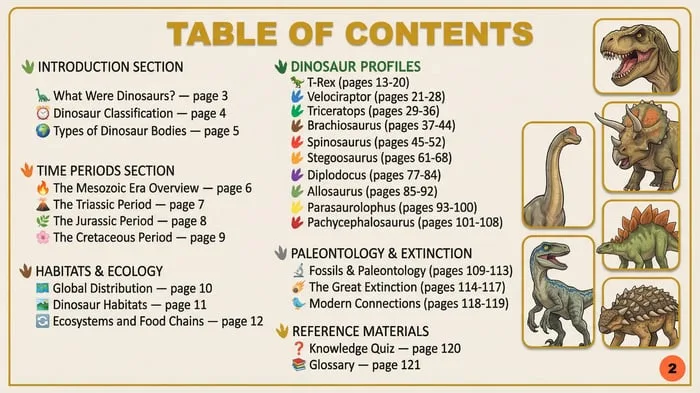
Dinosaurs: The Complete Student Field Guide: 122 illustrated pages covering what dinosaurs were, the Triassic, Jurassic and Cretaceous periods, habitats and food chains, profiles of T. rex, Velociraptor, Triceratops, Brachiosaurus, Stegosaurus and Ankylosaurus, and a paleontology and extinction section.
Sources and scope
- Natural History Museum, London: Dino Directory: profiles of many dinosaurs with period, diet and size.
- University of California Museum of Paleontology: educational material on fossils, dinosaurs and the history of life.
- National Park Service: Fossils and Paleontology: information about fossils in US national parks.
- National Science Teaching Association: resources for science teachers and families.
This list covers widely accepted dinosaur facts for children ages about 6 to 11. Scientific understanding changes as new fossils are found, so check museum sources for the latest findings.
Key takeaways
- The best dinosaur facts for kids are accurate, surprising, and easy to check.
- Use a timeline so children see that dinosaurs lived across three periods.
- Teach that birds are living dinosaurs and pterosaurs were not dinosaurs.
- Bust movie myths by comparing them with museum reconstructions.
- Teach one fact a day with a short activity and a Friday check.





Leave a Comment