

Time estimation activities help middle schoolers answer a question many of them get wrong every day: “How long will this take?” Picture a grade 8 resource room. Kai says his science lab report will take “like ten minutes.” He starts it at 9:45 pm the night before it is due, and it takes almost two hours. The next day, he is tired, upset, and convinced he is “bad at school.”
Kai’s problem is not effort. Like many students with executive function challenges, he has trouble predicting time. The good news is that estimation is a skill students can practice. This list gives you eight activities, ranked from the quickest to run to the ones that build a longer habit. By the end, you will know how to teach students to guess, check, and adjust their time predictions.
Examples are fictional. Adapt to the student’s goals and agreed supports. This is guidance, not a diagnosis.
At a glance
- Every activity follows one cycle: predict, do, check, reflect.
- Quick games like the one-minute guess build interest.
- Breaking tasks into steps gives more realistic totals.
- A weekly log shows each student’s personal pattern and buffer.
- Backward planning turns estimates into a start date.
How we ranked these activities
We ranked the eight time estimation activities by one clear rule: how quickly a teacher can run them in a normal class. Activities at the top fit into five minutes. Activities near the bottom work best as a routine over several weeks.
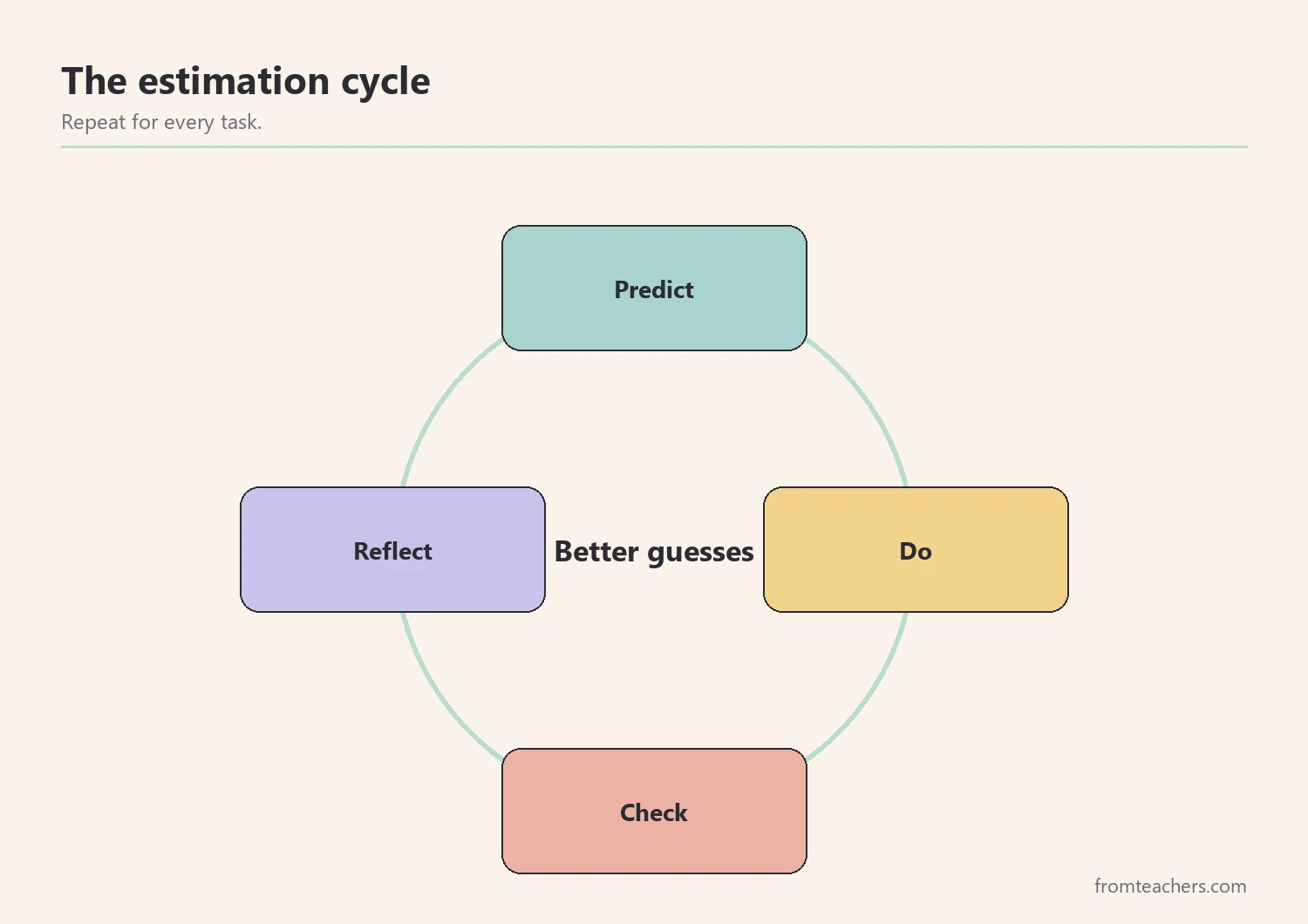
Every activity follows the same simple cycle: predict, do, check, and reflect. That cycle is the heart of time estimation, because students only improve when they compare their guess with what really happened.

The ready-made option: a task planning and self-monitoring sheet
Students need a place to write predictions and actual times side by side. The executive functioning sheet for student task planning and self-monitoring includes a task planning section where students break a task into up to five steps and estimate time for each, a time management section with start time, end time, actual time taken, and whether they stayed on schedule, a materials checklist, self-monitoring questions, and a self-evaluation with an effort rating and next steps.
As a result, every task becomes a small estimation practice, and students build a record of their own patterns.
1. The one-minute guess
What it is: students close their eyes and raise a hand when they think one minute has passed.
Why it works: it is quick, fun, and shows students that their inner sense of time may run fast or slow.
How to use it: run it at the start of class. Show the real time on a timer afterward. Repeat once a week and let students track their own results.
Example: Kai raised his hand at 34 seconds. His surprise opened a good discussion about why tasks often take longer than he expects.
2. Guess the task time
What it is: before a short, familiar task, such as copying homework into a planner, students write how long they think it will take. Then they time it.
Why it works: it gives instant feedback on a real school task.
How to use it: use tasks of two to ten minutes. Students write “guess” and “actual” in two columns.
Example: Kai guessed one minute for writing down homework. It took four.
3. Everyday time list
What it is: students time ordinary routines: brushing teeth, packing a bag, walking to class, making a sandwich.
Why it works: real times become reference points for future planning. “A shower takes me 12 minutes” is useful when planning a morning.
How to use it: send home a simple list of five routines to time with a phone or kitchen timer. Compare results in class.
4. Break it into steps, then estimate
This is often the most useful of all time estimation activities for longer assignments.
What it is: students break a task into steps and estimate each step separately, then add the times.
Why it works: people tend to underestimate whole tasks. Estimating smaller steps usually gives a more realistic total.
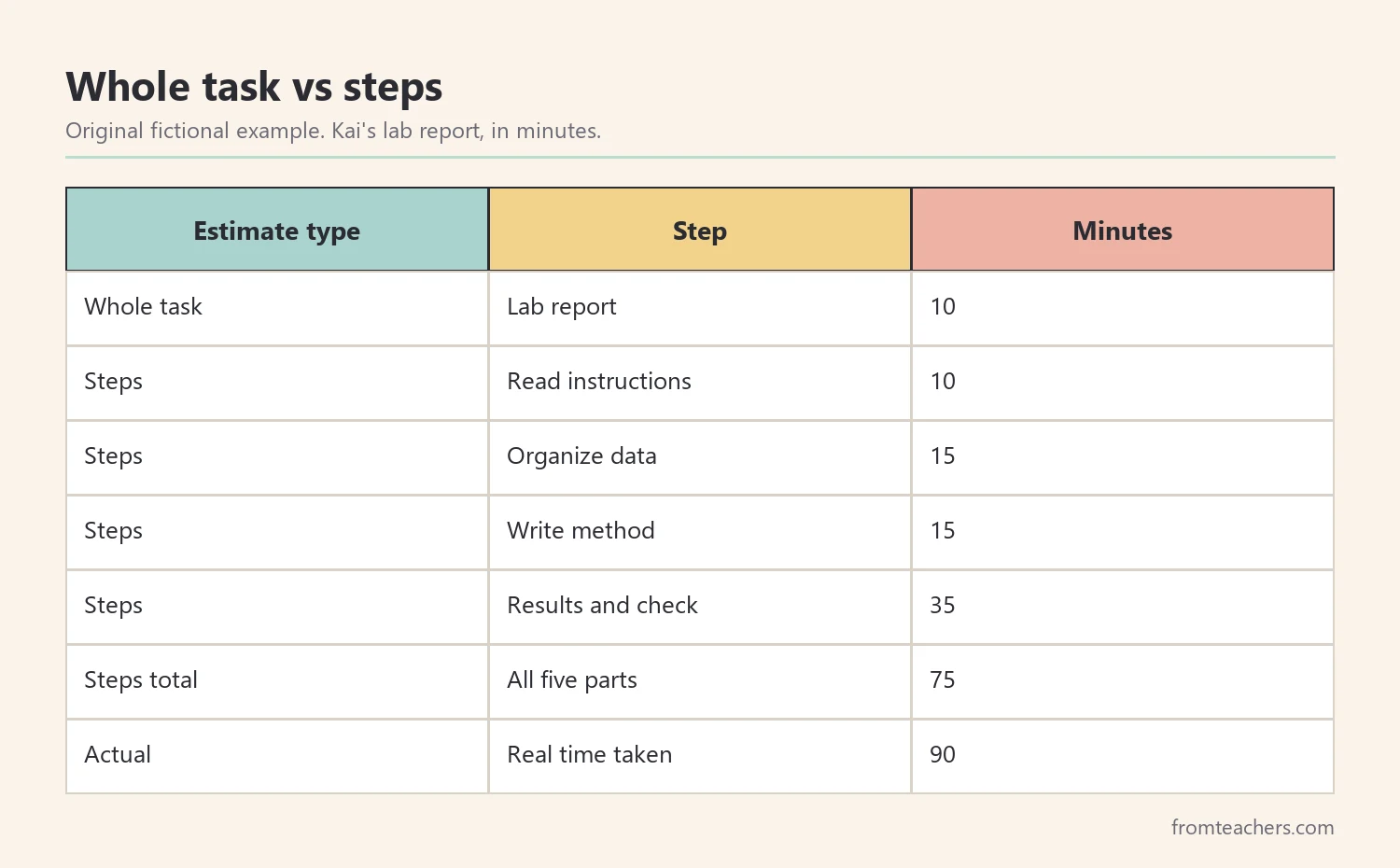
How to use it: model with a real assignment. For a lab report, steps might be: read the instructions, organize the data, write the method, write results, and check.
Example: when Kai broke his lab report into five steps, his estimate jumped from 10 minutes to 75 minutes. It actually took 90, which was much closer.
5. The estimation buffer
What it is: students add extra time to every estimate, such as one quarter more, to cover surprises.
Why it works: real work includes distractions, missing materials, and tricky parts. A buffer makes plans more realistic.
How to use it: after a few weeks of data, students can calculate their own typical gap and set a personal buffer.
Example: Kai’s data showed he usually needed about a quarter more time than his step estimates. He began adding that buffer.
6. Visual timers during work
What it is: a timer that shows time passing, such as a shrinking colored disk or a progress bar.
Why it works: many students with ADHD or executive function challenges find visible time easier to track than numbers on a clock.
How to use it: set the timer to the student’s estimate for one step. When it ends, the student checks progress and decides whether to continue or adjust.
7. Weekly estimation log
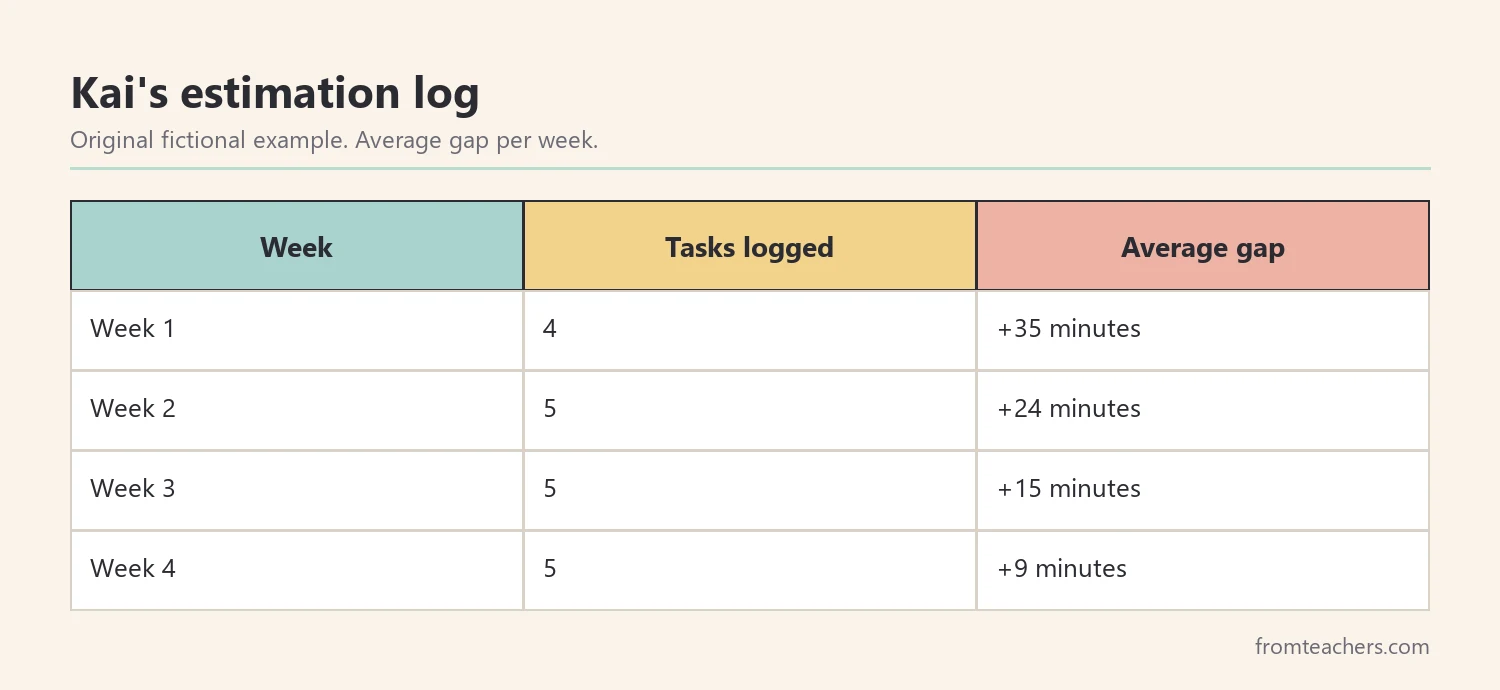
What it is: a simple log of three to five tasks per week, each with an estimate, actual time, and difference.
Why it works: patterns appear over time. A student may learn they underestimate writing but estimate math well.
How to use it: review the log for five minutes each Friday. Ask, “Which kind of task surprised you most?”
Example: Kai’s four-week log is shown in Figure 3.
8. Backward planning from a due date
What it is: students start from a deadline and place each step on a calendar, working backward.
Why it works: it combines estimation with scheduling, so students can see when to start.
How to use it: use a paper calendar. Students write the due date, list steps with estimates and buffers, then place steps on earlier days.
Example: for a book project due Friday, Kai placed reading on Monday and Tuesday, notes on Wednesday, and writing on Thursday, with a short check on Friday morning.
Teaching time estimation activities step by step
First, start with low-stakes games, such as the one-minute guess, so students enjoy the idea. Next, move to real school tasks and steps. Then add buffers and logs once students have some data. Finally, connect estimation to planning with backward calendars.
In addition, keep the tone curious, not critical. A large gap between guess and actual time is information, not failure. Celebrate when the gap shrinks.
A sample 20-minute lesson
If you want to introduce the skill in one session, this simple lesson works in a resource room, advisory, or study skills class.
First, open with the one-minute guess (3 minutes). Record a few results on the board without names, so students see that almost everyone is off. Next, show a real assignment and ask the class to guess how long it will take as a whole (2 minutes). Write the guesses down.
Then break the same assignment into steps together and estimate each step (7 minutes). Add the step estimates and compare the total with the first guesses. Students usually notice that the step total is much larger. Ask, “Which number do you trust more, and why?”
After that, introduce the idea of a buffer (3 minutes). Explain that surprises always happen, so planners add extra time. Finally, have each student choose one task for tonight, write a guess, and promise to write the actual time tomorrow (5 minutes).
The next day, start class by checking those predictions. This follow-up is the most important part. Without it, the lesson stays an interesting idea instead of a habit.
For example, in Kai’s class, the follow-up showed that 9 of 11 students underestimated their homework. Kai’s gap was 25 minutes. Instead of feeling embarrassed, he joked that he was “in good company,” and the class agreed to keep a shared log for the month.
Supporting different learners
Some students need extra structure while they build this skill. The table below shows simple adjustments.
| Need | Adjustment |
|---|---|
| Trouble reading clocks | Visual timers and simple minutes only |
| Anxiety about being wrong | Private logs, no sharing |
| Trouble starting tasks | Estimate only the first step |
| Writing difficulties | Circle time ranges instead of writing |
Moreover, if a student has an IEP or 504 plan, check whether time management goals or accommodations already exist. Estimation practice can support those goals directly, and the data can be shared at reviews.
Parents can help too. Families can time evening routines, use the same estimate and check columns for homework, and talk about surprises without blame. A short shared language, such as “What’s your guess?” and “How close were you?”, keeps school and home consistent.
Common mistakes and how to avoid them
- Estimating whole projects only: break tasks into steps first.
- Skipping the check: without the actual time, students cannot improve.
- Criticizing big gaps: treat gaps as data and praise improvement.
- No buffer: teach students to add extra time based on their own pattern.
- Doing it once: estimation improves with regular practice over weeks.

Questions teachers and parents ask about time estimation activities
Why do some students struggle so much with time?
Time management is one of the executive function skills. Some students, including many with ADHD, find it harder to sense and plan time. It can improve with practice and supports.
How often should students practice?
Short practice two or three times a week works well. A weekly review of the log helps students notice patterns.
Should students use phones as timers?
Phones can work at home, but they can be distracting in class. A simple visual timer or kitchen timer may be better at school.
What is a good goal for improvement?
Aim for the gap between estimate and actual time to shrink over several weeks. Exact targets depend on the student and task.
Can these activities help with homework battles?
Often, yes. When students know a task takes 40 minutes, not 10, they can plan when to start, which reduces late-night stress.
Related reading: ADHD support strategies for class and home, special education: a complete guide.
A companion resource for time estimation activities:
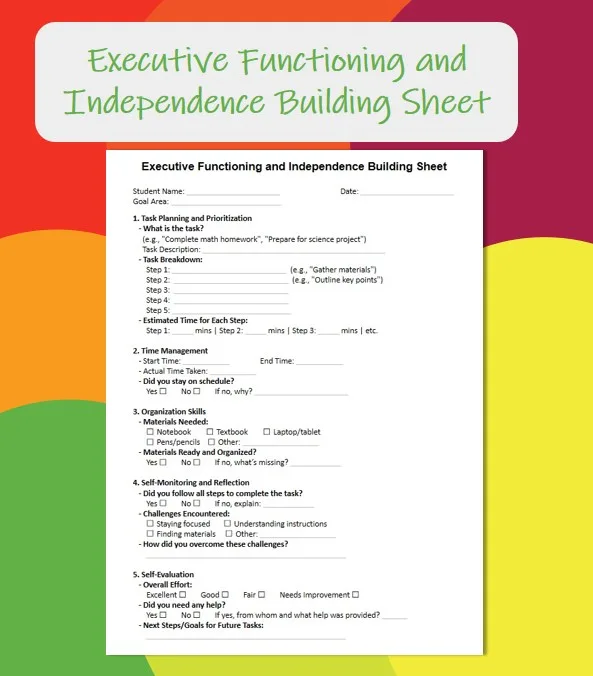
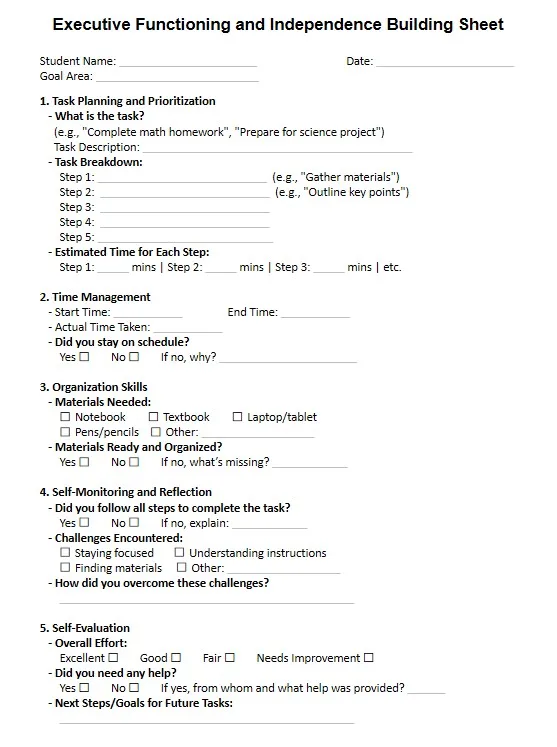
Executive Functioning Sheet: Student Task Planning & Self-Monitoring Tool: a one-page sheet with task planning and prioritization in up to five steps with time estimates, time management with start, end and actual time, a materials checklist, self-monitoring and reflection questions, and a self-evaluation with next steps.
You may also need: Executive Function Guide: Why Smart Students Get Stuck.
Sources and scope
- CHADD: information on ADHD, including time management and executive function.
- Understood.org: articles on executive function and time management for families and teachers.
- Child Mind Institute: resources on ADHD and organization skills.
- National Center for Learning Disabilities: resources on supporting students with learning and attention issues.
This list covers classroom and home activities to practice estimating time. It does not diagnose ADHD or executive function difficulties or replace an evaluation.
Key takeaways
- Good time estimation activities follow one cycle: predict, do, check, reflect.
- Start with quick games, then move to real tasks broken into steps.
- Logs reveal personal patterns, and buffers make plans realistic.
- Backward planning connects estimates to a calendar and a start date.
- Keep it curious and blame-free, and celebrate shrinking gaps.










Leave a Comment