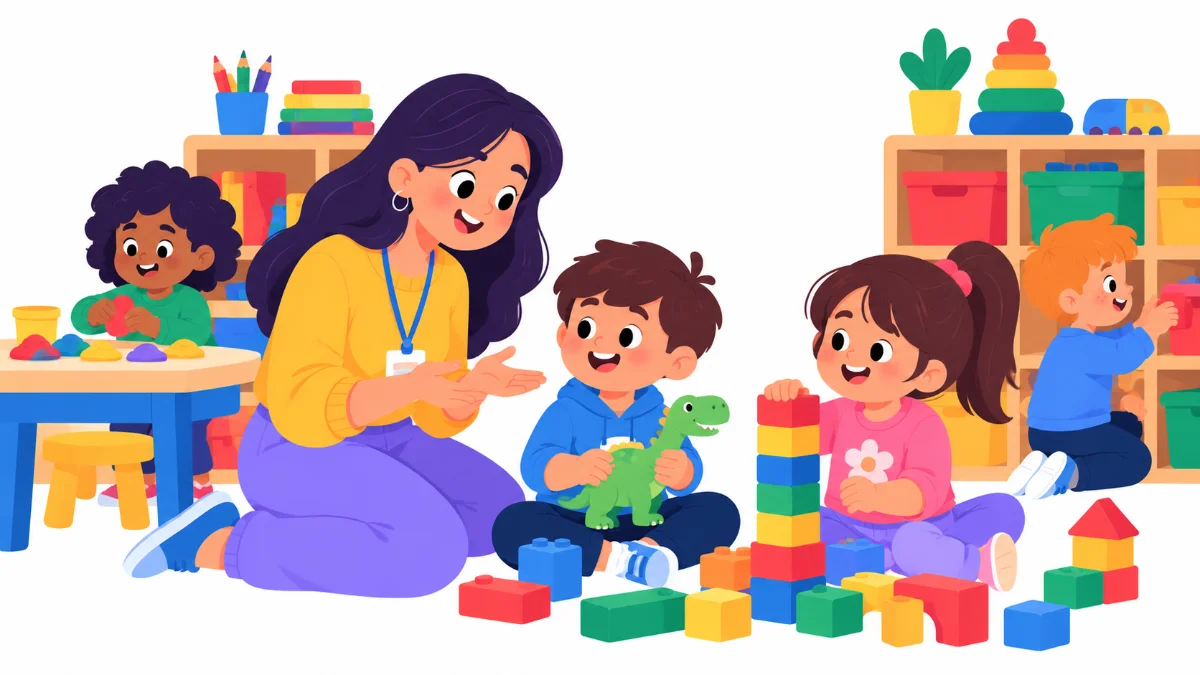

Pragmatic language in preschool is the social side of talking: taking turns, greeting friends, joining play and staying on topic. Picture Theo, age 4. He knows many words and can name every dinosaur in the classroom book. Yet at the play dough table he talks only about dinosaurs, walks away when a friend answers, and grabs toys instead of asking. His teacher, Ms. Alvarez, wonders whether this is typical for his age or something to watch.
This list is for preschool and pre-K teachers, assistants and early childhood staff. It describes seven signs that a child may need more support with pragmatic language in preschool, ordered by how easily you can see them during a normal day. For each sign, you will learn what it looks like, what is usually typical at this age, how to observe it and what to try in class. You will also see how to record what you notice and when to talk with families and a speech-language pathologist (SLP).
Examples are fictional. Young children develop at different rates. This list is guidance for observation, not a diagnosis. Only qualified professionals can evaluate a child’s communication.
At a glance
- Pragmatic language in preschool is still developing, so single moments mean little.
- Look for patterns across several days, activities and partners.
- Write down what you see, not labels or guesses.
- Simple classroom supports, such as modeling and visuals, help many children.
- Share observations with families and the SLP when a pattern continues.
How this list is ordered
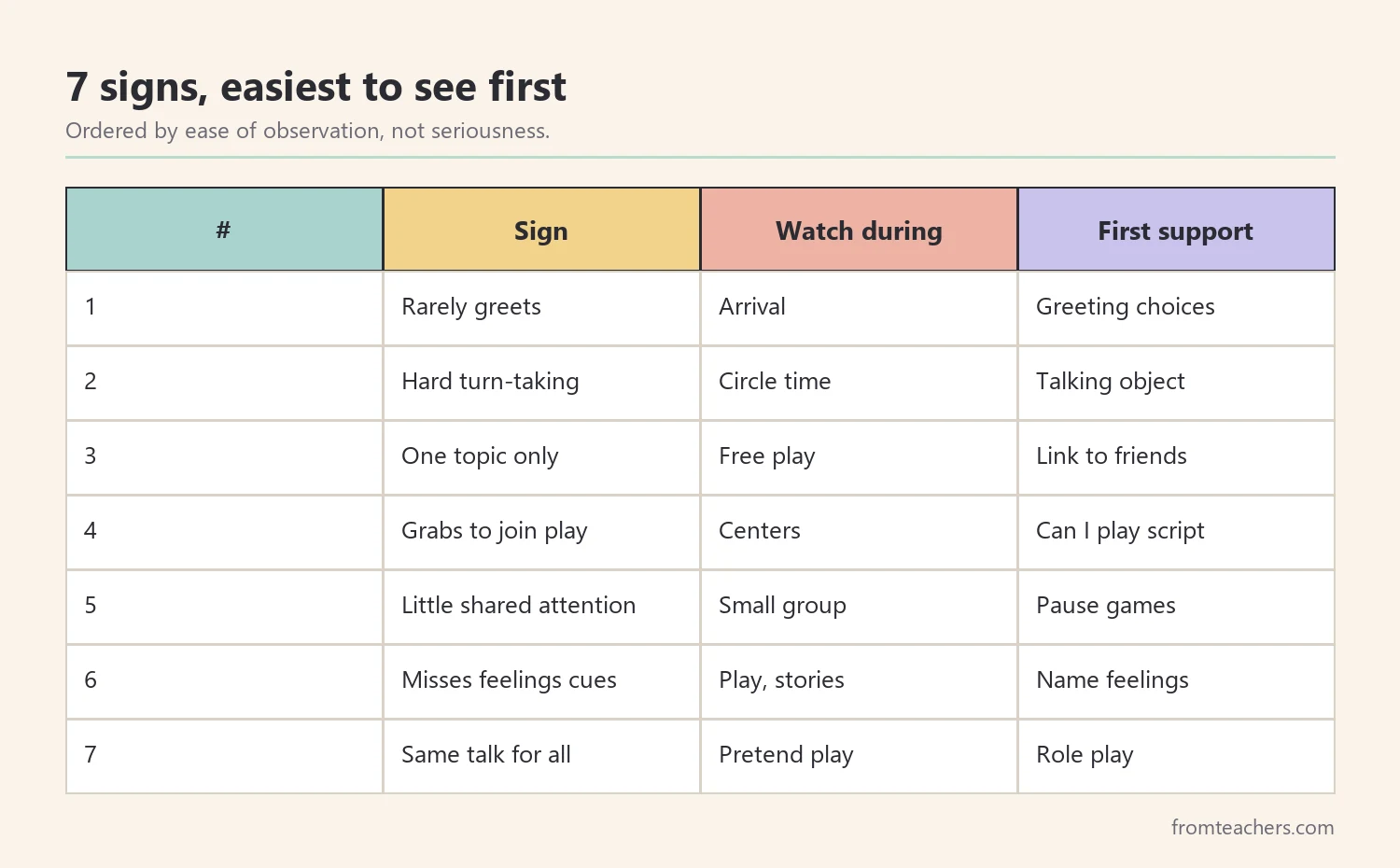
We ordered the seven signs by how easy they are to observe during a regular preschool day. The first signs show up in almost every activity, such as greetings and turn-taking. The later signs need a closer look, such as understanding tone or adjusting talk for different listeners.
Importantly, this is not a ranking of seriousness. Every child is different, and many preschoolers show some of these behaviors at times. Organizations such as ASHA describe how social communication skills grow through the early years. What matters is a pattern that continues and gets in the way of play and learning. Figure 1 shows the seven signs.
1. Rarely greets or responds to greetings
First, watch arrival time. Most preschoolers respond in some way when a familiar adult or friend says hello, with a word, a wave or a smile.
What it may look like: the child walks past greetings every day, even with familiar people, and does not respond with words, gestures or eye gaze.
What to try: model greetings warmly and offer choices, such as a wave, a high five or “hi.” A greeting visual at the door can help too.
Example: Theo often walked straight to the dinosaur shelf. Ms. Alvarez added a picture choice board for greetings. Within two weeks, he chose a high five most mornings.
2. Has trouble taking turns in conversation
Next, notice back-and-forth talk, a core part of pragmatic language in preschool. Conversations at this age are short, but children usually begin to listen and respond.
What it may look like: the child talks over others, does not wait for an answer or walks away while a friend is responding.
What to try: use a “talking object,” such as a small toy passed between speakers at circle time. Turn-taking games with simple rules also help pragmatic language in preschool.
Example: At circle, Theo held the talking dinosaur, said one sentence and passed it. Gradually, he started waiting for a friend’s answer.
3. Stays on one favorite topic
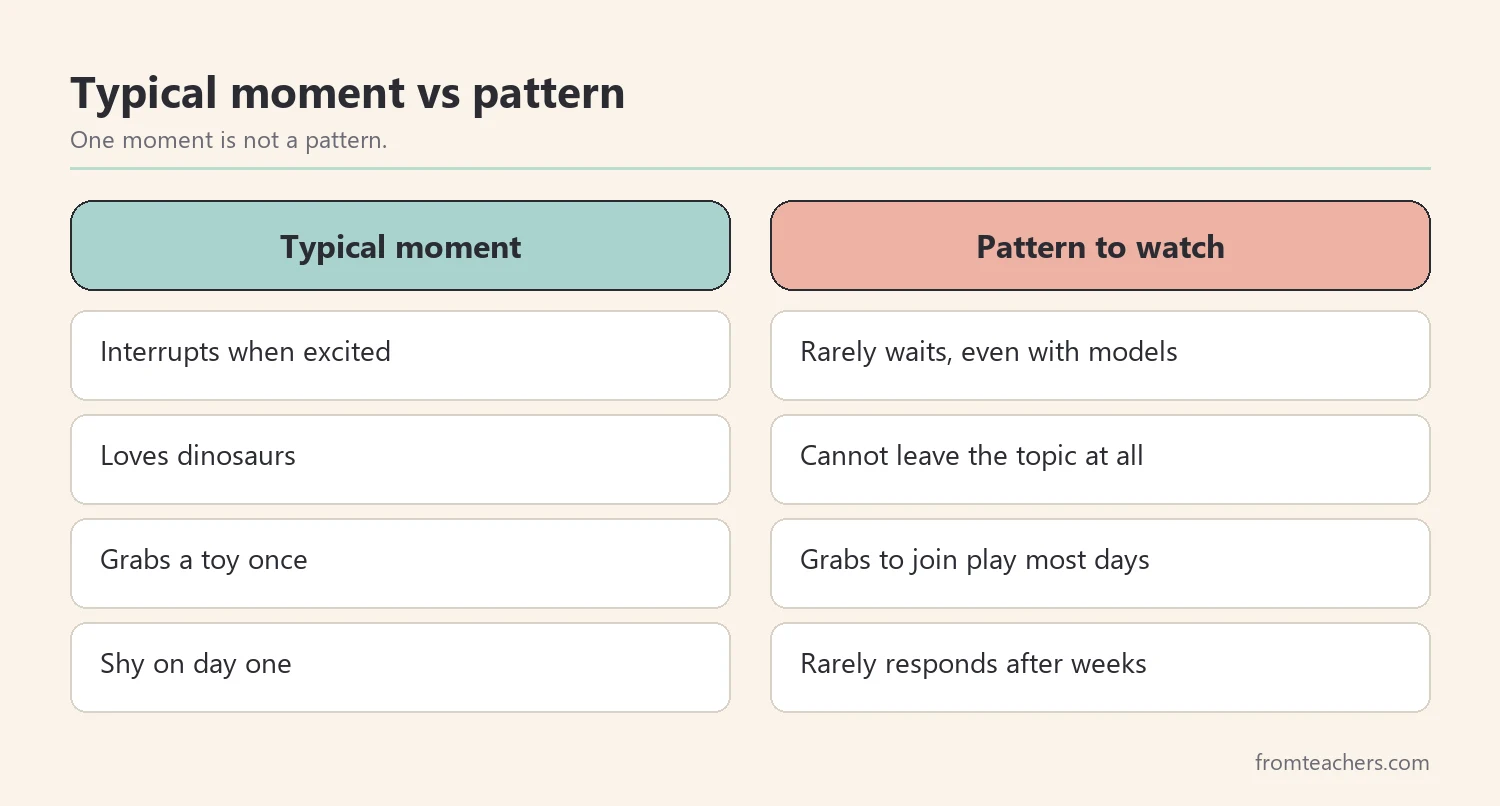
Many young children love one topic. That is normal. However, it may be a sign to watch when the child cannot shift to a friend’s topic even briefly.
What it may look like: every conversation returns to trains, dinosaurs or a TV show, and the child does not respond to what others say.
What to try: connect the favorite topic to the friend’s interest, such as “Your dinosaur can visit Mia’s farm.” Praise any comment about a friend’s idea.
Example: Theo’s dinosaur joined the block tower game. He commented once on his friend’s tower, and Ms. Alvarez named it right away.
4. Joins play by grabbing or pushing
Joining play is a big social skill and a clear window into pragmatic language in preschool. Many children learn to ask, watch first or bring a toy to share.
What it may look like: the child often grabs toys or pushes into a group, even after reminders, and seems unsure how to join.
What to try: teach a short script: “Can I play?” or “I have a truck too.” Practice it with puppets, then coach it during real play.
Example: Ms. Alvarez practiced “Can I play?” with Theo using puppets. At the sand table, she whispered the script and he used it.
5. Uses little eye gaze or gesture to share attention
Young children often point, show or look back and forth to share something exciting. This is sometimes called joint attention.
What it may look like: the child rarely shows objects to others, points to share interest or looks to see if an adult noticed.
What to try: play face-to-face games, such as bubbles or peekaboo, and pause before the fun part. Respect the child’s comfort, because eye contact is not the only way to show attention.
Example: During bubbles, Ms. Alvarez paused. Theo pointed at the wand and looked at her, a moment she recorded in her notes.
6. Misses tone of voice or facial expressions
Understanding feelings from faces and voices is a quieter part of pragmatic language in preschool, and it is still developing. Even so, many children begin to notice when a friend is sad or upset.
What it may look like: the child keeps playing roughly when a friend cries, or does not seem to notice an adult’s serious voice.
What to try: name feelings often: “Mia’s face looks sad. Her tower fell.” Use feelings books and mirror games.
Example: After a story about feelings, Theo pointed to the sad face and said, “Mia sad.” That was progress worth recording.
7. Talks the same way to everyone
Finally, the hardest sign to see is adjusting talk for different listeners. Older preschoolers often simplify speech for a baby or speak more politely to a visitor.
What it may look like: the child uses the same loud voice and topics with babies, friends and visitors, and does not notice when a listener is confused.
What to try: pretend play with roles, such as doctor and patient or store and customer, gives practice. Ask, “How would you talk to a baby doll?”
Example: In the pretend clinic, Theo used a soft voice for the baby doll after a model. Ms. Alvarez noted that he needed the model first.
How to observe pragmatic language in preschool
Observation works best when it is regular and simple. Instead of writing long notes, use a checklist that rates each skill by how often you see it, such as never, rarely, sometimes, often or always. The pragmatic skills checklist for social communication uses this kind of five-point frequency scale for ten skills, with space for notes.
Moreover, observe in several settings: arrival, free play, snack, circle and outdoor play. A child may greet easily at snack but not at arrival. Figure 3 shows how Ms. Alvarez recorded Theo over four weeks.

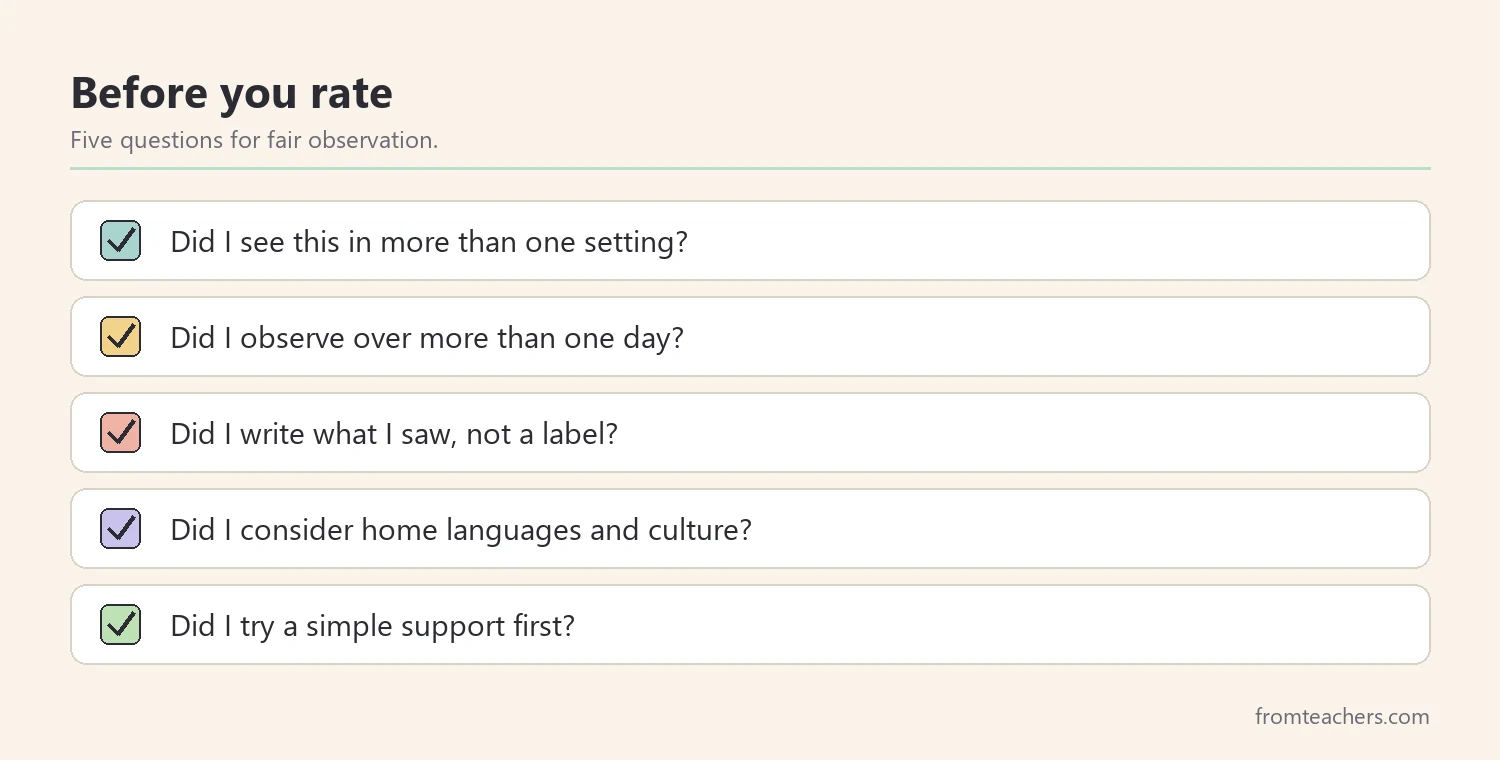
Before you rate, check the five questions in Figure 4. They keep observations fair and useful.
Daily routines that build pragmatic language in preschool
You do not need special lessons to support social communication. In fact, the preschool day is full of natural practice. The key is to plan small moments on purpose and to model the words children need.
| Routine | Skill to practice | Simple idea |
|---|---|---|
| Arrival | Greeting | Greeting choice board |
| Snack | Requesting | Child asks a friend to pass the cup |
| Circle | Turn-taking | Talking object |
| Centers | Joining play | “Can I play?” script |
| Cleanup | Working together | Partner jobs |
For example, snack time is ideal for practicing requests. Instead of handing out cups, let children ask a friend. Similarly, partner jobs at cleanup give a reason to talk and cooperate. These routines support pragmatic language in preschool for every child, not only those you are watching closely.
In addition, plan which adult models which skill. When the teacher and assistant both coach the same script, children hear it many times a day. Consistent modeling is one of the simplest ways to strengthen pragmatic language in preschool, and it fits naturally into play-based learning. Over a few weeks, you will often see children start using the scripts with each other, even without an adult nearby. That kind of carryover is exactly what good support for pragmatic language in preschool looks like.
When to talk with families and the SLP
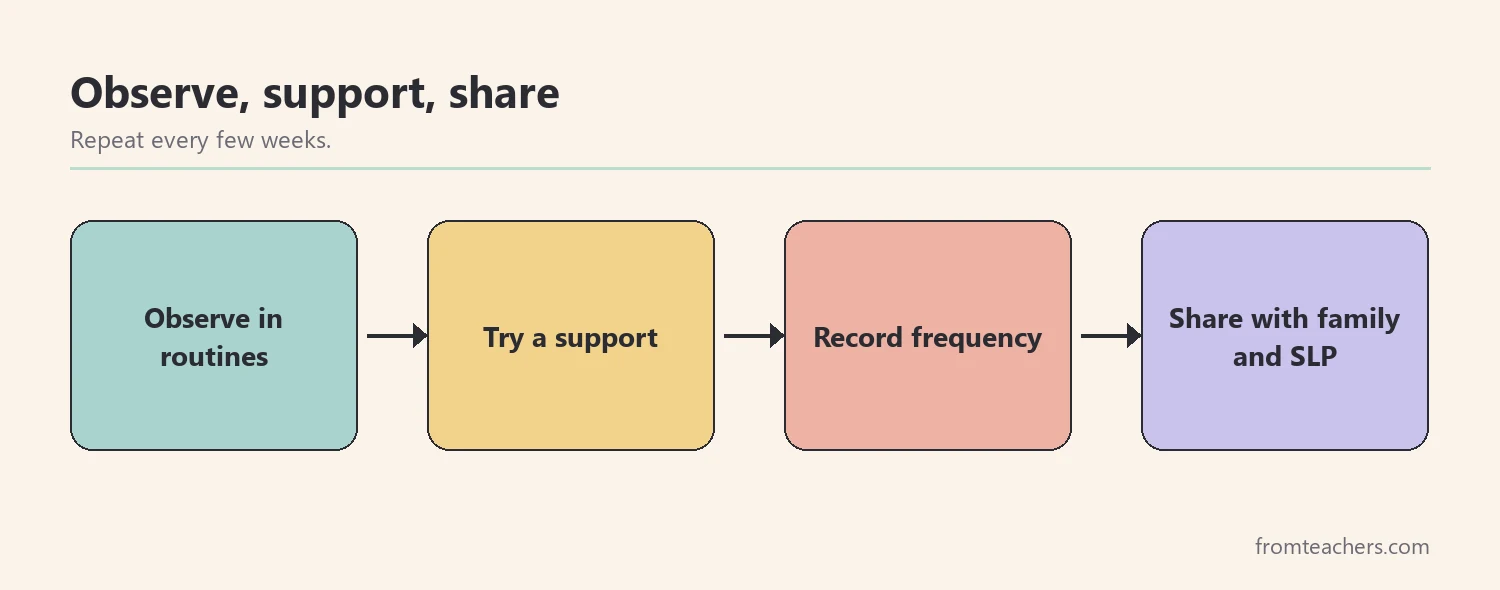
If a pattern continues for several weeks, even with classroom supports, it is time to share. Start with the family. Share specific observations and ask what they see at home. Families often notice the same patterns, or very different ones.
Then, follow your program’s process for involving the SLP or early intervention and special education team. Your notes on pragmatic language in preschool give them a clear starting point. Figure 5 shows the simple cycle.
Common mistakes and how to avoid them
- Judging from one day. Fix: observe over several weeks and settings.
- Using labels in notes. Fix: write what you saw, such as “grabbed truck twice at sand table.”
- Requiring eye contact. Fix: accept other ways of showing attention.
- Waiting too long to share. Fix: talk with families early, with concrete examples.
- Forgetting bilingual and cultural differences. Fix: learn about the child’s home languages and communication styles before drawing conclusions.
Questions teachers ask about pragmatic language in preschool
Is it normal for preschoolers to interrupt?
Yes, often. Young children are still learning to wait. Watch whether the child is learning over time with modeling and reminders.
Can a child have many words but weak pragmatic language in preschool?
Yes. Vocabulary and social use of language are different skills. A child may know many words and still find conversation or play hard.
Should I tell parents I think something is wrong?
Share observations, not conclusions. Describe what you saw and ask what they notice at home. Leave evaluation to qualified professionals.
How often should I use a checklist?
Many teachers rate once every week or two. That is often enough to see change without taking much time.
Do children learning two languages develop pragmatics differently?
Bilingual children develop social language skills too, sometimes on a different timeline in each language. Ask families about communication at home.
Related reading: Autism Social Skills, Parent-Teacher Collaboration in Special Education, and Special Education Tracking Tools.
You may also need: Individual Student Communication Plan for classrooms.
A companion resource for pragmatic language in preschool:
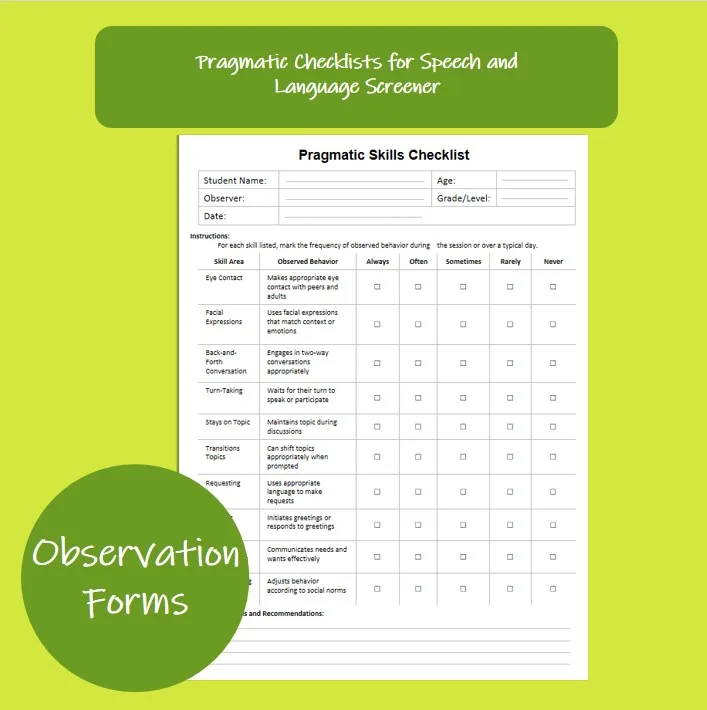
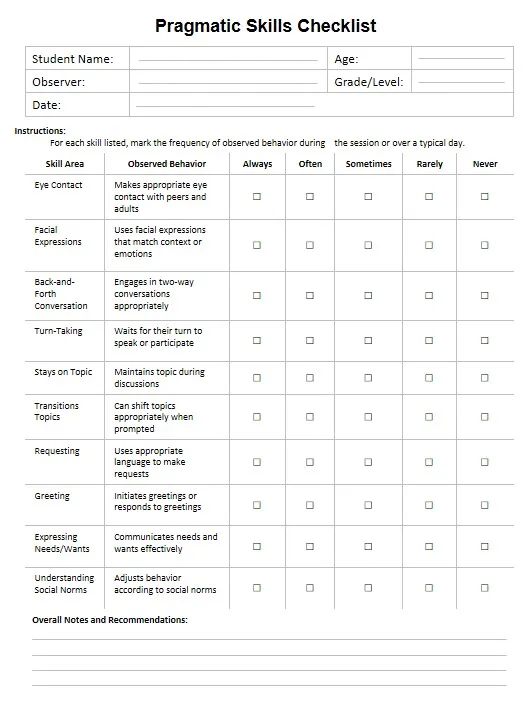
Pragmatic Skills Checklist Social Communication Screener for Speech Therapy: a one-page, typeable checklist that rates ten pragmatic skills, from eye contact and turn-taking to staying on topic and understanding social norms, on a five-point frequency scale, with space for notes and recommendations.
Sources and scope
- ASHA: Speech and Language Development: information on how communication skills develop in young children.
- American Speech-Language-Hearing Association: professional resources on social communication.
- NAEYC: guidance for early childhood educators on supporting play and social development.
- Center for Parent Information and Resources: information on early intervention and special education for young children.
This list covers classroom observation of social communication in preschool. It does not cover diagnosis or therapy, and it does not replace evaluation by an SLP or early intervention team.
Key takeaways
- Pragmatic language in preschool is still growing, so look for patterns, not moments.
- Start with easy signs: greetings, turn-taking and joining play.
- Try simple supports such as modeling, scripts and visuals.
- Rate skills by frequency across settings and weeks.
- Share specific observations with families and the SLP.
Leave a Comment