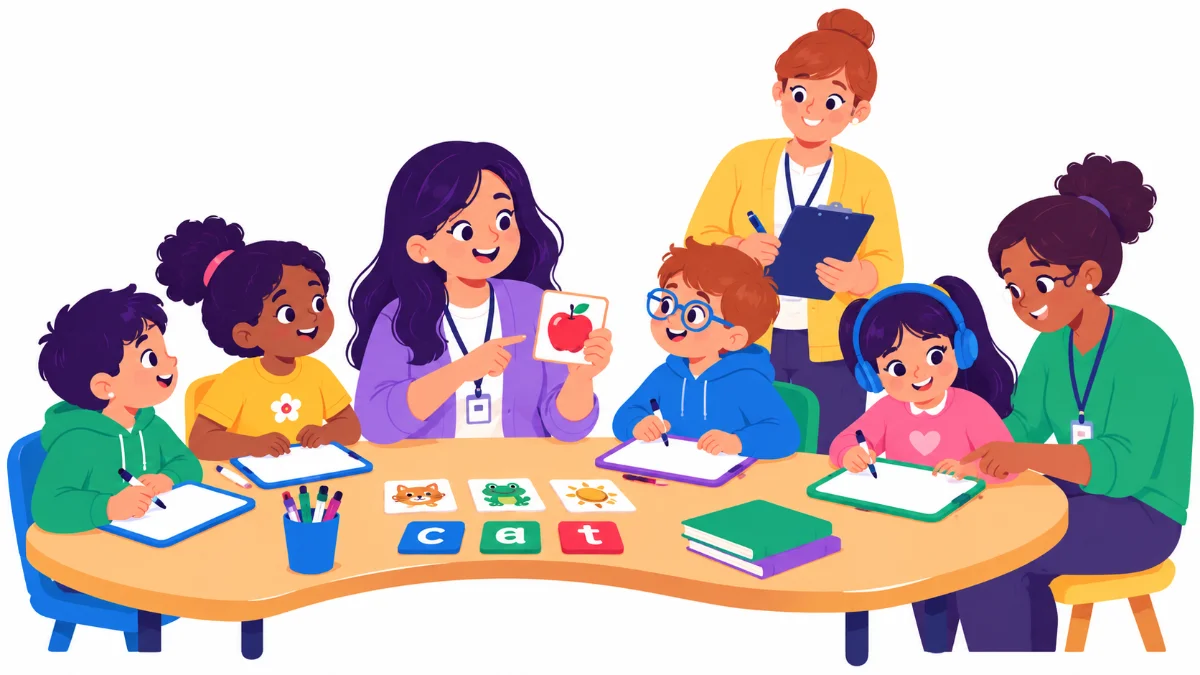

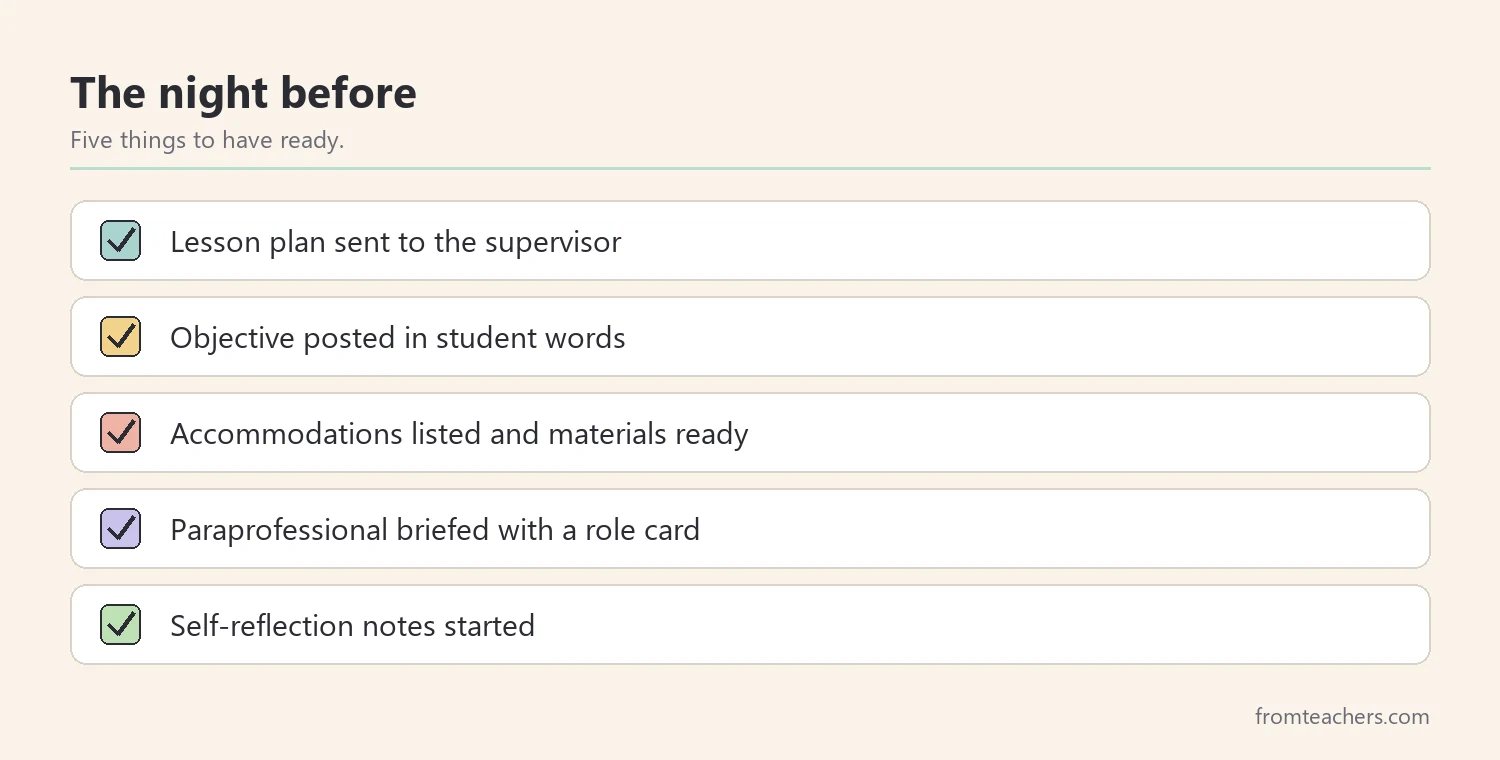
These special education student teaching tips are for the person who is about to be observed, not the person holding the clipboard. Picture Priya, a teacher candidate in a K-2 resource room, the night before her first formal observation. Her lesson plan is ready, her materials are copied, and she has no idea what her university supervisor will actually look for.
This list walks teacher candidates through ten practical tips, organized around the four areas most special education observation forms cover: planning, classroom environment, teaching practice and professional dispositions. For each tip, you will see what supervisors often look for, how to show it in a real lesson and a short example from Priya’s placement. By the end, you will know how to prepare, teach and reflect with confidence.
Examples are fictional. Follow your program’s own observation tool, your cooperating teacher’s guidance and each student’s IEP.
At a glance
- Most observation forms rate planning, environment, teaching practice and dispositions.
- Clear objectives and visible accommodations are easy wins in planning.
- Checking for understanding throughout the lesson matters more than a perfect script.
- Reflection and openness to feedback are part of the evaluation.
- Reading the observation form before you teach removes most surprises.
How this list is organized
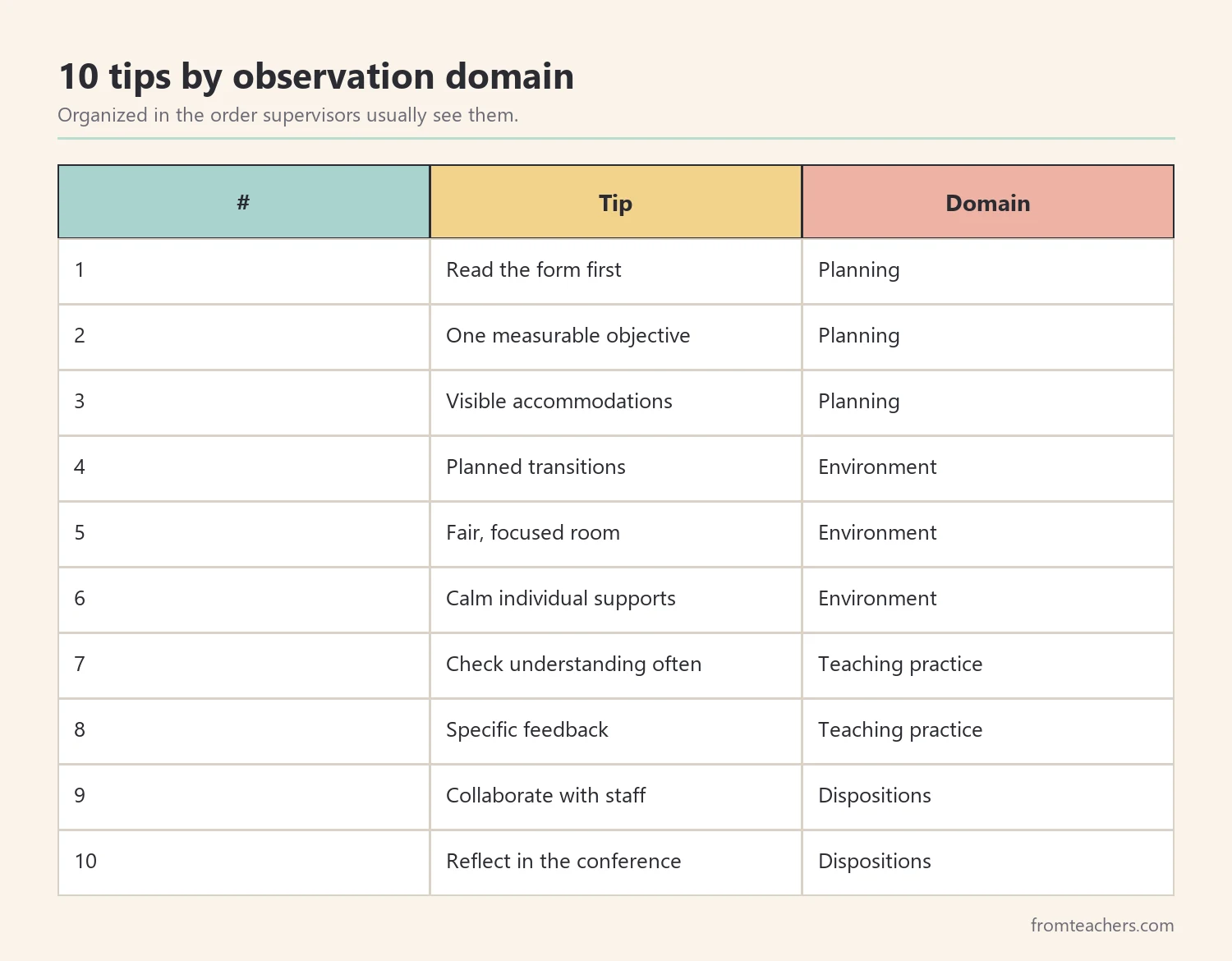
We did not rank these tips by importance, because every program weighs areas differently. Instead, the list follows the four domains found on many special education observation forms, in the order supervisors usually see them: the plan before the lesson, the room during the lesson, the teaching itself and your professional behavior after it. As a result, you can use it as a checklist from planning night to feedback conference.
These special education student teaching tips work for early childhood and K-12 placements, in resource rooms, self-contained classes and co-taught general education settings. Figure 1 shows all ten tips at a glance.
1. Read the observation form before you plan
The first of these special education student teaching tips is the simplest. Ask your supervisor for the exact form they will use, and read every item. Many forms rate each area on a scale, such as Minimal to Advanced, and list specific behaviors under each.
Why it matters: you cannot show what you do not know is being looked for.
Example: Priya noticed her form had a line on “accommodations and modifications.” She had planned them but had not written them down. She added a short section to her plan.
If your program does not provide a form, you can practice with a special education student teacher observation form for CCSE and ECSE placements, which rates instructional planning, classroom environment, teaching practice and professional dispositions, with sections for strengths, suggestions and goals.
2. Write one clear, measurable objective
Next, focus your plan. A clear objective tells the observer what students should be able to do by the end, and how you will know.
How to show it: post the objective in student-friendly words, such as “I can read words with short a,” and refer to it at the start and end.
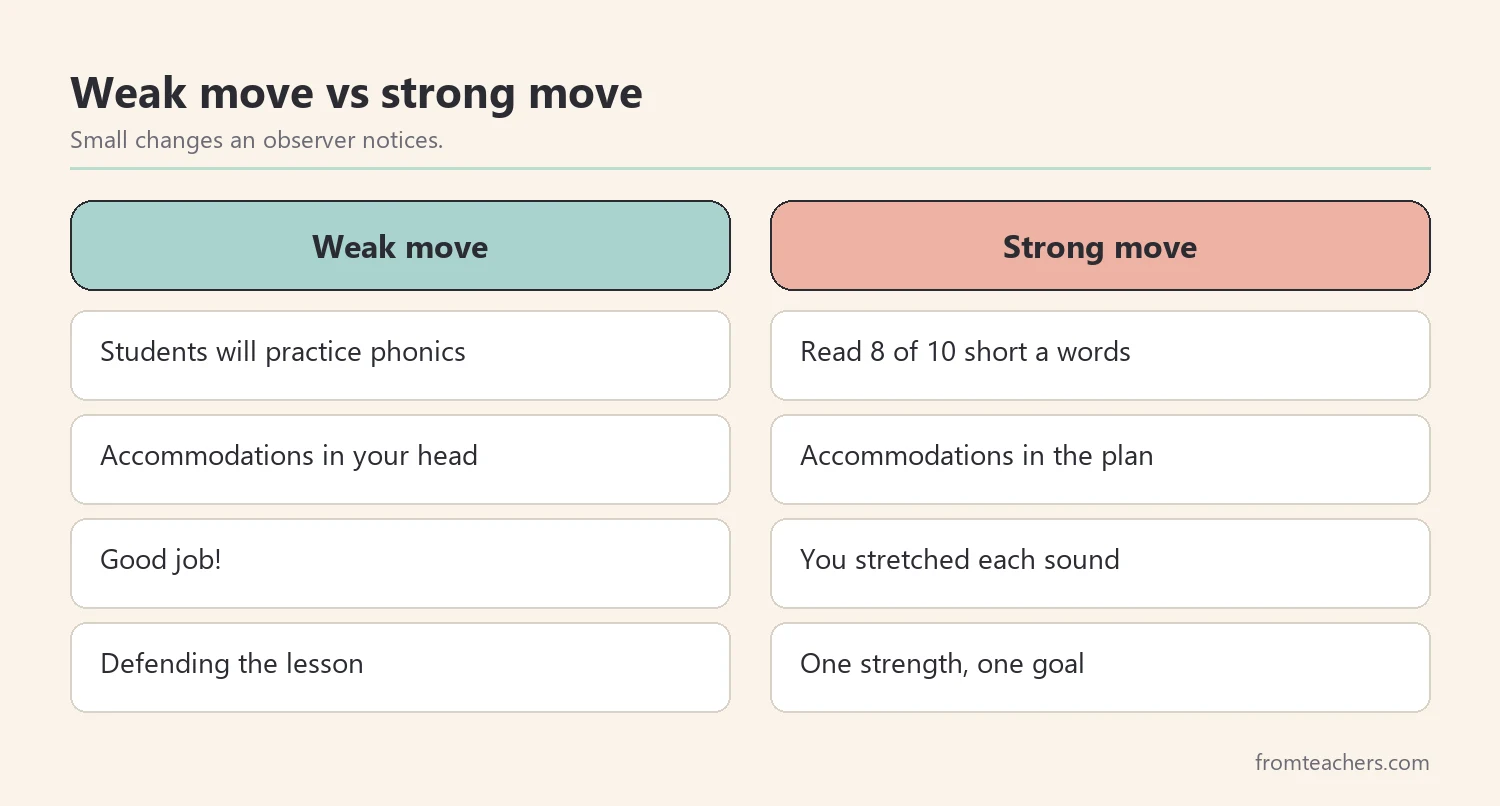
Example: Priya changed “Students will practice phonics” to “Students will read 8 of 10 short a words correctly.”
3. Make accommodations visible in the plan
Supervisors want to see that you know your students’ IEPs. Listing accommodations in the plan shows planning, and using them in the lesson shows practice.
How to show it: add a short table to your plan with each student’s initials, the relevant accommodation and how you will provide it.
| Student | Accommodation | In this lesson |
|---|---|---|
| J.M. | Visual supports | Picture cards for each word |
| A.K. | Movement breaks | Stand-up sorting game |
| L.T. | Reduced items | 6 words instead of 10 |
4. Plan your transitions
Transitions are where many lessons lose time and calm. Observers notice how students move between activities.
How to show it: plan each transition with a signal, a short direction and a time limit. For example, “When the chime rings, bring your whiteboard to the rug in ten seconds.”
Example: Priya practiced transitions with her students the day before. During the observation, they moved from table to rug in under a minute.
5. Set up the room for fairness and focus
Classroom environment items often include fairness, management and individualized supports. In other words, does every student have what they need to take part?
How to show it: seat students where they can see and hear, have materials ready for each student, and call on students fairly, using name sticks or a simple turn system.
6. Use individualized interventions calmly
In special education settings, a behavior or attention challenge during an observation is normal. What matters is how you respond.
How to show it: use the student’s behavior plan strategies, such as a break card or a first-then board, calmly and without stopping the whole lesson.
Example: one student left the table during Priya’s lesson. She quietly showed his first-then card, and he returned within a minute. Her supervisor noted it as a strength.
7. Check for understanding often
Teaching practice items usually include questioning, feedback and checking for understanding. Observers want to see that you know whether students are learning, not just that you delivered the content.
How to show it: use quick checks every few minutes, such as whiteboards, thumbs up or pointing to the answer. Adjust when students struggle.
8. Give specific feedback to students
“Good job” is kind, but specific feedback teaches. For example, “You stretched out each sound, and that helped you read it” tells the student exactly what worked.
How to show it: plan two or three feedback phrases linked to your objective and use them during practice.
9. Collaborate with your cooperating teacher and staff
Professional dispositions often include collaboration. In special education, you may work with paraprofessionals, therapists and general education teachers in the same lesson.
How to show it: brief the paraprofessional before the lesson, give them a clear role and thank them afterward.
Example: Priya gave her paraprofessional a short card: “Support L.T. with picture cards during practice.” The lesson ran more smoothly than her rehearsal.
10. Reflect honestly in the feedback conference
Finally, the conference after the observation is part of the evaluation. Supervisors look for reflective practice: can you name what went well, what did not and what you will change?
How to show it: bring a short self-reflection with one strength, one challenge and one goal. Listen, take notes and ask clarifying questions.
Turning special education student teaching tips into a growth plan
One observation is a snapshot. Over a placement, you will usually be observed several times, and the real goal is growth. Therefore, keep a simple record of your ratings and the feedback you received in each domain.
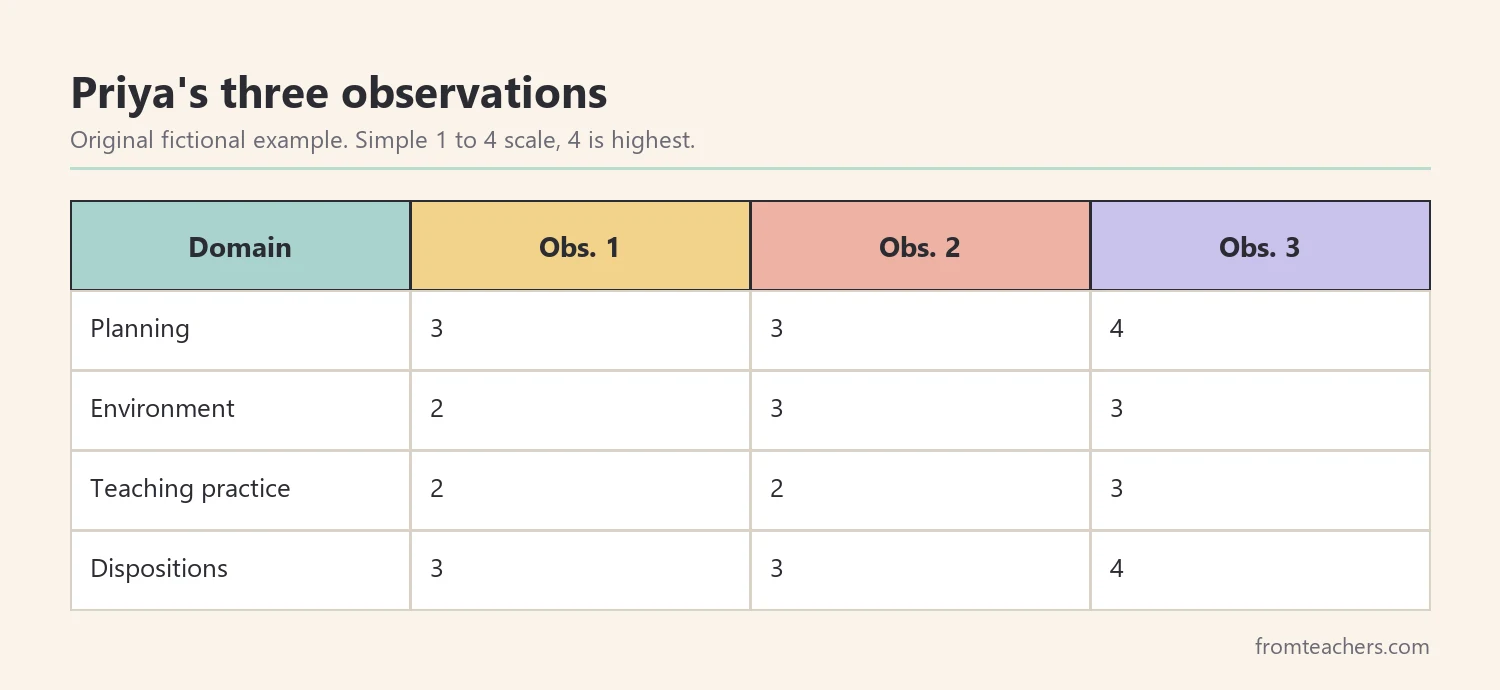
For example, Priya’s first observation showed strong planning but limited checking for understanding. She set one goal: use a quick check every five minutes. By her third observation, her teaching practice rating had moved up, as Figure 3 shows.
Also, ask your cooperating teacher for short, informal feedback between formal visits. Five minutes after a lesson is often enough to try one change before the next observation.
In addition, record your own lessons when your program allows it and families have given permission. Watching yourself teach, even for ten minutes, often shows things no one mentioned, such as how long you wait after a question or which students you call on most.
Next, connect your goals to students, not only to the form. For instance, “check for understanding more often” becomes stronger when you add “so that L.T. gets help before he gives up.” Supervisors notice candidates who keep the focus on learners.
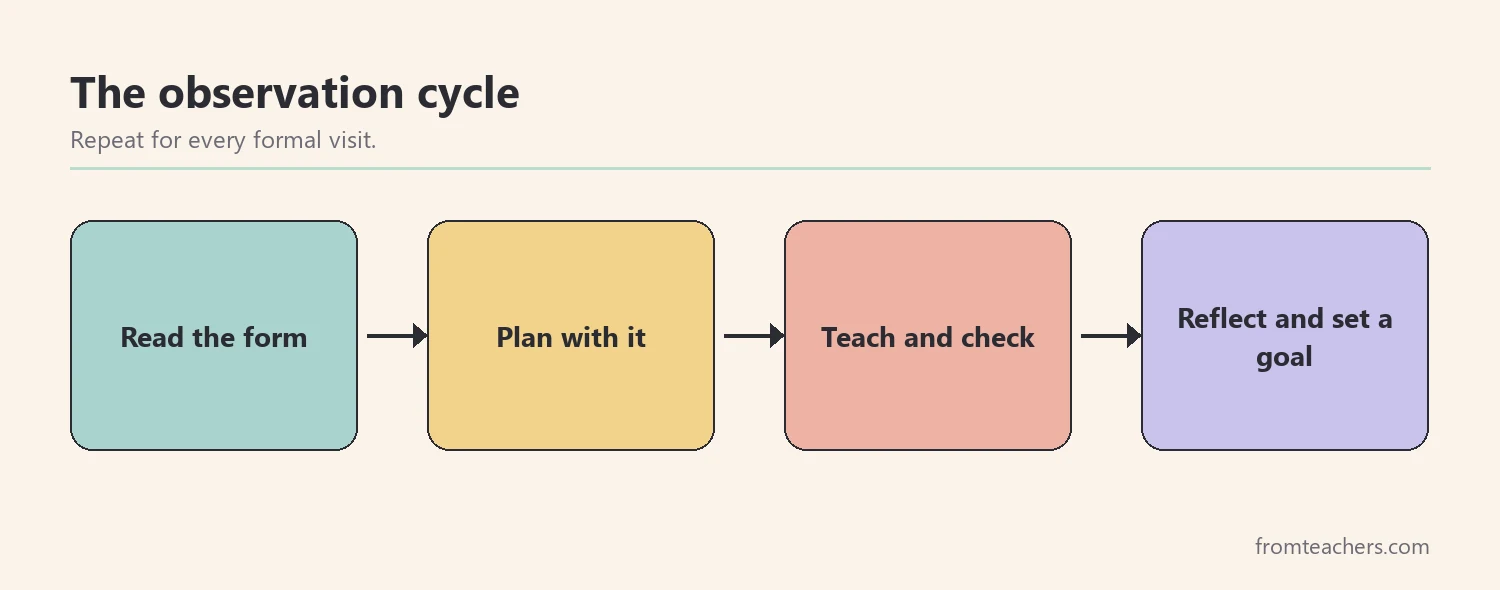
Finally, remember that every new teacher has weak areas. Supervisors are looking for a candidate who listens, reflects and improves. Figure 5 shows a simple cycle you can repeat for every observation.
Building relationships before observation day
An observed lesson goes better when students already know and trust you. In special education settings, this matters even more, because many students find new adults and changes in routine hard.
First, spend the early weeks of your placement learning each student’s interests, strengths and triggers. Read the IEPs with your cooperating teacher, and ask which strategies work best for each student. Then use those strategies in small ways every day, not only when someone is watching.
Next, prepare students for the visit. A short, calm explanation, such as “A visitor will watch me teach tomorrow. She is here to help me learn,” reduces surprise. Some students benefit from a picture of the visitor or a note on the visual schedule.
Also, keep the routine as normal as possible on observation day. A brand-new activity format can unsettle students who rely on predictability. Instead, use a familiar structure with your new objective inside it.
For example, Priya added “visitor” to the class picture schedule the day before. Two students who usually struggled with new adults stayed calm, and one even waved to the supervisor at the end.
Common mistakes and how to avoid them
- Planning a lesson that is too long. Fix: plan for less and include an extension if time remains.
- Forgetting IEP accommodations on observation day. Fix: list them in the plan and prepare materials in advance.
- Ignoring the paraprofessional. Fix: give a clear role and brief them before the lesson.
- Getting defensive in the conference. Fix: listen first, then ask questions.
- Setting too many goals. Fix: choose one or two goals per observation.
Questions teacher candidates ask about special education student teaching tips
What do supervisors look for most?
It depends on the program, but most forms cover planning, environment, teaching practice and professional dispositions. Ask for your program’s form early.
What if a student has a meltdown during my observation?
Respond calmly, follow the student’s plan and keep others safe. Supervisors often see a calm, plan-based response as a strength.
Should I teach a lesson I have taught before?
A familiar routine with a new objective often works well. Students know the structure, and you can focus on teaching.
How do I handle critical feedback?
Take notes, thank your supervisor and choose one goal to work on. Feedback is the main purpose of the observation.
Can I share my lesson plan with my supervisor in advance?
Many programs require it. Even when they do not, sending it ahead helps your supervisor understand the context.
Related reading: Special Education Strategies Guide, Accommodations vs Modifications in Special Education, and Special Education Challenges and Strategies.
You may also need: Teacher Observation Feedback Form and Classroom Walkthrough Rubric.
A companion resource for special education student teaching tips:
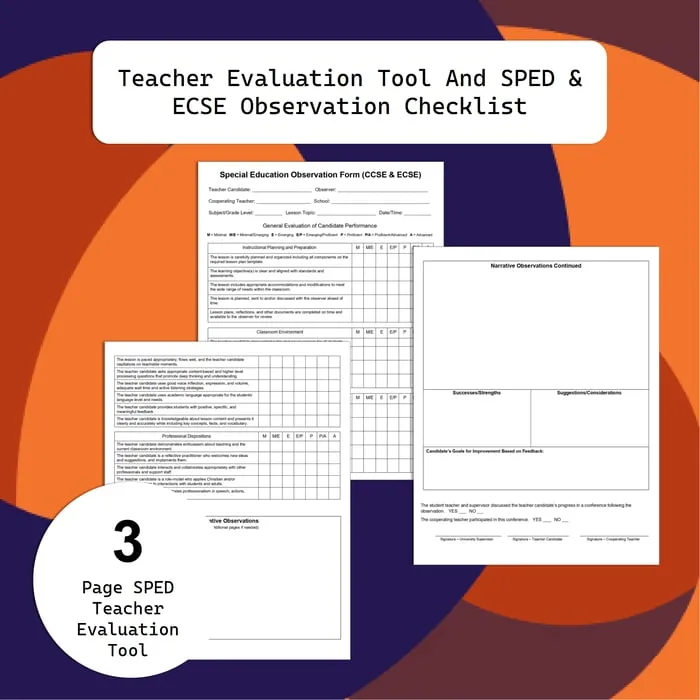
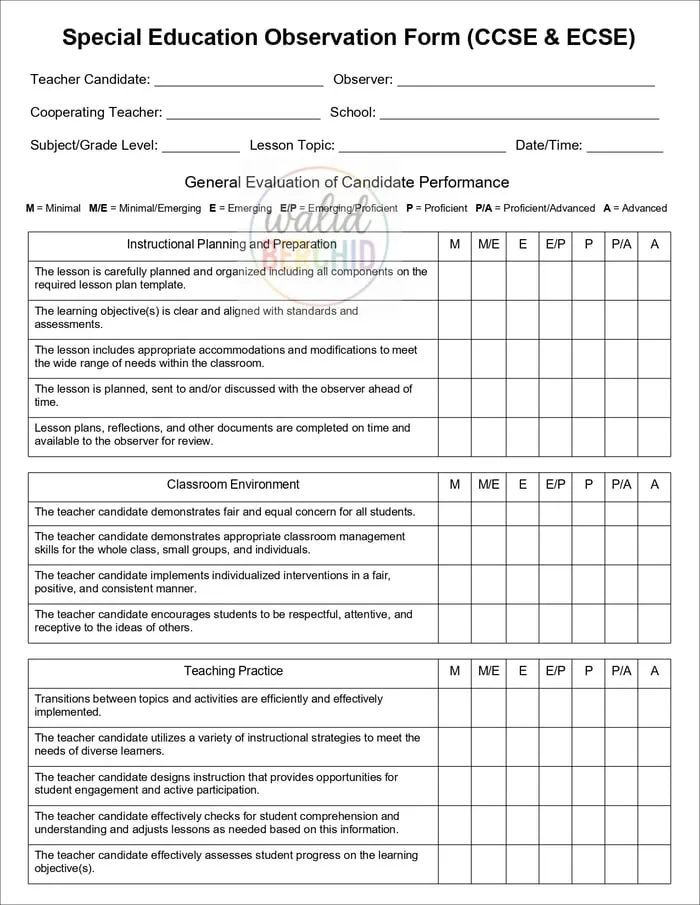
Special Education Student Teacher Observation Form: CCSE/ECSE Evaluation Tool: a three-page form with rating scales from Minimal to Advanced for instructional planning, classroom environment, teaching practice and professional dispositions, plus narrative, strengths, suggestions, goals and conference sections.
Sources and scope
- Council for Exceptional Children: professional standards and resources for special educators.
- IRIS Center: free modules on evidence-based practices, classroom management and accommodations.
- CAST UDL Guidelines: a framework for planning lessons that work for diverse learners.
- Individuals with Disabilities Education Act (IDEA): the federal law behind IEPs and special education services.
This list offers general tips for special education teacher candidates. It does not replace your program’s requirements, your supervisor’s guidance or your state’s licensure standards.
Key takeaways
- Use these special education student teaching tips with your program’s own observation form.
- Show planning through clear objectives and visible accommodations.
- Plan transitions and use individualized supports calmly.
- Check for understanding often and give specific feedback.
- Reflect honestly and set one or two goals after each observation.
Leave a Comment