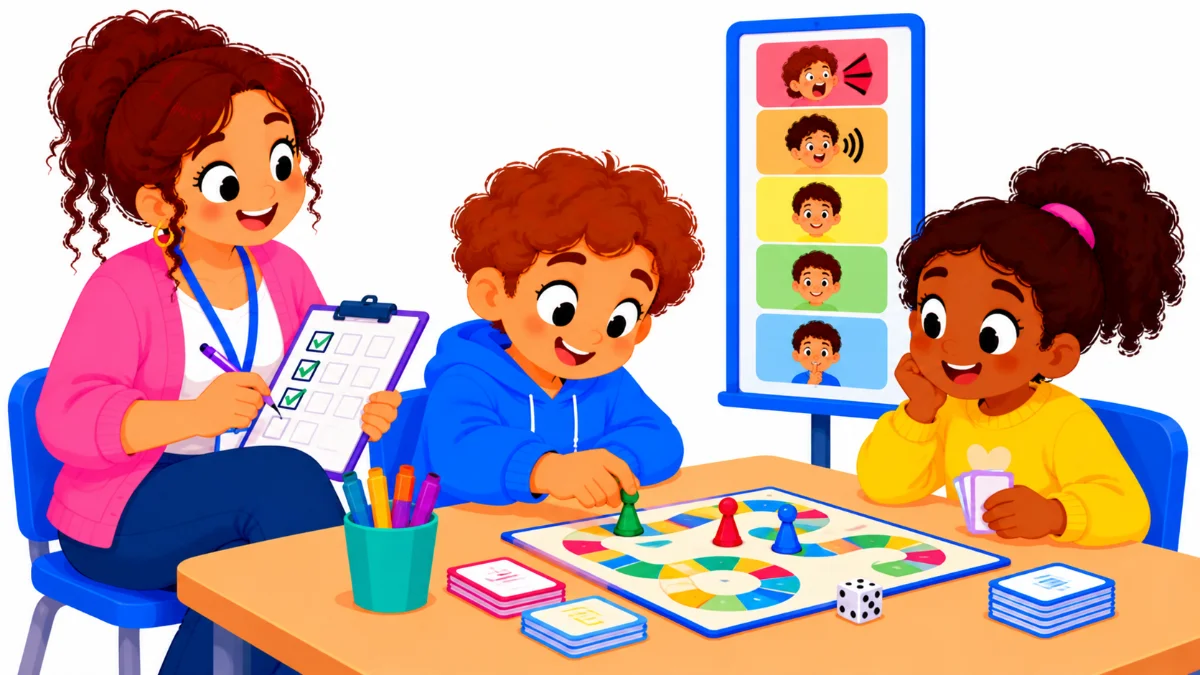

Knowing which pragmatic language skills to observe turns a vague worry like “social skills are hard for her” into clear notes a team can act on. Picture a grade 3 classroom during partner work. Sofia, age 8, explains her favorite video game in great detail, does not notice her partner trying to speak, and then looks confused when the partner walks away.
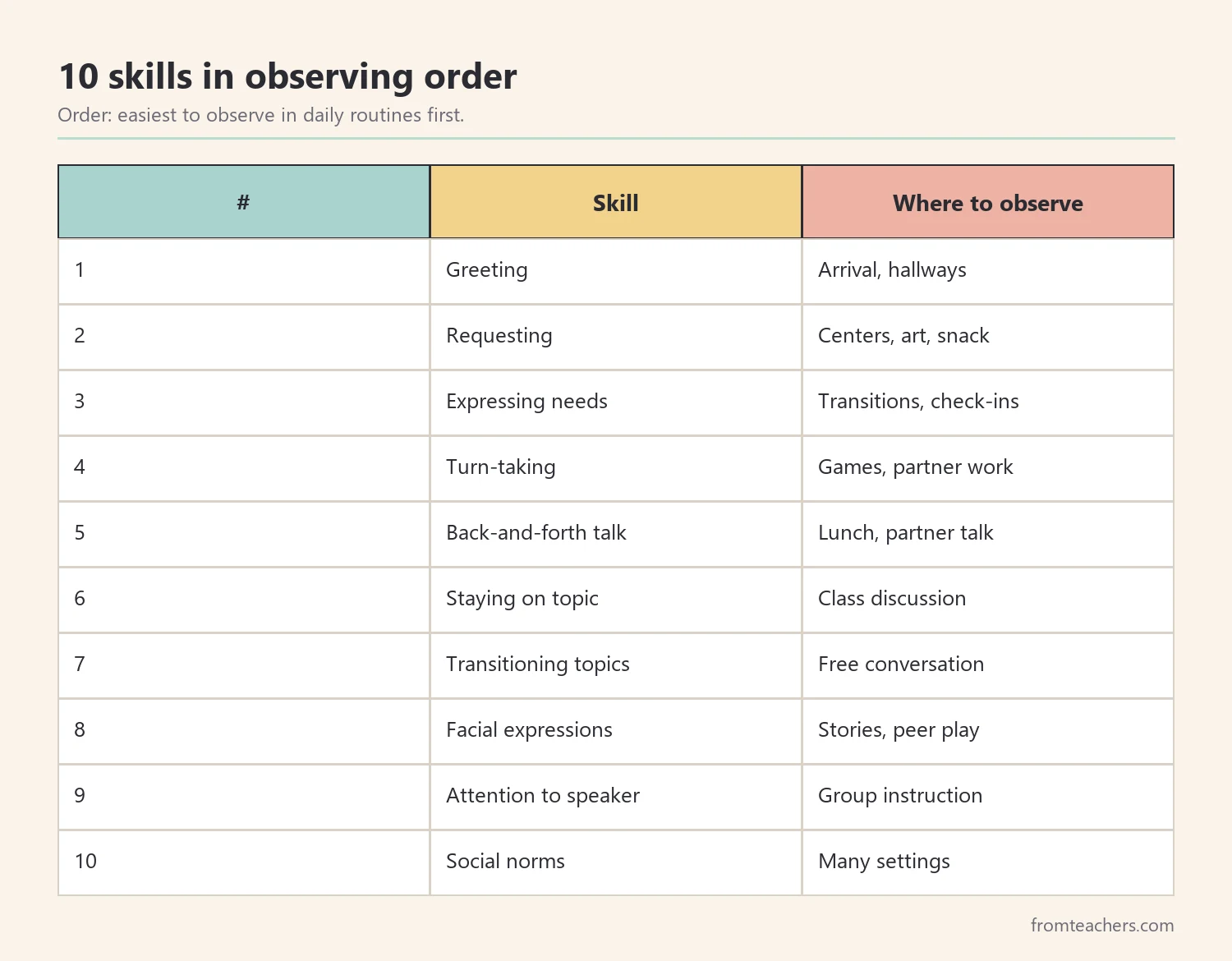
This list covers ten skill areas that speech-language pathologists (SLPs) and teachers often look at, ordered from the easiest to observe in a short session to the ones that need several settings. By the end, you will know what each skill looks like, where to observe it, how to rate it consistently, and how to share your notes.
Examples are fictional. Observation notes support, but do not replace, assessment by a qualified SLP. Respect different communication styles, including those of autistic students. This is guidance, not a diagnosis.
At a glance
- Start with skills you can see daily, like greetings and requests.
- Observe in at least two settings.
- Use one frequency scale and add a short example to each rating.
- Respect different communication styles, including eye contact.
- Share notes with the SLP and choose one or two priorities.
How we ordered these skills
We did not rank skills by importance, because that depends on each student’s goals. Instead, we used one practical rule: how easily a teacher can observe the skill during ordinary school moments. Greetings and requests happen often and are easy to spot. Understanding social norms needs many settings and more interpretation, so it comes last.
As a result, you can start observing the first few skills tomorrow and add the rest over a week or two.
The ready-made option: a pragmatic skills checklist
If you want a consistent form, the pragmatic skills checklist and social communication screener is a one-page checklist. It has fields for student name, age, observer, grade, and date, ten skill areas with a clear behavior description for each, a five-point frequency scale from Always to Never, and an Overall Notes and Recommendations section.
Because every observer uses the same descriptions and scale, notes from the classroom teacher, SLP, and family can be compared.
1. Greeting
What to look for: responding to and starting greetings, such as “hi” or a wave, with peers and adults.
Where to observe: arrival, hallways, and the start of small group sessions.
Example: Sofia greeted her teacher every morning but rarely responded when classmates said hi. Her rating for peer greetings was “Sometimes.”
2. Requesting
What to look for: asking for items, help, or information in a way others understand.
Where to observe: centers, art, snack, and independent work.
Example: Sofia asked clearly for materials (“Can I have the glue?”) and was rated “Often.”
3. Expressing needs and wants
What to look for: telling others about feelings, preferences, and needs, such as “I need a break” or “I don’t like loud noise.”
Where to observe: transitions, noisy times, and one-to-one check-ins.
Example: Sofia could say she was hungry but struggled to say when she felt frustrated. She was rated “Sometimes.”
4. Turn-taking
What to look for: waiting for a turn in games and conversations, and giving others a turn.
Where to observe: board games, partner work, and circle time.
Example: In games with clear rules, Sofia waited well. In conversation, she often kept talking. The team noted the difference between settings.
5. Back-and-forth conversation
What to look for: responding to what others say and keeping an exchange going for several turns.
Where to observe: lunch, partner talk, and morning meeting.
Example: Sofia’s conversations usually lasted one or two turns before she returned to her own topic. She was rated “Rarely” for sustained exchanges.
6. Staying on topic
What to look for: keeping comments related to the current topic.
Where to observe: class discussions and partner work.
Example: During a science discussion about plants, Sofia added comments about her video game. Her teacher noted the exact topic shifts, including what was being discussed just before each one. That detail later helped the SLP see that shifts happened most when the class topic felt unfamiliar.
7. Transitioning topics
What to look for: changing topics smoothly, for example by saying “That reminds me…” or checking if others are ready.
Where to observe: free conversation at lunch or recess.
Example: Sofia changed topics suddenly without a bridge, which confused peers. That became a clear target for teaching, and the SLP suggested a few bridge phrases to practice.
8. Facial expressions
What to look for: using and understanding facial expressions that match the situation, such as noticing when someone looks bored or upset.
Where to observe: stories, games, and peer interaction.
Example: Sofia did not notice her partner’s bored expression during her long explanation. The SLP planned activities on reading facial cues.
9. Eye contact and attention to the speaker
What to look for: how the student shows they are listening, which may include looking toward the speaker.
Where to observe: conversations and group instruction.
Important note: many autistic people find eye contact uncomfortable, and looking away does not mean they are not listening. Many SLPs and autistic self-advocates encourage teams to focus on other ways of showing attention, such as responding, nodding, or orienting the body, rather than forcing eye contact.
Example: Sofia looked at the table while listening but answered questions accurately. The team decided not to target eye contact.
10. Understanding social norms
What to look for: understanding unwritten rules, such as personal space, volume, and how talk differs with friends and adults.
Where to observe: several settings over time, including class, lunch, library, and assemblies.
Example: Sofia spoke loudly in the library but adjusted when given a visual volume scale. The team noted that visual supports helped.
Rating pragmatic language skills to observe consistently
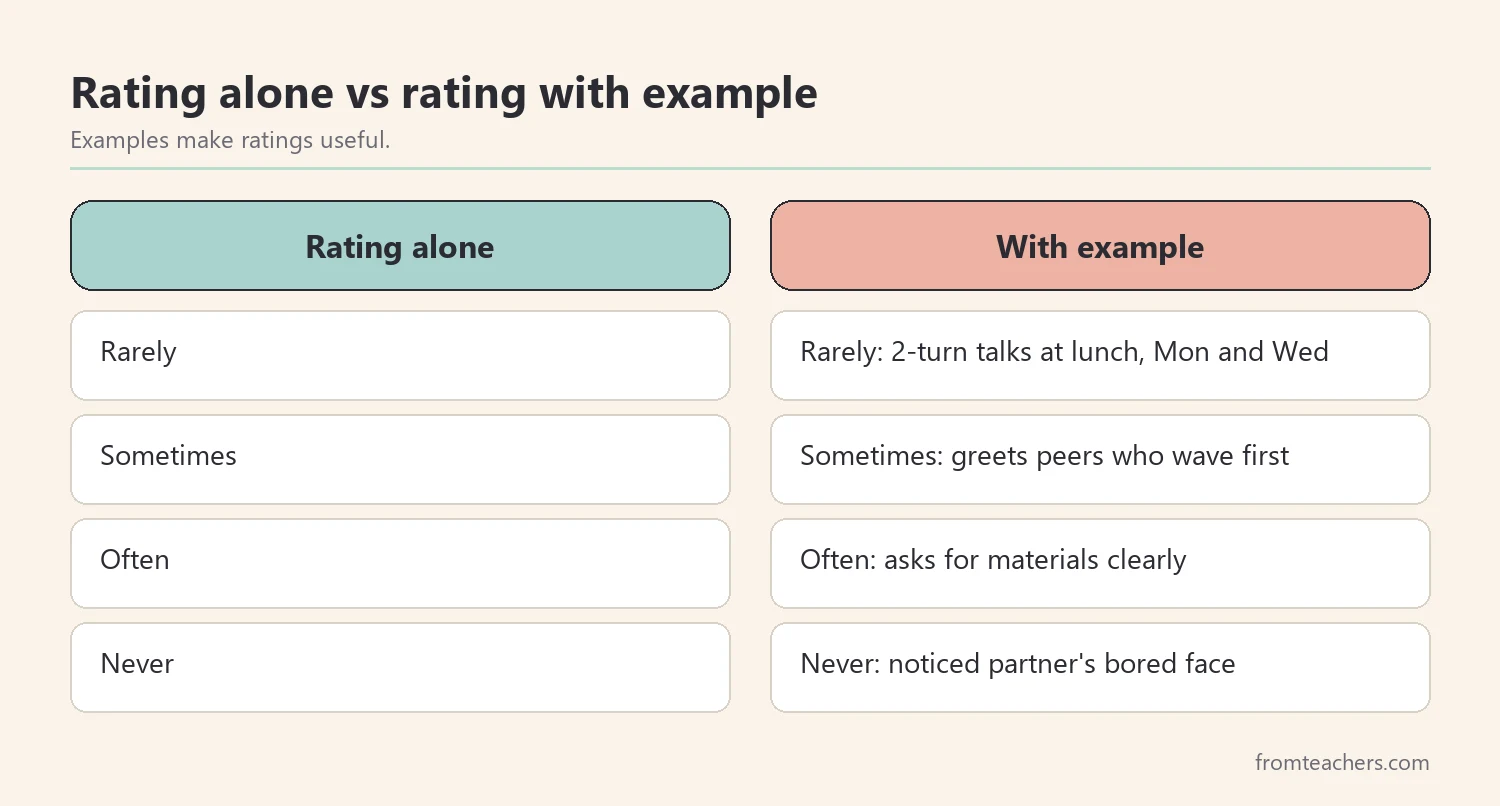
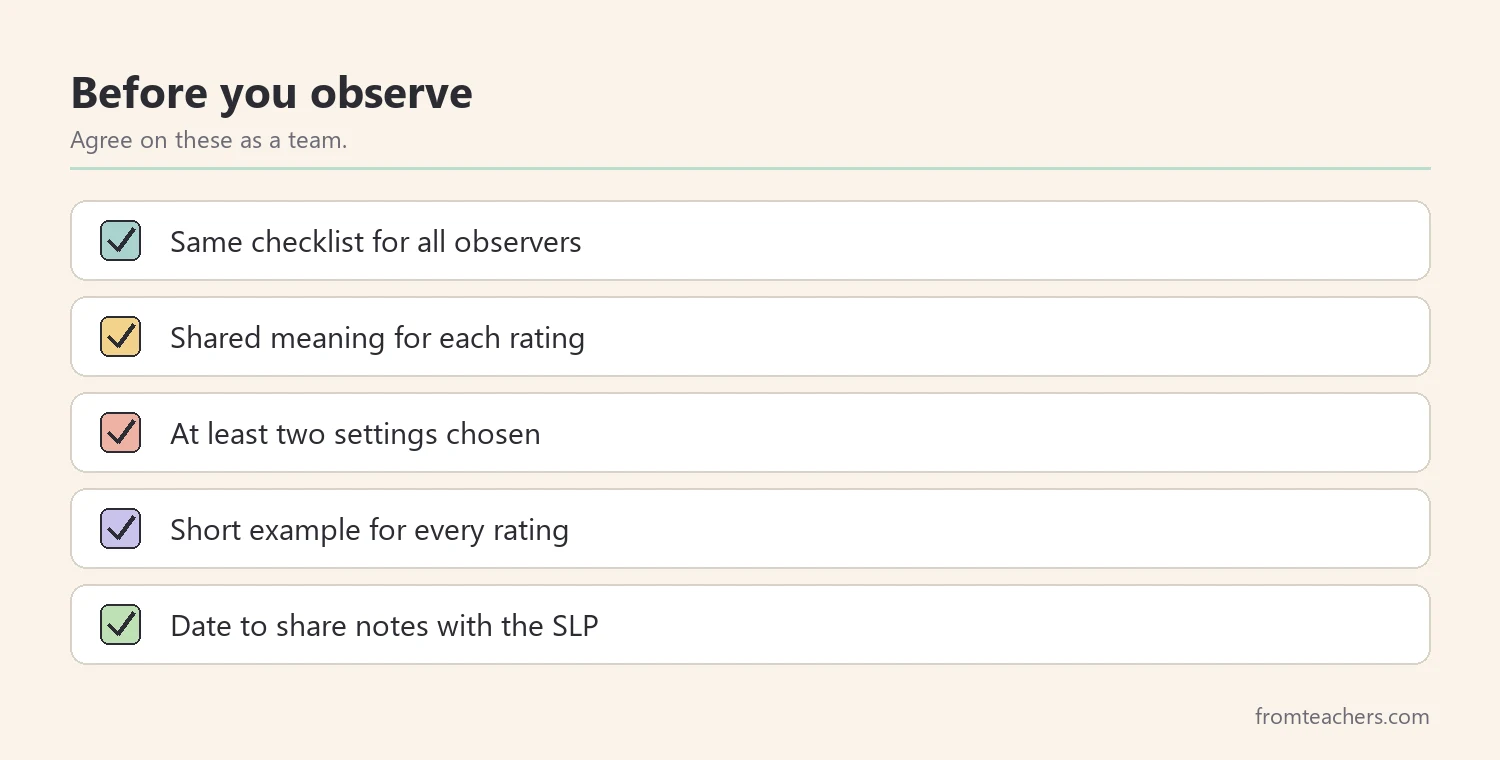
Consistent ratings make notes useful. Use a frequency scale, such as Always, Often, Sometimes, Rarely, and Never, and agree on what each means. For example, “Often” might mean most opportunities you saw, and “Sometimes” about half.
In addition, write a short example next to each rating. “Rarely: two-turn conversations at lunch on Monday and Wednesday” is far more useful than a rating alone.
Here is how Sofia’s team compared ratings across two observers and two settings.
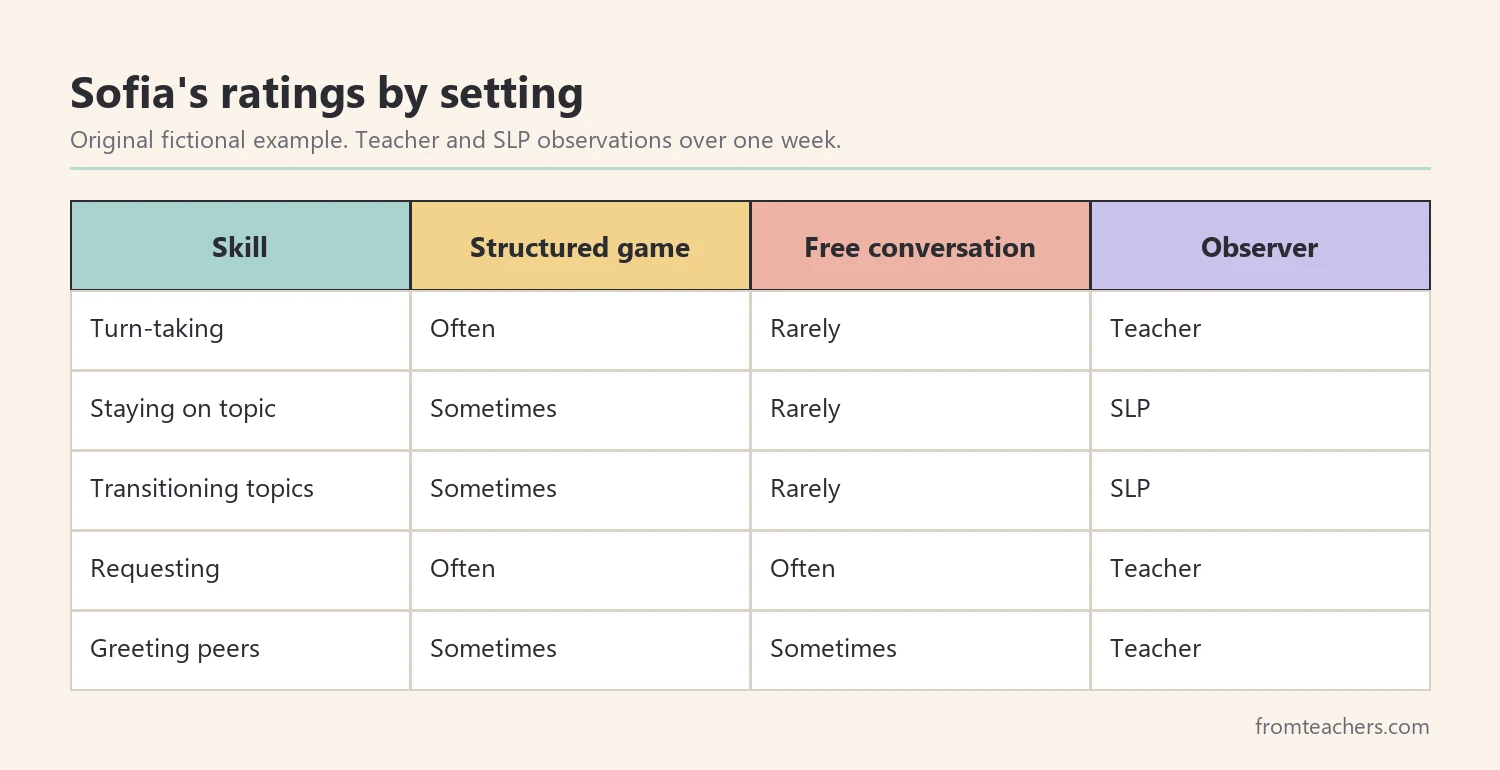
The comparison was revealing. Sofia did better in structured settings, such as games with rules, than in free conversation. As a result, the SLP planned to start with structured practice and then move toward unstructured lunch conversations.
Simple practice ideas by skill group
Once the team has chosen priorities, practice should feel natural rather than like a test. The ideas below are common starting points that SLPs and teachers adapt to each student.
Greetings and requests. Build them into routines. For example, a student can greet two classmates during morning arrival, or request materials from a peer during centers instead of from the teacher. Short, frequent practice in real moments works well.
Turn-taking and back-and-forth conversation. Start with structured games that have clear turns, then use a visual cue, such as a talking stick or a “my turn, your turn” card, in short partner conversations. Gradually remove the cue as turns become smoother.
Staying on topic and changing topics. Use a simple topic board with pictures. When the student wants to change topics, teach a bridge phrase like “Can I tell you about something else?” Practice in pairs with a timer, then in real lunch conversations.
Facial expressions and attention. Use stories, short videos, or photos to talk about what faces might show. Explain feelings in words, too, because some students find faces hard to read. For attention, accept many ways of showing listening.
Social norms. Make unwritten rules visible. A voice volume scale, a personal space visual, or a short social narrative written with the student can explain expectations clearly and respectfully.
In every case, involve peers where possible. Classmates who understand that communication styles differ, and who know a few simple strategies, make practice far more natural.
From observation to support
Observation is the first step. Next, share notes with the SLP and family, choose one or two priority skills, and agree on how to practice them across settings.
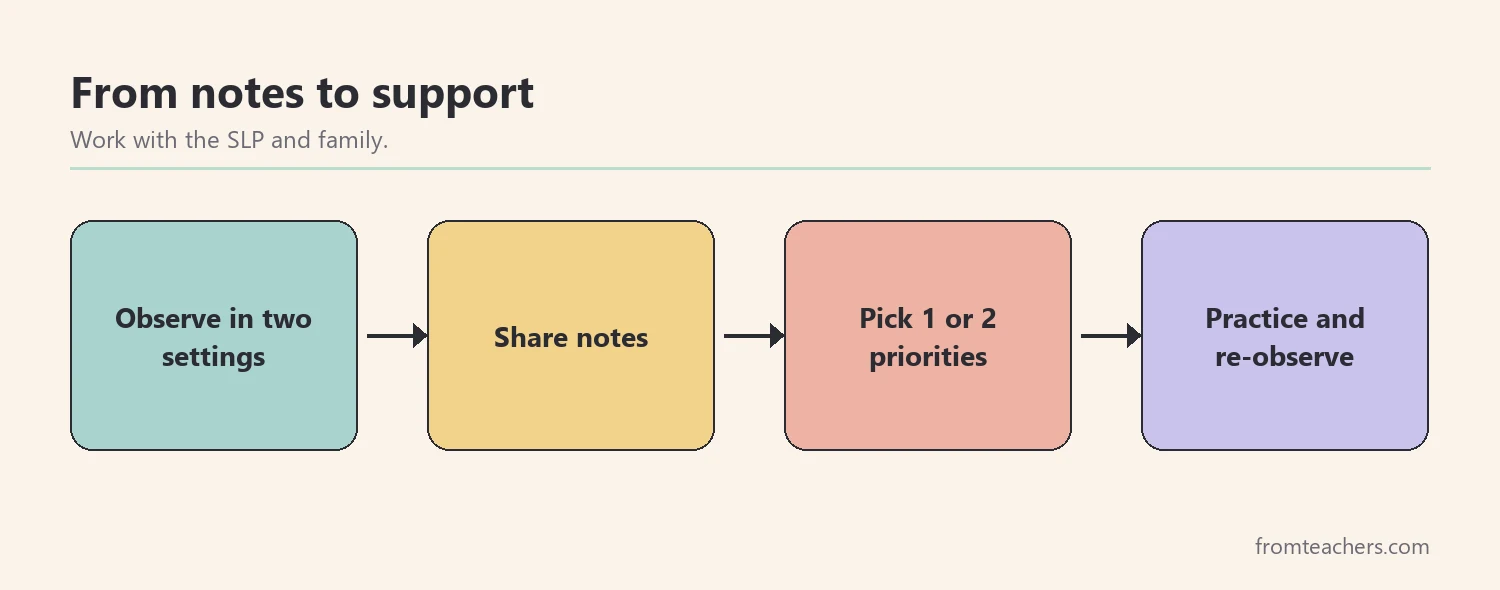
Moreover, focus on skills that matter to the student. Sofia wanted friends to keep playing with her, so turn-taking in conversation became her first goal. Linking goals to what the student cares about increases motivation.
Next, plan how to measure change. Re-observing with the same checklist, in the same settings, gives a fair comparison. Keep the student involved, too. Older students can rate themselves on one skill and compare with the adult rating, which builds self-awareness.
Also, think about the environment, not just the student. Clear group roles, visual supports, and peers who understand different communication styles can make social success much easier.
In addition, review regularly. Re-observe the priority skills every few weeks using the same scale and settings. When the ratings move from Rarely to Sometimes, or from Sometimes to Often, share that progress with the student and family.
Common mistakes and how to avoid them
- Observing only one setting. Fix: watch at least two settings, such as class and lunch.
- Ratings without examples. Fix: add a short note to each rating.
- Forcing eye contact. Fix: focus on other ways the student shows attention.
- Too many goals at once. Fix: choose one or two priority skills.
- Treating a checklist as a diagnosis. Fix: share notes with the SLP for formal assessment if needed.
Questions teachers and parents ask about pragmatic language skills to observe
What are pragmatic language skills?
Pragmatics refers to how we use language socially: greeting, taking turns, staying on topic, and adjusting how we talk to different people and situations.
Who should observe?
Teachers, SLPs, paraprofessionals, and families can all contribute. Using the same checklist helps compare views.
How long should an observation last?
Short observations across several days and settings are often more useful than one long session.
Should every student be expected to make eye contact?
No. Communication styles differ, and many autistic students listen best without eye contact. Focus on whether communication is effective and comfortable.
Can parents use the checklist at home?
Yes. Home observations, such as family meals or playdates, add valuable information. Share them with the SLP and teacher.
Related reading: Autism Social Skills Development, Spectrum Voices: Essential Strategies, and How Parents and Teachers Can Team Up.
You may also need: Conversation Skills for Kids: Friendship Foundations.
A companion resource for pragmatic language skills to observe:
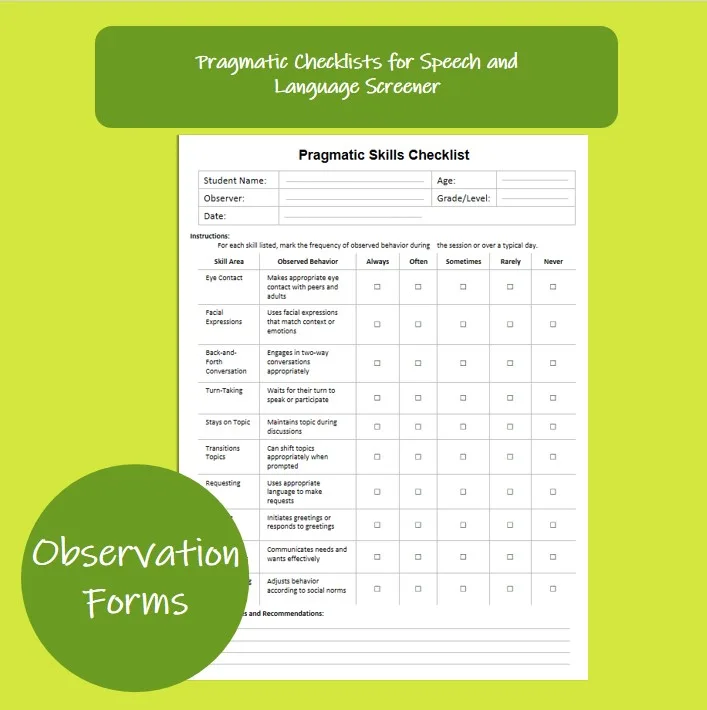
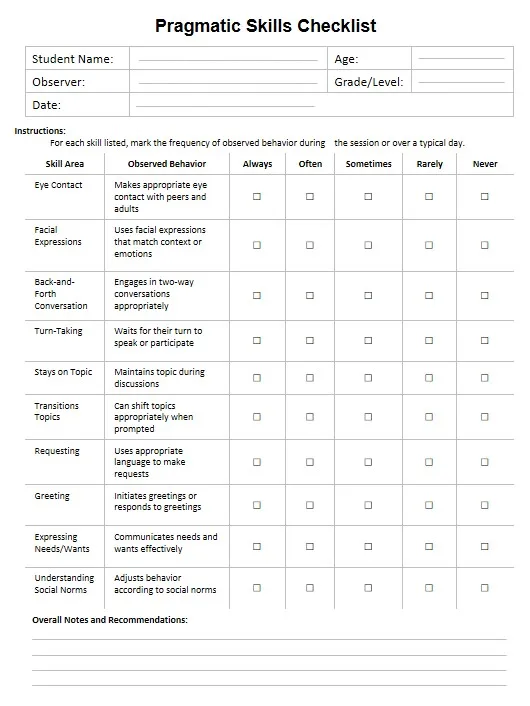
Pragmatic Skills Checklist Social Communication Screener for Speech Therapy: a one-page checklist with student, age, observer, grade and date fields, ten pragmatic skill areas with behavior descriptions, a five-point frequency scale from Always to Never, and an Overall Notes and Recommendations section.
Sources and scope
- ASHA Practice Portal: Social Communication Disorder: professional information on social communication and pragmatics.
- American Speech-Language-Hearing Association: information for families and professionals on speech and language.
- AFIRM Modules: learning modules on evidence-based practices for autistic learners, including social skills supports.
- Understood.org: articles for families on social communication challenges.
This list covers classroom observation of pragmatic language skills. It does not replace formal assessment or diagnosis by a qualified speech-language pathologist.
Key takeaways
- Start with pragmatic language skills to observe in daily routines, like greetings and requests.
- Observe in at least two settings and add short examples to ratings.
- Use one frequency scale so observers can compare notes.
- Respect different communication styles, including around eye contact.
- Share notes with the SLP and pick one or two priority skills.










Leave a Comment