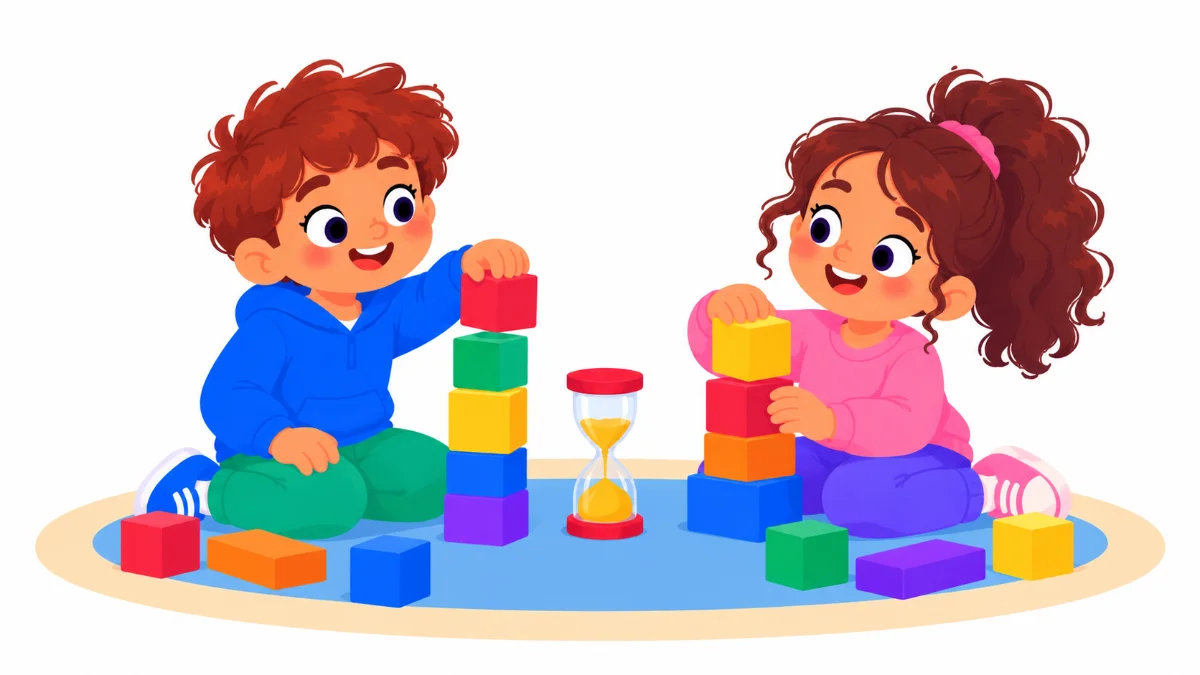

Turn-taking skills help children share time, space, and activities without arguments, tears, or grabbing. Picture a first grader at the block center. A classmate is using the tallest blocks, and he wants them now. He reaches in, the tower falls, and both children end up crying. He is not being mean. He simply has not yet learned what to do while he waits.
This guide gives you five steps to build turn-taking skills: teach waiting, teach kind words, make turns fair, stay calm when it is not your turn, and celebrate others. By the end, you will have a simple, visual way to teach sharing in centers, games, and group work.
Examples are fictional. Adapt to the student’s goals and agreed supports. This is guidance, not a diagnosis.
At a glance
- Turn-taking means sharing time, space, and activities with others.
- Waiting is a skill to teach, with things to do while you wait.
- Kind words such as “Can I have a turn?” make asking easier.
- Timers and clear order make turns feel fair to everyone.
- Celebrating other people’s turns builds a kinder classroom.
Before the steps, a quick note on why this matters. Turn-taking skills show up everywhere: in games, conversations, lines, group projects, and play. Children who can take turns tend to have an easier time joining play and keeping friends. These skills are learned, not automatic, so they deserve direct teaching like reading or math.
1. Start turn-taking skills with waiting
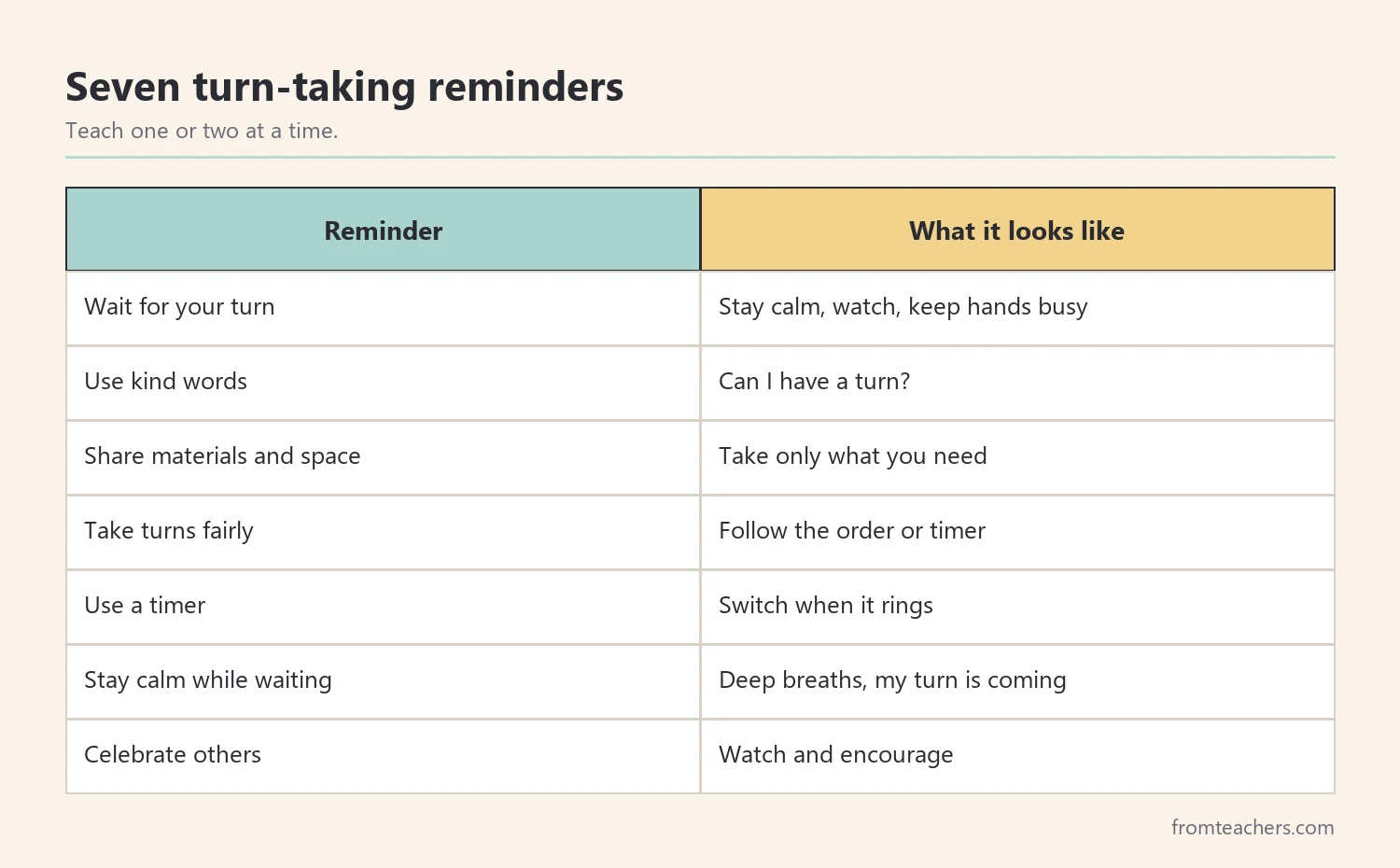
First, make waiting concrete. “Be patient” is too vague for most young children. Instead, show what waiting looks like: staying calm, watching what the other person is doing, and keeping hands to yourself.
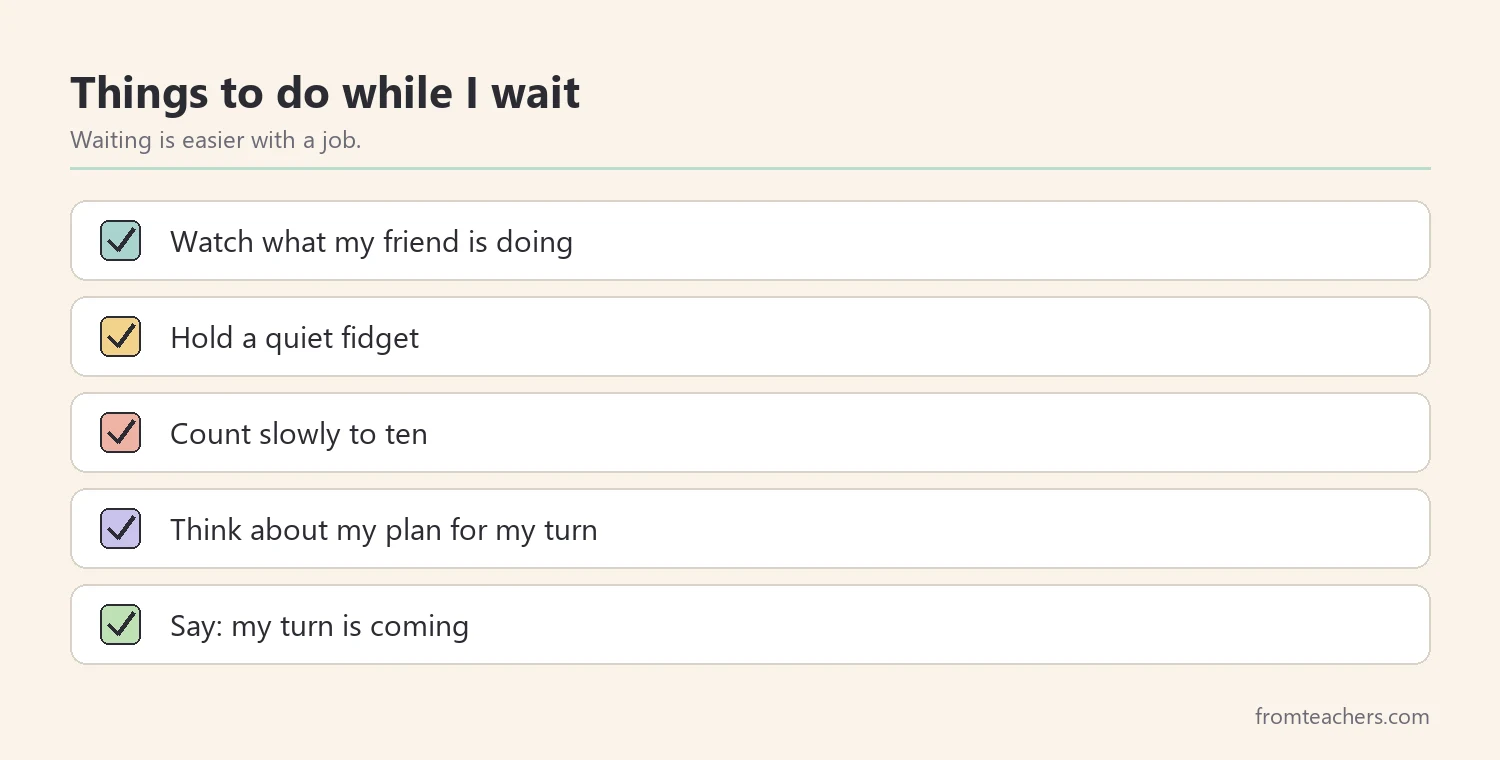
Next, give children a job while they wait. Empty waiting is hard. Waiting with something to do is much easier. A child can watch their friend, hold a quiet fidget, count slowly, or plan what they will build on their turn.
Also, practice waiting in short, easy steps. Start with very short waits, such as five seconds, and praise success. Then slowly make the waits longer. This builds turn-taking skills the same way small steps build any new habit.
In addition, use the same words every time. “Wait for your turn. What can you do while you wait?” Predictable language helps children remember the routine, especially those who find language hard to process.
Worked example. Noah is a fictional first grader. His teacher, Ms. Jensen, notices that he grabs materials at the block center. She teaches him a waiting job: “Watch my friend and plan my tower.” She practices with him during a calm moment, using a five-second wait, then ten, then thirty.
2. Use kind words to ask for a turn
Next, teach children what to say. Many children grab because they do not have quick words to ask. Short, kind phrases make asking easier: “Can I have a turn?”, “Can I use it when you are done?”, and “Thank you.”
First, model these phrases in front of the class. Act out a short scene with a puppet or another adult. Show one version where someone grabs, and another where someone asks. Ask the class which one felt better.
Also, teach the answer side. The child who has the item needs words too: “Yes, when I am done” or “You can have it after the timer.” Turn-taking skills work in both directions, so both children need a script.
In addition, accept different ways of asking. Some children use pictures, signs, or a device. A child who taps a “my turn?” picture is asking just as clearly as one who speaks.
Then, keep the phrases visible. A poster near centers or play areas reminds children of the words when they need them. The turn-taking reminders poster with seven building-block sections is one ready-made option for a play or center area.
Worked example. Ms. Jensen and a classroom assistant act out the block scene. First, the assistant grabs. Then she asks, “Can I have a turn when you’re done?” Noah practices the second version three times and gets a high five each time.
3. Make turns fair with timers and order
Next, take the guesswork out of fairness. Arguments often start because children do not know how long a turn lasts or who goes next. Clear rules make turn-taking skills easier to use.
First, use a timer. A sand timer or visual timer shows exactly how long each turn lasts. When the timer rings, the turn switches. Children often accept this more easily, because the timer decides, not a person.
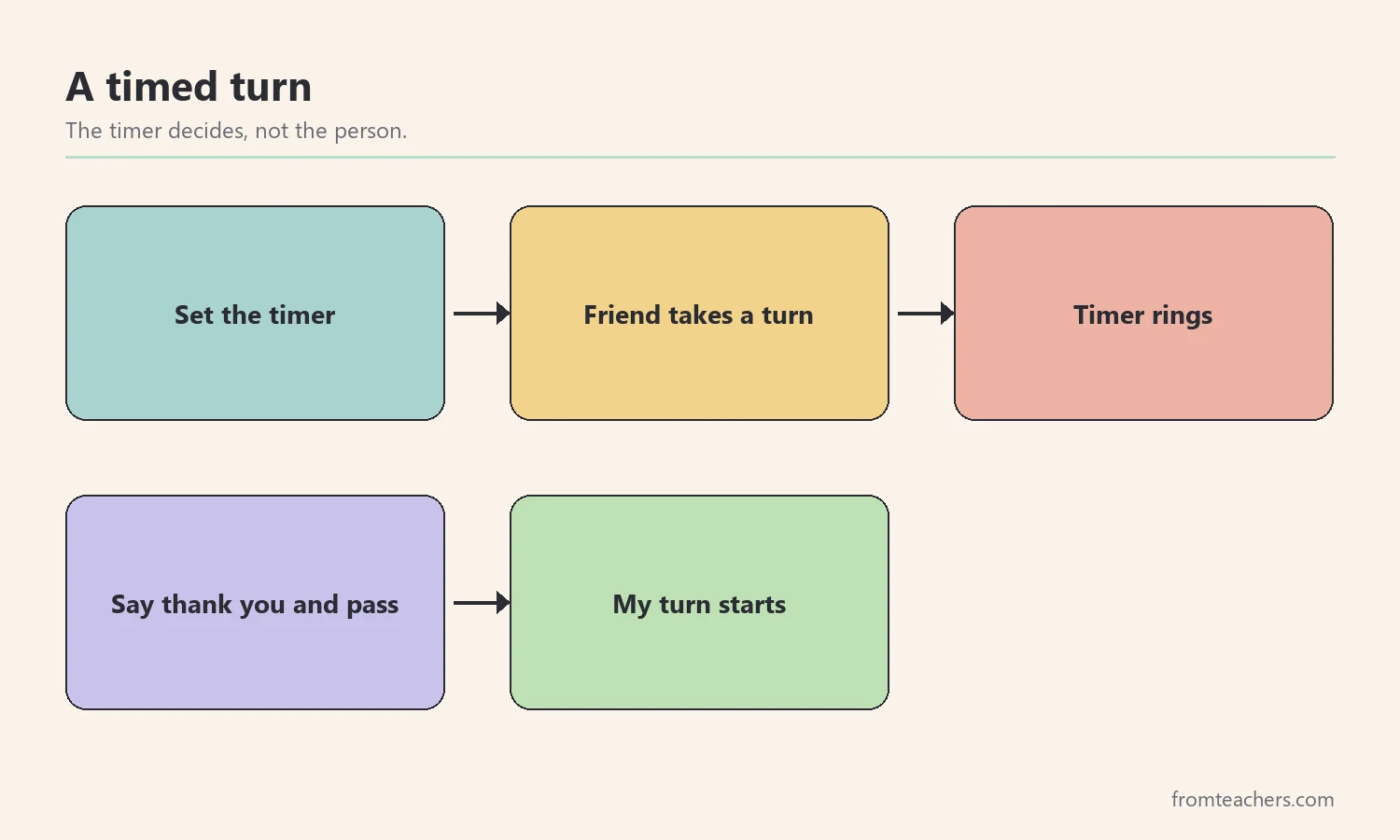
Also, set a clear order. A list of names, a turn card that moves along the table, or a simple “first, then” board shows who goes next. Order helps children trust that their turn is coming.
In addition, teach sharing of space and materials, not just toys. Children can take only what they need, let others use items during their turn, and keep their hands to themselves when it is not their turn.
Meanwhile, keep turns short at first. Long turns are hard for the children waiting. Start with one or two minutes, then adjust as turn-taking skills grow.
Worked example. Ms. Jensen puts a two-minute sand timer at the block center and a turn card with three names. When the sand runs out, the builder says “thank you” and passes the tallest blocks to the next name on the card. Arguments at the center drop within a week.
Adapting turn-taking skills for different learners
Every class has children who need a different path. Some autistic children find unpredictable sharing very stressful. Some children with ADHD find waiting physically hard. Others are still learning language and cannot yet use spoken phrases. Turn-taking skills can still be taught to all of them, with the right adjustments.
First, make it even more visual. A picture of “my turn” and “your turn,” held up and flipped, can replace words entirely. Many children understand the card faster than a spoken reminder.
Also, shrink the group. Practicing turn-taking skills with one partner is much easier than with four. Start with an adult as the partner, then a calm peer, then a small group.
In addition, give movement while waiting. A child who needs to move can hold a squeeze ball, stand instead of sit, or be the one who flips the timer. A job keeps the body busy and the wait shorter.
Finally, keep expectations realistic. Progress may be slow, and some days will be harder than others. Small, steady gains in turn-taking skills are worth celebrating, and the child’s team can help set goals that fit.
4. Stay calm when it is not your turn
Next, prepare for strong feelings. Even with clear rules, waiting can feel frustrating. Children need a plan for what to do when they feel upset about not having a turn.
First, teach calming tools. Simple options include taking deep breaths, saying a short self-talk phrase such as “My turn is coming,” and keeping the body safe. Practice these when children are calm so they can use them later.
Also, show the difference between upset reactions and calm choices. Grabbing, yelling, or knocking things over can become waiting, breathing, and asking. A simple before-and-after chart helps children see the swap.
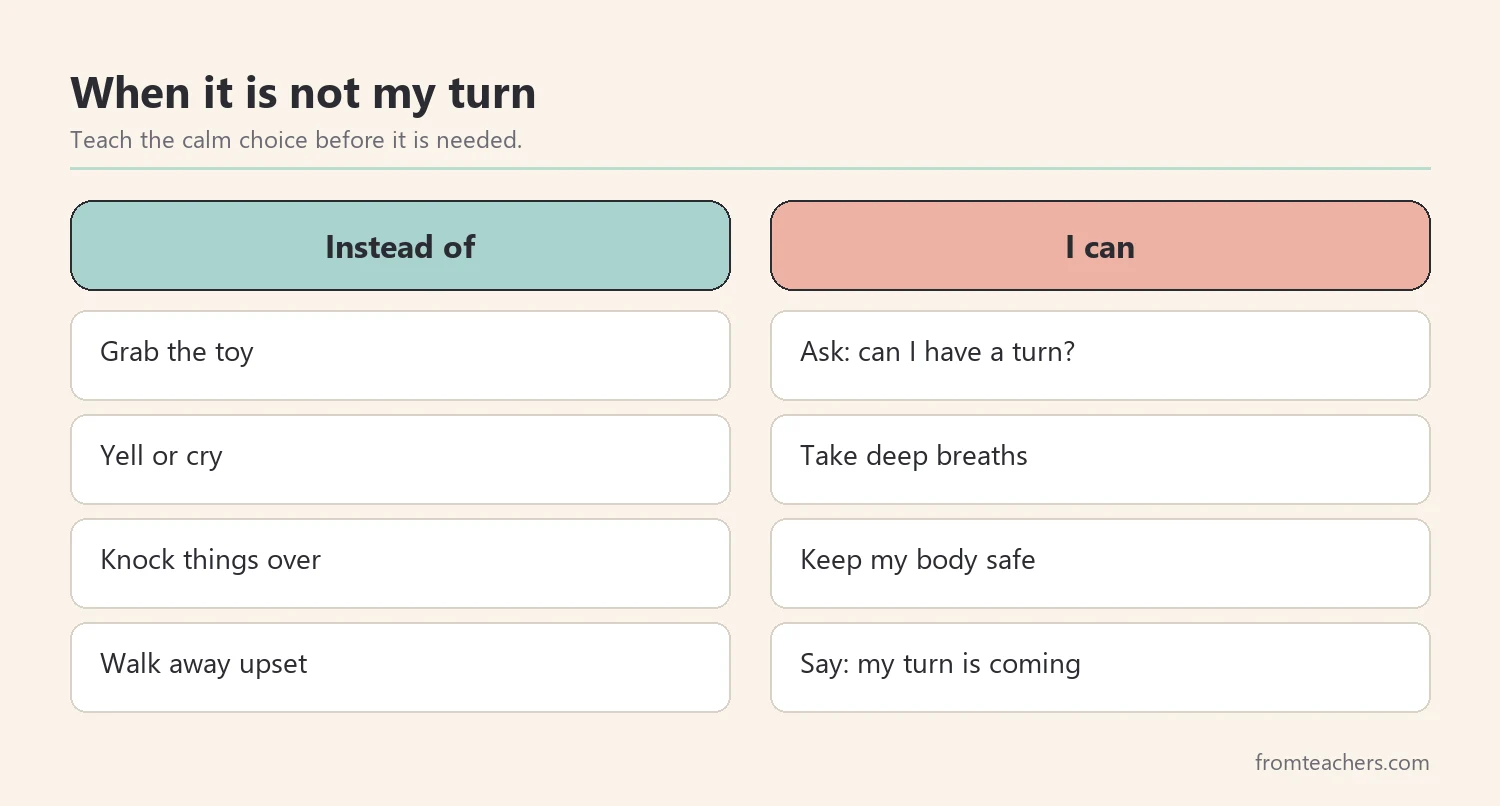
In addition, notice and name feelings. “You really want the blocks. It is hard to wait.” Naming the feeling often calms it. Then guide the child back to a waiting job.
Then, plan extra support for children who find this very hard. Some children may need a shorter wait, a personal timer, or a first turn sometimes. Talk with the special education teacher or counselor about what supports fit the child’s plan.
Worked example. One day, Noah’s face turns red while he waits. Ms. Jensen kneels and says, “It is hard to wait. Let’s take a big breath.” Together they say, “My turn is coming.” Noah watches the sand timer and takes his turn when it runs out.
5. Celebrate others and review turn-taking skills
Finally, teach children to enjoy other people’s turns. Watching respectfully, encouraging peers, and noticing what others did well turn waiting into a social moment. “Nice tower!” builds friendships and makes the next turn easier for everyone.
First, model encouragement. Comment on what children do well during their turns. Then invite others to join in: “What do you like about Maya’s tower?”
Also, collect simple data. Count how many turn moments a child had during center time and how many times they waited calmly. A short tally over a few weeks shows whether turn-taking skills are growing.
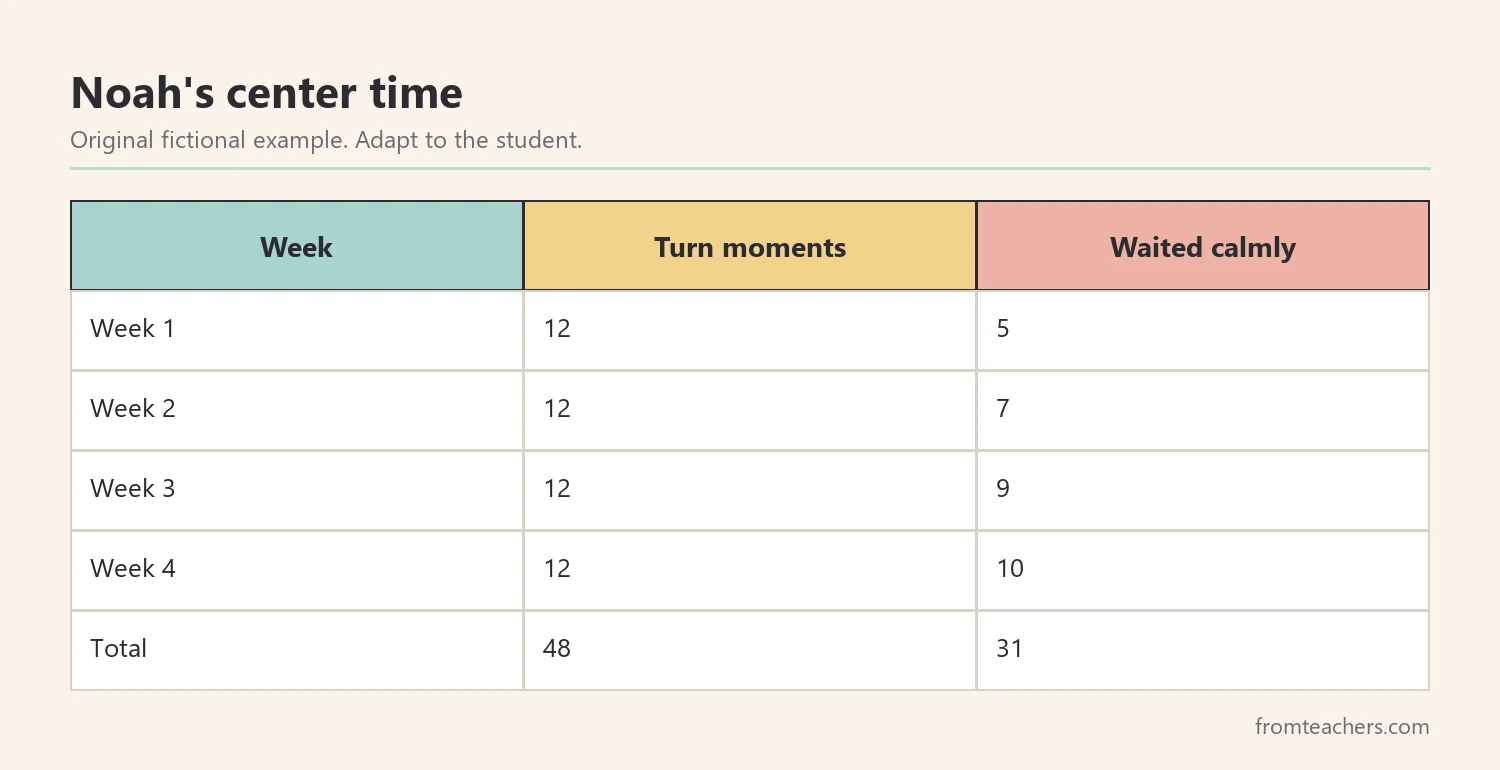
In addition, share progress with families. A note such as “Noah waited calmly for the blocks four times today” is clear and positive. Families can use the same timer and phrases during games at home.
Then, fade support slowly. As children get better at waiting and asking, reduce reminders and lengthen turns. Keep the poster and timer available for harder days.
Worked example. Ms. Jensen tracks Noah during 12 turn moments each week. He waits calmly 5 times in week 1, 7 times in week 2, 9 times in week 3, and 10 times in week 4. Across four weeks, that is 31 calm waits out of 48 turn moments.
Turn-taking skills in conversation and games
Turn-taking is not only about toys. Conversations, board games, and class discussions all need turns. So, use the same ideas: wait, listen, and then speak. A talking object, such as a small ball passed around a circle, makes conversational turns visible.
Also, choose games that build turn-taking skills on purpose. Simple board games, rolling a ball back and forth, or building a tower one block at a time all give many short turns. Keep games short at first, and praise waiting as much as winning.
Finally, think about older students. Group projects need turn-taking too: sharing materials, taking turns to talk, and listening to each idea. The same reminders apply, with more grown-up language.
Common mistakes and how to avoid them
- Saying “be patient” without teaching how. Children do not know what to do. Fix: give a waiting job.
- Long turns at the start. Waiting feels endless. Fix: use short, timed turns.
- Adults deciding who goes next each time. Turns feel unfair. Fix: use a visible order and timer.
- Teaching only the asker. The child with the toy has no words. Fix: teach both sides of the script.
- Only correcting grabbing. Children hear more about mistakes than success. Fix: praise calm waiting often.
Questions teachers and parents ask about turn-taking skills
At what age do children learn turn-taking?
Children start to learn simple turn-taking in the toddler and preschool years, and keep developing it through early school. Every child moves at their own pace. Children with developmental differences may need more direct teaching and practice.
What if a child refuses to give up a turn?
First, use a timer so the switch is predictable. Give a one-minute warning before it rings. Then praise the child when they pass the item, even if they needed help.
Should I make every child share every toy?
Not always. Some classrooms allow a child to finish their turn before passing an item, which can feel fairer than instant sharing. Clear rules matter more than the exact system.
How can parents practice at home?
Short board games, rolling a ball, and sharing snacks are easy practice. Use the same phrases and a kitchen timer, and praise calm waiting.
Can turn-taking be an IEP goal?
Turn-taking and other social skills sometimes appear in IEP goals. That decision belongs to the child’s team. Simple counts of turn moments make progress easy to show.
Related reading: Autism Social Skills Development: Practical Strategies for Growth, Moving Beyond Shame and Behavior Charts: Positive Alternatives for Effective Classroom Management, and Meltdowns vs Tantrums: A Guide to Understanding and Responding.
A companion resource for turn-taking skills:
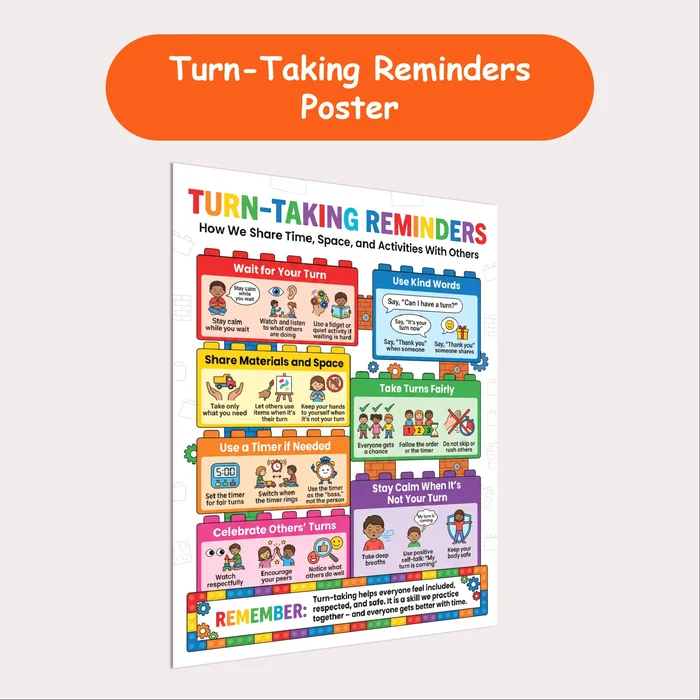
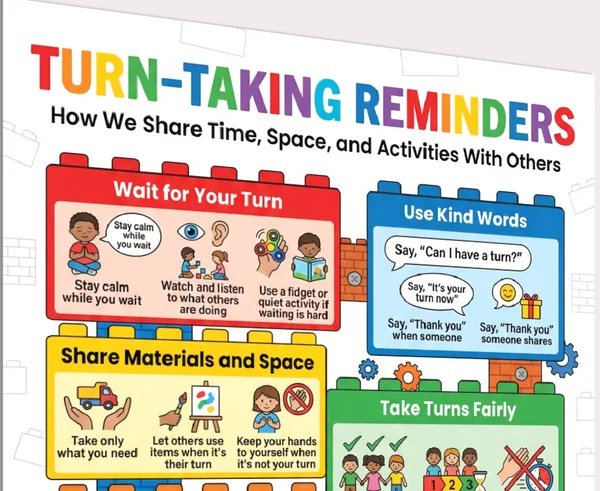
Turn-Taking Reminders Poster: a printable poster that shows how we share time, space, and activities with others, in seven building-block sections. A playful social skills poster for special education and early learning classrooms.
Sources and scope
- National Association for the Education of Young Children (NAEYC): guidance on early learning and social development.
- CASEL: a framework for social and emotional learning, including relationship skills.
- Centers for Disease Control and Prevention (CDC): information on child development and developmental milestones.
- IRIS Center, Vanderbilt University: free modules on classroom behavior and early childhood supports.
This guide covers everyday classroom and home teaching of sharing and waiting. It does not replace a behavior plan, social skills therapy, or the decisions of the child’s support team.
Key takeaways
- Turn-taking skills cover sharing time, space, and activities.
- Give children a waiting job instead of only saying “be patient.”
- Teach kind words for both asking and answering.
- Use timers and a clear order to keep turns fair.
- Celebrate others’ turns and track calm waiting over time.


Leave a Comment