

The afternoon energy slump hits many upper elementary classrooms right after lunch and recess, when eyes droop and pencils stop moving. Picture Sofia, a fourth grader who is bright and chatty at 9 a.m. but stares out the window by 1:30. Her teacher, Mr. Reed, has tried raising his voice and moving her seat, yet the dip returns every day.
This list is for teachers in grades 3 to 5. It gives ten practical fixes for the afternoon energy slump, ranked from the ones that need no preparation to the ones that need a little planning. Each idea explains why it can help, how to run it and how it worked for Sofia’s class. You will also see how students can track their own energy, which turns a daily problem into a lesson in self-awareness.
Examples are fictional. Adapt to the student’s goals and agreed supports. This is guidance, not a diagnosis.
At a glance
- An after-lunch dip is common and usually not a behavior problem.
- Movement, water, light and fresh air are the cheapest fixes.
- Schedule hands-on work in the afternoon and lectures in the morning.
- Students can learn to notice and name their own energy levels.
- A few days of simple tracking shows when and why energy drops.
How we ranked these ideas
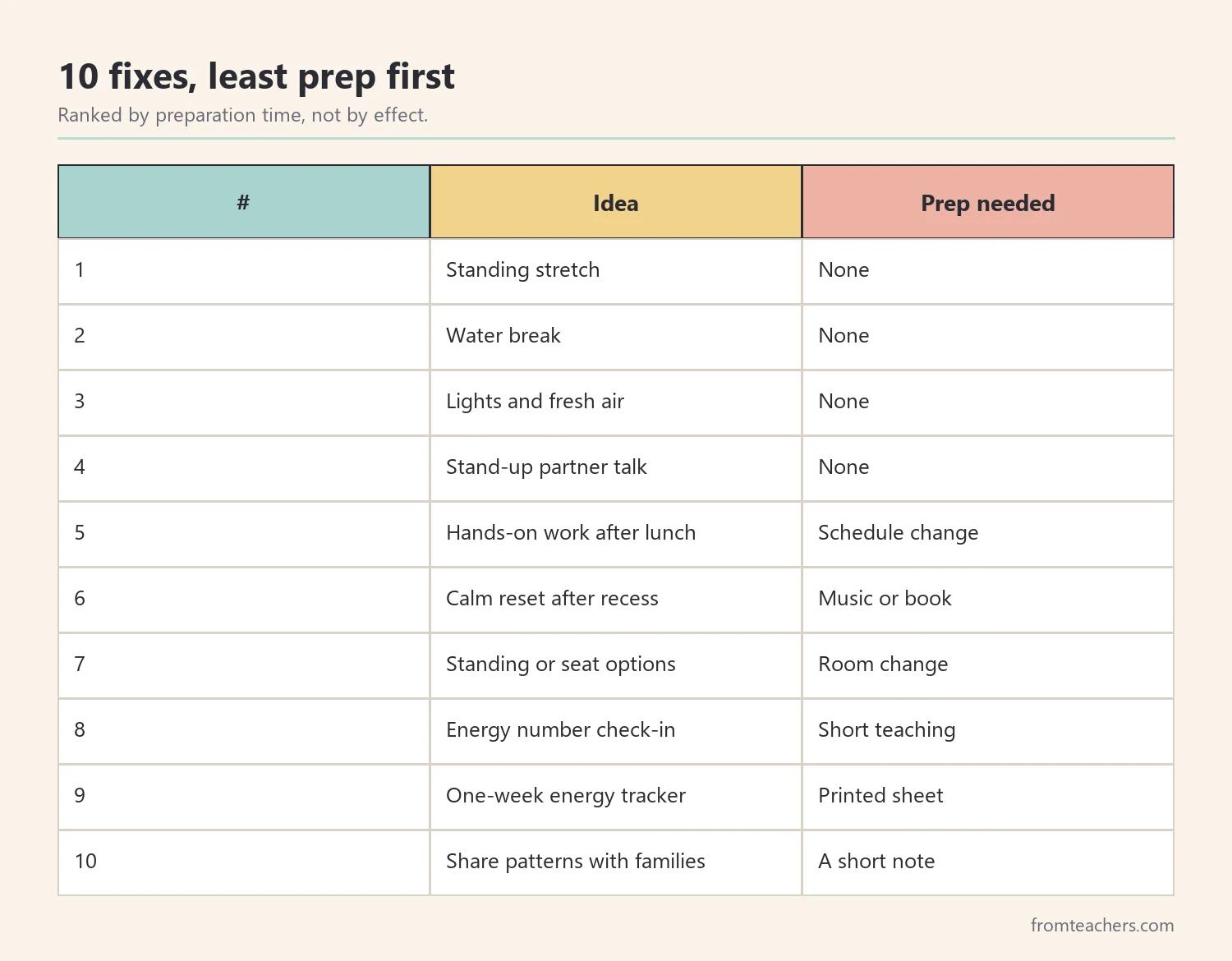
We ranked the ten ideas by preparation time. Ideas 1 to 4 need no materials and can start today. Ideas 5 to 7 need a small change to your room or schedule. Finally, ideas 8 to 10 need a bit of planning, such as a tracking sheet or a conversation with families.
We did not rank them by effectiveness, because what works depends on the class. Instead, try two or three, watch what happens and keep the ones that help. Figure 1 shows the full ranking.
1. A two-minute standing stretch
First, get everyone on their feet. A short stretch beside the desks wakes up the body without turning the room into a gym.
Why it can help: sitting still for a long time makes many children feel sleepy. Brief movement breaks are a widely used classroom strategy for refocusing attention.
How to run it: lead three or four slow moves: reach up, touch toes, roll shoulders, march in place. Keep it under two minutes.
Example: Mr. Reed started every afternoon block with a stretch. Sofia, who usually slumped, laughed during the marching and sat up straighter afterward.
2. A water break
Next, check water bottles. Many children drink little at lunch, especially on busy or hot days.
Why it can help: staying hydrated supports general comfort and alertness, and it is an easy habit to build.
How to run it: after recess, give everyone thirty seconds to drink. Keep bottles on desks if school rules allow.
Example: Sofia’s bottle often came home full. After a daily water moment, she began finishing it by the end of the day.
3. Switch on the lights and open a window
A dim, warm room can make the dip worse. Bright light and fresh air change the feel of the room in seconds.
Why it can help: light and cooler air signal “awake” to many people. Also, a stuffy room after lunch feels heavy for everyone.
How to run it: open blinds or turn lights fully on after recess, and open a window if it is safe.
Example: Mr. Reed noticed he had dimmed the lights for a video and never turned them back up. Fixing that alone made the room feel livelier.
4. Stand-up partner talk
Swap sitting discussion for standing discussion. Students find a partner across the room, stand and answer one question.
Why it can help: it combines movement, social energy and learning. Students who would drift during whole-class discussion usually talk to a partner.
How to run it: pose a question, say “stand, walk, talk,” give two minutes, then ask a few pairs to share.
Example: During science, Sofia explained the water cycle to a partner across the room. She remembered it better the next day than her notes from the morning.
5. Move hands-on work to the afternoon
Now look at your schedule. If the afternoon is mostly listening and copying, the dip will win.
Why it can help: active tasks such as experiments, building, art and games naturally keep students engaged when energy is lower.
How to run it: where possible, place lectures and new explanations in the morning and labs, projects and practice games after lunch.
Example: Mr. Reed moved math games to 1:30 and the math mini-lesson to the morning. Sofia stayed engaged through the whole afternoon block.
6. A calm reset after recess
Sometimes the problem is not low energy but scattered energy. Students come in hot, loud and unsettled, then crash a few minutes later.
Why it can help: a short calm routine helps the class shift from playground mode to learning mode, which can prevent the crash.
How to run it: three slow breaths, a minute of quiet reading or soft music while students settle and drink water.
Example: Sofia’s class began each afternoon with two minutes of quiet music. The room felt calmer, and the slump arrived later.
7. Flexible seating or standing options
Some students simply need to change position. A standing spot, a clipboard on the carpet or a seat by the window can help.
Why it can help: different positions help some children stay alert. Choice also gives students a sense of control over their own energy.
How to run it: offer two or three options with clear rules: work gets done, and the spot is shared fairly.
Example: Sofia chose a standing spot at the counter for reading. She read more pages there than at her desk.
8. An energy check-in with a number
Teach students to rate their energy from 1 to 5 at a few points in the day. This is the start of self-awareness, and it works well for the afternoon energy slump.
Why it can help: once students can name a low number, they can choose a strategy, such as a stretch or water, instead of just drifting.
How to run it: at the start of morning, after lunch and before dismissal, students hold up fingers or write a number.
Example: Sofia rated herself 4 in the morning and 2 after lunch nearly every day. She began asking for a water break on her own.
9. A one-week energy tracker
For students who want to dig deeper, a written tracker shows patterns over several days. It connects energy to sleep, breakfast, activity and mood.
Why it can help: patterns are easier to see on paper. A student may notice that low-sleep nights lead to hard afternoons.
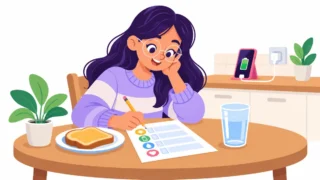
How to run it: for one week, students fill in a short sheet morning and afternoon. A ready-made daily energy level tracker covers a morning check-in, energy and mood across the day, habits and a reflection, so there is nothing to design.
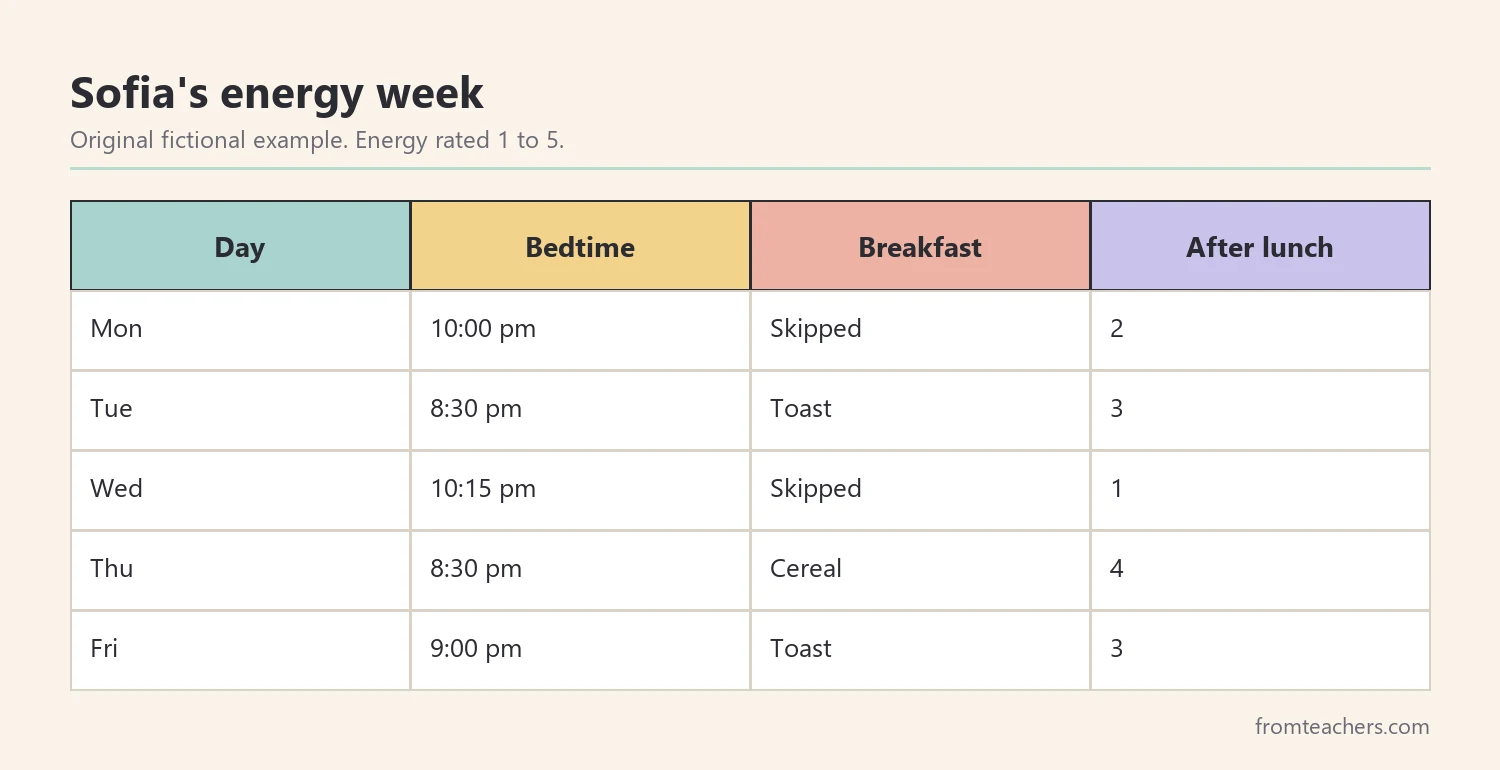
Example: Sofia’s tracker, summarized in Figure 2, showed that her lowest afternoons followed late bedtimes and skipped breakfasts. She shared it with her mom, who adjusted bedtime.
10. Share patterns with families
Finally, some causes of the afternoon energy slump start at home: late screens, short sleep or no breakfast. School cannot fix these alone, but families can help.
Why it can help: a calm, specific note invites families to work with you instead of feeling blamed.
How to run it: share what you see in neutral language, such as “Sofia’s energy drops after lunch most days.” Ask whether they notice the same at home. If tiredness seems unusual or does not improve, suggest families check with their pediatrician.
Example: Sofia’s mother said bedtime had slipped to 10 p.m. They agreed on an earlier routine, and Sofia’s afternoon ratings slowly rose.
Morning versus afternoon: planning around energy
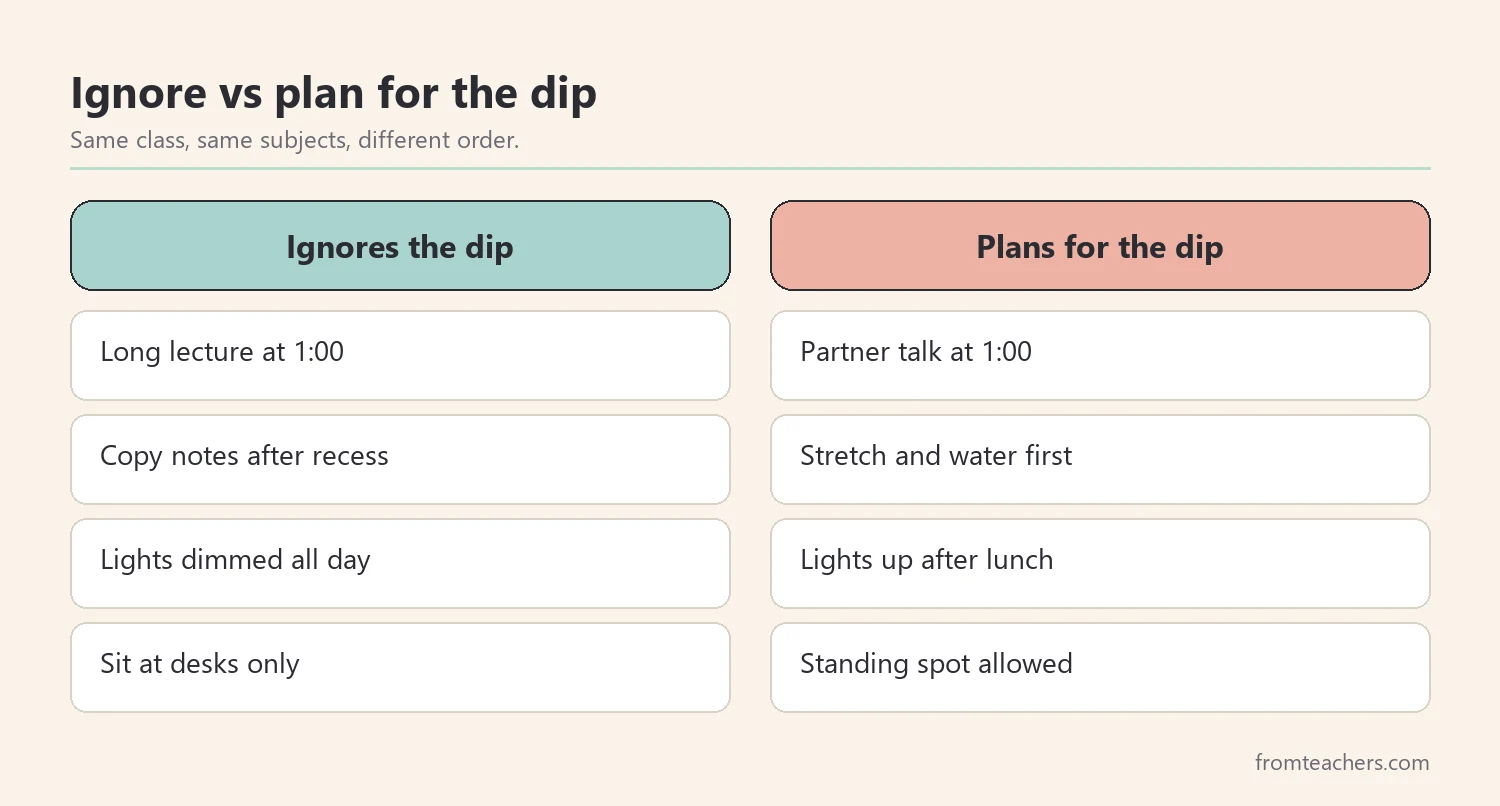
Many teachers find that matching tasks to energy works better than fighting it. Figure 3 compares a schedule that ignores the afternoon energy slump with one that plans for it. The examples are general, so adapt them to your timetable.
| Time | Typical energy | Good task fit |
|---|---|---|
| Early morning | Often rising | New lessons, reading |
| Late morning | Often high | Math, writing |
| Right after lunch | Often lower | Movement, partner talk |
| Mid afternoon | Mixed | Projects, labs, art |
These patterns vary by child. Some students are slow starters who come alive after lunch. That is exactly why individual tracking is useful.
Teaching students to use their own strategies
Ultimately, the goal is not for the teacher to fix every slump. Instead, students learn to notice low energy and pick a strategy themselves. Figure 4 shows a simple four-step routine students can learn.
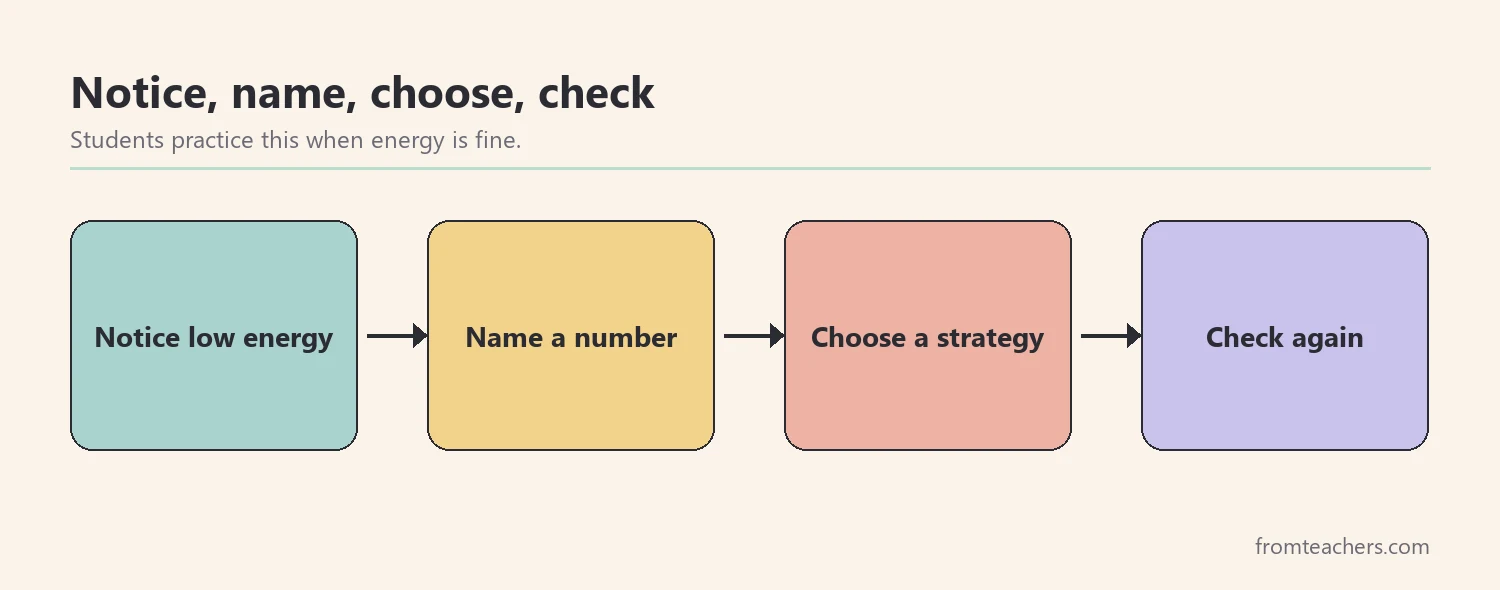
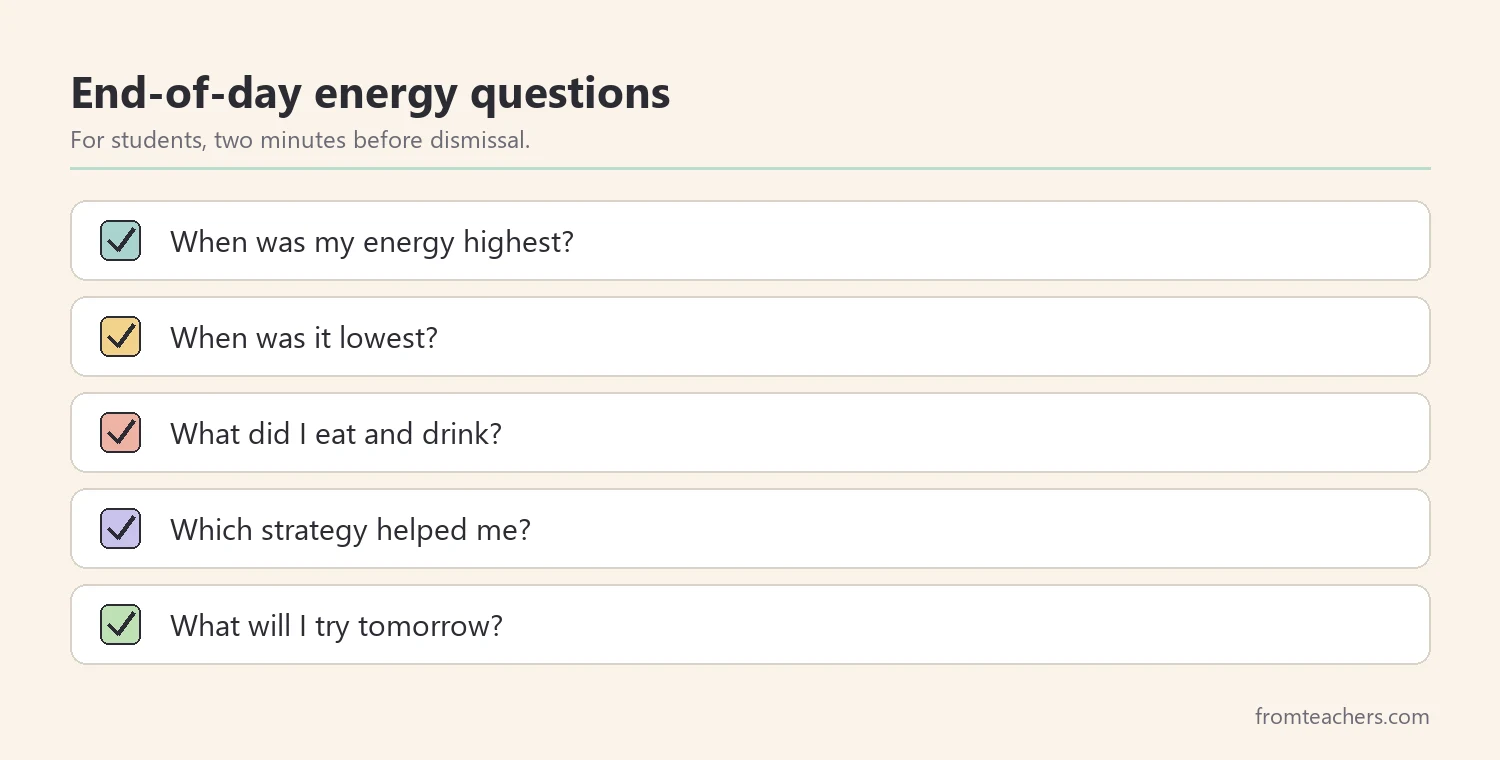
Post a short menu of allowed strategies, such as water, a stretch at the desk, a standing spot or three slow breaths. Then practice it when energy is fine, so students know what to do when it is not. Figure 5 lists questions students can use when they reflect at the end of the day.
Common mistakes and how to avoid them
- Treating the dip as misbehavior. Fix: respond with a strategy, not a consequence.
- Using recess as a punishment. Fix: protect movement time, since it often helps afternoon focus.
- Turning breaks into chaos. Fix: keep them short, structured and predictable.
- Tracking without reflection. Fix: end each tracker week with two or three questions.
- Blaming families. Fix: share observations neutrally and ask what they notice.
Questions teachers ask about the afternoon energy slump
Is the afternoon energy slump normal for kids?
Many children, like many adults, feel a dip after lunch. However, constant exhaustion or sudden changes should be shared with families and the school nurse.
How long should a brain break last?
Most classroom movement breaks last one to three minutes. Short and predictable breaks are easier to manage than long, open ones.
Can students track their energy without it taking over the lesson?
Yes. A number from 1 to 5 takes seconds. A fuller tracker can be done for one week as a short project.
What if one student is always tired?
Look at patterns first, then talk with the family. If tiredness continues, suggest they check with a doctor.
Does this work for students with ADHD?
Movement, choice and self-monitoring are common supports for many students with attention needs. Follow any individual plan the student already has.
Related reading: 5 Practical Teaching Tips to Boost Classroom Focus, Effective ADHD Classroom Strategies, and Learning Styles Student Success Guide.
You may also need: Healthy Habits for Kids: Sleep, Nutrition and Routines.
A companion resource for the afternoon energy slump:
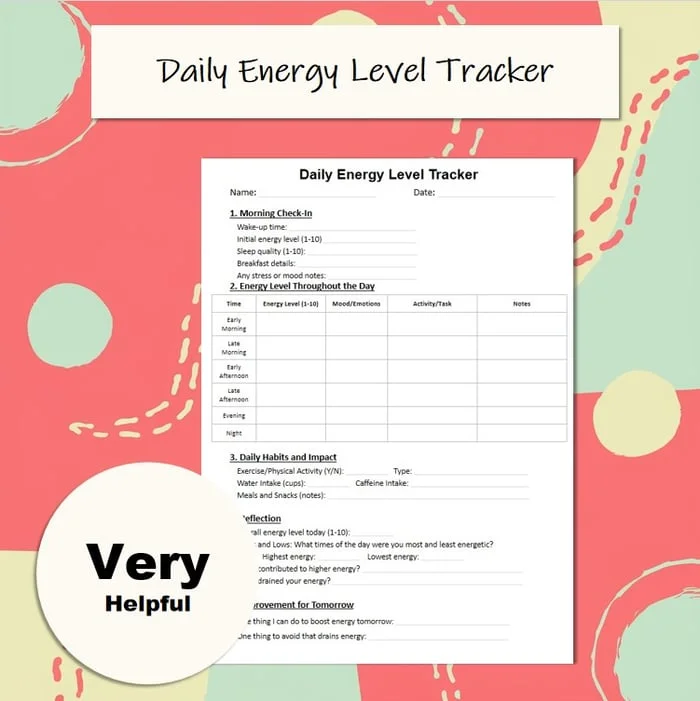
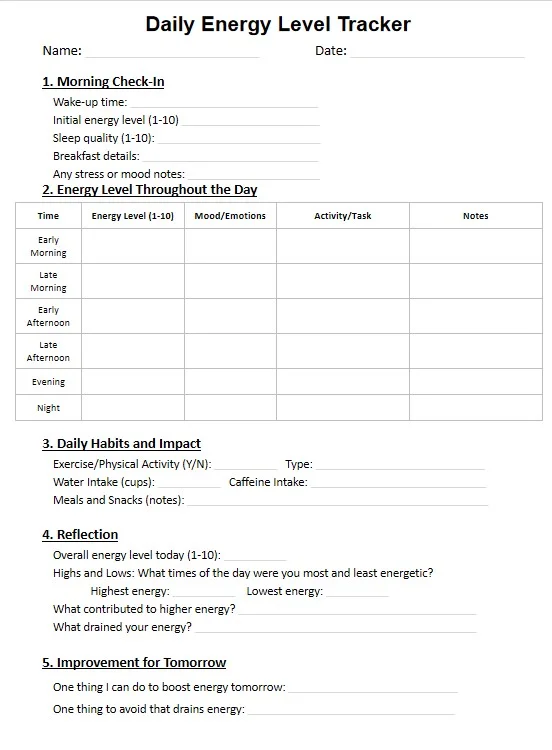
Daily Energy Level Tracker Sleep Mood and Habit Reflection Worksheet: a one-page tracker with a morning check-in for wake-up time, sleep quality and breakfast, an energy and mood table across six parts of the day, daily habits such as exercise, water and meals, a reflection on high and low points, and one idea for tomorrow.
Sources and scope
- KidsHealth (Nemours): articles for families and educators on sleep, nutrition and activity in children.
- Sleep Foundation: general information on sleep needs and habits for children.
- Center on PBIS: resources on positive classroom routines and environments.
- Edutopia: classroom articles from teachers on brain breaks, movement and routines.
This list covers simple classroom routines for the everyday afternoon dip in upper elementary grades. It does not cover medical causes of tiredness; persistent fatigue should be discussed with families and the school nurse.
Key takeaways
- The afternoon energy slump is common and best met with strategies, not consequences.
- Start with no-prep fixes: stretch, water, light and standing talk.
- Plan active work for the afternoon when you can.
- Teach students to rate and track their own energy.
- Share patterns with families calmly and specifically.








Leave a Comment