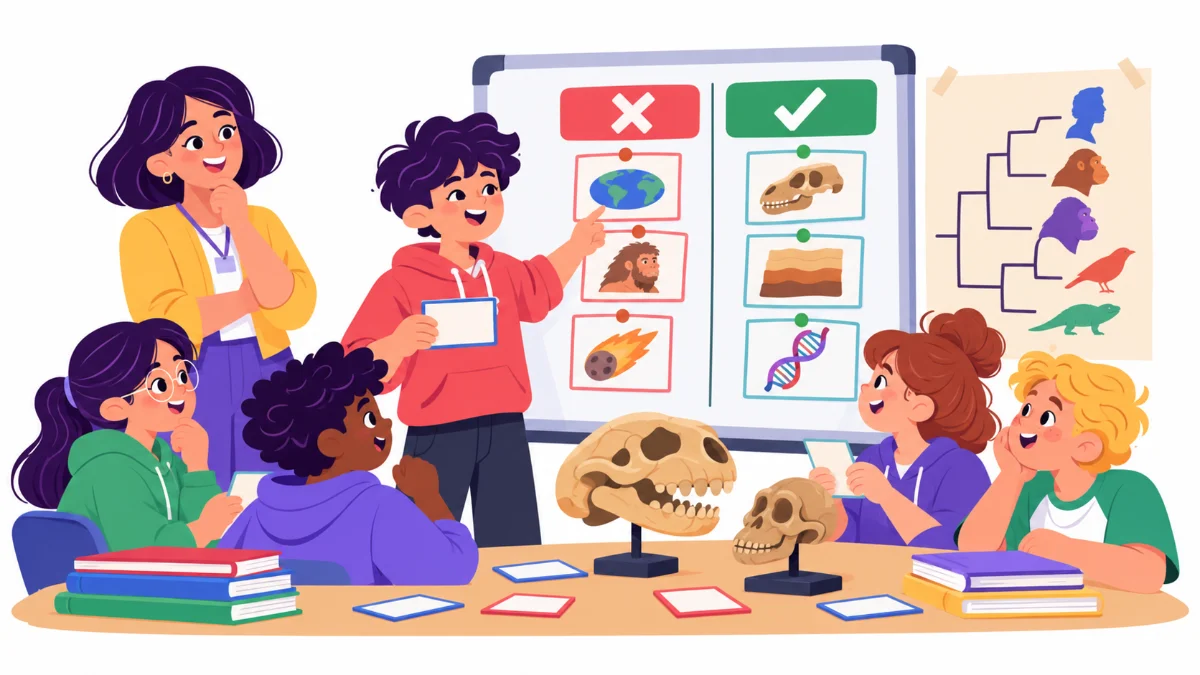

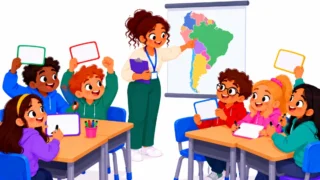
Human evolution misconceptions arrive in the classroom long before the unit does. Picture the first lesson in Ms. Adeyemi’s grade 7 science class. She asks, “Where did humans come from?” and Priya answers confidently, “From monkeys, like chimps, but they changed.” Three other students nod.
This list is for middle school science teachers, homeschool parents and tutors. It covers ten misconceptions students often bring with them, in the order they usually come up in a unit. For each one, you get a plain correction, a quick classroom move and a check question, so you can spot the idea early and replace it with the evidence.
Examples are fictional. Adapt to the student’s goals and agreed supports. This is guidance, not a diagnosis.
At a glance
- Misconceptions are normal starting points, not mistakes to punish.
- Ask students what they think before you teach.
- Replace an idea with evidence, not only with a “no.”
- Use the family tree as a bush, not a ladder.
- Check again at the end of the unit to see what changed.
How this list is ordered
We did not rank these misconceptions by how common they are, since we have no data for your class. Instead, they follow the order of a typical middle school unit: big ideas about evolution first, then human ancestors, then what evolution means for us today.
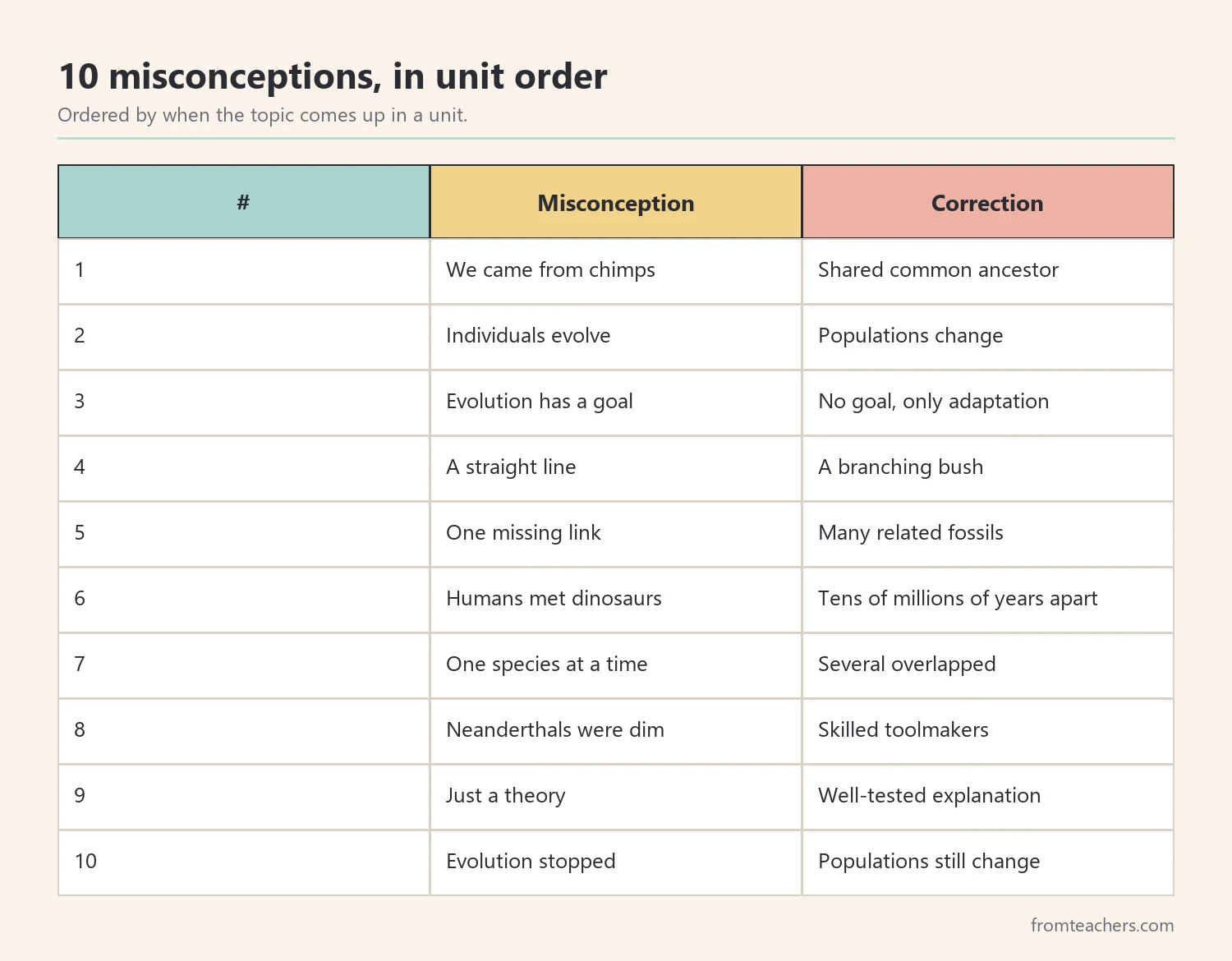
Therefore, you can tackle each misconception when its topic arrives, rather than all at once. Figure 1 shows the full list with the key correction for each.
1. “Humans evolved from chimpanzees”
This is the classic among human evolution misconceptions. Students hear “humans and apes are related” and picture chimps slowly turning into people.
The correction: humans and chimpanzees share a common ancestor that lived millions of years ago. Since then, each line has evolved separately. Chimps are our cousins, not our grandparents.
Classroom move: compare it to a family tree. You and your cousin share grandparents, but you did not descend from your cousin.
Check question: “Are chimpanzees still evolving today?” (Yes, like every living species.)
2. “Evolution happens to individuals”
Students often imagine one animal changing during its lifetime, like a giraffe stretching its neck.
The correction: evolution happens in populations over many generations. Individuals with helpful traits tend to survive and have more offspring, so those traits become more common.
Classroom move: run a quick natural selection simulation, such as colored paper “beetles” on a patterned background, over several rounds.
Check question: “Can one person evolve?” (No. Populations change over generations.)
3. “Evolution has a goal, and humans are the top”
Many students picture evolution as progress toward something better, with humans at the end.
The correction: evolution has no goal. Traits spread when they help survival and reproduction in a particular environment. A trait that helps in one place can be useless in another.
Classroom move: ask students to name an animal that is “better” than humans at something, such as smell, speed or seeing in the dark.
Check question: “Is a shark less evolved than a human?” (No. It is adapted to its own environment.)
4. “Human evolution is a straight line”
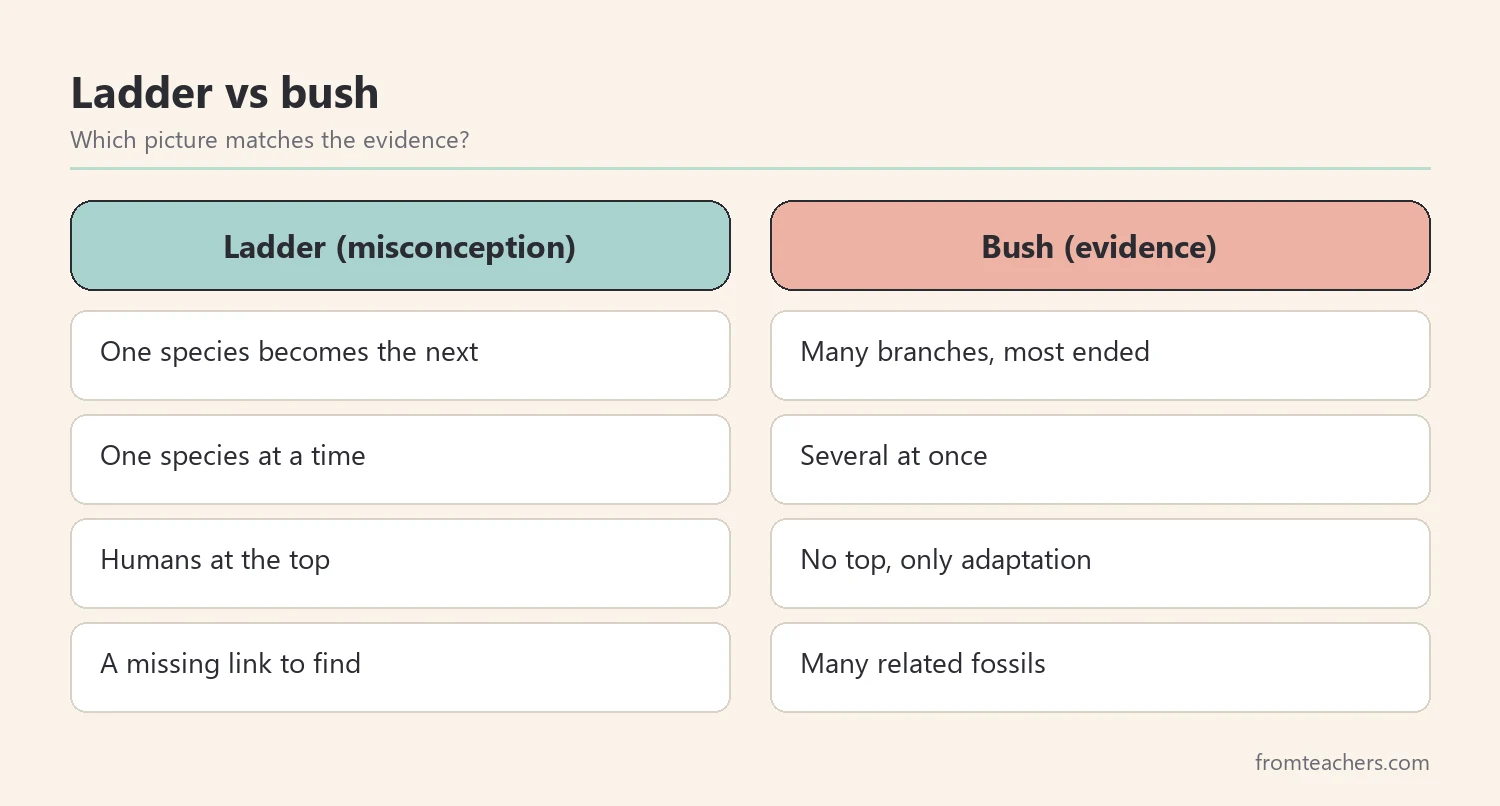
The famous “march of progress” image shows one figure turning into the next. It sticks in students’ minds.
The correction: scientists describe the human family tree as a branching bush. Many species lived, some at the same time, and most branches ended without descendants today.
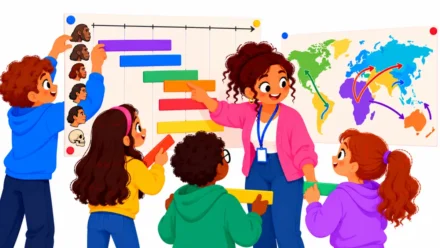
Classroom move: build a timeline with overlapping bars for each species. Then ask students what they notice.
Check question: “Did every hominin species turn into the next one?” (No. Many branches ended.)
5. “There is one missing link”
Students may have heard that scientists are still searching for “the missing link” between apes and humans.
The correction: there is no single missing link. Scientists have found many fossils from different species, each showing a mix of older and newer features. Every new find adds detail to the bush.
Classroom move: show images of fossils such as the “Lucy” skeleton of Australopithecus afarensis and discuss which features look more ape-like and which look more human-like. A ready-made human evolution guide for middle school helps here: it covers six hominin species, the human family tree, fossil dating and ancient DNA, with discussion questions and a quiz for grades 6 to 8.
Check question: “Why do scientists not talk about one missing link?” (Because there are many related fossils, not one.)
6. “Early humans lived with dinosaurs”
Cartoons and movies put cave people and dinosaurs in the same scene. Unsurprisingly, many students believe it.
The correction: non-bird dinosaurs died out about 66 million years ago. The earliest hominins appear only a few million years ago. A huge gap separates them.
Classroom move: make a timeline with toilet paper or a long strip of paper, marking dinosaurs and hominins at scale. The tiny human section surprises students.
Check question: “Could Homo erectus have seen a T. rex?” (No. They lived tens of millions of years apart.)
7. “Only one human species lived at a time”
Because only Homo sapiens exists today, students assume it was always that way.
The correction: for much of the past, several human species shared the planet. For example, Homo sapiens and Neanderthals lived at the same time, and they sometimes met.
Classroom move: return to the overlapping timeline from item 4 and count how many species lived at one moment in time.
Check question: “Name two human species that lived at the same time.” (Homo sapiens and Homo neanderthalensis.)
8. “Neanderthals were dim brutes”
Old drawings show hunched, club-carrying Neanderthals. The image has stuck around for a long time.
The correction: evidence shows Neanderthals made skilled stone tools, used fire and survived in tough climates. In addition, many people living today carry a small amount of Neanderthal DNA, because the two groups interbred.
Classroom move: show an old drawing next to a modern museum reconstruction. Ask students what changed and why.
Check question: “What evidence tells us Neanderthals were skilled?” (Tools, fire use and survival in cold places.)
9. “Evolution is just a theory”
Students may hear “theory” and think “guess.” In everyday speech, that makes sense.
The correction: in science, a theory is a well-tested explanation supported by a large body of evidence. Evolution is supported by fossils, DNA, anatomy and observations of living populations.
Classroom move: compare “theory” in science with other well-supported theories, such as germ theory, that students already accept.
Check question: “What does theory mean in science?” (A well-tested explanation backed by evidence.)
10. “Humans have stopped evolving”
Finally, students often think evolution is finished now that humans have medicine and technology.
The correction: human populations continue to change. A commonly taught example is the ability of many adults to digest milk, which became common in some populations after people began keeping dairy animals.
Classroom move: discuss how culture, such as farming, can shape which traits are helpful.
Check question: “Is evolution still happening in humans?” (Yes, populations continue to change.)
Measuring human evolution misconceptions before and after
A short true or false quiz at the start and end of the unit shows what changed. Use the same ten statements both times. Here is how Ms. Adeyemi’s class did.
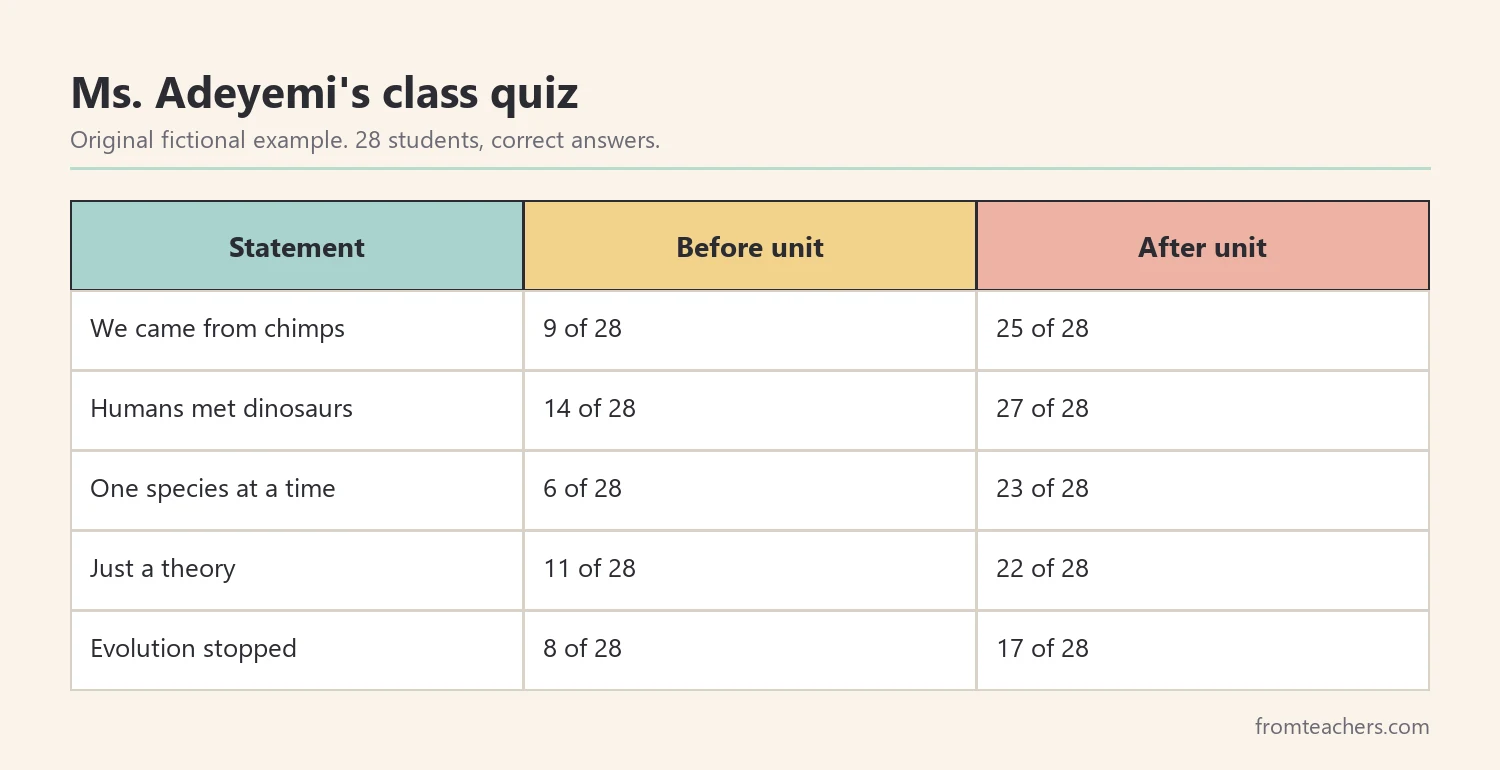
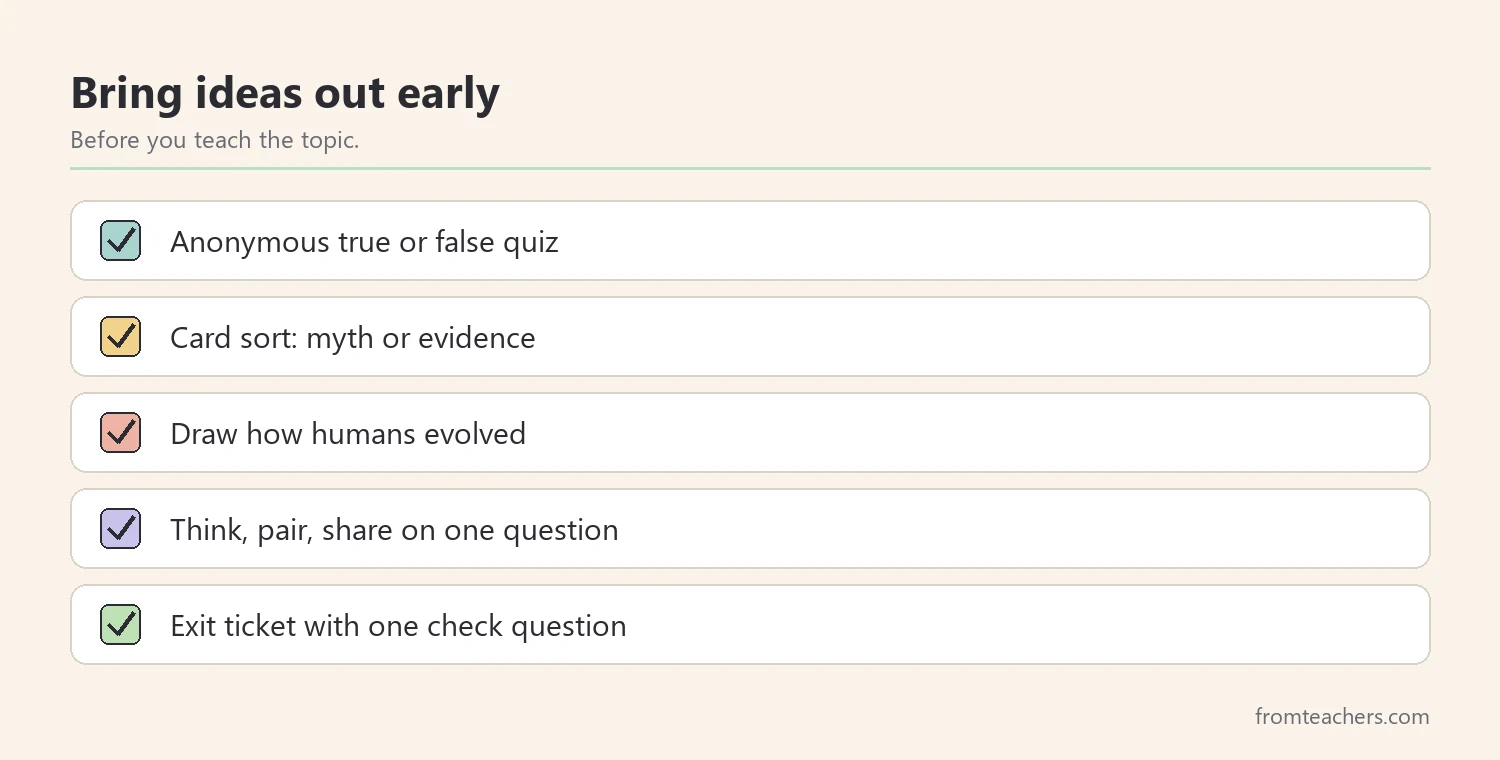
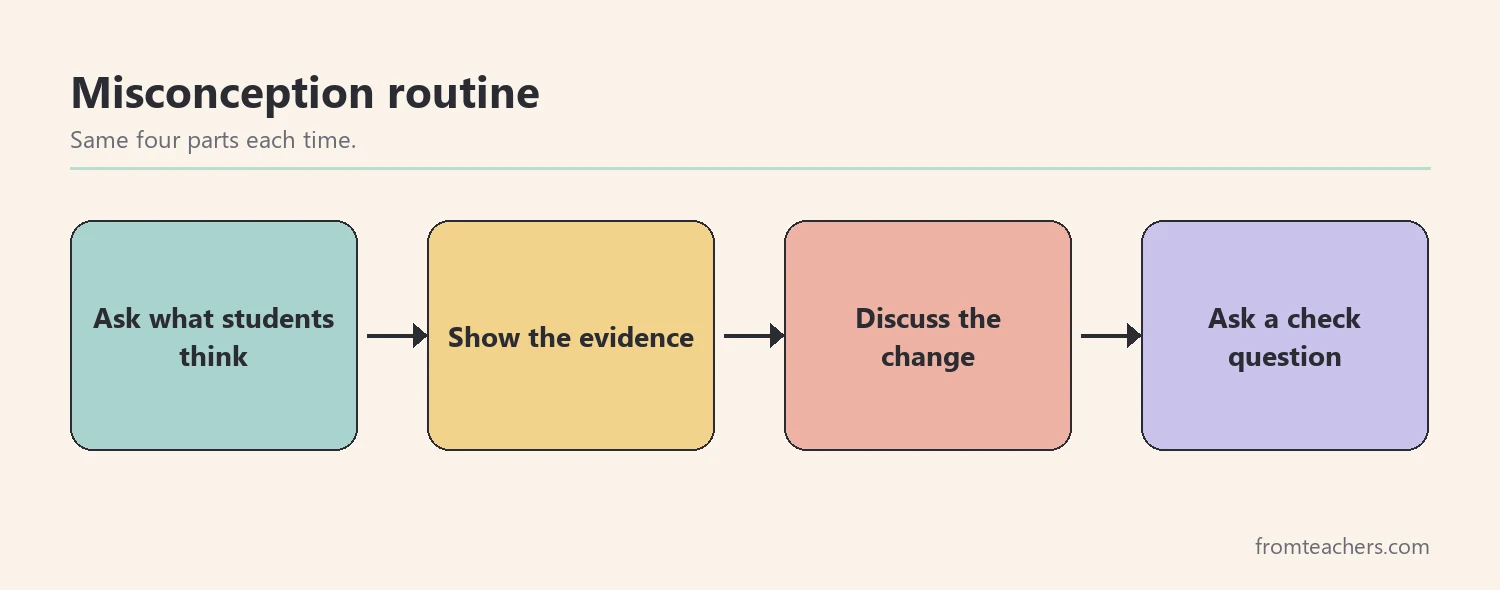
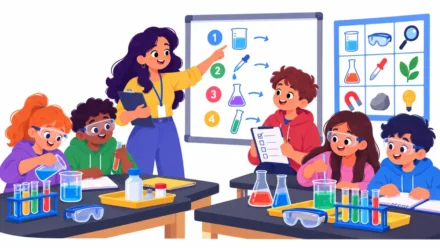
Most ideas shifted well. However, “humans have stopped evolving” moved least, so she planned an extra discussion on it next year. Figure 4 lists simple ways to bring misconceptions out early, and Figure 5 shows her four-part routine.
Teaching tips for sensitive conversations
Evolution can touch on family beliefs. Keep the focus on what the evidence shows and how scientists know it. Students do not have to agree, but they should understand the science.
Also, keep the tone respectful. Correct ideas, never students. A student who shares a misconception has helped the whole class learn.
In addition, plan for students who need extra support. Visual timelines, fossil photos and sentence starters such as “The evidence shows…” help students with reading or language difficulties take part fully. Likewise, a short glossary card with words like ancestor, population and adaptation keeps vocabulary from becoming a barrier.
Bringing families into the unit
Many misconceptions come from home conversations, films and books, so families can help replace them too. Send home two or three of the true or false statements and invite students to quiz an adult. Students enjoy being the expert for once.
Similarly, suggest a free online visit to a natural history museum’s human origins pages. Families can explore species profiles together, and students often return to class with new questions. That curiosity is the best sign that a misconception has been replaced by real understanding.
Finally, keep a short list of the questions students bring back. Over a few years, that list becomes a reliable guide to which ideas need the most time in your own classroom.
Common mistakes and how to avoid them
- Correcting without evidence. Fix: pair every correction with a fossil, a timeline or a simple activity.
- Using the march of progress image. Fix: show a branching bush instead.
- Skipping the pre-quiz. Fix: ask first, so you know which ideas to target.
- Overloading dates. Fix: use rounded dates and a visual timeline for ages 11 to 13.
- Treating questions as challenges. Fix: welcome questions as a sign of thinking.
Questions teachers and parents ask about human evolution misconceptions
Why do these misconceptions last so long?
Many come from everyday language, cartoons and old images. They also feel intuitive. Therefore, they need to be replaced with evidence, not just corrected once.
When should I ask students about their ideas?
At the very start of the unit, before any teaching. A quick anonymous quiz or card sort works well and keeps the mood relaxed.
How precise should the dates be for middle school?
Rounded dates and clear order are usually enough. Museum websites give more detail if students are curious.
Can I teach this at home?
Yes. Homeschool families can use the same true or false statements and timeline activities, then visit a natural history museum or its website.
What if a student strongly disagrees?
Listen respectfully, explain the evidence and keep the focus on understanding. Students are assessed on what the science says, not on personal belief.
Related reading: Learning Styles Student Success Guide, 5 Practical Teaching Tips to Boost Classroom Focus, and Homeschooling vs Public Schooling.
You may also need: Dinosaurs: The Complete Student Field Guide.
A companion resource for human evolution misconceptions:
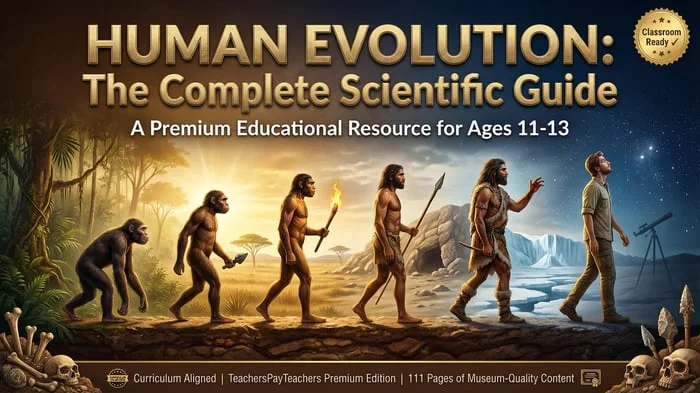
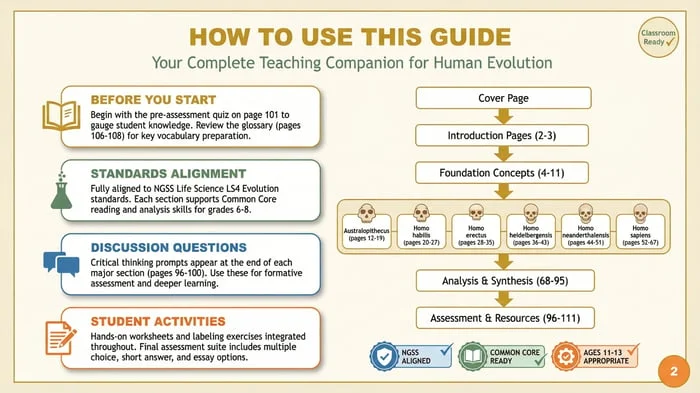
Human Evolution: The Complete Scientific Guide: a 111-page guide for ages 11 to 13 covering natural selection, the human family tree, six hominin species, the Out of Africa migration, fossil dating, ancient DNA and what makes us human, with discussion questions, a student quiz and a glossary.
Sources and scope
- Smithsonian National Museum of Natural History: Human Origins: species profiles, fossil evidence and teaching resources on human evolution.
- Natural History Museum, London: Human evolution: accessible articles on our species and its relatives.
- Understanding Evolution, University of California Museum of Paleontology: teacher resources, including material on common misconceptions about evolution.
- National Center for Science Education: support for teachers teaching evolution accurately.
This list covers common misconceptions about human evolution for middle school science. It simplifies dates and details for students aged about 11 to 13 and does not cover every fossil find or ongoing scientific debate.
Key takeaways
- Human evolution misconceptions are common and fixable.
- Ask first, then replace each idea with clear evidence.
- Use a branching bush and overlapping timelines.
- Keep dates rounded and activities hands-on for ages 11 to 13.
- Re-check at the end of the unit to see what changed.

Leave a Comment