
ABC data at home helps parents see what happens just before and just after a challenging behavior, so the behavior starts to make sense. Picture an eight-year-old who throws his tablet almost every evening. Sometimes it happens at dinner, sometimes at bedtime, sometimes after a sibling walks in. His parents feel the behavior comes “out of nowhere,” but the pattern is usually there, waiting to be written down.
This guide is for parents and caregivers who want to collect simple antecedent, behavior, consequence notes at home, either on their own or because the school team or a behavior specialist asked for them. By the end, you will know what to record, how to keep it quick, how to spot patterns, and how to share your notes so they help plan support.
Examples are fictional. Adapt to your child’s needs and any plan agreed with professionals. This is guidance, not a diagnosis.
At a glance
- Pick one behavior and describe it so anyone could recognize it.
- Write the A, B, and C within an hour, while it is fresh.
- Use checkboxes for common home situations to save time.
- After two weeks, look for repeated triggers and repeated outcomes.
- Share your notes with the school or behavior specialist before changing plans.
1. Understand why ABC data at home matters
ABC stands for antecedent, behavior, and consequence. The antecedent is what happened just before. The behavior is what your child did. Next comes the consequence, which is what happened right after. Together, they help adults understand what a behavior might be communicating.
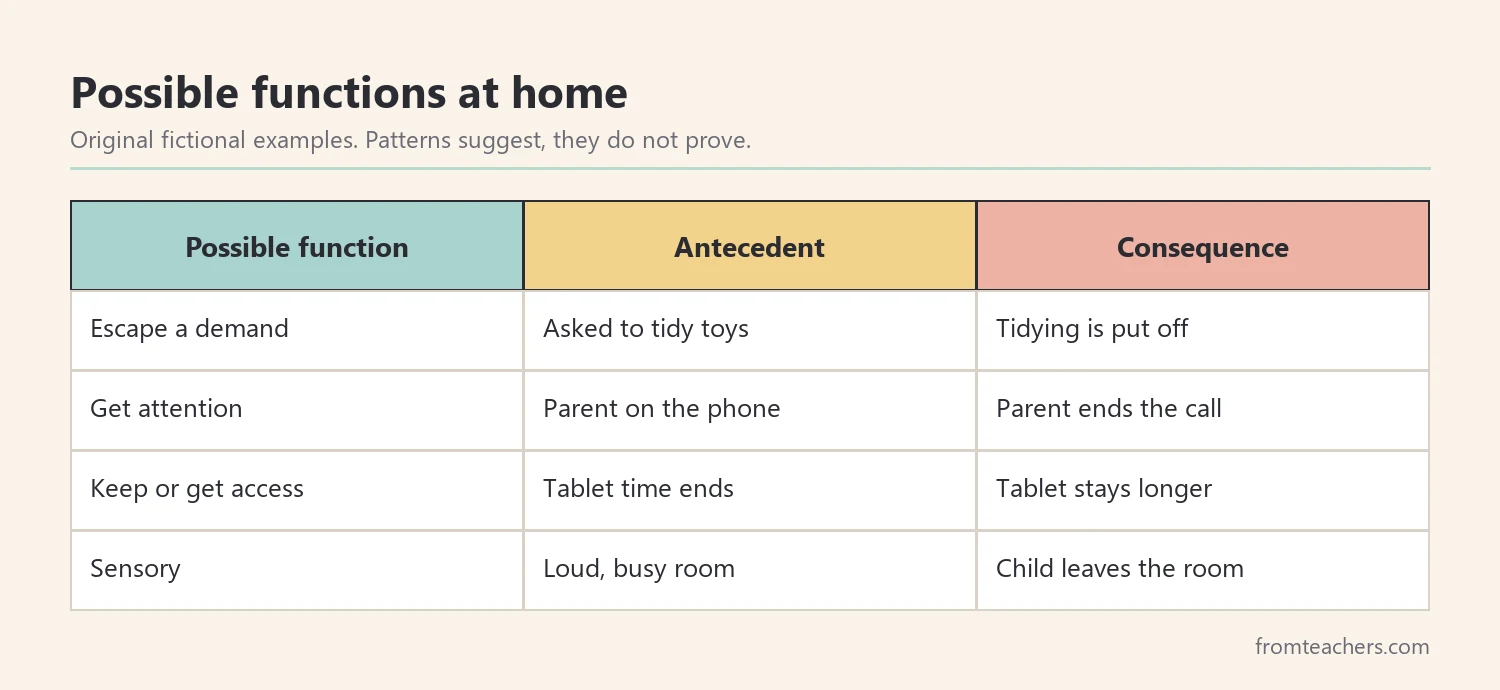
Many behaviors serve a purpose for the child. Common purposes include escaping a demand, getting attention, getting access to something, or getting or avoiding sensory input. ABC data at home does not prove a purpose, but it often points clearly toward one.
Home matters because many behaviors look different there. Demands, routines, siblings, and screens are part of home life, and they rarely appear at school in the same way. When a behavior specialist or school team plans support, notes from home add important information.
Theo (fictional, age 8) has frequent evening outbursts, including throwing objects. His school team was starting a functional behavior assessment and asked his parents for home notes. His mother, Ms. Chen, agreed, but worried she would not have time between dinner, homework, and bedtime.
2. Define one behavior clearly
First, choose one behavior to track. It should be the behavior that matters most right now, usually because it is frequent, unsafe, or very disruptive. Tracking several behaviors at once is hard for busy parents and makes patterns harder to see.
Next, describe the behavior in observable words. “Throws objects” is clearer than “has a tantrum.” “Throws a held object, such as a tablet or toy, toward a wall, floor, or person” is clearer still. A clear definition means both parents, or a grandparent, count the same thing.
Then, decide when to track. If the behavior mostly happens in the evening, you might track from 4 p.m. to bedtime. If it happens all day on weekends, track all day on Saturdays and Sundays. A defined window keeps ABC data at home realistic.
Ms. Chen and her husband agreed on this definition: “Theo throws a held object toward a wall, floor, or person.” They tracked from after school until bedtime on weekdays, and from lunch until bedtime on weekends.
| Vague | Clear and observable |
|---|---|
| Has a meltdown | Cries and lies on the floor for more than one minute |
| Is aggressive | Hits or kicks a person |
| Is defiant | Says “no” and walks away after a request |
| Loses it | Throws a held object |
3. Record ABC data at home quickly
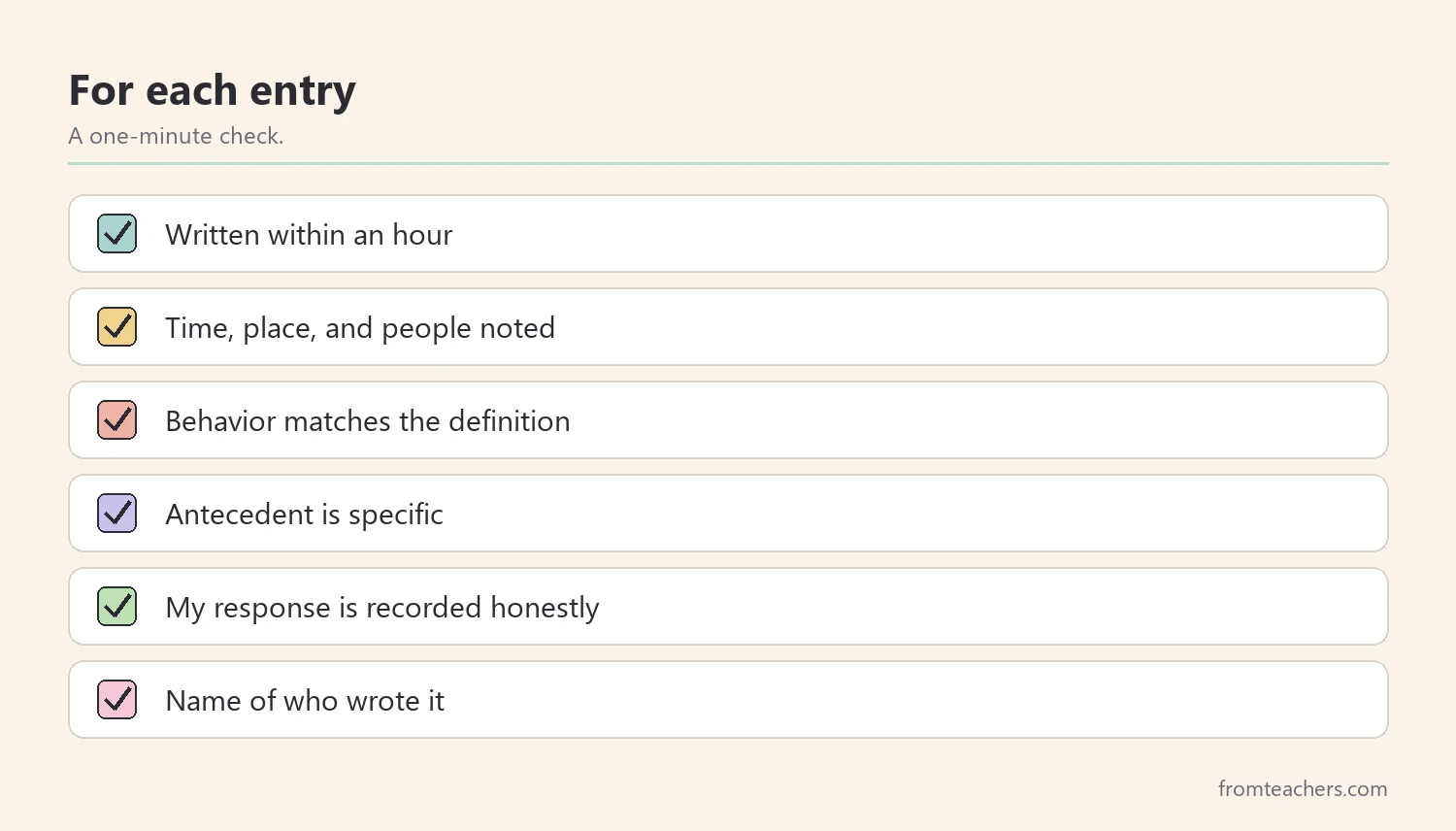
Next, record each incident within an hour, while details are fresh. Waiting until the next day leads to guesses. A short entry is fine; you do not need full paragraphs.
A home form with checkboxes saves a lot of time. Instead of writing everything, you tick common antecedents, such as “asked to stop an activity” or “sibling took a toy,” common behaviors, and common consequences, such as “item removed” or “parent talked with child.” Then you add one short note.
Ms. Chen used the home version of ABC data collection forms for classroom and home, which has checkbox options worded for home settings, space for notes, and a summary section for patterns. She kept a few copies and a pen on top of the fridge.
Also, record the time, the place, and who was present. These details often reveal patterns, such as “always after 7 p.m.” or “only when the older sibling is home.”
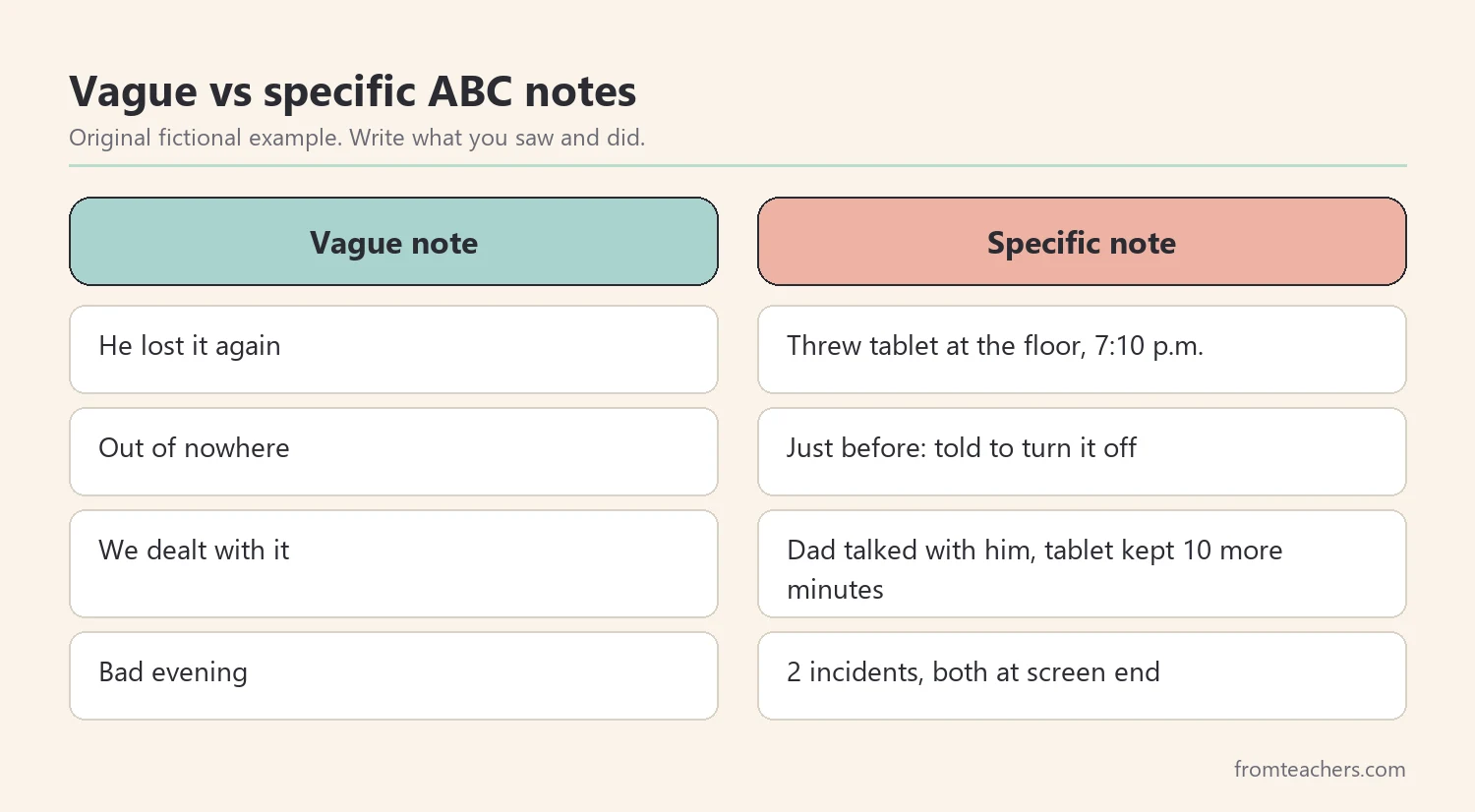
In addition, write what you actually did, even if you are not proud of it. If the tablet was taken away, or if you gave in to end the outburst, write it honestly. The consequence column is where many important patterns appear, and accurate notes help professionals help you.
Making recording fit a busy evening
Many parents worry that ABC data at home will take over their evenings. In practice, a few small habits keep it manageable. First, keep the forms where incidents usually happen, such as the kitchen or living room, with a pen attached. Second, agree who records: often the adult who was present, not always the same parent.
Third, use short codes for repeated details. For example, “T” for tablet, “S” for sister, or “BT” for bedtime. Finally, if you cannot write right away, take a quick voice memo on your phone and copy it onto the form later that evening.
Ms. Chen found that each entry took about two minutes. On busy nights, she ticked the boxes and wrote only one line of notes. That was enough for the pattern to appear.
4. Look for patterns in ABC data at home after two weeks
After about two weeks, gather your forms and look at them together. You are looking for things that repeat: the same kind of antecedent, the same time of day, the same people, or the same consequence.
A simple tally works well. Count how many incidents followed each type of antecedent. Then count the consequences. Patterns in ABC data at home often jump out once the numbers are side by side.
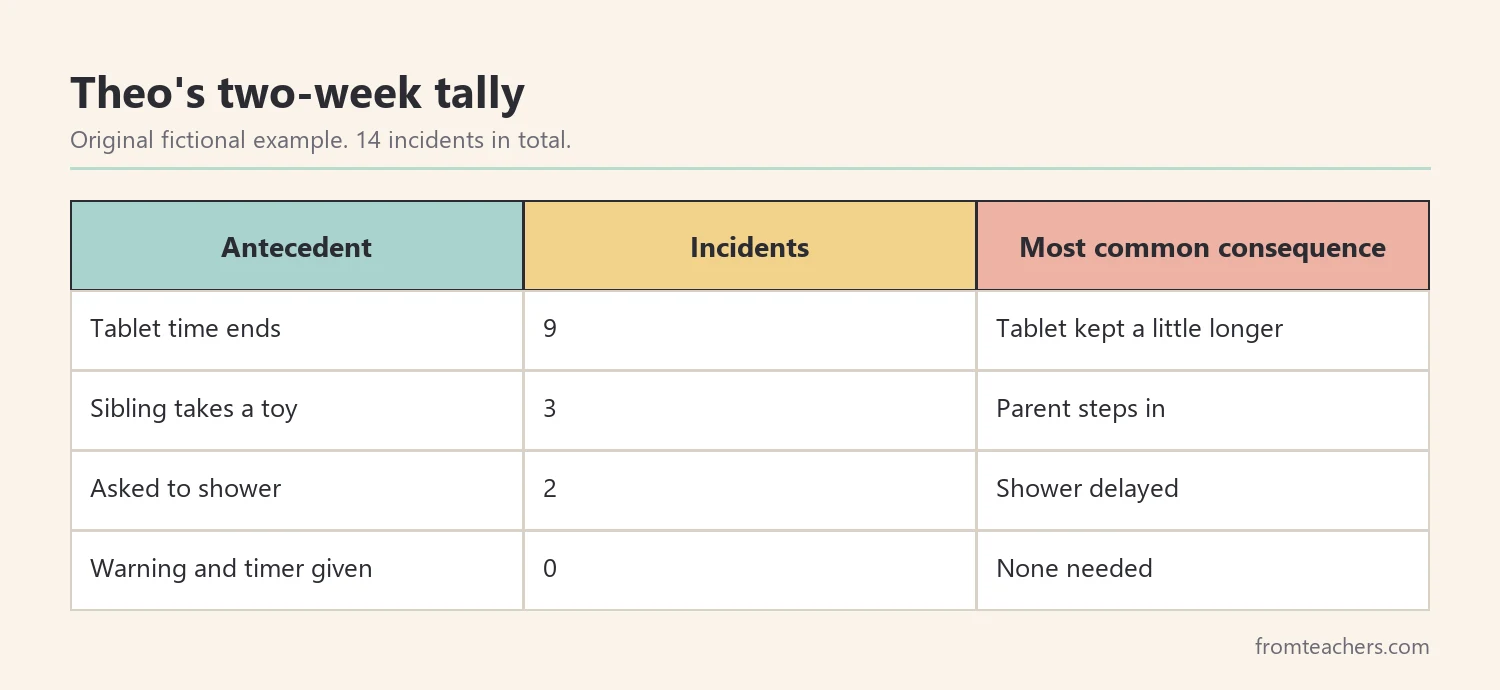
As Figure 3 shows, most of Theo’s incidents followed a request to stop using his tablet. After many of them, the tablet stayed with him a little longer while his parents tried to calm him. That pattern suggested that the behavior might be helping Theo keep access to the tablet. However, his parents treated this as a possible explanation to discuss, not a final answer.
Also, notice what does not happen. Theo had no incidents on days when he got a five-minute warning and a timer before tablet time ended. That detail was as useful as any incident.
Moreover, compare weekdays and weekends. Theo had fewer incidents on Saturdays, when tablet time ended at a fixed, predictable moment before lunch. On weekdays, the end time changed depending on dinner and homework. That difference gave the team another clue: predictability around transitions seemed to matter for Theo. Small details like this are easy to miss without written notes, which is why ABC data at home is worth the few minutes it takes.
Then, write a short summary. Two or three sentences are enough: when the behavior happens most, what usually comes before, what usually follows, and what seems to help.
5. Share notes and plan support together
Next, share your summary and forms with the school team or behavior specialist. Ask them to compare your ABC data at home with their school data. Sometimes the same function shows up in both places; sometimes home and school are very different.
Then, plan support together. Effective plans usually include three parts: changes to antecedents that prevent the behavior, teaching a replacement behavior that meets the same need, and changes to consequences so the behavior no longer works as well.
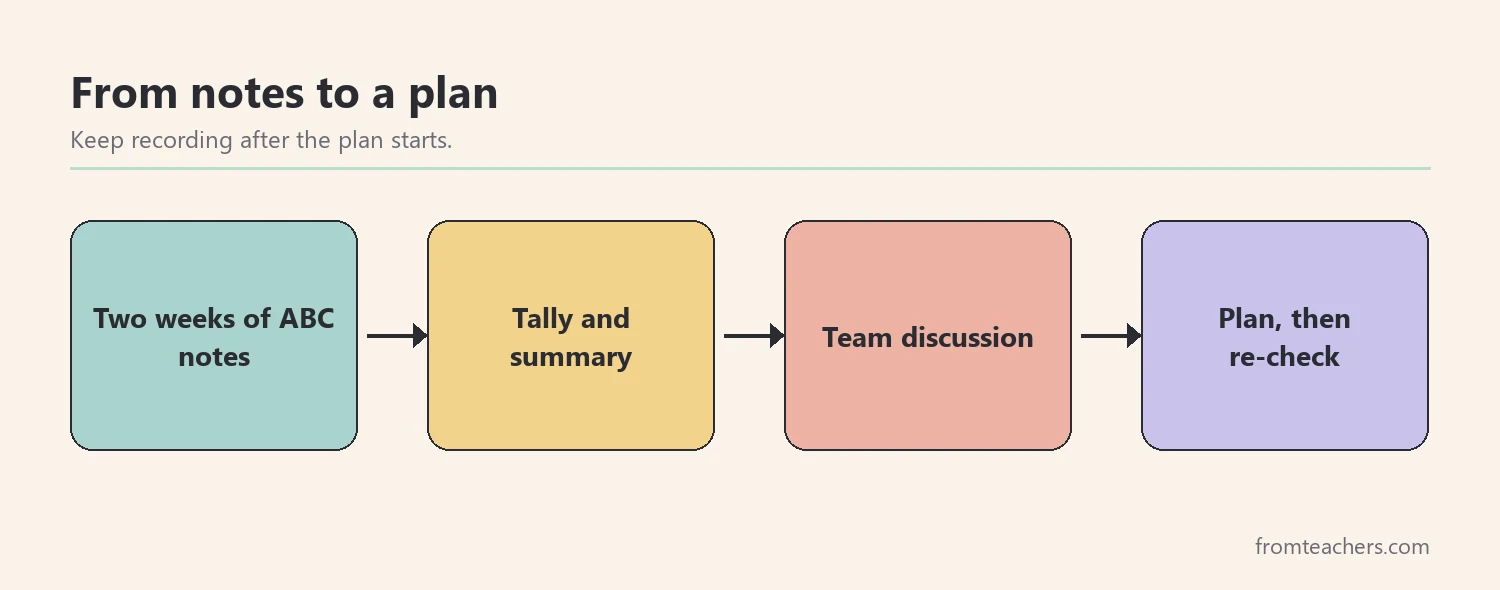
For Theo, the team agreed on a home plan. First, a five-minute warning and a visual timer before tablet time ended. Second, teaching Theo to ask “Can I finish this level?” as a replacement for throwing. Third, the tablet would go on the shelf calmly after any throw, with no extra minutes.
Talking with your child about the plan
Where it is appropriate, involve your child in the plan. Explain changes in simple, calm words at a quiet time, not during an outburst. For example, “From now on, you will get a five-minute warning and a timer before tablet time ends. If you need more time, you can ask, ‘Can I finish this level?'”
Then, practice the replacement behavior when everyone is calm. Role-play the moment, and praise your child warmly when they use the new words. Children are more likely to use a new skill in a hard moment if they have practiced it in easy moments first.
Over time, your ABC data at home will show whether the new skill is replacing the old behavior. Celebrate small wins with your child, such as the first evening with no throwing.
In addition, keep recording for two to four more weeks after the plan starts. The same forms let you compare before and after. If incidents drop, the plan is working. If not, the team can adjust it.
Finally, look after yourself. Tracking challenging behavior can be emotionally hard, especially on evenings with several incidents in a row. Remember that you are collecting information to help your child, not grading your parenting.
Common mistakes and how to avoid them
- Tracking too many behaviors. Several behaviors at once quickly become overwhelming. Fix: start with one clearly defined behavior.
- Writing from memory days later. Details fade and guesses creep in. Fix: record within an hour.
- Labeling instead of describing. “He was being manipulative” is an interpretation. Fix: write what your child did and said.
- Leaving out your own response. The consequence is a key part of ABC data at home. Fix: write what happened right after, honestly.
- Deciding the function alone. One parent’s view may miss things. Fix: discuss patterns with the school or a behavior professional.
Questions parents ask about ABC data at home
How long should I collect ABC data at home?
Two weeks is a common starting point, because it usually includes enough incidents and different days. Your school team or behavior specialist may suggest a different length based on how often the behavior happens.
What if the behavior happens many times a day?
Record as many as you can within your chosen time window. If that is too much, agree with the team on recording a sample, such as every incident between 4 and 7 p.m.
Can other family members fill in the forms?
Yes. Grandparents, babysitters, and older siblings can help, as long as everyone uses the same behavior definition. Ask them to add their name to each entry.
Should I change my response while collecting data?
For the first period, it often helps to respond as you normally would, so the notes show the real pattern. Then the team can plan changes together. If safety is a concern, always keep everyone safe first.
Is ABC data the same as a functional behavior assessment?
No. ABC data is one piece of information. A functional behavior assessment is a broader process led by professionals that may include interviews, observations, and records.
Related reading: Meltdowns vs Tantrums: A Guide to Understanding and Responding, Moving Beyond Shame and Behavior Charts, and How Parents and Teachers Can Team Up for Special Education Success.
You may also need: Functional Behavior Assessment Summary Form Editable FBA ABC Data Template.
A companion resource for ABC data at home:
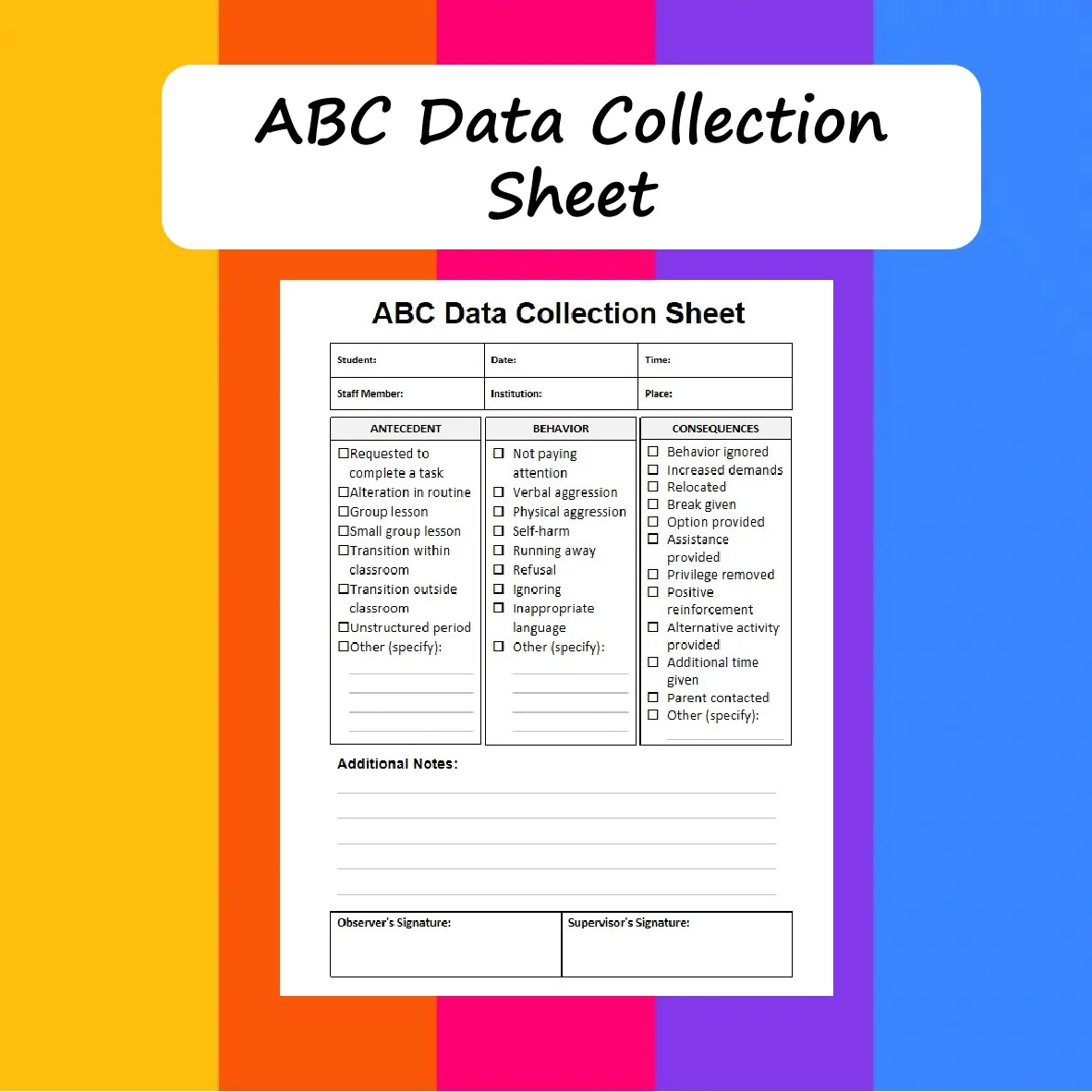
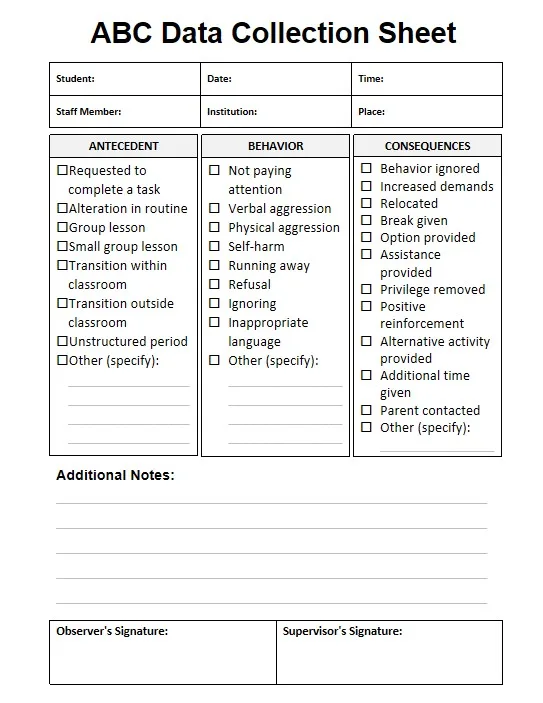
ABC Data Collection Forms: Antecedent-Behavior-Consequence (Classroom & Home): three forms (classroom, home, and general) with checkbox options for common antecedents, behaviors, and consequences, notes space, a summary and reflection section, and signature lines.
Sources and scope
- IRIS Center, Vanderbilt University: free modules on functional behavior assessment and behavior support.
- Center on PBIS: information on positive behavior support at school and at home.
- CDC: Parenting resources: public health guidance for parents on positive parenting and behavior.
- Understood.org: family-friendly explanations of behavior assessments and plans.
This guide covers informal ABC notes collected by families. It does not replace a functional behavior assessment or a behavior plan written by qualified professionals, especially when safety is a concern.
Key takeaways
- ABC data at home shows what comes before and after a behavior.
- One clearly defined behavior makes tracking manageable.
- Quick, honest entries within an hour give the most useful notes.
- Two weeks of tallies often reveal a clear pattern.
- Shared notes lead to a joint plan and a clear way to check it.








Leave a Comment