

An ADHD homework routine can turn the hardest hour of the evening into something predictable and calmer. Picture a fifth grader who sits down at 5 p.m. with a math sheet, gets up for water, sharpens three pencils, starts a conversation about a video game, and at 7 p.m. is in tears with two problems done. The parent is exhausted, the child feels like a failure, and tomorrow looks the same.
This guide is for parents and caregivers of children with ADHD, roughly ages 8 to 12. It shows how to set up the space, the timing, and the steps of homework so your child needs fewer reminders and you need fewer battles. By the end, you will have a simple plan you can try for two weeks and adjust using what you see.
Examples are fictional. Adapt to your child’s needs and any supports agreed with the school. This is guidance, not a diagnosis.
At a glance
- Same time, same place, same steps: routine does the reminding for you.
- Break homework into short, timed chunks with planned movement breaks.
- Start with a quick plan so your child sees the end before starting.
- Use calm, short scripts instead of long lectures when focus slips.
- Track a few simple numbers for two weeks, then adjust one thing.
1. Understand why homework is so hard with ADHD
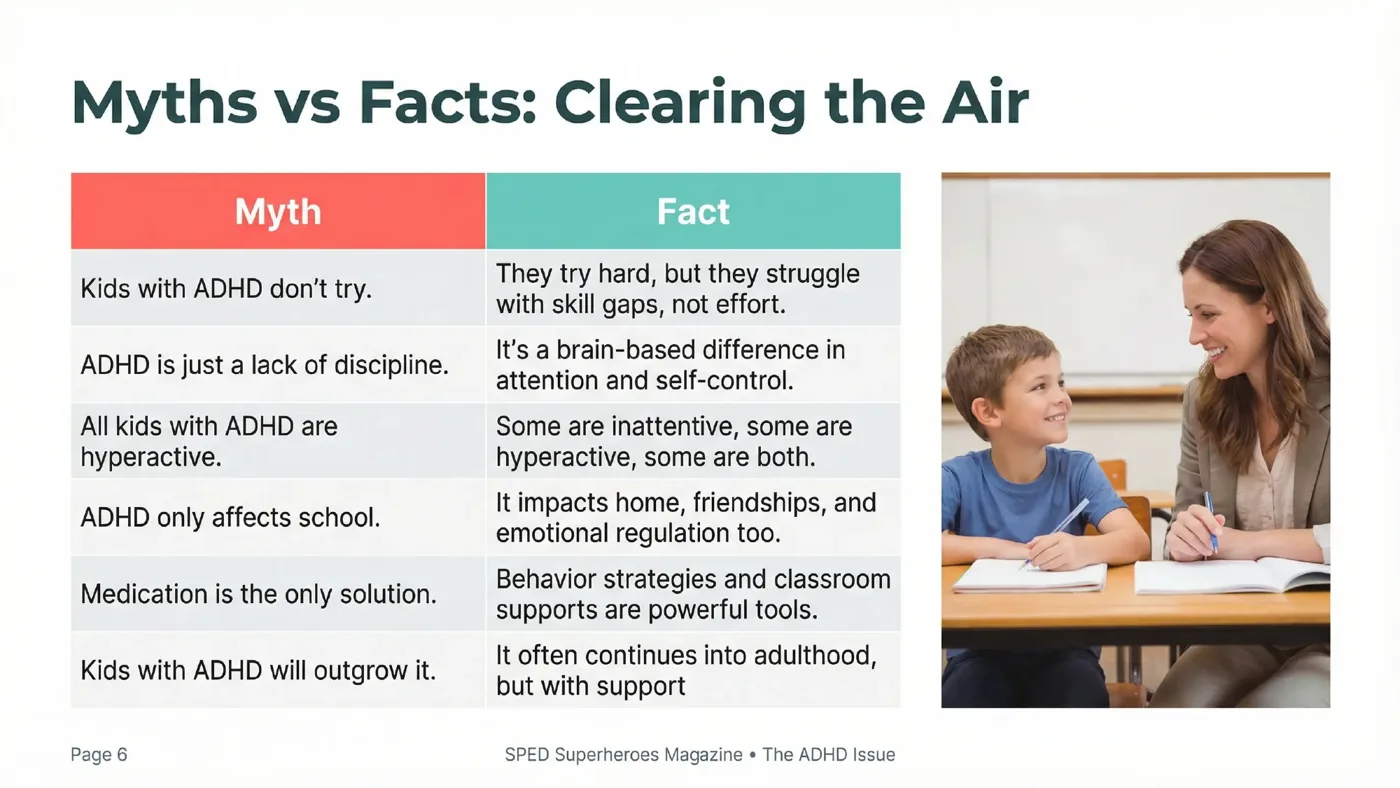
ADHD affects attention, impulse control, and executive functions such as planning, starting tasks, managing time, and holding information in mind. Homework asks for all of these at once, at the end of a long day, often after medication (if any) has worn off. Therefore, homework difficulty is usually a skills problem, not a motivation problem.
This shift in view changes how you respond. When a child “won’t” start, it is often that they “can’t yet” start without support. An ADHD homework routine builds that support into the environment, so your child does not have to rely on willpower alone.
Max (fictional, age 10, grade 5) has ADHD. His parents described homework as “a two-hour fight for twenty minutes of work.” When they looked closer, they noticed three repeating moments: getting started, staying seated after the first problem, and switching from one subject to another.
Before you change anything, spend three or four evenings simply noticing. Where does homework break down? Is it the start, the middle, or the switch between tasks? Is it worse on certain days or after certain activities? Write one line each evening. These notes will tell you where your ADHD homework routine needs the most support.
| Breakdown point | What it looks like (fictional) | Skill involved |
|---|---|---|
| Starting | 15 minutes of pencil sharpening | Task initiation |
| Middle | Up after every problem | Sustained attention |
| Switching | Forgets the next subject | Planning, working memory |
| Finishing | Work done but not in the bag | Organization |
2. Set up the space and the time for an ADHD homework routine
First, choose one homework spot and keep it the same every day. It should be quiet enough to focus, but close enough that an adult can check in. For many children with ADHD, a corner of the kitchen table works better than a bedroom full of distractions.
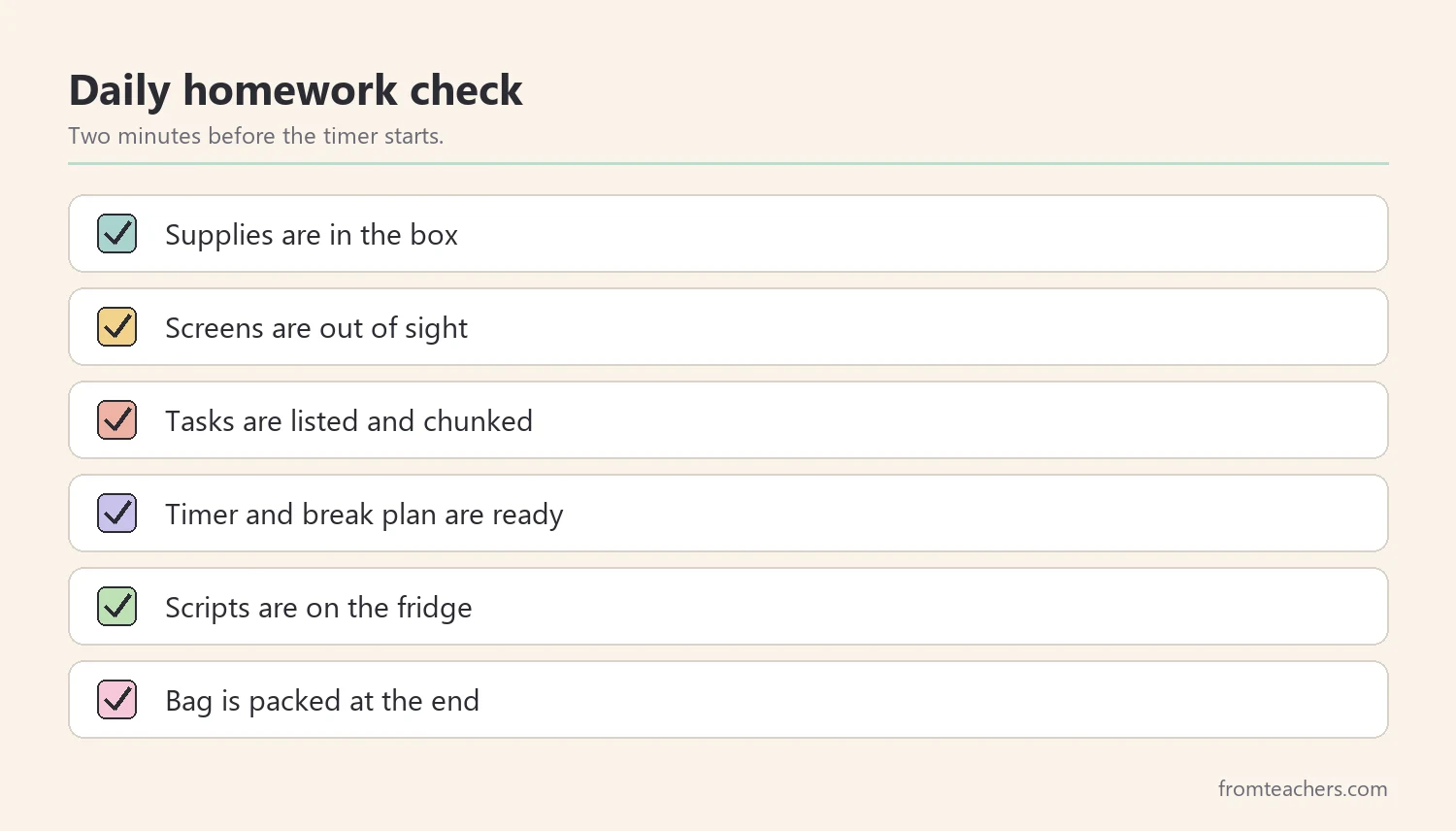
Next, stock the spot before homework starts. Pencils sharpened, eraser, ruler, calculator if allowed, water bottle, and a timer. When everything is already there, there is less reason to get up, and fewer chances for a five-minute errand to become thirty minutes.
Then, choose a consistent start time. Some children need a break after school to move and eat; others do better starting soon before their energy drops. Try one time for a week, note how it goes, and adjust if needed. The key is that the time is predictable, not that it is perfect.
Max’s parents set his homework spot at the end of the kitchen table, facing the wall rather than the living room. They agreed on 4:30 p.m., after a snack and twenty minutes outside. A small box held all his supplies, and a visual timer sat in front of him.
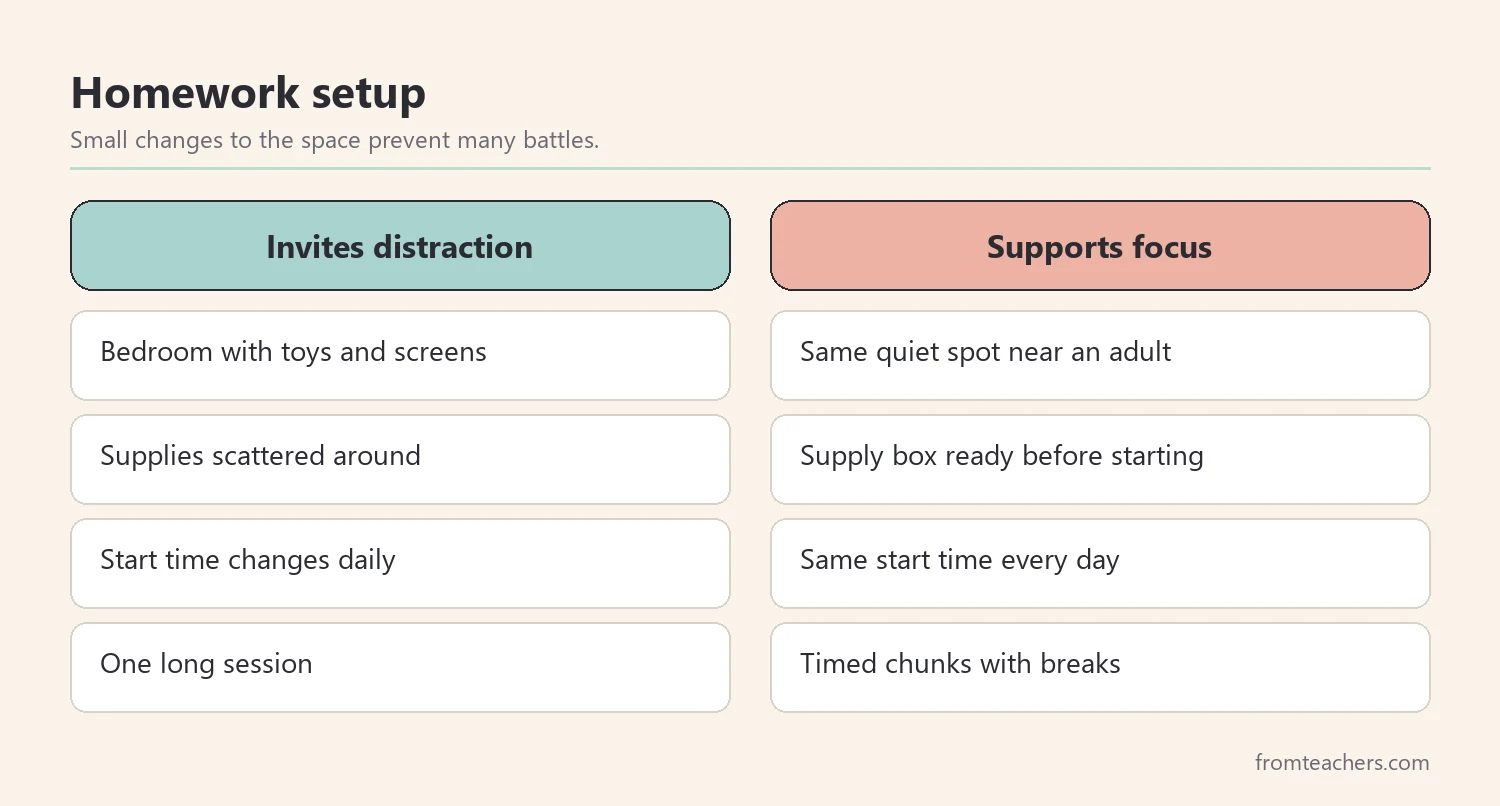
Also, reduce screens during homework. If homework is done on a device, close other tabs and put the phone in another room. If not, keep devices out of sight. Simple changes to the space often remove the biggest distractions without any arguments.
3. Break homework into short, timed chunks
Long homework sessions are very hard for most children with ADHD. Instead, break the work into short chunks, often 10 to 20 minutes depending on your child, followed by a short movement break. An ADHD homework routine built on chunks feels more manageable because the end of each chunk is always in sight.
Start each session with a two-minute plan. Together, list the tasks, estimate how many chunks each needs, and decide the order. Many children like to start with something quick to build momentum; others prefer to tackle the hardest task while they are fresh. Let your child help choose.
For a structured plan, many families use the ADHD support toolkit with a homework plan, home routines, and printable trackers, which explains routines, scripts, and supports for both school and home in plain language.
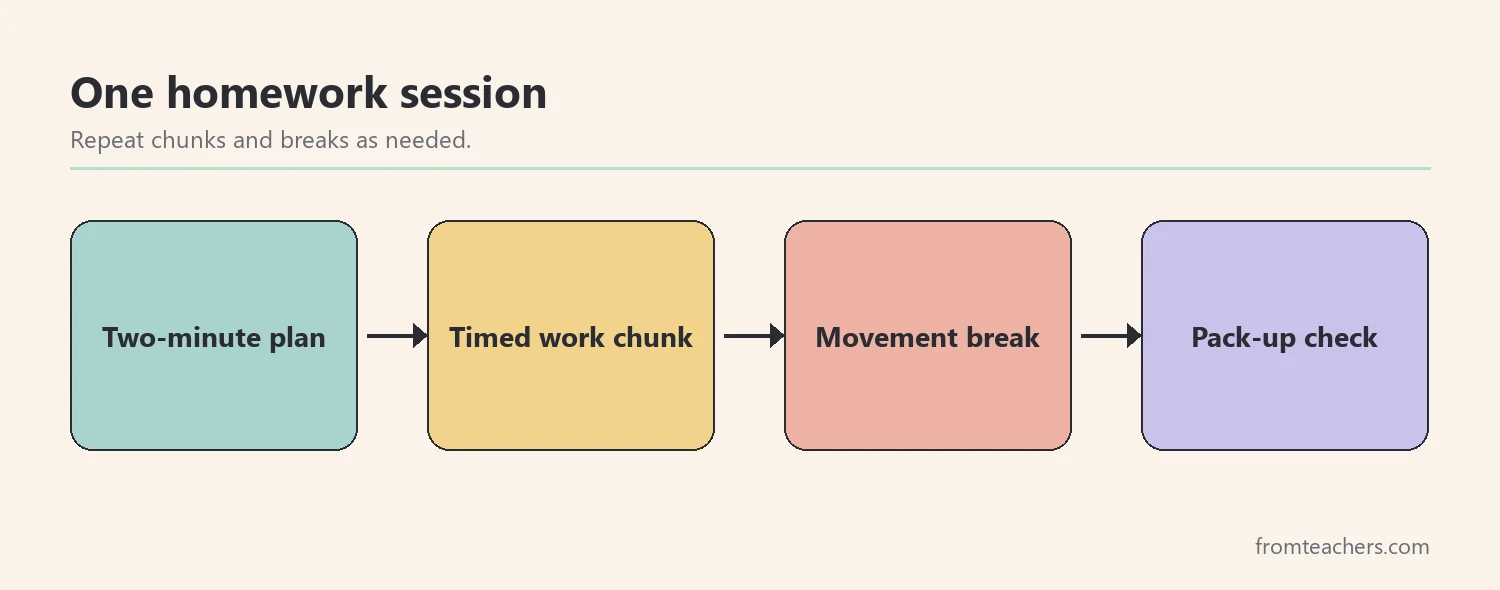
During each chunk, the goal is focused effort, not perfection. When the timer goes off, your child takes a planned break: jumping jacks, a quick walk around the house, a drink of water. Keep breaks short and active, and avoid screens, which are hard to stop.
Max’s plan used 15-minute chunks with 3-minute breaks. On a typical night, he had math (two chunks) and reading (one chunk). He crossed off each chunk on a small card. Seeing three boxes, and then two, and then one, made the evening feel finite.
Adjusting the plan as your child grows
An ADHD homework routine for an eight-year-old looks different from one for a twelve-year-old. Younger children usually need an adult close by, shorter chunks, and a visual checklist with pictures. Older children can take on more of the planning themselves, such as estimating chunks and setting the timer.
As your child gets older, move gradually from doing the plan together to checking the plan they made. For example, a sixth grader might write the task list alone and show it to you before starting. In this way, the ADHD homework routine slowly builds independence instead of dependence on a parent.
In addition, involve your child in reviewing what works. Ask, “Was 15 minutes too long tonight?” or “Did starting with reading help?” Children who help design their own ADHD homework routine are usually more willing to follow it on hard evenings.
4. Use calm scripts when focus slips
Even with a good routine, focus will slip. How you respond in those moments makes a big difference. Long explanations, raised voices, and repeated warnings tend to turn a lapse into a power struggle.
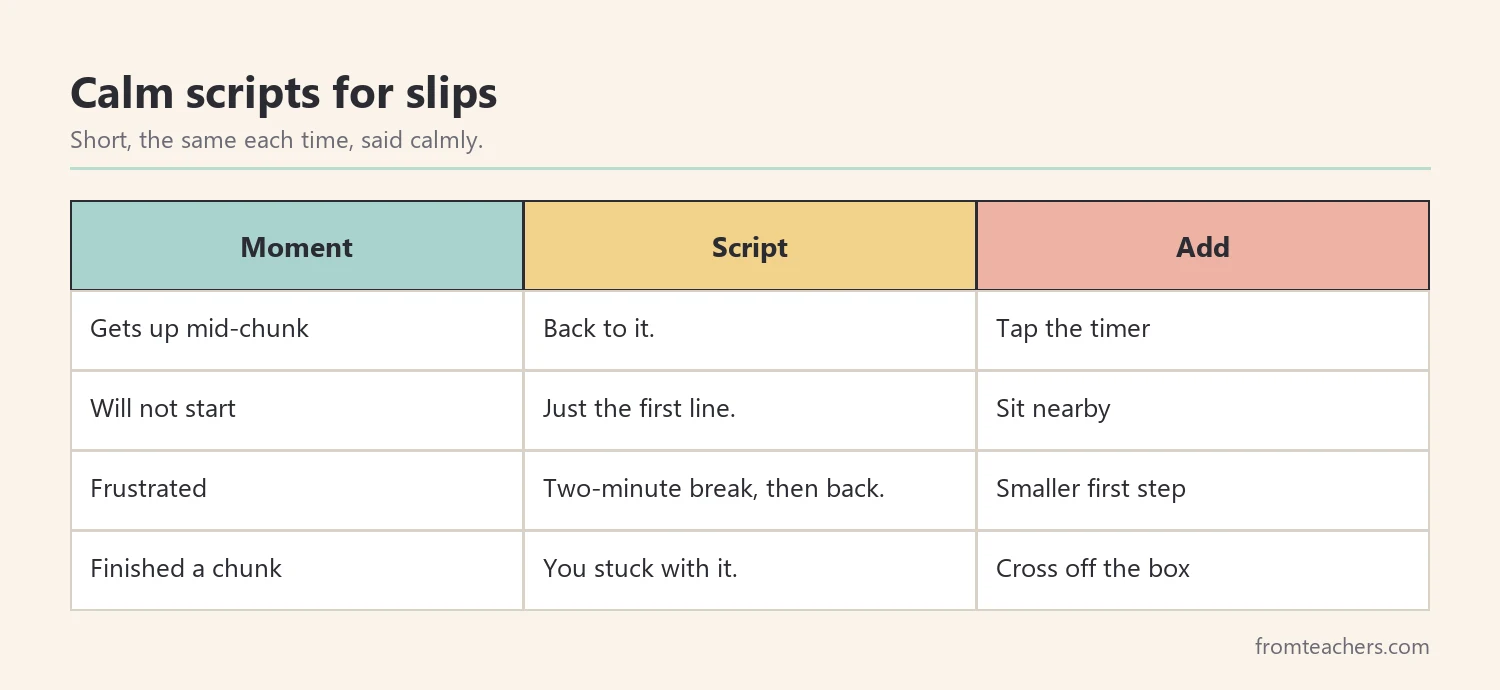
Instead, use short, calm, predictable scripts. The same few words, said the same way, become part of the routine. Your child learns what they mean, and you avoid making up a new lecture each night.
In addition, use your body language. Sitting nearby, a hand on the table next to the page, or simply pointing at the timer often works better than words. For many children with ADHD, fewer words mean less to process and less to argue with.
When frustration builds, it is fine to pause. Say, “Let’s take a two-minute break and come back.” A short reset often prevents a meltdown. After the break, return to the same task, perhaps with a smaller first step: “Just do the first line, then we’ll see.”
Max’s father noticed that when he said “Back to it” calmly and tapped the timer, Max usually returned within a minute. When he said “Why are you up again? You always do this,” the evening fell apart. He kept a sticky note with three scripts on the fridge as a reminder for himself.
Finally, praise effort in specific words. “You stayed with that problem even when it was hard” tells your child exactly what to repeat. Over time, specific praise becomes part of what makes the ADHD homework routine work.
5. Track your ADHD homework routine for two weeks
After you set up the routine, track a few simple numbers for two weeks. You do not need detailed data. Instead, note the start time, the number of chunks completed, the number of reminders you gave, and a rating of how the evening felt.
At the end of each week, look at the numbers together. Are starts getting quicker? Are reminders going down? Are some days much harder than others? These patterns show whether your ADHD homework routine is helping and where it needs adjusting.
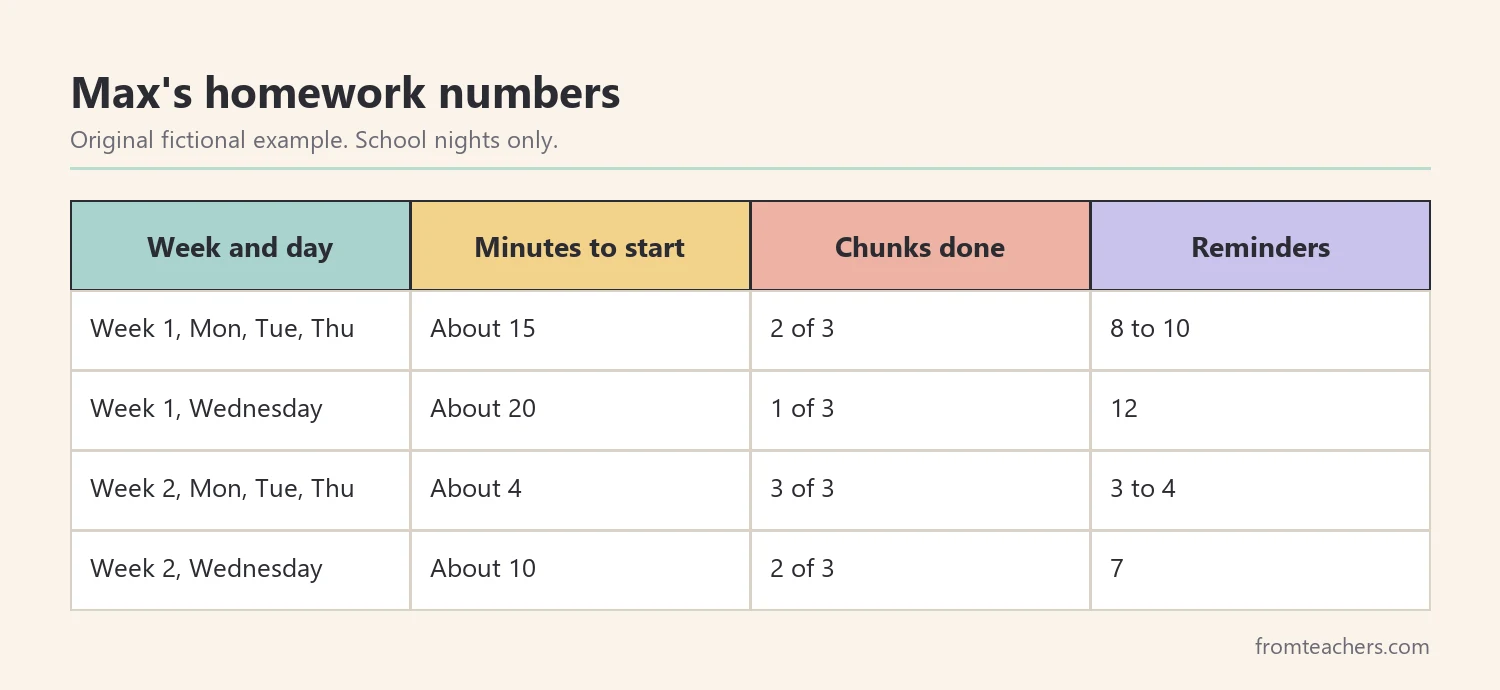
As Figure 4 shows, Max’s start delay dropped from about 15 minutes to about 4 minutes over two weeks. Reminders also fell. However, Wednesdays stayed hard. His parents realized he had soccer practice on Tuesday evenings and was tired the next day. They moved Wednesday homework a little earlier and shortened the chunks to 10 minutes on that day only.
Then, change only one thing at a time. If you change the time, the chunk length, and the space all at once, you will not know what helped. Small, single changes make it clear what works for your child.
Also, share what you learn with the teacher. A short note such as “Max focuses best in 15-minute chunks with movement breaks; homework longer than 45 minutes is very hard” can help with planning. Some families ask the school team whether homework accommodations, such as reduced problem sets, are appropriate.
Common mistakes and how to avoid them
- Changing the routine every night. Constant changes remove the predictability that helps. Fix: keep the same time, place, and steps for at least a week.
- Long sessions with no breaks. Sixty minutes straight is very hard with ADHD. Fix: short timed chunks with active breaks.
- Lecturing during homework. Long talks add more to process and often lead to arguments. Fix: use short scripts and save discussions for calm times.
- Screen breaks. Screens are hard to stop and often derail the session. Fix: choose movement or snack breaks instead.
- Doing the homework for your child. It ends the fight but not the problem. Fix: help with the first step, then step back.
- Not telling the school. Teachers may not know homework takes two hours. Fix: share your notes and ask about adjustments.
Questions parents ask about an ADHD homework routine
How long should an ADHD homework routine take?
It depends on the child’s age, the school’s expectations, and the amount assigned. If homework regularly takes much longer than the teacher expects, share your notes with the school. The goal is focused, reasonable effort, not hours at the table.
Should homework be done right after school?
Some children need a snack and movement first; others focus better before they relax. Try one time for a week, track how it goes, and adjust. Consistency matters more than the exact time.
Are rewards a good idea for homework?
Small rewards can help, especially at the start, such as choosing an evening activity after homework. Pair them with specific praise so that, over time, effort and success become rewarding on their own.
What if my child refuses to start?
Make the first step tiny: “Just write your name and the first answer.” Sit nearby for that first step. Starting is often the hardest part, and a small win can carry your child into the next chunk.
Can the school help with homework difficulties?
Yes. Teachers and IEP or 504 teams can discuss supports, such as clear written assignments, reduced repetition, or extended deadlines. Your homework notes give them concrete information.
Related reading: ADHD in Children: A Guide to Effective Classroom and Home Support, Effective ADHD Classroom Strategies to Support Student Success, and How Parents and Teachers Can Team Up for Special Education Success.
You may also need: Homework Help for ADHD: Focused, Simple, and Supportive Study Strategies.
A companion resource for an ADHD homework routine:

ADHD Support Toolkit: Classroom And Home Strategies: a 49-page guide with classroom supports, executive function help, parent partnership scripts, home routines, a homework plan without fights, and printable trackers.
Sources and scope
- CDC: ADHD: public health information on ADHD, including parent training and behavior therapy.
- CHADD: a national organization with family resources on ADHD at home and school.
- Understood.org: parent-friendly articles on homework, focus, and executive function.
- IRIS Center, Vanderbilt University: free modules on supporting students with attention and behavior needs.
This guide covers practical homework routines at home. It does not give medical advice about ADHD or medication, which should come from your child’s doctor.
Key takeaways
- An ADHD homework routine supports skills like starting, focusing, and switching tasks.
- The same time, place, and steps each day reduce reminders and arguments.
- Short timed chunks with active breaks make homework manageable.
- Calm, short scripts keep slips from becoming power struggles.
- Two weeks of simple numbers show what to adjust next.










Leave a Comment