

A sensory friendly morning routine can change the whole tone of a school day for a child with sensory processing differences. Picture a six-year-old who screams when her socks feel “wrong,” refuses the toothbrush, gags at breakfast, and is already exhausted by the time she reaches the school gate. Her parents are not doing anything wrong; the morning simply asks for too much sensory processing, too fast.
This guide is for parents and caregivers. It shows how to find the sensory pressure points in your morning, reorder and adjust the steps, prepare clothing and food in advance, and build in calming input before school. By the end, you will have a simple plan to try for two weeks and a way to tell whether it is helping.
Examples are fictional. Adapt to your child’s needs and any advice from your child’s occupational therapist or doctor. This is guidance, not a diagnosis.
At a glance
- Map your morning to find where sensory overload builds up.
- Prepare clothes, food, and bags the night before.
- Give calming input early, not after a meltdown.
- Use a visual sequence so your child knows what comes next.
- Track a few simple signs for two weeks and adjust one step at a time.
1. Map the morning to plan a sensory friendly morning routine
First, spend three or four mornings simply noticing. Write down each step of the routine in order, from waking up to arriving at school. Next to each step, note how your child responded: calm, mildly upset, or very upset.
Then, look for sensory triggers in the steps that go badly. Sensory processing differences often show up in two broad ways. Some children are over-responsive, so sounds, textures, smells, or light feel too strong. Others are under-responsive and seek more input, such as crashing, spinning, or chewing. Many children show a mix.
A sensory friendly morning routine starts from this map. Instead of guessing, you can see exactly where the pressure builds. Often, two or three steps cause most of the trouble.
Ava (fictional, age 6) has sensory processing differences noted by her occupational therapist. Her parents mapped five mornings. Getting dressed, brushing teeth, and the noisy car ride were the hardest moments every day. Breakfast was hard on some days, depending on the food.
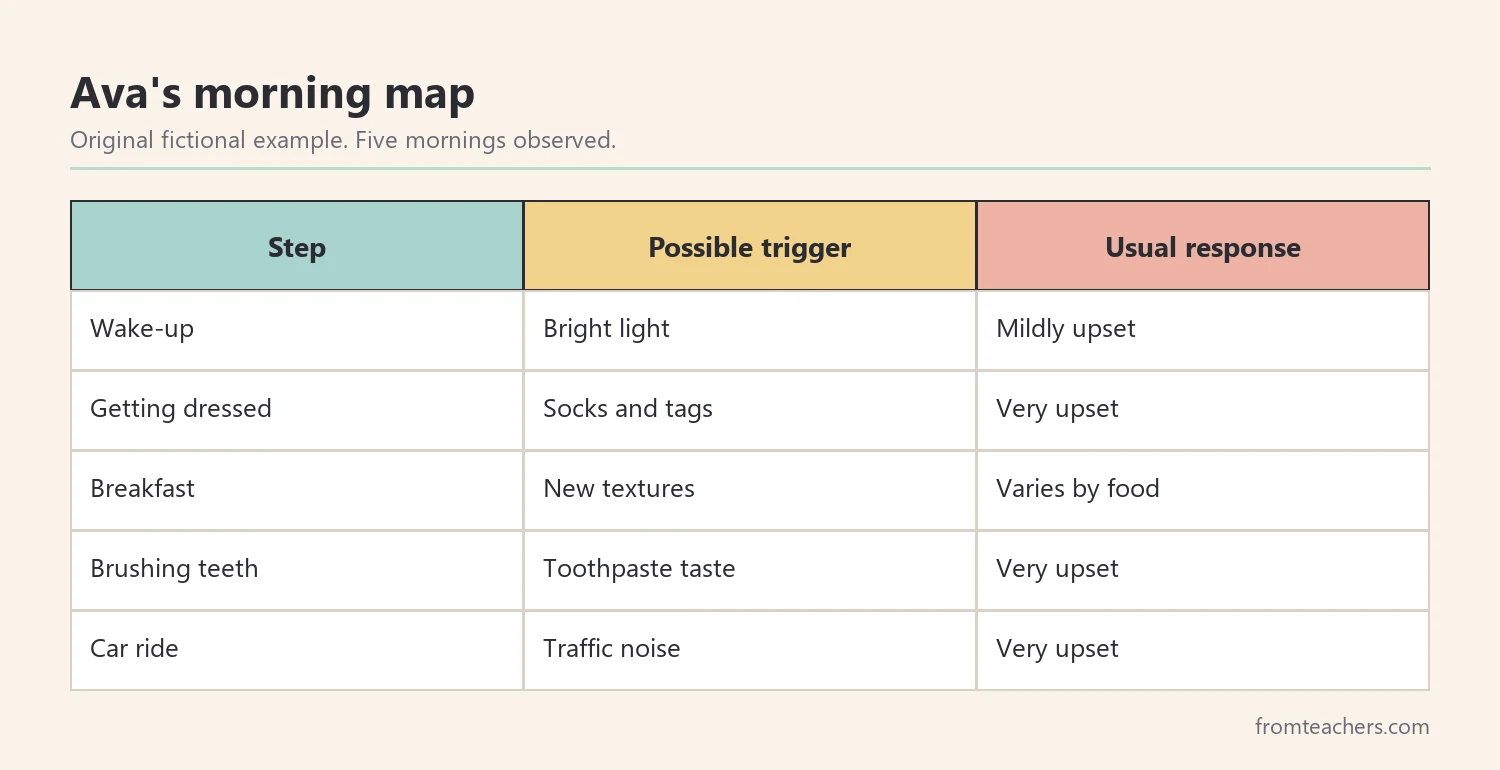
Also, notice what goes well. If your child is calm while being wrapped in a blanket on the sofa, or while jumping on a mini trampoline, write it down. Those moments point to sensory input that may help regulate your child, and they will become part of the plan.
2. Move preparation to the night before
Mornings are short and stressful. Therefore, move as many decisions as you can to the evening, when everyone has more time and patience.
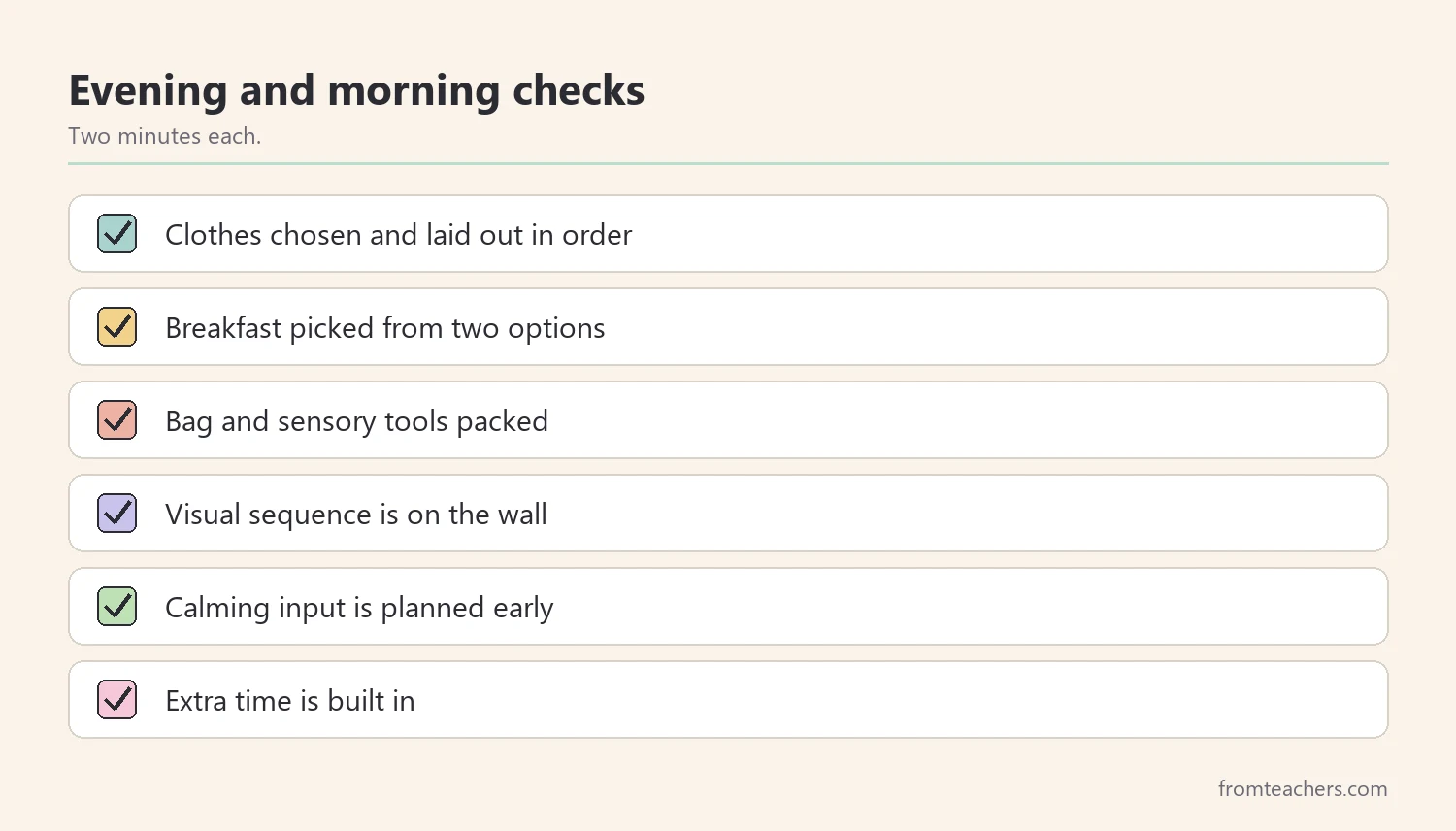
First, prepare clothing. Let your child choose tomorrow’s outfit in the evening from a small set of comfortable options. Many children with tactile sensitivity prefer soft fabrics, no tags, and seamless socks. Lay the clothes out in the order they will be put on.
Next, plan breakfast. Offer two familiar, accepted options and let your child choose the night before. Mornings are not the time to introduce new foods or textures. Try new foods at calmer times, such as weekend lunches.
Then, pack the school bag, set out shoes, and prepare any sensory tools your child takes to school, such as headphones or a fidget. In the morning, everything should be ready and in its place.
Ava’s parents created a “tomorrow basket” by her bed. Each evening, she placed her chosen clothes, socks inside out (she preferred the seams outside), and a picture card of her chosen breakfast in the basket. In the morning, there was nothing to decide and nothing to search for.
| Evening task | Why it helps |
|---|---|
| Choose clothes from soft options | Fewer arguments and textures in the morning |
| Pick one of two breakfasts | Predictable taste and texture |
| Pack bag and sensory tools | No rushed searching |
| Preview the morning sequence | Fewer surprises |
3. Adjust the hardest steps
Next, look at the two or three steps that caused the most trouble on your map. For each one, ask: Can we change the order, the materials, the environment, or the way we do it?
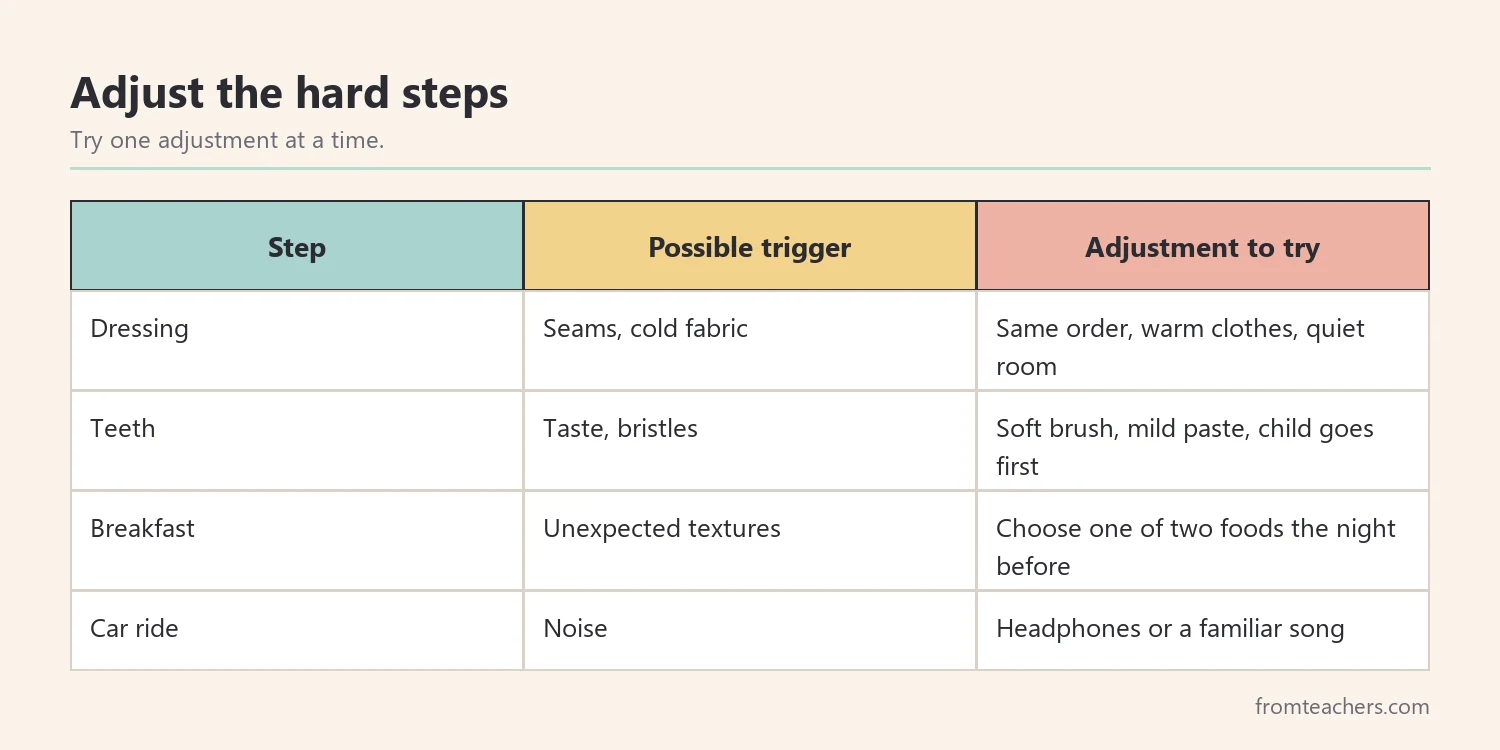
For toothbrushing, a softer brush, a milder toothpaste, or letting your child brush first and then you finish may help. When dressing, warming clothes on a radiator, dressing in a quiet room, or following the same order every day can help. For the car, headphones, a familiar song, or a quiet ride can reduce noise.
The parent section of the SPD guide with strategies for parents and teachers covers sensory-friendly routines, a calming space at home, and ways to blend sensory input into everyday activities. Ava’s parents used it to pick adjustments that matched her profile rather than trying everything at once.
Change one step at a time. If you change toothbrushing, dressing, and the car ride on the same day, you will not know which change helped. Start with the step that causes the most distress.
For Ava, her parents started with dressing. They moved it to her quiet bedroom instead of the busy bathroom, warmed her clothes on the radiator, and always used the same order: underwear, pants, shirt, socks last. Within a week, dressing went from very upset most days to mildly upset on some days.
4. Add calming input before the hard parts
Many children regulate better when they get the right kind of sensory input before a demanding task. A sensory friendly morning routine therefore includes short, planned calming or organizing activities, placed early in the morning rather than used only after a meltdown.
Examples include deep pressure, such as a tight hug or a heavy blanket for a minute; heavy work, such as carrying a laundry basket or pushing a chair; rhythmic movement, such as rocking or swinging; and quiet time in a dim, calm space. What helps depends on your child, so use what you noticed in your map.
Your occupational therapist can suggest specific activities and how long to do them. In the meantime, choose a few gentle options your child already enjoys and that feel calm, not exciting.
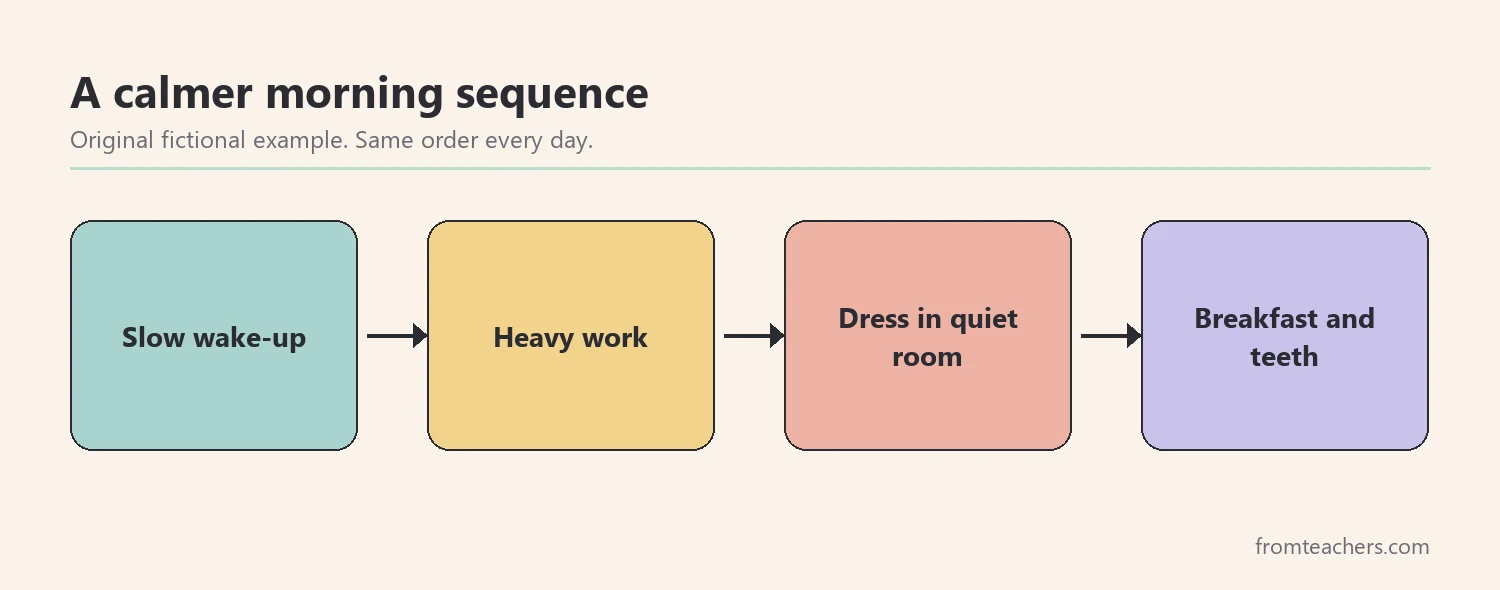
Then, build a visual sequence. A simple strip of picture cards on the wall or the fridge shows each step of the morning in order. Your child can move a clip or turn over each card when it is done. Predictability itself reduces stress for many children.
A closer look
Ava’s new sequence began with a slow wake-up: lights dimmed, a favorite song, and five minutes under a heavy blanket. Then, she carried her “tomorrow basket” to the bedroom, which counted as heavy work. Dressing, breakfast, teeth, and shoes followed in the same order every day.
Moreover, keep the visual strip short. Five or six pictures are usually enough for a young child. If the strip is too long, it becomes another thing to process. As your child gets used to the sequence, you can combine steps or let your child arrange the cards themselves.
Also, allow extra time. A sensory friendly morning routine usually needs a slower pace. Waking ten or fifteen minutes earlier often costs less than a rushed morning that ends in tears.
When a morning still goes wrong
Even the best sensory friendly morning routine will have hard days. Illness, poor sleep, a new teacher, or a change in weather can make sensory input feel stronger. On those days, lower the demands rather than pushing through.
For example, skip a non-essential step, offer the most comfortable clothes even if they do not match, or allow a familiar breakfast eaten in a quiet corner. Then, keep your voice low and your words few. Long explanations add more input to an already full system.
Afterward, when everyone is calm, note what happened in your tracker. A single hard morning is not a sign that the plan failed. However, if hard mornings start to cluster, look for a pattern, such as late bedtimes or a new trigger at school. In this way, your sensory friendly morning routine keeps improving with what you learn.
Finally, look after yourself too. A calm adult is one of the most regulating things a child can have nearby. Preparing the night before helps parents as much as it helps children.
5. Track your sensory friendly morning routine and share what works
After you make changes, track a few simple signs for two weeks. You do not need detailed data. Instead, note for each morning: how many hard moments there were, how long the routine took, and how your child seemed at drop-off.
At the end of each week, compare the numbers with the first mapping week. Are there fewer hard moments? Is drop-off calmer? If one step is still hard, choose a new adjustment for that step only.
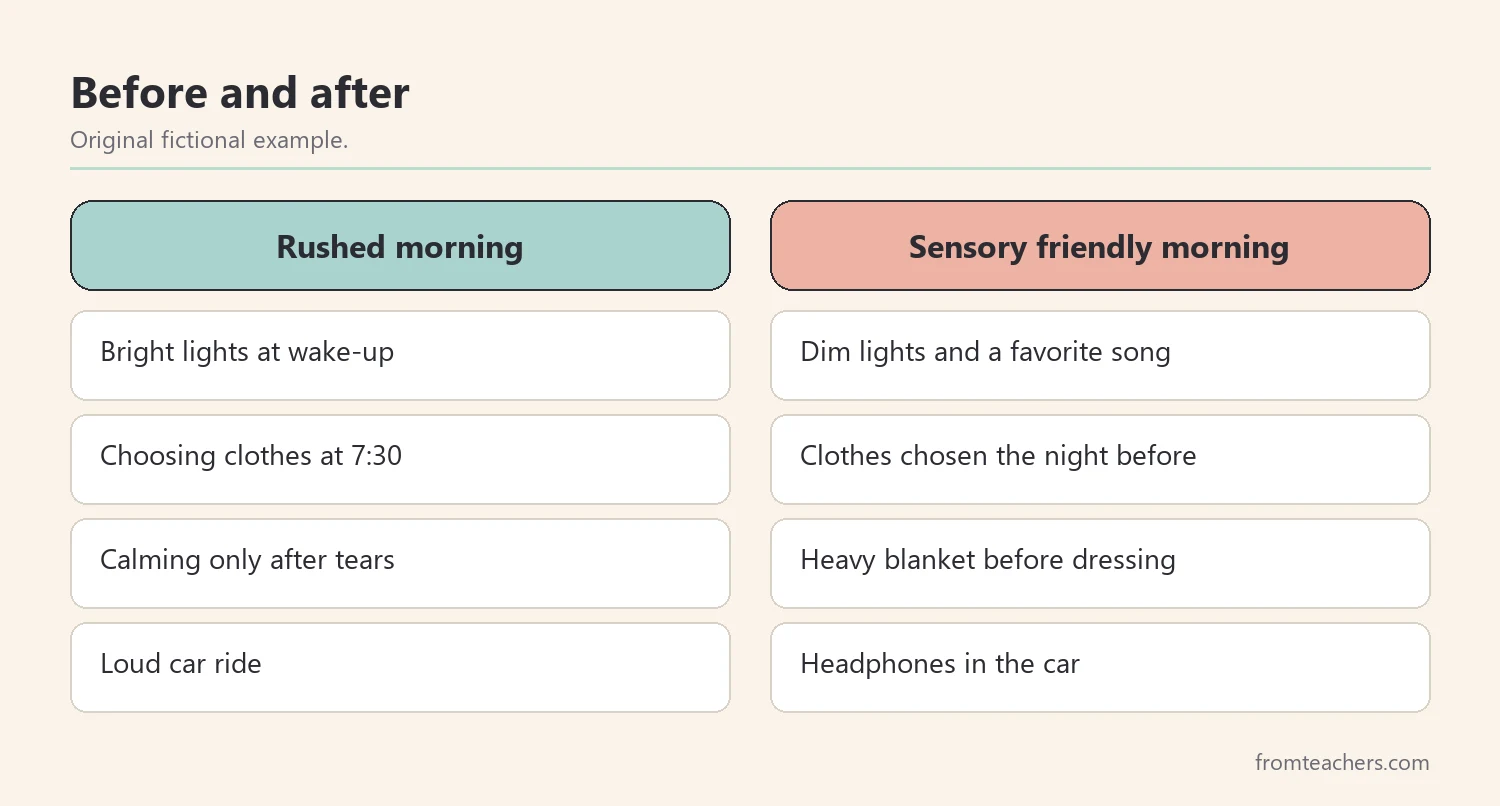
As Figure 4 shows, Ava’s mornings moved from rushed and loud to slower and more predictable. Her teacher also noticed that she settled into class more easily. Her parents shared their morning sequence with the school, and the teacher used a similar visual strip for the classroom arrival routine.
In addition, share findings with your child’s occupational therapist and school team. A short note such as “Heavy blanket and heavy work before dressing helped; car noise is still hard” gives professionals useful information for planning support.
Finally, include your child. Older children can help choose calming activities, decide the order of steps, and say what feels better. Learning to notice and name their own needs is a skill that will serve them for years.
Common mistakes and how to avoid them
- Changing everything at once. Too many changes can be overwhelming and hide what works. Fix: adjust one step at a time.
- Using calming input only after a meltdown. By then, the child is already overloaded. Fix: build calming input into the routine before hard steps.
- Rushing. A tight schedule leaves no room for sensory needs. Fix: wake a little earlier and slow the pace.
- Introducing new foods or clothes on school mornings. New textures add stress at the worst time. Fix: try new things on calmer days.
- Treating sensory reactions as misbehavior. Punishment rarely helps sensory overload. Fix: look for the trigger and adjust the environment.
Questions parents ask about a sensory friendly morning routine
How long does it take for a sensory friendly morning routine to help?
Some families notice small changes within days, while others need several weeks. Track a few signs for at least two weeks before deciding whether a change works.
Does my child need a diagnosis to use these ideas?
No. Many children have sensory preferences without a formal diagnosis. If sensory reactions strongly affect daily life, talk with your child’s doctor or an occupational therapist about an evaluation.
What if siblings have different needs in the morning?
That is common. Try staggering wake-up times, giving each child a separate space to dress, or using headphones for the child who is sensitive to noise. Small separations can reduce conflict.
Should I tell the school about our morning routine?
Yes, it can help. Teachers may use similar supports at arrival, and they can tell you how your child seems after a calm morning compared with a hard one.
Can a sensory friendly morning routine work on weekends too?
Yes. Keeping the main steps similar on weekends maintains predictability. You can relax the timing while keeping the order and the calming activities.
Related reading: Managing Sensory Overload: Practical Strategies for Autism and ADHD, Meltdowns vs Tantrums: A Guide to Understanding and Responding, and How Parents and Teachers Can Team Up for Special Education Success.
You may also need: Morning Routine Visual Steps: Visual Schedule Cards.
A companion resource for a sensory friendly morning routine:
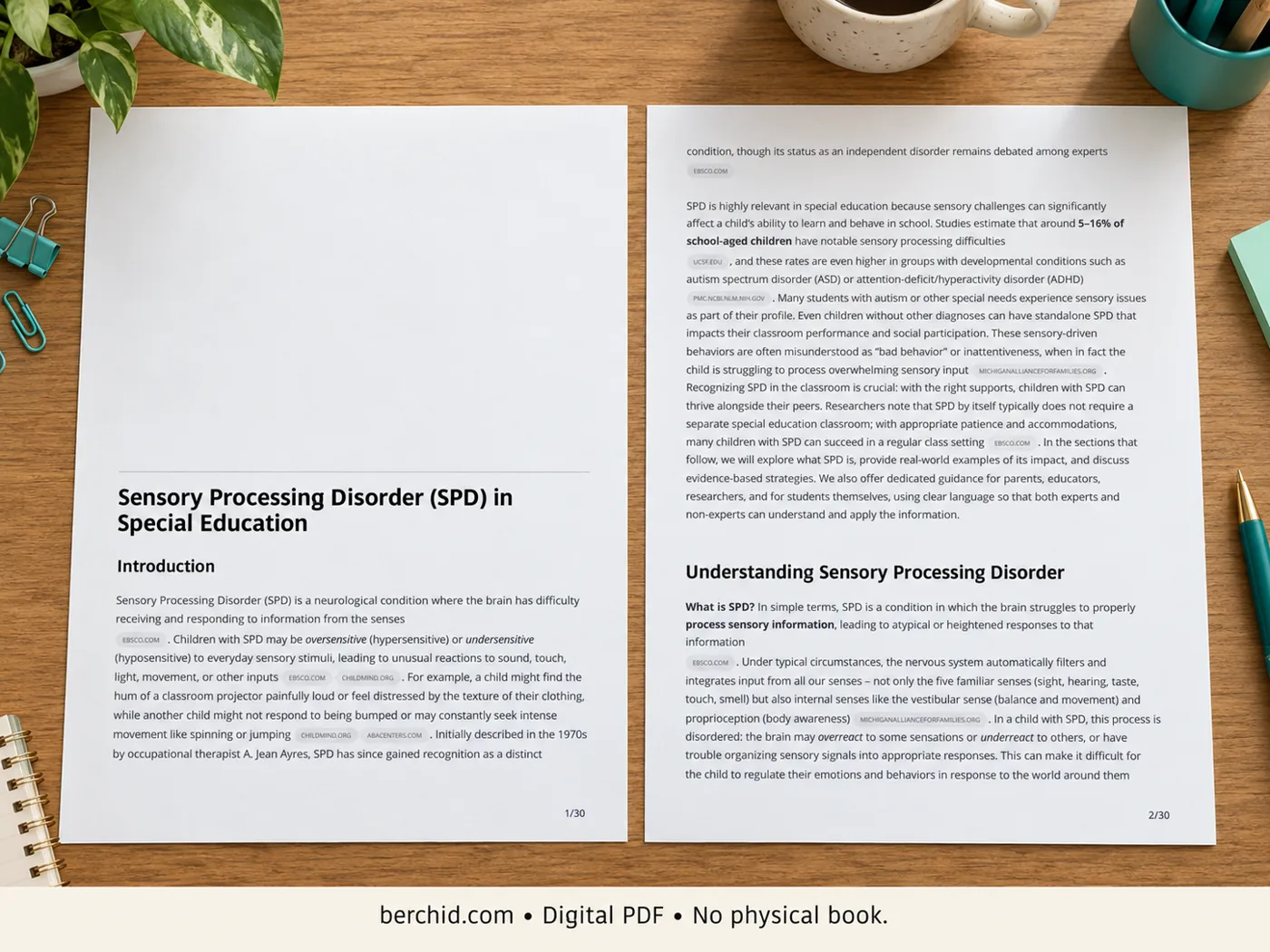
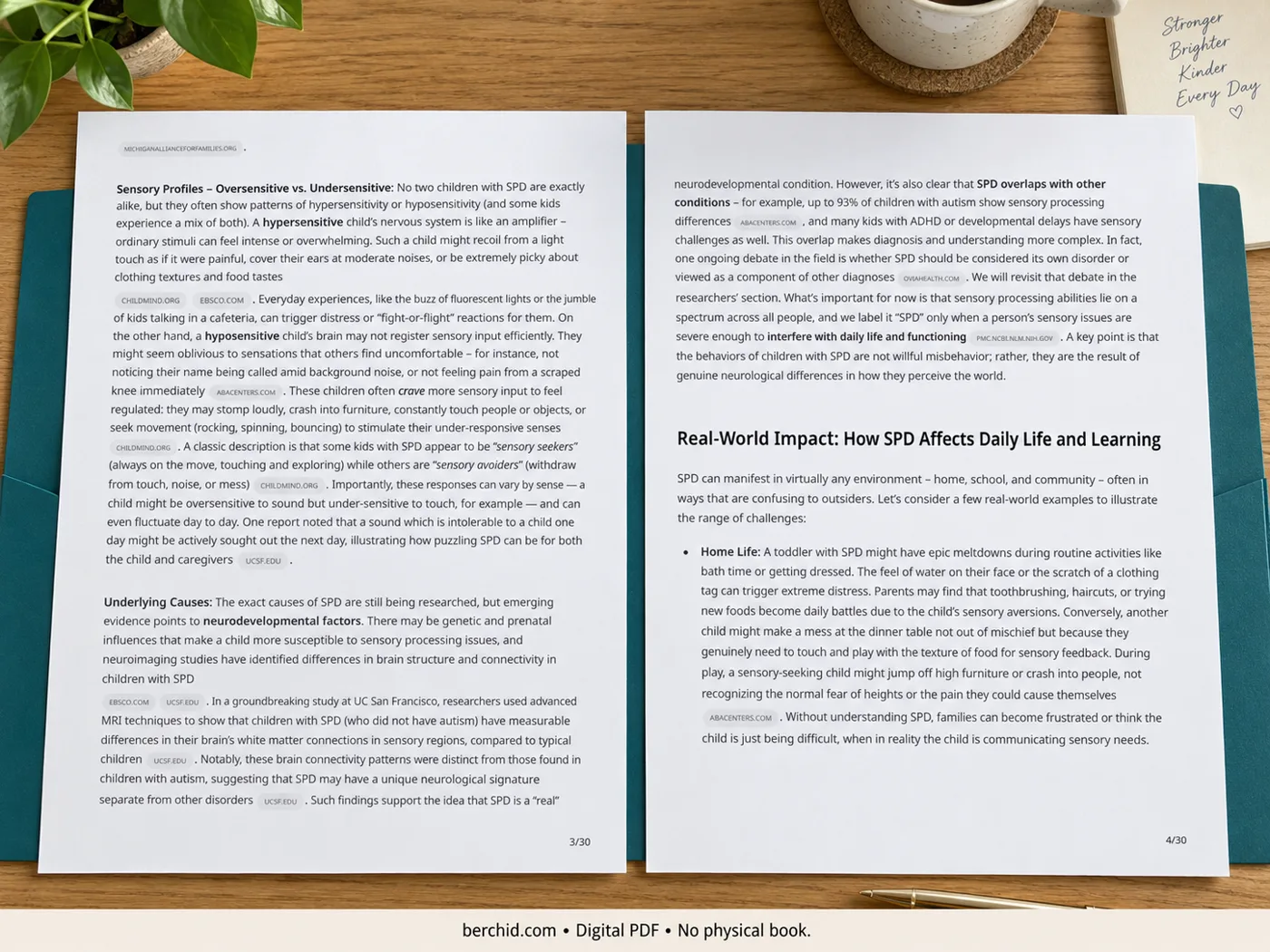
Sensory Processing Disorder (SPD) Guide: Strategies for Parents & Teachers: a 30-page guide with an overview of sensory profiles, a parent section on sensory-friendly routines and calming spaces, an educator section, and a section written for children on self-regulation.
Sources and scope
- American Occupational Therapy Association (AOTA): information on occupational therapy and sensory integration for children.
- Understood.org: parent-friendly articles on sensory processing challenges and daily routines.
- HealthyChildren.org, American Academy of Pediatrics: parent information on child development and routines.
- IRIS Center, Vanderbilt University: free modules on supporting students with disabilities at school.
This guide covers practical morning routines at home. It does not diagnose sensory processing differences or replace advice from an occupational therapist, doctor, or other qualified professional.
Key takeaways
- A sensory friendly morning routine begins with mapping where overload builds.
- Evening preparation removes many morning decisions and textures.
- Adjust the hardest steps one at a time.
- Calming input works best before hard steps, not after a meltdown.
- Two weeks of simple tracking shows what to keep and what to change.










Leave a Comment