
Geography review games for middle school can turn the dreaded week before a unit test into some of the liveliest lessons of the term. Picture a grade 7 class on a Thursday afternoon. The map quiz is on Monday, half the room is quietly copying capital cities from a list, and the other half is quietly not.
This guide is for middle school social studies and geography teachers who want review time that sticks. By the end, you will have five game formats that work with 12 to 14 year olds, a way to mix challenge levels in one room, and a simple method to check which countries and capitals students actually remember.
Examples are fictional. Adapt to your curriculum and your students’ needs.
At a glance
- Review works best when students retrieve facts, not just reread them.
- Middle schoolers respond to humor, competition, and a bit of choice.
- Country “personalities” give memory a hook beyond the name on a map.
- Mix team games with quick solo checks to see who really knows what.
- Track a few target facts so review time goes where it is needed.
1. Plan geography review games for middle school around retrieval
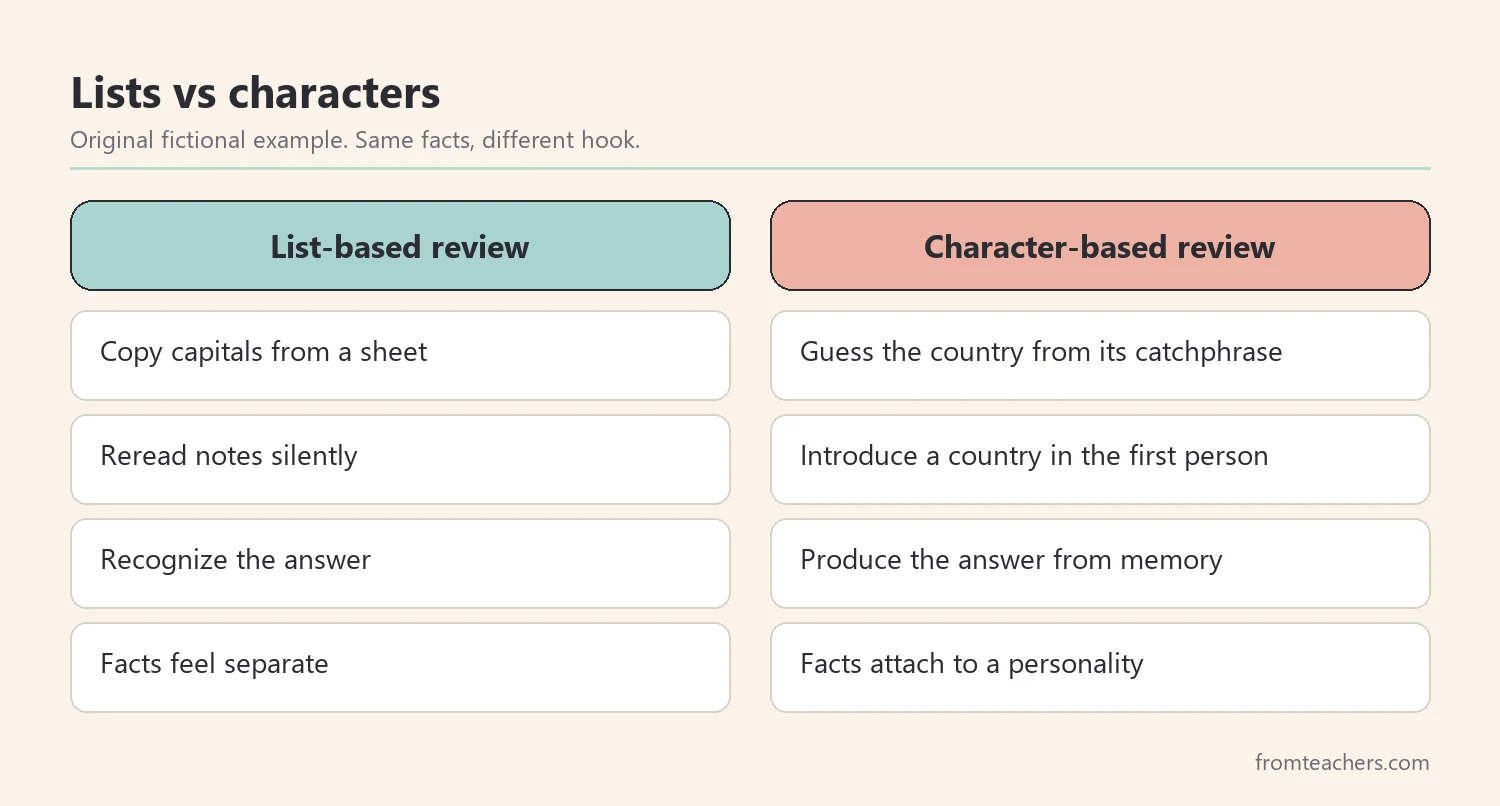
First, decide what the review is for. Rereading notes feels productive, yet it often leads to recognition rather than recall. Students see “Canberra” and think “I know that,” but cannot produce it when the quiz asks for the capital of Australia. Retrieval practice, where students pull the answer out of memory, tends to build stronger recall.
So, design each game so students must produce an answer before they see it. Cards with the country on one side and the answer on the back, quick-fire questions, and “guess the country” clues all work this way.
Next, list the target facts. A unit on a single continent might include countries, capitals, and one or two key features for each. Keep the list visible to you, since it is the backbone of every game you run.
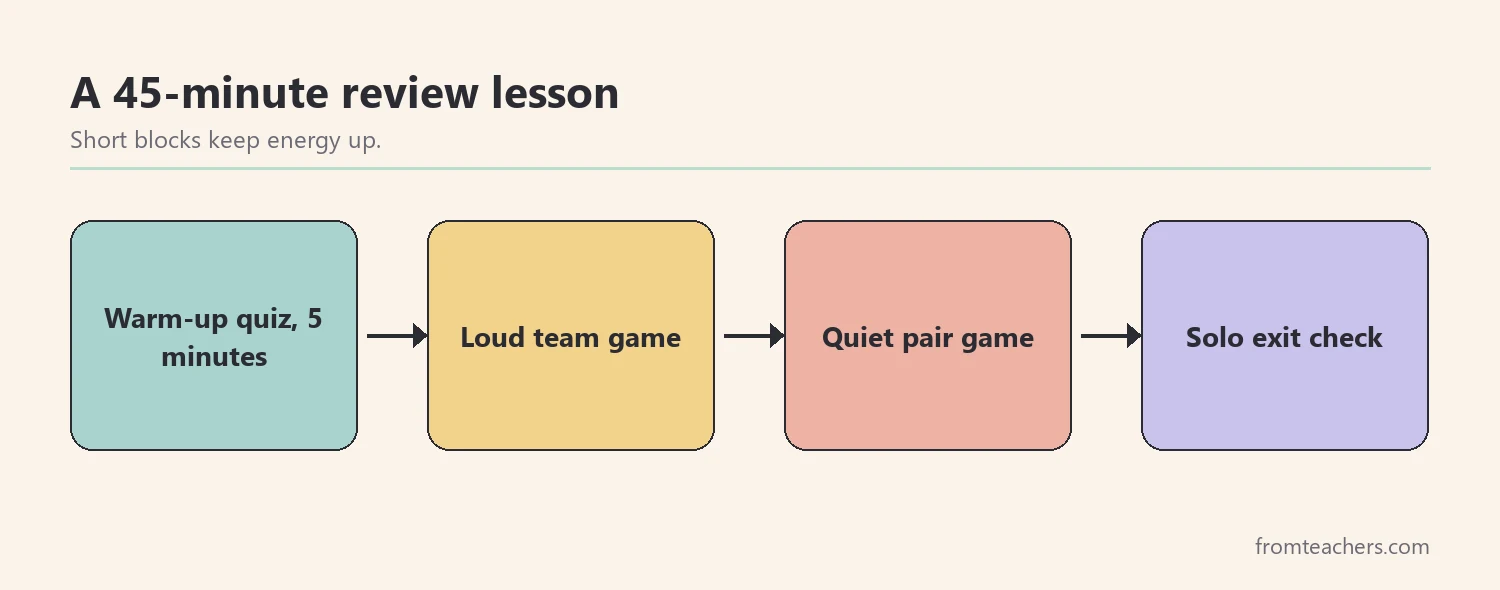
Then, decide the mix of time. A 45-minute review lesson could include a warm-up quiz, two games, and a short exit check. Short blocks keep energy up, which matters a lot with young teens late in the day.
Meet Mr. Chen (fictional), who teaches grade 7 geography. His class was finishing a unit on South America. His target list had twelve countries, their capitals, and a fact for each. He planned three review lessons in the week before the quiz, each with a different set of games, so students practiced the same facts in fresh ways.
Finally, share the goal with students. “By Monday, everyone should be able to name the capital of each country on this list” is clear and fair. Review games feel more meaningful when students know exactly what they are reviewing for.
2. Give every country a personality
Middle schoolers remember stories and characters far better than lists. Therefore, one of the strongest hooks for geography is to treat each country like a person with a nickname, a job, and a catchphrase.
The If Countries Were Humans! country profile slides do exactly this for all 195 countries. Each slide shows the country name, continent, and capital, along with a fun nickname, a job title, a first-person catchphrase, and a set of real facts. For example, Cabo Verde appears as the Atlantic Music Island with the job title Morna Music Ambassador.
In class, these characters become the raw material for review games. Because each country has a memorable voice, students have something to hold on to beyond the spelling of a capital. A student who forgets the capital might remember the catchphrase, and the catchphrase often leads back to the facts.
Here are quick ways to use the profiles in review:
- Who am I? Read a catchphrase aloud. Teams guess the country.
- Job fair: Show three job titles. Students match them to countries on a map.
- Nickname swap: Students invent a new nickname for a country based on its real facts.
- Character card: Each student presents “their” country in thirty seconds, in the first person.
Mr. Chen gave each student one South American country profile on Monday. On Wednesday, students introduced their country in character, then the class guessed the capital before the slide revealed it. Even quiet students joined in, because speaking as a country felt less personal than speaking as themselves.
3. Run five games that work with 12 to 14 year olds
Now, choose the games. Not every format suits every class, so it helps to have several ready. Middle schoolers enjoy competition, but they also need structure to keep it friendly.
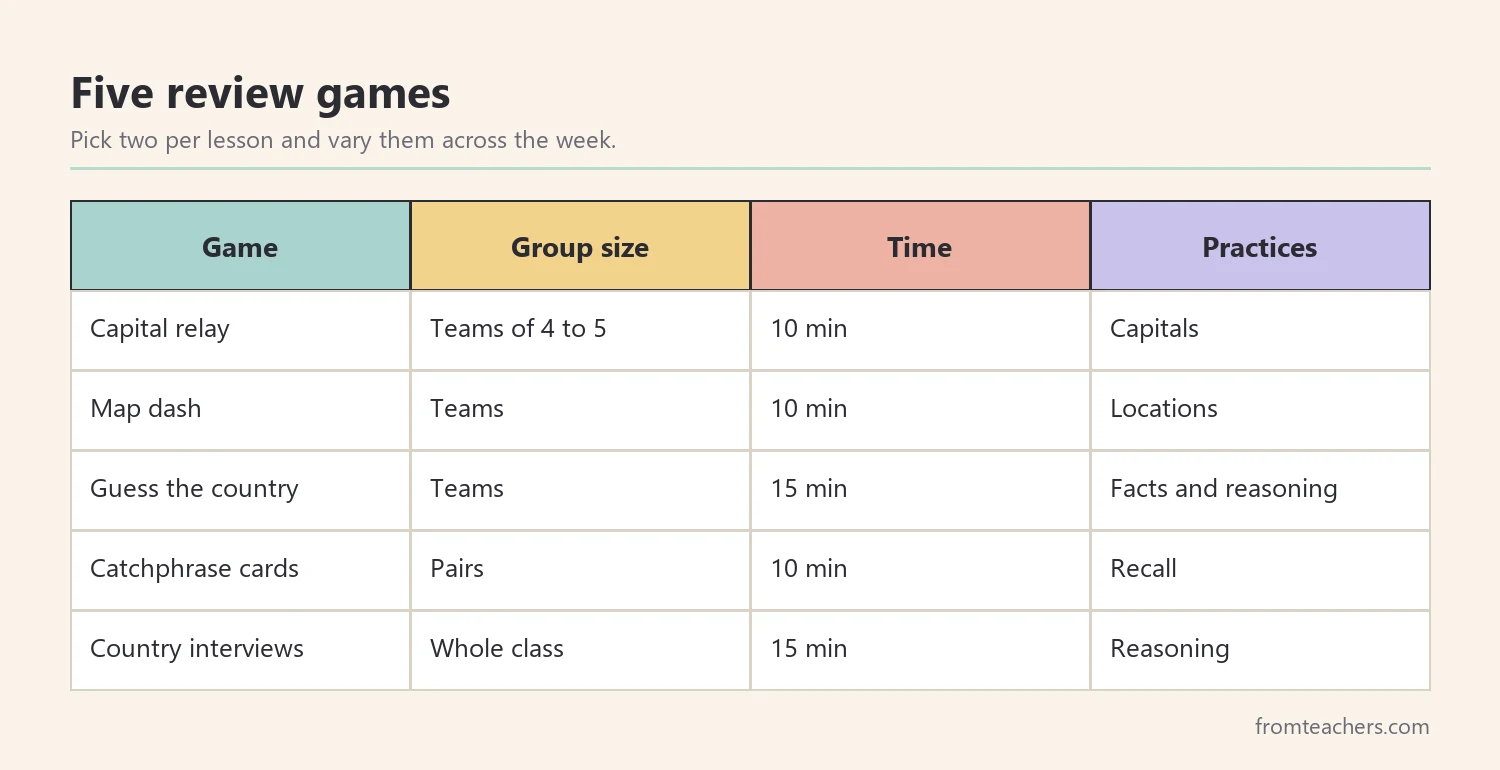
Capital relay. Teams line up at the board. One student at a time writes a capital for a country you call out, then passes the marker. The fastest correct team wins the round. Because everyone must take a turn, no one can hide.
Map dash. Project a blank map. Call out a country nickname from the profiles, and teams race to point to the right country. This links the character to the location, which many students find hard.
Guess the country. Read three facts, one at a time. Teams score more points if they guess after the first fact and fewer after the third. It rewards real knowledge while still giving everyone a chance.
Catchphrase cards. Pairs quiz each other with cards: catchphrase on the front, country and capital on the back. This is a quiet game that works well after a loud one.
Country interviews. One student plays a country; the class asks yes or no questions to guess which one. “Are you in South America? Is your capital on the coast?” This builds geographic reasoning, not just memory.
Also, set ground rules for team games. Rotate who answers, allow a short “phone a friend” once per round, and celebrate good guesses as well as correct answers. As a result, the games stay fun even for students who are less confident.
4. Mix challenge levels in one room
Every middle school class includes students who already know most capitals and students who are still learning the continents. However, you do not need separate lessons. Instead, adjust the challenge inside the same game.
For example, during “Guess the country,” give some teams a word bank of possible answers, while others play without one. In the capital relay, let students choose a “gold” country worth more points or a “silver” country worth fewer. Choice keeps advanced students challenged and lets others build confidence.
In addition, plan supports for students with learning differences. Larger print slides, a printed map at each desk, extra time in timed rounds, and a partner who reads clues aloud can all help. If a student has an IEP or 504 plan, check which accommodations apply to quizzes and use them during review too, so practice matches test conditions.
Similarly, mind the social side. Some young teens dread being wrong in front of peers. Team answers, whiteboards held up at the same time, and quiet pair games give everyone a safe way to take part. Mr. Chen used mini whiteboards for every round, so no single student’s mistake was on display.
Also, vary the format across the week. A loud relay on Tuesday, a quiet card game on Wednesday, and an interview game on Thursday reach different learners. Moreover, the variety keeps review from turning into one more routine students tune out.
Let students build the next game
Once students know the formats, hand some of the work to them. Writing a good quiz question is a form of review in itself, because students must check facts, choose what matters, and think about what a classmate might confuse.
For example, give each pair two country profiles and ask them to write three “Guess the country” clues, from hardest to easiest. Then, collect the clues and use them in the next lesson. Students love hearing their own clue read aloud, and they listen closely to see whether anyone can solve it.
In addition, set a few rules for student-written questions. Every clue must be based on a real fact from the profile or the textbook. No clue may give away the capital directly. And each pair must check the answer before handing it in. These rules keep the questions accurate and fair.
Mr. Chen used student clues for the Thursday lesson. Because each pair had studied two countries closely, they became the “experts” when those countries came up. That small role gave several quieter students a reason to speak.
Also, keep the best clues. Over time, you build a bank of student-written questions you can reuse with future classes, which saves preparation time each year.
5. Check what students actually remember
Games are fun, but they can hide gaps. Loud teams carry quiet members, and confident guessers mask uncertainty. Therefore, end each review lesson with a quick solo check.
Keep it short: five countries, write the capital, no notes, two minutes. Collect the slips, sort them into “secure” and “not yet,” and tally the results by country. This takes about five minutes after class and tells you exactly what to review next.
Here is Mr. Chen’s tally for five tricky countries across three review lessons:
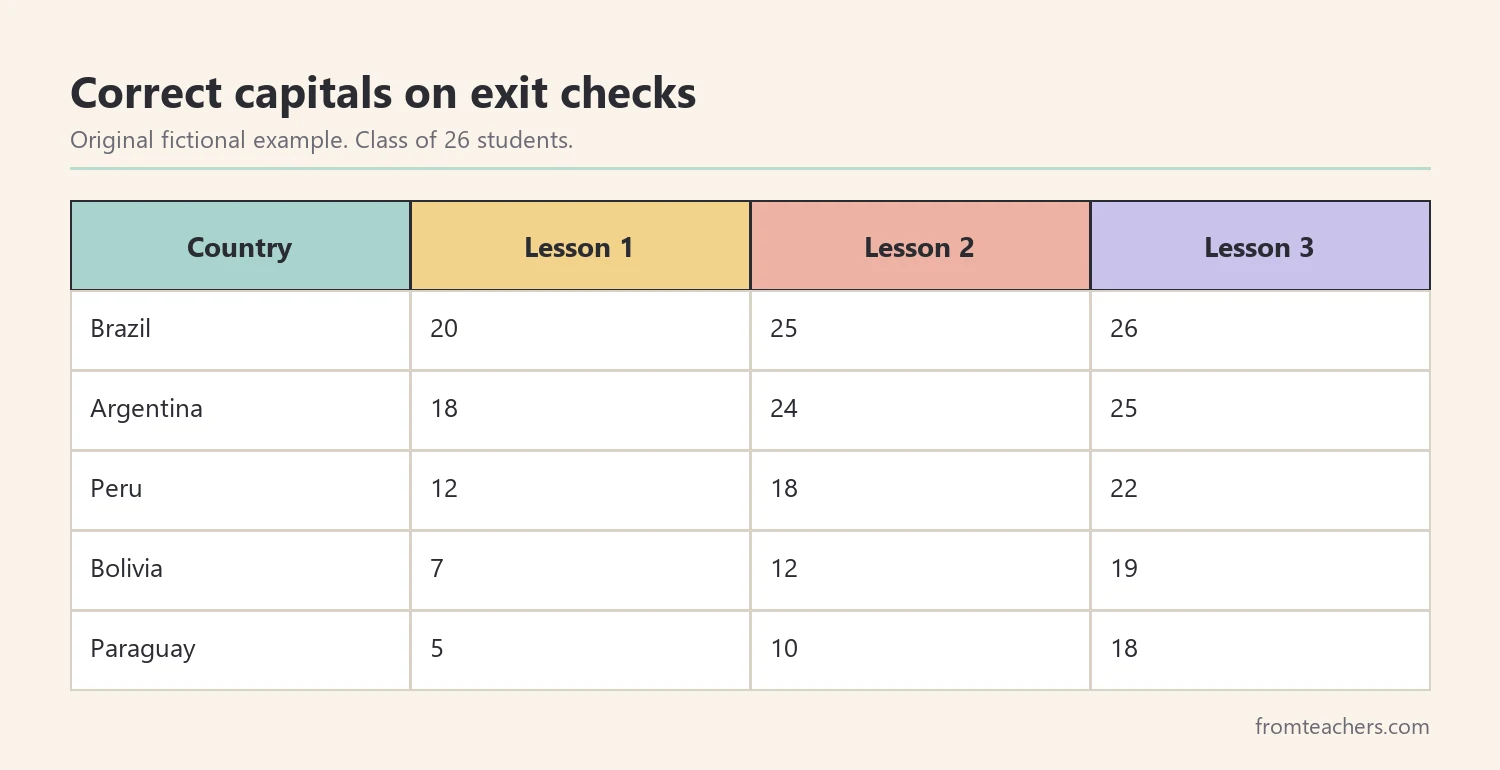
The pattern guided his next lesson. Most students knew Brazil and Argentina well by the second check, so he dropped them from games. Paraguay and Bolivia stayed lower, so he made them the focus of Thursday’s interview game. By the final check, every country had moved up.
Also, share results with students. A class chart of “countries we have mastered” is motivating, especially if it focuses on the class as a team rather than on individuals. Students often ask to beat their own record the next day.
Finally, keep a few target facts in later units. A two-minute capital quiz once a month helps students hold on to what they learned. Spaced review like this tends to protect memory far better than a single cram session before the test.
Common mistakes and how to avoid them
- Relying on rereading. Looking at notes feels like study but builds weak recall. Fix: design games where students produce the answer first.
- Letting a few students dominate. Fast responders can carry whole teams. Fix: rotate answerers and use whiteboards held up together.
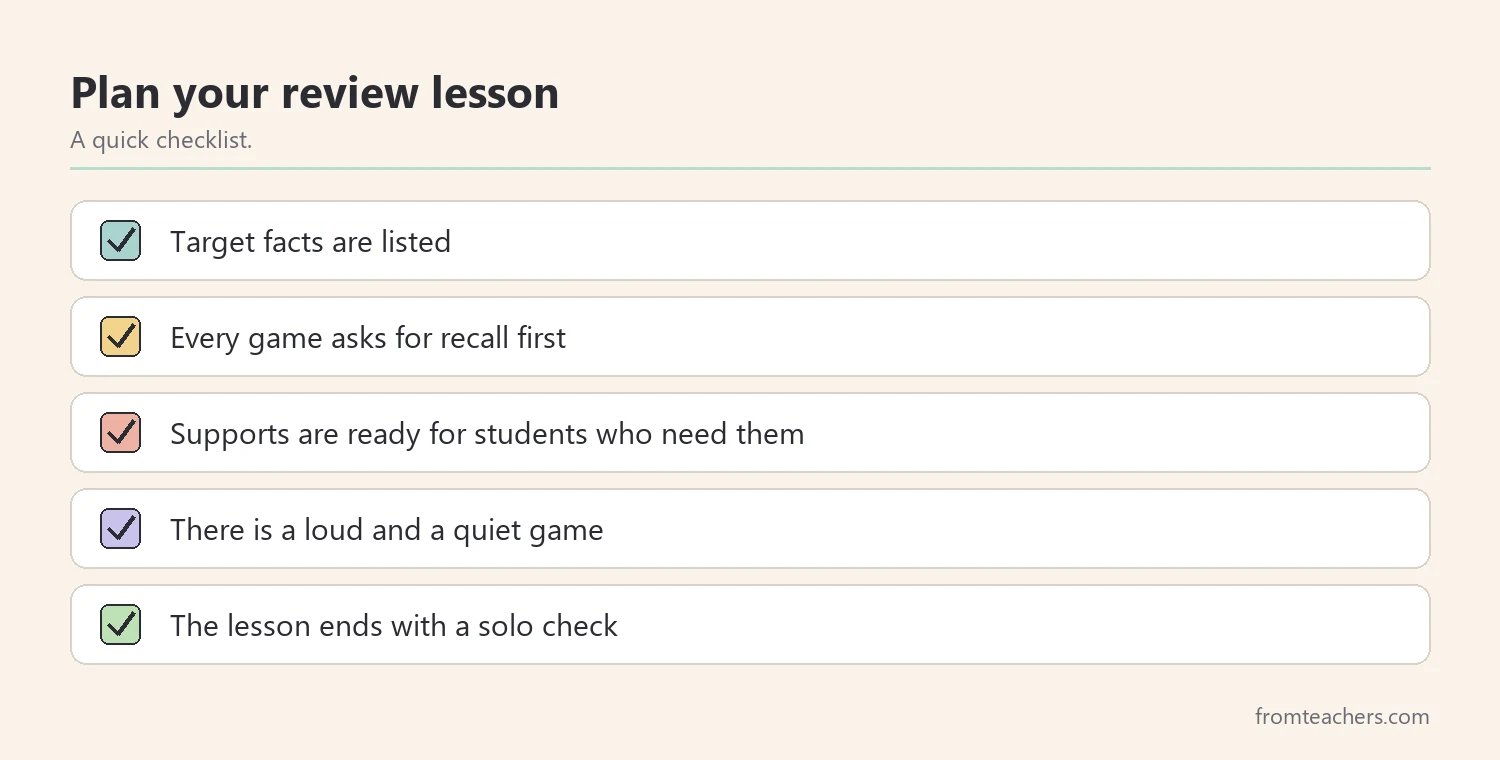
- Skipping the solo check. Team success can hide individual gaps. Fix: end each lesson with a two-minute exit check.
- Reviewing everything equally. Easy countries take time from hard ones. Fix: use your tally to focus on the “not yet” list.
- Making it all competition. Some students shut down under pressure. Fix: mix team games with quieter pair formats.
Questions teachers ask about geography review games for middle school
How long should a review game last?
Many teachers find that ten to fifteen minutes per game keeps energy high. Two short games and a quick exit check fit well in a typical lesson. If a game is going really well, you can extend it, but end before students lose interest.
Are these games suitable for students with learning disabilities?
Yes, with sensible supports. Word banks, printed maps, extra time, and partner reading make most formats accessible. Check the student’s IEP or 504 plan and use the same accommodations during review as on the test.
How do I keep competition friendly?
Set clear rules before the first round, reward good thinking as well as correct answers, and change teams often. Short rounds also help, because no team stays behind for long.
Can these games work for older or younger students?
Yes. Younger students may need simpler clues and fewer countries per round. Older students can handle more facts, map reasoning, and student-led quiz writing.
How many countries should students review at once?
It depends on your unit and class. A focused set of ten to fifteen countries per review week is manageable for many classes. Larger sets can be split across several lessons.
Related reading: 5 Practical Teaching Tips to Boost Classroom Focus and Learning, Learning Styles Student Success Guide, and Accommodations vs Modifications in Special Education.
You may also need: If Organs Were Humans!.
A companion resource for geography review games for middle school:
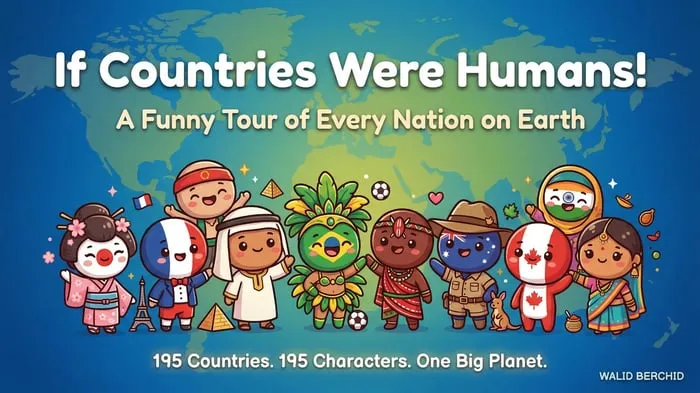
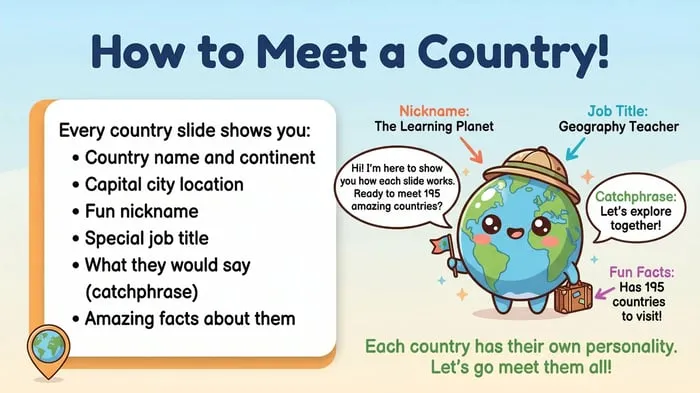
If Countries Were Humans!: 195 country profile slides, each with continent and capital, a fun nickname and job title, a first-person catchphrase, real facts, and Did You Know extras for elementary and middle school geography.
Sources and scope
- What Works Clearinghouse: practice guides, including guidance on organizing instruction and study to improve learning.
- National Council for the Social Studies: standards and teaching resources for social studies educators.
- National Geographic Education: free maps, activities, and reference material for geography classes.
- CAST UDL Guidelines: a framework for planning lessons that work for a wide range of learners.
This guide covers classroom review games for middle school geography. It does not cover full curriculum design or formal assessment, which follow your school’s standards and policies.
Key takeaways
- Geography review games for middle school work best when students retrieve answers.
- Country characters give facts a memorable hook.
- Five simple formats cover loud, quiet, and reasoning-based review.
- Choice and supports let every student take part in the same game.
- Quick solo checks show where to focus the next lesson.



Leave a Comment