

Arkansas facts for kids can start with one question that wakes up any classroom: “Would you like to visit a park where you can dig for real diamonds and keep what you find?” Hands go up, eyes widen, and suddenly a state study feels like an adventure instead of a list to memorize. The challenge is turning that first spark into facts students actually remember a week later.
After reading this guide, you will be able to plan a short Arkansas unit, teach the capital, nickname, and symbols, explore two famous landmarks, connect them to simple science, and check what students learned. One fictional class appears throughout, so you can see each step in practice.
Examples are fictional. Adapt to your students’ grade level, goals, and agreed supports. This is general classroom guidance.
At a glance
- Arkansas is called “The Natural State,” and its capital is Little Rock.
- Key symbols include the northern mockingbird, the apple blossom, the pine tree, the white-tailed deer, and the diamond.
- Crater of Diamonds State Park lets visitors search for diamonds and keep what they find.
- Hot Springs National Park protects naturally warm spring water and historic bathhouses.
- A five-day plan with short review games helps Arkansas facts for kids stick.
1. Plan your Arkansas facts for kids unit and start with a map
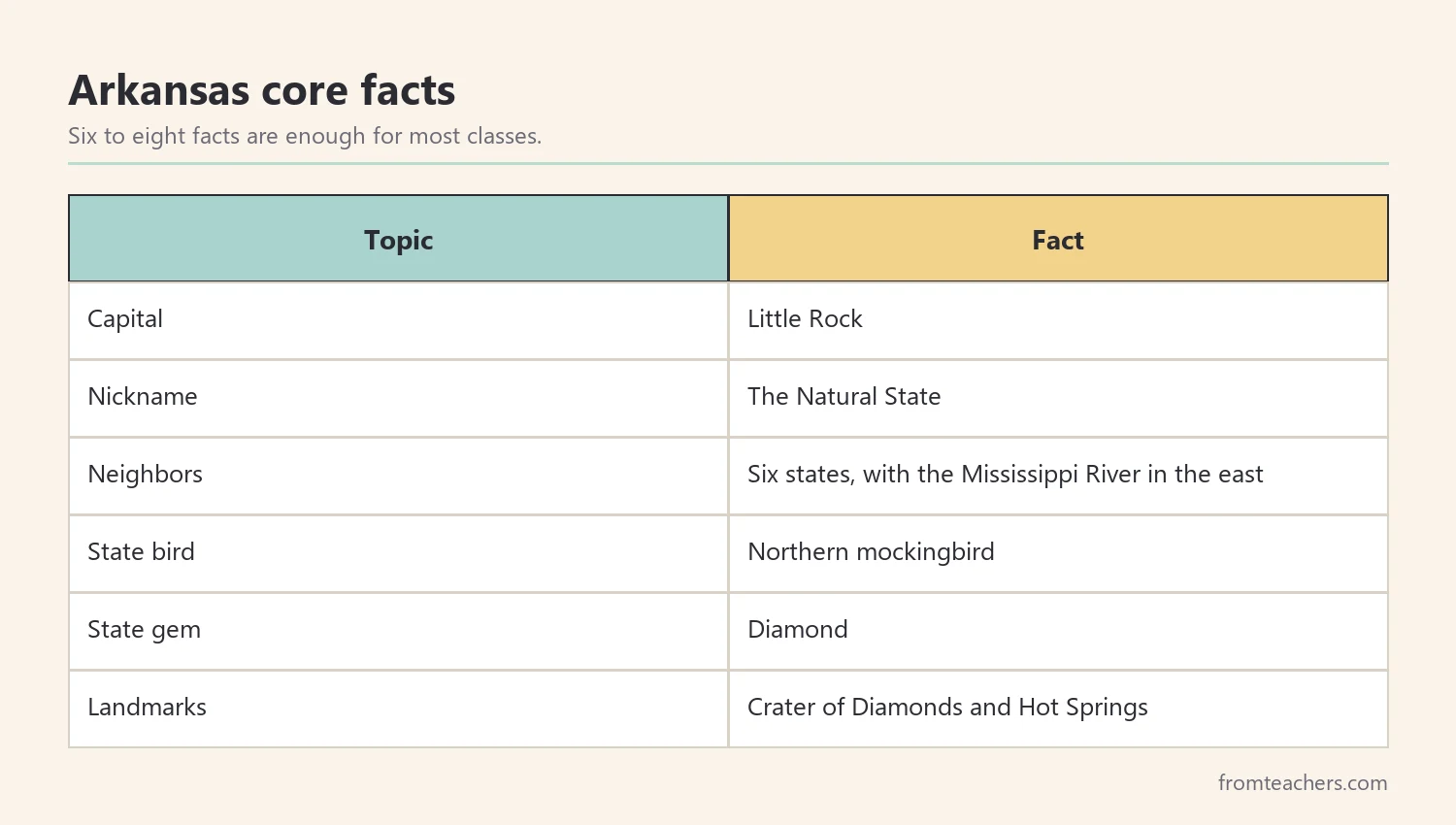
Before teaching any facts, decide what students should know by the end. A short list of Arkansas facts for kids keeps the unit focused. For most elementary classes, five to eight core facts are enough, with extra details for curious learners.
Next, start with location. Arkansas sits in the south-central United States. It borders six states: Missouri, Tennessee, Mississippi, Louisiana, Texas, and Oklahoma. Much of its eastern border follows the Mississippi River.
A map activity makes these Arkansas facts for kids concrete. Have students find Arkansas, count its neighbors, and trace the Mississippi River with a finger. Then ask why a river might make a good border. This simple question builds geography thinking, not just memory.
Worked example: Ms. Reed’s fourth grade
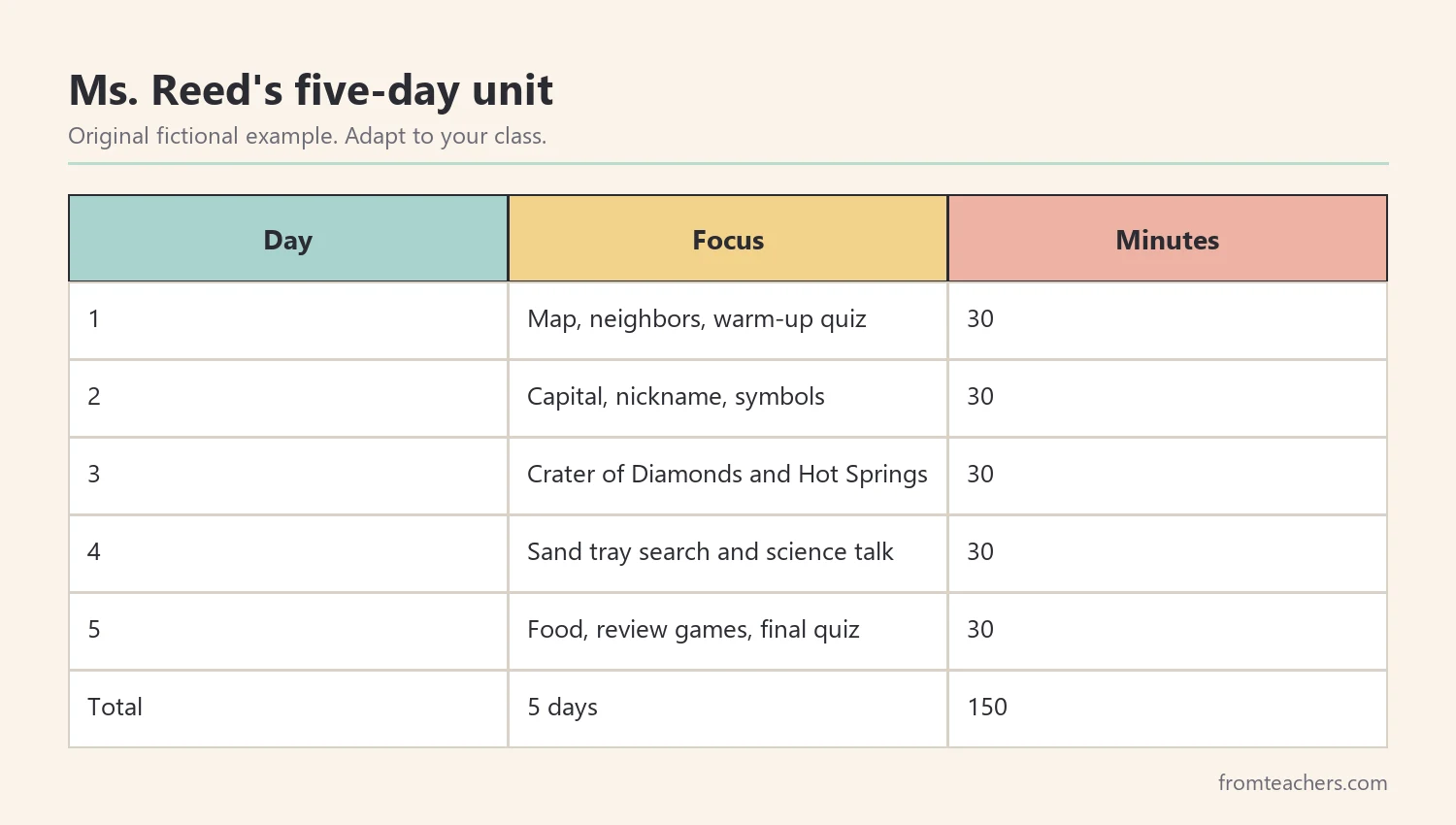
Ms. Reed is a fictional fourth grade teacher planning a five-day Arkansas unit. She has 30 minutes each afternoon for social studies. She chooses six core facts: the capital, the nickname, the six neighboring states, the state bird, Crater of Diamonds State Park, and Hot Springs National Park.
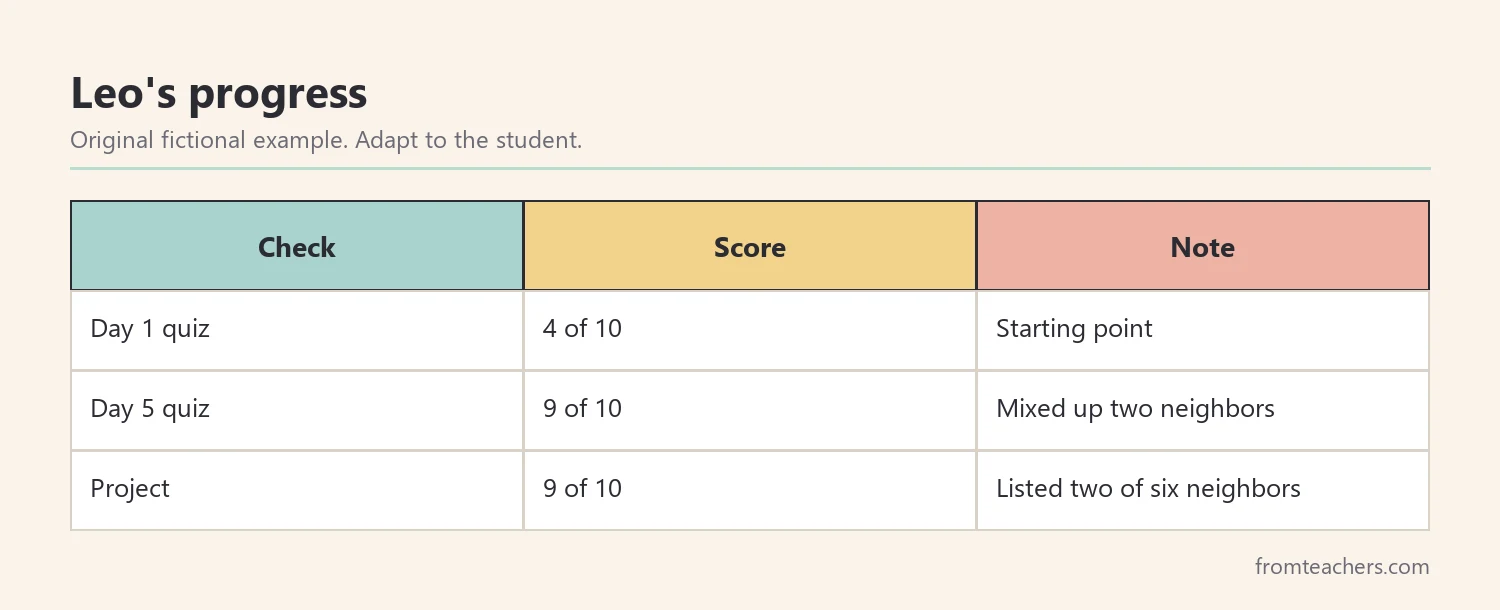
On day one, she gives a quick 10-question warm-up quiz. One student, Leo, answers 4 of 10 correctly. Ms. Reed will use the same quiz on day five to see what changed.
2. Teach Arkansas facts for kids about the capital, nickname, and symbols
Capital and nickname facts are short, so they work best with a hook. Otherwise, they blur together with every other state students have studied. The capital of Arkansas is Little Rock, which sits along the Arkansas River near the middle of the state. The nickname “The Natural State” celebrates its forests, rivers, lakes, and mountains, including the Ozark and Ouachita Mountains.
State symbols give children an easy way into a new place. Arkansas facts for kids often focus on these:
| Symbol | Arkansas choice | Quick activity |
|---|---|---|
| Bird | Northern mockingbird | Listen to bird calls |
| Flower | Apple blossom | Draw and label petals |
| Tree | Pine | Compare needles and leaves |
| Mammal | White-tailed deer | Find its habitat on a map |
| Gem | Diamond | Link to Crater of Diamonds |
The mockingbird is a favorite because it can copy the songs of other birds. For example, play a few bird calls and let students guess which sound a mockingbird might imitate. This turns a fact into a listening game.
In Ms. Reed’s class, students make a symbol card for each item, with a picture on the front and one sentence on the back. Leo draws a detailed mockingbird and writes, “It copies other birds.” Ms. Reed keeps the cards in a bag for review games later in the week.
A slide-by-slide resource saves preparation here. The Arkansas state study slideshow introduces the capital, the nickname, and the state symbols one fact at a time with kid-friendly illustrations.
3. Explore Crater of Diamonds and Hot Springs with Arkansas facts for kids
Landmarks are where Arkansas facts for kids become memorable. Two stand out, and they make a natural pair for comparison.
First, Crater of Diamonds State Park is near the town of Murfreesboro. It is known as a place where the public can search a field for diamonds and keep what they find. Students are often amazed that a state park works this way.
Second, Hot Springs National Park protects natural springs where warm water flows up from the ground. Historic bathhouses line the main street of the city of Hot Springs. The National Park Service page for Hot Springs shares photos that help students picture the area.
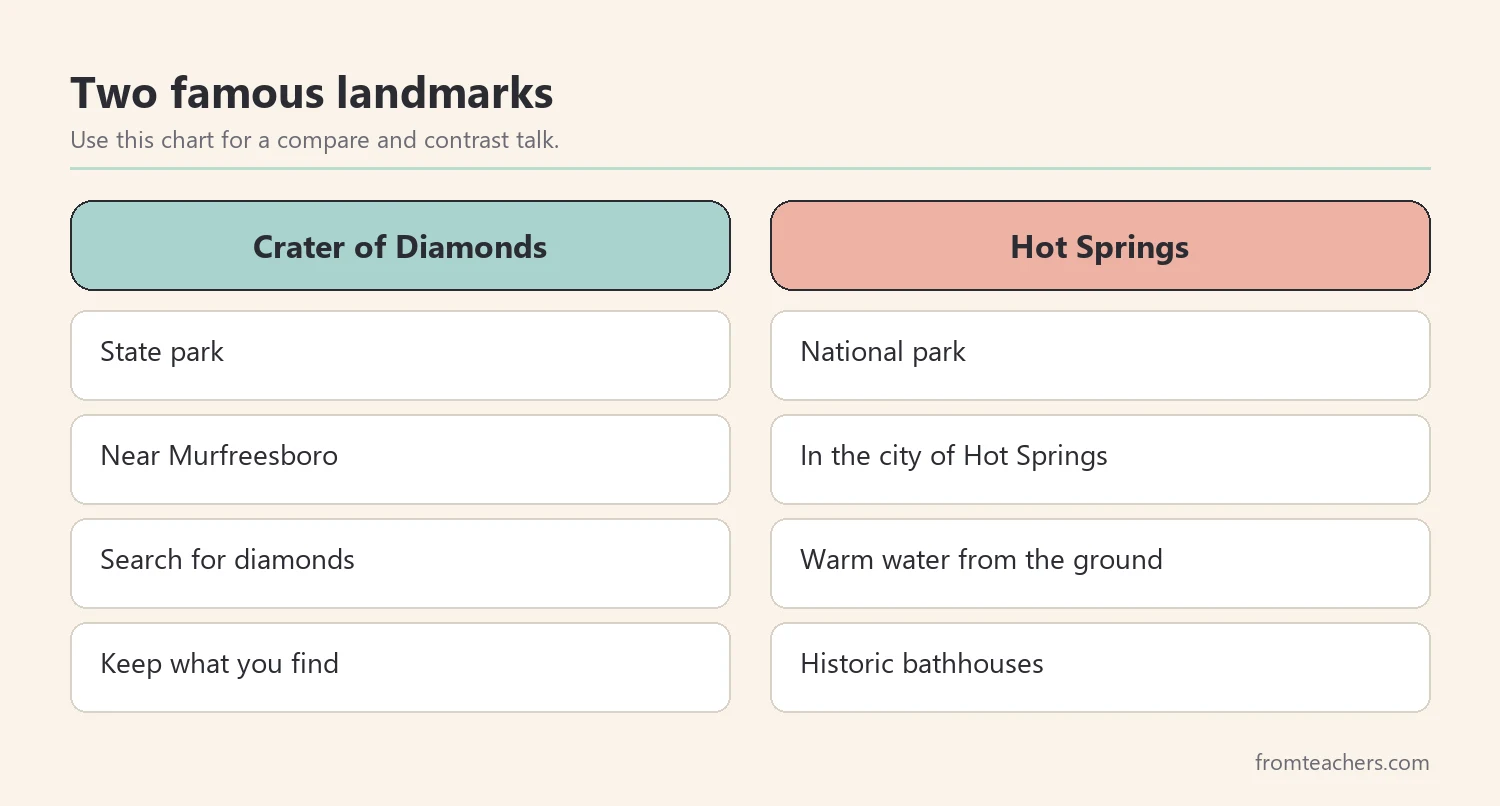
A compare-and-contrast chart works well for these Arkansas facts for kids. Ask students what each place is known for, what visitors do there, and what kind of park it is. Then ask which one they would visit first, and why.
Ms. Reed’s students vote on the landmark they would visit first. Of 24 students, 15 choose Crater of Diamonds and 9 choose Hot Springs. Each student writes one reason. Leo writes, “I want to find a diamond and keep it.” That sentence later becomes part of his final project.
Other places can extend the lesson. For instance, students might compare a mountain area with a river area and list what visitors could do in each. The Ozarks and the Buffalo River are good choices for students who finish early or want to learn more about outdoor life in the state.
4. Connect Arkansas facts for kids to simple science
State study does not have to stay in social studies. In fact, the two landmarks lead naturally into earth science questions that children love to ask.
For diamonds, keep the science simple. Diamonds form deep underground under very high heat and pressure, and some are carried closer to the surface over long periods of time. Students do not need more detail than that at the elementary level.
For hot springs, talk about water that travels deep underground, warms up, and returns to the surface. Again, the goal is curiosity, not technical vocabulary.
Hands-on activities help these Arkansas facts for kids land, especially for students who learn best by doing:
- Sand tray search: hide a few clear craft gems in trays of sand and let small groups sift with spoons.
- Warm and cool water: with adult supervision, let students feel the difference between warm and cool water in cups and describe it.
- Pressure demo: press a stack of soft clay layers under a book to show how pressure changes shape.
For students who need extra support, keep activities short and visual. Offer picture cards, sentence starters such as “Arkansas has…”, and a partner to read with. These supports let every child join the same lesson.
In Ms. Reed’s class, the sand tray search takes 15 of the 30 minutes on day four. The rest of the time goes to a short discussion and drawing. Leo finds two gems and labels a picture “deep, hot, pressure.”
5. Add food and culture, then review
Food is a friendly way to talk about a place, and it adds a personal touch to Arkansas facts for kids. Popular Arkansas dishes include fried catfish, cornbread, and pecan pie. Students can compare these foods with meals from their own homes, which builds connections without singling anyone out.
Keep this part respectful and simple. Avoid claiming that everyone in a state eats the same foods. Instead, present them as dishes many people enjoy there.
Then move to review. Short, playful review beats one long lecture, because students retrieve Arkansas facts for kids many times in small doses rather than once. Try these quick formats:
- Symbol bag: pull a symbol card and have the class name it.
- True or false: read a statement and let students stand or sit.
- Map relay: teams race to point to a neighboring state.
- Exit ticket: each student writes three Arkansas facts for kids in their own words.
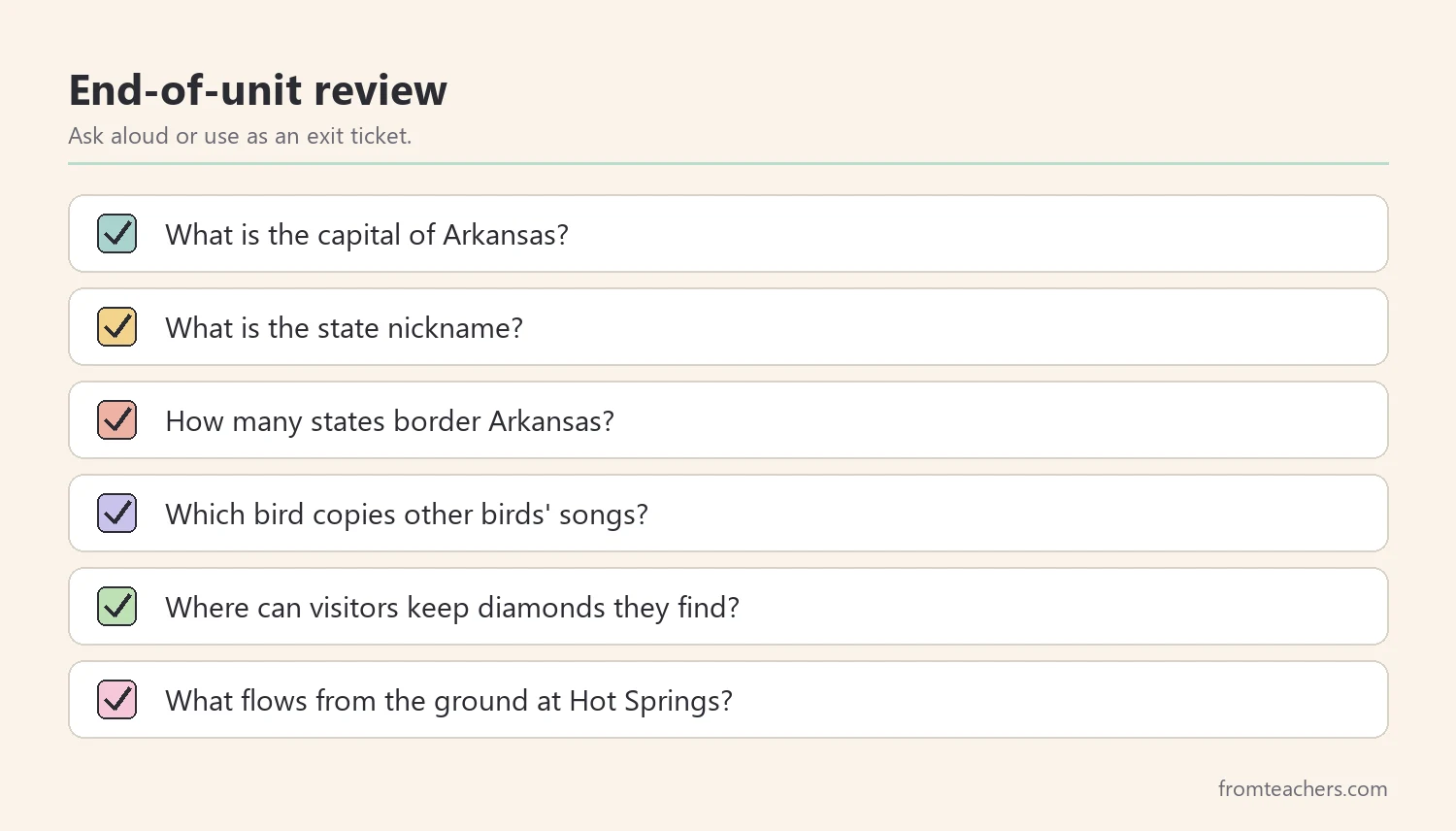
On day five, Ms. Reed gives the same 10-question quiz from day one. Leo now answers 9 of 10 correctly, up from 4. He still mixes up Louisiana and Mississippi on the map, so Ms. Reed gives him a labeled map to keep in his folder.
6. Check learning with a small Arkansas facts for kids project
A short project lets students show what they know about Arkansas in their own way. In addition, it gives quieter students a chance to shine without speaking in front of the class. It also gives you a clear record of learning beyond the quiz.
Keep the project small. A one-page poster, a mini book, or a short “travel guide” all work. Ask for the same core pieces so grading stays fair:
| Project part | What students include | Points |
|---|---|---|
| Location | Map with Arkansas and its neighbors | 2 |
| Capital and nickname | Little Rock and “The Natural State” | 2 |
| Symbols | At least three symbols with pictures | 3 |
| Landmark | One landmark and why it is special | 3 |
| Total | 10 |
Leo makes a travel guide titled “Come Dig for Diamonds.” He includes the map, the capital, the nickname, three symbols, and his landmark sentence. He earns 9 of 10 points; he lists only two neighboring states, so he loses one point under location.
For students who need more support, adapt the format rather than the content. A student might dictate sentences, use picture labels, or complete a fill-in template with the same four parts. That way, every learner shows real knowledge of the same core facts.
Finally, celebrate. Display the projects, invite another class to visit, or let students present one favorite fact. A celebratory ending helps children remember the unit as something they enjoyed.
Common mistakes and how to avoid them
- Teaching too many facts at once. Fix: choose five to eight core facts and save extras for early finishers.
- Skipping the map. Fix: start every state study with location and neighbors.
- Making science too technical. Fix: keep explanations to heat, pressure, and water for elementary students.
- Presenting food as what everyone eats. Fix: describe dishes as popular, not universal.
- Only testing at the end. Fix: give a short warm-up quiz on day one so you can see growth.
- Forgetting supports. Fix: offer picture cards, sentence starters, and partner reading for students who need them.
Questions teachers and parents ask about Arkansas facts for kids
What is the capital of Arkansas?
The capital is Little Rock. It sits along the Arkansas River near the center of the state.
Why is Arkansas called “The Natural State”?
The nickname celebrates the state’s natural beauty, including forests, rivers, lakes, and the Ozark and Ouachita Mountains. It is a good starting point for talking about geography and outdoor life.
Can visitors really keep diamonds at Crater of Diamonds State Park?
Yes. The park is known for letting visitors search for diamonds and keep what they find. Check the park’s official information before planning a real visit, since rules and hours can change.
What grade level fits these Arkansas facts for kids?
Most of these ideas suit grades 2 to 5. Younger students can focus on symbols and the map, while older students can add the science connections and a written project.
How can parents teach this at home?
Parents can look at a map together, play bird calls, cook cornbread, or set up a small sand tray search. Short, playful activities work as well at home as they do in class.
Related reading: 5 Practical Teaching Tips to Boost Classroom Focus and Learning, Learning Styles Student Success Guide, and Homeschooling vs. Public Schooling: Which Educational Path Is Right for Your Child?
A companion resource for teaching Arkansas facts for kids:
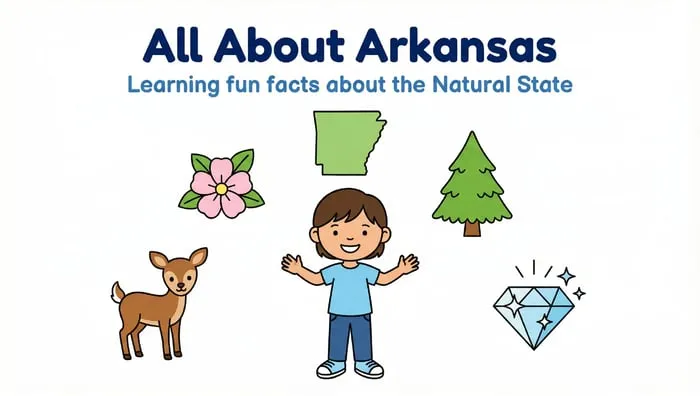
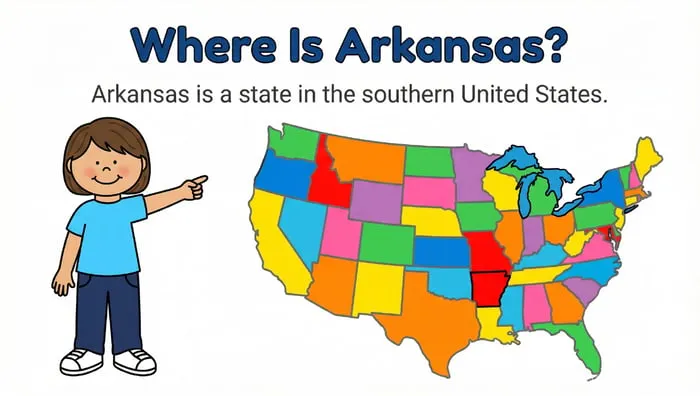
Arkansas State Study: a 33-slide, hand-illustrated resource covering Little Rock, the nickname, state symbols, Crater of Diamonds, Hot Springs, Arkansas foods, and a review slide.
Sources and scope
- National Park Service: official information on national parks and rivers, including Hot Springs and the Buffalo River.
- Arkansas State Parks: official information on state parks, including Crater of Diamonds.
- U.S. Geological Survey: maps and earth science resources for teachers.
- Library of Congress: historical maps, photos, and primary sources about U.S. states.
This guide offers an elementary introduction to Arkansas for classroom and home use. It does not cover detailed state history, government, or advanced geology.
Key takeaways
- Start Arkansas facts for kids with a map: the state borders six states and the Mississippi River.
- Teach Little Rock, “The Natural State,” and five symbols with quick activities.
- Use Crater of Diamonds and Hot Springs to spark questions and comparisons.
- Keep science simple and hands-on.
- Measure growth with a day-one and day-five quiz plus a short project.






Leave a Comment