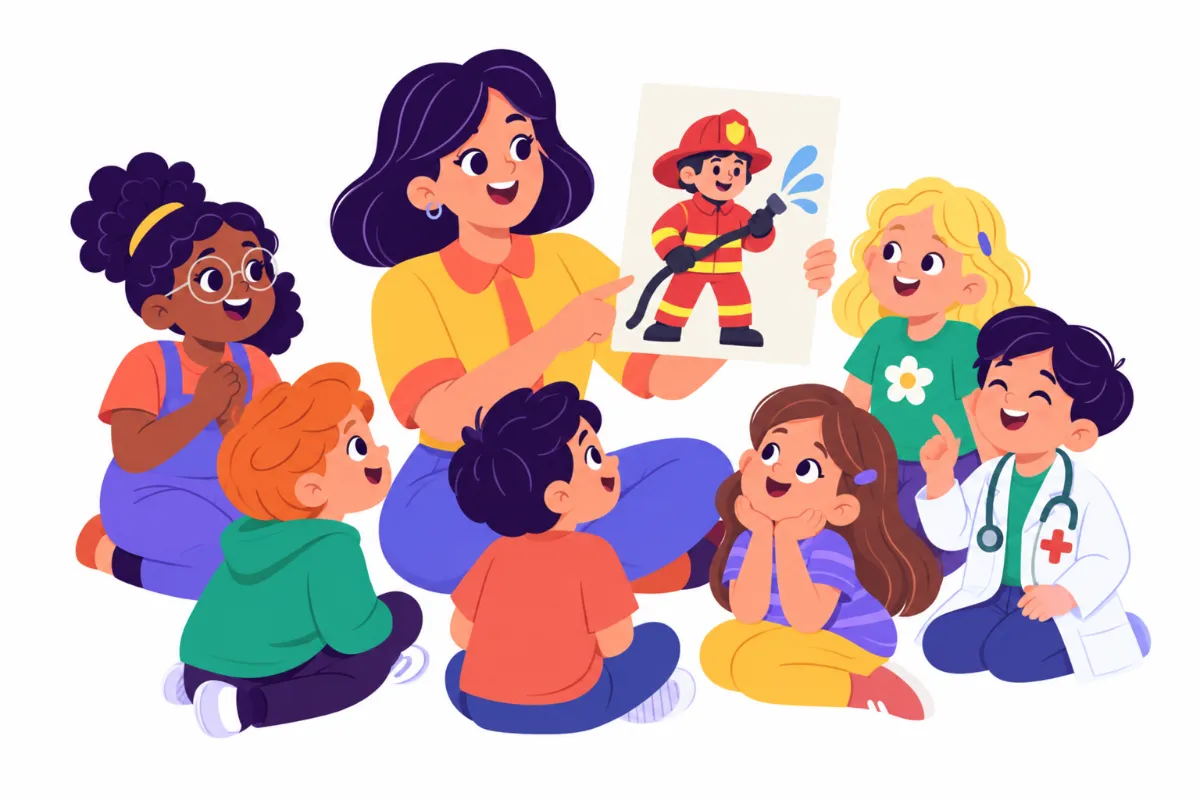

Teaching kids about jobs often starts with a simple question that a five-year-old asks out of nowhere: “Why does the garbage truck come every Tuesday?” That question is a door. Behind it is a whole lesson about people, work, and the skills that keep a community running.
This guide gives you a five-step plan for a short community helpers unit at school or at home. By the end, you will be able to introduce the idea of a job, present helpers in small groups, connect each job to a skill, bring jobs to life through play, and check what children learned.
Examples are fictional. Adapt to the children’s ages, needs, and interests.
At a glance
- Start with the big idea: a job is work people do to help others and earn a living.
- Introduce two helpers a day, not ten at once.
- Connect every job to one skill children can practice themselves.
- Use pretend play, books, and real visitors to make jobs concrete.
- Check learning with simple talk and drawing, not tests.
1. Start teaching kids about jobs with “What is a job?”
First, give children the big idea before the details. Young learners need a simple definition they can repeat. For example: “A job is work a person does to help others. People usually get paid for their job.”
Next, connect the idea to the children’s own lives. Ask who they see working each day: the bus driver, the lunch staff, the crossing guard, the librarian. Then, ask what would happen if that person did not come to work. This question helps children see that every job matters to someone.
Moreover, keep the language simple and concrete. Words like “help,” “work,” “tools,” and “skill” will come up all week, so introduce them with pictures and gestures on the first day. When teaching kids about jobs, a small, shared vocabulary makes every later lesson easier.
Also, talk about jobs at home. Families do a lot of unpaid work, such as cooking, cleaning, and caring for younger siblings. Mentioning this shows that helping is valued in many places, not only in paid jobs.
Worked example. Ms. Patel is a fictional kindergarten teacher. On Monday morning, she shows a photo of the school cafeteria and asks, “Who works here?” Nora, age 5, says, “The lunch lady gives us food.” Ms. Patel writes Nora’s words on chart paper under the heading “People who help us.” By the end of circle time, the chart has six helpers from around the school.
In short, teaching kids about jobs works best when it starts close to home. Children understand helpers they already know before they learn about new ones.
2. Introduce community helpers in small groups
Teaching kids about jobs is a little like building a puzzle. Each helper is one piece, and children need time to look at every piece before the whole picture makes sense.
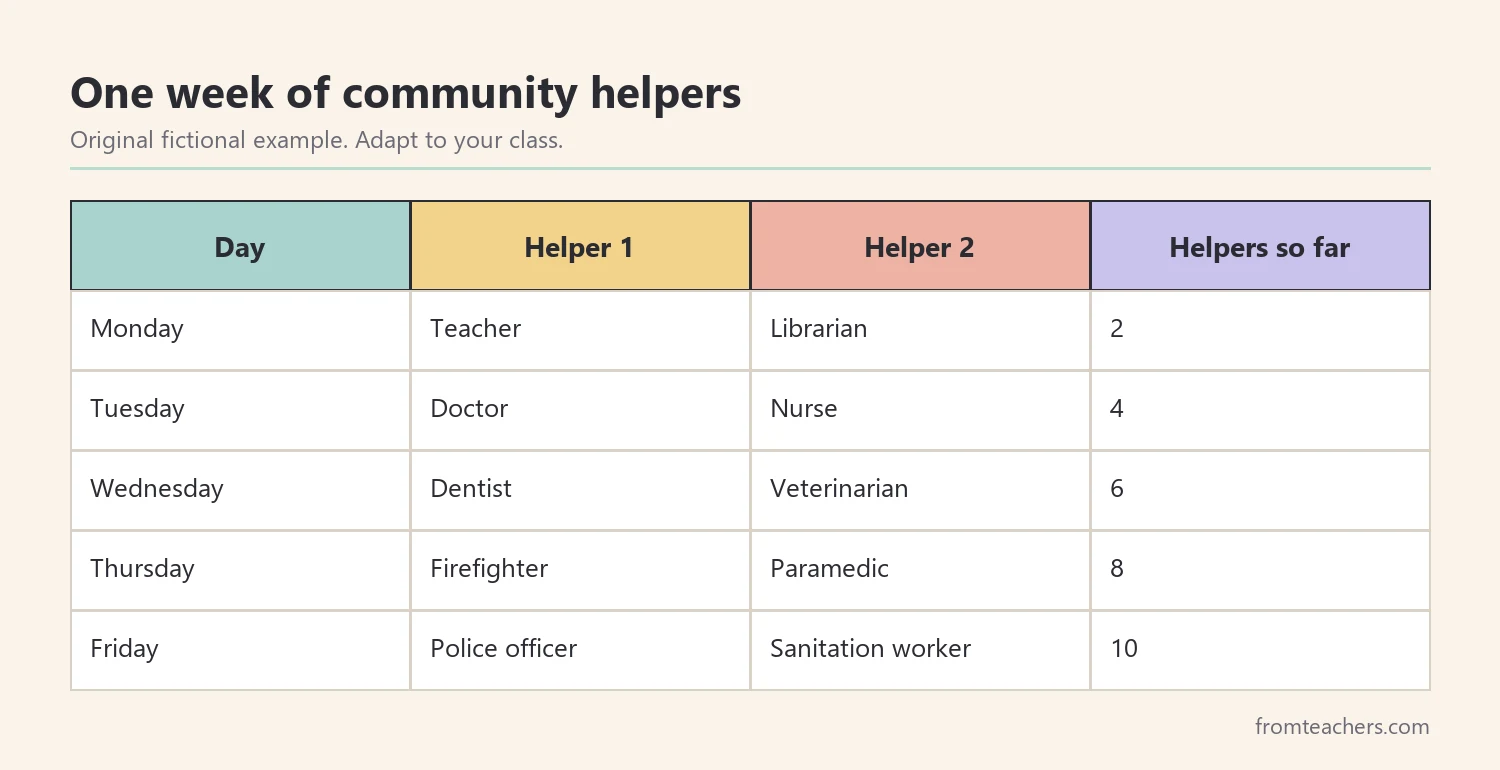
Once the big idea is clear, introduce helpers a few at a time. Ten new jobs in one lesson is too much for most young children. Instead, plan two helpers a day across one school week, so children have time to talk, play, and remember.
Choose a mix of familiar and less familiar jobs. Familiar helpers, such as teachers and doctors, build confidence. Less familiar ones, such as sanitation workers or veterinarians, stretch vocabulary and spark questions. Furthermore, pair jobs that share a theme, such as two jobs that keep people healthy.
When teaching kids about jobs in small groups, also leave a few minutes for questions. Young children often ask surprising things, such as whether doctors get sick or where firefighters sleep. These questions show real thinking, so write them down and come back to them.
For each helper, use the same short pattern so children know what to expect. Show a clear picture, name the job, ask what the person does, and let children act it out. A predictable pattern frees up attention for the new content.
A ready-made slideshow can save a lot of planning here. The Jobs Around Us community helpers slideshow introduces many helpers with simple, kid-friendly explanations and a skill callout for each job.
Worked example. Ms. Patel plans her week: teacher and librarian on Monday, doctor and nurse on Tuesday, dentist and veterinarian on Wednesday, firefighter and paramedic on Thursday, and police officer and sanitation worker on Friday. That is 2 helpers a day for 5 days, or 10 helpers in all. On Tuesday, Nora brings in a toy stethoscope from home to show the class.
3. Teaching kids about jobs through real skills
Next, go beyond “what they do” to “what they need to be good at.” This is where teaching kids about jobs becomes social and emotional learning too. Every job depends on skills, and many of those skills are ones children can practice right now.
For each helper, choose one main skill and explain it in plain words. Then, ask children when they use that skill themselves. For example, a librarian needs to be organized, and children practice organizing when they put blocks back on the right shelf.
| Job | What they do | One key skill |
|---|---|---|
| Teacher | Helps children learn | Patience |
| Nurse | Cares for sick people | Caring |
| Firefighter | Puts out fires and rescues people | Being strong |
| Librarian | Helps people find books | Organizing |
| Sanitation worker | Collects trash to keep streets clean | Teamwork |
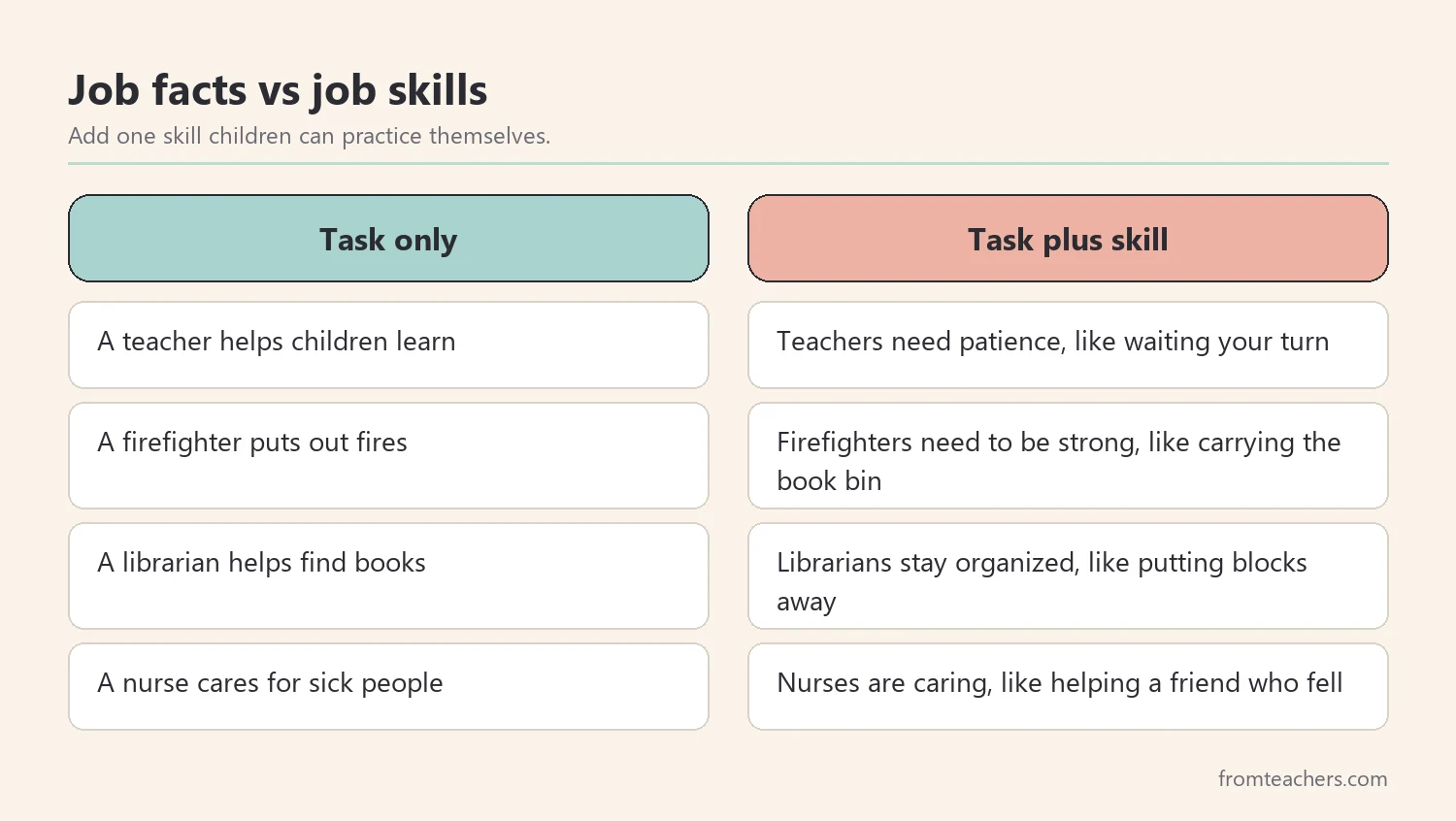
In addition, praise the skill when you see it in class. “You were so patient waiting for your turn, just like a teacher” links the lesson to real behavior. Over time, children begin to see themselves as people who already have useful skills.
Worked example. After the firefighter lesson, Ms. Patel asks, “When do you need to be strong?” Nora says, “When I carry the big book bin.” Ms. Patel adds a small “Being strong” picture to the class job chart next to the bin carrier job. The next day, three children ask for that job.
4. Bring jobs to life with play, books, and visitors
Children learn best when they can see, touch, and act. So, after each lesson, give children a way to experience the job. Teaching kids about jobs through pretend play helps them practice new words and try on new roles.
Pretend play also gives quieter children a way in. A child who will not speak in circle time may happily play the librarian and stamp books for ten minutes. In this way, teaching kids about jobs supports language and confidence at the same time.
Set up a simple dramatic play area that changes through the week. On health days, it can be a doctor’s office with a clipboard, bandages, and a toy stethoscope. On library day, it can be a check-out desk with a few books and a date stamp. In addition, choose a picture book for each helper and read it during story time.
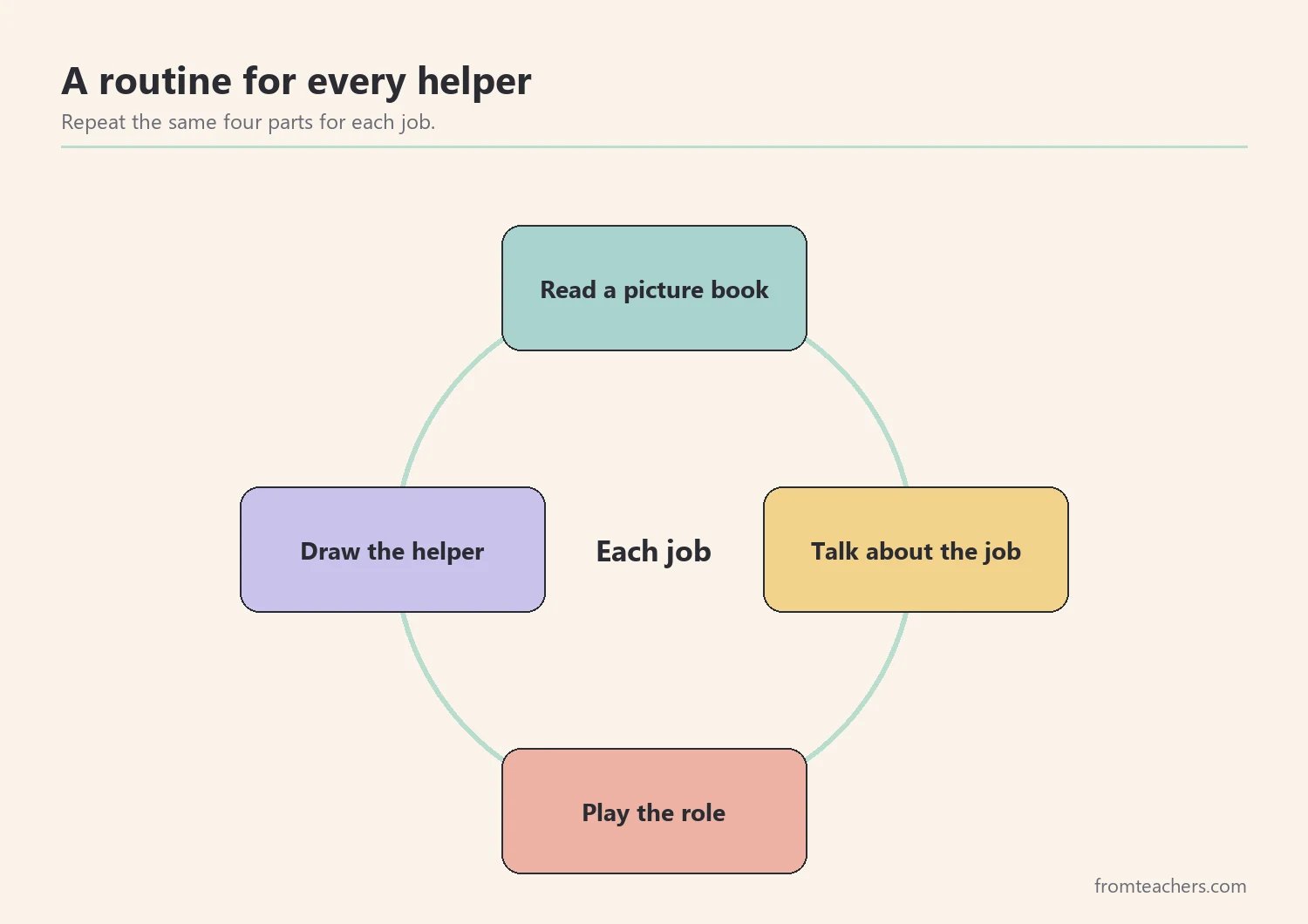
Visitors make the biggest impression. Invite a family member, a school staff member, or a local helper to talk for ten minutes. Ask them to bring one tool they use and to share one skill their job needs. Before the visit, help children prepare two or three questions, such as “What is the hardest part of your job?”
Also, include a wide range of people in your pictures, books, and visitors. Children should see that any job can be done by people of different backgrounds and genders.
Worked example. On Thursday, a parent who works as a paramedic visits Ms. Patel’s class. She shows a blood pressure cuff and explains that her job needs calm and quick thinking. Nora asks, “Do you drive fast?” The paramedic explains that ambulances drive carefully even when they hurry. That afternoon, the play corner becomes an ambulance made from chairs.
5. Review what teaching kids about jobs achieved
Finally, check understanding in ways that fit young children. Tests are not needed. Instead, use talk, drawing, and simple matching games to see what children remember about each helper and skill.
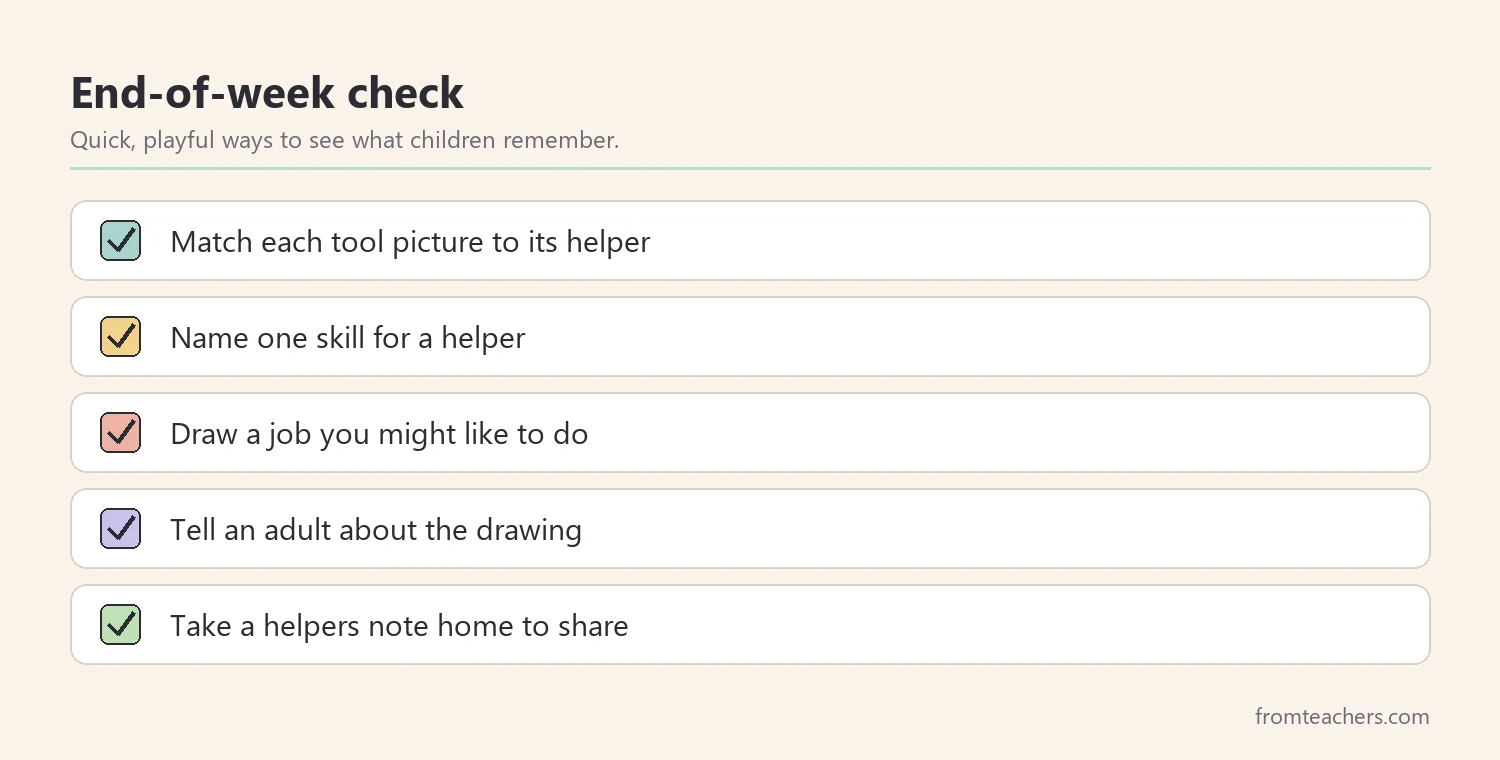
One easy check is a picture match. Show a tool, such as a fire hose or a library card, and ask which helper uses it. Another is a drawing prompt: “Draw a job you might like to do and the skill it needs.” Then, ask each child to tell you about the drawing while you write their words.
Notice which jobs children talk about most in the following weeks. Their play and questions will show you what stuck, and they may point to the next helpers worth adding when you return to teaching kids about jobs later in the year.
In addition, share the learning with families. A short note listing the week’s helpers and skills invites families to talk about their own jobs at home. Some families may even offer to visit next time.
Above all, keep the tone positive and open. The goal of teaching kids about jobs at this age is not to choose a career. It is to build vocabulary, respect for workers, and an early sense that skills grow with practice.
Worked example. On Friday, Ms. Patel holds up ten tool pictures, one for each helper from the week. Nora matches eight of the ten correctly. Her drawing shows a veterinarian holding a cat, and she dictates, “I want to be a vet because I am caring with my dog.” Ms. Patel adds the drawing to a class book called “Jobs We Might Do.”
Common mistakes and how to avoid them
- Too many jobs at once. When teaching kids about jobs, a long list overwhelms young children, and they forget most of them. Fix: two helpers a day with plenty of play and talk.
- Only naming tasks. Children learn facts but miss the bigger idea. Fix: connect each job to one skill children can practice.
- Stereotyped pictures. Children may think some jobs are only for certain people. Fix: choose varied pictures, books, and visitors.
- Ranking jobs. Talking about “important” and “less important” jobs teaches the wrong message. Fix: show how every helper makes the community work.
- Skipping review. You cannot tell what stuck. Fix: end the week with a picture match and a drawing.
Questions teachers and parents ask about teaching kids about jobs
What age is right for teaching kids about jobs?
Preschool through early elementary is a natural fit, because community helpers are a common social studies topic at these ages. Younger children focus on names and tools. Older children can talk about skills, training, and how jobs connect.
How long should a unit on teaching kids about jobs last?
One to two weeks works well for most classes. A one-week plan with two helpers a day covers ten jobs. You can extend it if children are still curious.
How can parents teach kids about jobs at home?
Talk about the helpers you meet during errands, such as a pharmacist or a mail carrier. Share what your own work involves in simple words. In addition, let children help with real tasks at home and name the skill they are using.
What if a child’s family member has no job right now?
Keep the conversation broad and kind. Talk about all kinds of helping work, including caring for family at home. Avoid asking children to report on parents’ jobs in front of the class.
Should teaching kids about jobs include money?
A short mention is enough for young children: people usually get paid for their work and use the money to buy what they need. Deeper money lessons can come later. For now, focus on helping and skills.
Related reading: Building Workplace Readiness: Essential Skills for Career Success, School Counseling Strategies: Empowering Students to Dream Big, and 5 Practical Teaching Tips to Boost Classroom Focus and Learning.
A companion resource for teaching kids about jobs:
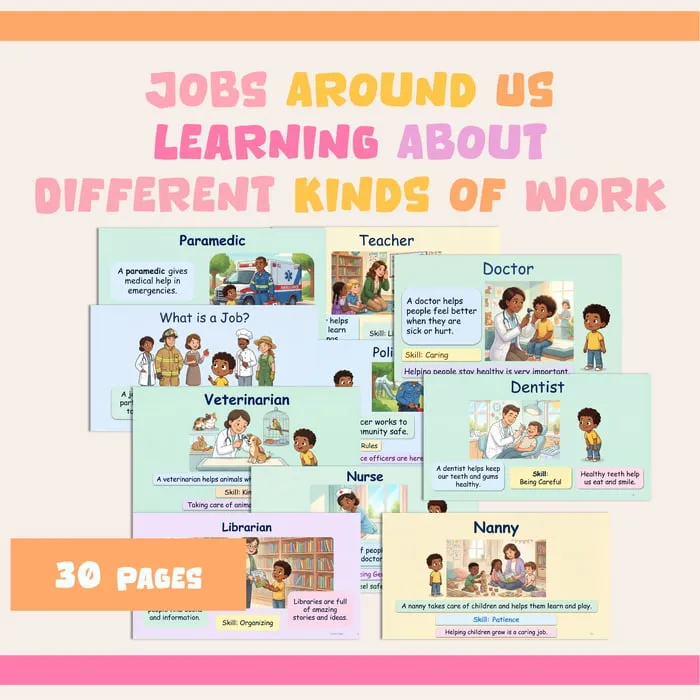
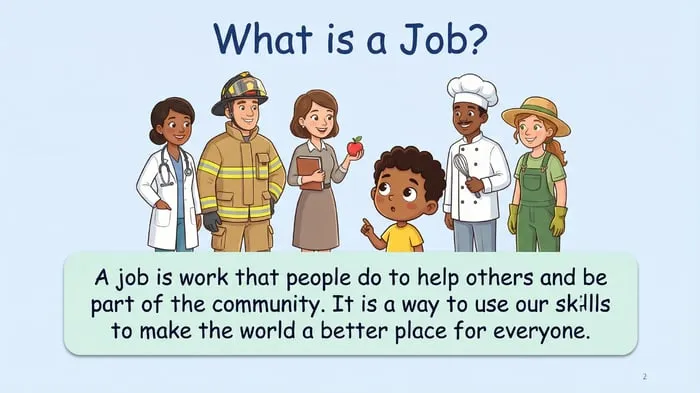
Jobs Around Us: Learning About Different Kinds of Work: a 30-slide illustrated slideshow that introduces “What Is a Job?” and many community helpers, with a kid-friendly explanation and a skill callout for each job.
Sources and scope
- National Association for the Education of Young Children (NAEYC): guidance on play-based, developmentally appropriate early learning.
- National Council for the Social Studies: resources on social studies teaching, including community and civic learning.
- Occupational Outlook Handbook, U.S. Bureau of Labor Statistics: plain descriptions of what workers in many jobs do, useful for teacher background.
- Reading Rockets: ideas for read-alouds and building vocabulary with young children.
This guide covers simple ways to introduce jobs and community helpers to young children at school or at home. It does not cover formal career assessment or career counseling for older students.
Key takeaways
- Start teaching kids about jobs with a simple definition and helpers children already know.
- Introduce two helpers a day so children have time to play and remember.
- Connect every job to one skill children can practice now.
- Use pretend play, books, and visitors to make jobs concrete.
- Review with picture matches and drawings, and share the learning with families.
Leave a Comment