

Teaching a handful of hominin species for students gives the human evolution story a clear shape instead of a confusing tangle of Latin names. Picture a grade 7 science class. Daniel looks at a poster with more than twenty species on a branching tree and asks, “So which one is our grandparent?” It is a great question, and it shows why a focused starting set helps.
This list presents six well-known species in the order they appear in the fossil record. By the end, you will know the key facts for each, a simple activity, how to explain the “bush, not ladder” idea, and how to check what students remember.
Classroom examples are fictional. Dates are approximate and based on museum sources such as the Smithsonian Human Origins Program. Scientific understanding changes as new fossils and methods appear, so encourage students to check current sources.
At a glance
- Start with six well-known species, not the whole family tree.
- Order them by first appearance in the fossil record.
- Teach the branching bush, not a straight ladder.
- Say about for dates and separate facts from open questions.
- Pair each species with one piece of evidence and one activity.
How we chose and ordered these species
We did not rank species by importance, because each tells part of the story. Instead, we chose six species that are widely taught, well represented by fossils, and useful for showing major changes: walking upright, toolmaking, larger brains, migration, and culture. Then we ordered them by when they first appear in the fossil record, from oldest to youngest.
Importantly, this order does not mean each species turned into the next. Human evolution is often described as a branching bush, with several species living at the same time. We return to that idea after the list.

The ready-made option: a complete scientific guide
If you want a full unit, the Human Evolution: The Complete Scientific Guide has 111 pages. It covers natural selection and the human family tree, the same six hominin species listed below, a global migration section on the Out of Africa journey, fossil dating methods, ancient DNA, and what makes us human, including art, cave paintings, trade, and abstract thought.
It also includes classroom tools such as discussion questions, which makes it easy to build lessons around each species.
1. Australopithecus afarensis
When and where: about 3.85 to 2.95 million years ago, in East Africa.
Key facts: walked upright on two legs but still had features suited to climbing. Its brain was small, closer in size to a chimpanzee’s. The famous partial skeleton nicknamed “Lucy,” found in Ethiopia in 1974, belongs to this species.
Activity: compare photos of a chimpanzee pelvis, a human pelvis, and a reconstruction of Lucy’s. Ask students what the shape suggests about walking.
Example: Daniel’s group noticed that Lucy’s pelvis looked more like ours than a chimpanzee’s, which led to a lively discussion about walking upright.
2. Homo habilis
When and where: about 2.4 to 1.4 million years ago, in East and southern Africa.
Key facts: its name means “handy man,” because it was linked with early stone tools. Its brain was somewhat larger than that of Australopithecus.
Activity: look at images of simple stone flakes and choppers. Discuss what they might have been used for, such as cutting meat or plants.
Example: The class sorted pictures into “natural rock” and “shaped tool,” which was harder than they expected. Several “tools” turned out to be ordinary broken rocks, and students began to see why experts look for specific marks of shaping.
3. Homo erectus
When and where: from about 1.89 million years ago to roughly 110,000 years ago, in Africa and Asia.
Key facts: body proportions were similar to ours, with long legs suited to walking long distances. It is widely described as among the first hominins to spread beyond Africa, and it survived for a very long time.
Activity: trace its range on a world map and compare it with the range of Australopithecus afarensis.
Example: Daniel was surprised that one species lasted well over a million years. “That’s way longer than we have been around,” he noted.
4. Homo heidelbergensis
When and where: about 700,000 to 200,000 years ago, in Africa and Europe, and possibly Asia.
Key facts: it had a larger brain and a strong body. Some scientists consider it a possible common ancestor of Neanderthals and modern humans, though this is still discussed.
Activity: use it to teach the phrase “scientists think” and discuss why some questions remain open.
Example: The class wrote two columns: “What we know” and “What scientists are still debating.” Heidelbergensis appeared in both.
5. Homo neanderthalensis
When and where: about 400,000 to 40,000 years ago, in Europe and southwestern and central Asia.
Key facts: Neanderthals were well adapted to cold climates, made sophisticated tools, used fire, and buried some of their dead. Studies of ancient DNA show that they interbred with Homo sapiens, and many people living today carry a small amount of Neanderthal DNA.
Activity: challenge the “caveman” stereotype. Compare old drawings of Neanderthals with modern museum reconstructions.
Example: Daniel said the modern reconstruction “looks like someone you might see at the store,” which opened a discussion about bias in old science.
6. Homo sapiens
When and where: from about 300,000 years ago to today, first in Africa, later worldwide.
Key facts: our species. Early fossils come from Africa, and over time Homo sapiens spread across the world. Art, symbols, long-distance trade, and complex culture are well documented in our species’ history.
Activity: look at images of ancient cave art and discuss what it tells us about how people thought and communicated.
Example: Students designed their own “cave art” message for future archaeologists and explained the symbols.
A bush, not a ladder
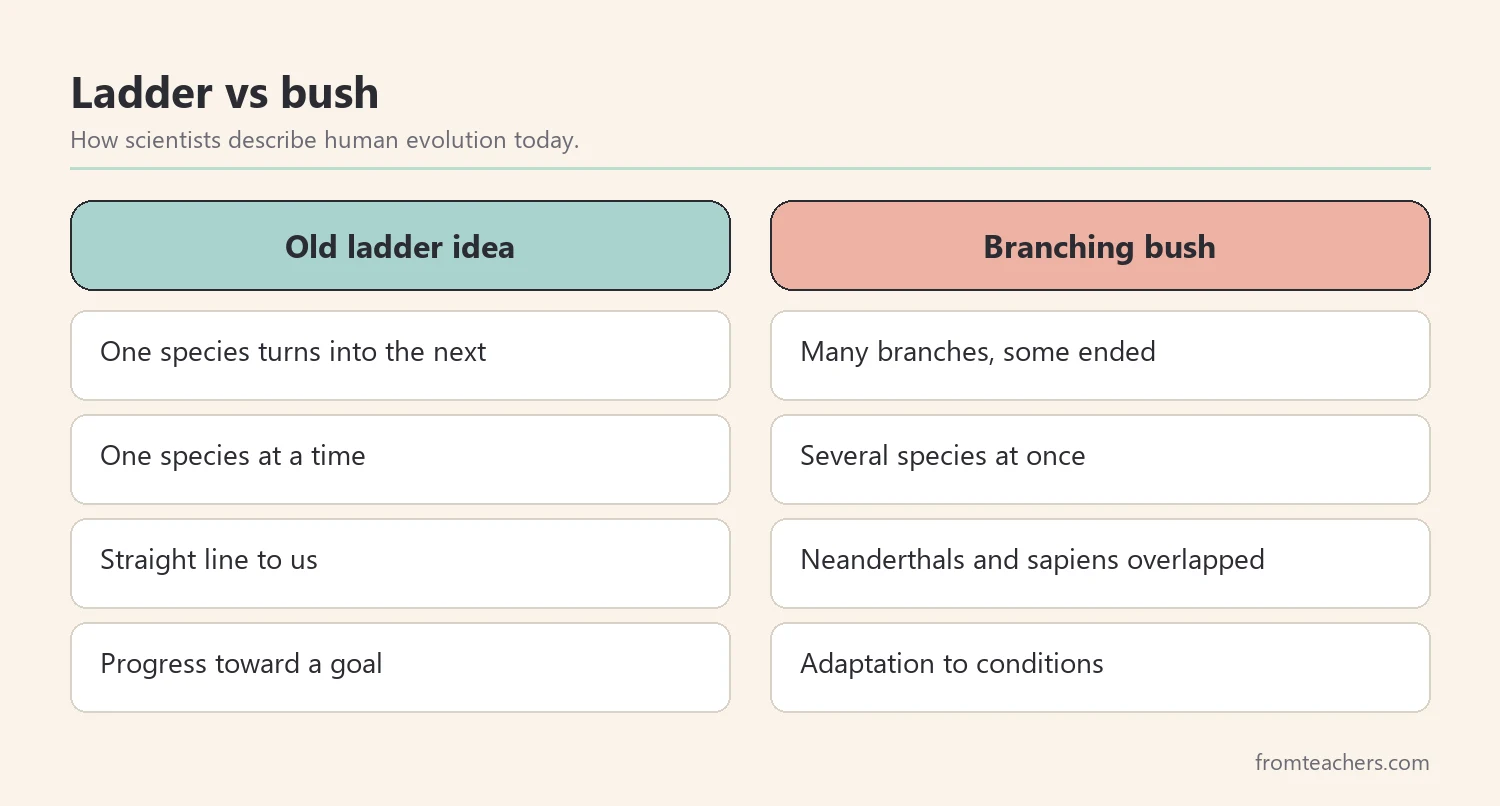
The old “march of progress” image shows one species turning neatly into the next. Scientists now describe human evolution more like a branching bush. Several hominin species lived at the same time, and many branches ended without descendants.
For example, Neanderthals and Homo sapiens lived at the same time for many thousands of years. Showing overlapping time bars helps students see this.
A simple classroom activity makes the point memorable. Give each group a colored strip of paper cut to the length of one species’ time range, using the same scale for all. When groups place their strips on the wall, students can see at a glance which species overlapped and which did not. Daniel’s class discovered that Homo erectus overlapped with several later species, which surprised almost everyone.
In addition, explain how scientists know. Fossils, dating methods, stone tools, and ancient DNA each provide evidence. When the evidence is limited, scientists say so, which is an important lesson in itself.
Teaching hominin species for students in a short unit
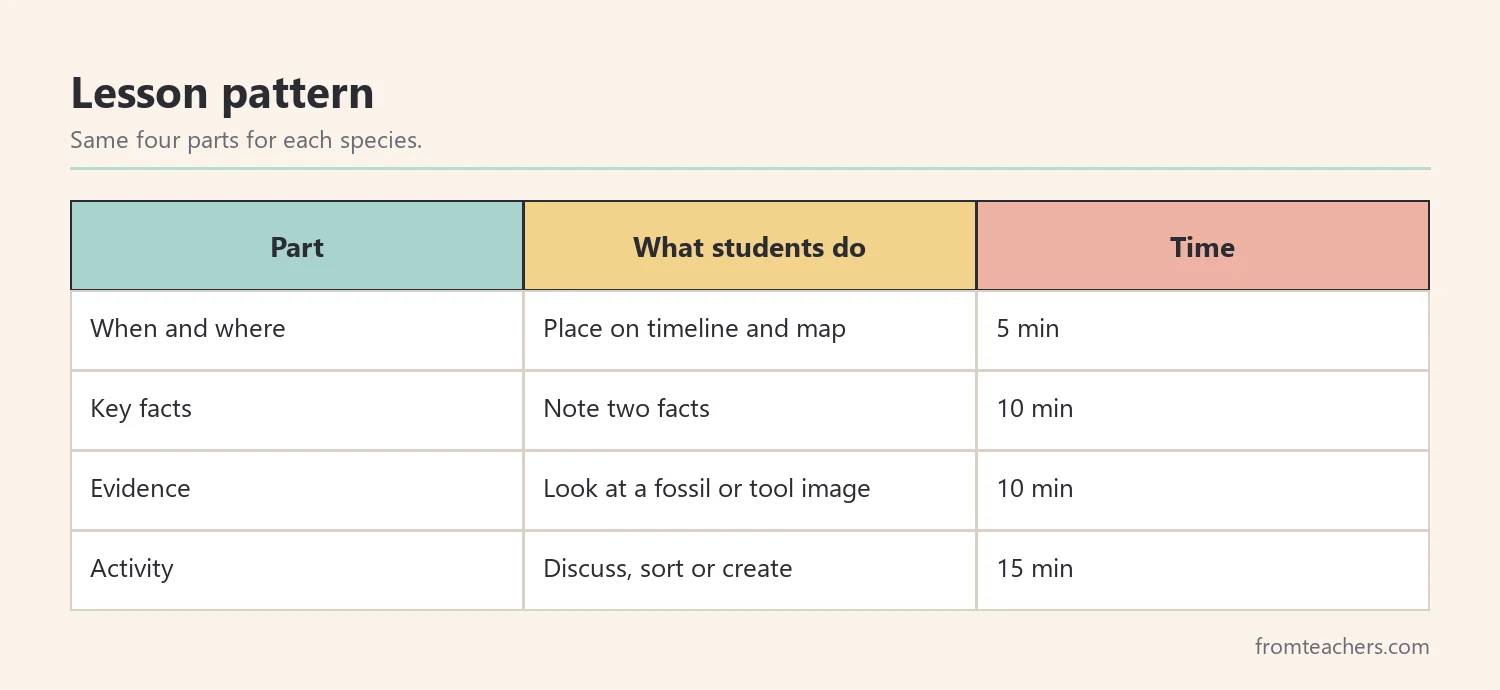
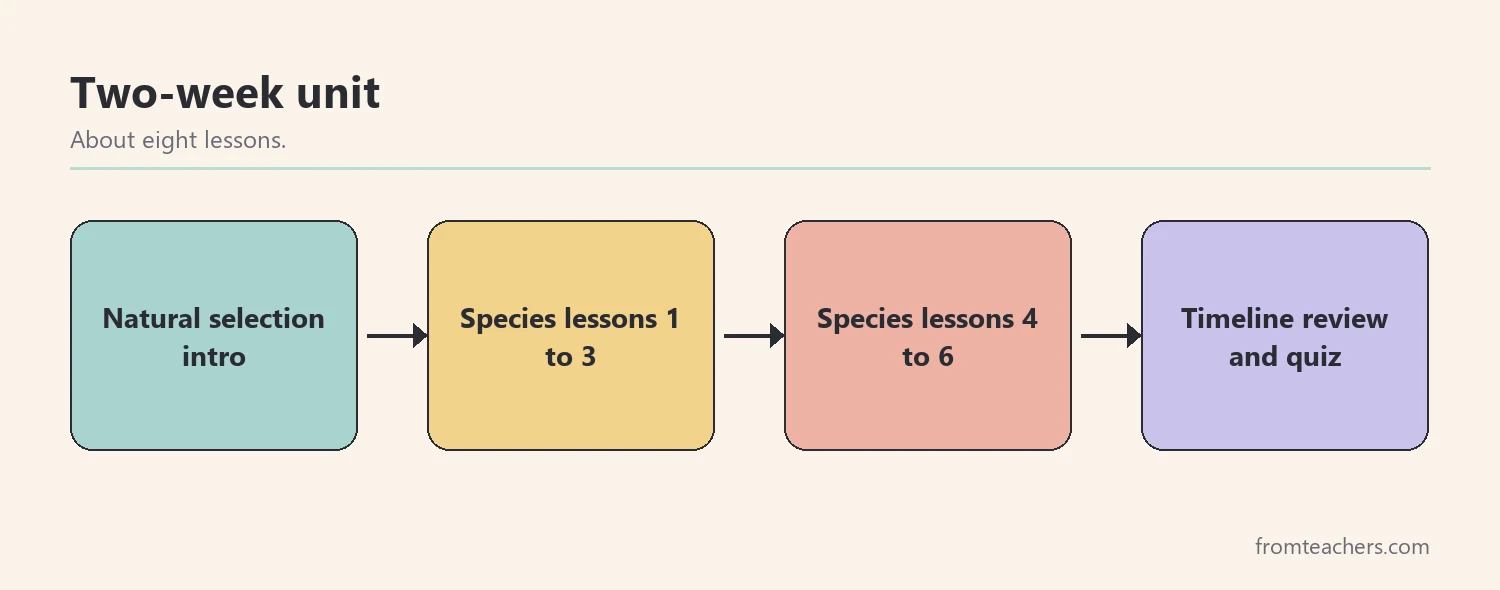
Six species fit nicely into a two-week mini unit: one species per lesson, plus an introduction to natural selection and a final review. Each lesson can follow the same pattern: when and where, key facts, one piece of evidence, and one activity.
Here is how Daniel’s class performed on short quizzes.
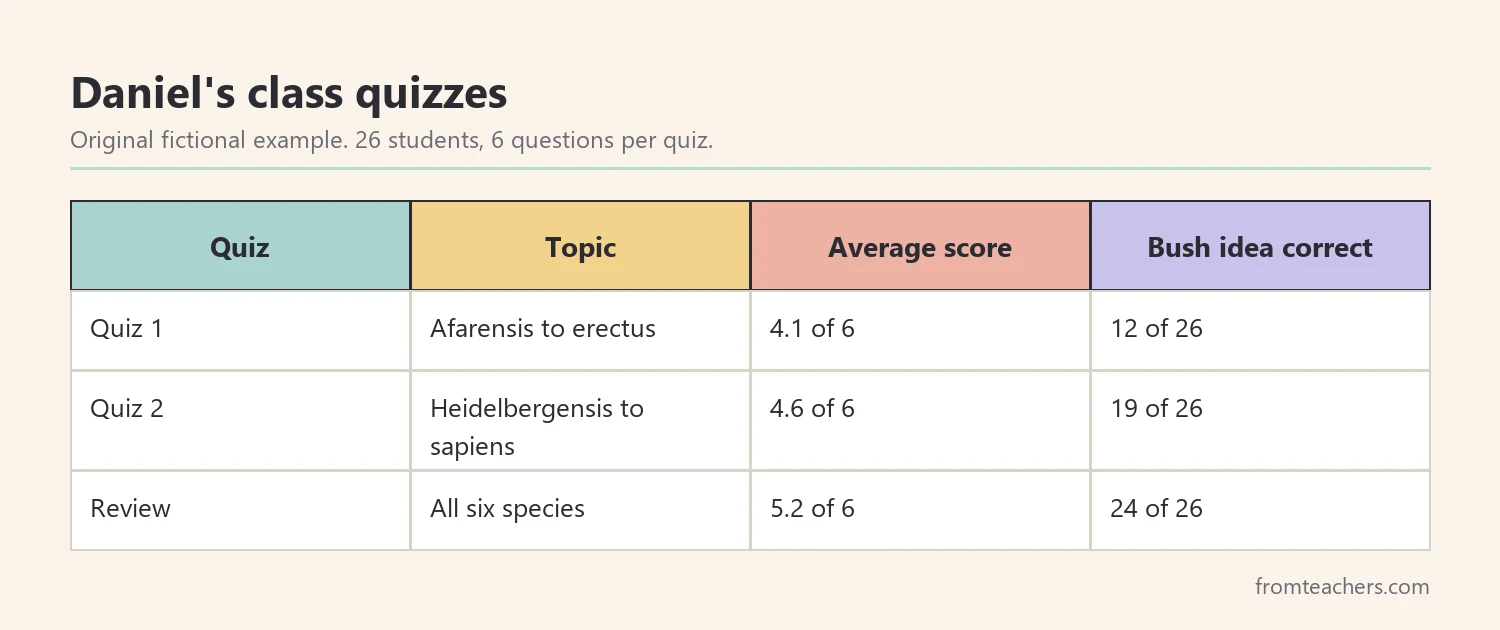
The class improved steadily, and the overlapping timeline was the turning point for understanding “bush, not ladder.” As a result, the teacher kept the timeline on the wall for the rest of the term.
Moreover, be sensitive to students’ backgrounds. Families hold different views, and the goal in science class is to understand the evidence and how scientists interpret it, while keeping the classroom respectful for everyone.
Supporting every learner in the unit
Human evolution includes long names, big numbers, and abstract ideas, so a few supports make the unit accessible to more students.
First, give each species a short “ID card” with the name, a pronunciation guide, approximate dates, region, and one picture. Students with reading difficulties can refer to the cards instead of searching through long texts. In addition, pre-teach key words such as fossil, bipedal, extinct, and ancestor with simple definitions and images.
Next, make time scales concrete. A long strip of paper or a hallway timeline, where one meter stands for a set number of years, helps students feel the difference between thousands and millions of years. Many students find this more meaningful than a list of numbers.
Also, offer different ways to show learning. Some students might write a short report, others could draw a labeled comparison, and others could record a short explanation. The goal is understanding the evidence, not only writing about it.
For students who are ready for more, suggest extension questions: How do scientists date a fossil? What can ancient DNA tell us that bones cannot? Why are some species known from only a few fossils? These questions lead naturally to the methods sections of museum websites.
Finally, close each lesson with a two-minute check. One quick question, such as “Which species is linked with early stone tools?”, shows who needs another look before the next lesson.
Common mistakes and how to avoid them
- Teaching a straight line of ancestors. Fix: use overlapping timelines and the bush image.
- Presenting dates as exact. Fix: say “about” and explain that dates are refined over time.
- Using “caveman” stereotypes. Fix: compare with modern museum reconstructions.
- Stating debates as facts. Fix: separate “we know” from “scientists are still discussing.”
- Too many species at once. Fix: start with six, then add more for curious students.
Questions teachers and parents ask about hominin species for students
What does “hominin” mean?
Hominin refers to modern humans and the extinct species more closely related to us than to chimpanzees and bonobos.
Did humans evolve from chimpanzees?
No. Humans and chimpanzees share a common ancestor that lived millions of years ago. Both lineages have changed since then.
Why are the dates so approximate?
Dates come from dating the rocks and sediments around fossils, and new finds can extend or shorten a species’ known range. Scientists update dates as evidence improves.
What age is this topic suitable for?
Middle school students usually handle six species well. Younger students can focus on Lucy, toolmaking, and the idea of fossils as clues.
Where can students explore more?
The Smithsonian Human Origins Program and natural history museums offer online resources, images of fossils, and interactive timelines.
Related reading: Homeschooling vs. Public Schooling, Learning Styles Student Success Guide, and 5 Practical Teaching Tips to Boost Classroom Focus and Learning.
You may also need: Dinosaurs: The Complete Student Field Guide.
A companion resource for hominin species for students:
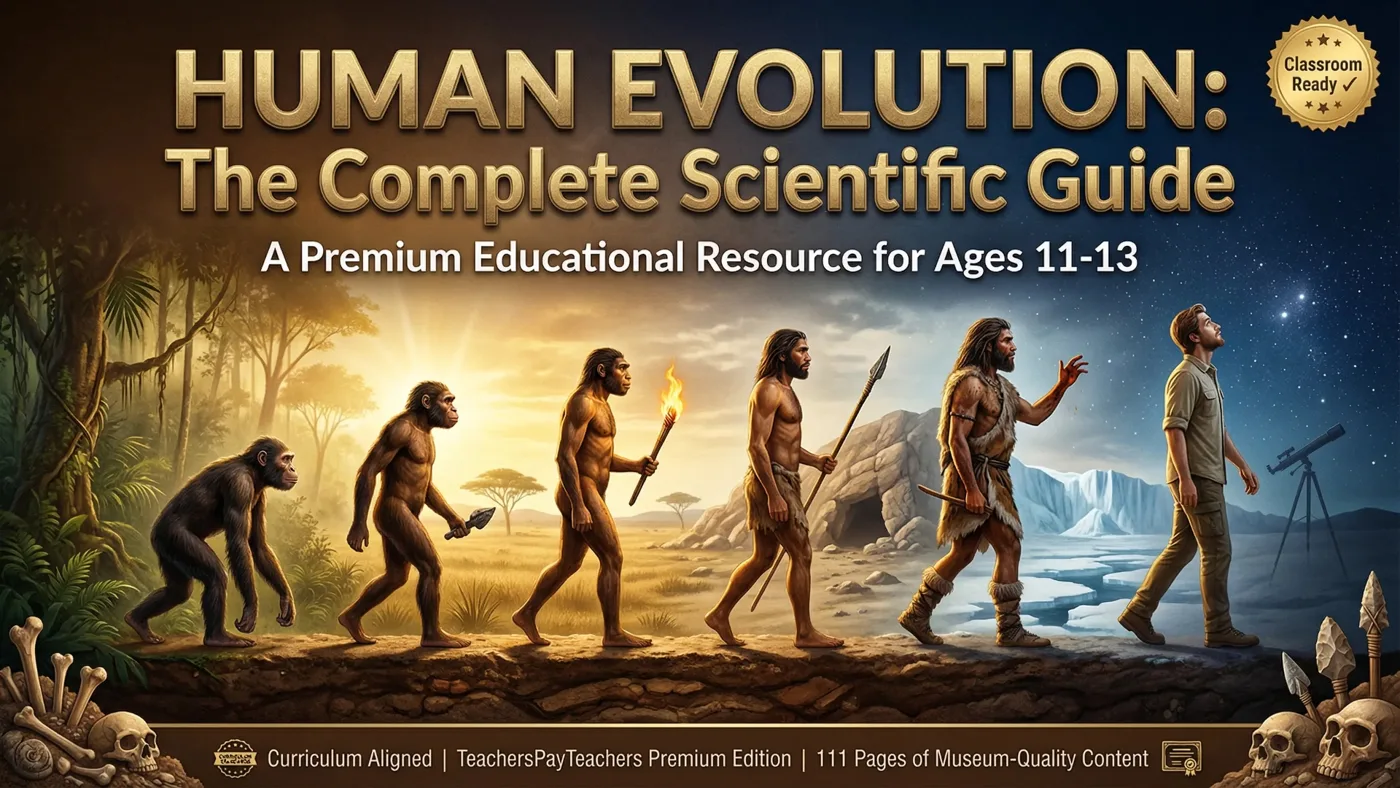
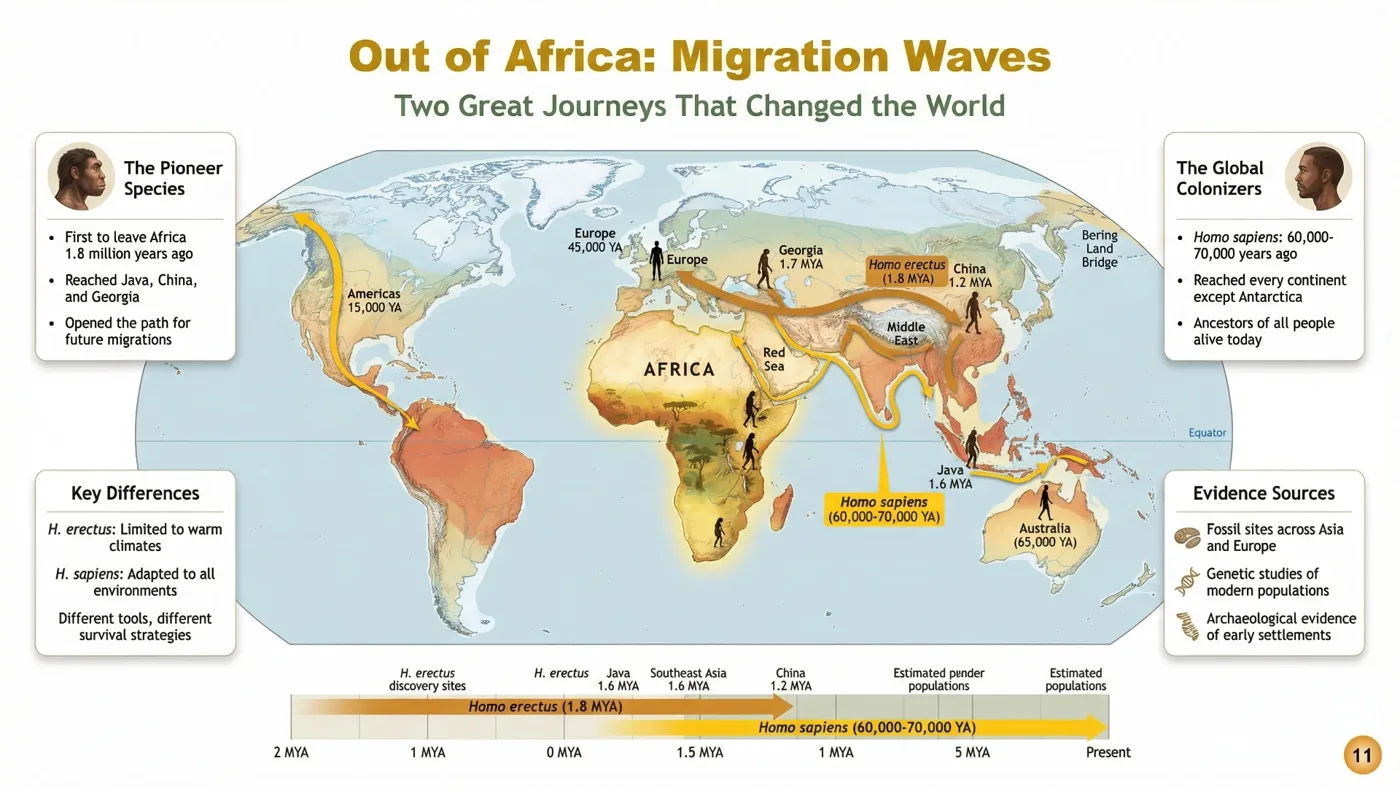
Human Evolution: The Complete Scientific Guide: 111 pages covering natural selection and the human family tree, six hominin species from Australopithecus afarensis to Homo sapiens, the Out of Africa migration, fossil dating and ancient DNA, what makes us human, and built-in classroom tools.
Sources and scope
- Smithsonian National Museum of Natural History: Human Origins Program: species profiles, fossil images and timelines for human evolution.
- Understanding Evolution, University of California Museum of Paleontology: teaching resources on evolution and natural selection.
- University of California Museum of Paleontology: educational material on fossils and the history of life.
- National Science Teaching Association: resources for science teachers.
This list introduces six hominin species for middle school learners using approximate, museum-based dates. It is not a complete account of human evolution, and details may change as new evidence is published.
Key takeaways
- Six well-known hominin species for students give the story a clear shape.
- Order them by first appearance, but teach the bush, not the ladder.
- Use “about” for dates and separate known facts from open questions.
- Pair each species with one piece of evidence and one activity.
- Keep the discussion evidence based and respectful.








Leave a Comment