

Good reflection prompts for students turn the last five minutes of the day into real learning instead of a rush for backpacks. Picture a grade 5 classroom at 2:55. Nia stares at a blank page that says “Reflect on your day,” writes “good,” and closes her notebook.
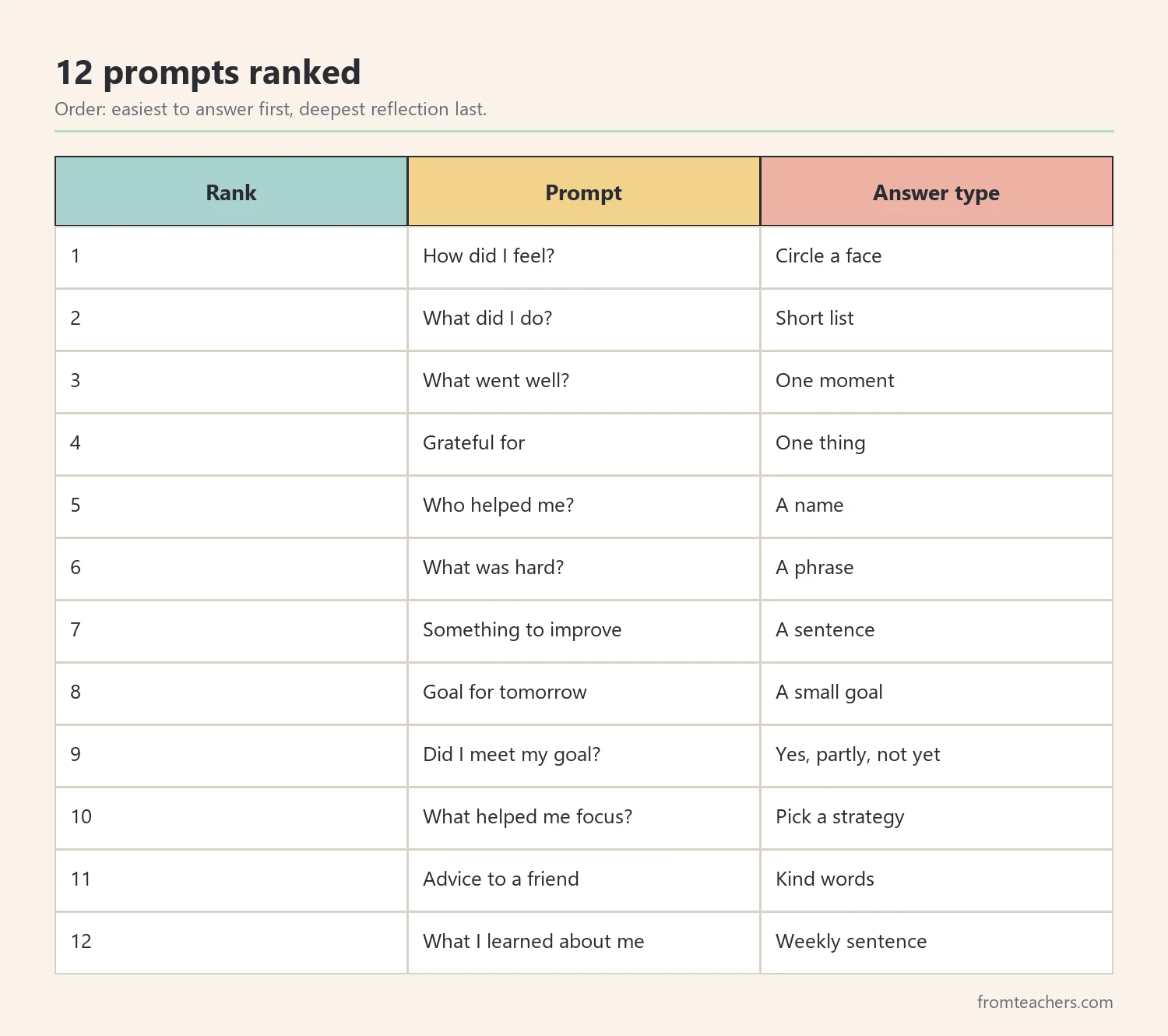
This list ranks twelve prompts from the easiest to answer to the deepest. By the end, you will know which prompts to use with reluctant writers, how to build a short daily routine, and how to read the answers for patterns without grading feelings.
Examples are fictional. Adapt to the student’s age, goals, and agreed supports. This is guidance, not a diagnosis or counseling.
At a glance
- Start with prompts that need only a check or one word.
- Move toward goals and self-evaluation as reflection grows.
- Use three or four prompts in a five-minute daily routine.
- Respond to journals with short comments, never grades.
- Track goals met over time to see patterns.
How we ranked these prompts
No study ranks reflection prompts, so we used a clear, practical rule instead. Prompts that need only a check, a word, or a short phrase come first. Prompts that ask students to plan, evaluate, or explain come later. Therefore, the list doubles as a progression: start at the top with younger or reluctant students, then move down as reflection becomes a habit.
In addition, we grouped prompts by purpose: noticing feelings, naming wins, planning ahead, and noticing others. A balanced routine usually uses one prompt from each group.
The ready-made option: a one-page daily reflection journal
If you want a consistent page instead of inventing prompts each day, the daily reflection journal for students with SEL check-in and goal setting puts several of the prompts below on one sheet. It includes What I Did Today, a three-face feeling scale, What Went Well, Something I Can Improve, My Goal for Tomorrow with a Did I Meet My Goal from Yesterday check, Who Helped Me Today, a gratitude prompt, and space for teacher comments.
Because the layout stays the same, students learn it quickly, and you can compare pages over time.
1. How did I feel today? (circle a face)
Why it works: it needs no writing, so every student can answer. It also opens the door to talking about feelings.
How to use it: offer three faces, such as happy, okay, and sad. Older students can add one word.
Example: Nia circled the middle face and added “tired.” Her teacher made a quiet note to check in the next morning.
2. What did I do today?
Why it works: recalling the day is the first step of reflection, and it is concrete.
How to use it: ask for two or three things, in a list. For younger students, a picture counts.
Example: Nia wrote “fractions, library, recess soccer.” That short list gave her something to build on.
3. What went well today?
Why it works: it trains students to notice success, not only problems.
How to use it: ask for one specific moment. “My group finished the poster” is better than “everything.”
Example: Nia wrote, “I scored a goal at recess.” Her teacher replied with a short comment, which made her smile the next day.
4. What am I grateful for today?
Why it works: it shifts attention to positive parts of the day. Many SEL programs include gratitude practice as part of building self-awareness and relationships.
How to use it: keep it small and specific: a person, a moment, or an object.
Example: “My friend shared her markers.” Small and specific is the goal.
5. Who helped me today?
Why it works: it helps students notice support around them, which builds connection.
How to use it: accept any helper, including classmates, staff, or family. Encourage students to thank that person the next day.
Example: Nia wrote, “Mr. Ortiz explained fractions again.” The next morning, she told him thank you.
6. What was hard today?
Why it works: it gives students permission to name struggles without judgment.
How to use it: make clear there is no wrong answer, and do not grade it. Respond with support, not correction.
Example: Nia wrote, “Fractions with different bottoms.” That told her teacher exactly where to reteach.
7. Something I can improve
Why it works: it moves from noticing to growth, in a low-pressure way.
How to use it: model your own answer sometimes. “I can improve how clearly I explain directions” shows that adults reflect too.
Example: Nia wrote, “Ask for help sooner.” That became the seed for her next goal.
8. My goal for tomorrow
Why it works: one small goal gives tomorrow a purpose. Goal setting is a common part of self-management skills.
How to use it: keep goals small and checkable, such as “raise my hand once in math.”
Example: Nia’s goal was “ask a question in math before I get stuck.”
9. Did I meet my goal from yesterday?
Why it works: it closes the loop. Without it, goals are forgotten.
How to use it: use yes, partly, or not yet. “Not yet” keeps the tone hopeful.
Example: Nia checked “partly” and wrote that she asked after getting stuck. Her teacher praised the honesty.
10. What helped me focus or calm down?
Why it works: students learn which strategies work for them, which supports self-regulation.
How to use it: provide a short list of strategies to choose from, such as breathing, a break, or music during work time.
Example: Nia noticed that working near the window was harder, while sitting near the board helped.
11. What would I tell a friend who had my day?
Why it works: self-talk is often harsher than how we speak to friends. This prompt invites kindness.
How to use it: use it after hard days, not every day.
Example: After a tough test, Nia wrote, “You studied, and you can try again.” It was the most encouraging thing she had written all month.
12. What did I learn about myself this week?
Why it works: it asks students to step back and notice patterns, the deepest level of reflection.
How to use it: use it on Fridays, after a week of daily entries.
Example: Nia wrote, “I do better when I ask early.” That one sentence summed up a month of practice.
Adapting prompts for different learners
Not every student reflects best with a pencil. Fortunately, each prompt above can be adapted without losing its purpose.
For students who find writing hard, offer sentence starters such as “Today I felt…” or “One thing that went well was…” In addition, allow drawings, picture choices, or a quick voice recording if your classroom uses devices.
For students who use AAC or picture supports, prepare a small board with feelings, places, and people from the school day. Then the student can point to “library,” “happy,” and “Mr. Ortiz” to answer three prompts in seconds.
For students who become anxious when asked about feelings, start with the concrete prompts, such as What did I do today, and let the feeling scale stay optional at first. Trust grows when reflection feels safe.
Finally, for older students who think journals are “babyish,” change the format, not the purpose. A sticky note exit ticket, a private digital form, or a two-line planner entry can hold the same prompts. Many middle school students respond well when they choose their own goal and track it privately.
Whatever the format, keep one rule: the student owns the reflection. Your role is to give a clear prompt, a little time, and a kind response.
Also, think about privacy. Some students will only write honestly if they know classmates will not read their page. Collect journals face down, store them in a folder, and tell students who reads them. That small promise often makes the answers more thoughtful.
Building a five-minute routine with reflection prompts for students
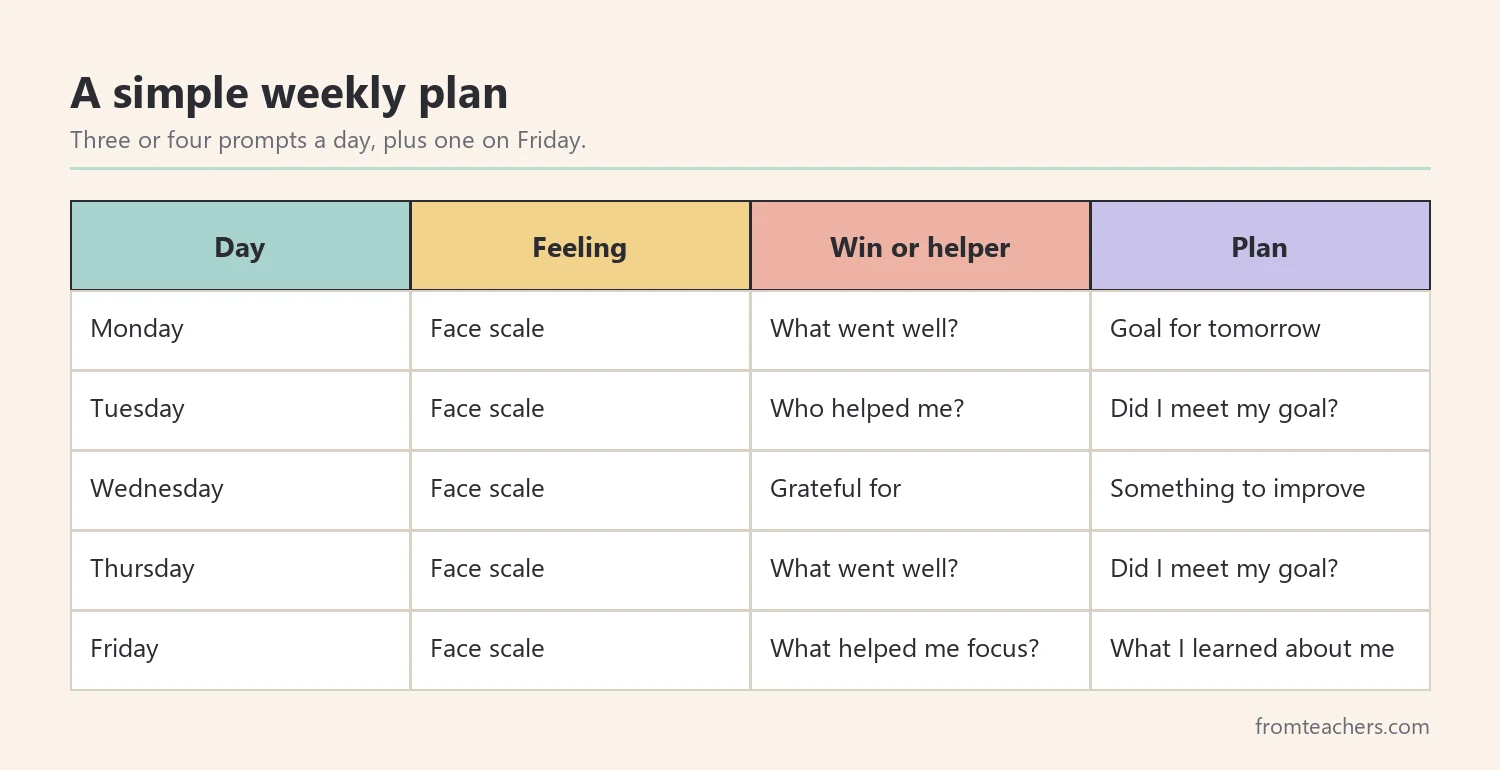
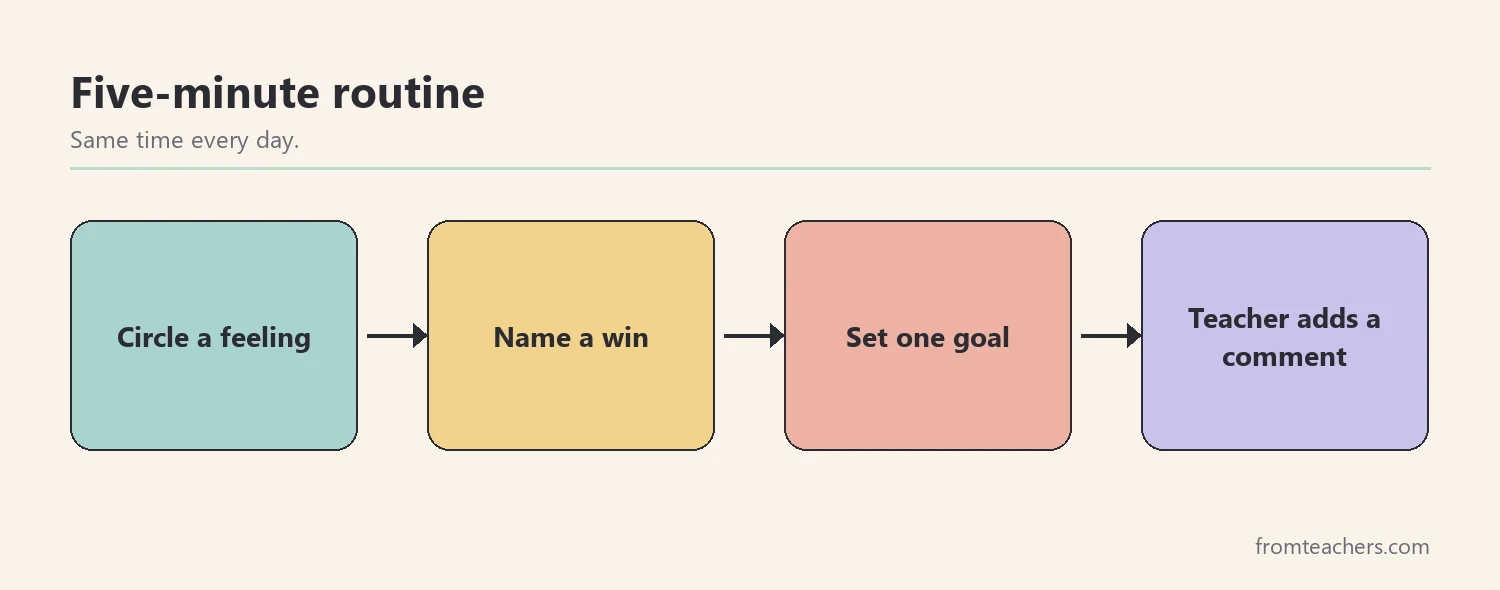
A routine matters more than any single prompt. Use the same time each day, such as the last five minutes before dismissal. Keep the page short, and choose three or four prompts at most. Then add one weekly prompt on Fridays.
Here is a simple weekly plan that combines prompts from each group.
Also, read a few journals each day rather than all of them at once. A one-line comment, such as “I noticed you asked for help today,” builds trust and shows students their words matter.
Over time, the answers form useful data. For example, Nia’s teacher tracked how often Nia met her daily goal and which feeling face she circled.
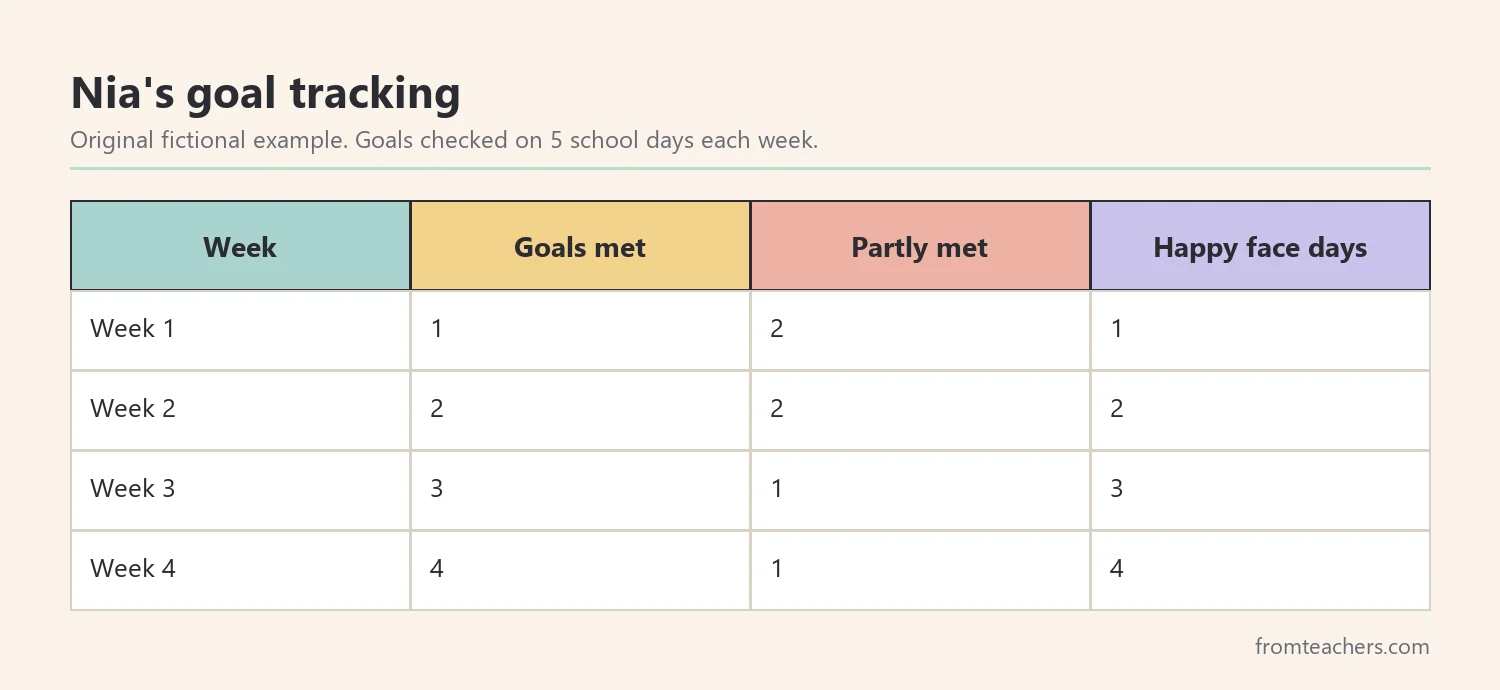
The pattern was gentle but clear. As Nia met more daily goals, she also chose the happy face more often. As a result, her teacher shared the progress with Nia’s family at conferences.
Common mistakes and how to avoid them
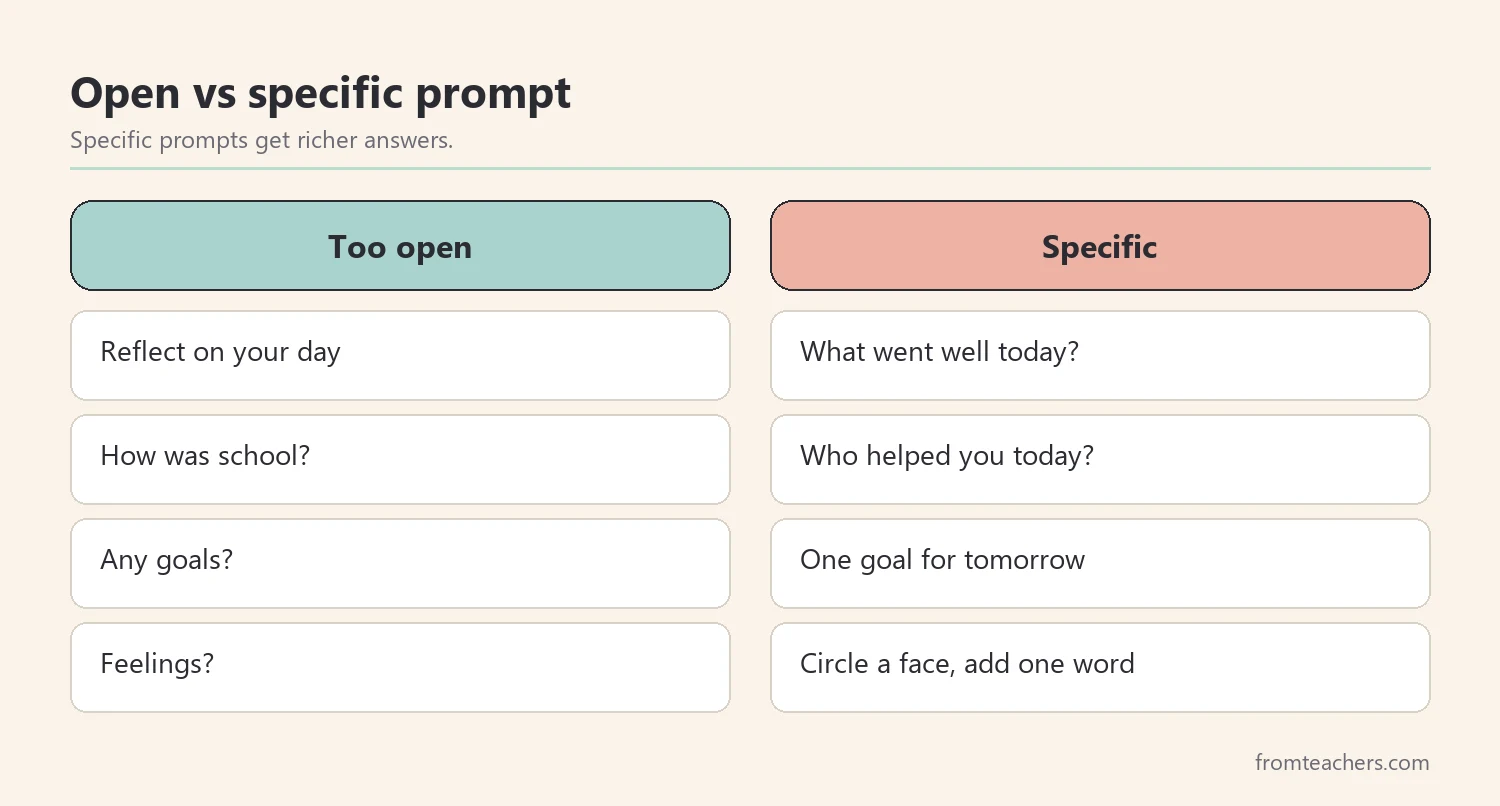
- Prompts that are too open. “Reflect on your day” often gets one word. Fix: ask a specific question.
- Grading reflections. Students stop being honest. Fix: respond, do not score.
- Too many prompts. Reflection becomes a chore. Fix: three or four prompts a day.
- Never responding. Students feel unheard. Fix: comment on a few journals daily.
- Ignoring worrying answers. Fix: follow your school’s procedures and involve the counselor when something concerns you.
Questions teachers and parents ask about reflection prompts for students
What age are these prompts for?
The first prompts suit early elementary students, especially with pictures. The later prompts fit upper elementary and middle school. Adjust wording and length to the student.
How long should reflection take?
Five minutes is often enough. A short, consistent routine usually works better than a long weekly session.
What if a student writes the same answer every day?
That is common at first. Model a few richer answers, rotate prompts, or ask a follow-up question in your comment.
Can students reflect without writing?
Yes. Students can circle faces, draw, use sentence starters, or share aloud with a partner. Choose the format that fits the student.
Can families use these prompts at home?
Absolutely. Dinner or bedtime is a natural time to ask “What went well today?” and “Who helped you?” Consistent questions at home and school help reflection become a habit.
Related reading: Building Stronger School Counseling Programs, Essential Trauma-Informed Teaching Strategies, and 5 Practical Teaching Tips to Boost Classroom Focus and Learning.
You may also need: Executive Functioning Sheet Student Task Planning and Self-Monitoring Tool.
A companion resource for reflection prompts for students:
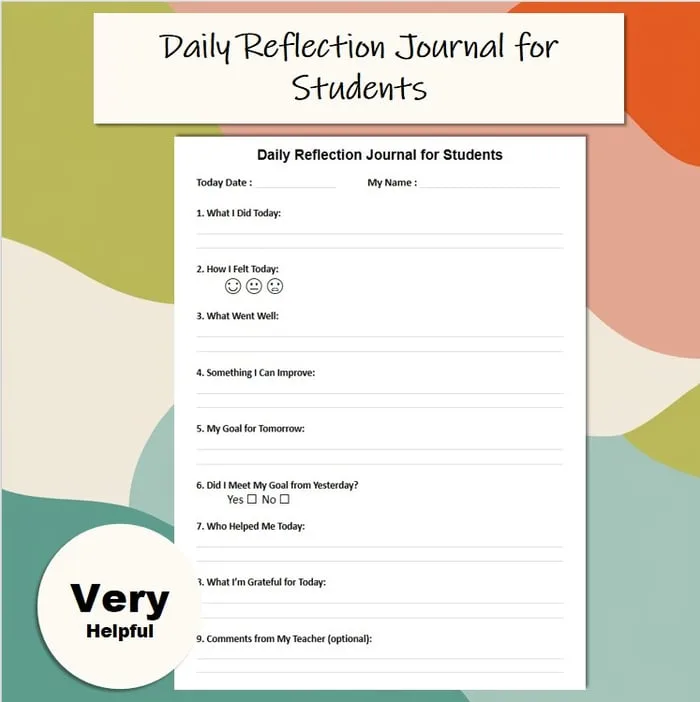
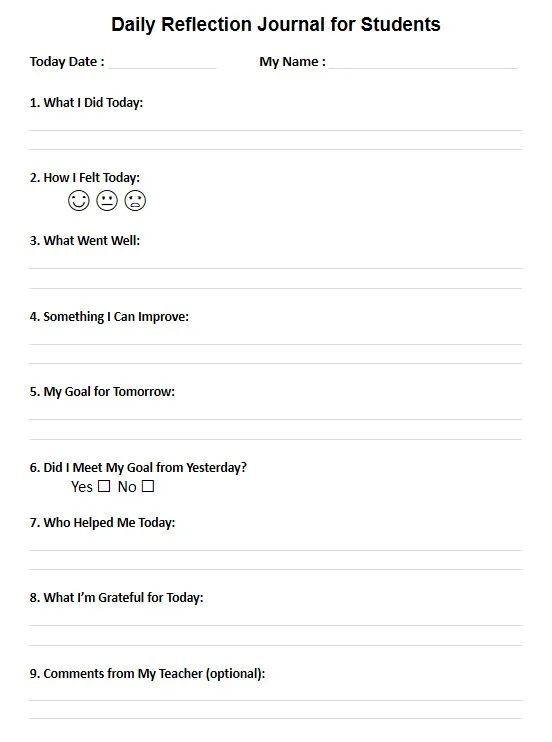
Daily Reflection Journal for Students SEL Check In and Goal Setting Sheet: a one-page journal with What I Did Today, a three-face feeling scale, What Went Well, Something I Can Improve, a goal for tomorrow with a check on yesterday’s goal, Who Helped Me, a gratitude prompt, and teacher comments.
Sources and scope
- CASEL: the Collaborative for Academic, Social, and Emotional Learning, with a widely used SEL framework including self-awareness and self-management.
- Understood.org: practical guidance for families and teachers on learning and thinking differences.
- IRIS Center, Vanderbilt University: free modules for educators, including classroom behavior and self-regulation topics.
- Center on PBIS: resources on positive, proactive classroom systems.
This list covers simple daily reflection prompts for classroom and home use. It does not replace counseling or mental health support; follow your school’s procedures if a student’s answer raises concern.
Key takeaways
- Start reflection prompts for students with easy answers, like a feeling face.
- Move toward planning and self-evaluation as reflection becomes a habit.
- Keep the routine to five minutes and three or four prompts.
- Respond to journals, do not grade them.
- Track goals met over time and share progress with families.










Leave a Comment