

Printable classroom posters can do much more than decorate a wall: when they are chosen, placed, and taught with care, they become visual reminders that students actually use. Picture a second grader who is starting to get upset during a group activity. She looks up, sees a calm down poster near her table, and points to a breathing step. Nobody had to say a word.
That moment does not happen by chance. This guide shows you how to make printable classroom posters work in five steps: choose posters by need, place them where the skill happens, teach each poster, prompt in the moment, and review your walls over time. By the end, you will be able to turn a set of posters into a simple, practical support system.
Examples are fictional. Adapt to the student’s goals and agreed supports. This is guidance, not a diagnosis.
At a glance
- Choose posters based on the skills your students need most right now.
- Place each poster where students use the skill, not only on a bulletin board.
- Teach every poster directly before you expect students to use it.
- Point to posters in the moment, then fade your prompts.
- Rotate posters, review what is working, and share them with families.
1. Choose printable classroom posters by need
First, start with your students, not with the posters. Printable classroom posters work best when each one supports a skill your class is learning right now. Ask yourself which moments are hardest in your room: calming down, starting work, joining a group, or following routines.
Next, sort possible posters into skill areas. Common areas include emotional regulation and coping, feelings and social-emotional learning, executive function and study skills, social skills and communication, and classroom expectations and routines. Thinking in areas helps you see where your walls are strong and where they are thin.
Also, choose fewer posters than you think. A wall covered with posters can become visual noise, especially for students who are easily distracted or overwhelmed. Start with a small set that matches your current goals and add more later.
In addition, involve students where you can. Ask the class which reminders would help them most. Students are more likely to use a poster they helped choose.
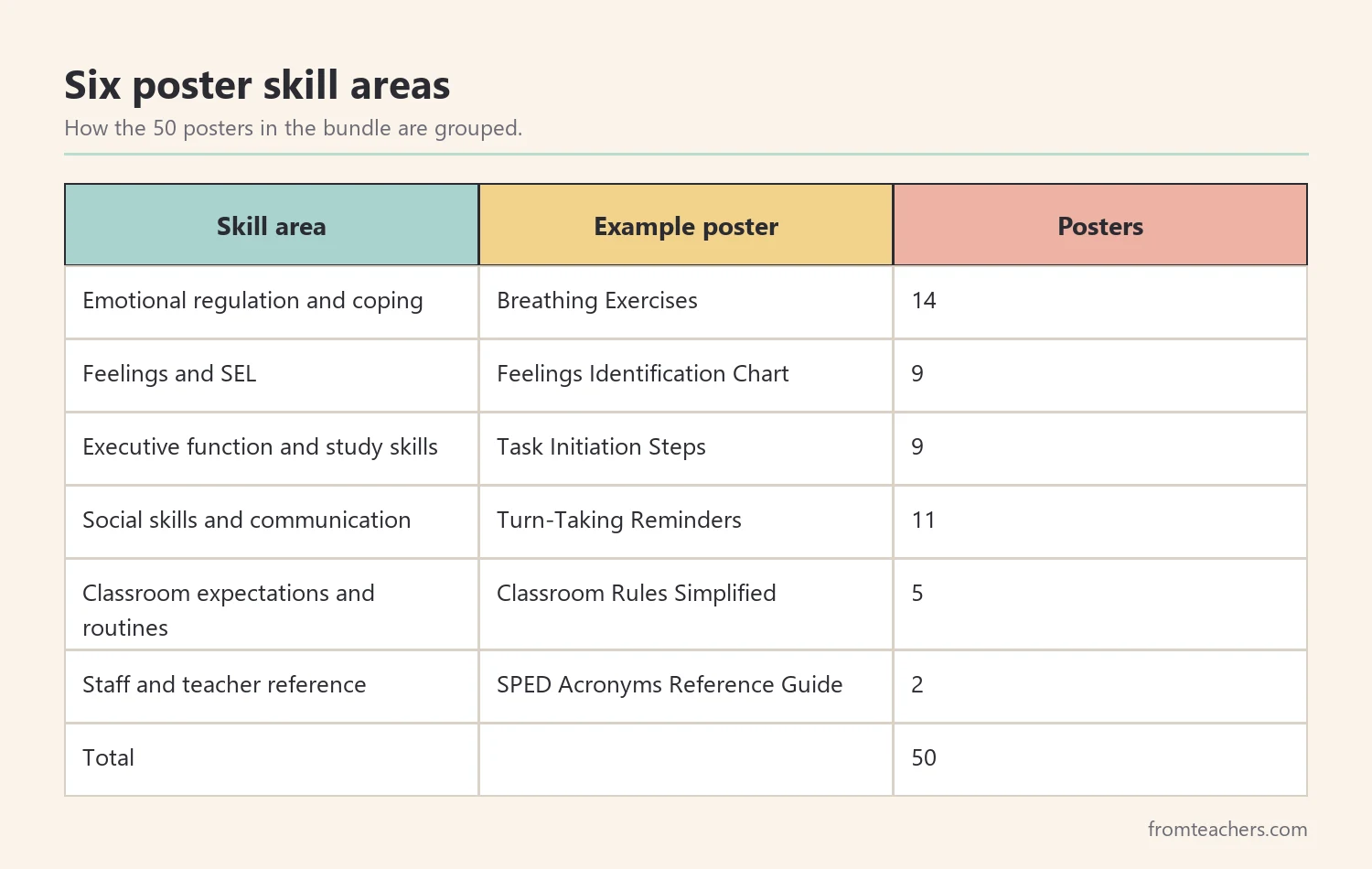
Meanwhile, think about the adults too, because printable classroom posters can guide staff as well as students. A staff reference poster, such as a list of common acronyms or supportive phrases, can help support staff and substitutes use consistent language.
Worked example. Mr. Grant teaches a fictional second-grade class. Transitions and group work are his hardest times, and one student, Ava, often becomes upset when plans change. He chooses four posters to start: a calm down corner poster, a breathing exercises poster, a turn-taking reminder, and a classroom rules poster.
2. Place posters where the skill happens
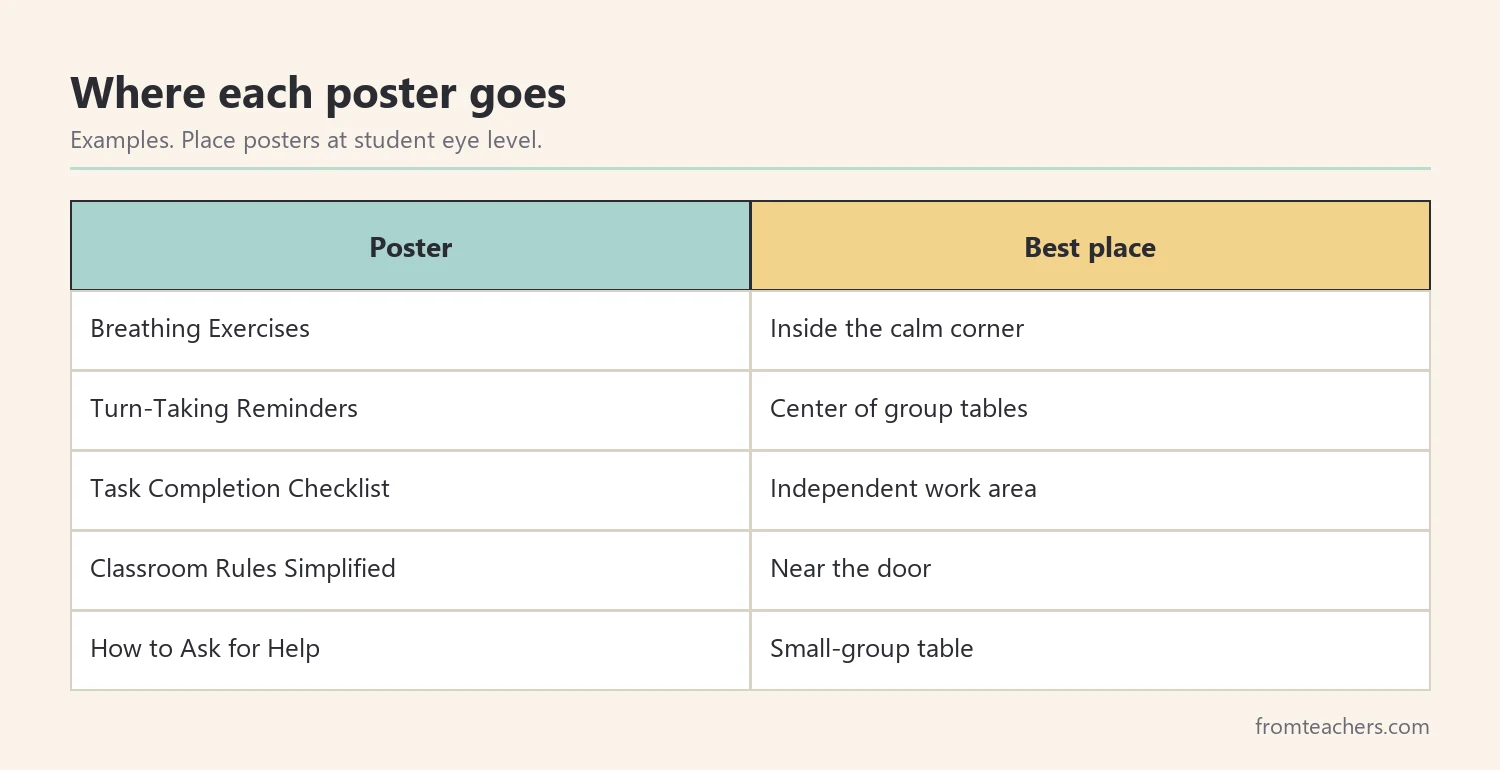
Next, think about location. A poster helps most when a student can see it at the moment they need it. Breathing steps belong near the calm corner. Turn-taking reminders belong near group tables. A task completion checklist belongs near the independent work area.
First, walk through your room and note where each skill is used. Then, place each poster at student eye level in that area. If students sit most of the day, eye level is lower than you might expect.
Also, consider small copies. A desk copy or a page in a student’s binder can be more useful than a large wall poster for a student who needs a personal reminder. The same image in two places also helps with consistency.
In addition, protect your posters. Laminating or using sheet protectors keeps printable classroom posters clean and easy to point to for a whole year.
To build a full set quickly, the classroom posters mega bundle brings 50 printable posters together in one bundle, grouped into emotional regulation and coping, feelings and SEL, executive function and study skills, social skills and communication, classroom expectations and routines, and staff reference.
Worked example. Mr. Grant places the breathing and calm down posters inside the calm corner, at seated eye level. He puts the turn-taking reminder at the center of the group table. He also prints a small breathing poster for Ava’s desk folder.
3. Teach every poster directly
Next, teach the poster before you expect students to use it. Putting a poster on the wall is not the same as teaching the skill. Students need to know what the poster means, when to use it, and what it looks like in action.
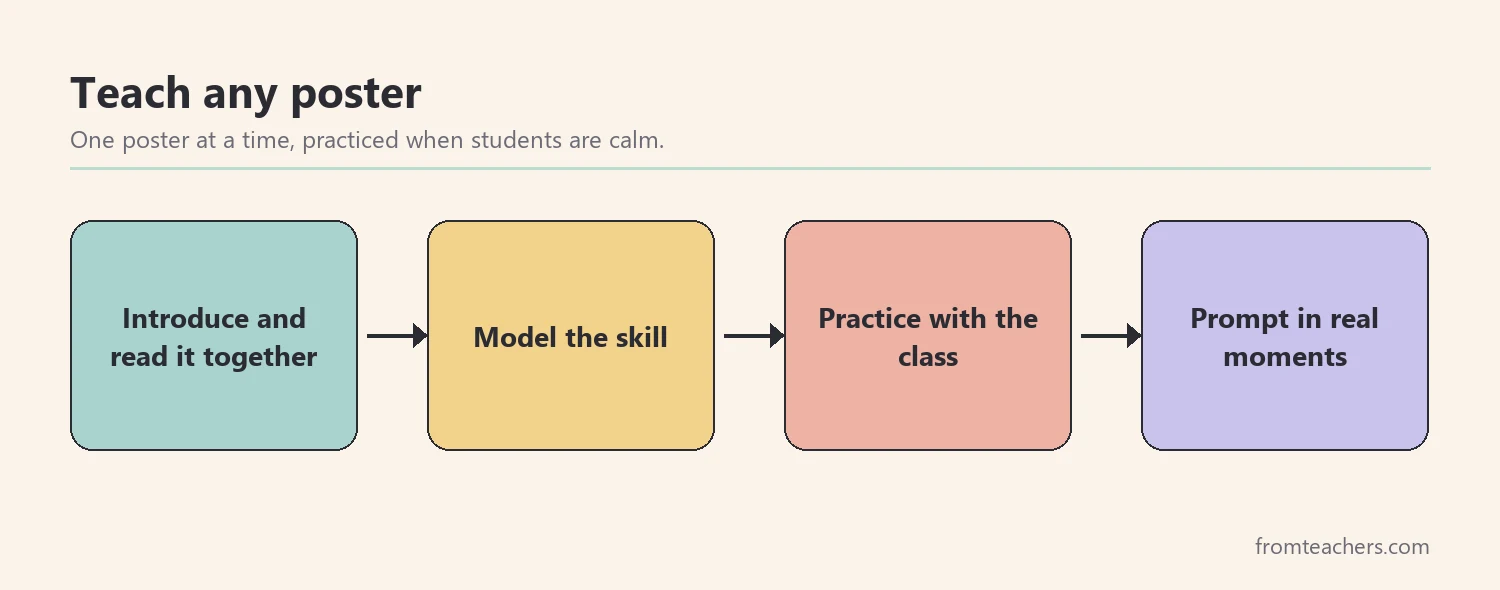
First, introduce one poster at a time. Read it together, explain each step, and connect it to a real moment: “When you feel your body getting hot and tight, look at this poster.” Then, model the skill yourself while pointing to the steps.
Also, practice when students are calm. Practicing a calming routine during a calm moment makes it easier to use during a hard one. Role-play, short games, and quick class rehearsals all work well.
In addition, revisit posters often. A short review at morning meeting, or a quick “Which poster could help here?” during a lesson, keeps printable classroom posters active instead of forgotten.
Meanwhile, adapt for different learners. Some students need the poster read aloud. Others need fewer steps, a desk copy, or a symbol-supported version. The goal is access for every student.
Worked example. Mr. Grant teaches the breathing poster during morning meeting on Monday. The class practices each step together, and he models it while pointing to the poster. On Tuesday, two students show the class how they would use it. On Wednesday, he introduces the turn-taking reminder in the same way.
4. Prompt in the moment with printable classroom posters
Next, use posters during real moments. When a student starts to struggle, a quiet point to the poster can be enough. This keeps your words short and gives the student a clear next step.
First, use the least prompt needed. Start with a glance or a point. If that is not enough, add a short phrase: “Breathing poster.” If the student still needs help, model the first step together.
Also, praise the use of the poster, not only the result. “You looked at the poster and chose a breathing step. That was a smart choice.” This tells students that using the support is a skill in itself.
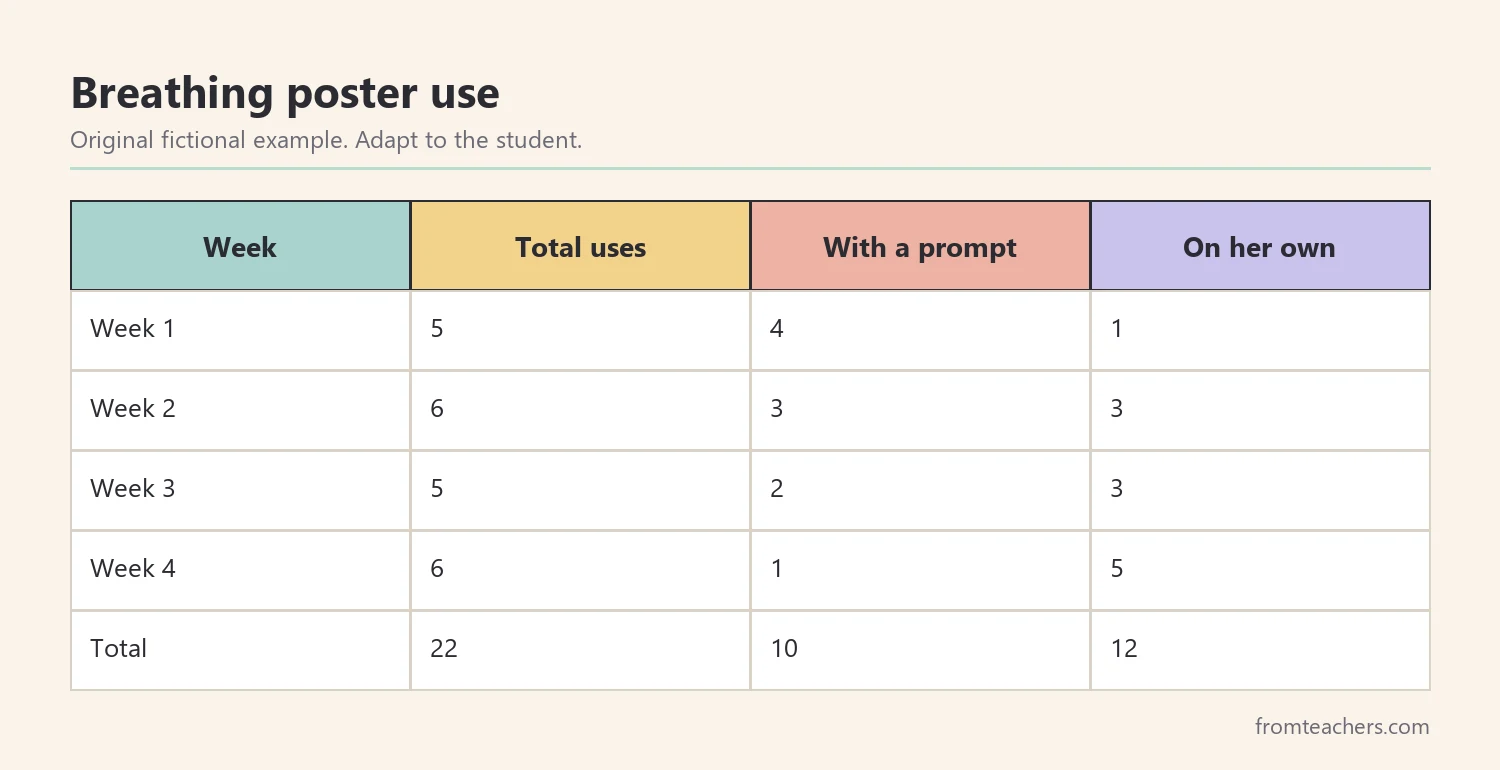
In addition, track a few key uses. A short tally for one or two students shows whether a poster is helping. You can count how often the student uses the poster with a prompt and how often they use it on their own.
Then, fade your prompts over time. The goal is for students to use printable classroom posters independently. As students use them on their own, step back and let the poster do the reminding.
Worked example. Mr. Grant counts how often Ava uses the breathing poster. In week 1, she uses it 5 times, 4 with a prompt and 1 on her own. In week 2, she uses it 6 times, 3 with a prompt and 3 on her own. In week 3, she uses it 5 times, 2 with a prompt and 3 on her own. In week 4, she uses it 6 times, 1 with a prompt and 5 on her own. Across four weeks, that is 22 uses, 12 of them independent.
5. Rotate, review, and share
Finally, keep your walls alive. Posters that stay in the same place all year can fade into the background. A short review every few weeks helps you decide what to keep, move, or replace.
First, ask three questions. Do students use this poster? Is it in the right place? Does it still match a current goal? If the answer is no, move or replace it.
Next, rotate posters with your teaching. When you start a unit on friendships, bring out social skills posters. Before testing season, add study habit and test anxiety reminders. Rotation keeps printable classroom posters connected to what students are learning now.
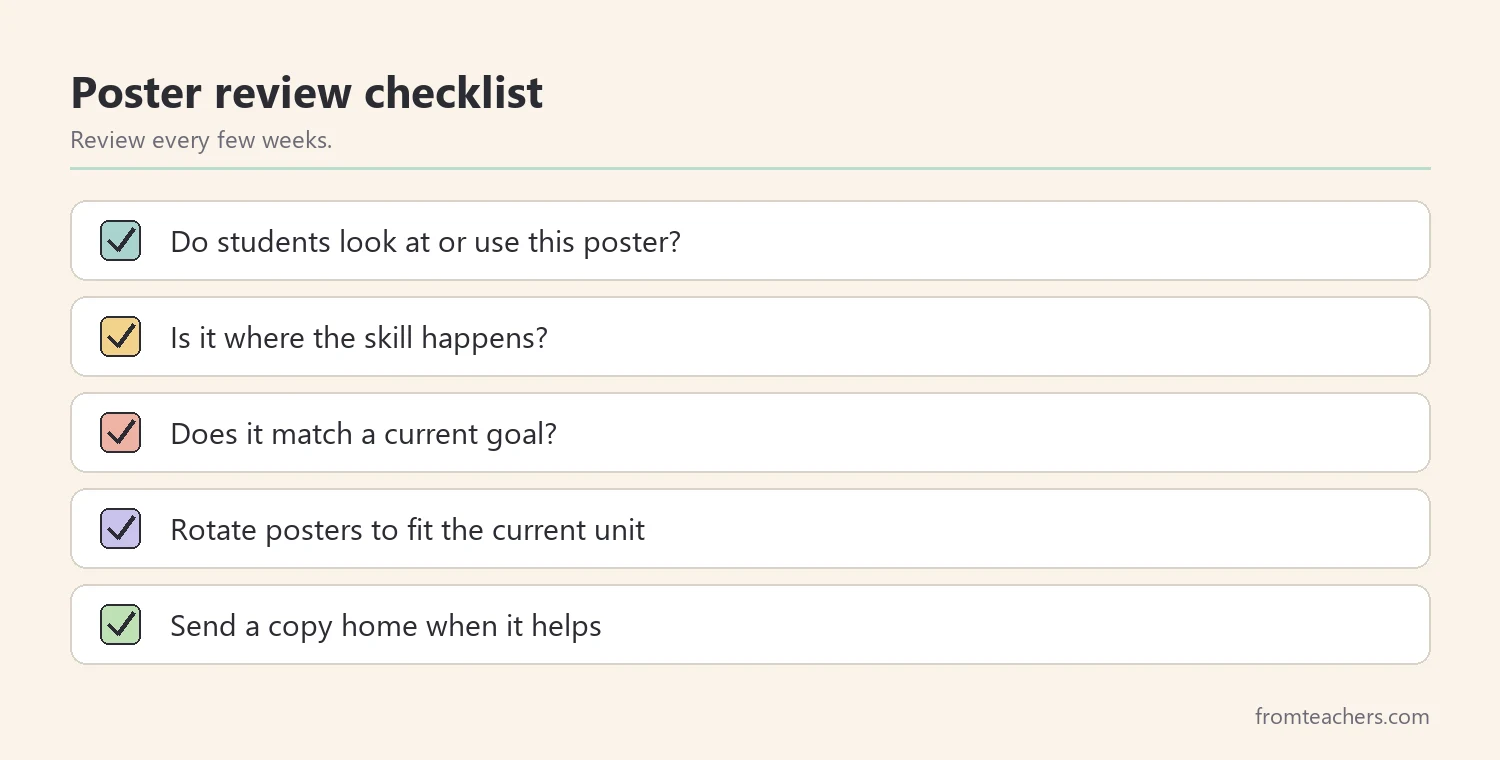
Also, share posters with families. A copy of the breathing steps or the calm down routine at home helps students use the same skill in both places. Families appreciate knowing the exact words used at school.
In addition, ask students for feedback. Which posters help them most? Which ones do they never look at? Their answers often surprise teachers and lead to better walls.
Worked example. After four weeks, Mr. Grant reviews his posters. The breathing poster stays, because Ava and several classmates use it. He moves the classroom rules poster closer to the door, where most reminders happen. He also sends a copy of the breathing poster home with Ava, and her family puts it on the fridge.
Printing and preparing printable classroom posters
Good preparation makes posters last. First, check the print size. Printable classroom posters can usually be printed at letter or A4 size, and larger copies work well for walls that students see from across the room.
Next, print a test page. Check that the text is easy to read from where students sit. If it is not, print larger or move the poster closer to the students who need it most.
Also, keep a master folder. Store one clean copy of all your printable classroom posters in a folder or binder, so you can reprint a worn poster or make a desk copy in minutes.
In addition, label each poster on the back with its skill area. When you rotate printable classroom posters during the year, labels make it quick to find the right set for a new unit or a new goal.
Then, share the folder with support staff. When every adult knows where the posters are, printable classroom posters become part of the whole team’s language, not only the lead teacher’s.
Designing a calm, useful wall
Keep visual clutter low when you hang printable classroom posters. Leave space around each poster, so it stands out. A few well-placed posters are easier to read than many crowded ones.
Also, keep the language positive. Posters that describe what to do, such as “Use a calm voice,” are clearer than lists of what not to do.
Finally, follow your students’ support plans. Posters support the strategies the team has agreed on. They do not replace individual supports.
Common mistakes and how to avoid them
- Too many posters at once. Walls become visual noise. Fix: start small and add with purpose.
- Posting without teaching. Students ignore the poster. Fix: teach and model each one.
- Placing posters far from the skill. Students cannot see them when needed. Fix: post them where the skill happens.
- Talking too much in hard moments. Words add stress. Fix: point to the poster and keep it short.
- Never changing the wall. Posters fade into the background. Fix: review and rotate every few weeks.
Questions teachers and parents ask about printable classroom posters
How many posters should be on the wall?
There is no single number. Start with a few posters linked to current goals, and add more only when students use the ones you have. Leave space so each poster is easy to see.
Do posters work for older students?
Yes, when the content and design suit their age. Executive function, study habits, and self-advocacy reminders are often useful in middle and high school.
Should every student have a desk copy?
Not always. Desk copies help students who need a personal reminder or who sit far from the wall. Decide student by student.
Can posters be used at home?
Yes. Sharing the same poster at home helps students use the same words and steps in both places. Families can place it where the skill is needed, such as the bedroom or the kitchen.
How do I know if a poster is working?
Watch whether students look at it, point to it, or use its steps. A short tally for one or two students gives you clear information.
Related reading: Managing Sensory Overload: Practical Strategies for Autism and ADHD, Moving Beyond Shame and Behavior Charts: Positive Alternatives for Effective Classroom Management, and 5 Practical Teaching Tips to Boost Classroom Focus and Learning.
A companion resource for printable classroom posters:
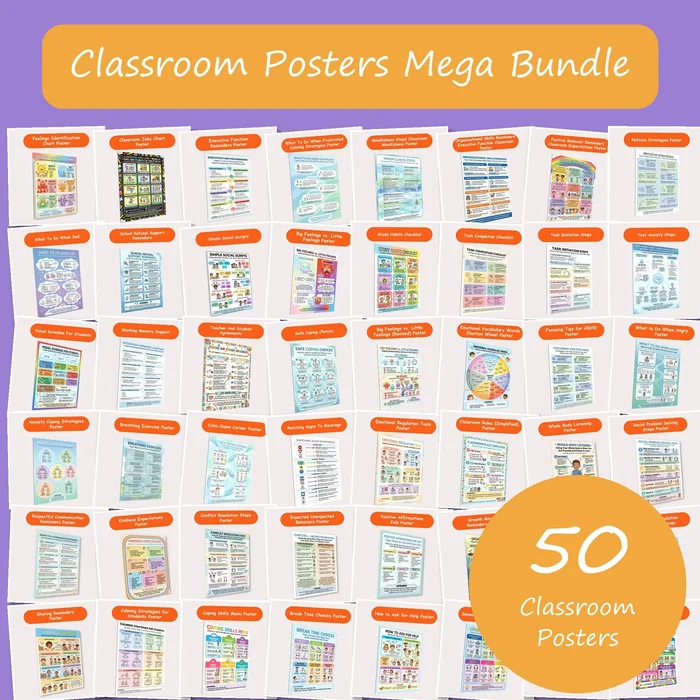
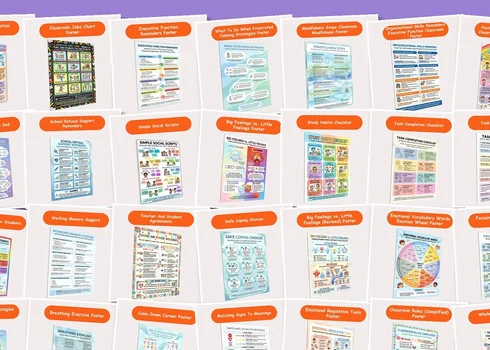
Classroom Posters Mega Bundle: 50 Printable SEL, Behavior and Classroom Posters: visual reminders for emotional regulation, coping skills, feelings, executive function, social skills, and classroom expectations, as high-resolution, print-ready PDFs.
Sources and scope
- CASEL: information on social and emotional learning in schools.
- Center on PBIS: information on teaching and reinforcing positive classroom expectations.
- IRIS Center, Vanderbilt University: free modules on classroom behavior management and the classroom environment.
- CAST: information on Universal Design for Learning and multiple means of representation.
This guide covers practical classroom and home use of visual reminder posters. It does not replace individual behavior plans, counseling, or the decisions of a student’s support team.
Key takeaways
- Choose printable classroom posters based on current student needs.
- Place each poster where the skill is used.
- Teach, model, and practice every poster.
- Point to posters in the moment, then fade prompts.
- Review, rotate, and share posters with families.







Leave a Comment