

An end of day reflection routine gives students a calm landing after a busy school day. Picture the last ten minutes before dismissal: chairs scraping, backpacks half packed, someone looking for a lost jacket, and nobody quite sure what they learned. Then the bell rings, and the day is gone without a single pause to notice what went well.
This guide shows teachers and support staff how to build a short, predictable routine that fits into those final minutes. You will learn how to set it up, how to teach students to reflect honestly, how to use goals that carry over to tomorrow, and how to read the journals without adding hours of marking.
Examples are fictional. Adapt to the student’s goals and agreed supports. This is guidance, not a diagnosis.
At a glance
- Keep the routine short: about five to eight minutes.
- Use the same questions every day so students can focus on thinking, not on reading prompts.
- Model honest, simple answers before asking students to write.
- Connect today’s reflection to one small goal for tomorrow.
- Skim journals weekly and respond with a short comment, not a grade.
1. Protect time for an end of day reflection routine
First, choose a fixed slot. The best time is usually after cleanup and before packing up, when the room is already calm. If reflection happens after backpacks are on, students will rush through it to get to the door.
Next, keep it short. Five to eight minutes is often enough for students to complete a one-page journal. A short routine is easier to protect on busy days, and consistency matters more than length.
Also, signal the start the same way every day. Some teachers dim the lights, play quiet music, or put a visual timer on the board. These cues tell students that the noisy part of the day is over and a quieter part has begun.
In Ms. Lee’s fictional grade 5 class, the routine starts at 2:52 every afternoon. She plays one calm song, sets a seven-minute timer, and hands out journals from a bin by the door. Priya, one of her students, used to leave every day still upset about small conflicts. After two weeks of the routine, she began to arrive at the door calmer and ready to talk with her family.
Moreover, tell families about the routine. A short note home explaining the questions helps parents ask better questions at pickup. Instead of “How was school?”, they can ask “What went well today?” and get a real answer, because their child has already thought about it during the end of day reflection routine.
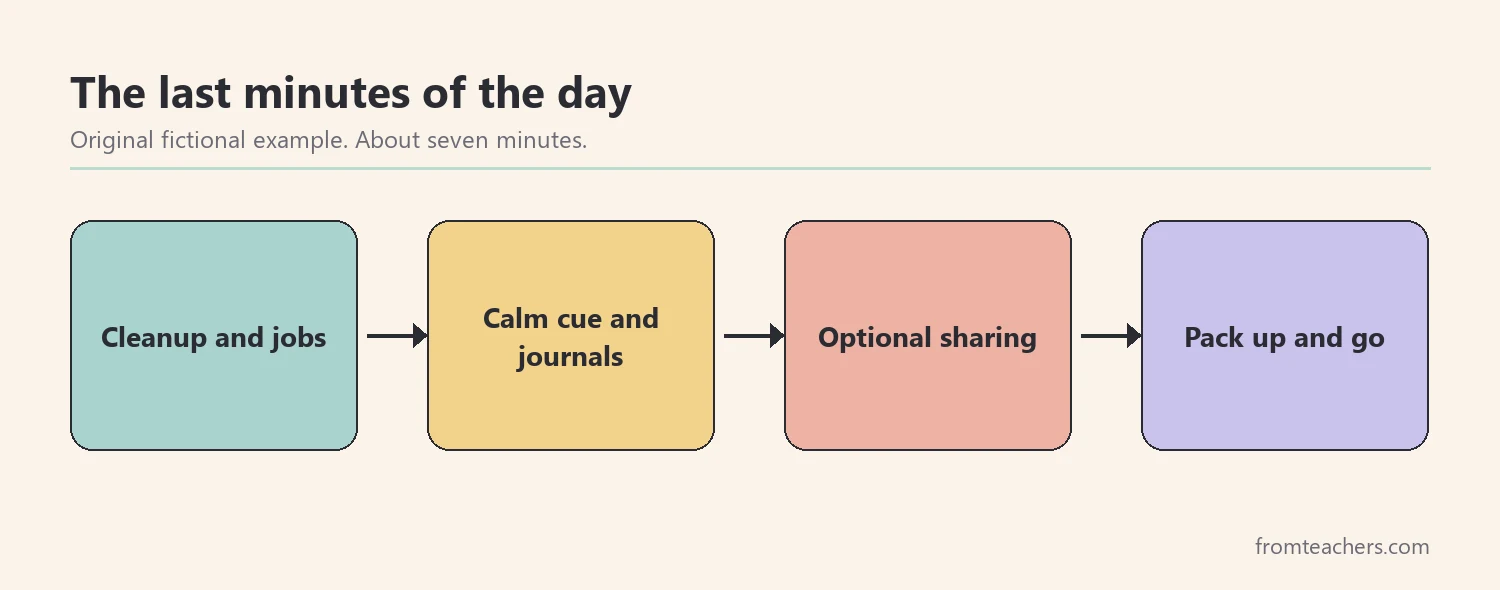
| Time | What happens |
|---|---|
| 2:45 | Cleanup and jobs |
| 2:52 | Calm song, journals out |
| 2:59 | Two volunteers share one line |
| 3:02 | Pack up and dismissal |
2. Use the same prompts every day
When questions change daily, students spend their energy decoding the prompt. In contrast, the same prompts each day free them to think about the content. Over time, they start to notice patterns in their own answers.
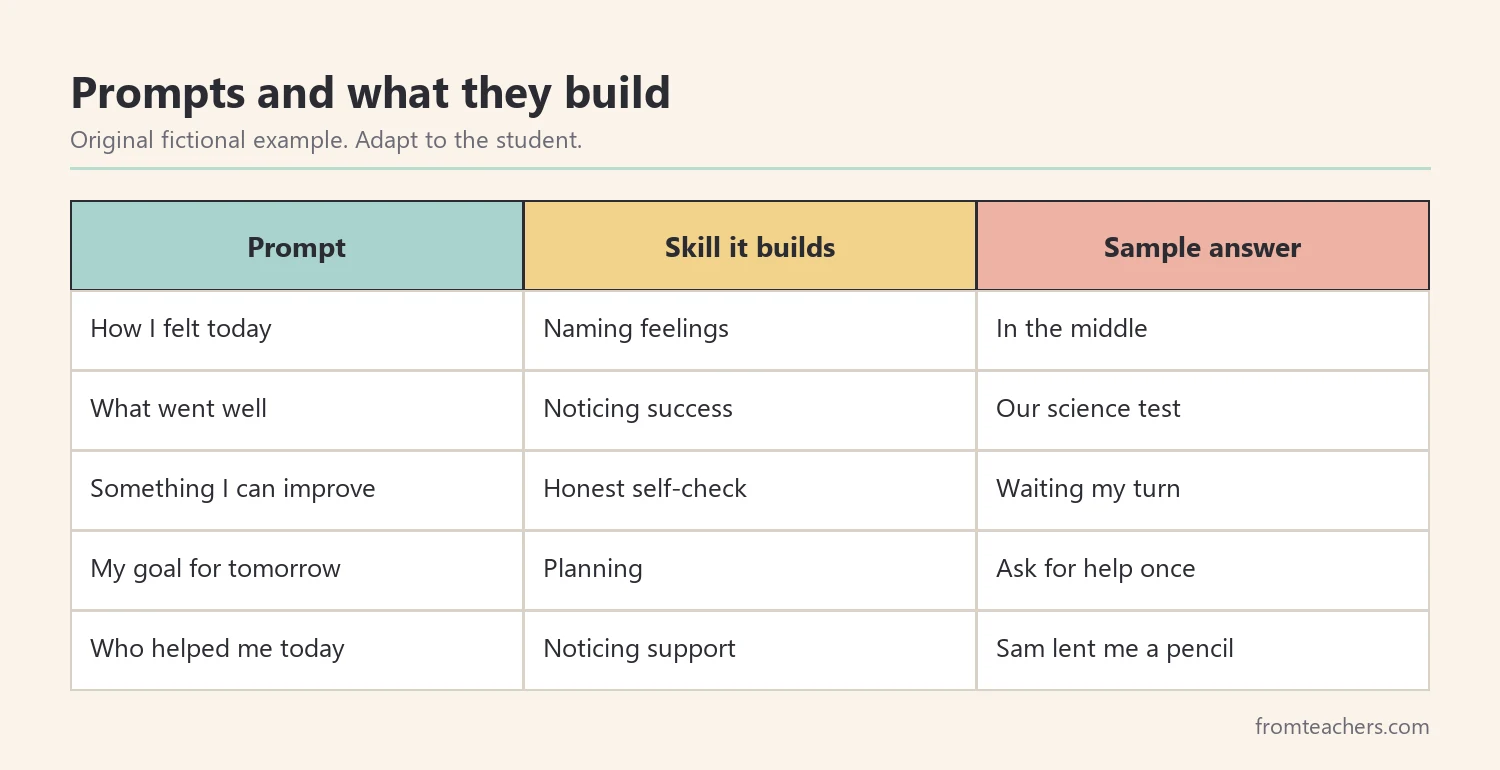
A good set of prompts covers what happened, how it felt, what went well, and what to improve. A gratitude question and a question about who helped can widen the focus beyond the student. For example, the daily reflection journal for students with SEL check-in and goal setting includes What I Did Today, a three-face feeling scale, What Went Well, Something I Can Improve, My Goal for Tomorrow, Who Helped Me Today, and a gratitude prompt.
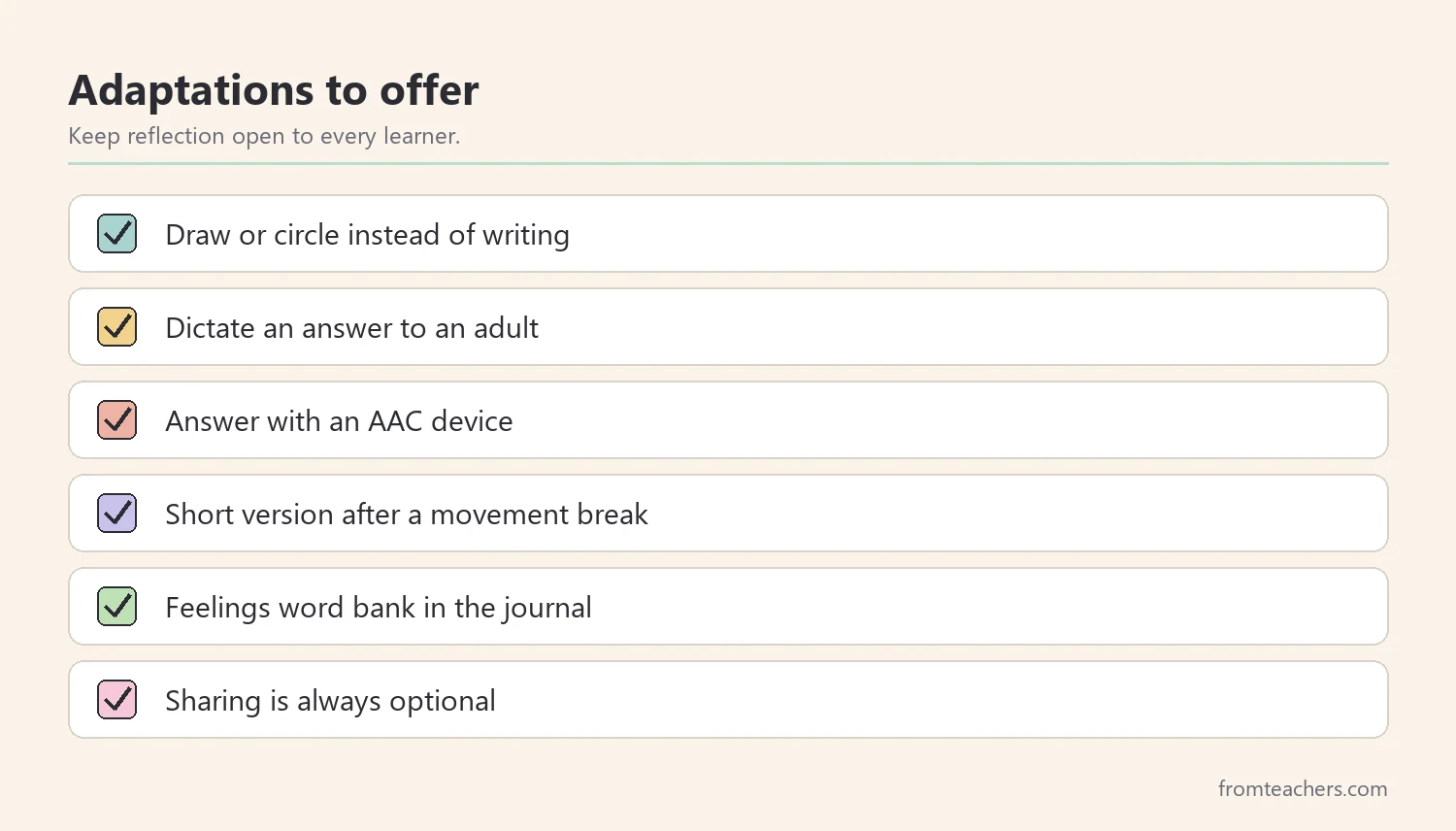
In addition, offer choices for students who find writing hard. They can draw, write single words, dictate to an adult, or circle a face. The aim of an end of day reflection routine is thinking, not handwriting practice.
Similarly, keep the journals in one predictable place. A bin or a folder for each table group saves time and stops pages from disappearing into desks. When students know exactly where their journal lives, the end of day reflection routine starts faster and the whole class settles sooner.
However, do not overload the page. If students regularly leave sections blank, it may be too long for your class or your time slot. You can ask students to complete only three sections on busy days, as long as you choose the same three each time.
3. Model honest reflection before students write
Many students do not know what reflection looks like. Asked “How did today go?”, they write “good” and move on. Therefore, spend the first week modeling your own answers aloud.
For instance, Ms. Lee might say: “Today I felt in the middle. What went well was our science experiment. Something I can improve is giving clearer directions before group work. My goal for tomorrow is to write the steps on the board first.” Students hear that adults reflect too, and that improvement is normal.
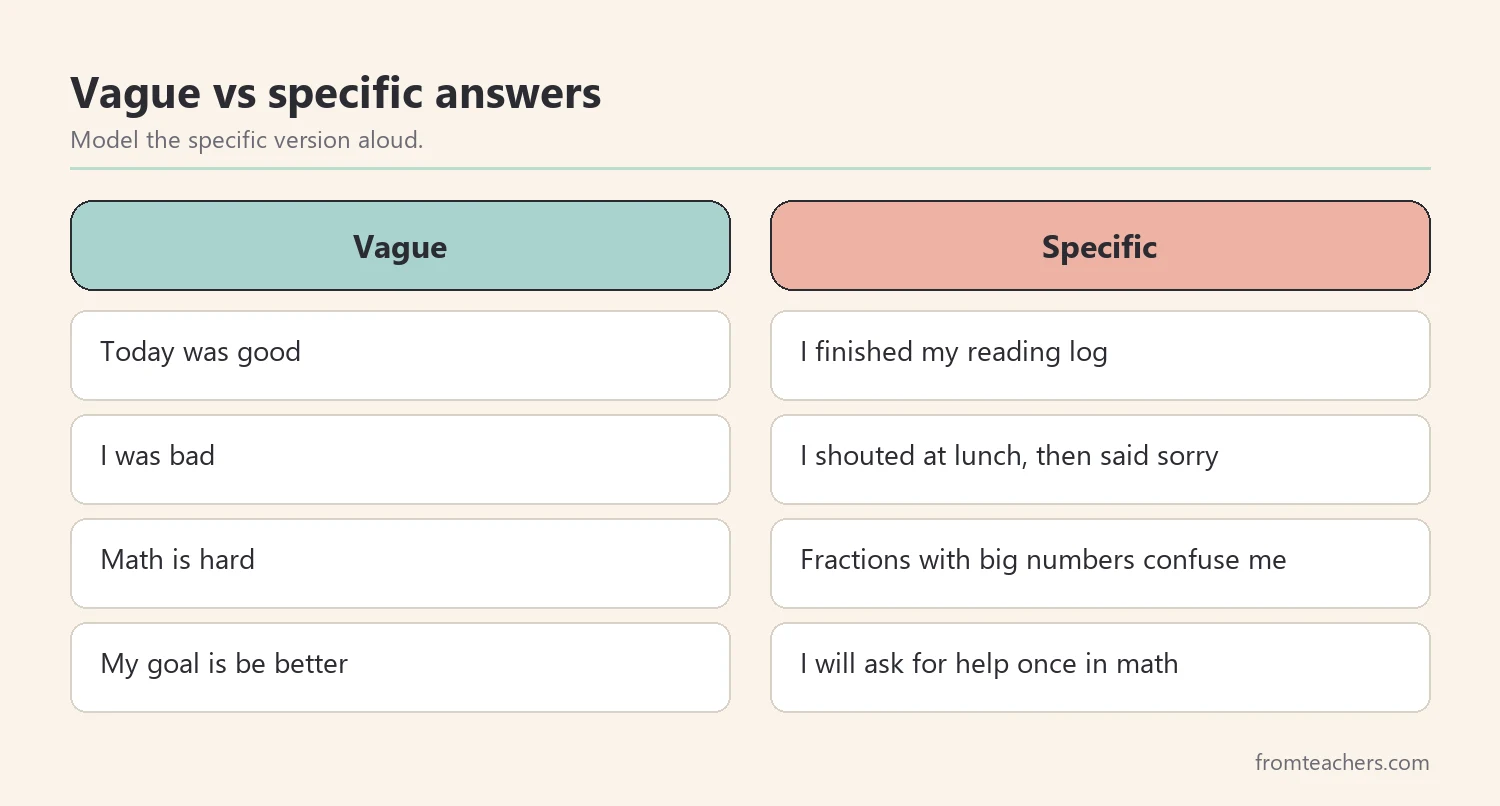
Also, show the difference between vague and specific answers. A short comparison on the board helps students see what a useful answer looks like.
Next, make honesty safe. Students will not write “I was upset at lunch” if they think it will get them in trouble. Explain that the journal is for growth, not discipline. If something serious comes up in a journal, follow your school’s procedures, but keep everyday reflections free of consequences.
Finally, celebrate effort over polish. A short, honest sentence is worth more than a long, careful one that says nothing. Over a few weeks, the end of day reflection routine becomes a habit students often look forward to.
4. Connect reflection to tomorrow’s goal
Reflection becomes powerful when it leads to action. That is why a goal for tomorrow belongs in every journal entry. The next day, students check whether they met yesterday’s goal before setting a new one.
Keep goals small and concrete. “Be better at math” is too big. “Ask for help once during math” or “finish the warm-up before the timer” is something a student can actually do and check.
In addition, teach a simple goal pattern: one action, one time, one place. For example, “I will raise my hand once in reading group.” That pattern makes goals easier to remember and easier to measure.
Priya’s early goals were broad, such as “be nicer.” With coaching, she changed them to “say good morning to Sam at the door” and “take three breaths before I answer when I am upset.” She met the second goal on four of five days in her third week, and she noticed it herself in the journal.
| Too big | Small and concrete |
|---|---|
| Be better at math | Ask for help once in math |
| Be nicer | Say good morning to one classmate |
| Focus more | Finish the warm-up before the timer |
| Be organized | Put my homework folder in my bag |
Moreover, link goals to IEP or support plans where appropriate. If a student has a goal about regulation or work completion, the daily journal can give them a student-friendly way to practice it. Talk with the case manager first so the language matches.
5. Read journals without drowning in paperwork
Reading thirty journals every afternoon is not realistic. Instead, skim a few each day, so every student’s journal is read at least once a week. Many teachers split the class into five groups, one for each weekday.
Also, respond briefly. A comment such as “I noticed you helped Sam today” or “Great goal, I will watch for it tomorrow” takes seconds and shows students that someone is reading. Avoid grades, because a graded journal quickly becomes a performance.
Next, look for patterns, not single days. Several days of “sad” faces, repeated mentions of the same conflict, or goals that are never met can tell you where a student needs support. A light tally sheet helps you see these patterns over time.
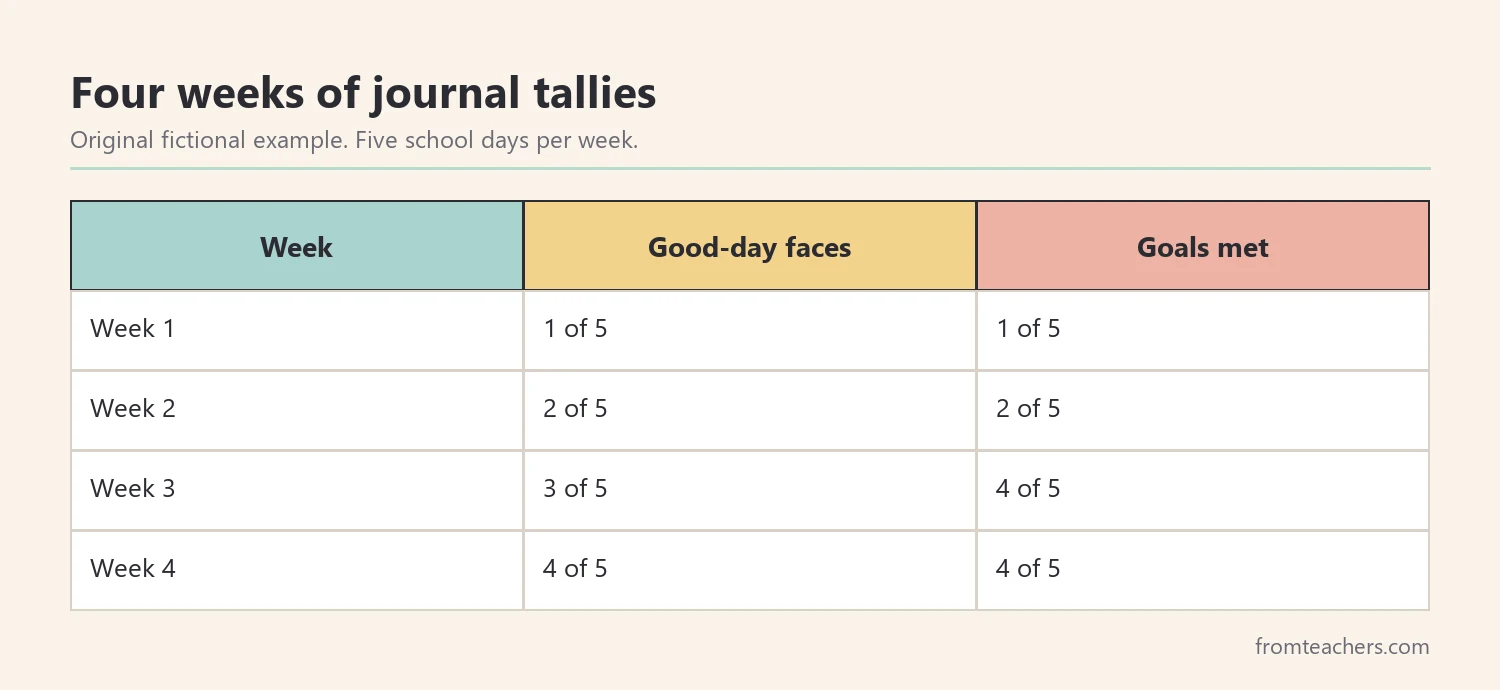
In addition, invite students to read back through their own journals once a month. Looking at four weeks of entries, many students notice changes they would never spot day to day. That monthly look back is one of the quiet strengths of an end of day reflection routine, because it shows students their own growth in their own words.
For Priya, the tally showed more “good” days over four weeks and more goals met. Ms. Lee shared the trend with Priya, who was surprised and proud. That conversation took two minutes and did more for her motivation than any sticker.
6. Adapt the end of day reflection routine for different learners
Not every student reflects the same way. For younger students or those with limited writing, use picture prompts, a feeling face to circle, and one spoken sentence to an adult. For older students, add a short free-write line or a weekly reflection on a bigger goal.
Students who use AAC can answer with their device, and an adult can record the response. Students with attention challenges may do better with a shorter version and a movement break first. Similarly, students who find feelings hard to name may need a small feelings word bank taped inside their journal.
In addition, think about sharing. Some students love to read their win aloud, while others find it stressful. Keep sharing voluntary, and offer a “pass” option that is always accepted. That way, the end of day reflection routine stays safe for everyone.
Finally, ask students for feedback on the routine itself every few weeks. Which question is most useful? Which one feels boring? Small changes based on their answers keep the end of day reflection routine fresh and show students that their voice shapes the classroom.
Common mistakes and how to avoid them
- Running the routine after backpacks are on. Students rush to the door. Fix: schedule reflection before packing up.
- Changing the prompts every day. Students spend time decoding. Fix: use the same prompts for weeks at a time.
- Grading the journal. Students start writing for the teacher. Fix: respond with short comments, never scores.
- Accepting only written answers. Some students are shut out. Fix: allow drawing, circling, dictation, or AAC.
- Using journals for discipline. Honesty disappears. Fix: keep everyday reflections free of consequences, and follow school procedures for serious concerns.
- Letting it drop on busy days. The habit fades. Fix: keep a three-minute version for short days.
Questions teachers and parents ask about an end of day reflection routine
How long should the routine take?
Most classes can complete a one-page journal in five to eight minutes once the routine is familiar. In the first week, allow a little longer while you model answers. On short days, a three-minute version keeps the habit alive.
What if a student writes the same thing every day?
Repetition is common at first. Ask a gentle follow-up question, such as “What made it good today?” Sharing a model answer with more detail can also help. Over time, most students add more variety.
Can parents use the same journal at home?
Yes. A family can use the same prompts at dinner or bedtime. When home and school use the same questions, children practice reflection in more than one setting.
Is this the same as counseling?
No. A classroom reflection routine supports self-awareness and goal setting, but it is not therapy. If a journal raises concerns about safety or wellbeing, follow your school’s procedures and involve the counselor.
How do I start mid-year?
Just start. Explain the purpose, model it for a few days, and keep it short. Students usually adapt quickly when the routine is calm and predictable.
Related reading: School Counseling Strategies: Empowering Students to Dream Big, Trauma-Informed Teaching Strategies, and 5 Teaching Tips for Classroom Focus.
You may also need: Executive Functioning Sheet Student Task Planning and Self-Monitoring Tool.
A companion resource for your end of day reflection routine:
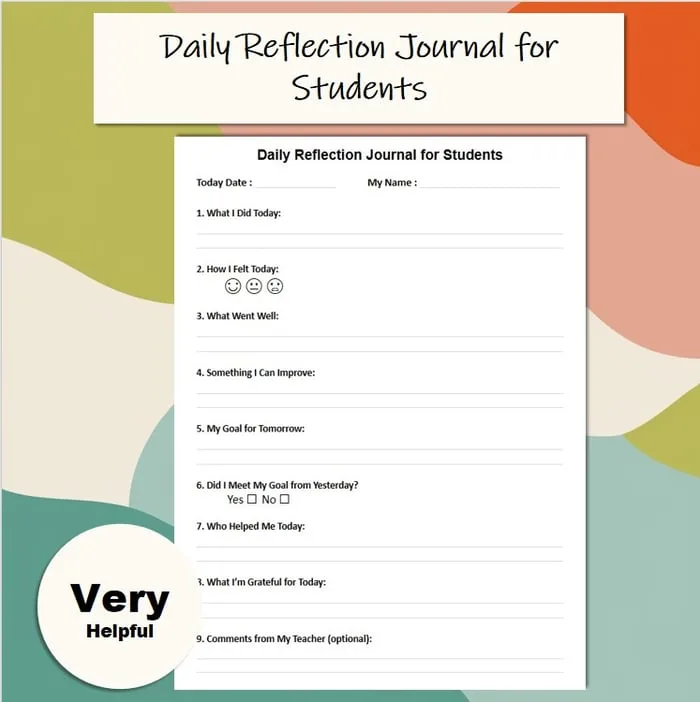
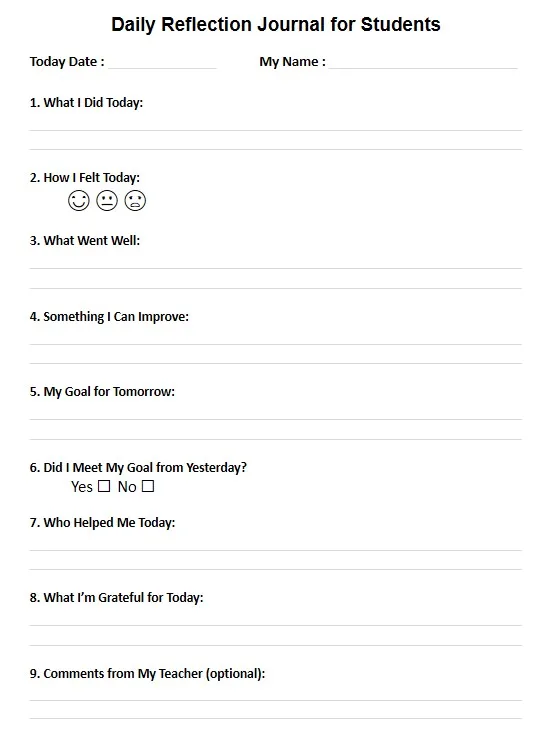
Daily Reflection Journal for Students: SEL Check-In and Goal Setting Sheet: one ready-to-use page with a feeling scale, What Went Well, Something I Can Improve, a goal for tomorrow with a yesterday check, a gratitude prompt, and space for teacher comments.
Sources and scope
- CASEL: the Collaborative for Academic, Social, and Emotional Learning, which describes core SEL competencies such as self-awareness and self-management.
- IRIS Center, Vanderbilt University: free modules on classroom routines and behavior supports.
- CAST UDL Guidelines: a framework for offering multiple ways for students to express what they know.
- Understood.org: practical articles for families and teachers on routines and self-awareness.
This guide covers a short classroom reflection routine for general and special education settings. It does not cover counseling, mental health assessment, or crisis response, which belong to trained professionals.
Key takeaways
- An end of day reflection routine works best before packing up, in a fixed five to eight minute slot.
- Repeat the same prompts so students can focus on thinking.
- Model honest, specific answers, and keep journals free of grades and discipline.
- Link each reflection to one small, concrete goal for tomorrow.
- Skim a few journals daily, respond briefly, and watch for patterns over weeks.










Leave a Comment