

Language development activities at home can turn ordinary moments, like setting the table or riding in the car, into steady practice for a child who finds words hard. Picture a seven-year-old who points instead of asking, says “that thing” when she means “the blue cup,” and seems not to hear when you give two directions at once. You want to help, but you are not a speech therapist and you do not want every evening to feel like therapy.
This guide is for parents and caregivers of children in kindergarten through about grade 3 who have receptive or expressive language needs. By the end, you will be able to use simple routines to build understanding and talking, work alongside your child’s teacher and speech-language pathologist (SLP), and notice small signs of progress.
Examples are fictional. Follow the advice of your child’s SLP and teachers. This is guidance, not a diagnosis or a therapy plan.
At a glance
- Receptive language is understanding; expressive language is using words.
- Everyday routines offer more practice than special sessions.
- Short, clear directions and wait time help understanding.
- Model and expand your child’s words instead of correcting them.
- Ask the SLP for one or two target skills to practice at home.
1. Understand receptive and expressive language at home
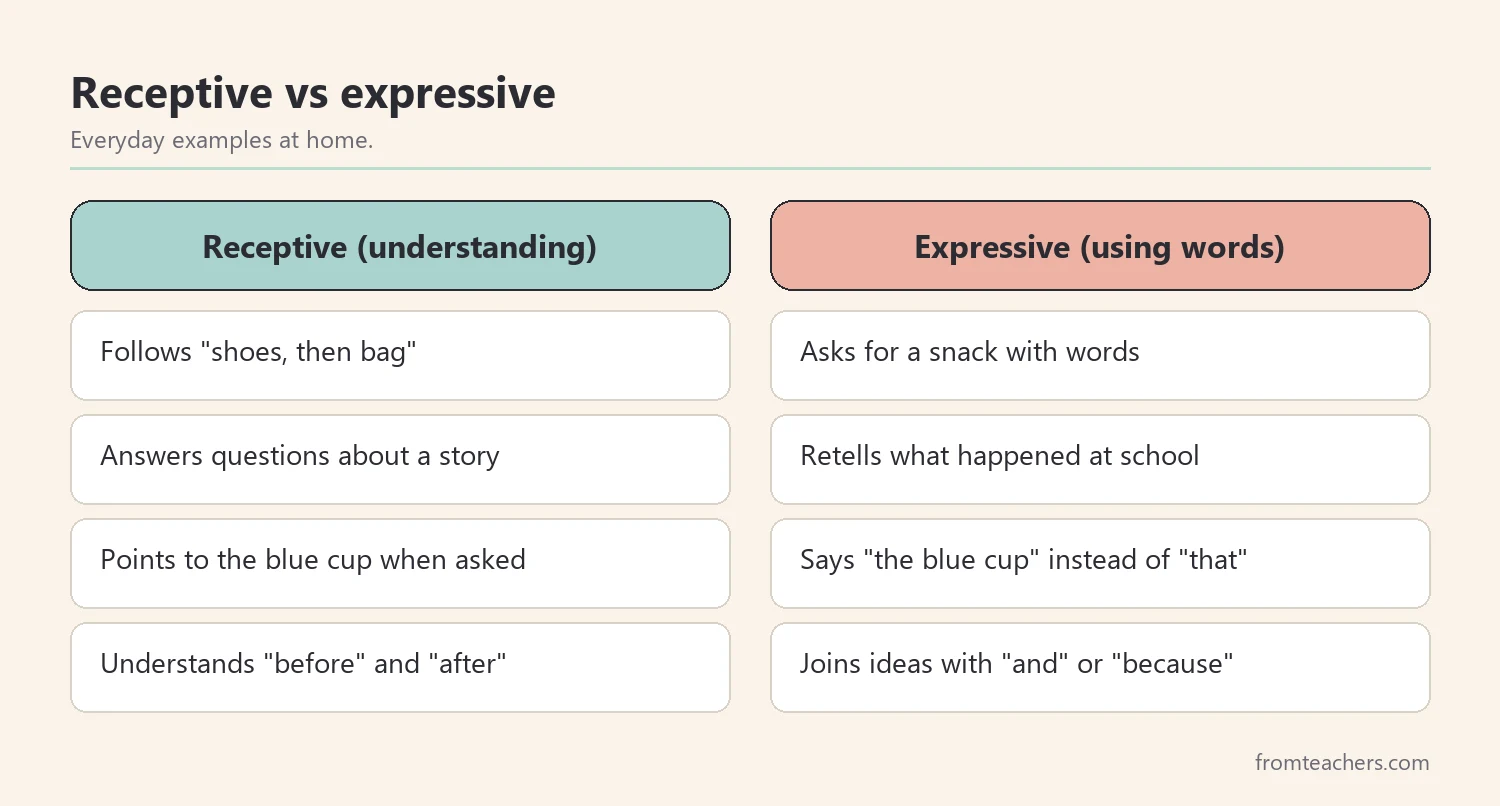
First, it helps to know the two big parts of language. Receptive language is understanding: following directions, answering questions, and making sense of stories. Expressive language is using words: naming things, building sentences, and telling what happened.
A child can struggle with one, the other, or both. For example, a child might understand stories well but have trouble finding the right word. Another might talk a lot but miss parts of longer directions. As a result, home support works best when it targets the right area.
Next, watch for patterns in daily life. Does your child follow one-step directions but get lost with two or three? Do they use short phrases when other children their age use longer sentences? Do they often say “thing” or “stuff” instead of specific words? These observations are useful to share with the school team.
Meet Sofia (fictional, age 7, grade 2). Her SLP shared two goals: following two-step directions and using describing words, like colors and sizes, in sentences. Her mother, Ana, wrote these two goals on a note on the fridge so the whole family knew what to practice.
Finally, remember that many children who need language support are bright and eager. A language need does not reflect intelligence or effort. With the right support, children often make steady progress.
2. Build understanding with clear, simple talk
Many children with receptive language needs do much better when adults adjust how they speak. Fortunately, these changes are simple and quickly become habits.
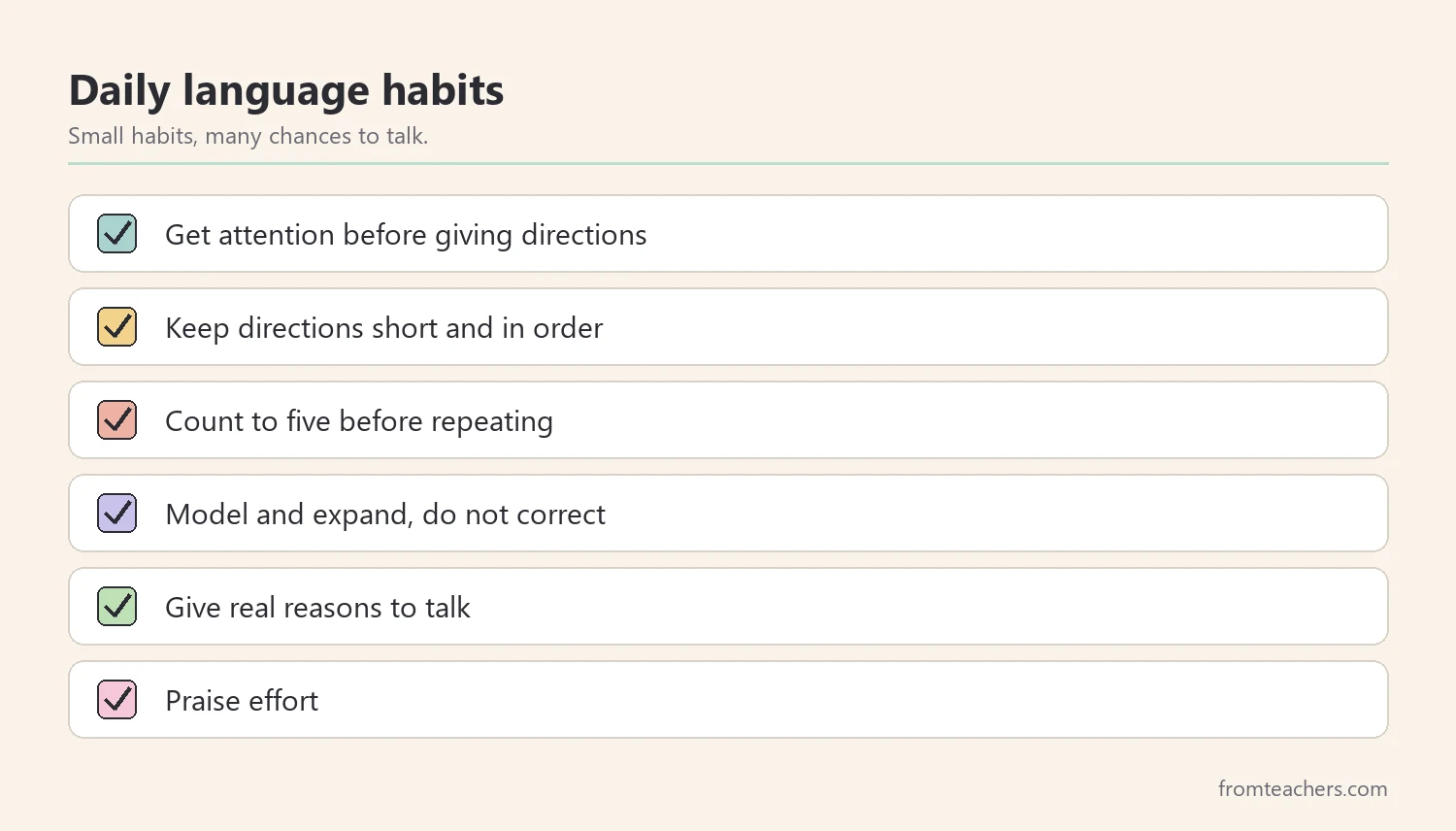
First, get your child’s attention before you speak. Say their name, wait for them to look, and then give the direction. A direction given from another room while your child is playing is easy to miss.
Next, keep directions short and in order. “Put on your shoes, then get your bag” is easier than “Before you get your bag, you need to put your shoes on.” The first matches the order of actions. In addition, use gestures and point to objects. Visual support makes words easier to understand.
Then, give wait time. Many children need a few extra seconds to process what they heard. Count silently to five before repeating. If you need to repeat, use the same words rather than rephrasing, so your child does not have to process a new sentence.
For Sofia, Ana practiced two-step directions during everyday tasks: “Get a spoon, then put it on the table.” At first, Sofia often did only the first step. Ana held up two fingers as she spoke and touched each finger for each step. Within a few weeks, Sofia followed most two-step directions without the finger cue.
Also, check understanding gently. Instead of “Do you understand?”, ask your child to show you or tell you what to do first. Many children say “yes” to the first question even when they are unsure.
The Speech and Language Toolkit: AAC, Receptive and Expressive Support includes separate sections for receptive and expressive language, with sentence frames and vocabulary routines. Although it is written for classroom teams, many of its strategies match what families can do at home, which makes school and home practice easier to line up.
3. Grow expressive language with everyday routines
Children learn to talk by hearing rich language and having many chances to use it. Everyday routines provide both, without extra time or materials. Language development activities at home are most effective when they are woven into what you already do.
Here are routines that work well:
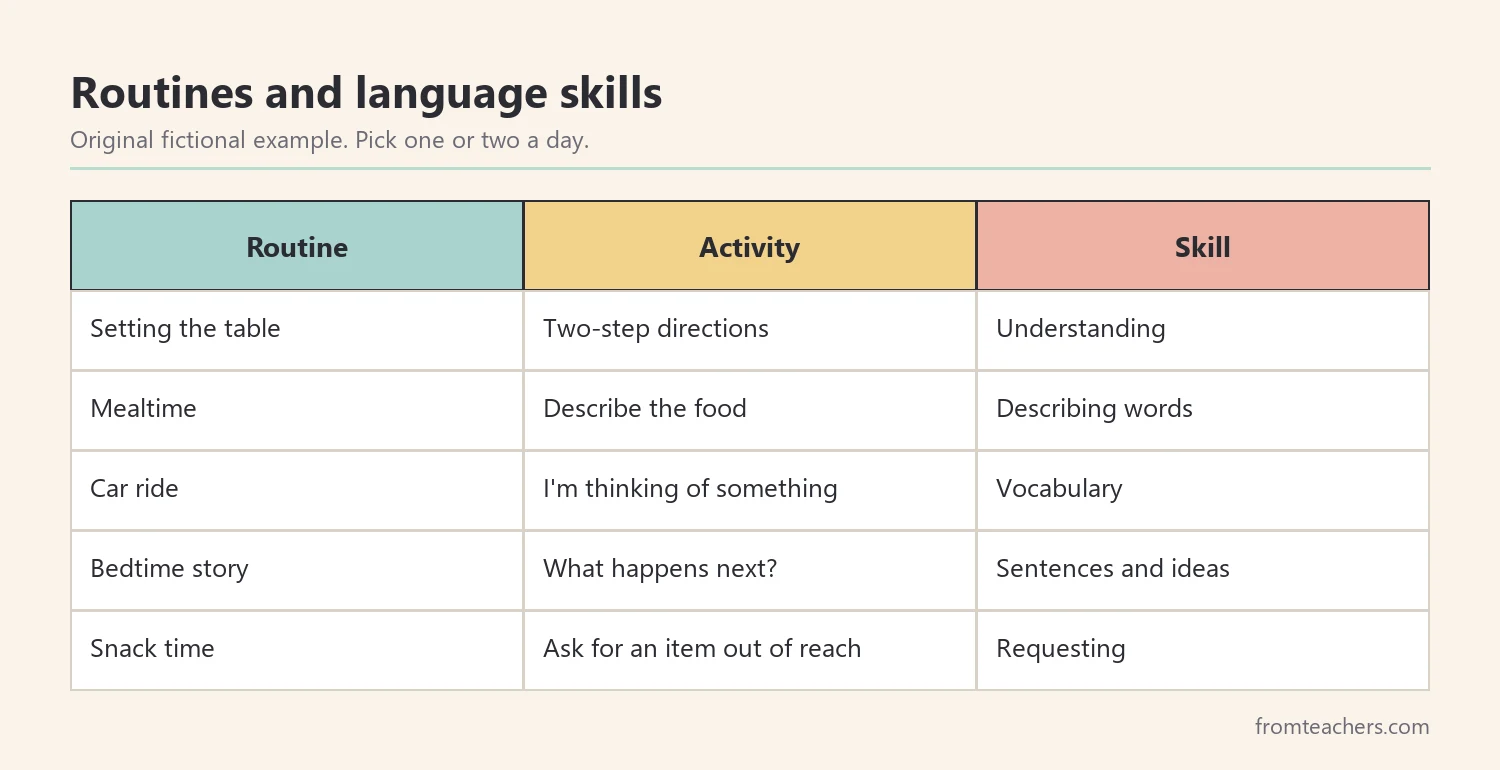
For example, at mealtimes, describe the food: “This apple is red and crunchy.” Then invite your child to describe something: “Tell me about your sandwich.” If they say “good,” you can model a fuller answer: “It’s good. It’s soft and has cheese.”
In the car, play “I’m thinking of something” games. Give clues with describing words: “I’m thinking of something big and yellow that carries kids.” Then let your child give clues for you to guess. This builds vocabulary and sentence structure in a playful way.
At bedtime, read together and talk about the pictures. Ask open questions: “What do you think will happen next?” or “How does the dog feel?” Pause and give your child time to answer. If they answer in one word, expand it into a sentence and continue the story.
Moreover, give your child real reasons to talk. Put a favorite snack slightly out of reach so they need to ask. Offer choices that require words: “Do you want the red cup or the blue cup?” These small moments create many chances to practice each day.
4. Model and expand instead of correcting
When a child makes a language mistake, the natural reaction is to correct it. However, frequent correction can make children reluctant to talk. A gentler approach is to model the right form and expand on what they said.
Modeling means repeating your child’s message correctly, without pointing out the mistake. If your child says “Him goed to the park,” you might say “Yes, he went to the park.” Your child hears the right form, and the conversation continues.
Expanding means adding a little more. If your child says “Big dog,” you might say “Yes, a big brown dog. He is running.” You keep their idea and show how to say more.
Here is how these responses compare with direct correction:
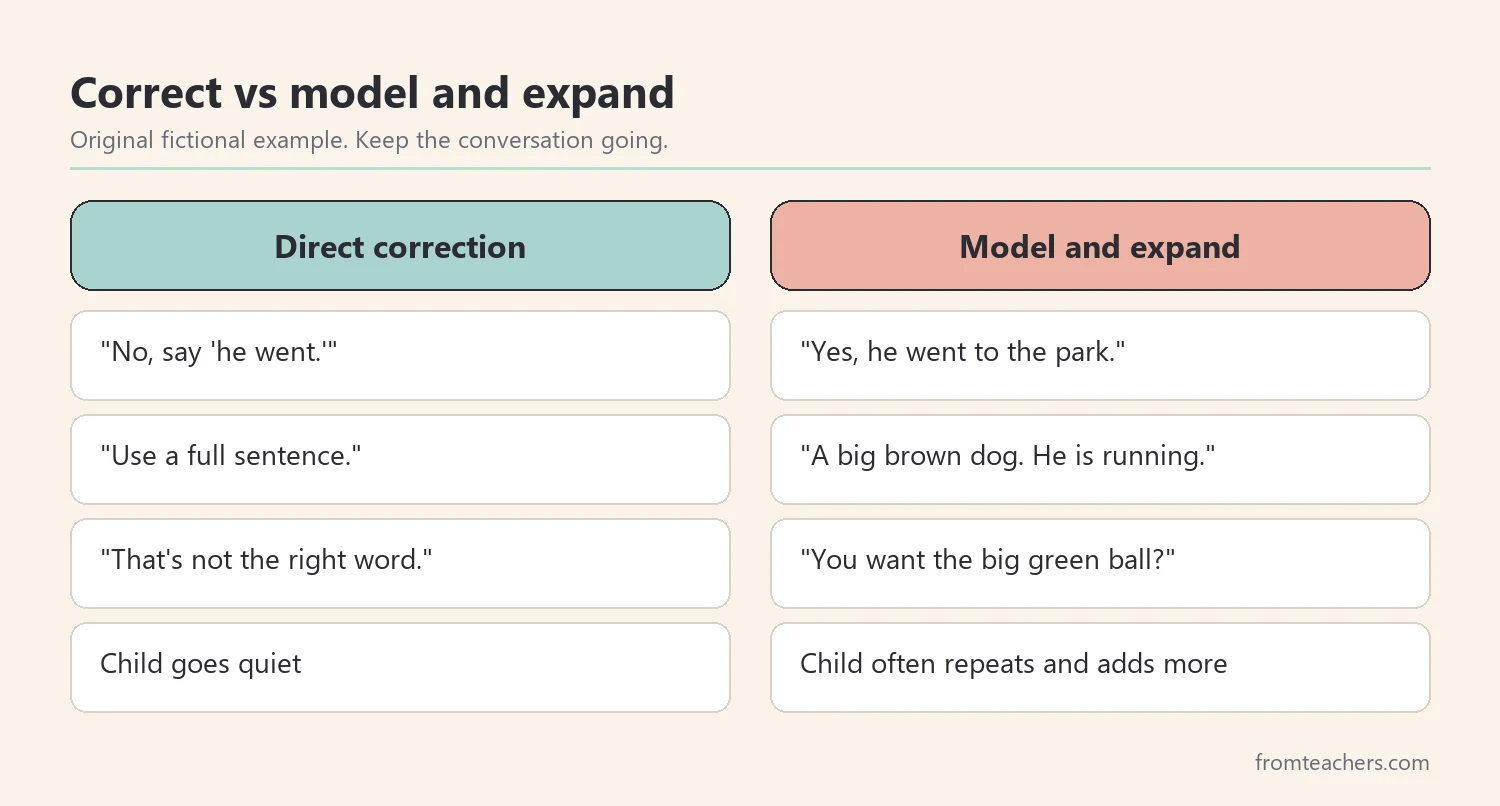
Ana used this approach with Sofia’s describing words. When Sofia said “I want that,” Ana replied “You want the big green ball?” Sofia often repeated the phrase, and over time she started using describing words on her own.
Also, keep the balance of talk in mind. Children need time to speak, not just to listen. Pause often, show interest, and let your child lead the topic sometimes. A conversation about dinosaurs or a favorite game often produces more language than any planned activity.
These are some of the simplest and most powerful language development activities at home, because they happen in every conversation without any special materials.
5. Work with the school team and notice progress
Home practice is most effective when it matches what happens at school. Therefore, stay in touch with your child’s teacher and SLP. Ask which goals they are working on and which strategies they use, so you can use the same ones at home.
A short note or message every few weeks is enough. For example: “Sofia is following most two-step directions at home now. What should we try next?” Teams usually welcome this kind of update, because it shows whether skills are carrying over beyond school.
Next, keep a simple record. A small notebook or a note on your phone works well. Once a week, note two or three examples related to your child’s goals. Over time, these notes show progress that is easy to miss day to day.
Here is Ana’s record for Sofia across six weeks:
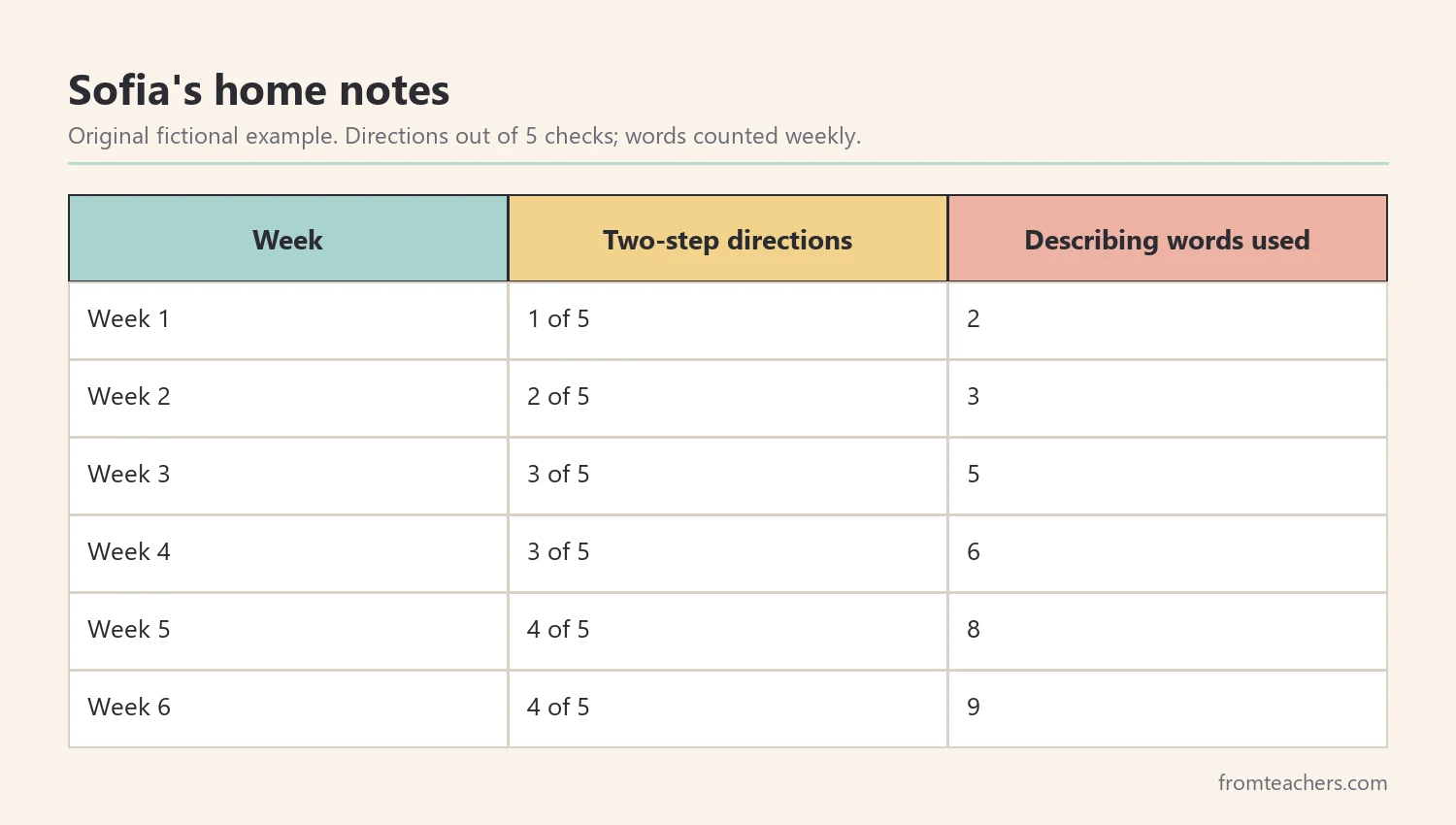
The record gave Ana and the SLP a shared picture. Two-step directions improved steadily, and describing words appeared more often. As a result, the SLP suggested adding a new home goal: telling a short story about the day in order.
In addition, involve the whole family. Siblings, grandparents, and babysitters can all use the same simple habits: getting attention first, keeping directions short, and modeling fuller sentences. When every adult and older child speaks in a similar way, your child gets far more practice than any single parent could provide.
Also, adjust when life gets busy. During hectic weeks, choose just one routine, such as the bedtime story, and keep it going. A small, steady habit protects progress better than an ambitious plan that stops after a few days.
Moreover, notice what your child enjoys. Some children talk most while drawing, building with blocks, or walking outside. Follow those interests, because a child who is engaged will try harder with new words and longer sentences.
Similarly, bring the school vocabulary home. If the class is studying weather or plants, ask the teacher for a short word list. Use those words at home, during walks or while cooking, so your child hears them in more than one place and remembers them more easily.
Finally, celebrate effort. Language growth can be slow, and children notice when adults are pleased with their efforts. Praise trying, not just getting it right: “I love how you told me about your picture.”
If you have ongoing concerns about your child’s speech, language, or hearing, talk with the school team or your pediatrician. They can advise whether an evaluation or other support would help.
Common mistakes and how to avoid them
- Turning practice into drills. Long sessions can make children avoid talking. Fix: use short moments in everyday routines.
- Correcting every mistake. Frequent correction can reduce talking. Fix: model and expand instead.
- Giving long, complex directions. Too many words at once are hard to process. Fix: keep directions short, in order, with gestures.
- Answering for your child. Jumping in removes chances to speak. Fix: wait a few seconds before helping.
- Practicing different goals than school. Mixed messages slow progress. Fix: ask the SLP which skills to practice at home.
Questions parents ask about language development activities at home
How much time should we spend on language practice each day?
There is no fixed amount. Short, frequent moments woven into routines are often more effective than long sessions. Ask your child’s SLP what they recommend for your child.
Should I use flashcards?
They can help with specific vocabulary, but real conversations and play usually build broader language. If you use flashcards, keep sessions short and link words to real objects and experiences.
My child uses a communication device or picture board. Can I still do these activities?
Yes. Model language on the device or board as you talk, and give your child chances to use it during routines. Ask the SLP or AAC team for ideas specific to your child’s system.
Can screen time help language development?
Watching together and talking about what you see can help. However, back-and-forth conversation with adults usually offers more practice than watching alone. Balance screens with plenty of talk and play.
What if my child speaks more than one language?
Speaking your home language is valuable. Rich language in any language supports overall development. Share information about your child’s languages with the school team so they can plan support accordingly.
Related reading: How Teachers Communicate With Parents in Special Education, How Parents and Teachers Can Team Up for Special Education Success, and Boost Access and Independence: An Assistive Technology Toolkit.
You may also need: Vocabulary Development Intervention Plans.
A companion resource for language development activities at home:
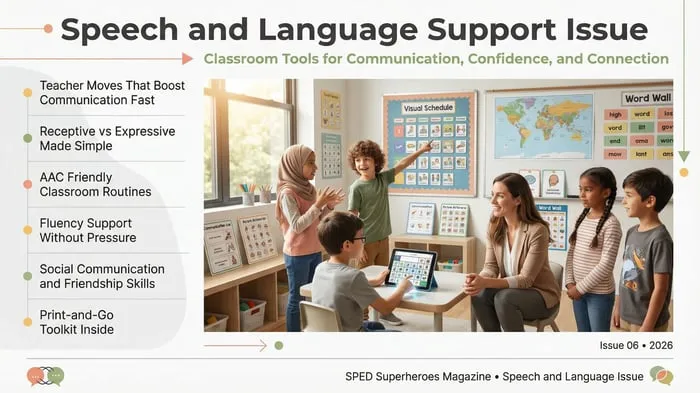
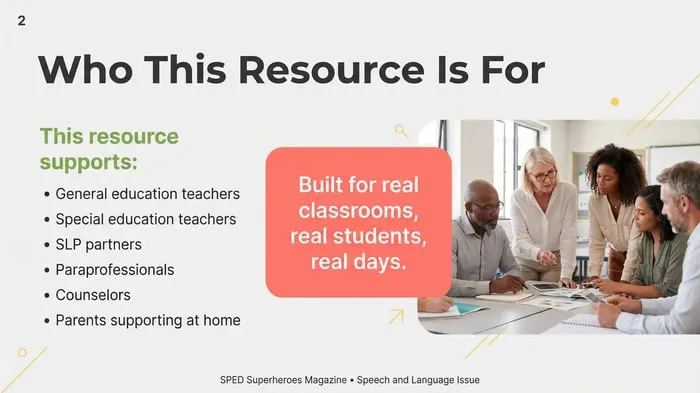
Speech and Language Toolkit: AAC, Receptive and Expressive Support: a 49-page guide for K to 8 teams with sections on receptive and expressive language, sentence frames, vocabulary routines, speech sounds and fluency, social communication, AAC basics, and parent communication.
Sources and scope
- American Speech-Language-Hearing Association (ASHA): information for families on speech and language development and disorders.
- National Institute on Deafness and Other Communication Disorders (NIDCD): research-based information on speech, language, and hearing.
- CDC Learn the Signs. Act Early.: developmental information and guidance on when to talk with a doctor.
- Understood.org: family-friendly explanations of language and learning differences.
This guide covers everyday home activities that support language. It does not cover assessment, diagnosis, or speech therapy, which belong to qualified speech-language pathologists and health professionals.
Key takeaways
- Language development activities at home work best inside everyday routines.
- Short directions, gestures, and wait time support understanding.
- Modeling and expanding build expressive language without pressure.
- Matching home practice with school goals speeds progress.
- Simple weekly notes help you and the SLP see growth.






Leave a Comment