

A parent input statement gives you a clear, calm way to be heard at your child’s IEP meeting. Picture a parent sitting at a long table with six school staff, a stack of reports, and a meeting that is already running late. When the chair asks, “Anything to add?” the most important points can vanish in the moment.
This guide shows you how to prepare one page that the team can read, discuss, and attach to the record. You will gather your notes, describe your child’s strengths, name your concerns with examples, set your priorities, then edit and share the statement. By the end, you will have a finished draft and a simple method you can reuse every year.
Examples are fictional. Adapt to your child’s goals and agreed supports. This is guidance, not legal advice or a diagnosis.
At a glance
- Write your statement before the meeting, not during it.
- Open with strengths so the team sees the whole child.
- Describe concerns with short, real examples from home.
- Pick two or three priorities instead of a long wish list.
- Send it ahead of time and ask that it be added to the IEP.
1. Gather your notes before you write
First, collect what you already have. A strong parent input statement grows out of real observations, not memory on the morning of the meeting. Start a folder or notebook about two to three weeks before the meeting date.
Next, pull together the basics: the current IEP, recent progress reports, report cards, and any notes or emails from teachers and therapists. In addition, add your own observations from home, such as how homework goes, how your child talks about school, and what has changed since last year.
Then, ask your child. Even young children can answer simple questions like “What is the best part of school?” and “What is hard?” Older students may want to write a few lines of their own. Their words often make the statement more powerful.
Also, keep your notes short and dated. One line per observation is enough, for example “Tuesday: reading log took 35 minutes, asked to stop twice.” Later, these dated lines become the examples in your parent input statement, and they show the team that the pattern is real rather than a single bad night.
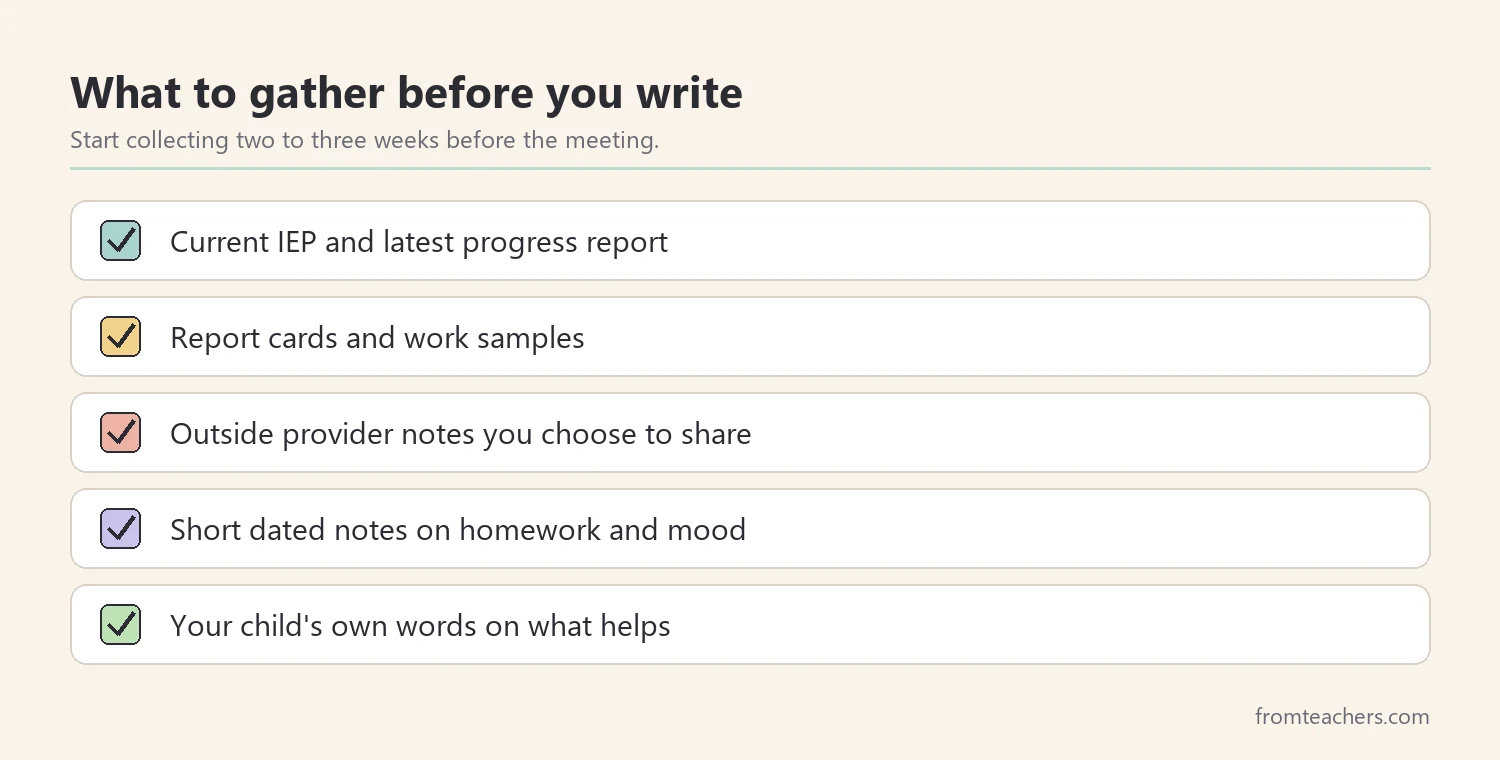
What to gather
- The current IEP and the most recent progress report.
- Report cards and samples of schoolwork.
- Notes from outside providers, if you choose to share them.
- Your own short notes on homework, routines, and mood.
- Your child’s answers about what helps and what is hard.
Worked example. Nora is a fictional third grader with an IEP for reading. Three weeks before her annual meeting, her mother opens a notebook. She copies two lines from the last progress report, saves three homework samples, and writes down what Nora says: “I like science, but reading out loud is scary.”
In short, good notes make the writing quick. As a result, your parent input statement will rest on specific moments the team can picture.
2. Start with your child’s strengths
Open your parent input statement with who your child is. Teams spend a lot of time on test scores and deficits, so a short paragraph about interests, talents, and personality helps everyone see the whole child. It also sets a warm, cooperative tone.
Keep this section to three or four sentences. Mention what your child enjoys, what they are proud of, and what motivates them. Also, include strengths that can be used at school, such as a love of drawing that could support writing, or a strong memory for facts.
Next, add one or two things that have gone well this year. Specific progress, even small, shows that you notice the team’s work. For example, “She now reads her bedtime book to her brother” says more than “Reading is getting better.”
| Instead of | Try |
|---|---|
| She is a good kid. | She is kind to younger children and loves to help. |
| He likes computers. | He builds simple games and explains them step by step. |
| Reading is better. | She now reads a short picture book aloud at home. |
Worked example. Nora’s mother writes: “Nora is curious, funny, and loves science experiments. She is proud of her rock collection and can name each rock. This year she started reading short books aloud to her little brother at bedtime, which she would not do last spring.”
Finally, read the paragraph aloud. If it sounds like your child, it is ready.
However, do not skip this section because time feels short. Strengths are often the bridge to solutions. When the team knows Nora loves science, for instance, they can use science texts to practice reading. A parent input statement that starts with strengths gives the team ideas, not only problems.
3. Name your concerns with real examples
Now, move to what worries you. This is the heart of the parent input statement, and specific examples make it useful. A concern the team can picture is much easier to discuss than a general feeling that “things are not going well.”
For each concern, write what you see, when it happens, and what it seems to affect. Keep a calm, factual tone. Therefore, describe behavior and results rather than blaming a person or a class.
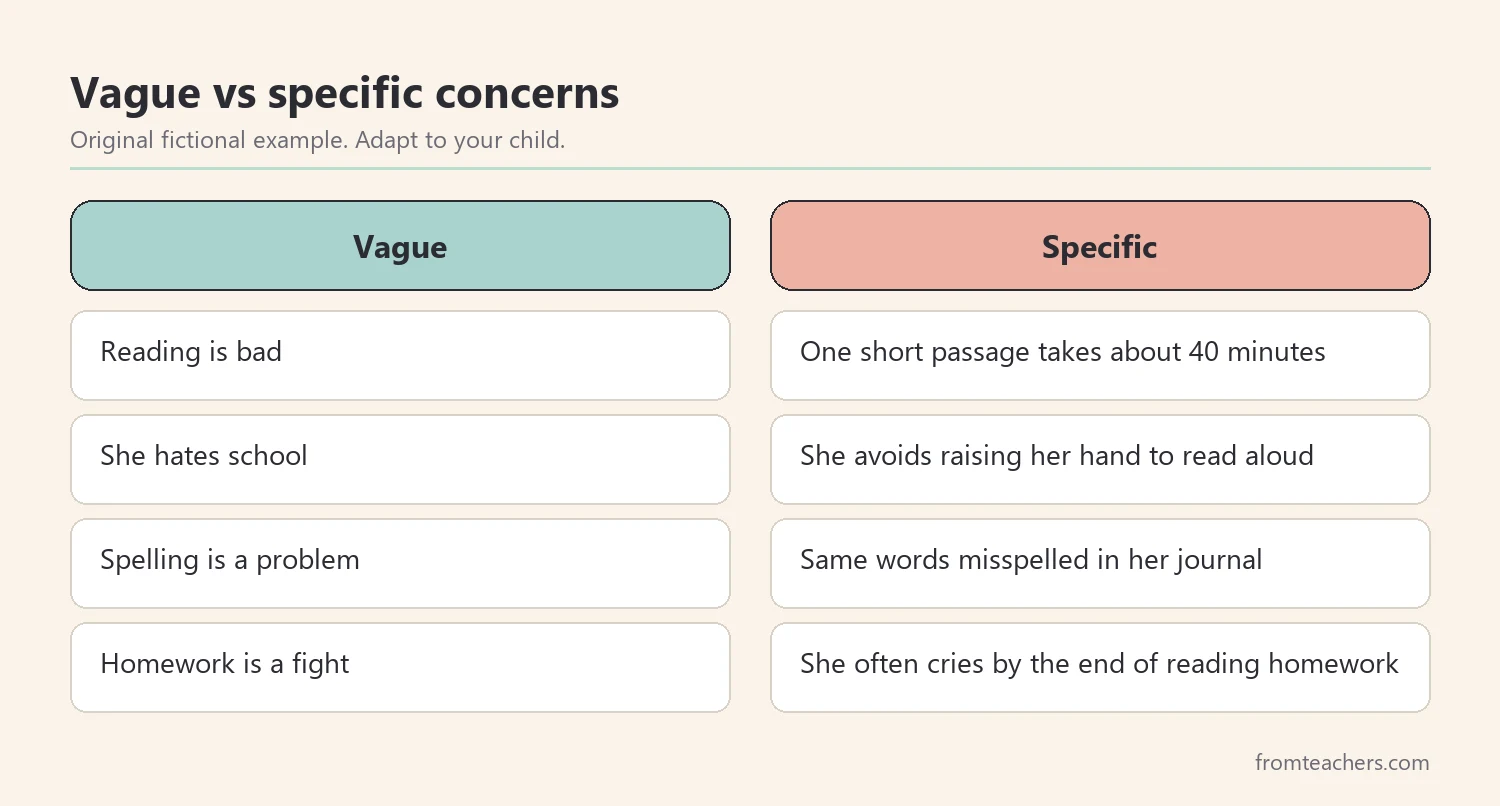
Also, separate school concerns from home concerns, and note any overlap. For instance, homework that takes two hours may connect to reading speed, attention, or understanding of directions. You do not need to know the cause. Simply describe the pattern and ask the team to help explain it.
If you want structured help with this part, the IEP Meeting Preparation Guide for Parents walks through understanding the IEP document, six weeks of preparation, strategies during the meeting, and follow-through afterward.
Worked example. Nora’s mother lists three concerns. First, reading homework takes about 40 minutes for one short passage, and Nora often cries by the end. Second, Nora says she skips raising her hand because she is afraid of reading aloud. Third, her spelling tests improve, but she still misspells the same words in her journal.
In other words, each concern is short, real, and easy to discuss. Because every example names a time and a result, the team can compare it with what they see at school.
Moreover, keep the concerns section to the points that matter most this year. A parent input statement with three clear concerns is easier to act on than one with ten. You can keep the rest in your notes and raise them at a later meeting or in an email to the teacher.
4. Set two or three priorities for your parent input statement
Next, turn concerns into priorities. A long wish list is hard for any team to act on, while two or three clear priorities can shape goals, services, and supports. So, ask yourself which changes would make the biggest difference this year.
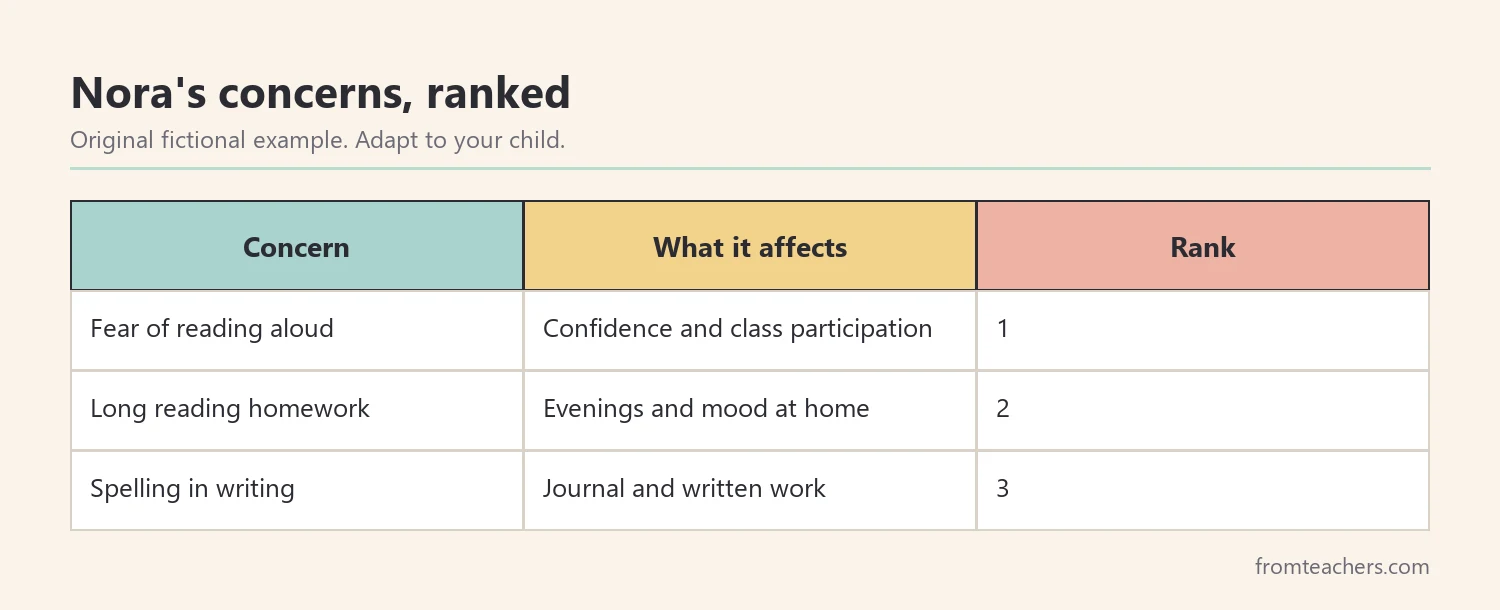
Rank your concerns by impact. Consider how much each one affects learning, confidence, friendships, and daily life at home. Then, choose the top two or three and write each as a hope, not a demand. For example, “I would like Nora to feel safe reading in class” invites discussion.
Also, include questions you want answered. Questions are a respectful way to raise topics you are unsure about, such as whether a different reading approach or an assistive technology tool might help. In addition, they give the team a clear reason to bring information to the meeting.
Finally, add a sentence about the long view. Where do you hope your child will be in a year? Your parent input statement can connect this year’s priorities to that bigger picture.
For older students, this is also a natural place to mention interests that might shape transition planning later. For younger children, it may be as simple as hoping they enjoy school and make a friend. Either way, the long view reminds everyone why the details matter.
Worked example. Nora’s mother ranks reading confidence first, homework time second, and spelling in writing third. She writes two priorities: “I would like Nora to feel safe reading in class, and I would like homework to take closer to 20 minutes.” She adds one question: “Could audiobooks or text-to-speech help her keep up with science reading?”
5. Edit, share, and follow up on the statement
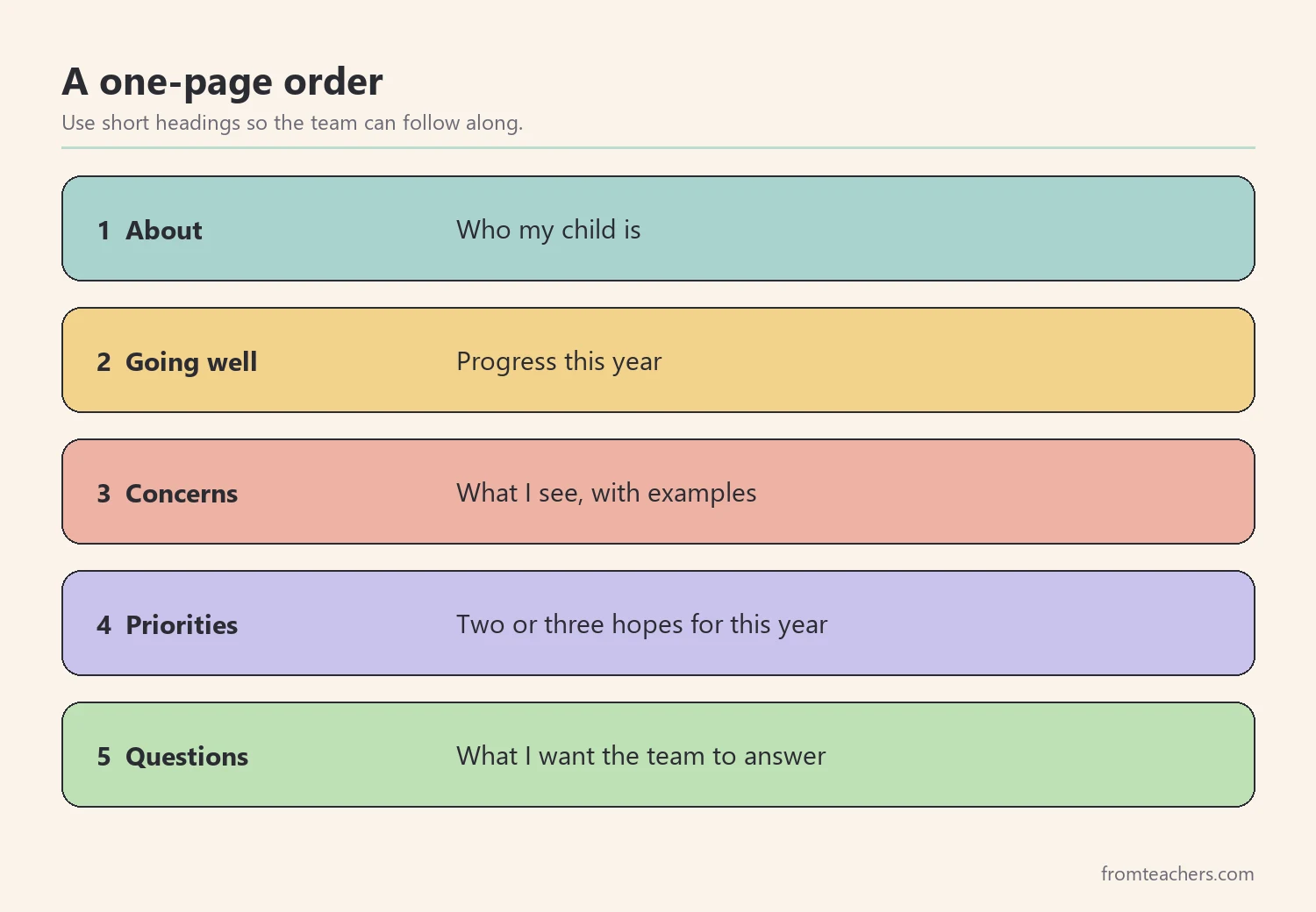
Now, put the pieces in order and trim. A good parent input statement fits on one page. Use short paragraphs or headings: about my child, what is going well, my concerns, my priorities, and my questions. Then, read your parent input statement once for tone and once for length.
Next, send the statement to the case manager a few days before the meeting. Ask that it be shared with the team and added to the parent concerns section of the IEP. Also, bring printed copies in case someone has not read it.
During the meeting, refer to your page. When a goal or service is discussed, connect it to your priorities: “This goal fits my first priority. How will we measure it?” In addition, take notes on what the team agrees to do.
Afterward, follow up. Check that your statement appears in the final IEP and that agreed actions have names and dates. Keep a copy in your folder so next year’s version starts from this one.
Then, check in a few weeks later. A short email asking how the new supports are going keeps the conversation open. As a result, your next parent input statement can report what changed, what helped, and what still needs work.
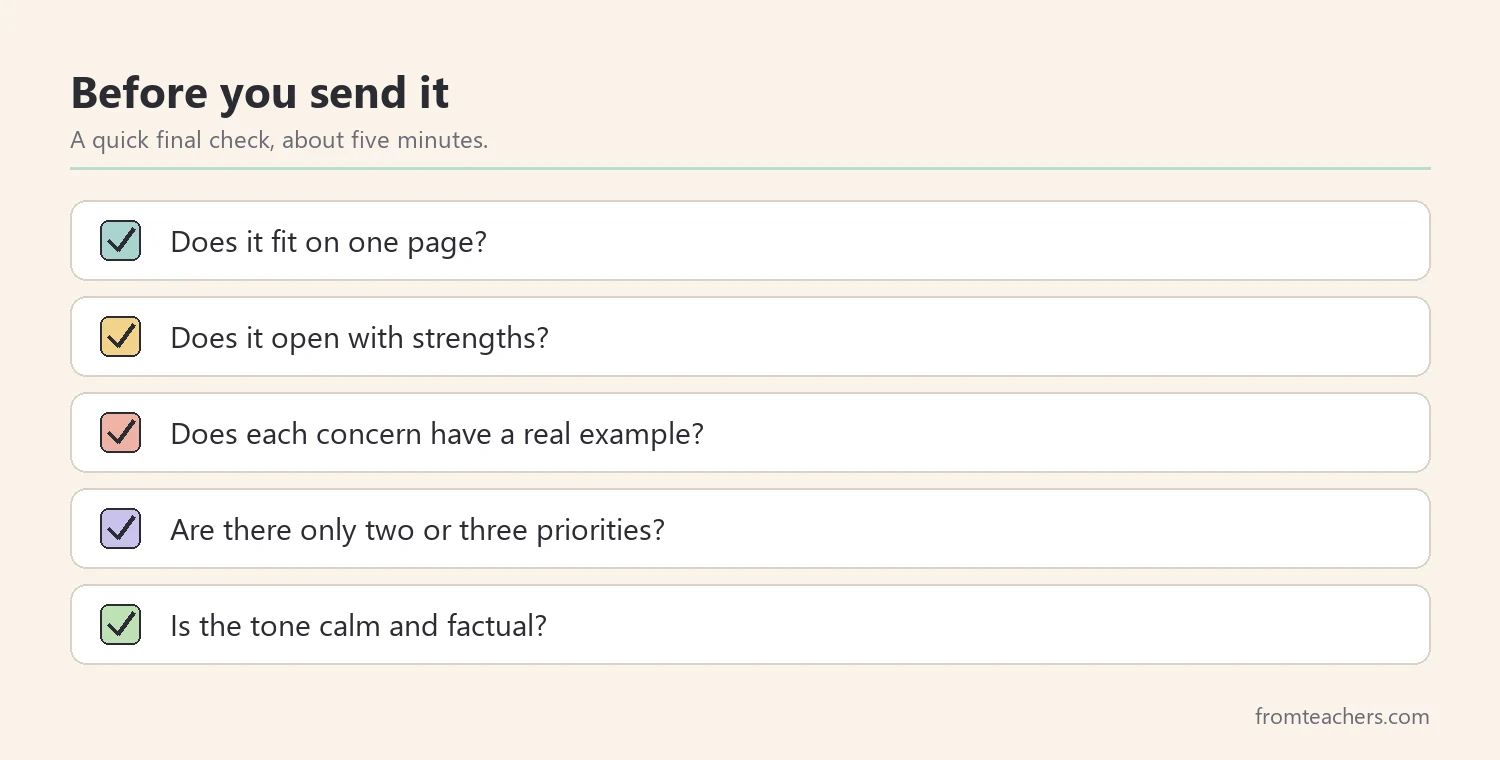
Worked example. Nora’s mother trims her draft to one page and emails it to the case manager four days before the meeting. At the meeting, the team discusses her two priorities first. The final IEP includes her statement, a reading goal, and a trial of text-to-speech for science, which she notes in her folder.
Common mistakes and how to avoid them
- Writing the parent input statement the night before. Rushed drafts miss key examples. Fix: start a notes folder two to three weeks ahead.
- Skipping strengths. A list of problems hides the whole child. Fix: open with a short paragraph on interests and progress.
- Vague concerns. “Reading is bad” is hard to act on. Fix: describe what you see, when, and what it affects.
- Too many priorities. Ten requests compete for attention. Fix: choose two or three and save the rest for later.
- An angry tone. Blame can make teams defensive. Fix: describe patterns and ask questions.
- Not checking the final IEP. Statements sometimes get left out. Fix: ask that the parent input statement be added and confirm it afterward.
Questions teachers and parents ask about a parent input statement
Does the school have to consider my statement?
Under IDEA, parents are members of the IEP team, and the team must consider parent concerns when developing the IEP. A written parent input statement makes your concerns easy to include. If you have questions about your rights, your state’s parent center can help.
How long should a parent input statement be?
One page is usually enough. Short paragraphs or headings make it easy to read during a busy meeting. If you need more space, attach supporting notes separately.
Can my child help write it?
Yes. Many families include a few lines in the child’s own words. Older students can write their own section, which builds self-advocacy skills.
Should I share private medical or family details?
Share only what helps the team support your child at school. You decide what to include. If something is sensitive, you can discuss it privately with the case manager.
Do I need a new statement every year?
Yes, update it before each annual review and before any meeting where big changes are planned. Start from last year’s version and change what is new. That way, the record shows how your child has grown.
Related reading: How Parents and Teachers Can Team Up for Special Education Success, How Teachers Communicate With Parents in Special Education, and Accommodations vs Modifications in Special Education: The Difference Explained.
A companion resource for a parent input statement:

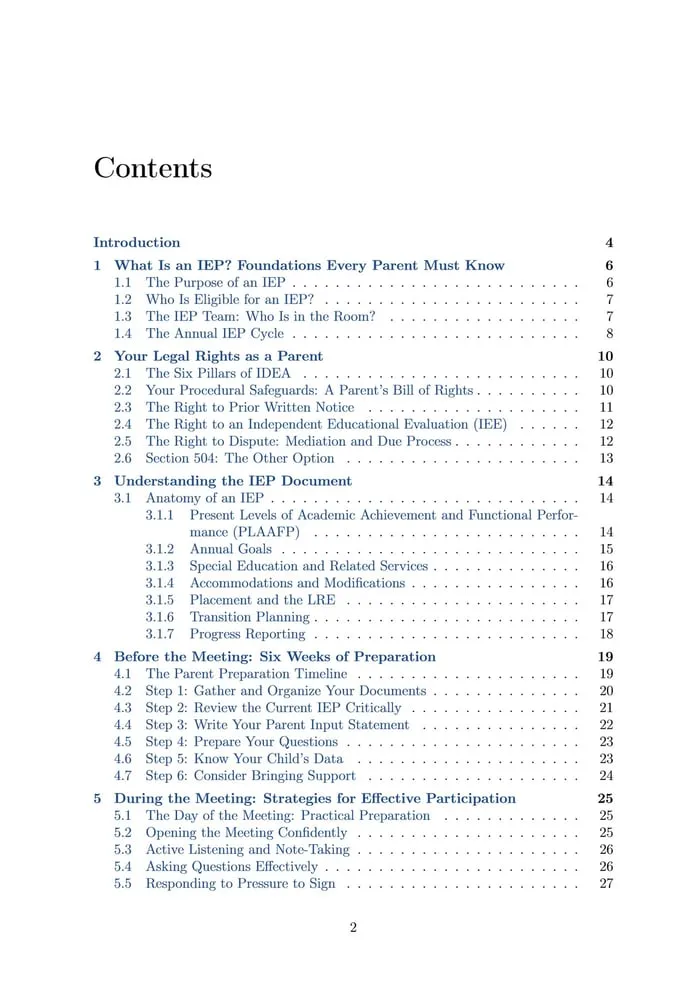
IEP Meeting Preparation Guide for Parents: a 60-page guide covering IEP foundations, your rights as a parent, understanding the IEP document, six weeks of preparation, strategies during the meeting, follow-through, difficult situations, transition planning, and self-advocacy.
Sources and scope
- IDEA, U.S. Department of Education: the law behind special education services, IEPs, and parent participation.
- Center for Parent Information and Resources: information for families and a way to find your state’s parent training and information center.
- IRIS Center, Vanderbilt University: free modules on IEPs and family collaboration.
- Understood.org: practical articles for families on IEP meetings and learning differences.
This guide covers preparing and sharing a written parent statement for IEP meetings. It does not cover legal disputes, evaluations, or eligibility decisions, which belong to the IEP team and, when needed, qualified advocates or attorneys.
Key takeaways
- A parent input statement turns your observations into one clear page.
- Open your parent input statement with strengths and recent progress.
- Describe concerns with short, specific examples.
- Choose two or three priorities and add your questions.
- Send your parent input statement early, ask that it be included, and check the final IEP.










Leave a Comment