

Math self-talk can turn the most common phrase in a word problem lesson, “I don’t know how to start,” into a quiet plan a student follows alone. Picture a fifth grader staring at a three-sentence problem. She knows how to divide and multiply, yet she waits for an adult to tell her which one to use.
This guide gives you five practical steps: choose a short script, model it out loud, practice with a cue card, fade your support, and track progress with the student. By the end, you will be able to teach students a repeatable inner voice for word problems, so they start, work, and check without waiting for you.
Examples are fictional. Adapt to the student’s goals and agreed supports. This is guidance, not a diagnosis.
At a glance
- Self-talk is a short set of questions a student asks herself while solving.
- Students learn it best when they first hear an adult think aloud.
- A small cue card supports practice, then fades away.
- The goal is independence: starting, solving, and checking without help.
- One simple weekly record shows whether the strategy is working.
1. Choose a short math self-talk script
First, decide what the student will actually say to herself. A script that is too long becomes another thing to remember. Therefore, aim for four or five short questions that cover the whole problem, from reading to checking.
A good math self-talk script follows the natural order of solving. It starts with understanding the question, moves to finding the useful numbers, then to choosing a plan, solving, and checking. Each line should be a question the student can answer in a few words.
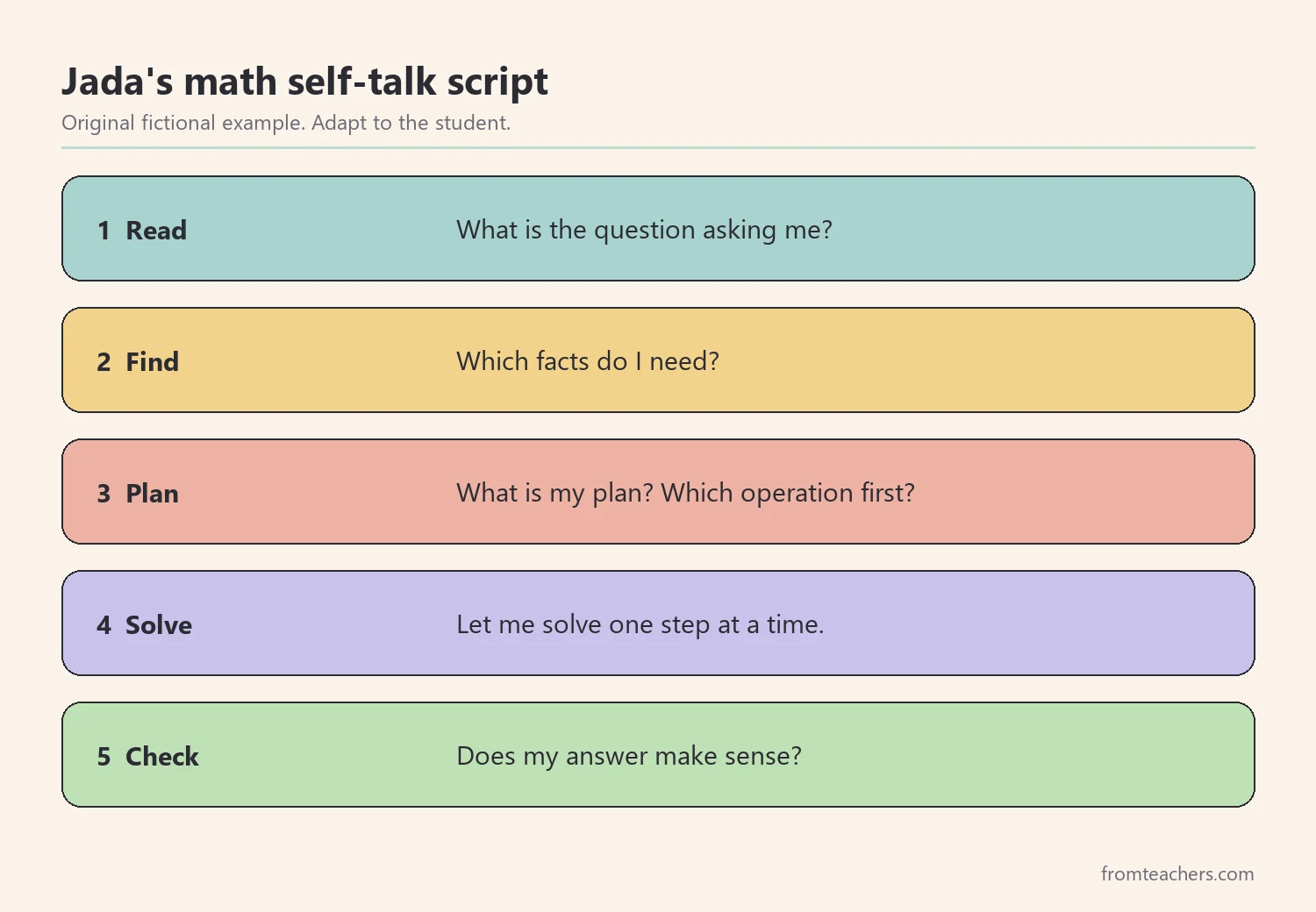
Also, write the script in the student’s voice. “What is the question asking me?” feels more personal than “Identify the question.” In addition, keep the same wording every time, so the words become automatic.
| Script line | What it helps with |
|---|---|
| What is the question asking me? | Knowing the goal before computing |
| Which facts do I need? | Ignoring extra information |
| What is my plan? | Choosing the operation or steps |
| Let me solve one step at a time. | Multi-step problems |
| Does my answer make sense? | Catching errors |
Why a script helps students who freeze
Many students who stall on word problems are not missing the math. Instead, they are missing a starting point. A fixed set of questions gives them that first move, so they do not have to invent a plan from nothing each time.
In addition, math self-talk turns a big, vague task into small, answerable parts. “Solve this problem” feels heavy. “What is the question asking me?” feels possible. As a result, the student spends less energy worrying and more energy thinking.
Finally, a script is easy to share. When the classroom teacher, a support teacher, and a parent all use the same math self-talk lines, the student hears one consistent message instead of three different methods.
Worked example. Jada is a fictional fifth grader. She computes well but freezes at word problems. Her teacher chooses the five lines above, prints them on a strip, and tapes it inside Jada’s math folder. They agree to call it “my math voice.”
2. Model math self-talk with a think-aloud
Students cannot copy thinking they never hear, and math self-talk is thinking. So, the next step is to solve a problem in front of them while saying every line of the script out loud. This is called a think-aloud, and it makes invisible thinking visible.
Choose a problem slightly below the student’s current level, so attention stays on the self-talk rather than on hard math. Then, read the problem once, ask the first question aloud, and answer it. Point to the words or numbers as you talk.
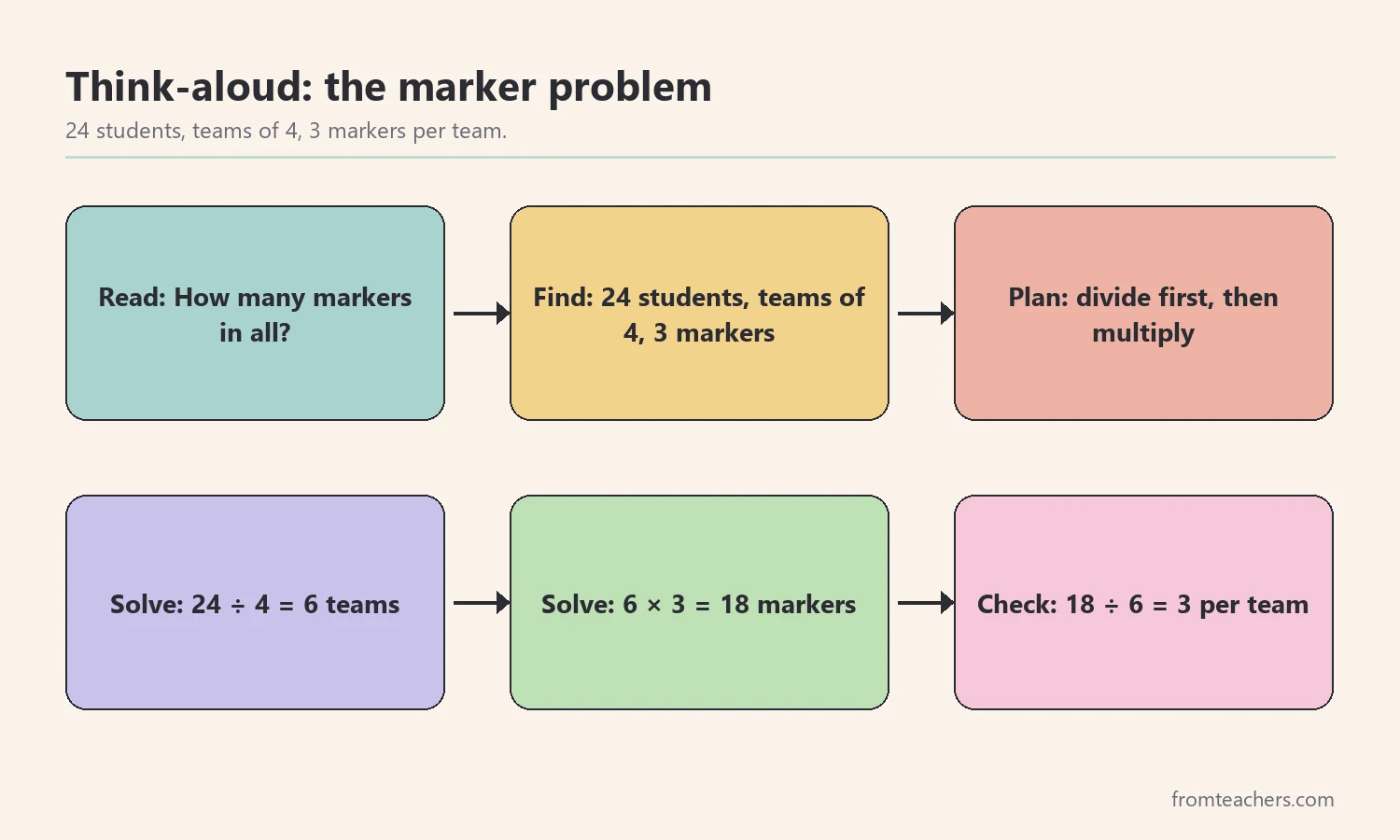
For example, use this problem: “A class has 24 students. They sit in teams of 4. Each team gets 3 markers. How many markers does the class need?”
Also, model a mistake on purpose sometimes. Say, “I’ll multiply 24 by 3. Wait, does that make sense? That is markers for every student, not every team.” When students see an adult catch an error calmly, checking feels normal instead of scary.
Next, repeat the think-aloud on two or three more problems over the following days. Change the story and the numbers, but keep the script lines exactly the same. In this way, students learn that the questions stay steady even when the problem changes. After a few rounds, pause before each line and let the group say it with you. That small shift moves ownership of the script from you to them, and it prepares students for the practice stage that follows.
Worked example. Jada’s teacher models the marker problem in a small group. She reads, asks “What is the question asking me?”, and underlines “How many markers.” She finds the facts 24, 4, and 3. Her plan is to divide first, then multiply: 24 divided by 4 is 6 teams, and 6 times 3 is 18 markers. Finally, she checks: 18 markers shared by 6 teams is 3 each, so the answer makes sense.
3. Practice with a cue card and guided prompts
After modeling, students need many short tries with support. In this stage, the student says the script quietly or in a whisper while you listen. A small cue card with the five questions stays on the desk.
Start with problems that use one operation, then move to two-step problems. Keep sessions short, about three or four problems, so practice stays focused. When the student skips a line, point to it on the card instead of telling the answer.
A ready-made set saves you from writing every prompt yourself. The word problem self-talk toolkit offers twenty tables written as “I struggle with…” statements, each paired with numbered solution steps and the expected result, covering key words, choosing the operation, extra information, and multi-step problems.
Guided prompts that keep thinking with the student
- “What does your card say to ask first?”
- “Which facts did you circle? Why those?”
- “Tell me your plan before you compute.”
- “How could you check that?”
In addition, praise the process, not only the answer. “You asked what the question wanted before you started” teaches more than “Good job.”
Worked example. Jada practices math self-talk with three problems a day for one week during small group. On day one, she skips the “Which facts do I need?” line twice. By day four, she whispers all five lines without looking at the card for the first problem.
4. Fade support so math self-talk becomes independent
Support that never leaves becomes a crutch. Therefore, plan how you will remove it from the start. Fading happens in small steps, and each step is a sign of real progress.
First, move from saying the script aloud to whispering it, and then to saying it silently. Next, shrink the cue card to one-word reminders, such as “Ask, Facts, Plan, Solve, Check.” Finally, remove the card for some problems while keeping it nearby.
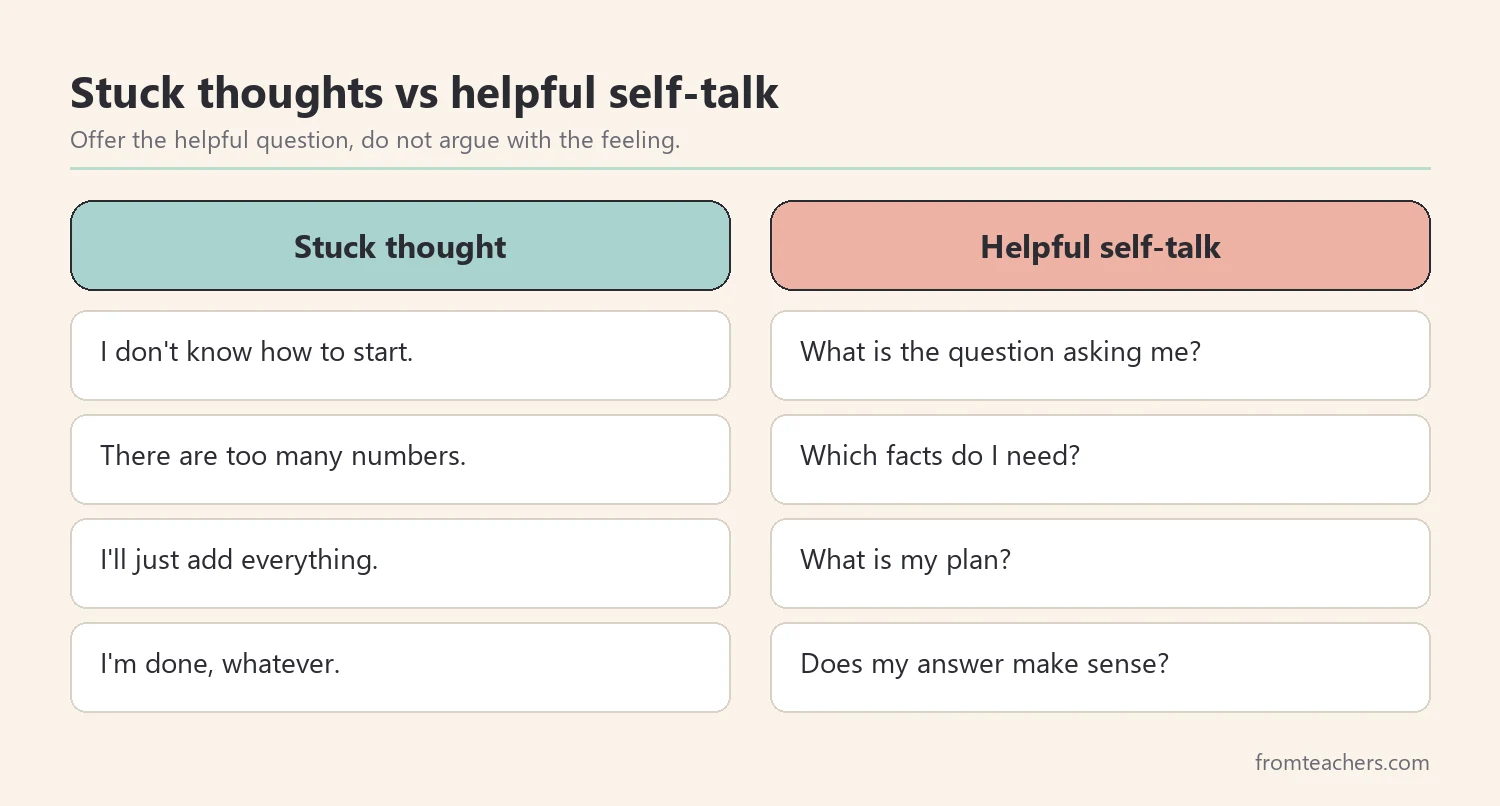
Also, pay attention to the emotional side. Some students already have a strong negative inner voice about math, such as “I’m bad at this.” Math self-talk gives them a calmer alternative. When you hear a stuck phrase, gently offer the matching helpful question instead of arguing with the feeling.
| Stage | Student says | Card |
|---|---|---|
| Guided | Aloud, with adult | Full questions |
| Partly independent | Whisper | One-word cues |
| Independent | Silently | Nearby, rarely used |
Worked example. In week three, Jada’s card becomes five single words. Her teacher stops sitting beside her and checks in only after the first problem. When Jada mutters “I can’t do this one,” her teacher points to the word “Facts” and walks away. Jada circles the numbers and starts.
5. Track progress and reflect with the student
Without a record, it is easy to miss slow progress. So, choose one simple measure linked to the original problem. For a student who freezes, the best measure is often how many problems she starts alone.
Use the same number of problems each week, so the numbers compare fairly. Record how many she started without help and how many she checked. In addition, add a short note about anything unusual, such as a new type of problem.
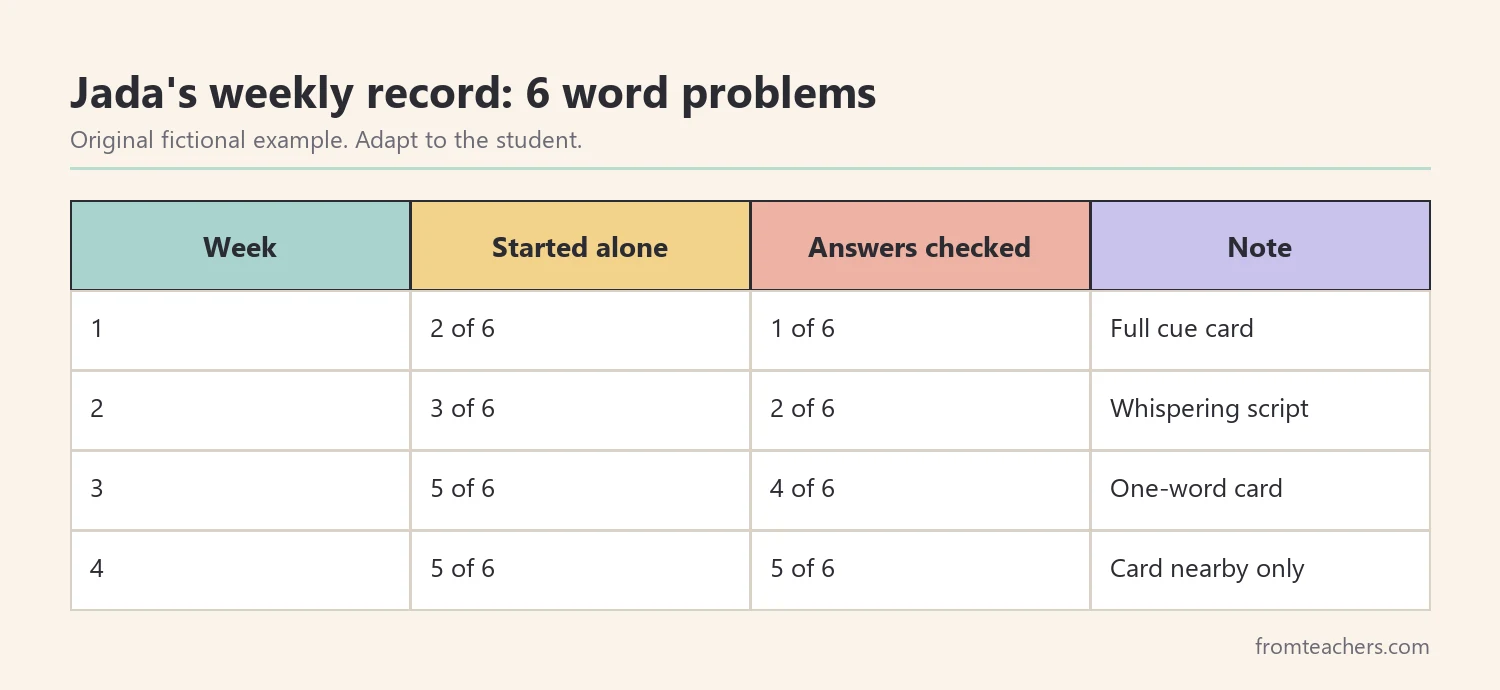
Then, look at the data together with the student, because math self-talk grows faster when students see it working. Ask what helped and what still feels hard. Students who see their own progress tend to trust the strategy more. Also, share the script with the family, so homework sounds like class.
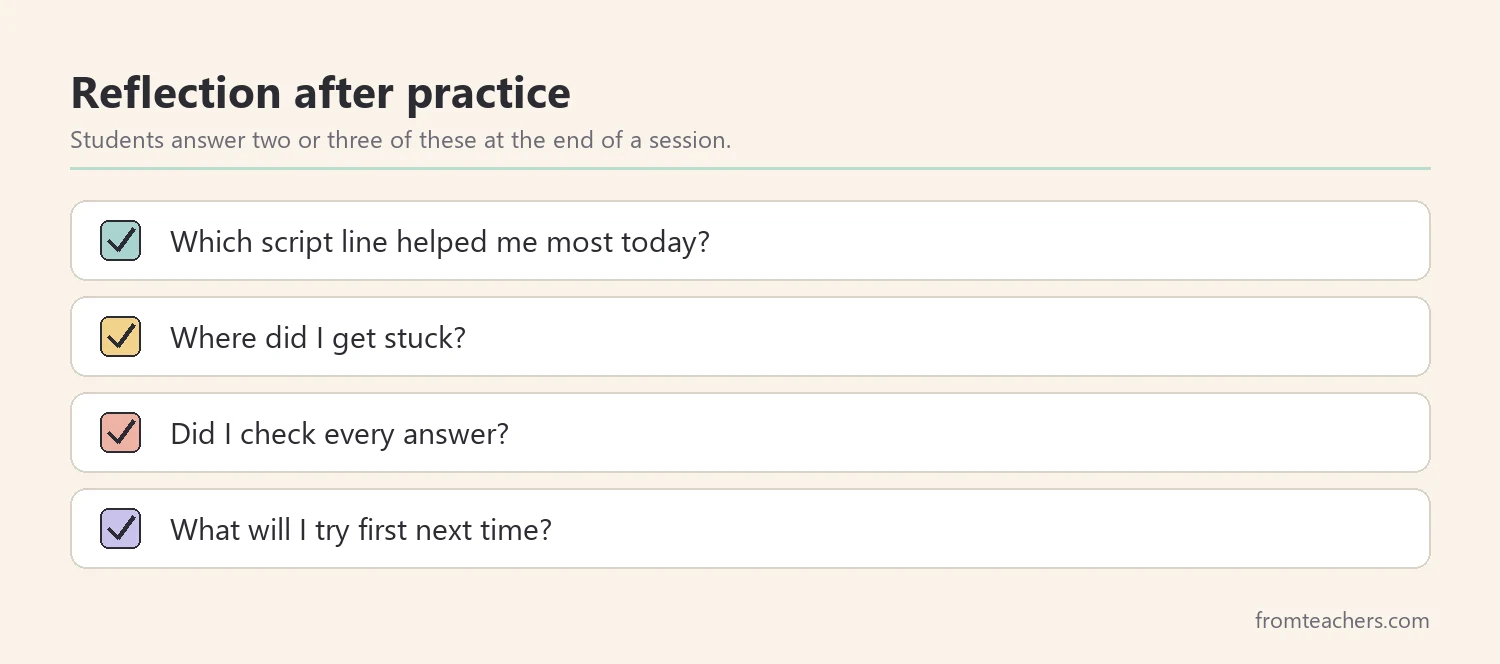
Worked example. Jada starts 2 of 6 problems alone in week one, 3 in week two, 5 in week three, and 5 in week four. She checks 1, 2, 4, and 5 answers over the same weeks. Her teacher shows her the record and asks which line helps most. Jada says, “Which facts do I need,” because it stops her from using every number.
Using math self-talk with the whole class
Although this guide follows one student, the same steps work for a whole class. Post the script on the wall, model it during the daily problem, and ask partners to whisper the lines to each other. Then, collect a quick exit ticket that asks students to write their plan before their answer.
Also, notice which students still wait for help. Those students may need the small group practice and cue card described above. Meanwhile, students who already use math self-talk well can add their own lines, such as “Do I need to estimate first?” or “Which unit goes with my answer?”
Over time, the class builds a shared language for problem solving. When you ask, “What does your math voice say next?”, every student knows what you mean, and math self-talk becomes part of how the room works.
Common mistakes and how to avoid them
- A script that is too long. Students forget it under pressure. Fix: keep math self-talk to four or five short questions.
- Skipping the think-aloud. Students cannot imitate what they never heard. Fix: model several problems before asking students to try.
- Telling the answer during practice. It teaches students to wait for you. Fix: point to the script line instead.
- Never fading the card. The card becomes a crutch. Fix: plan stages from aloud, to whisper, to silent.
- Relying only on key words. “Total” does not always mean add. Fix: ask what the question is asking before choosing an operation.
Questions teachers and parents ask about math self-talk
What grade levels is this approach good for?
It works well in upper elementary and middle school, where word problems become multi-step. Younger students can use a shorter script with pictures. Older students can add lines for units or estimation.
Will students feel silly talking to themselves?
Some might at first. Therefore, start with whispering in small groups and explain that adults use self-talk too. Over time, the talk becomes silent and nobody notices it.
How long until math self-talk becomes automatic?
It varies by student. Many need a few weeks of short daily practice before they use it without the card. Your weekly record will show when to fade support.
Can parents use the same script at home?
Yes, and it helps when they do. Share the exact wording, so homework help matches class. Ask parents to point to the script instead of solving the problem for their child.
Does math self-talk replace teaching math skills?
No. It helps students organize skills they already have. If a student cannot yet compute the steps, teach those skills alongside the self-talk.
Related reading: 5 Practical Teaching Tips to Boost Classroom Focus and Learning, Learning Styles Student Success Guide, and The Power of Data Tracking in Special Education.
A companion resource for math self-talk:
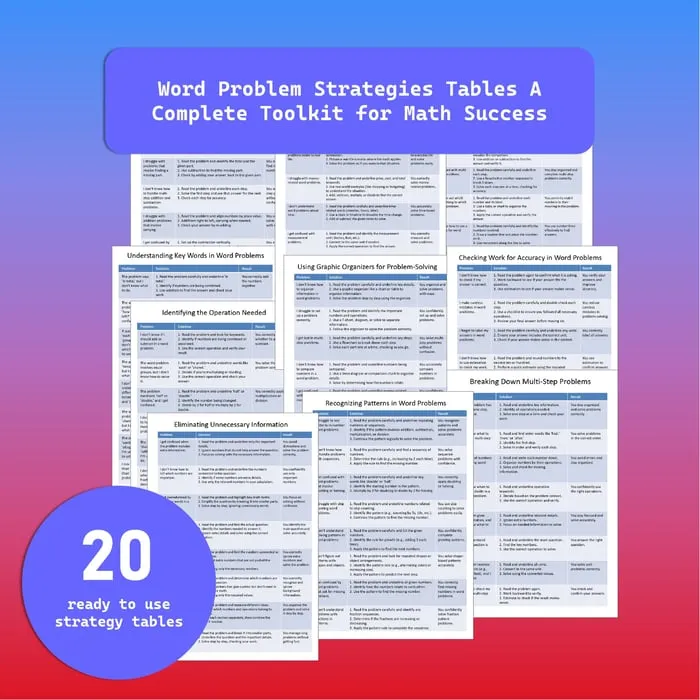
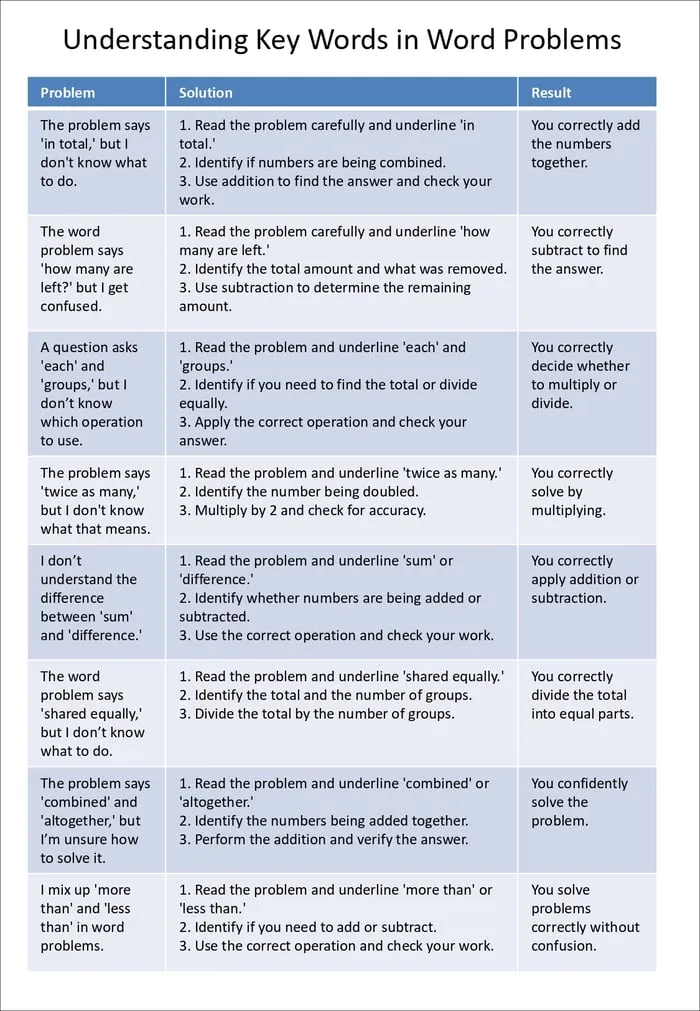
Word Problem Strategies: Student Self-Talk Toolkit: twenty printable strategy tables written in student voice, each pairing an “I struggle with…” statement with numbered solution steps and the expected result, for upper elementary through middle school.
Sources and scope
- National Council of Teachers of Mathematics: resources on problem solving and mathematics teaching.
- What Works Clearinghouse: practice guides and reviews of research on teaching math, including problem solving.
- IRIS Center, Vanderbilt University: free modules on math instruction and strategy teaching.
- Understood.org: practical articles for families and teachers on math difficulties.
This guide covers a classroom strategy for helping students organize their thinking on word problems. It does not cover assessment or diagnosis of math learning disabilities, which belong to qualified professionals.
Key takeaways
- Math self-talk is a short, fixed script of questions in the student’s own voice.
- Model it with think-alouds, including calm error checking.
- Practice with a cue card, then fade from aloud to whisper to silent.
- Track problems started alone and review the data with the student.
- Share the same script with families so home and school match.

Leave a Comment