

An ILP template earns its place on the first busy Monday of a new term, when a teacher needs to know what a student is good at, what he is working toward, and which supports are already agreed. Without one document, that information sits in emails, sticky notes, and someone’s memory. As a result, supports slip and progress becomes hard to show.
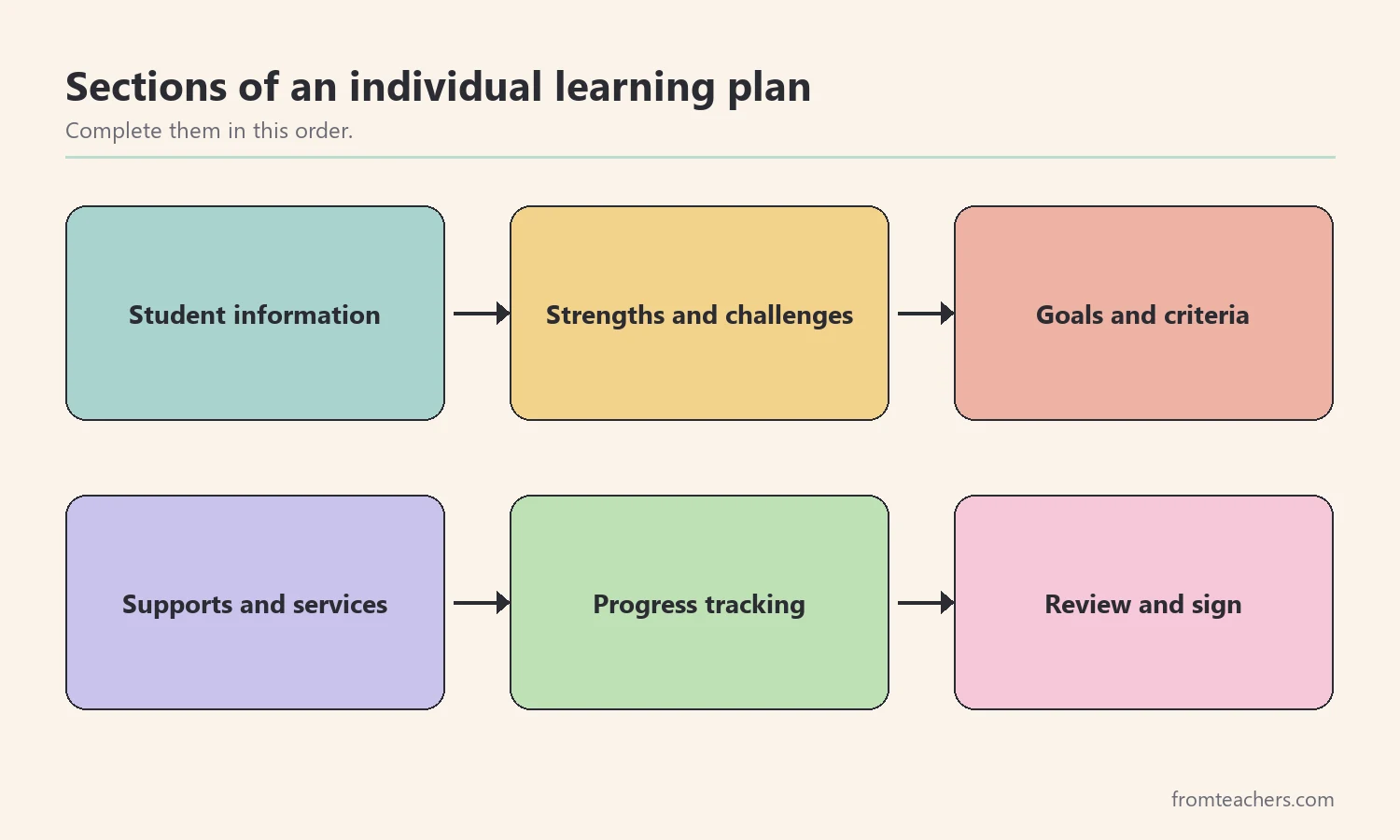
By the end of this guide, you will be able to complete each section of an individual learning plan, write goals with clear success criteria, list supports precisely, and keep progress notes that lead to decisions. Examples are fictional. Adapt to the student’s goals and agreed supports. This is guidance, not a diagnosis.
At a glance
- Gather work samples, notes, and family input before you write.
- Lead with strengths, then name challenges in observable terms.
- Give each goal a strategy, a success criterion, and a timeframe.
- List supports specifically: who, what, where, and how often.
- Use the progress table to record a next step, not just a note.
1. Gather information before you open the ILP template
First, collect what you already know. An ILP template is only as useful as the information you bring to it. Before writing a single goal, pull together recent work samples, assessment results, attendance notes, and observations from other teachers.
Next, ask the family and the student. Families often know which strategies work at home, and students can say what feels hard. A short conversation or a three-question form is enough. For example: What is going well? What is difficult? What would you like to get better at this year?
Then, check what plans already exist. If the student has an IEP or a 504 plan, the ILP should match those agreed supports, not replace or contradict them. In many schools, an individual learning plan sits alongside formal plans as a working classroom document.
| Source | What to bring |
|---|---|
| Work samples | Two or three recent pieces per subject |
| Assessments | Latest scores and teacher notes |
| Colleagues | One strength and one concern each |
| Family and student | Answers to three short questions |
| Existing plans | Agreed accommodations and services |
Worked example. Jonah is a fictional student in grade 6. His teacher gathers two writing samples, his reading check from last month, and notes from his math and science teachers. His mother shares that he reads comics happily at home but avoids long chapters. Jonah says writing paragraphs is the hardest part of school. Now the teacher has enough to fill the ILP template with real evidence.
2. Write strengths and challenges in the ILP template
Next, fill in the student information and the strengths and challenges section. Start with strengths, because they shape every strategy you choose later. A strength might be an interest, a skill, a learning preference, or a habit, such as “asks for help when stuck.”
Then, describe challenges as things you can see, not labels. “Writes one or two sentences when a paragraph is expected” is useful. “Lazy writer” or “weak in English” is not. Clear wording helps every adult who reads the ILP template understand the same picture.
Also, keep the section short. Three or four strengths and two or three priority challenges are plenty. If the list grows long, the plan loses focus.
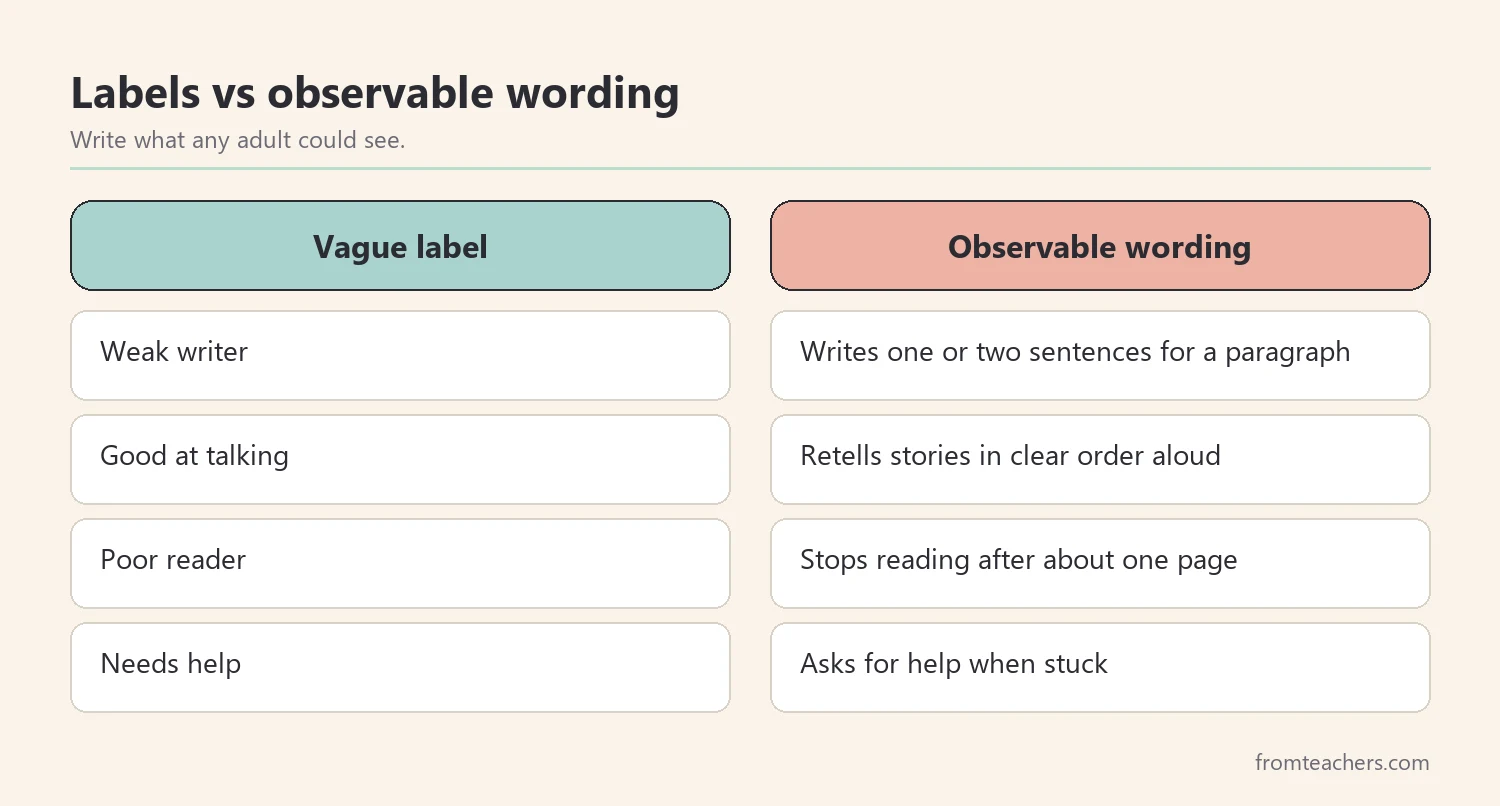
Worked example. In Jonah’s ILP template, the strengths section reads: strong oral storytelling, enjoys comics and graphic novels, works well with a partner, and follows a checklist once it is taught. The challenges section reads: writes one or two sentences when a paragraph is expected, and stops reading longer texts after about one page. Each line points toward a strategy.
Also, involve the student when you can. A student who helps name a strength is more likely to use it. For example, ask: When do you feel most confident in class? What helps you get started on hard work? Short answers in the student’s own words can go straight into the plan.
In short, strengths tell you how the student learns, and challenges tell you where to aim.
3. Set goals with strategies, success criteria, and timeframes
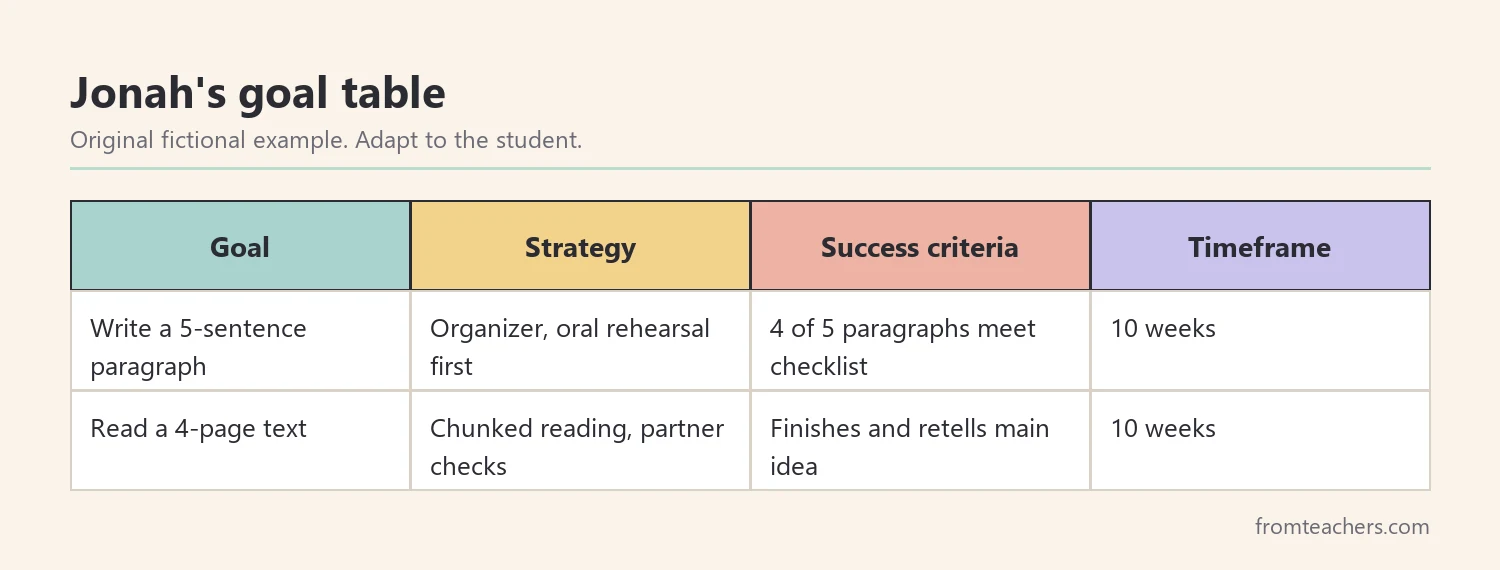
Now move to the goal-setting table. A good ILP template asks for more than a goal. It also asks how you will teach it, how you will know it worked, and by when. Those four columns turn a wish into a plan.
Write the goal so an observer could check it. Then choose one or two strategies that use the student’s strengths. Next, define success criteria with a number or a clear standard. Finally, set a realistic timeframe, often one term or about eight to twelve weeks.
| Goal | Strategy | Success criteria | Timeframe |
|---|---|---|---|
| Write a 5-sentence paragraph | Graphic organizer, oral rehearsal first | 4 of 5 paragraphs meet the checklist | 10 weeks |
| Read a 4-page text with stamina | Chunked reading, partner check-ins | Finishes and retells main idea | 10 weeks |
Keep the number of goals small. Two or three goals per term are easier to teach and track than six. In addition, link each goal to a challenge you named in step 2, so the ILP template reads as one connected story.
Worked example. Jonah’s writing goal uses his storytelling strength: he tells the paragraph to a partner first, then fills a five-box organizer. His success criterion is that 4 of 5 paragraphs meet a short checklist. His reading goal uses comics-style chunking: a four-page text split into four one-page sections with a quick partner check after each.
4. List accommodations, modifications, and services clearly
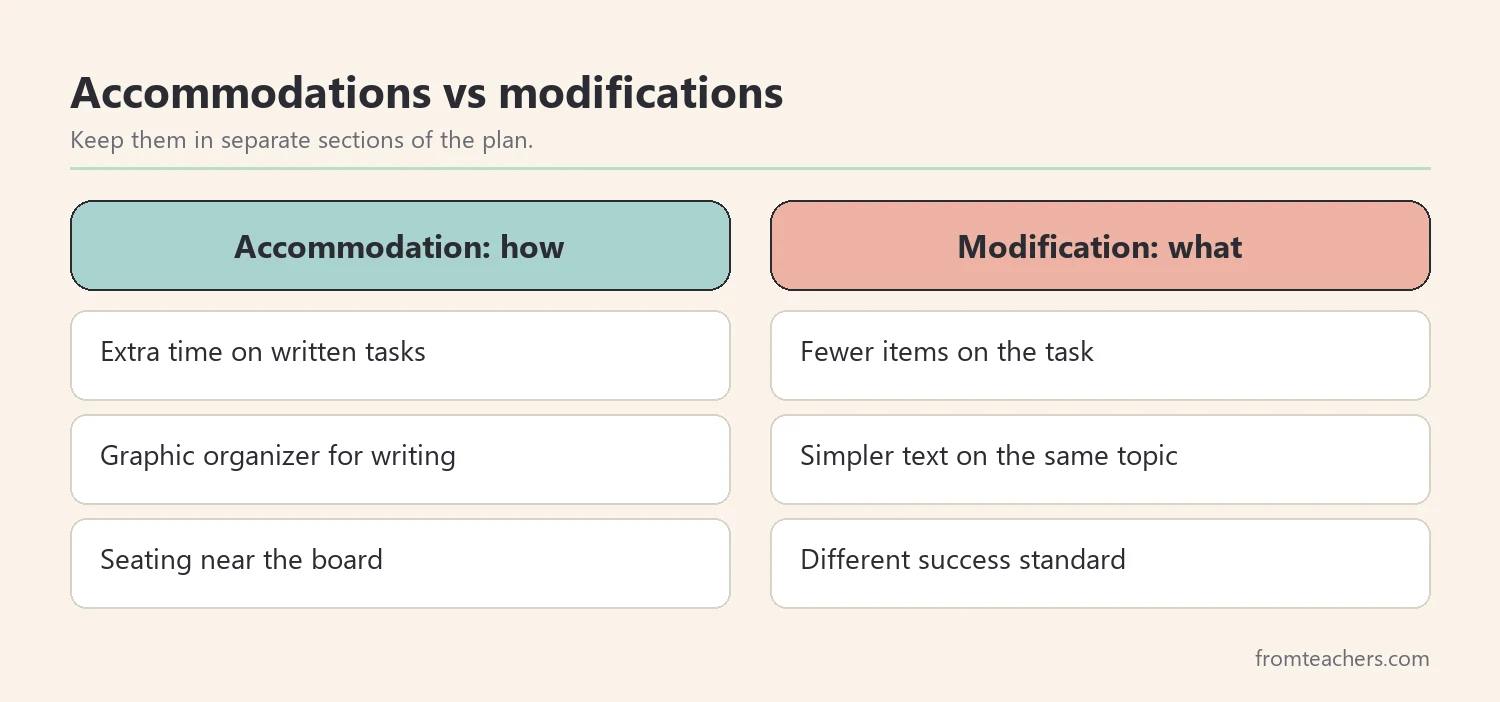
Then, record the supports. Accommodations change how a student learns or shows learning, such as extra time or a graphic organizer. Modifications change what the student is expected to learn, such as fewer or simpler items. Mixing the two causes confusion, so a clear ILP template keeps them apart.
Write each support specifically. “Extra time” is vague. “Up to 50% extra time on written tasks, in class” tells every adult what to do. Also note instructional supports, such as modeled examples, and environmental supports, such as seating near the board.
Next, list services with the provider and the frequency. For example, a reading specialist might work with the student twice a week in a small group. If a service changes, update the ILP template the same week.
If you want a ready structure for these sections, this fillable individual learning plan template includes separate areas for accommodations and modifications, services with provider and frequency, and a progress tracking table.
Worked example. Jonah’s supports include a five-box writing organizer, oral rehearsal before writing, reading texts split into one-page chunks, and seating near the board. He has no modifications, because he is working on grade-level content. His services list a reading specialist, small group, twice a week.
5. Track progress in the ILP template and plan next steps
Next, use the progress tracking table every few weeks. Each entry should include the goal, a short note with evidence, the date, and a next step. The next step column matters most, because it turns a record into a decision.
Keep notes short and factual. “3 of 5 paragraphs met the checklist” is clearer than “doing better.” In addition, attach or reference the work sample, so anyone reading the ILP template can see the evidence.
| Date | Paragraphs meeting checklist | Next step |
|---|---|---|
| Week 2 | 1 of 5 | Model the organizer again |
| Week 4 | 2 of 5 | Add sentence starters |
| Week 6 | 3 of 5 | Fade partner rehearsal to self-talk |
| Week 8 | 4 of 5 | Keep strategy, share with family |
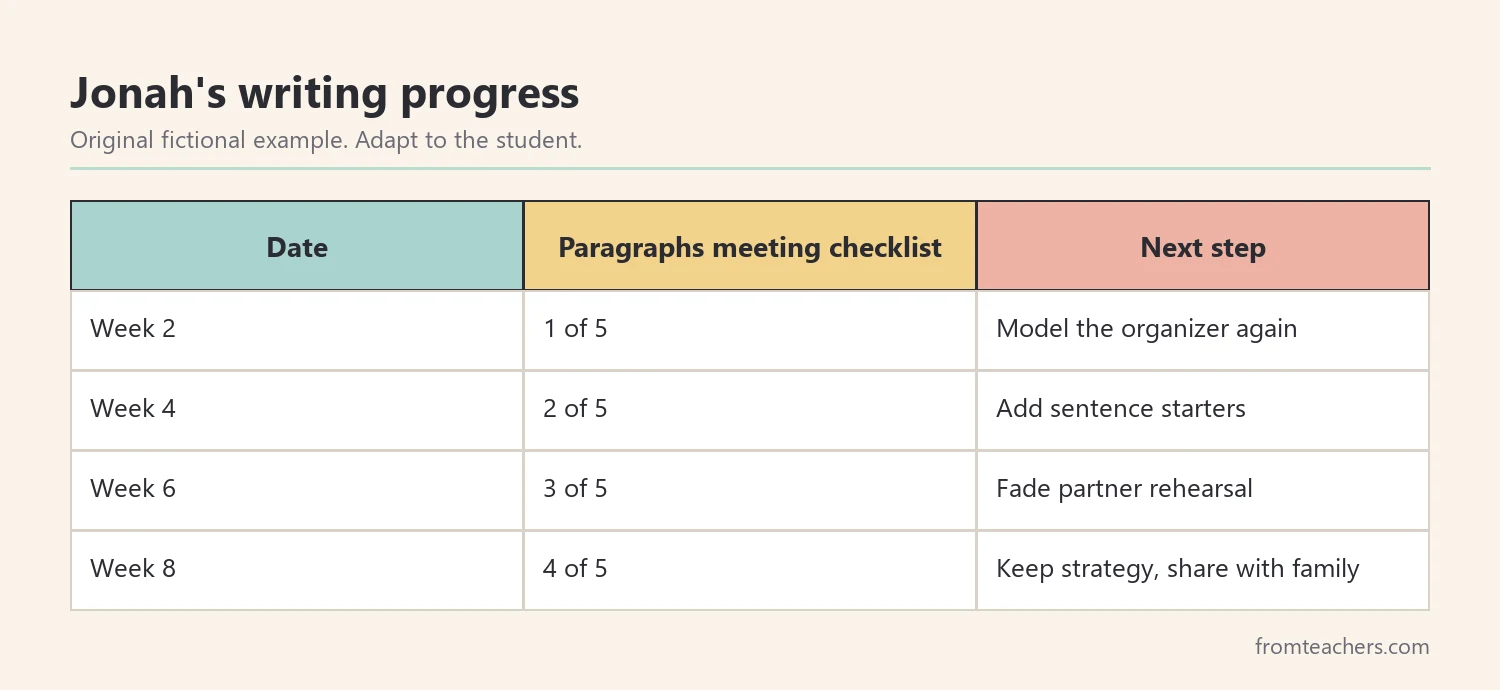
Worked example. By week 8, Jonah meets the checklist in 4 of 5 paragraphs, which matches his success criterion two weeks early. His teacher records the result and decides to keep the strategy until the end of the term. Meanwhile, the reading goal shows slower progress, so the next step is to add a short partner check-in after each page.
Also, look for patterns across goals. If one goal moves quickly and another stalls, compare the strategies. Sometimes a support that works in writing, such as rehearsing aloud first, can be borrowed for reading. Small changes like this often help more than starting over.
In short, progress notes are only useful when they change what you do next.
6. Review and share the ILP template with the family
Finally, review the plan with the family and, when appropriate, the student. Walk through strengths first, then goals, supports, and progress. Ask the family what they notice at home and whether the goals still feel right.
Next, collect parent or guardian and teacher signatures, if your school uses them. A signature shows that everyone has seen the same plan. However, it does not freeze the document. Update the ILP template whenever goals are met, supports change, or new information arrives.
- Schedule a review at least once per term.
- Share a copy with every adult who teaches the student.
- Store the plan where the next teacher can find it.
- Invite the student to name one goal in their own words.
Then, plan the handover. When a student changes classes or schools, a clear plan saves the next teacher weeks of guessing. Add a short summary note at the top: what worked, what did not, and what to try first. Because this note is brief, it is far more likely to be read.
Worked example. At the end-of-term meeting, Jonah explains his writing organizer to his mother. She asks for a copy to use with homework. Together, the team sets a new writing goal for the next term: two connected paragraphs. The updated ILP template is signed and shared with his new science teacher.
Common mistakes and how to avoid them
Most problems with an ILP template come from a few habits. Fortunately, each one is easy to fix.
- Writing from memory. Fix: gather work samples and family input first.
- Listing labels instead of behaviors. Fix: describe what you see the student do.
- Too many goals. Fix: keep two or three per term, each tied to a challenge.
- Vague supports. Fix: name who, what, where, and how often.
- Progress notes without decisions. Fix: end every entry with a next step.
- Filing the plan away. Fix: review and update it every term.
Questions teachers and parents ask about an ILP template
What is the difference between an ILP and an IEP?
An IEP is a legal document for eligible students under IDEA in the United States, with required parts and team decisions. An ILP is usually a school or classroom planning tool and can be used for any student. When a student has an IEP, the ILP template should match its agreed goals and supports.
Who should fill in the ILP template?
Usually the classroom teacher or case manager leads, with input from other teachers, specialists, the family, and the student. Shared ownership makes the plan more accurate and more likely to be used.
How many goals should an individual learning plan include?
Two or three goals per term is a practical range for most students. Fewer goals mean more teaching time and clearer data for each one.
How often should I update the progress table?
Every two to four weeks works well for many goals. Choose a rhythm you can keep, and make sure each entry includes evidence and a next step.
Can a fillable ILP template be printed?
Yes. A fillable PDF can be completed on a computer or printed and filled by hand. Many teachers type the plan and print a copy for family meetings.
Related reading: Accommodations vs Modifications in Special Education: The Difference Explained, The Power of Data Tracking in Special Education, and How Parents and Teachers Can Team Up for Special Education Success.
A companion resource for building an ILP template:
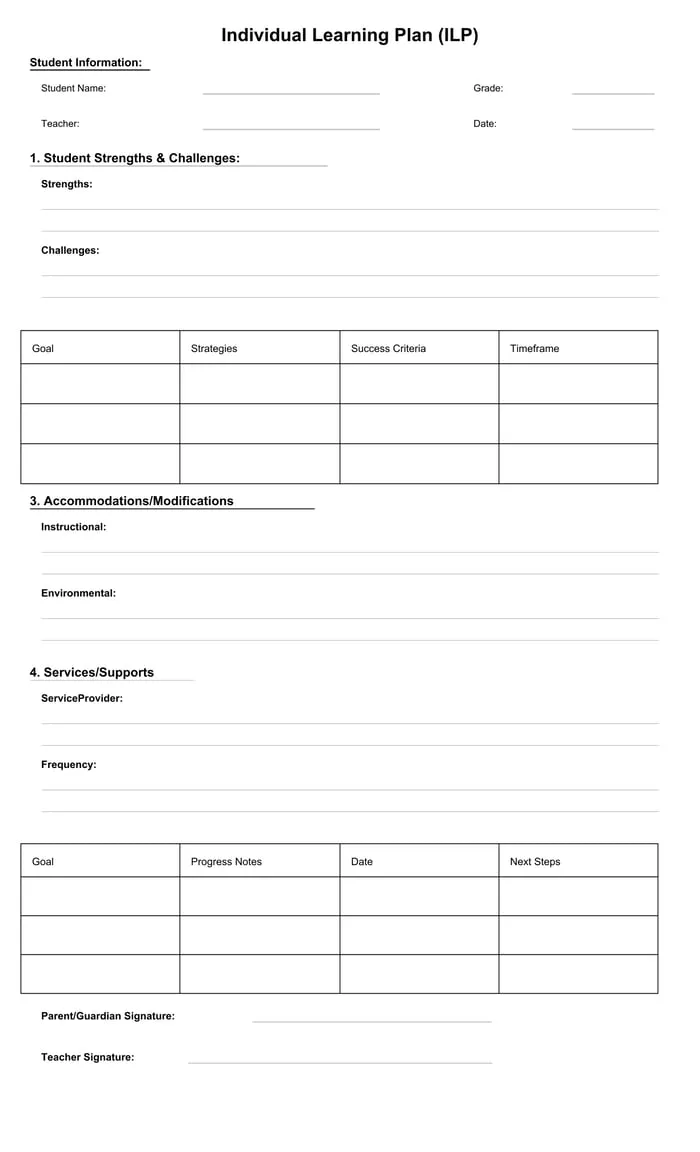
Individual Learning Plan ILP Template: a fillable PDF with sections for student information, strengths and challenges, goals with strategies and success criteria, accommodations and modifications, services, progress tracking, and signatures.
Sources and scope
- IDEA, U.S. Department of Education: the law behind IEPs, eligibility, and required plan components.
- IRIS Center, Vanderbilt University: free modules on accommodations, progress monitoring, and instructional planning.
- Understood.org: plain-language articles for families and teachers on learning plans and supports.
- CAST: the organization behind Universal Design for Learning, useful when choosing flexible strategies.
This guide explains how to complete and use an ILP template as a classroom planning tool. It does not give legal advice or replace the procedures for IEPs or 504 plans in your school or district.
Key takeaways
- An ILP template works best when you gather evidence and family input first.
- Lead with strengths and describe challenges in observable terms.
- Pair every goal with a strategy, success criteria, and a timeframe.
- Keep accommodations, modifications, and services specific and separate.
- End each progress note with a next step, and review the plan every term.










Leave a Comment