

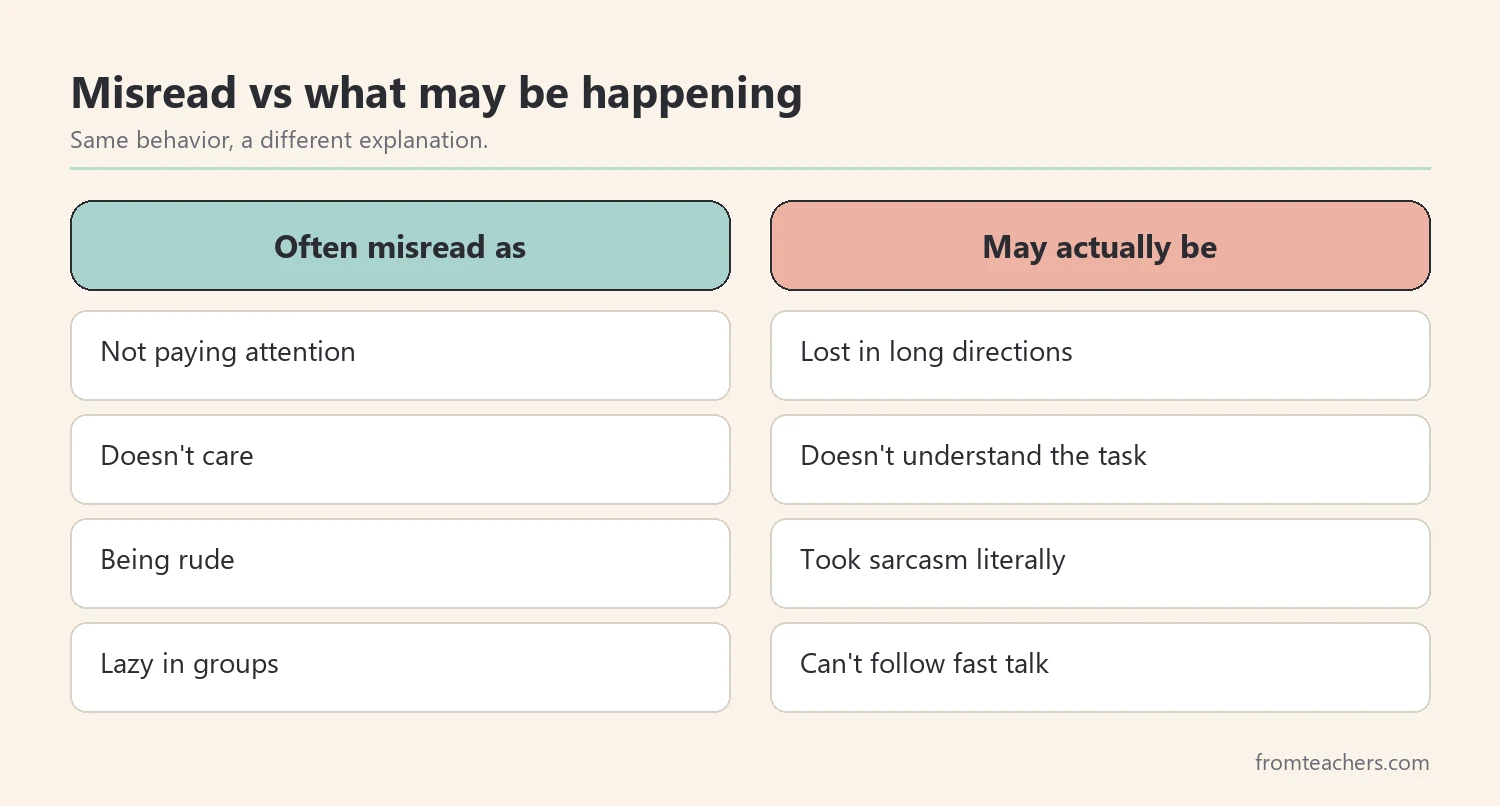
Signs of receptive language difficulties are easy to miss in middle school, where students are expected to listen, follow and keep up without much repetition. Picture Omar, a seventh grader who nods when his science teacher explains the lab, then sits still while everyone else starts. When she asks why he is not working, he says “I don’t get it,” and his classmates laugh. Some adults on his team think he is not paying attention. Others think he does not care.
This list is for middle school teachers in grades 6 to 8, including content-area teachers who may not have a speech or special education background. It walks through eight signs that a student may have trouble understanding spoken language, what each can look like in class, and one classroom support for each. By the end, you will know what to notice, what to try and when to talk with the speech-language pathologist (SLP).
Examples are fictional. Adapt to the student’s goals and agreed supports. This is guidance, not a diagnosis.
At a glance
- Receptive language means understanding what others say; expressive language means using words to communicate.
- Receptive difficulties can look like inattention, defiance or low motivation.
- Long directions, fast talk and abstract vocabulary are common barriers in middle school.
- Visual supports, chunked directions and checking for understanding help many students.
- Only a qualified professional, such as an SLP, can evaluate language skills.
How this list is ordered
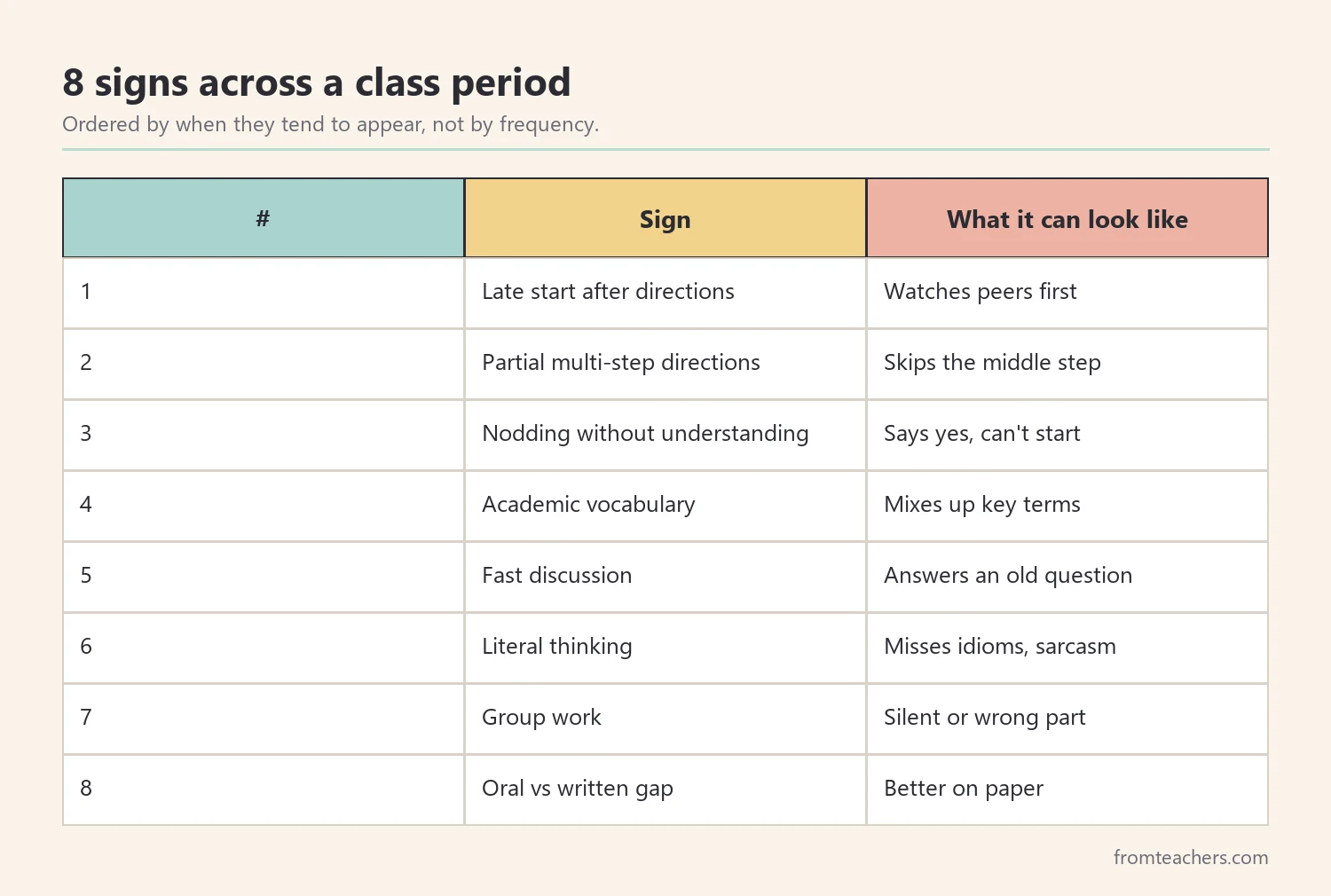
We did not rank these signs by how common they are, because that varies by student. Instead, the list follows a typical class period: first the directions at the start, then the lesson, then group work and finally homework and tests. As a result, you can watch for each sign as your own lesson unfolds.
Receptive language difficulties can occur on their own or with other needs, such as developmental language disorder, autism, ADHD, hearing loss or learning disabilities. They also differ from the normal process of learning English as a new language, although these can overlap. Figure 1 shows the eight signs.
1. Starting late after spoken directions
The first of the signs of receptive language difficulties often appears right after directions. The student waits, watches classmates and then copies what they do.
What it can look like: a delay before starting, looking around the room, asking a neighbor “What do we do?”
Classroom support: give directions in short chunks, show them in writing and point to each step as you say it.
Example: Omar’s science teacher, Ms. Patel, started writing lab steps on the board as numbered lines. Omar began working at the same time as his peers.
2. Following only part of multi-step directions
Next, watch what happens with longer directions. Many students with receptive needs remember the first or the last step and lose the middle.
What it can look like: finishing step one and stopping, or doing step three without steps one and two.
Classroom support: limit spoken directions to two or three steps at a time and add a checklist students can tick off.
3. Nodding without understanding
Middle schoolers often hide confusion to avoid embarrassment. A nod or “yes” may mean “Please stop asking.”
What it can look like: saying “I get it” and then being unable to explain or start the task.
Classroom support: instead of “Do you understand?”, ask “What will you do first?” Students show understanding by doing, not by agreeing.
Example: when Ms. Patel asked Omar “What will you measure first?”, he pointed to the wrong beaker. She showed him step one again, and he started correctly.
4. Struggling with academic vocabulary
Middle school content is full of new words, such as “photosynthesis,” “hypothesis” and “variable.” Students with receptive needs may need more exposure to learn them.
What it can look like: confusing similar words, using a word incorrectly, or losing the thread when a key term appears.
Classroom support: pre-teach three to five key words before each unit with a picture, a student-friendly definition and an example. Revisit them often.
Example: Ms. Patel added a “word wall” with pictures for each unit. Omar started using “variable” correctly in lab reports.
5. Losing the thread in fast discussion
Class discussions move quickly, with several voices and changing topics. Students who process language more slowly may fall behind.
What it can look like: answering a question that was asked earlier, repeating what someone already said, or tuning out.
Classroom support: post the discussion question visibly, pause between speakers and summarize key points every few minutes.
6. Taking figurative language literally
Idioms, sarcasm and jokes are common in middle school talk. Some students with receptive needs take them literally or miss the meaning.
What it can look like: confusion at “Let’s wrap this up,” missing a joke, or reacting to sarcasm as if it were serious.
Classroom support: say what you mean directly during instructions, and teach common idioms openly, as a fun class topic.
Example: when Ms. Patel said “Let’s hit the books,” Omar looked confused and glanced at his textbook. She now says “Open your books to page 42,” and keeps a weekly “idiom of the week” corner where the whole class draws the literal and the real meaning side by side. Students enjoy it, and Omar has learned a dozen common expressions.
Also, watch for difficulty with multiple-meaning words. In science, “matter,” “cell” and “table” mean something different from everyday use. Pointing out the second meaning out loud helps many students, not only those with receptive needs.
7. Difficulty in group work
Group work combines fast talk, overlapping voices and quick decisions. That makes it hard for many students with receptive difficulties.
What it can look like: staying silent, doing the wrong part, or becoming frustrated with peers.
Classroom support: give each group written roles and a short task card. For a ready set of tools, the Speech and Language Toolkit for AAC, receptive and expressive support includes sentence frames, vocabulary routines, social communication repair scripts and grade-level differentiation for K-8 classrooms.
8. Gaps between oral and written tasks
Finally, some students do better when they can read and reread than when they must listen once. Others show the opposite pattern. Either gap is useful information.
What it can look like: strong scores on a written quiz but weak answers to the same questions asked aloud, or missing details from a spoken lecture.
Classroom support: provide notes or slides after a lecture and allow students to review directions in writing during tests, when the IEP or school policy allows.
What to do when you notice signs of receptive language difficulties
One sign on its own may mean very little. Several signs that appear across classes and over weeks are worth sharing. First, write down specific examples: what you said, what the student did and what support helped.
Next, talk with colleagues. If other teachers see the same pattern, that is useful information. Then share your notes with the SLP, the school psychologist or the student’s case manager if the student already has an IEP.
Also, check hearing. Hearing problems can look like receptive language difficulties, so ask the school nurse whether a recent hearing screening is on file.
In addition, talk with the family. Parents may notice similar patterns at home, such as trouble following instructions or understanding jokes. Families of multilingual students can also share which language the student understands best, which helps the team separate language learning from a possible language difficulty.
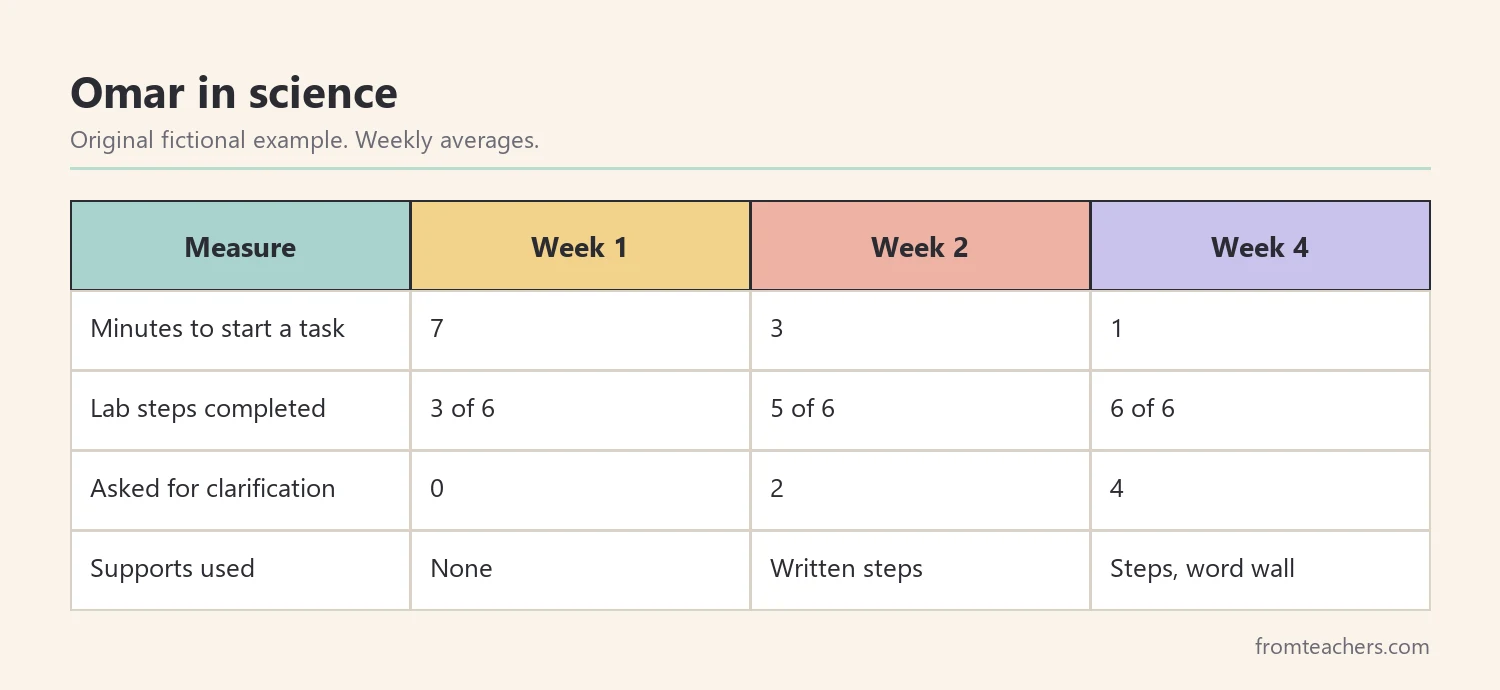
For example, Ms. Patel shared her notes with Omar’s English and math teachers, who had noticed similar delays. Together they brought examples to the SLP, who suggested consistent supports across classes while the team reviewed his needs. Figure 3 shows how quickly Omar started tasks once directions were chunked and written.
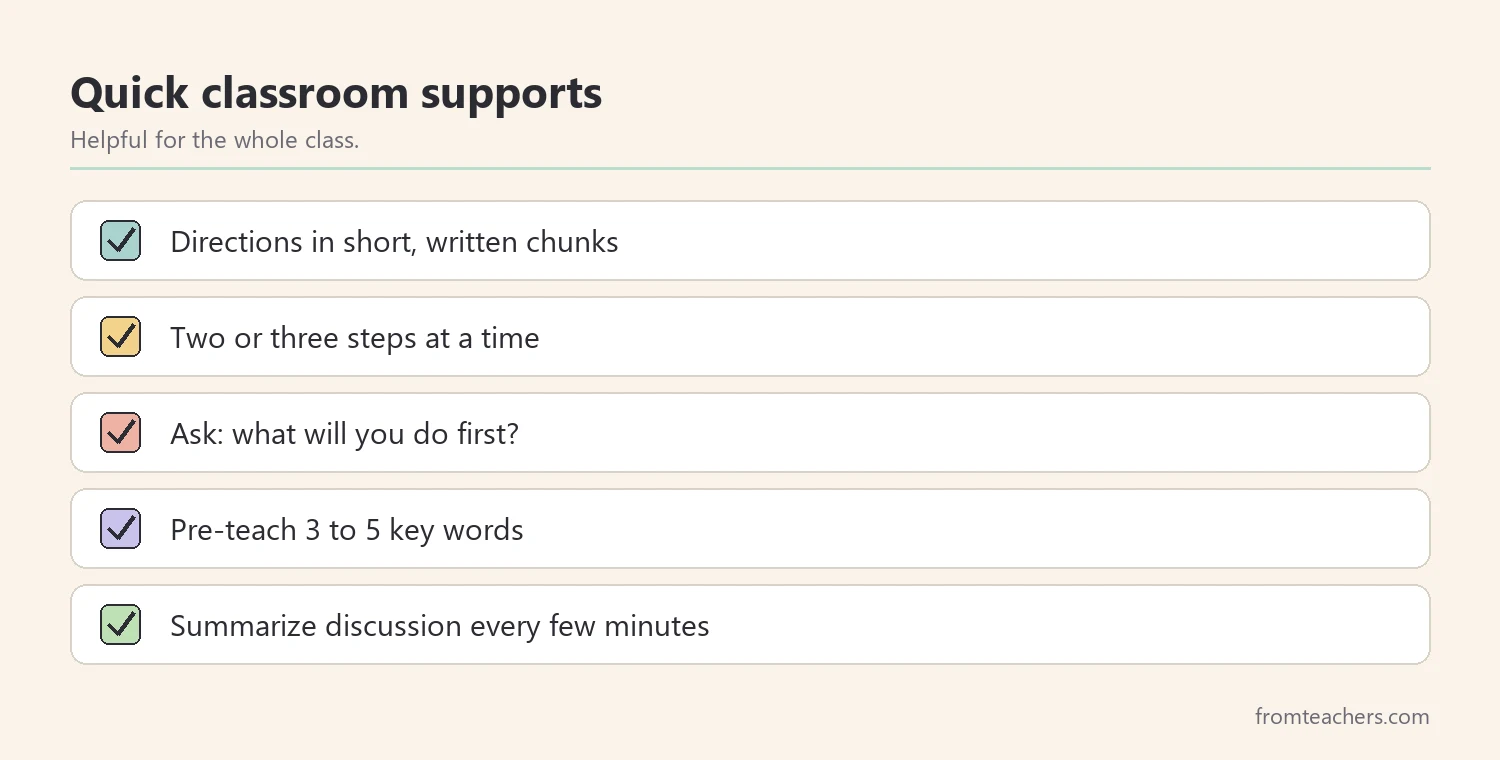
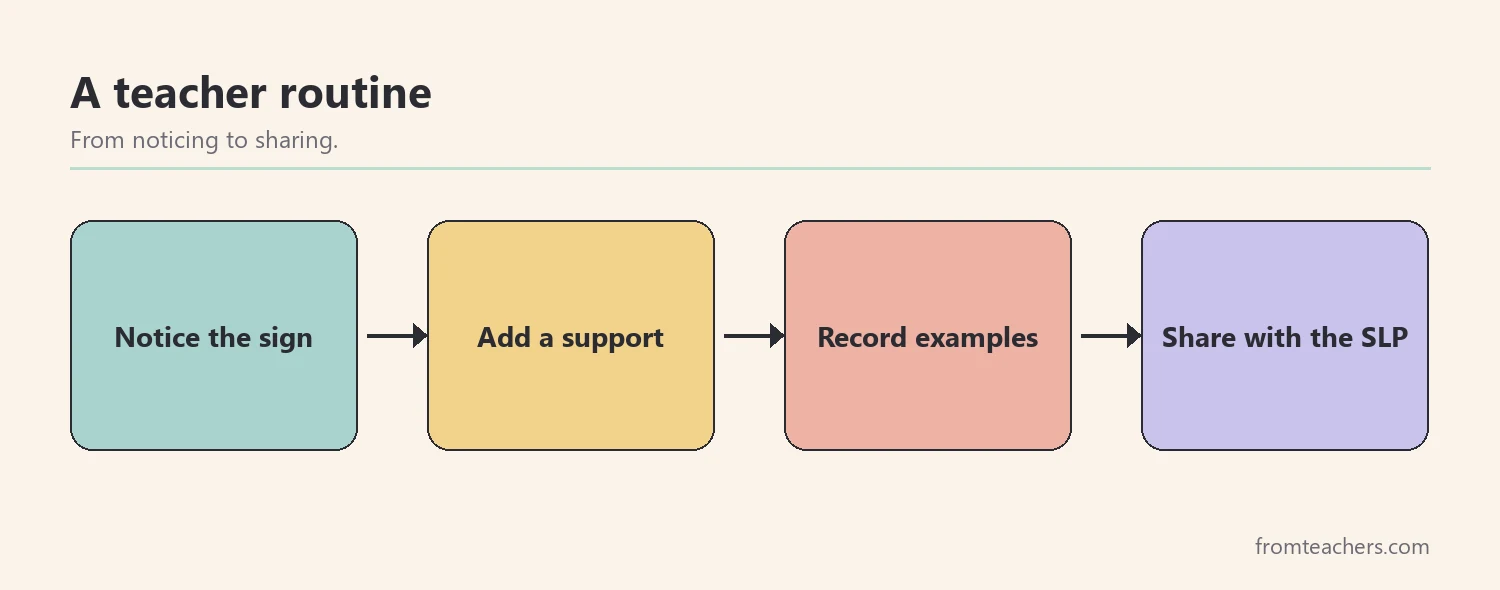
Finally, remember that many of these supports help every student. Written steps, clear vocabulary and checks for understanding are simply good teaching. Figure 5 shows a simple routine.
Supporting the student’s confidence
Middle schoolers are very aware of how they look to peers. A student who often misunderstands may feel embarrassed and start avoiding participation altogether. Therefore, protect dignity while you support understanding.
First, offer help privately. A quiet check at the desk works better than repeating directions loudly for one student. Next, make supports available to everyone, such as written steps on the board or a task card for each group, so no one feels singled out.
In addition, give processing time. After asking a question, wait a few seconds before calling on anyone. Some teachers let students jot an answer first, which gives slower processors a fair chance to take part.
Also, teach students to ask for clarification. Phrases such as “Can you say that another way?” or “What was the second step?” are useful for everyone. When a student uses one, thank them, because it shows good self-advocacy.
Common mistakes and how to avoid them
- Assuming the student is not listening. Fix: check whether the student understood, not only whether they heard.
- Repeating the same words louder. Fix: rephrase in shorter, simpler words and show it visually.
- Asking “Do you understand?” Fix: ask the student to say or show the first step.
- Calling out the student in front of peers. Fix: check in privately.
- Waiting for a diagnosis to help. Fix: add simple supports now and share notes with the SLP.
Questions teachers ask about signs of receptive language difficulties
Is this the same as ADHD?
No. Attention difficulties and receptive language difficulties can look similar and can occur together. An evaluation can help tell them apart.
Can a student have good speech but poor understanding?
Yes. Some students speak clearly and fluently but have trouble understanding complex language. That is why receptive skills deserve separate attention.
Should I talk to the SLP even if the student has no IEP?
Often, yes. Many schools have a process for sharing concerns, and the SLP can suggest supports or next steps.
How is this different from learning English?
Students learning English need time and support to understand a new language. A team should consider language background before deciding a student has a language difficulty.
Do these supports lower expectations?
No. They help students access the same content. The learning goals stay the same.
Related reading: Special Education Strategies, Autism Social Skills, and Teacher and Parent Communication in Special Education.
You may also need: Developmental Language Disorder (DLD): Classroom Strategies.
A companion resource for signs of receptive language difficulties:
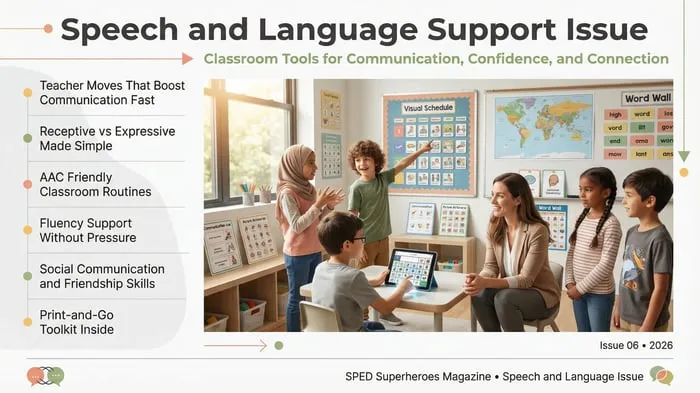
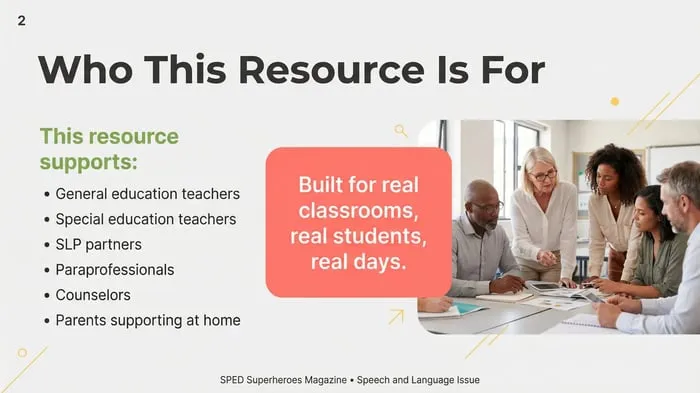
Speech & Language Toolkit: AAC, Receptive & Expressive Support: a 49-page guide for K-8 teachers, paraprofessionals and SLP partners, with receptive and expressive language sections, sentence frames, vocabulary routines, AAC basics and print-and-go data trackers.
Sources and scope
- American Speech-Language-Hearing Association (ASHA): information on language disorders and the role of SLPs in schools.
- National Institute on Deafness and Other Communication Disorders: background on speech, language and hearing.
- Understood.org: teacher and parent guides on language and learning differences.
- IRIS Center: free modules on supporting students with disabilities in general education classes.
This list helps middle school teachers notice possible receptive language difficulties and add classroom supports. It does not diagnose any condition and does not replace an evaluation by an SLP or other qualified professional.
Key takeaways
- Signs of receptive language difficulties can look like inattention or low effort.
- Watch directions, vocabulary, discussion, group work and test formats.
- Chunk and write directions, pre-teach vocabulary and check understanding by asking for the first step.
- Record examples and share them with the SLP and the family.
- Protect the student’s confidence by offering help privately and supports to all.







Leave a Comment