

Sensory overload at school often happens outside the classroom, in the loud, crowded spaces between lessons. Picture a second grader who copes well at his desk but covers his ears, freezes, and then bolts every time the lunch bell rings. The hallway, the cafeteria, and the bus are where his day falls apart.
This guide gives you a five-step process: map the triggers and early body clues, plan hallways and transitions, plan the bus and cafeteria, plan recess and surprise events like fire alarms, and then teach self-advocacy while tracking progress. By the end, you will have a simple plan for each loud space in the school day.
Examples are fictional. Adapt to the student’s goals and agreed supports. This is guidance, not a diagnosis.
At a glance
- Overload builds from noise, crowds, light, smells, and surprises, often in shared spaces.
- Learn each student’s triggers and early body clues before a crisis.
- Plan each loud space: timing, route, seat, and an exit option.
- Prepare for surprises like fire alarms with warnings and practice.
- Teach students to ask for a break and track whether the plan works.
1. Map triggers and body clues for sensory overload at school
First, find out what overwhelms the student and how it shows. Sensory overload at school happens when the input from noise, crowds, lights, smells, or touch becomes more than the student can process. Each student has a different mix of triggers, so start with observation, not assumptions.
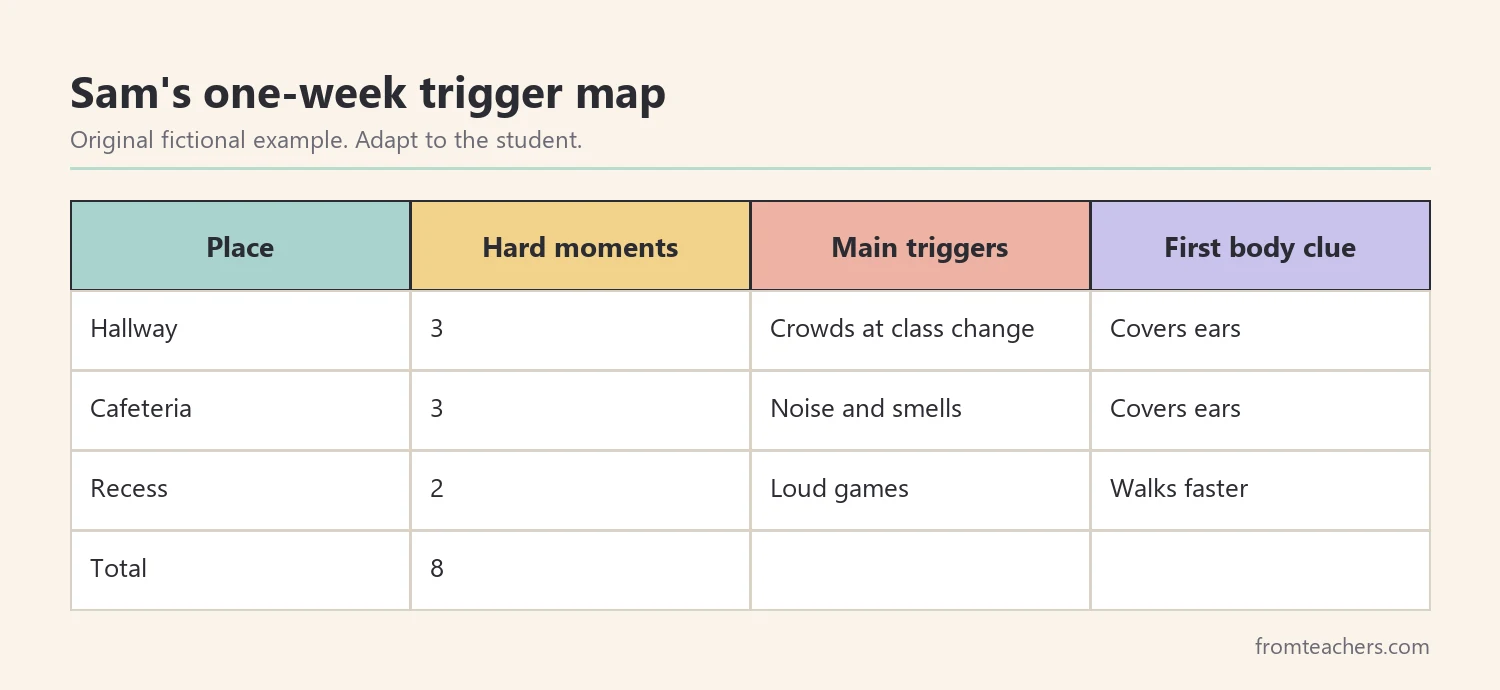
Next, keep a short log for a week or two. Note the place, the time, what was happening, and the first signs you saw. Early body clues might include covering ears, squinting, pacing, going quiet, or getting irritable. These clues are your chance to help before the student reaches a meltdown or shutdown.
Then, ask the student and the family. Many students can tell you what feels “too loud” or “too much” when asked calmly, and families often know which places are hardest. Also, talk with the occupational therapist (OT) if the student has one, since OTs often work on sensory regulation.
- Where and when did it happen?
- What sounds, sights, smells, or crowds were present?
- What was the first sign you noticed?
- What helped the student recover?
Worked example. Sam is a fictional student in grade 2. Over one week, his teacher logs eight hard moments. Three happen in the hallway at class change, three in the cafeteria, and two at recess. His first clues are covering his ears and walking faster. In class, by contrast, he is mostly calm.
Moreover, notice what helps. If a student recovers faster after a drink of water or a minute in a quiet corner, write that down too. Knowing what calms a student is just as useful as knowing what overwhelms them when you plan for sensory overload at school.
In short, the log tells you where to focus first. For Sam, the busiest shared spaces are the problem, not the lessons.
2. Prevent sensory overload at school, starting with hallways
Hallways are often the first place where sensory overload at school shows up. They are loud, crowded, and unpredictable, and students have little control over them. Fortunately, small changes in timing and route can make a big difference.
Start with timing. Letting a student leave a minute or two early, or a minute late, can turn a packed hallway into a quiet one. Next, consider the route. A longer but quieter path, such as one that avoids the gym or the main lobby, may be worth the extra steps.
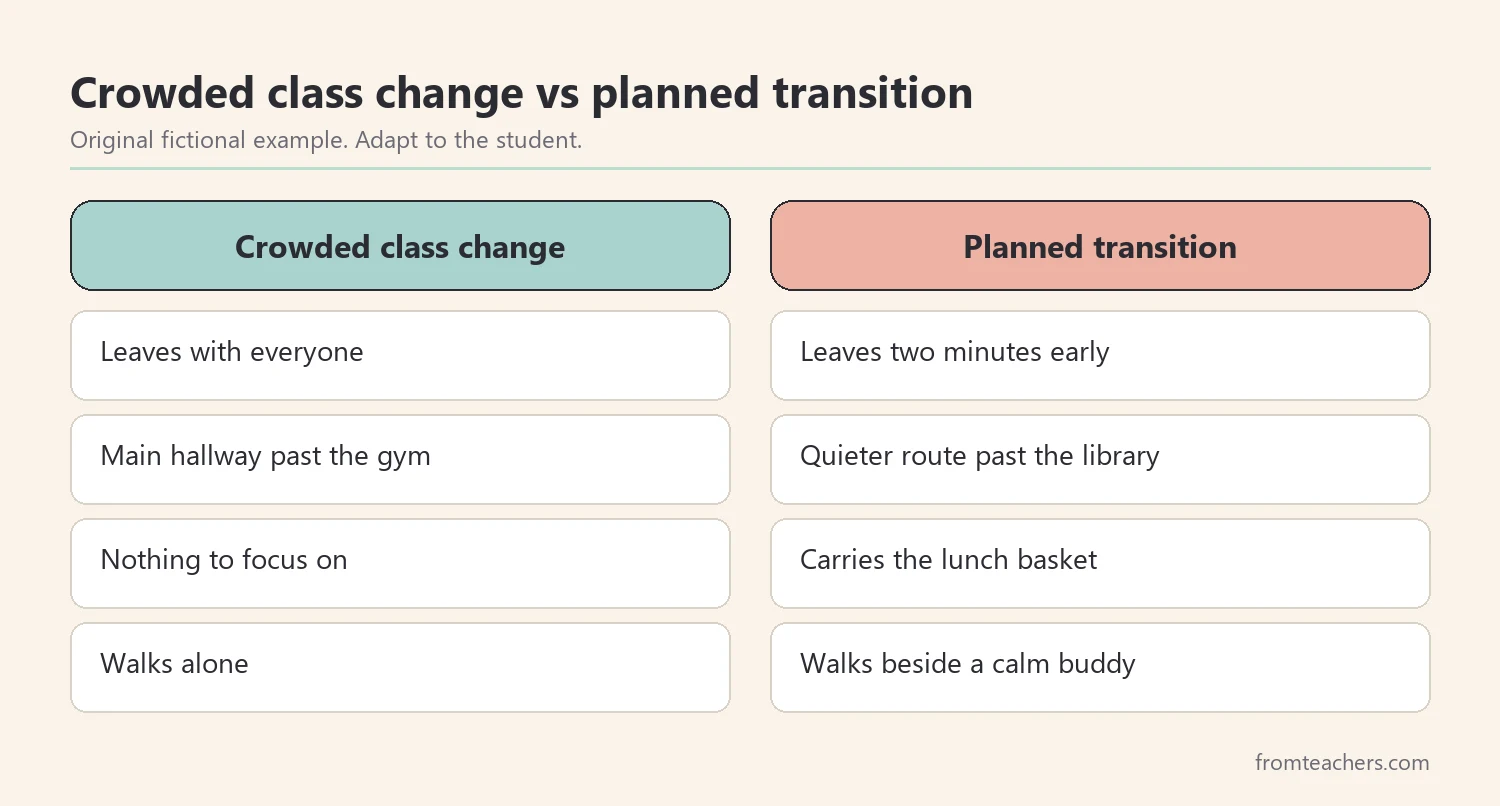
Also, give the student something to do. Carrying a light item for the teacher, walking beside a calm buddy, or following a simple visual of the route keeps attention on a task instead of the noise. In addition, noise-reducing headphones can help some students, if the team agrees and the student wants them.
A visual schedule that shows each transition helps too. When students know what is coming next, the hallway feels less like a surprise. Likewise, a short preview before unusual days, such as picture day or a field trip, can prevent sensory overload at school before it starts.
Worked example. Sam’s team lets him leave for lunch two minutes early with a buddy. He follows a quieter route past the library and carries the class lunch basket. After two weeks, his hallway hard moments drop from three a week to one.
3. Plan the bus and cafeteria
The bus and cafeteria combine noise, crowds, and smells, often with little adult support. For many students, sensory overload at school peaks here. So, plan these spaces as carefully as you plan a lesson. Because adults in these spaces change often, a short written plan helps everyone respond to sensory overload at school in the same way.
On the bus, a consistent seat near the front, away from the back where noise often builds, can help. Headphones, a small fidget, or a picture book may also give the student something calming to focus on. Meanwhile, share the plan with the driver, who is part of the team for that part of the day.
In the cafeteria, try a seat at the end of a table or near a wall, away from the busiest lines and the dish area. Some schools also offer a quieter lunch space for a small group. In addition, a short, familiar routine, such as “sit, open lunch, eat, then talk,” can make the space feel more predictable.
| Space | Simple supports to try |
|---|---|
| Bus | Same front seat, headphones, driver knows the plan |
| Cafeteria | End-of-table seat, quieter group option, simple routine |
| Lunch line | Go first or last, pre-order if available |
| Assemblies | Seat near an exit, preview what will happen |
For practical tools, the Too Loud and Too Crowded sensory overload toolkit includes scenarios for hallways, buses, cafeterias, and recess, along with a triggers and body clues log and calm-down strategies.
Worked example. Sam now sits at the end of a table near the cafeteria wall, and he goes through the line first. He wears headphones while he eats. His cafeteria hard moments drop from three a week to two, and his teacher notes that he recovers faster.
4. Plan recess and surprise events
Recess should be a break, yet for some students it is the hardest part of the day. Open spaces, loud games, and unclear rules can add up quickly. Therefore, give the student structure and choice.
Offer a few clear options, such as a quieter area of the playground, a structured game with a small group, or a calm activity like drawing with chalk. In addition, agree on a place the student can go if recess becomes too much, and make sure the adults on duty know it. Avoid taking recess away as a consequence, because many students need that movement time.
Surprise events need their own plan. Fire alarms, flickering lights, and sudden announcements can trigger sensory overload at school even in calm students. When possible, give a warning before planned drills, practice the route ahead of time, and let the student use headphones or cover ears during the alarm.
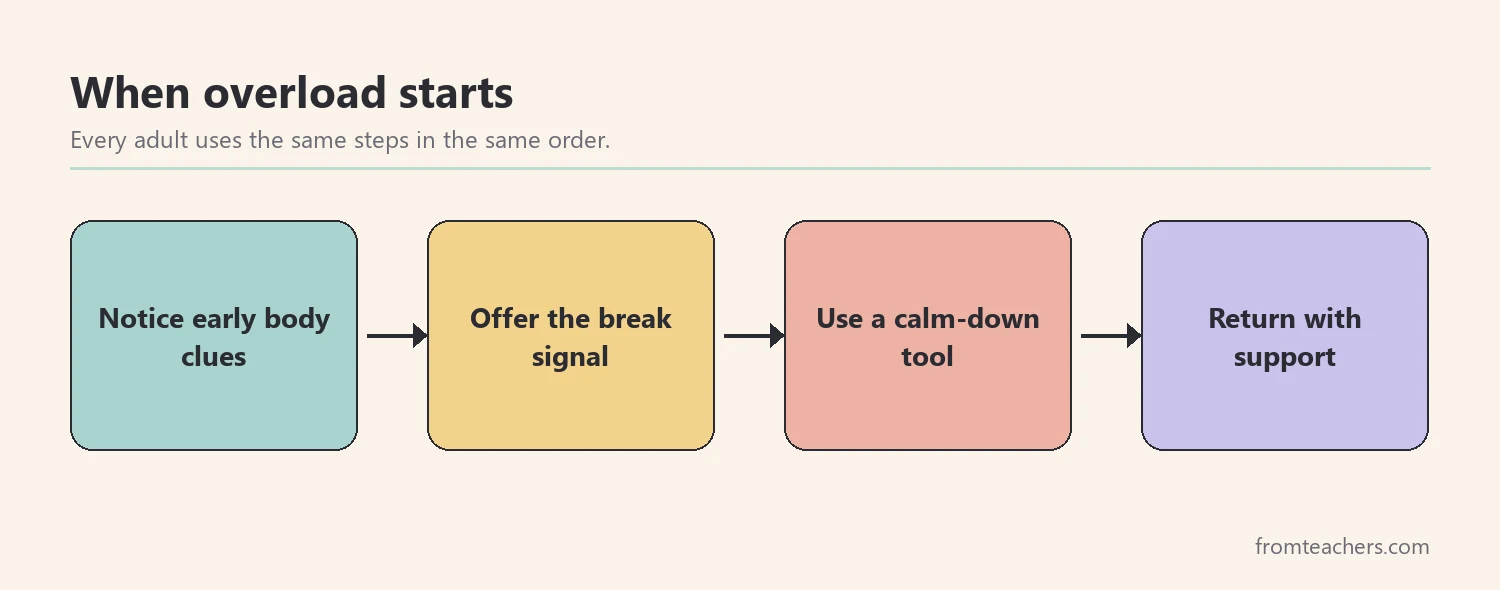
Finally, agree on one response for when overload starts. Every adult should know the student’s early clues, the break signal, the calm-down tool, and how the student returns. When everyone uses the same steps, the student knows what to expect. In addition, keep your voice low and your words few during these moments. Extra talking adds one more input to a system that is already full.
Also, plan the return. After a break, the student may need a quiet task, a drink of water, or a few minutes before rejoining a loud activity. Rushing the return can bring the overload straight back.
Worked example. At recess, Sam can choose between the swings area, a small ball game with an aide, or chalk drawing. Before the monthly fire drill, his teacher warns him in the morning and practices the route. During the drill, Sam wears his headphones and walks beside the aide.
5. Teach self-advocacy and track progress
Over time, the goal is for students to notice their own overload and ask for help. This is a skill, so teach it in calm moments, not during a hard one. Start simple and build up.
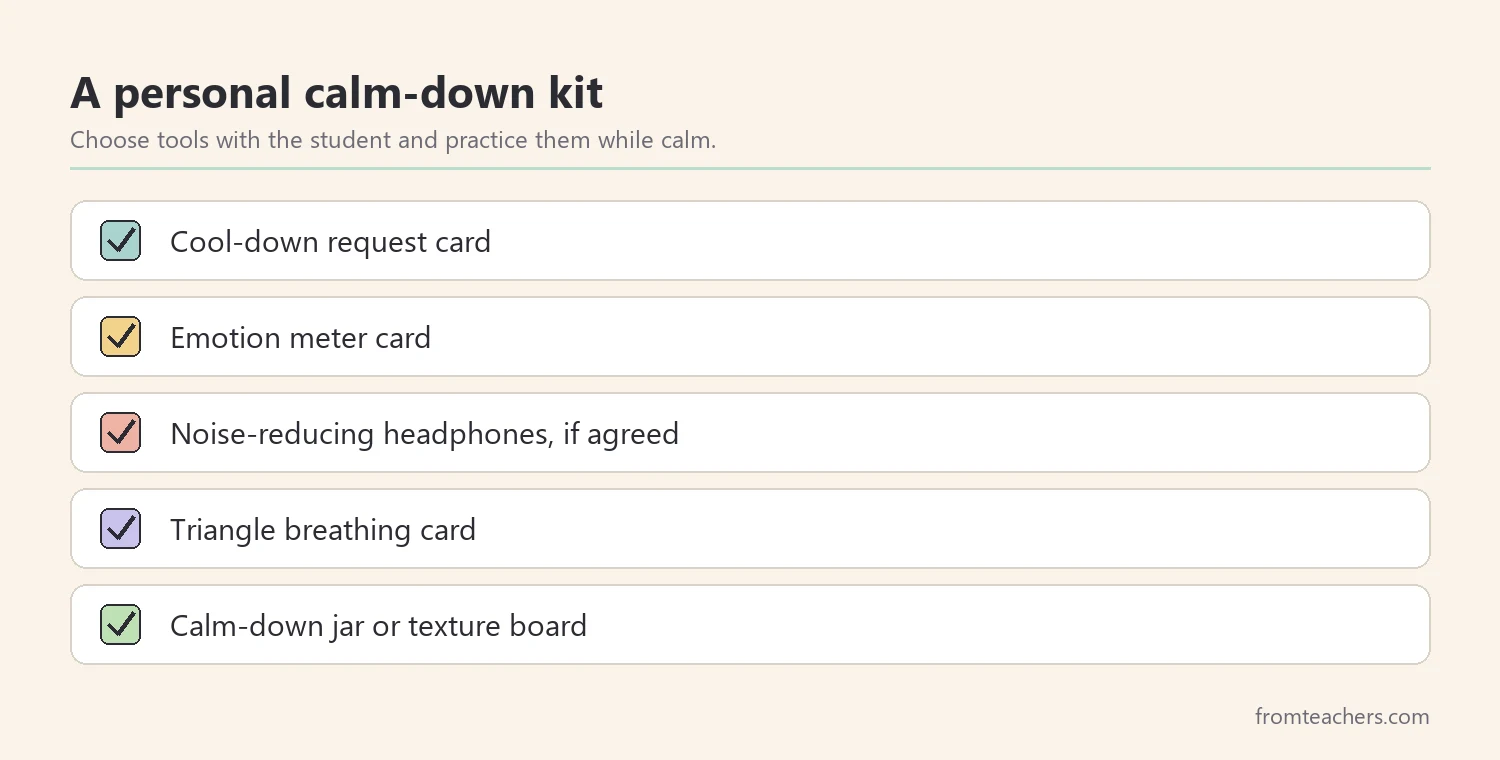
Begin with body awareness. Emotion meter cards or a simple scale can help a student name how full their “sensory cup” feels. Next, teach a way to ask for a break that does not need many words, such as a cool-down request card. Then, practice calm-down tools while the student is calm, for example triangle breathing, a calm-down jar, or a texture board.
Meanwhile, track one or two simple measures. Count hard moments by place, and count how often the student asks for a break on their own. Over a few weeks, the trend shows whether your plan for sensory overload at school is working.
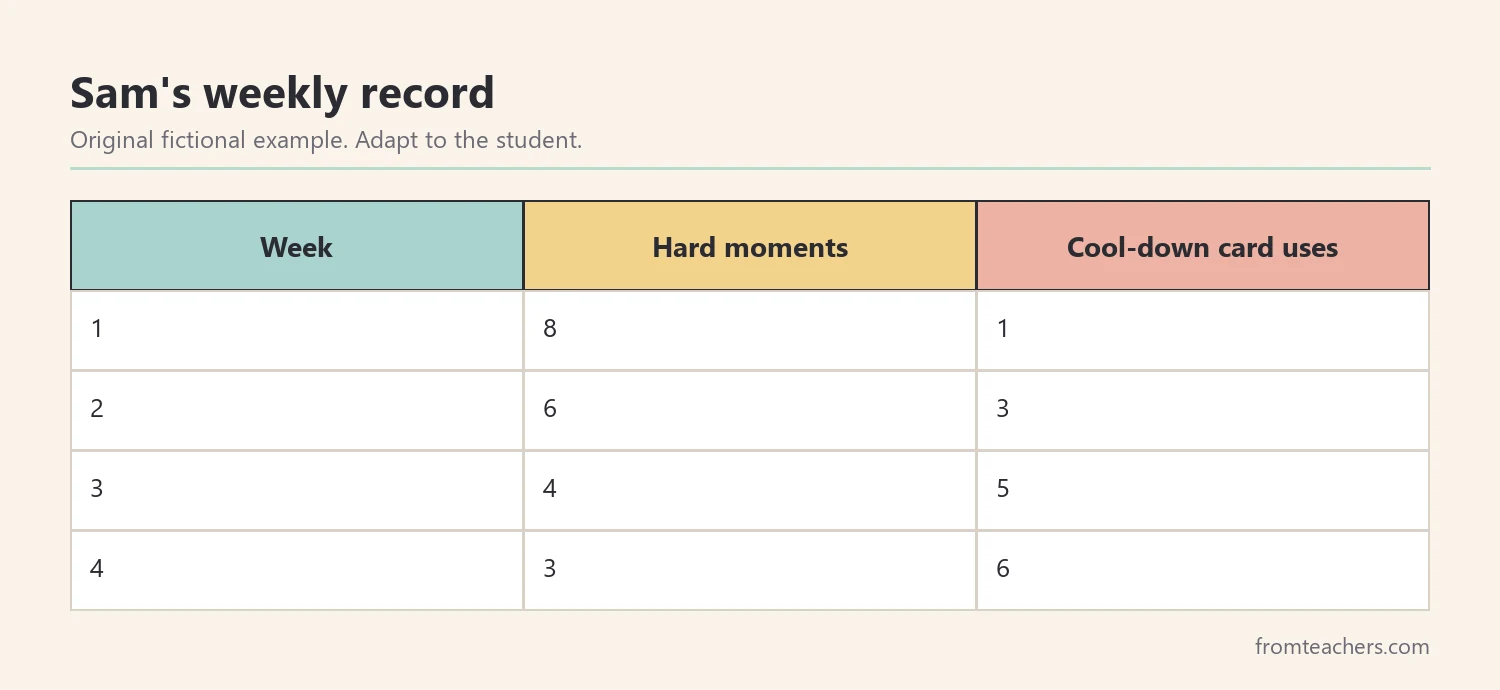
Review the data with the team and family every few weeks. Keep supports that help, and adjust one thing at a time. As the student gains skills, you can slowly fade some supports. However, keep the plan for sensory overload at school written down, so new staff and substitutes can follow it.
Worked example. Sam learns to use a cool-down request card and triangle breathing. Over four weeks, his hard moments fall from 8 to 3 per week, while his cool-down card uses rise from 1 to 6. The team shares the record with his parents, who start using a similar card at the grocery store.
Above all, remember that progress is rarely a straight line. Busy weeks, illness, or schedule changes can bring more hard moments. When that happens, return to the log, check which space is causing trouble, and adjust the plan for sensory overload at school one step at a time.
Common mistakes and how to avoid them
- Treating overload as misbehavior. A student fleeing a loud room may be overwhelmed, not defiant. Fix: look for triggers and early body clues.
- Planning only for the classroom. Many hard moments happen in shared spaces. Fix: make a plan for each loud space in the day.
- Waiting until the crisis. Help works best early. Fix: teach adults the student’s first clues and respond right away.
- Removing recess as a consequence. Students lose movement they need. Fix: use other responses and protect recess.
- Different responses from each adult. Mixed responses add confusion. Fix: share one simple response sequence with every adult, including the bus driver.
- Teaching calm-down tools during a meltdown. Students cannot learn new skills when overwhelmed. Fix: practice tools in calm moments.
Questions teachers and parents ask about sensory overload at school
How can I tell sensory overload at school from misbehavior?
Look at the pattern. Overload often follows specific triggers, such as noise or crowds, and comes with body clues like covering ears or freezing. If the behavior lines up with sensory triggers, treat it as a need, not a choice.
Should students with sensory needs skip recess or assemblies?
Usually, it is better to adjust than to remove. A quieter area, a seat near the exit, or a shorter stay can keep the student included. The team should decide based on the student’s needs.
Do headphones help with sensory overload at school?
Noise-reducing headphones help some students in loud spaces. Use them as one tool among several, and agree on when and where with the student, family, and team.
What should adults do when overload turns into a meltdown?
Keep the student and others safe, lower the noise and talk, and give space. Use few words and a calm voice. Afterward, once the student is calm, review what happened and adjust the plan.
Can parents help with sensory overload at school?
Yes. Parents can share which places and sounds are hardest, use the same calm-down tools at home, and practice routines like a quiet walk or breathing. Shared tools help the student use them in more places.
Related reading: Managing Sensory Overload: Practical Strategies for Autism and ADHD, Understanding Autism ADHD Meltdowns: Signs and Support Strategies, and Autism Spectrum Disorder: A Guide to Early Signs, Support, and Effective Strategies.
A companion resource for sensory overload at school:
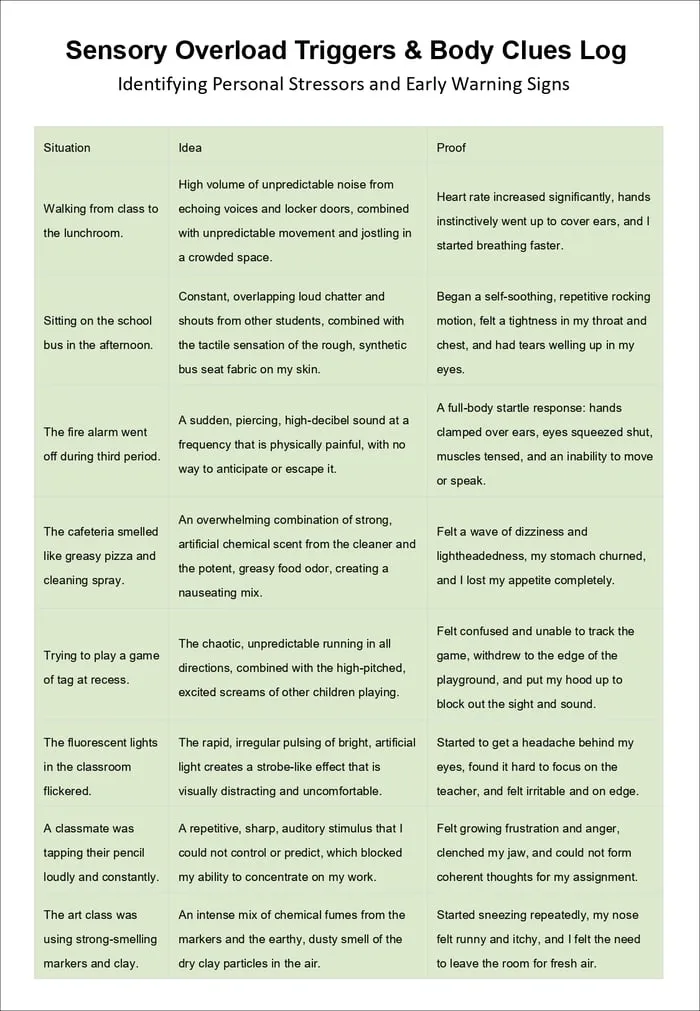
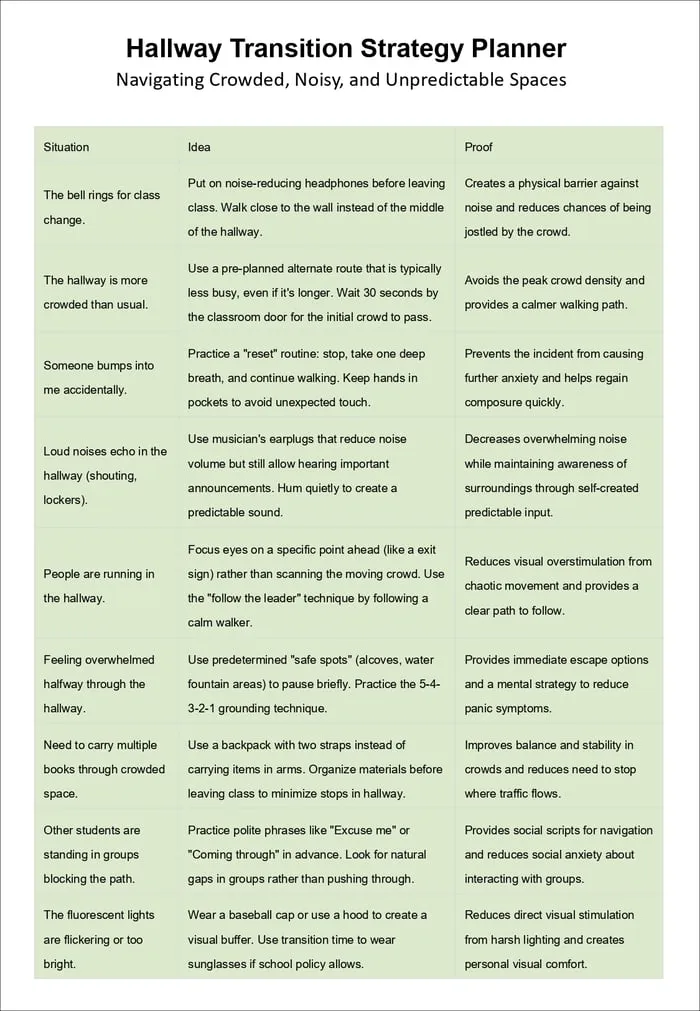
Too Loud and Too Crowded: Sensory Overload in Hallways, Buses, Cafeterias, and Recess: a 12-page printable toolkit with a triggers and body clues log, a calm-down strategy and tool inventory, scenarios for loud school spaces and fire alarms, emotion meter cards, and cool-down request cards.
Sources and scope
- American Occupational Therapy Association (AOTA): information on occupational therapy, including sensory and school-based practice.
- CDC Autism Spectrum Disorder: general information on autism, including sensory differences.
- IRIS Center, Vanderbilt University: free modules on supporting students with disabilities and classroom behavior.
- Understood.org: practical articles for families and teachers on sensory processing and learning differences.
This guide covers everyday school supports for students who become overwhelmed in loud, crowded spaces. It does not diagnose sensory processing differences or replace advice from an occupational therapist or the student’s team.
Key takeaways
- Sensory overload at school often happens in hallways, buses, cafeterias, and recess.
- Map triggers and early body clues before planning supports.
- To reduce sensory overload at school, adjust timing, routes, and seats for each loud space.
- Prepare students for fire alarms and other surprises.
- Teach break requests and calm-down tools, and track progress.







Leave a Comment