

A study habits checklist turns “go study” into clear actions a student can follow. Picture a sixth grader who sits down to study for a science quiz, opens the book, checks his phone, sharpens two pencils, and forty minutes later has read one page. He wanted to study. He just did not know what studying should look like.
This guide gives you a five-step process to teach study habits at school or at home: prepare the space, set small goals, study in short bursts with the right tools, review and ask for help, then close the session and track progress. By the end, you will be able to coach a student through a full session and see whether the habits are sticking.
Examples are fictional. Adapt to the student’s goals and agreed supports. This is guidance, not a diagnosis.
At a glance
- Good studying starts before the book opens: space, supplies, and one small goal.
- Short bursts with planned breaks work better than one long, tired session.
- Active tools such as flashcards and diagrams beat rereading.
- Regular review, asking for help, and kind self-talk keep progress going.
- A quick clean-up and a weekly record make the habits stick.
1. Prepare the space before using the study habits checklist
First, set up the place where studying happens. A cluttered desk and a buzzing phone pull attention away before work even begins. Therefore, the first habit is always the same: clear the desk, gather supplies, find a quiet and comfortable spot, and put the phone away.
Next, gather everything before starting. Students often lose minutes walking back and forth for a highlighter, a calculator, or the right notebook. A small supply caddy or a zip bag kept in one place solves this.
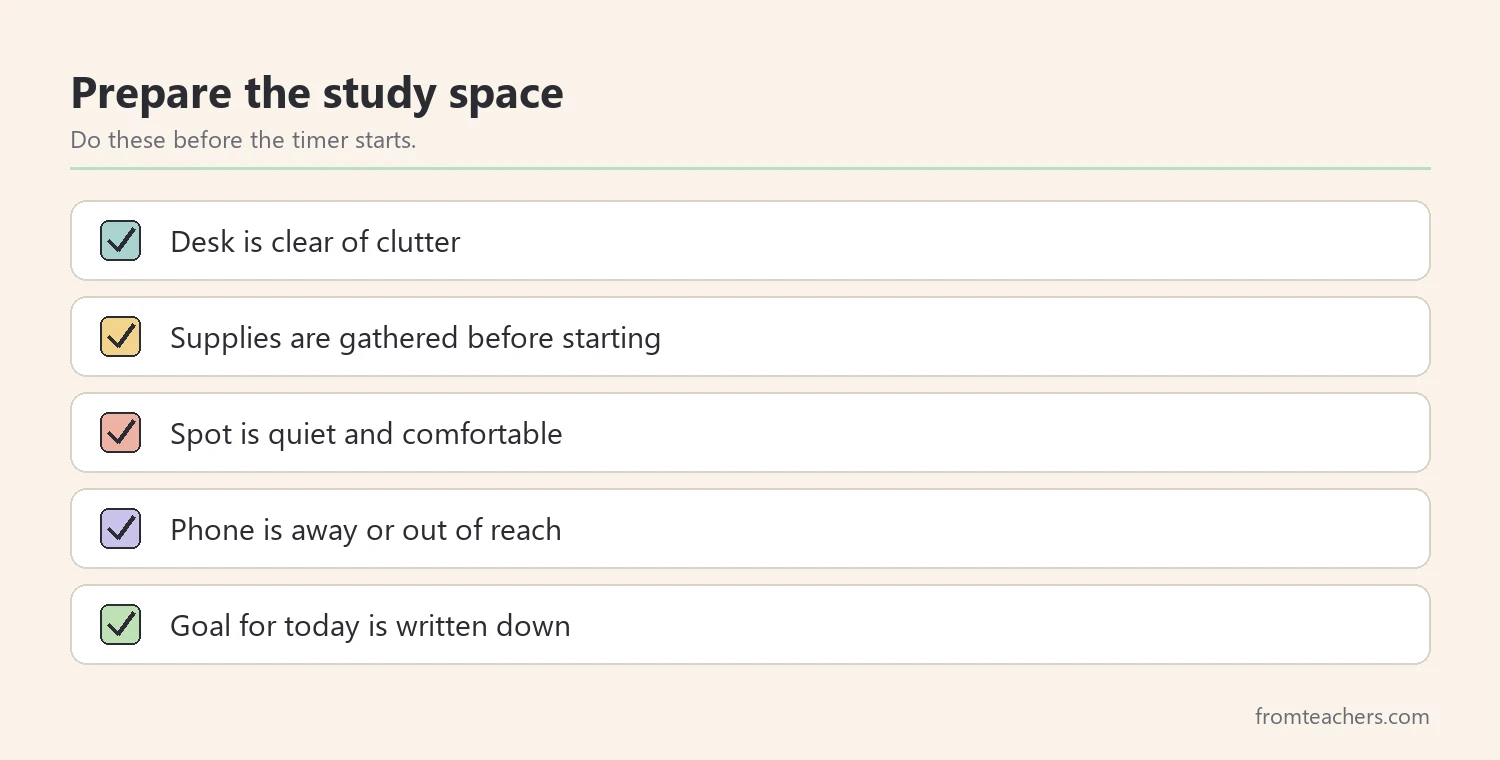
Families without a quiet room can still create a study zone. A folding board on the table, a basket of supplies, and a simple sign that says “Study time” signal to everyone that this is focused time.
Then, choose a consistent spot. It does not need to be fancy. A kitchen table at the same time each evening can work if the space is clear and quiet enough. Consistency helps the brain link the place with focused work.
In class, you can model this with a short routine before independent work. For example, give students one minute to clear desks and lay out exactly what they need. Over time, students begin to do it without a reminder.
For students who are easily distracted, small changes matter a lot. Facing a wall instead of a window, using headphones without music, or moving away from a busy hallway can each reduce interruptions. Try one change at a time and ask the student what helped.
Worked example. Jordan, a fictional sixth grader, studies at the kitchen table with his phone beside him. His parent and teacher agree on a new setup: phone charging in another room, a supply bag on the table, and the same 6:30 start time each school night.
2. Set a small goal and break work into steps
Vague plans like “study science” give no clear start or finish. A small goal does both. It is specific, achievable, and has a time limit, for example “Read five pages of chapter 3” or “Do problems 1 to 6 and check answers.”
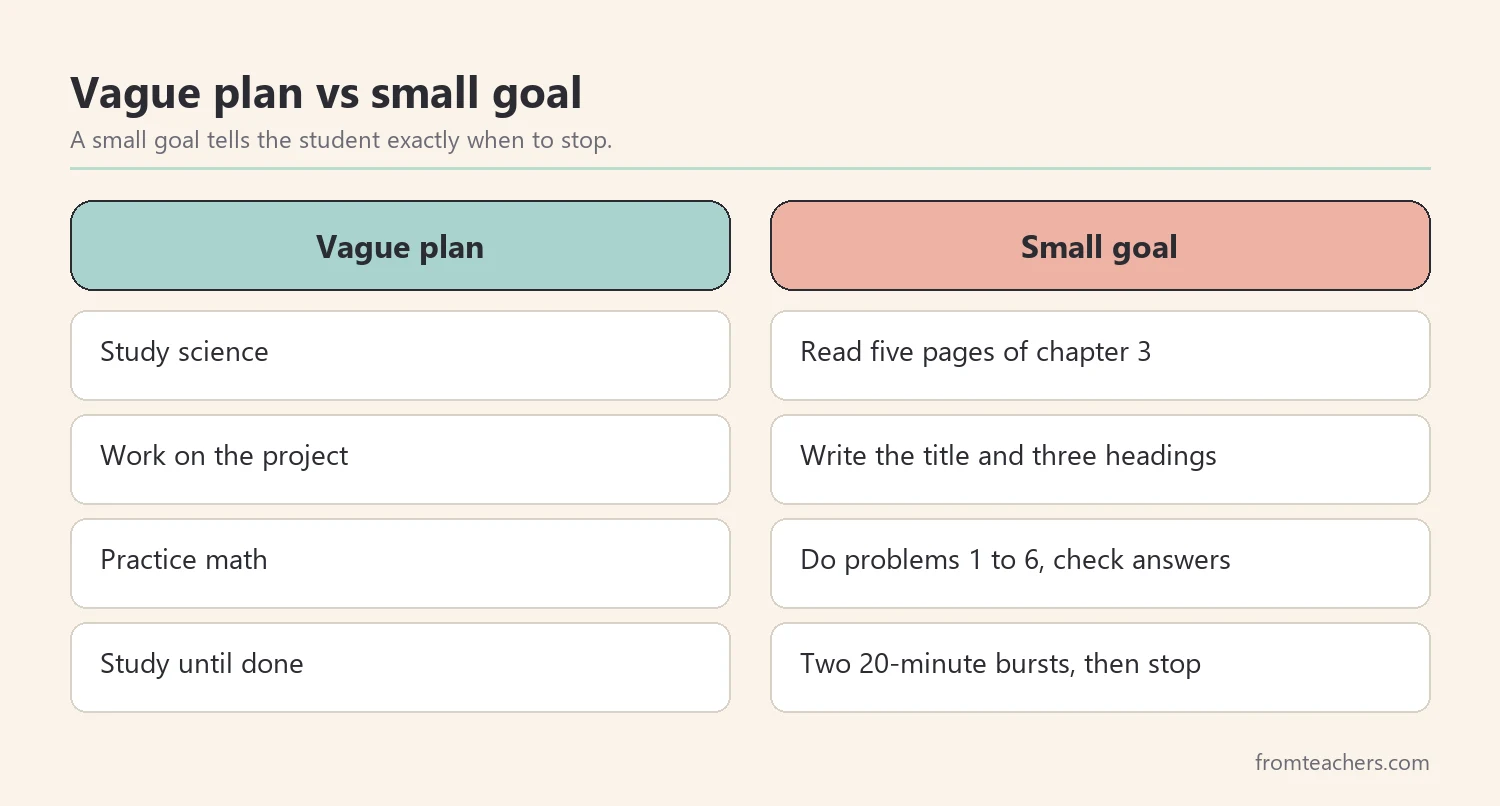
Next, break large tasks into smaller parts. A big project can feel like a heavy block nobody can lift. Instead, list each step clearly, focus on one step at a time, and track progress as each one is done.
Write the steps where the student can see them. A sticky note with three numbered steps is enough. Moreover, crossing off each step gives a small sense of success that keeps the student moving.
| Big task | Small steps |
|---|---|
| Science project poster | Pick topic, find 3 facts, sketch layout, draw, label |
| Spelling test Friday | Sort words, practice 5 a night, self-quiz Thursday |
| Book report | Finish reading, list main events, write draft, check |
Teach goal setting directly in class, too. Show two goals side by side and ask students which one tells them exactly when they are done. Then have each student rewrite one vague goal of their own. This takes five minutes and gives them a model to copy at home.
Finally, add a small reward for finishing the goal. It can be simple: five minutes of a favorite activity or a check on a chart. The reward is tied to the goal, not to perfection.
Worked example. Jordan’s quiz covers one chapter. His goal on Monday is “Read pages 40 to 45 and write three key words.” On Tuesday, it is “Make six flashcards.” Each goal fits into one session.
3. Study in short bursts with the right tools
Long sessions often end in tired, distracted reading. Short bursts work better. One common approach is the Pomodoro Technique: work for about 25 minutes, then take a 5-minute break. Many students, especially younger ones, start with shorter bursts such as 15 or 20 minutes.
During the burst, stay focused on the one goal. During the break, stand, stretch, or move. Breaks are part of the plan, not a reward for finishing everything. As a result, the student comes back to the next burst with more energy.
Next, choose active study tools. Rereading feels productive but often is not. Instead, try flashcards, diagrams, and mind maps; highlight only key information; and use colorful notes or sticky flags. Let the student test a few tools and find the ones that work for them.
It helps to match the tool to the kind of material. The table below gives simple starting points, and students can adjust once they see what works for them.
| Material | Tool to try | How to use it |
|---|---|---|
| Vocabulary or facts | Flashcards | Quiz yourself, sort into know and not yet |
| Processes or cycles | Diagram | Draw it from memory, then check |
| Big ideas and links | Mind map | Main idea in the middle, details around it |
| Long readings | Sticky flags | Flag one key point per page |
A checklist on the wall keeps all of this in front of the student so they do not have to remember it. The Study Habits Checklist poster with nine illustrated tips covers preparing your space, studying in short bursts, using study tools, and more, which makes it a useful reference for a homework station or classroom wall.
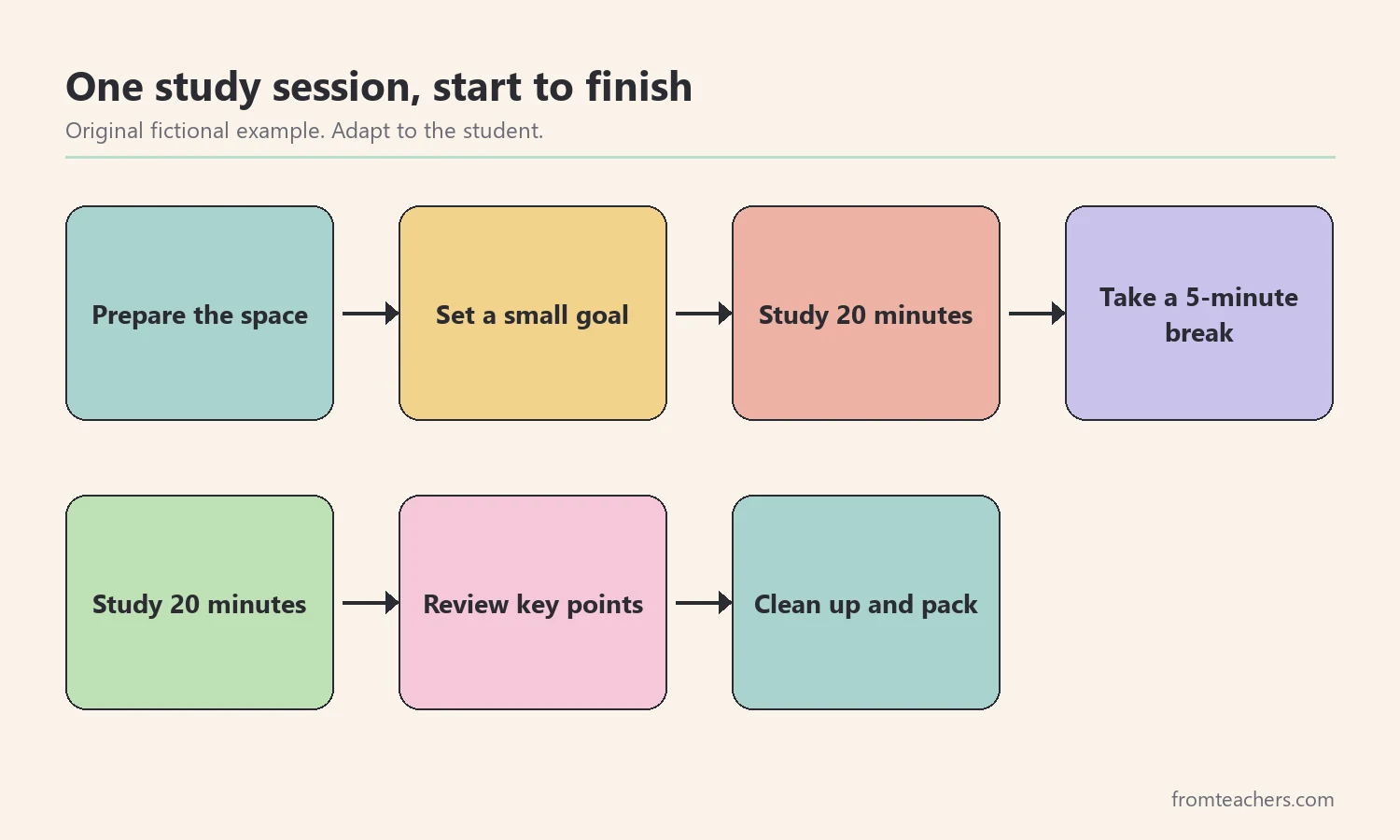
Worked example. Jordan sets a timer for 20 minutes, reads his five pages, and writes three key words. He takes a 5-minute stretch break, then turns the key words into flashcards in a second 20-minute burst.
4. Review regularly, ask for help, and stay positive
Learning sticks when students come back to it. So, build in regular review: look over notes after class, review key points daily, and practice what was learned. Repetition is what helps new information last.
One simple way to plan review is to attach it to something that already happens. For example, review flashcards right after dinner or during the first five minutes of a homework session. Linking a new habit to an existing routine makes it easier to remember.
Keep review short. Five minutes of quizzing yourself with flashcards is often more useful than an hour of rereading the night before a test. Spread review across several days instead of cramming.
Next, teach students that asking for help is a smart study habit, not a weakness. Students can speak up when they do not understand, talk to teachers or classmates, and use trusted resources or tutors. Practice the actual words, such as “Can you explain this part again?”
Also, coach a positive and patient attitude. Students can remind themselves “I can do it” and “Mistakes help me learn.” Celebrate effort, not just grades. In addition, encourage students to be kind to themselves when learning feels slow and to focus on progress.
| Unhelpful thought | Helpful replacement |
|---|---|
| I’m bad at science. | I’m still learning this chapter. |
| I don’t get it, so I quit. | I can ask for help on this part. |
| I made mistakes, so I failed. | Mistakes show me what to review. |
Worked example. On Wednesday, Jordan spends five minutes quizzing himself with his flashcards. He gets two wrong and writes them on a note to ask his teacher about. Instead of saying “I’m bad at this,” he tries “I’m still learning these two.”
5. Close the session and track the study habits checklist
Finally, end every session with a quick clean-up. Tidy the desk, pack the bag for tomorrow, review what was accomplished, and feel proud of the work. This small ending makes the next session easier to start because the space is ready.
Next, keep a simple weekly record. Two or three numbers are enough: sessions planned, sessions completed, and how many checklist tips the student used. Look at the trend over a few weeks rather than judging one night.
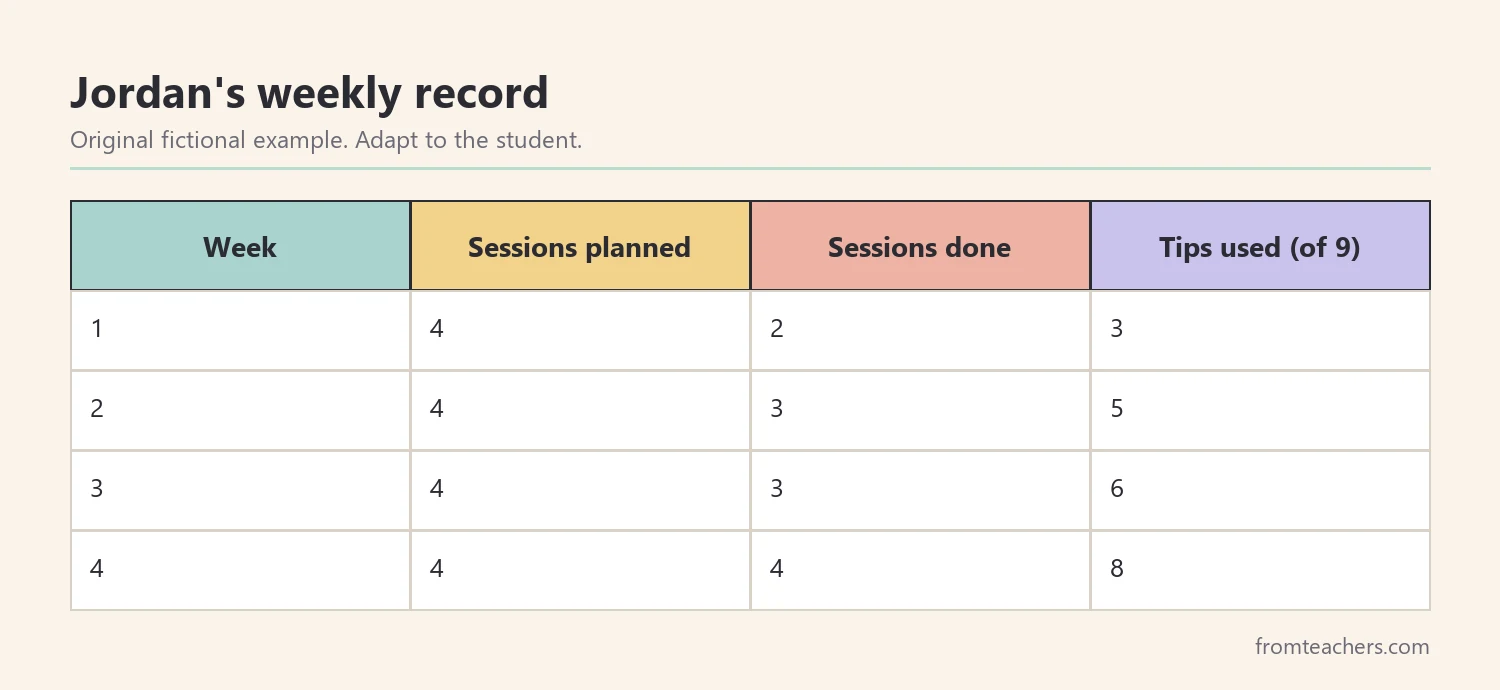
In this example, Jordan completed 2 of 4 planned sessions in week one and 4 of 4 in week four. He also moved from using 3 of the 9 tips to using 8. That is a clear sign the habits are becoming routine.
Students can keep the record themselves. A small grid taped inside a planner, with one box per session, takes seconds to fill in. Self-tracking builds ownership, and the student starts to notice patterns, such as skipping sessions on practice nights.
Then, review the record with the student. Ask which habits helped most and which felt hard. If one habit keeps slipping, make it smaller or add a visual cue. If the student uses accommodations at school, share what is working with the teacher or team.
Students with ADHD or other executive function challenges often benefit from extra structure: a timer they can see, a written checklist on the desk, and an adult check-in at the start. Keep the support in place until the habit is steady, then fade it slowly.
Worked example. After four weeks, Jordan and his parent agree to keep the timer and flashcards, and to add a Thursday review session before quizzes. His teacher notices he now asks questions during class.
Common mistakes and how to avoid them
- Starting without a plan. Fix: write one small, specific goal before the timer starts.
- Studying for too long without breaks. Fix: use short bursts with planned movement breaks.
- Only rereading notes. Fix: switch to active tools like flashcards and self-quizzing.
- Cramming the night before. Fix: spread short review sessions across the week.
- Teaching all nine habits at once. Fix: start with two or three and add more as they stick.
Questions teachers and parents ask about a study habits checklist
What age is a study habits checklist for?
Upper elementary through high school students can all benefit. Younger students need shorter bursts and more adult support. Older students can take more ownership of goals and tracking.
How long should a study burst be?
Start with what the student can manage with focus, often 10 to 20 minutes for younger students. Many older students use about 25 minutes. Adjust based on what you observe.
Should students study with music?
It depends on the student. Some focus better with quiet; others like soft background sound. Try both for a week and compare how much gets done.
How can parents help without taking over?
Help set up the space and the first goal, then step back. Check in at the start and the end of the session. Let the student do the work and the clean-up.
Does this help students with ADHD?
Many students with ADHD benefit from visible checklists, short bursts, and timers. Every student is different, so test a few habits and track what works. Coordinate with the student’s school team where supports are in place.
Related reading: 5 practical teaching tips to boost classroom focus, ADHD classroom strategies for student success, and Learning styles and student success.
A companion resource for building a study habits checklist:
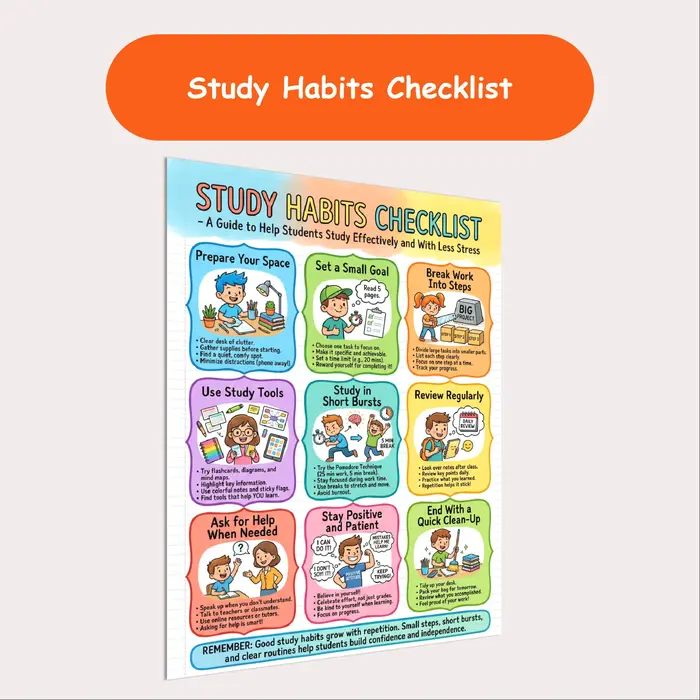
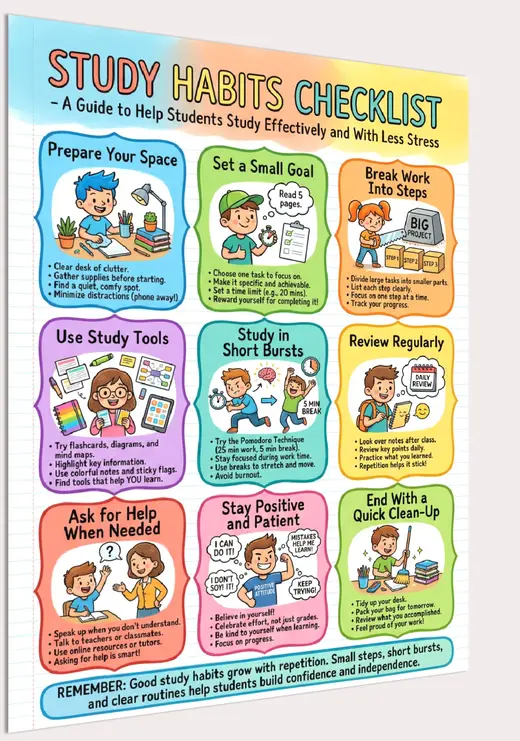
Study Habits Checklist Poster: a colorful printable study skills poster with nine illustrated tips for studying effectively and with less stress. Designed for classrooms, homework stations, and executive function support.
Sources and scope
- What Works Clearinghouse, Institute of Education Sciences: reviews of education research, including practice guides on organizing instruction and study.
- Understood.org: practical articles on executive function, homework, and learning differences.
- CHADD: information for families and educators on ADHD, including school and homework strategies.
- IRIS Center, Vanderbilt University: free modules on evidence-based instructional practices.
This guide covers everyday study routines for school and home. It does not cover diagnosis of ADHD or learning disabilities, which belong to qualified professionals and the student’s team.
Key takeaways
- A study habits checklist turns vague studying into clear actions.
- Prepare the space and set one small goal before starting.
- Study in short bursts with active tools and planned breaks.
- Review often, ask for help, and keep self-talk kind.
- End with a clean-up and track sessions weekly.





Leave a Comment