

Decision paralysis in students can turn a simple choice into a long, stressful pause. Picture a fifth grader during free-choice reading time. She walks to the shelf, picks up a book, puts it back, picks up another, and asks a friend which one is better. When the timer ends, she is still standing at the shelf, and the reading time is gone.
This guide gives you five steps to help: recognize the pattern, find what makes choices feel hard, shrink the number of options, teach a simple decision routine, and fade support as confidence grows. By the end, you will be able to help a student move from stuck to decided with less stress for everyone.
Examples are fictional. Adapt to the student’s goals and agreed supports. This is guidance, not a diagnosis.
At a glance
- Freezing over choices is common, and it affects both work and confidence.
- Fear of the wrong answer and too many options are frequent causes.
- Fewer options and a clear time frame make decisions easier.
- A short, repeatable routine teaches students how to decide.
- Practice with low-stakes choices first, then fade adult support.
1. Recognize decision paralysis in students
First, learn what it looks like. Decision paralysis in students shows up as long pauses before choosing, repeated questions like “Which one should I do?”, switching back and forth between options, or asking an adult to choose for them. Some students say “I don’t care” when they actually care a lot and feel stuck.
Next, notice where it happens. Common moments include choosing a writing topic, picking a book, selecting a center or partner, answering open questions, or deciding how to start a project. In many cases, the student can do the work easily once the choice is made.
Also, notice the cost. Time slips away, work stays unfinished, and the student may start to see themselves as “bad at deciding.” Over time, that belief can make every choice feel heavier. So, early support matters.
Separate it from other issues
In addition, separate decision paralysis in students from other issues. A student who does not understand the task needs teaching. Meanwhile, a student who does not want to do the task may be avoiding it. A student who freezes specifically at the moment of choosing needs help with deciding itself.
Then, keep short notes. Write the situation, how long the pause lasted, and what finally helped. These notes will guide your plan in later steps. They also help you see whether decision paralysis in students you teach is rare or part of a daily pattern.
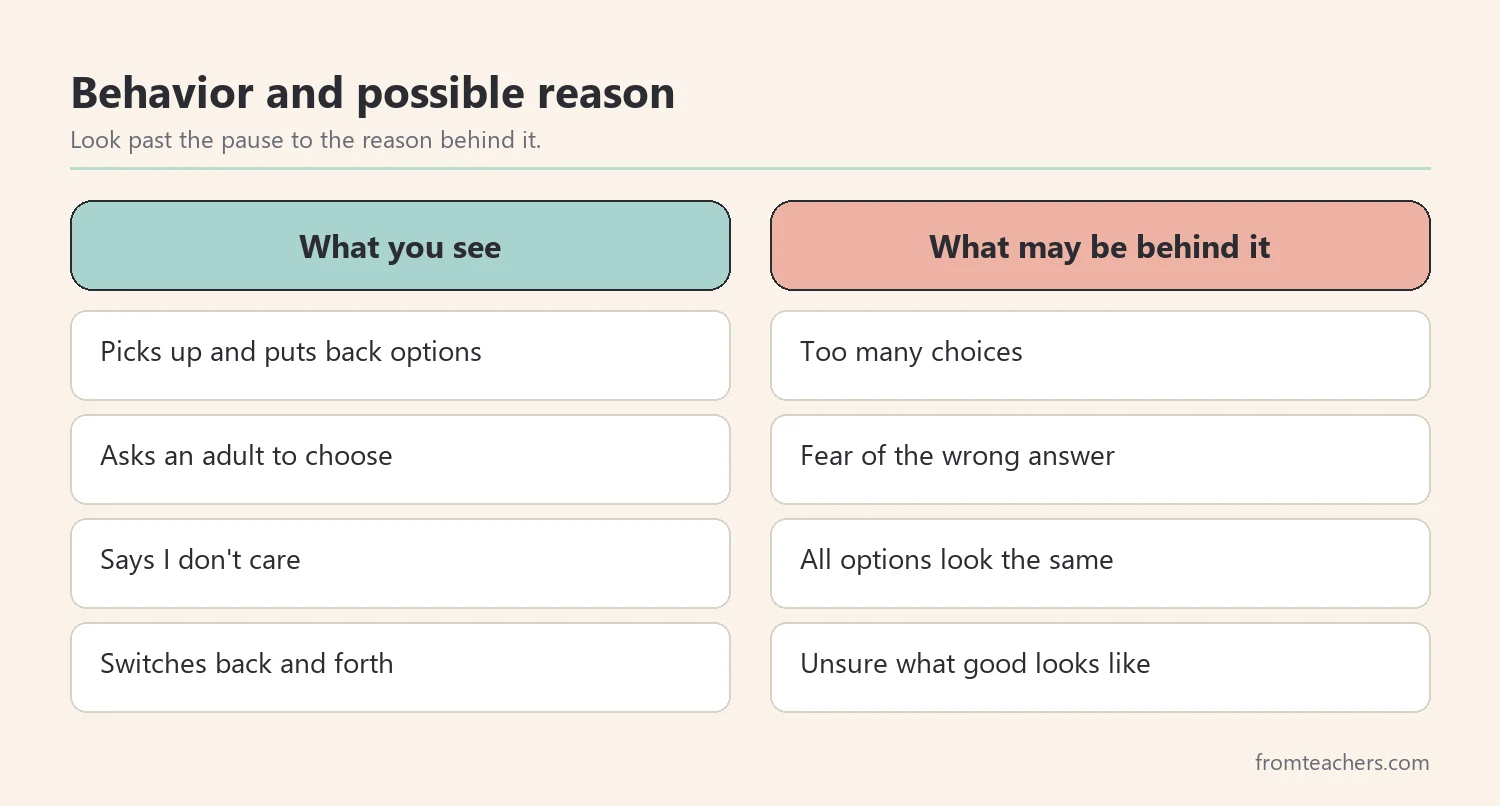
Worked example. Maya is a fictional student in grade 5. Her teacher, Mr. Reed, notices that she finishes math quickly but struggles with any choice. Over one week, he notes that Maya took more than five minutes to choose a book, a writing topic, and a center activity on four separate days. Once she chose, she worked well.
2. Find what makes the choice feel hard
Next, look for the reason behind the freeze. Decision paralysis in students often comes from a few common sources. The student may fear picking the wrong option. There may be too many choices. The options may look equally good, or the student may not know what “good” means for this task.
Also, think about perfectionism. Some students believe there is one perfect answer and worry that any other choice is a failure. Others worry about what peers or adults will think. These feelings are real, even when the choice seems small to an adult.
Meanwhile, consider the context. Tiredness, a noisy room, or a rushed transition can make any decision harder. Students with anxiety, attention differences, or executive function challenges may feel this more strongly, because weighing options takes extra mental effort.
In addition, ask the student directly at a calm time. “When you have to choose, what goes on in your head?” Some students describe a worried voice. Others say every option looks the same. Their answers help you pick the right support for decision paralysis in students like them.
Finally, choose one likely cause to work on first. You can adjust later, because decision paralysis in students often has more than one root. A clear focus makes your plan simpler and easier to explain to the student and family.
Worked example. Mr. Reed asks Maya what happens when she chooses. She says, “What if I pick the wrong book and it’s boring?” She also says the shelf has “too many good ones.” Mr. Reed notes two likely causes: fear of a wrong choice and too many options.
3. Shrink the number of options
Once you know the cause, start with the simplest change: fewer options. For many students, choosing between two or three is far easier than choosing from twenty. This one change often reduces decision paralysis in students right away.
For example, instead of “Pick any book,” offer “Choose one of these three.” Instead of “Write about anything,” offer two topic cards. You are still giving a real choice, which supports independence, but the load is smaller.
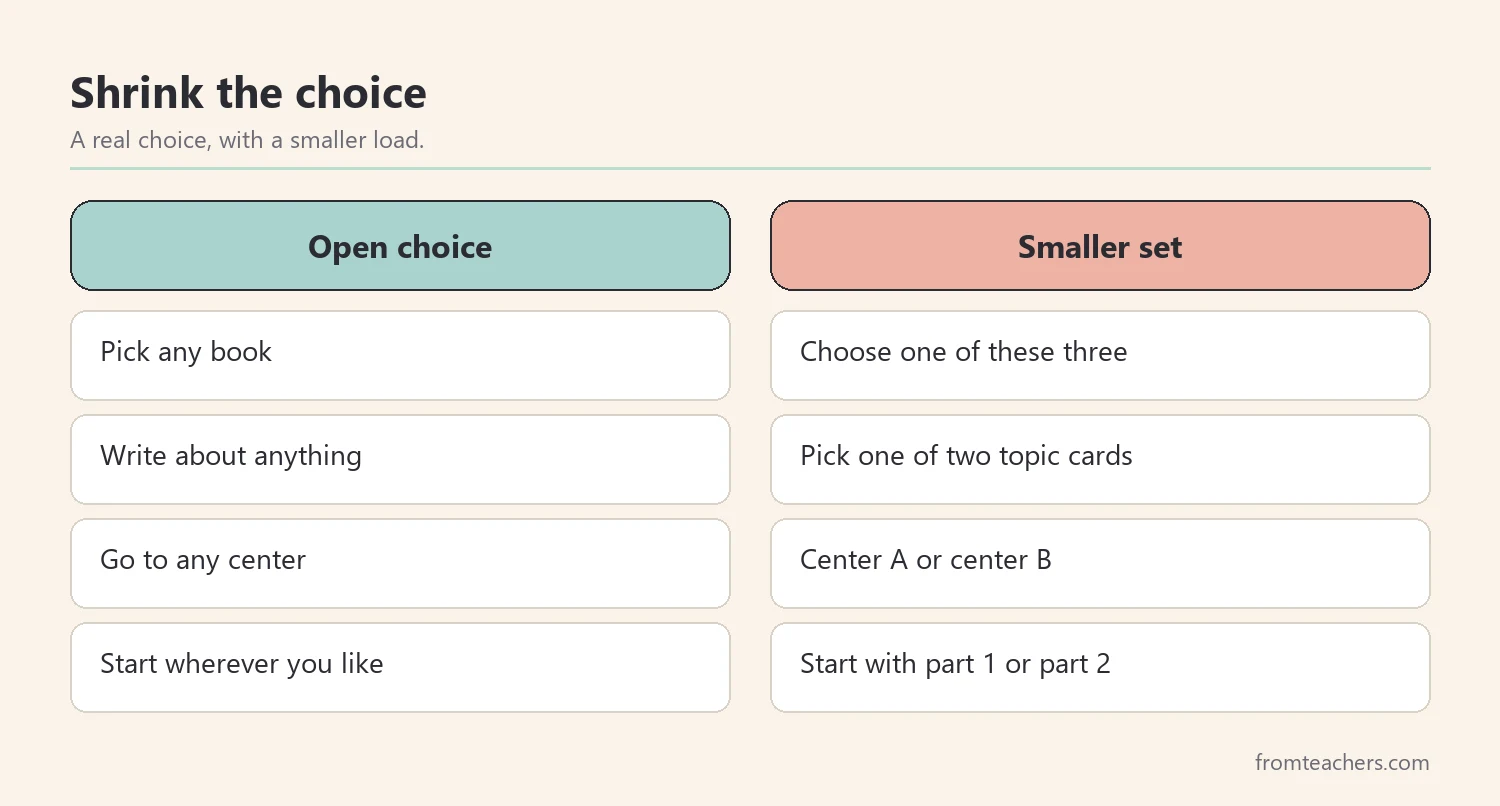
Also, add a time frame. “You have two minutes to choose” gives a clear end point. Pair it with reassurance: “Any of these is a good choice.” That sentence matters, because it lowers the fear of getting it wrong. Calm reassurance is one of the quickest ways to ease decision paralysis in students during a busy lesson.
Make choices reversible
In addition, make choices reversible when you can. “If you don’t like this book after ten pages, you can swap it.” When students know a choice is not permanent, the pressure drops and decisions come faster.
For ready-made responses, the decision paralysis strategy tables for students include 12 tables that explain what to do in each situation and why it helps, which saves planning time when you need a response quickly.
Worked example. Mr. Reed sets three books aside for Maya each week and says, “All three are good. You have two minutes. You can swap after ten pages.” On the first day, Maya chooses in about one minute and starts reading.
4. Teach a simple routine for decision paralysis in students
Next, teach a routine students can use on their own. Fewer options help in the moment, but a routine builds a lasting skill. Keep it short, the same every time, and easy to remember.
One simple routine has four steps. First, name the choice: “I need to pick a topic.” Second, narrow it to two options. Third, pick one reason that matters, such as “Which one do I know more about?” Fourth, choose and start. The reason step is powerful, because it gives the student a way to break a tie.
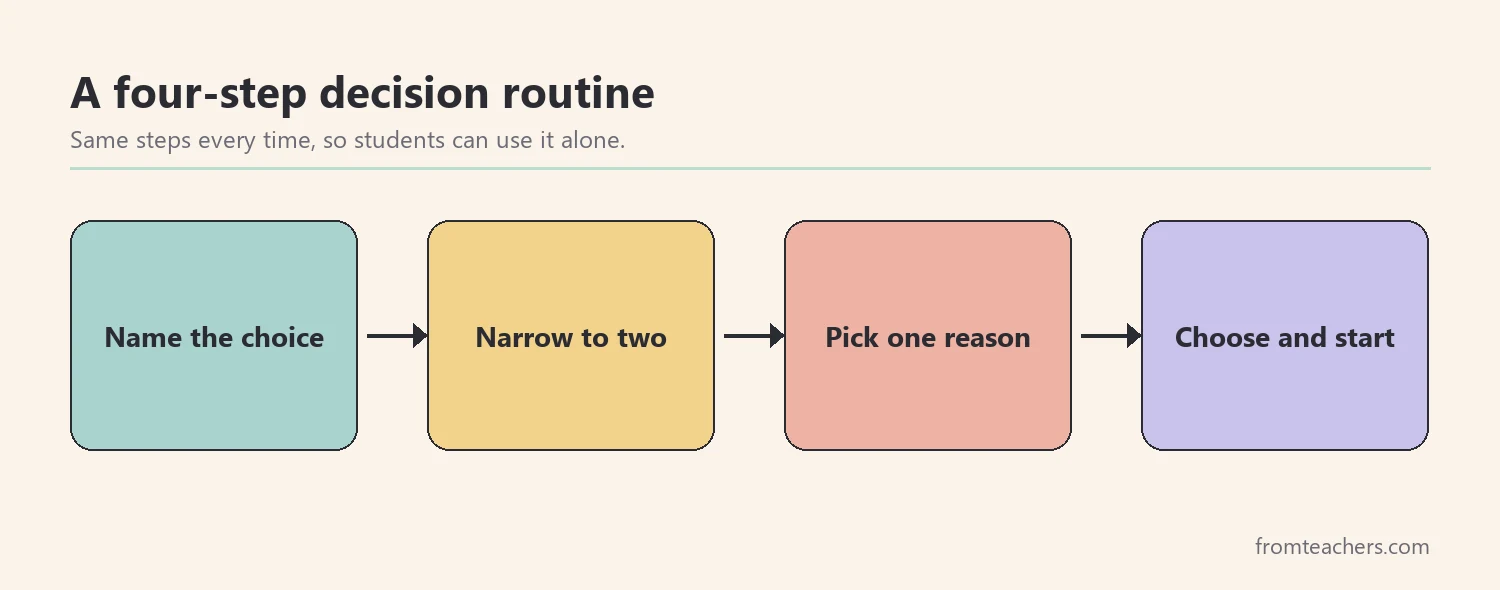
Also, model it out loud. Make your own small decisions in front of the class: “I need to choose a read-aloud. I’ll narrow it to two. My reason is that we just studied animals. So I’ll pick this one.” Students learn the routine faster when they hear it in action.
Post the steps where students can see them
Meanwhile, post the steps where students can see them. A small card on the desk or a poster near the book shelf works well. Over time, students start to use the routine without being reminded, which is the real goal when supporting decision paralysis in students.
In addition, teach the idea of “good enough.” Explain that most choices in school do not have one perfect answer. A good enough choice, made in time, is usually better than a perfect one that never happens. This idea alone can soften decision paralysis in students who worry about perfection.
Worked example. Mr. Reed tapes a four-step card to Maya’s desk. When choosing a writing topic, she narrows it to “my dog” or “the beach trip.” Her reason is “Which one has more details?” She chooses her dog and starts writing within two minutes.
5. Practice, praise, and fade support
Finally, give students many chances to practice with low-stakes choices. Choosing a pencil color, a warm-up game, or the order of two tasks are good starting points. Small wins build confidence before bigger choices come along.
Also, praise the process, not just the result. Say, “You narrowed it to two and picked a reason. That was a smart way to decide.” This tells the student exactly what to repeat next time, and it shows that decision paralysis in students can improve with skill.
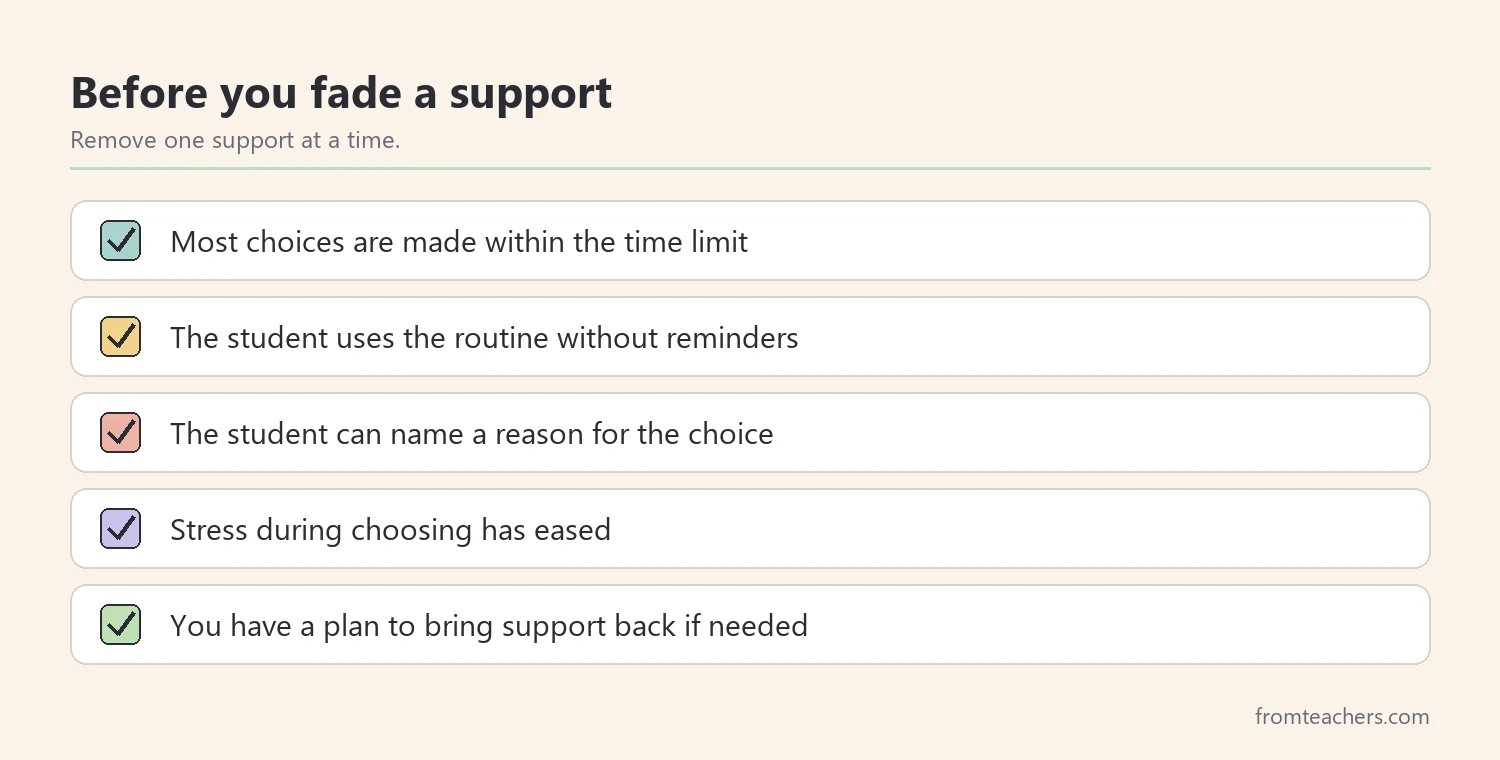
Next, fade support step by step. Move from three adult-picked options to student-picked options. Then shorten the reminder card, and finally remove it. If the student struggles again, bring back one support for a short time. That is normal and not a setback.
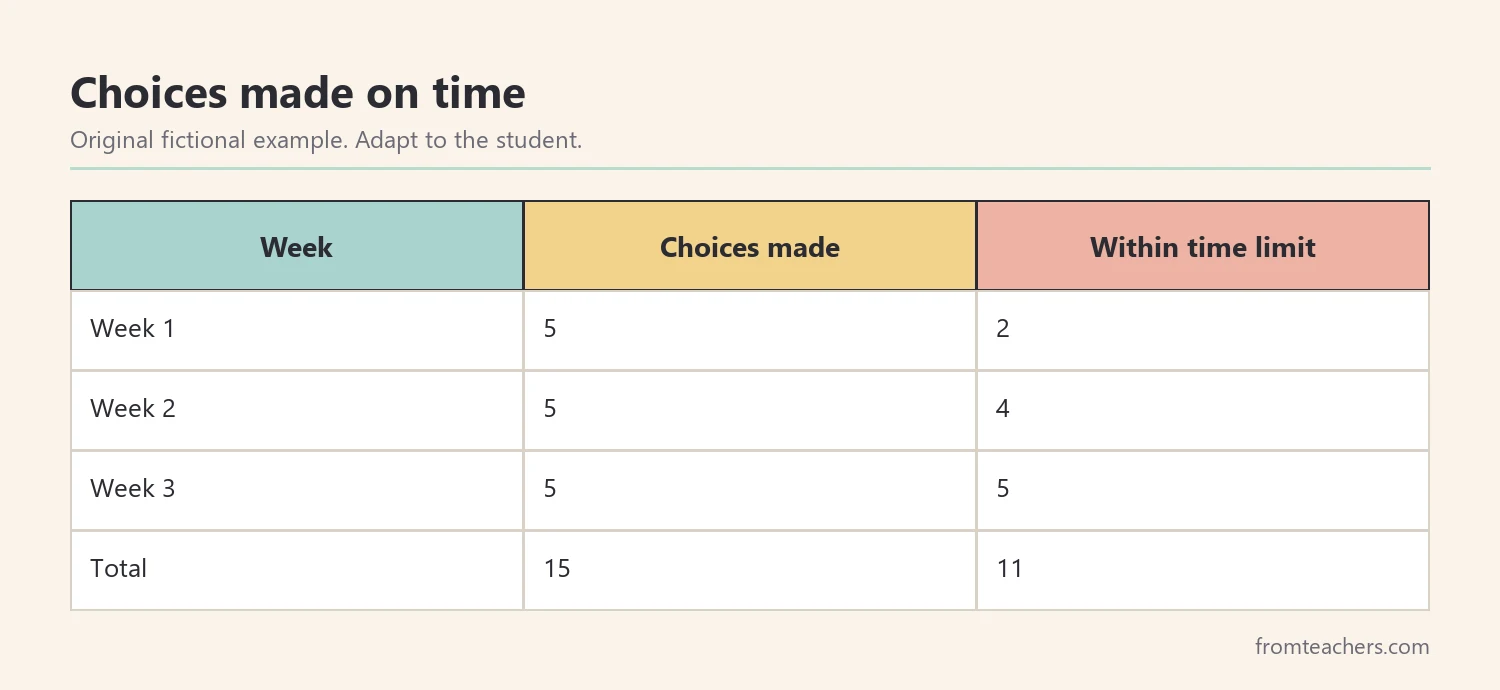
In addition, keep a simple record. Track how many choices the student made each week and how many were made within the time limit. A few numbers are enough to show progress to the student and family.
Then, share the routine with families. Parents can use the same steps at home for choices like snacks, clothes, or weekend plans. Using one routine in both places helps students practice more often. Consistent language at school and home is a simple, low-cost way to reduce decision paralysis in students over a full school year.
Worked example. Over three weeks, Mr. Reed records Maya’s choices. In week 1, she made 5 choices and 2 were within the time limit. By week 2, she made 5 choices and 4 were on time. In week 3, she made 5 choices and all 5 were on time. Across the three weeks, that is 11 of 15 choices made on time. Mr. Reed now lets Maya pick her own three books.
When to involve the wider team
Sometimes, decision paralysis in students comes with strong worry, tears, or physical complaints. It may also appear across many areas of life, not just school. In those cases, share your notes with the family and the school counselor or support team.
Also, check whether the student’s plan needs an update. A formal support plan may include agreed strategies, such as limited options or extra time. Your observations give the team useful, concrete evidence.
Finally, keep classroom routines steady while the team looks deeper. Predictable, kind support helps every student feel safer when making choices.
Common mistakes and how to avoid them
- Choosing for the student every time. It ends the pause but blocks skill building. Fix: narrow the options instead.
- Offering too many options. More choice can mean more stress. Fix: start with two or three.
- Rushing with pressure. “Just pick one!” raises anxiety. Fix: give a calm time frame and reassurance.
- Treating choices as permanent. High stakes make freezing worse. Fix: allow swaps when you can.
- Praising only the result. The student does not learn how to decide. Fix: praise the steps they used.
- Removing support too fast. Progress may slip. Fix: fade one support at a time.
Questions teachers and parents ask about decision paralysis in students
Is decision paralysis a sign of anxiety?
It can be linked to worry, but it is not a diagnosis on its own. Many students freeze over choices for other reasons, such as too many options. If you are concerned about anxiety, talk with the family and the school’s support team.
Should I just remove choices?
Not completely. Choice supports independence and motivation. Instead, offer fewer, clearer options and teach a routine for deciding. That keeps the benefits of choice without the overload.
What age can students learn a decision routine?
Even young children can learn a simple version, such as “pick one of two.” Older students can use a fuller routine with a reason step. Adjust the language and number of steps to the student.
How can parents help at home?
Parents can offer two options for small choices, give a short time frame, and praise the deciding process. Using the same routine as school helps students practice more often.
What if the student still cannot decide?
Offer a calm fallback, such as “If you don’t choose in two minutes, we’ll use the first option.” Then review later what made it hard. Over time, the fallback is needed less often.
Related reading: Bridging Gaps in Special Education: Practical Strategies for Teachers, ADHD in Children: A Guide to Effective Classroom and Home Support, and How Teachers Communicate With Parents in Special Education: Building a Strong Partnership.
A companion resource for decision paralysis in students:
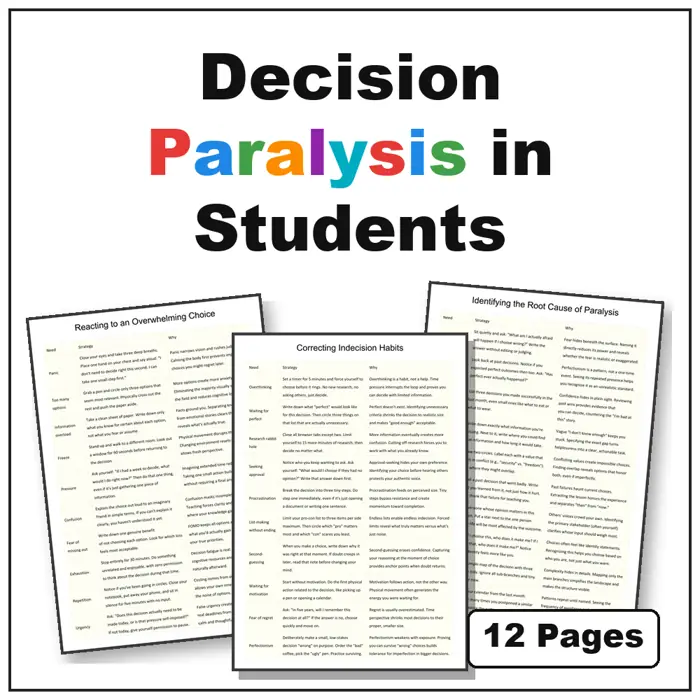
Decision Paralysis in Students: Strategies for Confident Choices: 12 strategy tables that explain what to do in each situation and why it helps students move from stuck to decided.
Sources and scope
- IRIS Center, Vanderbilt University: free modules on instruction, behavior, and classroom supports.
- Child Mind Institute: articles for families and educators on worry, perfectionism, and learning.
- Understood.org: family-friendly information on learning and thinking differences.
- CASEL: a nonprofit focused on social and emotional learning, including responsible decision-making.
This guide covers practical classroom and home strategies for students who freeze when making choices. It does not replace evaluation, diagnosis, or the decisions of the student’s support team.
Key takeaways
- Decision paralysis in students is common and can be taught through.
- Find the likely cause, such as fear of mistakes or too many options.
- Offer two or three options with a clear, calm time frame.
- Teach and model a short routine for deciding.
- Praise the process and fade support one step at a time.








Leave a Comment