
Knowing the different types of calming strategies helps teachers and parents give each child a real choice when their body and brain need to feel safe again. Picture a third grader during a fire drill rehearsal. The bell rings, her hands go over her ears, and she starts breathing fast. One adult says “Calm down.” Another kneels and says, “Let’s do slow belly breaths together, then you can hold your squeeze ball.” Only the second response gives her something to do.
This guide walks you through five steps: learn the six types of calming strategies, teach breathing and movement tools, add sensory and environmental tools, teach thinking and social tools, and build a personal plan with practice. By the end, you will be able to help each student build a short, reliable calming toolkit.
Examples are fictional. Adapt to the student’s goals and agreed supports. This is guidance, not a diagnosis.
At a glance
- Calming strategies fall into six types: breathing, movement, sensory, thinking, social, and environmental.
- Different students, and different moments, need different types.
- Teach every strategy when students are calm, not during a crisis.
- A personal plan with two or three favorites works better than a long list.
- All students need calming tools sometimes, so teach them to everyone.
1. Learn the six types of calming strategies
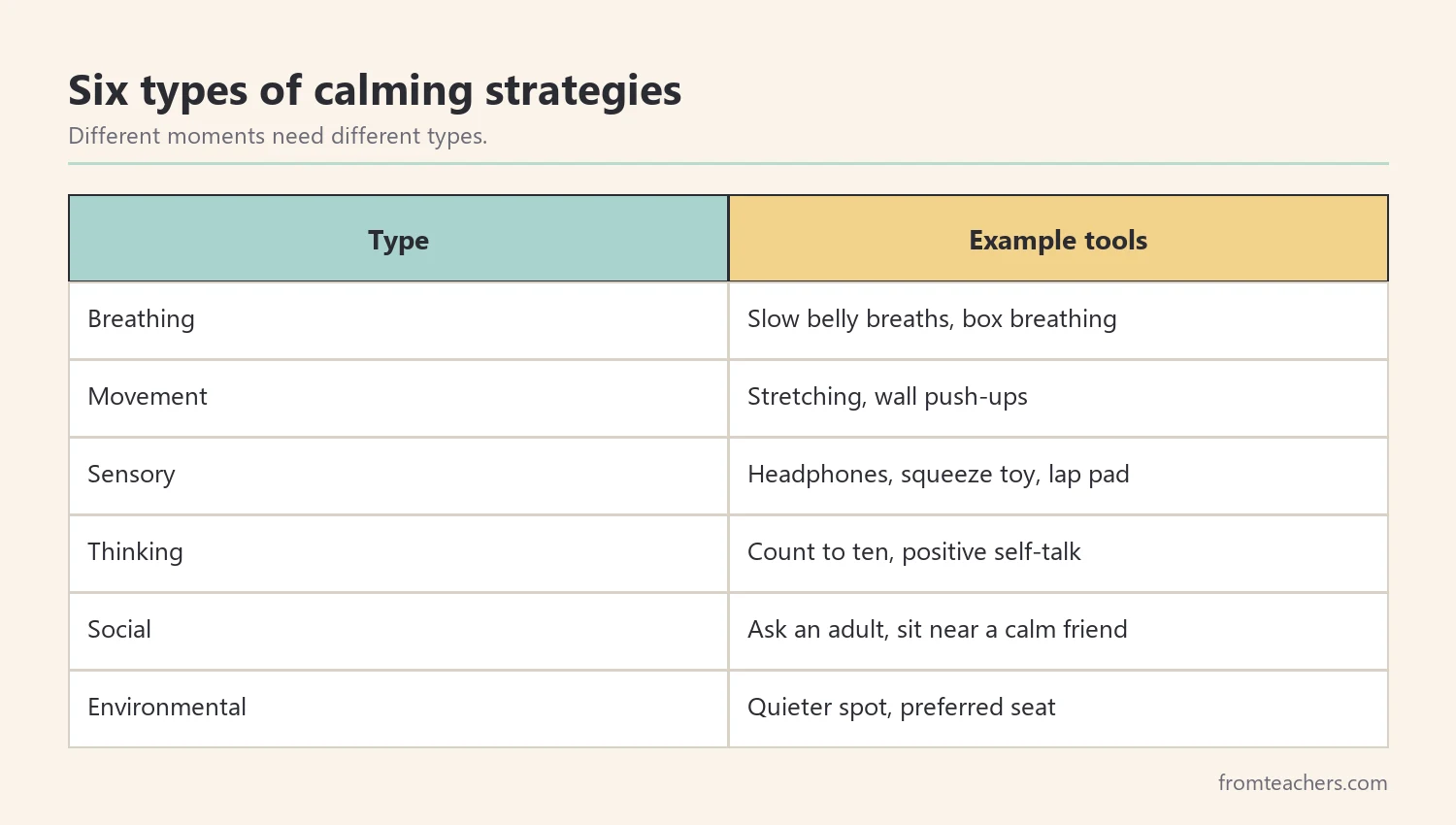
First, organize what you teach. A random list of tips is hard for students to remember. By contrast, grouping tools into types helps students understand why a tool works and which one to try when the first one fails. Six types of calming strategies cover most needs.
Breathing strategies slow the body down, such as slow belly breaths or box breathing. Movement strategies release energy, such as stretching or wall push-ups. Sensory strategies use touch, sound, and pressure, such as noise-canceling headphones or a weighted lap pad. Thinking strategies use the mind, such as counting slowly or positive self-talk. Social strategies involve other people, such as asking an adult for help. Environmental strategies change the space, such as moving to a quieter spot.
Next, explain why variety matters. A student who is full of restless energy may need movement before breathing will help. A student overwhelmed by noise may need an environmental change first. Knowing the types of calming strategies lets adults and students choose more wisely.
Meet Lily
Consider Lily, a fictional student in grade 3. Lily is sensitive to noise and gets overwhelmed during assemblies, fire drills, and loud group work. Her teacher, Mr. Reyes, notices that telling her to breathe rarely helps at first. He decides to explore all six types with her.
Then, observe before you plan. For a week, jot down when a student seems to struggle and what, if anything, helps. Does the student calm faster after a walk, or after a quiet chat? Does noise seem to trigger the hardest moments? These simple notes show which types of calming strategies to try first, so you are not guessing.
Finally, teach the whole class, not only one student. All students need calming tools sometimes. Teaching everyone reduces stigma and gives every child a shared language for asking for what they need.
2. Teach breathing and movement strategies
Breathing and movement are two of the most portable types of calming strategies. They need no materials, and students can use them almost anywhere. So, they are a good place to start.
Begin with breathing. Teach slow belly breaths: breathe in for four, out for four. Teach “smell the flower, blow the candle” for younger students. Then try box breathing by tracing a square with a finger: in, hold, out, hold. Finally, teach a simple deep breath followed by a slow exhale.
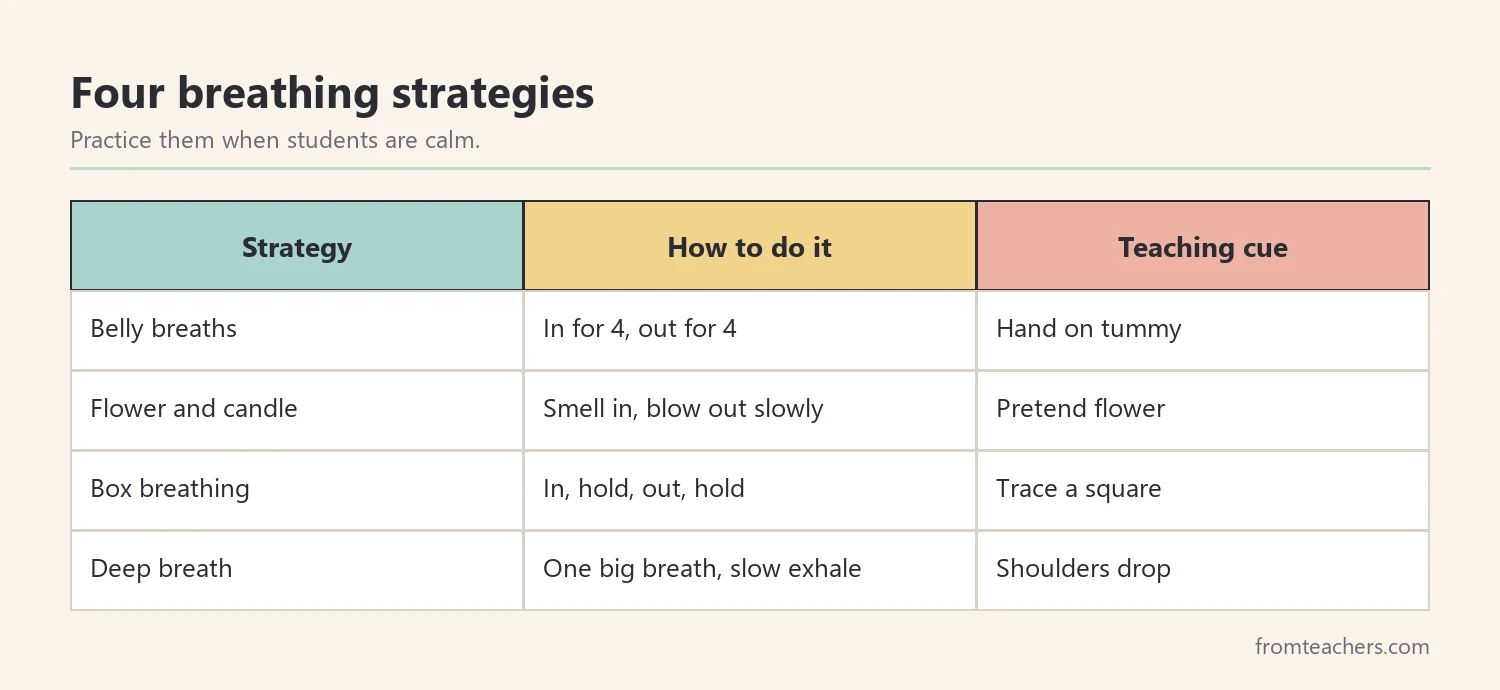
Next, teach movement. Stretch arms, legs, or neck. Do wall push-ups or chair push-downs. Walk to a calm corner or quiet space. Take a short sensory break. Movement helps when energy is high and sitting still feels impossible.
Also, practice daily in short bursts. A one-minute breathing warm-up at the start of a lesson builds the habit. A stretch break between activities lets students rehearse movement tools. Practice when calm makes the tools ready when stress arrives.
For Lily, box breathing turned out to be a favorite because tracing the square gave her hands something to do. Mr. Reyes taught it during morning meeting, and the whole class practiced. When the next fire drill came, Lily traced a square on her leg while walking outside.
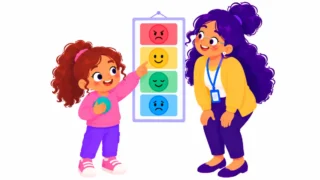
In addition, use visual reminders. Students often forget the steps when upset. A clear calming strategies poster for students, sorted into six strategy types with clean line drawings, gives them something to look at instead of trying to remember.
3. Add sensory and environmental strategies
Some students need more than breathing and movement. Sensory and environmental types of calming strategies change what the student feels or where they are, and they can be especially helpful for students with sensory processing differences, autism, or anxiety.
Sensory strategies include noise-canceling headphones, holding a weighted item or lap pad, using a fidget tool or squeeze toy, and trying calming textures like putty, fabric, or sand. Each student responds differently, so let them try several options during calm times.
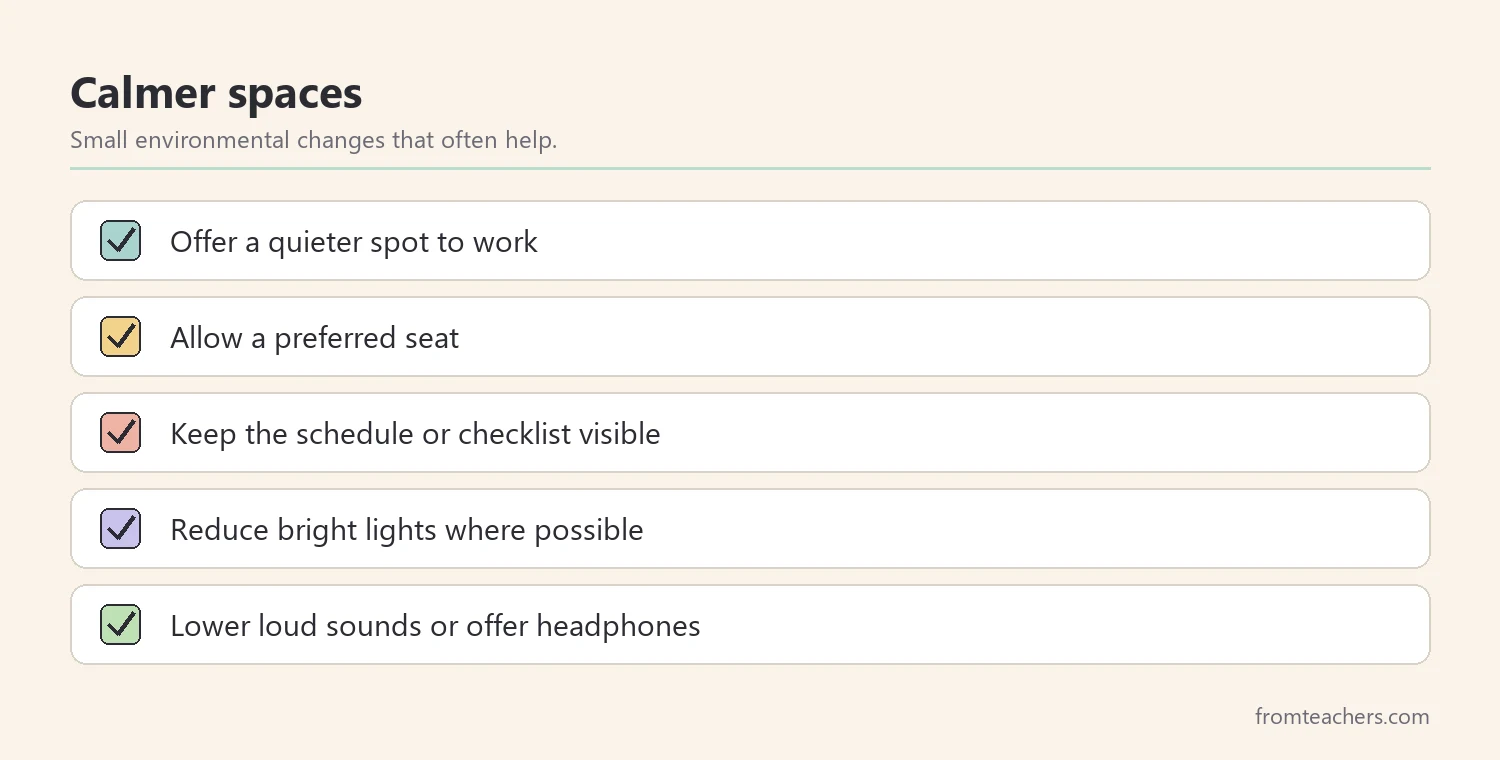
Environmental strategies change the setting. A student might move to a quieter spot, sit in a preferred seat, look at their schedule or checklist, or reduce bright lights or loud sounds. These adjustments often prevent overwhelm before it starts.
Next, plan access. Sensory tools only help if students can get them quickly. Keep a small basket in a calm corner, and teach students how to take an item, use it, and return it. Agree on rules together, such as “fidgets stay in hands.”
For Lily, headphones made the biggest difference. Mr. Reyes kept a pair in her desk. Before assemblies, she put them on and sat at the end of the row, near the door. Those two changes, one sensory and one environmental, turned assemblies from a daily struggle into something she could manage.
Also, coordinate with specialists. An occupational therapist can recommend sensory tools that fit a student’s needs. Changes to seating or routines may also be part of a student’s accommodations, so check with the support team.
4. Teach thinking and social types of calming strategies
Thinking and social strategies use the mind and other people. They work well once the body is a little calmer, and they help students regain a sense of control.
Thinking strategies include counting slowly to ten, using positive self-talk such as “I can handle this,” thinking of a safe or happy place, and grounding: naming five things you can see. These tools give the mind a focus other than the worry.
Social strategies include asking for help from an adult, telling someone “I need a break,” sitting near a calm friend, and joining a quiet, structured activity. Many students forget that asking for help is a calming tool. Teach it explicitly, and practice the words.
Next, rehearse the phrases. Students who struggle with language under stress benefit from short scripts and break cards. Practice “I need a break” until it feels natural. Then, make sure adults respond quickly and kindly when a student uses it.
How grounding helped Lily
For Lily, grounding helped during loud group work. She learned to look around and name five things she could see. Mr. Reyes noticed her lips moving quietly and knew she was using her tool. After a minute, she usually rejoined the group.
Also, connect thinking strategies to the student’s own words. Self-talk works best when it sounds like the student, not like a poster. Ask, “What could you tell yourself when the room gets loud?” A student might choose “This will end soon” or “I know what to do.” Write the sentence on their personal card, next to the other types of calming strategies they have chosen.
Moreover, model these tools yourself. Say out loud, “I’m feeling a bit stressed. I’m going to count to ten slowly.” When students see adults use thinking and social types of calming strategies, they learn that everyone needs them.
5. Build a personal plan and practice
Finally, help each student choose favorites. A list of twenty tools is overwhelming in a hard moment. Instead, build a short personal plan with two or three tools from different types of calming strategies.
A simple plan answers three questions. When do I usually need a tool? What will I try first? What will I try if the first one does not work? Write the answers on a small card the student keeps nearby.
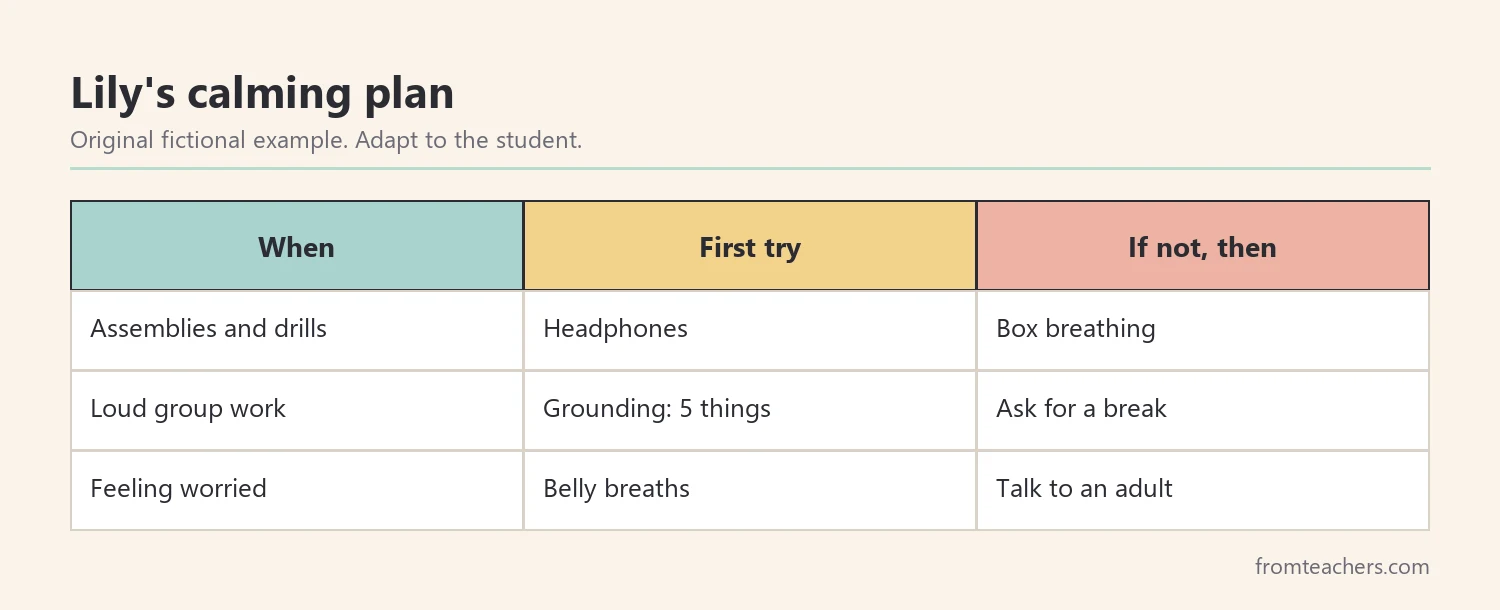
Also, mix types in each plan. If the first tool is sensory, make the second one a different type, such as breathing or asking for help. Mixing types of calming strategies gives the student a real backup when one approach is not enough, and it builds a wider toolkit over time.
Practice the plan regularly
Next, practice the plan regularly. Rehearse it during calm times, review it weekly, and adjust it when something stops working. Students grow, and their favorite tools may change.
Then, track what helps. A quick note after each use, showing the tool and whether it helped, is enough. Over a few weeks, patterns appear.
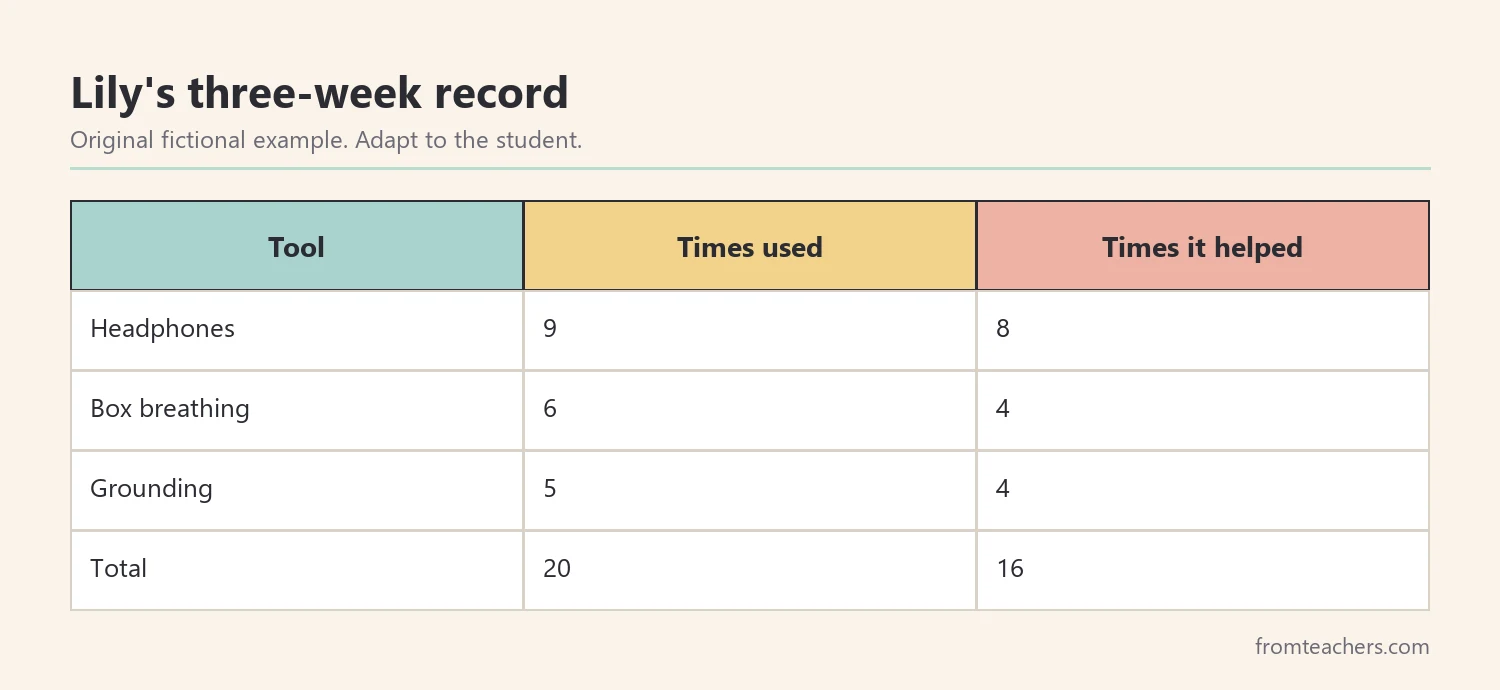
In Lily’s fictional three-week record, she used headphones 9 times and they helped 8 times. Box breathing was used 6 times and helped 4 times. Grounding was used 5 times and helped 4 times. In total, she used 20 tools, and 16 of those uses helped. That data helped Mr. Reyes keep headphones as her first tool for noisy events.
Moreover, share the plan with families and other staff. When everyone knows a student’s plan, the student gets consistent support across settings. Practicing these strategies every day helps students stay regulated, confident, and ready to learn.
Common mistakes and how to avoid them
- Only teaching breathing. Some students need other tools first. Fix: teach all six types of calming strategies.
- Teaching tools during a crisis. Stressed brains cannot learn. Fix: practice when students are calm.
- Offering too many choices. Students freeze. Fix: build a personal plan with two or three favorites.
- Making tools hard to reach. Students give up. Fix: keep sensory items close and easy to return.
- Never checking what works. Unhelpful tools stay in the plan. Fix: track use and adjust.
Questions teachers and parents ask about types of calming strategies
Which type of calming strategy works best?
There is no single best type. It depends on the student and the moment. That is why teaching several types of calming strategies matters: students can switch if one does not help.
Are calming tools only for students with disabilities?
No. All students need calming tools sometimes. Teaching them to the whole class helps everyone and reduces stigma for students who use them more often.
What if a student uses a calming tool to avoid work?
Set clear limits, such as a timer for breaks, and a plan to return. If avoidance continues, look for the reason, such as work that feels too hard, and talk with the team.
How young can children learn these strategies?
Preschoolers can learn simple breathing and movement tools with pictures and games. Older students can manage more complex thinking strategies and personal plans.
How many types of calming strategies should one student learn?
Start with two or three tools from different types, then add more as the student gains confidence. A small set used often beats a long list used rarely.
Should calming strategies be part of an IEP or 504 plan?
For some students, yes. Sensory tools, breaks, or seating changes may be listed as accommodations. The student’s team decides what belongs in a formal plan.
Related reading: Managing Sensory Overload: Practical Strategies for Autism and ADHD, Understanding Autistic Burnout and School Exhaustion: Prevention and Support Strategies, and Accommodations vs Modifications in Special Education: The Difference Explained.
A companion resource for types of calming strategies:
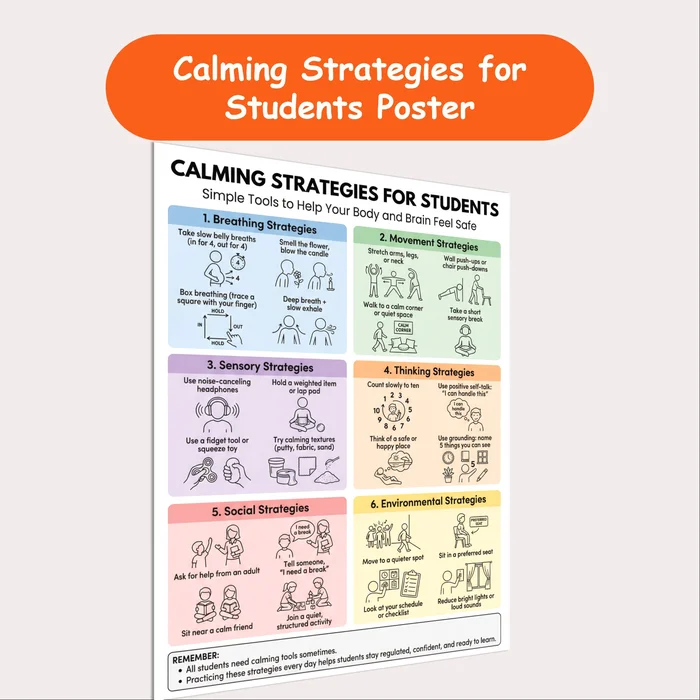
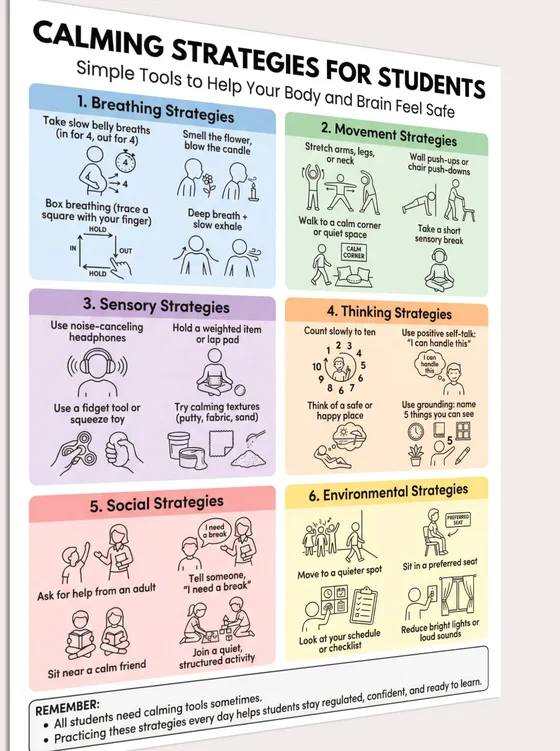
Calming Strategies for Students Poster: simple self-regulation tools sorted into six strategy types, with clean line drawings that make it a calm, readable poster for classrooms and calm corners.
Sources and scope
- American Occupational Therapy Association: information on sensory needs and self-regulation in children.
- CASEL: a framework for social and emotional learning, including self-management.
- IRIS Center, Vanderbilt University: free modules on classroom supports and behavior.
- Understood.org: family-friendly information on sensory processing, anxiety, and focus.
This guide covers everyday classroom and home calming tools. It does not replace occupational therapy, counseling, mental health care, or the decisions of the student’s support team.
Key takeaways
- Six types of calming strategies give students real choices.
- Start with breathing and movement, then add sensory and environmental tools.
- Teach thinking and social tools, including asking for help.
- Build a short personal plan with a first and second tool.
- Practice when calm, track what helps, and adjust.





Leave a Comment