

Test anxiety strategies help students show what they actually know when the pressure is on. Picture a seventh grader who studied all week for a science quiz. When the paper lands on his desk, his hands get sweaty, his mind goes blank, and he spends ten minutes stuck on the first question. Afterward, he remembers every answer.
This guide gives you a five-step process that follows the test itself: understand the worry and plan ahead, prepare before the test, start well, stay steady during the test, then check gently, reflect, and track progress. By the end, you will be able to teach a clear before, during, and after routine that students can use on their own.
Examples are fictional. Adapt to the student’s goals and agreed supports. This is guidance, not a diagnosis.
At a glance
- Some worry before a test is common. The goal is to keep it from taking over.
- A calm body and slow reading of the directions set up a good start.
- Starting with easy questions and focusing on one at a time keeps students steady.
- Quiet calm-down tools work at the desk without drawing attention.
- Reflection after the test turns each quiz into practice for the next one.
1. Understand test worry and plan test anxiety strategies ahead
First, remember that some nervousness before a test is normal. It can even help students focus. The problem starts when worry becomes so strong that students cannot think clearly, freeze on questions, or rush without reading.
Next, notice what test worry looks like for each student. Some students complain of a stomachache. Others become very quiet, tap their pencil, or ask to leave the room. Many say “I’m going to fail” or “I don’t know anything” even when they are well prepared.
Then, plan before test day, not during it. Students learn calming tools best when they are calm. If you wait until the student is already panicking, the new tool will feel like one more thing to remember.
A clear sequence makes this easier to teach. Seven steps work well: two before or at the start of the test, three during the test, and two after. Each step has a short, specific action.
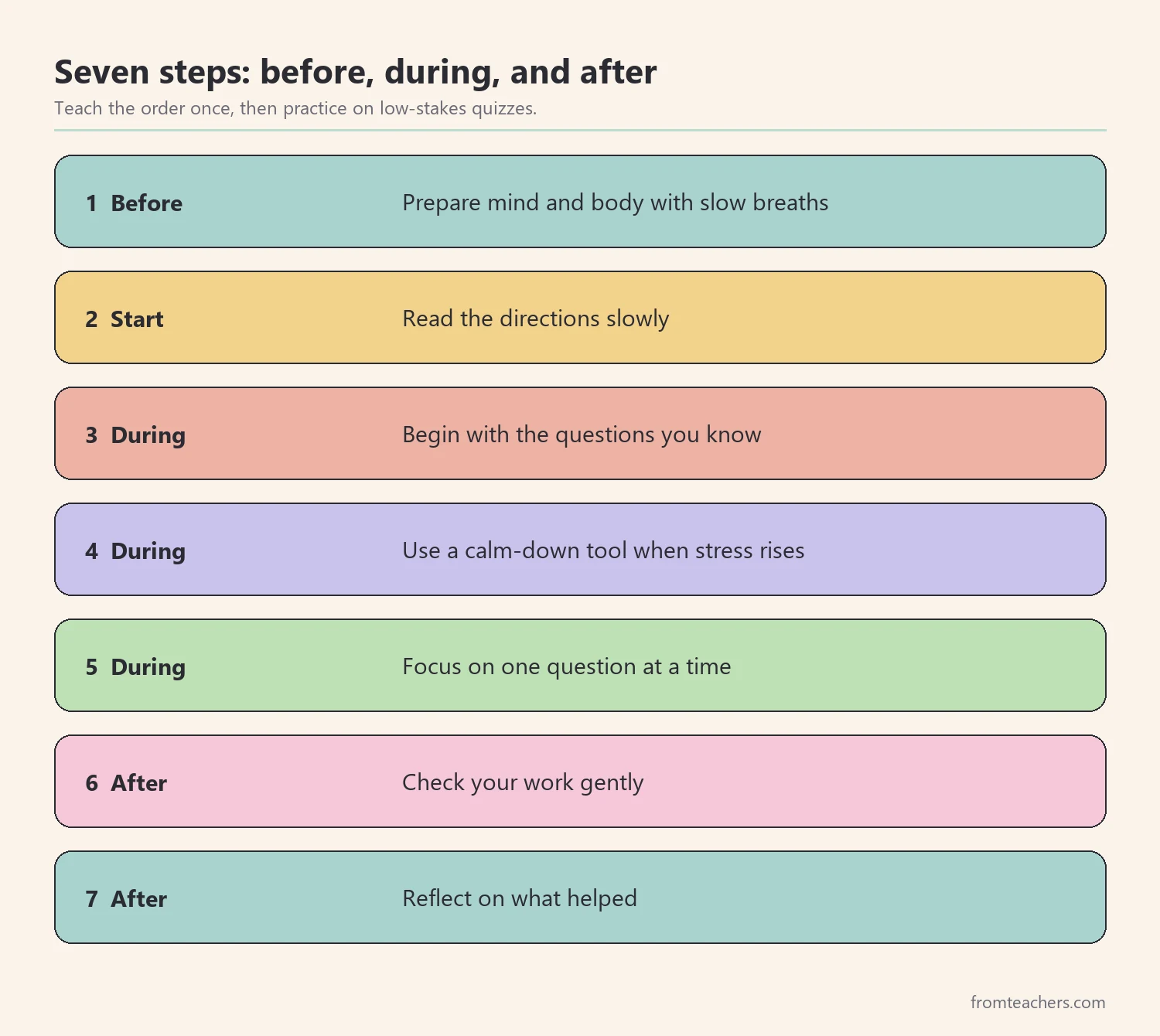
In addition, talk with the student about past tests. Ask, “When does the worry start? What does it feel like? What helped, even a little?” Their answers tell you which steps to teach first.
If worry is intense, frequent, or affects school attendance, involve the school counselor or the student’s team. This guide supports everyday classroom practice and does not replace professional help.
Worked example. Ethan, a fictional seventh grader, rates his worry before quizzes as 5 out of 5. He often runs out of time because he gets stuck on early questions. His teacher and counselor agree to teach him the seven steps over two weeks of low-stakes practice quizzes.
2. Prepare mind and body before the test
A calm body makes a calm brain. So, the first step happens before the test begins: take slow, steady breaths, stretch the shoulders, neck, and hands, and say a short phrase like “I can do this.”
Teach belly breathing in a simple way. Breathe in through the nose so the belly rises, then breathe out slowly. Three slow breaths is enough. Practice it at the start of class for a week so it feels familiar on test day.
Next, prepare the thoughts as well as the body. Many anxious students carry unhelpful thoughts into the test. Practice steadier replacements ahead of time, and write them on a card the student can see.
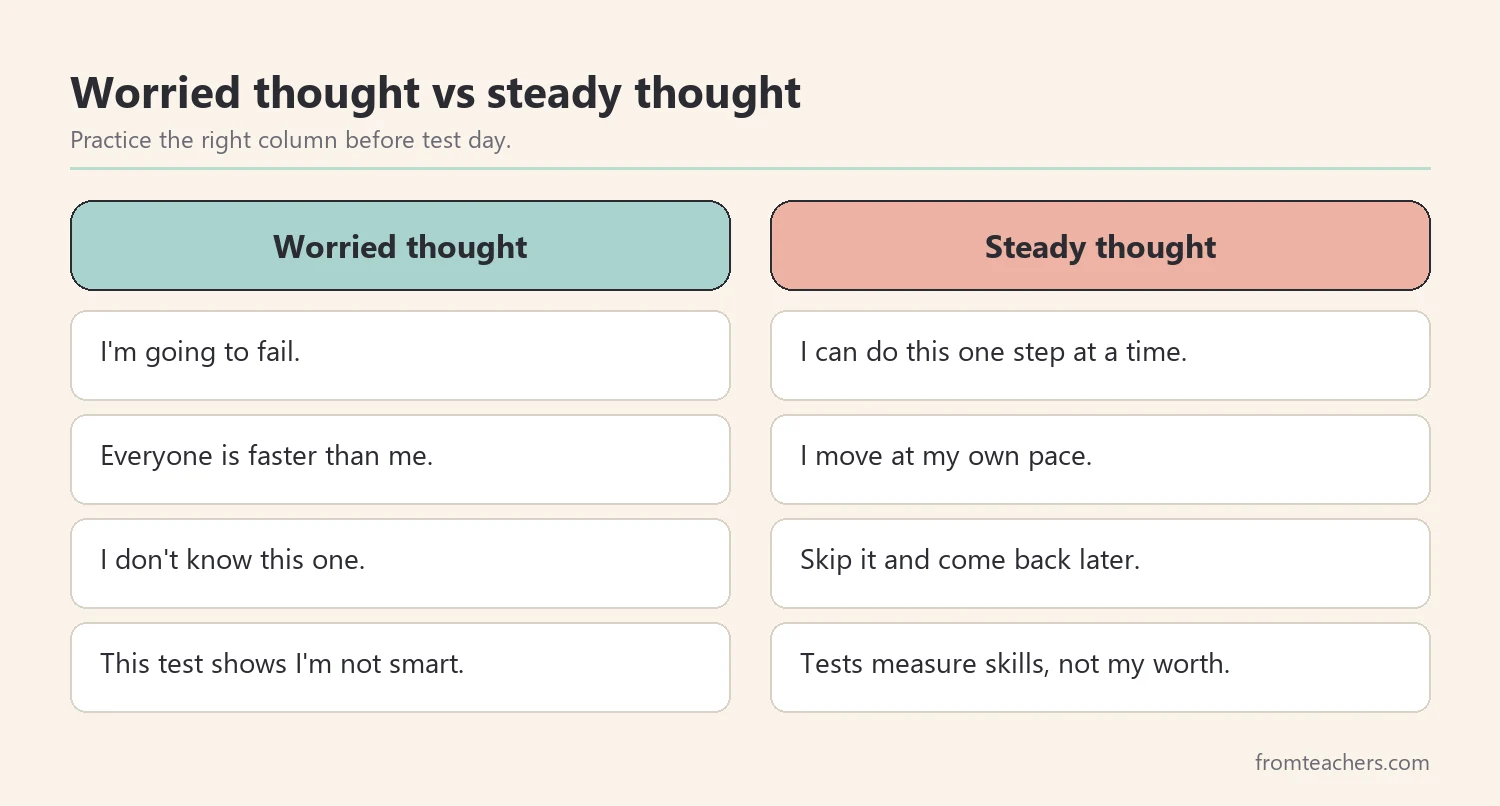
Some students also benefit from a short worry dump before the test. Give them one minute to write down what they are worried about on scrap paper, then fold it and put it aside. Naming the worry can make it feel smaller, and the student starts the test with a clearer head.
Also, keep the morning routine predictable. A good night’s sleep, breakfast, and arriving on time help, but they are not always in the student’s control. Focus on what the student can do: the breathing and the phrase.
One of the most useful test anxiety strategies is simply rehearsal. Give a short practice quiz that does not count, and walk through the first two steps together. Rehearsal makes the real test feel less new.
Worked example. Before each practice quiz, Ethan’s class does three belly breaths and a shoulder roll together. Ethan keeps a card in his pencil case with “I can do this one step at a time.”
3. Start the test well: read slowly and begin with easy questions
The first few minutes set the tone. Therefore, teach students to read the directions slowly at the start. Take your time, ask for help if something is unclear, and underline or highlight key words if allowed. Clear directions reduce confusion and help students feel in control.
Next, start with easy questions. Students can answer the ones they know first, build confidence before tackling harder items, and skip tricky questions to return to later. Early success lowers anxiety and keeps the brain steady.
Classroom routines can support these test anxiety strategies for everyone. Read the directions aloud to the whole class, give a moment for questions, and remind students that skipping and returning is allowed. When the whole class hears the same message, anxious students feel less singled out.
Skipping can feel wrong to some students. Practice it on purpose. During a practice quiz, ask students to mark one question with a small star to come back to later. That way, skipping becomes a strategy, not a failure.
| First minutes | What the student does |
|---|---|
| Minute 1 | Three slow breaths, phrase on the card |
| Minutes 2 to 3 | Read directions, underline key words |
| Minutes 4 onward | Answer known questions first, star the rest |
A visual reminder helps students remember the order when their mind feels busy. The Test Anxiety Steps poster for before, during, and after a test lays out seven sequential steps with short “why this helps” notes, which makes it a calm anchor in a classroom, testing room, or counseling office.
Worked example. On practice quiz 2, Ethan reads the directions slowly and underlines “explain.” He answers three questions he knows and stars two. He returns to the starred ones with more time than he expected.
4. Use test anxiety strategies to stay steady during the test
Worry can rise suddenly in the middle of a test, often at a hard question. That is the moment for a calm-down strategy. Quick tools bring the body back to a calm state so the student can keep thinking.
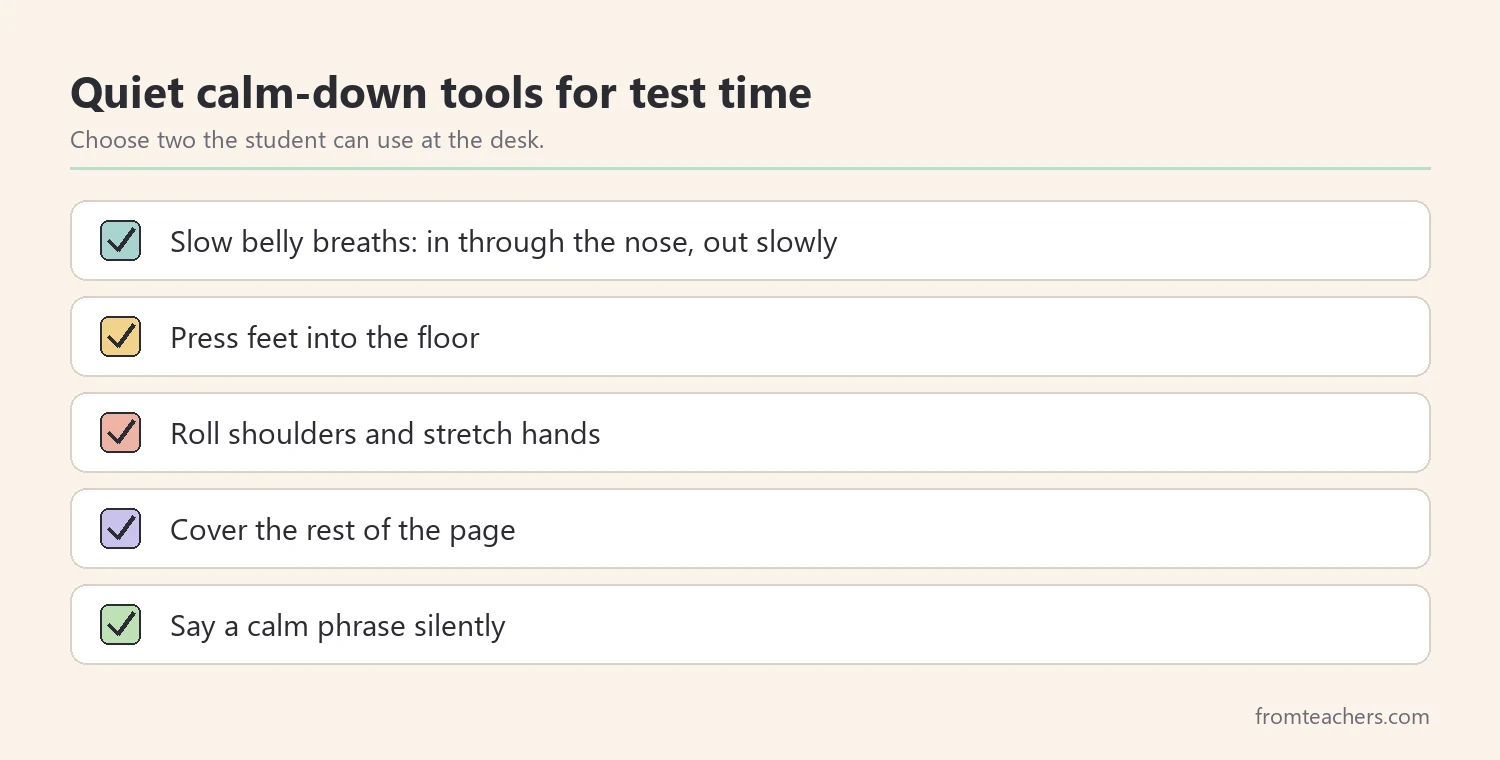
Choose tools that are quiet and invisible to classmates. Slow breaths, pressing the feet into the floor, and stretching the hands all work at the desk. Let the student pick two favorites and practice them often.
Next, teach students to focus on one question at a time. They can cover other parts of the page if needed, avoid worrying about how others are doing, and move at their own pace. Breaking the test into small steps keeps it manageable.
Covering the page is simple and powerful. A blank index card or a folded sheet hides the questions below. Seeing one question instead of twenty makes the task feel smaller.
Plan for time, too. Before the test, show students how to glance at the clock at the halfway point and check how many questions remain. A quick, planned check is calmer than repeated worried glances, and it helps students decide when to move on from a hard item.
In addition, remind students that looking around the room usually adds stress. Someone always seems faster. “I move at my own pace” is a helpful phrase for this moment.
Worked example. On practice quiz 3, Ethan feels his chest tighten at a graph question. He presses his feet into the floor, takes two slow breaths, and covers the rest of the page with an index card. He finishes on time for the first time.
5. Check gently, reflect, and track progress
After answering, students should check their work gently. They can look for skipped questions, fix mistakes calmly, take a short stretch break if allowed, and avoid rereading everything obsessively. A quick, calm check improves accuracy without raising worry again.
Then, reflect after the test. Ask the student to notice which strategies helped them stay calm and to celebrate their effort. Remind them that tests measure skills, not their worth. Reflection builds confidence for the next test and reduces future worry.
| Reflection question | Example answer |
|---|---|
| Which tool did I use? | Feet on the floor and two breaths |
| When did worry go up? | At the graph question |
| What will I try next time? | Cover the page earlier |
Next, keep a simple record across several quizzes. Track the worry rating before the quiz, the number of tools used, and whether the student finished on time. These numbers show whether the test anxiety strategies are helping.
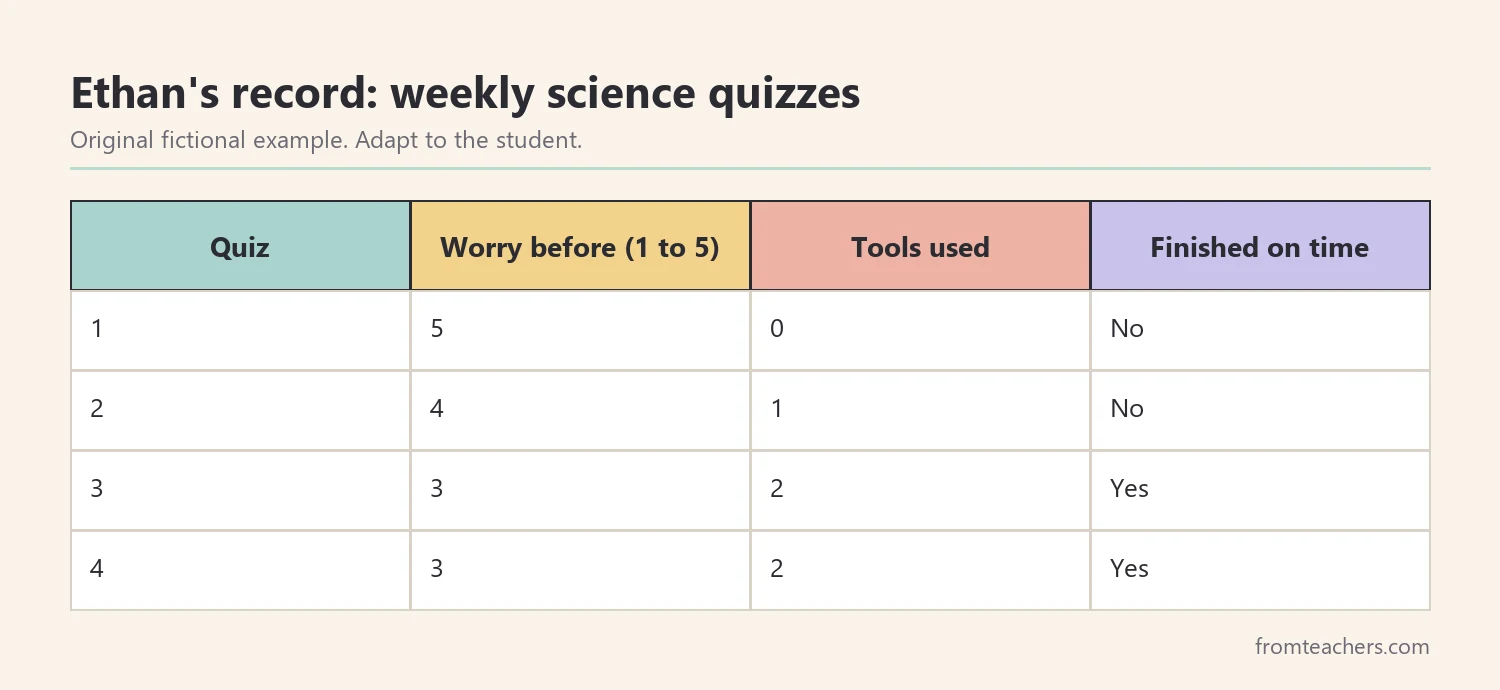
In this example, Ethan’s worry rating dropped from 5 to 3, he moved from using no tools to using two, and he finished on time in quizzes 3 and 4. That is real progress, even though some worry remains.
Look at patterns, not single scores. A hard unit or a short night of sleep can push the worry rating up for one quiz. What matters is whether the student is using the tools more often and recovering faster when worry rises. Celebrate those small changes with the student, because noticing progress builds the confidence that keeps worry lower next time.
Share the record with the family and, where relevant, the school counselor or 504 team. Some students have testing accommodations, such as a quieter room or extra time. The team decides what supports fit.
Worked example. After quiz 4, Ethan writes one sentence: “Covering the page helped most.” His teacher adds a blank card to his pencil case, and his counselor plans to check in before the unit test.
Common mistakes and how to avoid them
- Teaching tools only on test day. Fix: practice on low-stakes quizzes for a week or two first.
- Telling students to just relax. Fix: give a specific action, such as three slow breaths.
- Insisting on answering in order. Fix: teach skipping and returning as a strategy.
- Choosing loud or visible tools. Fix: pick quiet tools the student can use at the desk.
- Skipping reflection. Fix: ask one or two short questions after every quiz.
Questions teachers and parents ask about test anxiety strategies
Is test anxiety a real thing or just nerves?
Many students feel nervous before tests, and for some the worry is strong enough to affect their performance. Only qualified professionals can diagnose an anxiety disorder. Teachers and parents can still teach calming routines to any student.
At what age can students use these steps?
Upper elementary students through high school can use them. Younger students may need simpler words and more adult practice. Older students can take more ownership of tracking and reflection.
Should anxious students get extra time?
Some students have extra time or a separate room as a formal accommodation. That decision belongs to the student’s IEP or 504 team. In everyday class, you can still reduce time pressure on practice quizzes.
How can parents help the night before?
Keep the evening calm and predictable. Practice the breathing and the steady phrase once, then stop studying at a reasonable time. Avoid adding pressure about grades.
What if a student panics and cannot continue?
Follow the plan agreed with the school team, which may include a short break or a quiet space. Afterward, reflect calmly and adjust the plan. Involve the counselor if this happens often.
Related reading: School counseling programs, Trauma-informed teaching strategies, and Accommodations vs modifications in special education.
A companion resource for teaching test anxiety strategies:
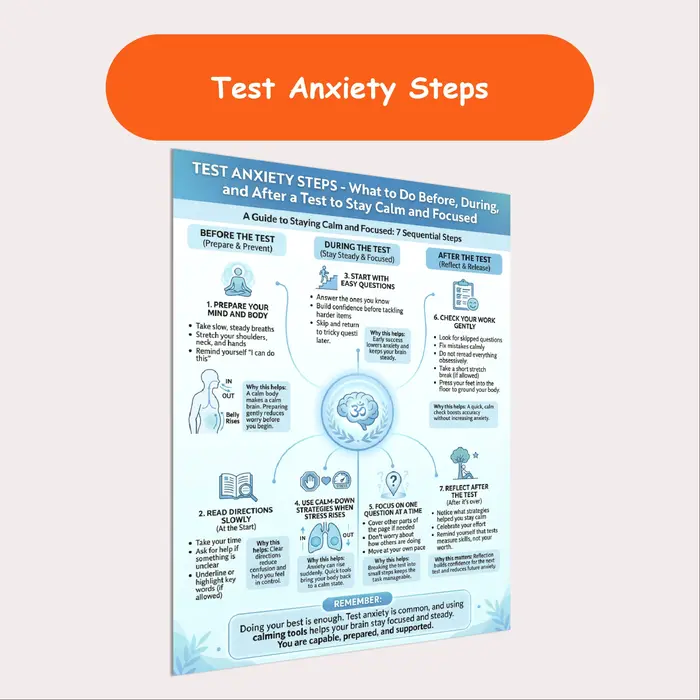
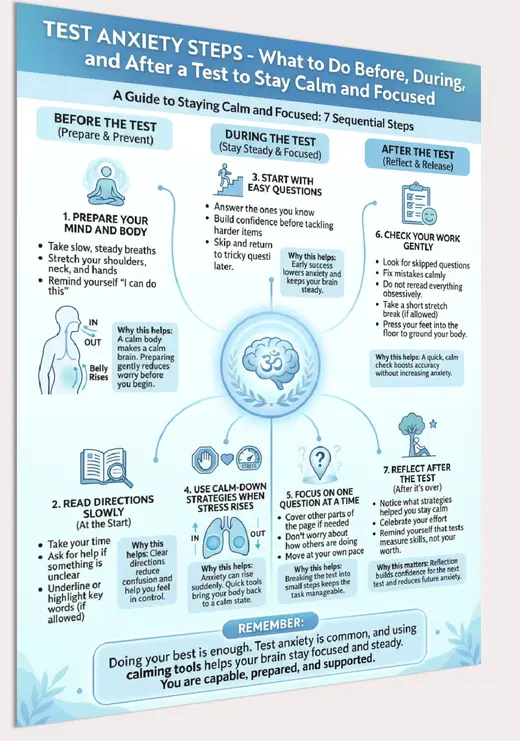
Test Anxiety Steps Poster: a supportive printable poster with seven sequential steps for staying calm and focused before, during, and after a test. Designed for classrooms, testing rooms, and counseling offices.
Sources and scope
- American School Counselor Association: resources on the school counselor’s role in student well-being.
- Child Mind Institute: family and educator guides on children’s anxiety.
- CASEL: a widely used framework for social and emotional learning, including self-management.
- Understood.org: practical articles on testing, anxiety, and learning differences.
This guide covers everyday classroom and home routines for test-time worry. It does not cover diagnosis or treatment of anxiety disorders, which belong to qualified professionals.
Key takeaways
- Test anxiety strategies work best when practiced before test day.
- Start with a calm body, slow reading, and easy questions.
- Use quiet desk tools and focus on one question at a time.
- Check gently, then reflect on what helped.
- Track worry, tools, and finishing over several quizzes.







Leave a Comment