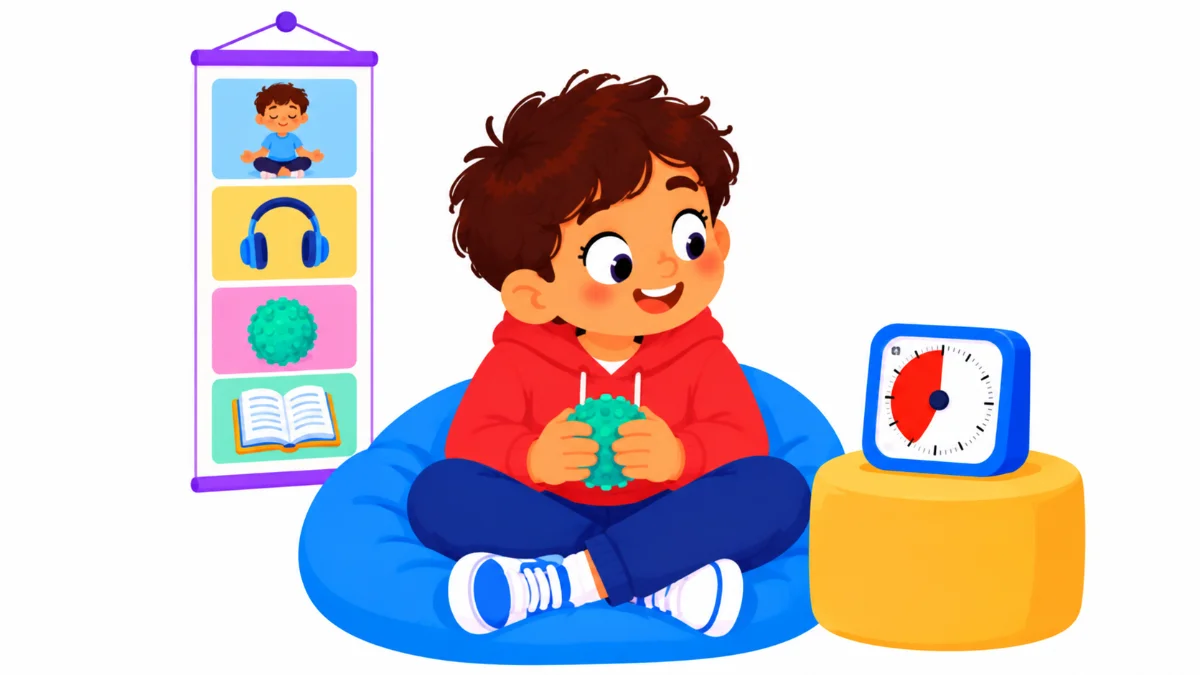

A calm down corner routine turns a cozy space into a real learning tool: a clear set of steps that helps students regulate, reset, and return ready to learn. Picture a second grader who heads to the calm corner, sits on the beanbag, and then stays there for half an hour because nobody ever taught what to do next. The space exists, but the routine is missing.
This guide follows six steps that students can learn and use on their own: notice how I feel, choose a calming tool, try a calming strategy, use positive self-talk, check in with myself, and return when ready. By the end, you will be able to teach, practice, and review a calm down corner routine with your class.
Examples are fictional. Adapt to the student’s goals and agreed supports. This is guidance, not a diagnosis.
At a glance
- The calm down corner is not a punishment. It is a safe place to practice regulation.
- A clear routine tells students what to do from arrival to return.
- Six steps: feel, choose a tool, try a strategy, self-talk, check in, return.
- Teach and practice the routine when students are calm.
- Simple tracking shows whether students are returning ready to learn.
Before the steps, set up the space. Choose a quiet spot away from heavy traffic, with a soft seat, a few tools, and a visual of the routine at eye level. Keep it simple and tidy. Explain to the class that anyone can use the corner, and that it is a place for help, not for trouble. This framing matters, because students avoid a space that feels like a time-out.
Then, teach the calm down corner routine to the whole class before anyone needs it. Walk through each step together, let students try the tools, and role-play arriving and leaving. When every student knows the routine, using the corner feels ordinary rather than special, and no one feels singled out.
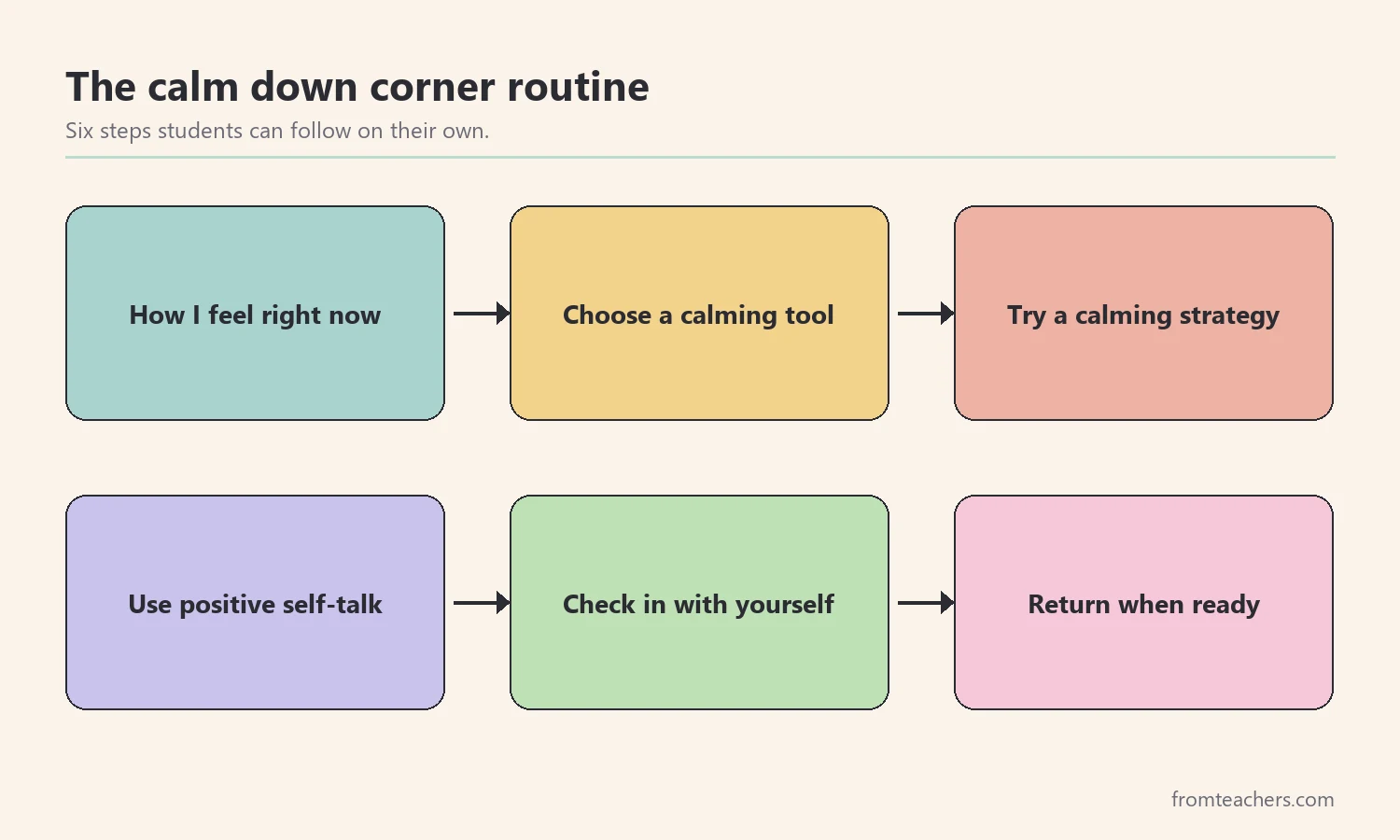
1. Start the calm down corner routine by noticing how I feel
First, the routine starts with noticing. Students look at a set of feeling faces and point to the one that matches: angry, frustrated, overwhelmed, sad, worried, tired, stressed, or confused. The goal is to notice the feeling so they know what their body needs.
Next, teach the feeling words in advance. Many students know “mad” and “sad” but not “overwhelmed” or “frustrated.” Read short stories, act out faces, and talk about times you felt each one. A wider feeling vocabulary makes this first step much easier.
Also, accept whatever the student chooses. There is no wrong answer. A student who points to “tired” when you expected “angry” is giving you useful information. Thank them and move to the next step of the calm down corner routine.
In addition, offer non-verbal options. Some students cannot talk when upset. Pointing, placing a clip on a face, or holding up a card works just as well.
Worked example. Leo is a fictional grade 2 student who often becomes upset during writing time. His teacher, Ms. Rivera, practices the feeling faces with him during a calm morning. Leo says he usually feels “frustrated” during writing, then “overwhelmed” if it lasts a long time.
2. Choose a calming tool
Next, students pick one tool that helps their body slow down and feel safe. Useful options include breathing cards, a fidget or stress ball, a weighted item, a visual timer, a sensory bottle, coloring or drawing supplies, and noise-canceling headphones.
Also, keep the number of tools manageable. Too many choices can overwhelm a student who is already upset. Six to eight tools in clear bins is usually plenty. Rotate them every few weeks to keep interest without adding clutter.
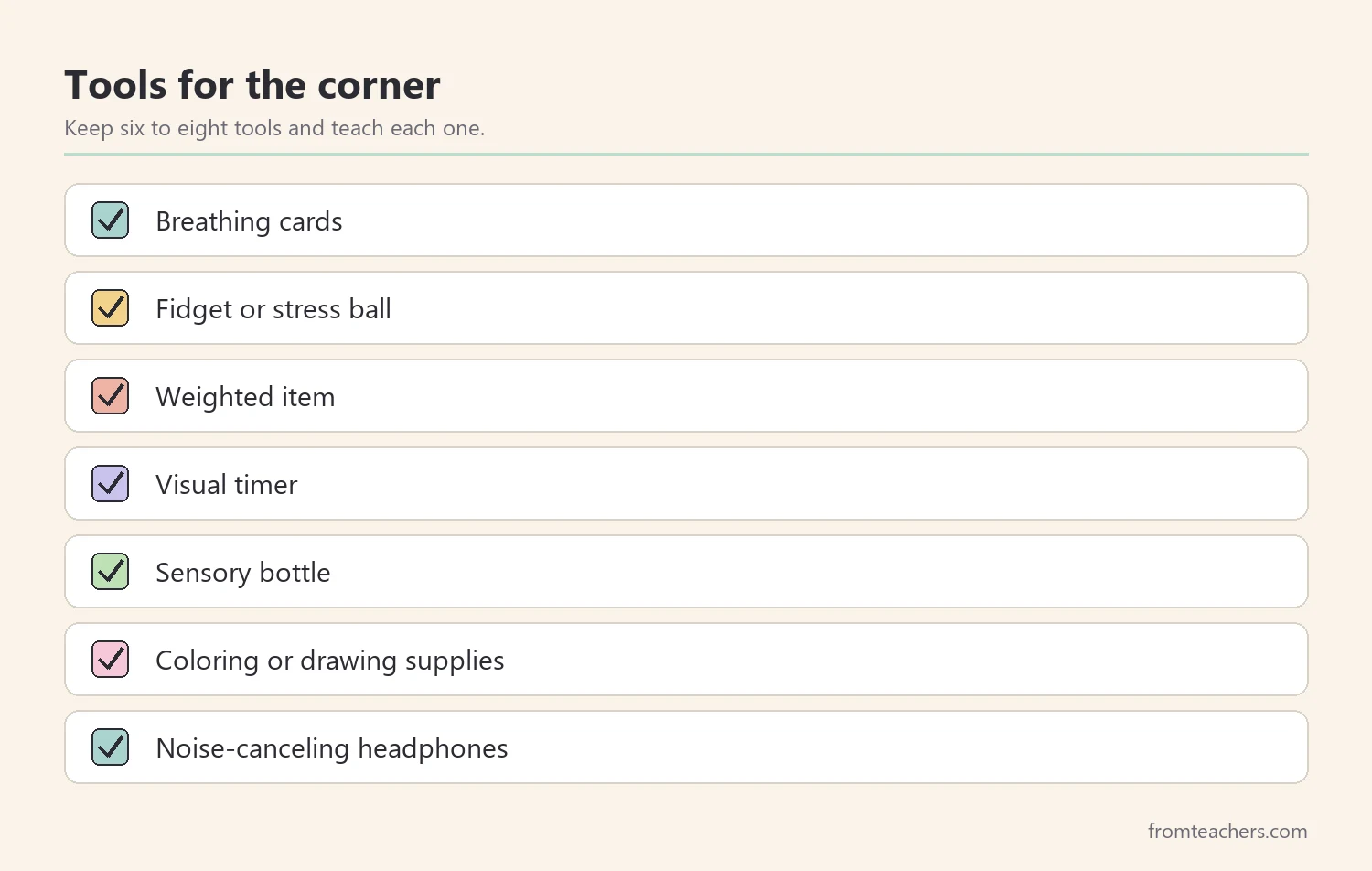
In addition, teach how to use each tool. Show how to squeeze a stress ball, how to watch a sensory bottle settle, and how to set the visual timer. Clear expectations keep tools helpful and stop them from becoming toys.
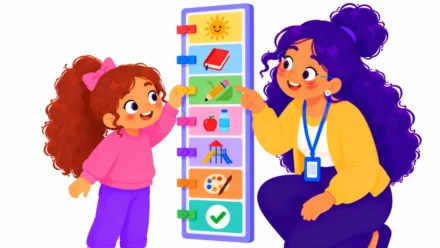
For a ready-made visual of the full routine, the calm down corner poster guides students through six steps to regulate, reset, and return ready to learn, with feeling faces, calming tools, and positive self-talk on one page. Posting it inside the corner lets students follow the steps without an adult talking them through it.
Worked example. Leo tries several tools during practice sessions. He chooses the visual timer and the fidget ball as his favorites. Ms. Rivera shows him how to set the timer for five minutes.
3. Try a calming strategy
Next, students use a body-based strategy to give their mind and body time to settle. Simple options include taking five deep breaths, counting to 10, stretching arms and shoulders, pressing feet into the floor, wrapping themselves in a hug, or thinking of a peaceful place.
Also, practice each part of the calm down corner routine during calm times. A student who has already tried pressing their feet into the floor during a relaxed morning will find it much easier to do when upset. Short daily practice builds familiarity.
In addition, pair the tool with the strategy. For example, a student might hold the fidget ball while taking five deep breaths, or watch the sensory bottle while counting to 10. Pairing makes the calm down corner routine feel natural instead of like a list of separate tasks.
Meanwhile, keep adult talk minimal. If you need to support a student, use a calm voice and few words: “Five slow breaths. I’ll do them with you.” Too much talk can make it harder to settle.
Worked example. During practice, Leo likes counting to 10 while squeezing the fidget ball. He says it helps him “slow down my brain.” Ms. Rivera adds a small picture of this pairing to his personal card.
4. Add positive self-talk to the calm down corner routine
Next, students replace overwhelming thoughts with supportive ones. Short phrases work best: “I can calm my body,” “I can calm,” “This feeling will pass,” “I can handle this step by step,” and “I am safe.”
Also, teach self-talk out loud first. Read the phrases together, then let students choose one or two favorites. Later, they can say them quietly or in their heads.
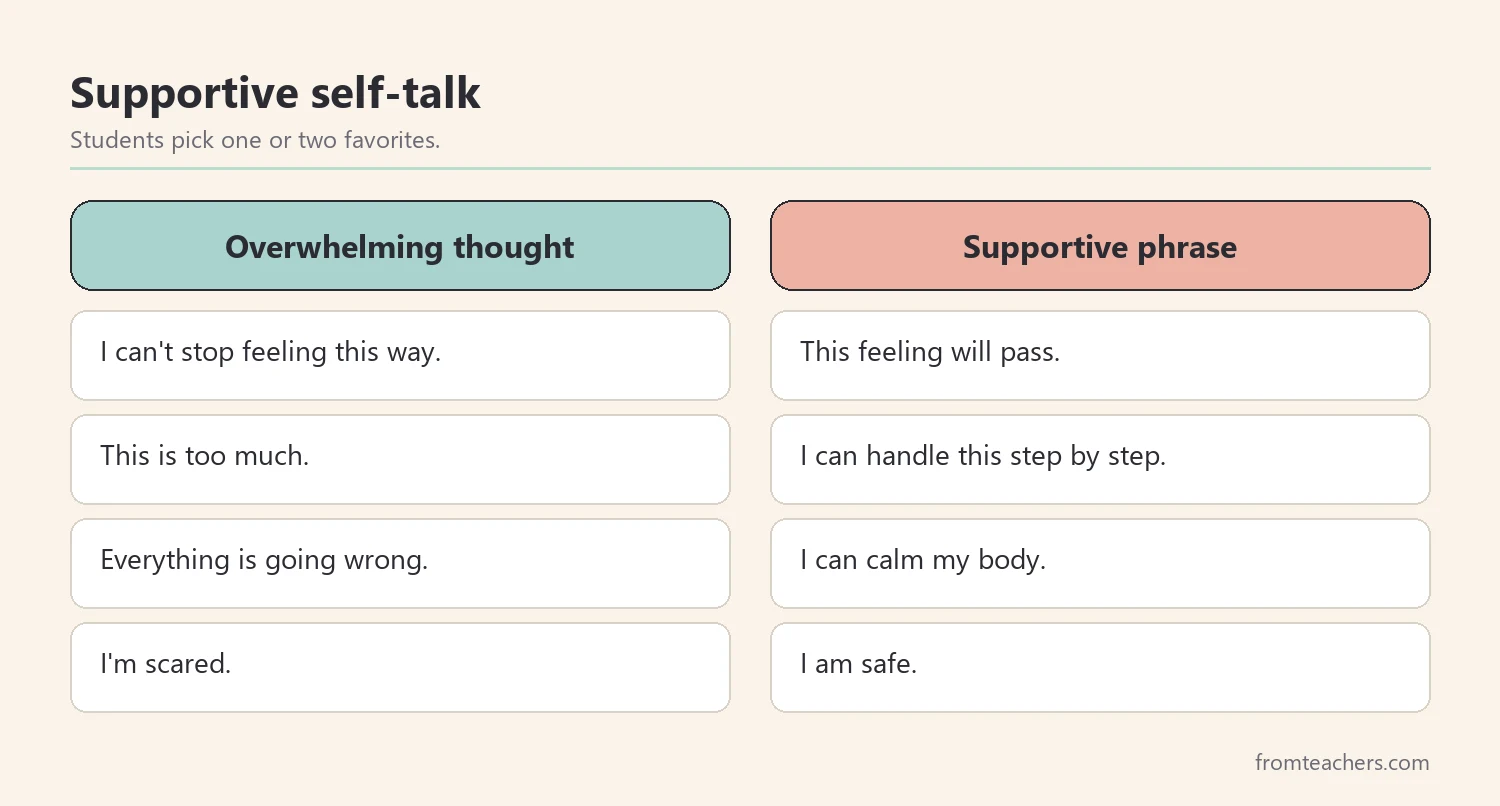
In addition, model self-talk yourself. Say, “This is frustrating, but I can handle it step by step,” when something goes wrong in class. Students learn self-talk by hearing adults use it naturally.
Then, keep the phrases visible. Speech bubbles on the poster or on a small card in the corner remind students what to say when their own words are hard to find. Visible phrases are an important part of the calm down corner routine for students who are still learning to regulate.
Worked example. Leo chooses “I can handle this step by step” because writing feels like a lot of steps. Ms. Rivera writes it on a sticky note in his writing folder, so he sees it before he even reaches the corner.
5. Check in with myself
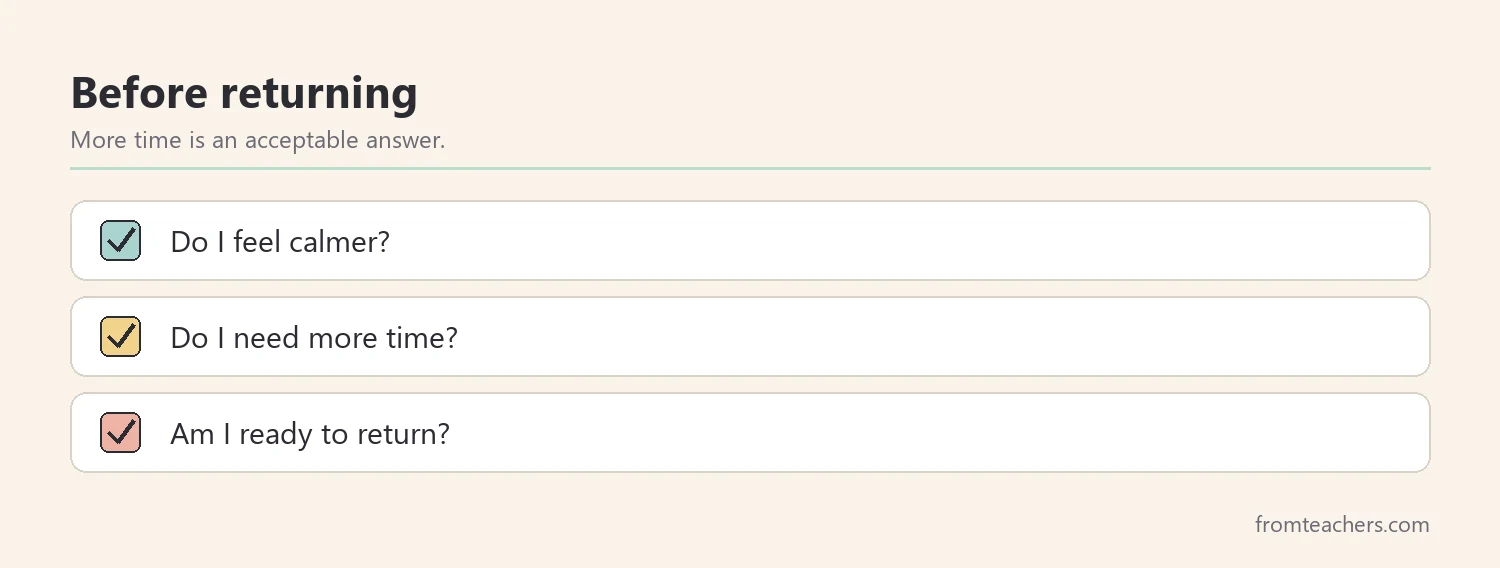
Next, students notice their progress before moving on. Three simple questions help: Do I feel calmer? Do I need more time? Am I ready to return? These questions teach students to read their own body instead of relying only on adults.
Also, make “I need more time” an acceptable answer. If students feel pressured to return quickly, they may go back before they are ready, and the feeling may return. A visual timer can help: if the student needs more time, they reset it once.
In addition, agree on a limit with the team. Most students need only a few minutes. If a student regularly stays much longer, talk with the family and support team to understand what is happening and adjust the plan.
Also, connect the check-in to the start of the calm down corner routine. Ask students to look at the feeling faces again. If the face they choose now is different from the one they chose at the start, that change is a clear sign of progress they can see for themselves.
Meanwhile, offer a quick adult check. A thumbs up from across the room or a brief “How are you feeling now?” lets the student know you noticed their effort.
Worked example. After five minutes, Leo’s timer beeps. He asks himself the three questions and decides he is ready. On another day, he resets the timer once because he still feels “overwhelmed,” and then returns.
6. Finish the calm down corner routine: return when ready
Finally, students rejoin the class feeling steady and supported. Returning is a skill too. Students go back to the activity, ask for help if needed, and use a quiet voice and calm body as they rejoin.
Also, make the return smooth. Greet the student warmly, show them where the class is in the task, and offer a small first step. A cold or public return can make students reluctant to use the calm down corner routine next time.
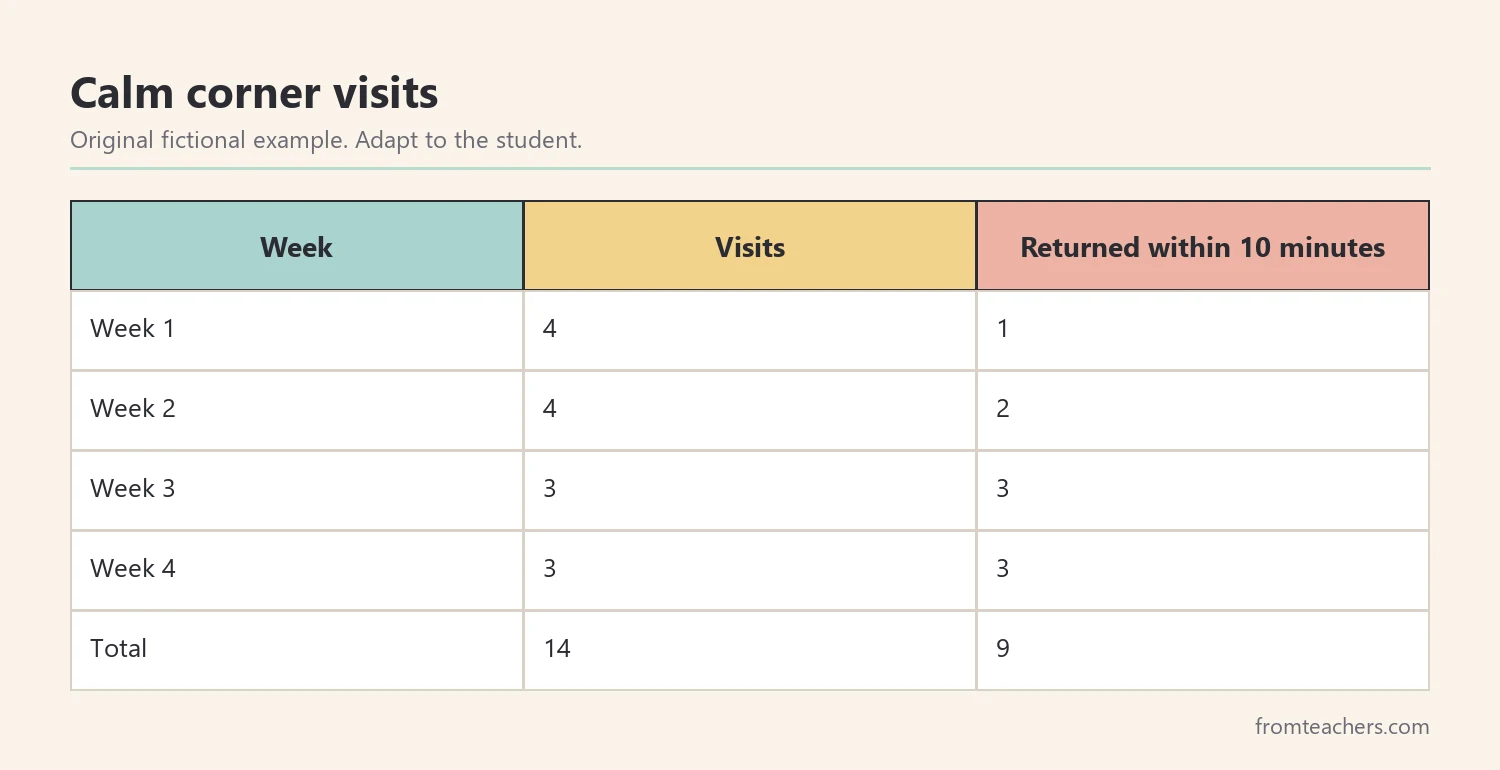
Next, track a few simple numbers. Count how many times the student used the corner and how many times they returned within an agreed time. Over weeks, the numbers show whether the routine is working.
Then, review the calm down corner routine itself every few weeks. Ask students which steps help most and which feel confusing. Small changes, such as a new tool or a clearer picture, keep the routine useful.
In addition, share progress with families. A note such as “Leo used the calm corner and returned to writing on his own today” builds confidence and helps families use similar steps at home.
Worked example. Ms. Rivera tracks Leo’s calm corner visits for four weeks. In week 1, 4 visits and 1 return within ten minutes. Week 2 brings 4 visits and 2 returns within ten minutes. In week 3, 3 visits and 3 returns. By week 4, the numbers hold at 3 visits and 3 returns. That is 14 visits and 9 returns within ten minutes across the month.
Common mistakes and how to avoid them
- Using the corner as a time-out. Students avoid it. Fix: present it as a safe place for help.
- No clear steps. Students sit without regulating. Fix: post and teach a six-step calm down corner routine.
- Too many tools. The corner becomes a play area. Fix: keep six to eight tools and teach each one.
- Teaching only during meltdowns. Learning is limited. Fix: practice the routine when calm.
- Rushed returns. The feeling comes back. Fix: use the check-in questions and a timer.
- Cold welcome back. Students feel embarrassed. Fix: greet warmly and offer a small first step.
Questions teachers and parents ask about a calm down corner routine
Is a calm down corner the same as a time-out?
No. A time-out removes a child as a consequence. A calm down corner is a supportive space where students practice regulation and return when ready.
How long should a student stay in the corner?
Many students need only a few minutes. A visual timer helps. If a student regularly needs much longer, review the plan with the family and support team.
Can older students use a calm corner?
Yes. Older students may prefer a calmer name, such as a reset space, and more mature tools, but the same six steps work well.
What if a student refuses to go to the corner?
Do not force it. Offer a strategy at the desk instead, and revisit the routine during a calm time. Some students need to see others use the corner first.
Can the routine work at home?
Yes. A calm down corner routine travels well. Families can set up a small calm spot with a few tools and use the same steps and words. Consistency between home and school helps.
Related reading: Managing Sensory Overload: Practical Strategies for Autism and ADHD, Meltdowns vs Tantrums: A Guide to Understanding and Responding, and Moving Beyond Shame and Behavior Charts: Positive Alternatives for Effective Classroom Management.
A companion resource for a calm down corner routine:
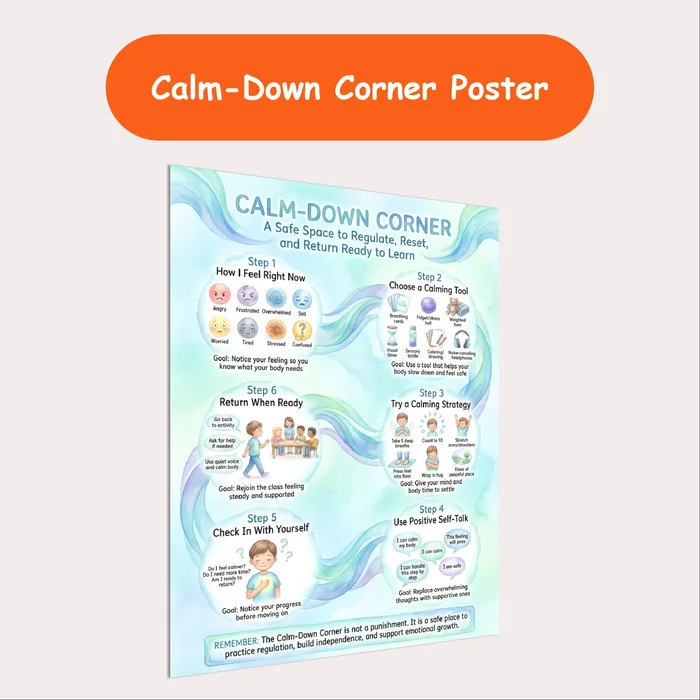
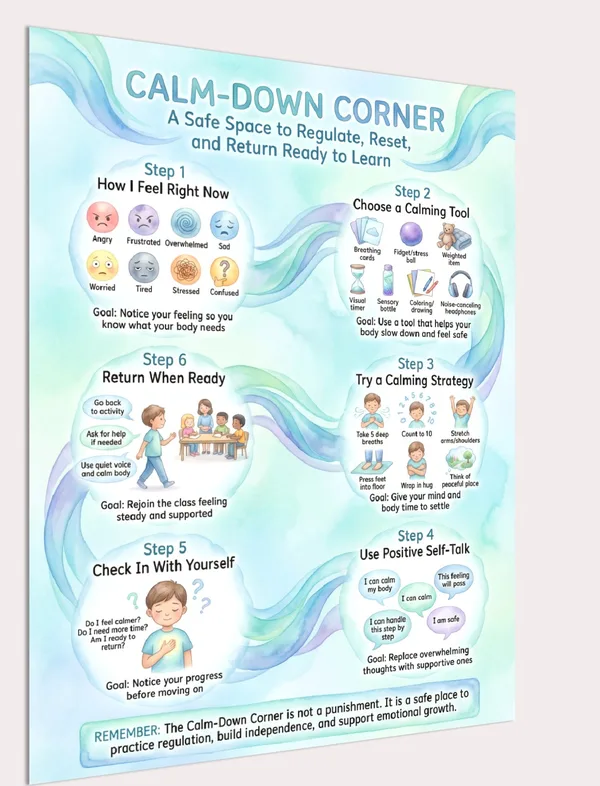
Calm Down Corner Poster: six steps to regulate, reset, and return ready to learn, with feeling faces, calming tools, and positive self-talk, for classrooms and special education settings.
Sources and scope
- CASEL: resources on social and emotional learning, including self-management.
- Center on PBIS: information on positive behavior supports and classroom practices.
- IRIS Center, Vanderbilt University: free modules on classroom behavior and supports.
- Understood.org: family-friendly information on learning and thinking differences.
This guide covers everyday classroom and home use of a calm space and routine. It does not replace mental health care, safety plans, behavior plans, or the decisions of a student’s support team.
Key takeaways
- A calm down corner routine gives students clear steps from arrival to return.
- Start by noticing the feeling, then choose a tool and a strategy.
- Use positive self-talk to replace overwhelming thoughts.
- Check in before returning and make “more time” acceptable.
- Welcome students back warmly and track smooth returns.






Leave a Comment