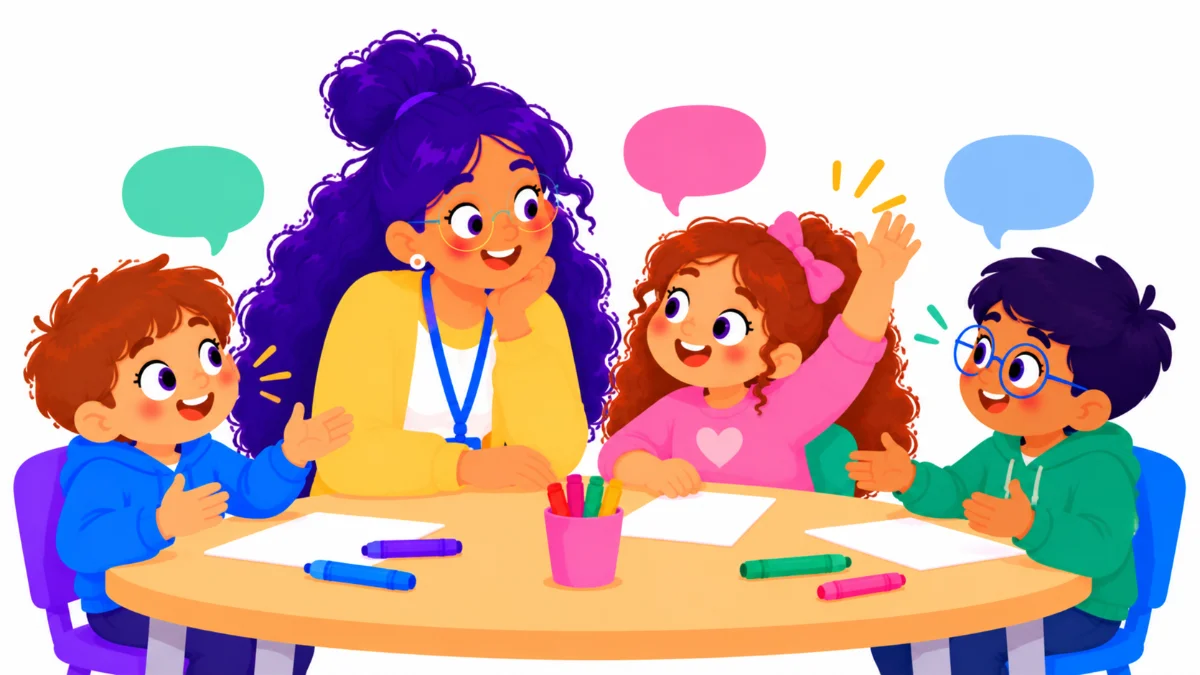

Classroom communication skills, such as starting a conversation, asking a question politely, and fixing a misunderstanding, are rarely taught directly, yet students use them all day. Picture a fifth grader who wants to join a group at lunch. He stands nearby, says nothing, then walks away. Later he tells his teacher that nobody wants to talk to him. The truth is simpler: no one ever showed him the steps.
This guide gives you five steps to teach classroom communication skills to diverse learners: choose one skill, break it into steps, model the phrases, practice in real moments, and teach repair when conversations break down. By the end, you will have a clear routine you can use with any skill and any age.
Examples are fictional. Adapt to the student’s goals and agreed supports. This is guidance, not a diagnosis.
At a glance
- Conversation is a set of smaller skills that can be taught one at a time.
- Numbered steps and ready phrases make each skill clear and visual.
- Model first, then practice in short, real conversations.
- Teach students how to repair a conversation when it goes wrong.
- Respect different communication styles, including AAC and scripts.
Before you begin, remember that communication looks different for different students. Some speak in full sentences, some use short phrases or scripts, and some use AAC, signs, or pictures. The goal is not to make everyone communicate the same way. It is to give each student clear, usable tools to connect with others in their own way.
1. Choose one communication skill to teach
First, narrow your focus. “Better communication” is too broad to teach. Instead, think of conversation as a set of smaller skills: starting a conversation, asking questions politely, keeping a conversation going, clarifying a misunderstanding, using a friendly tone, and ending a conversation kindly.
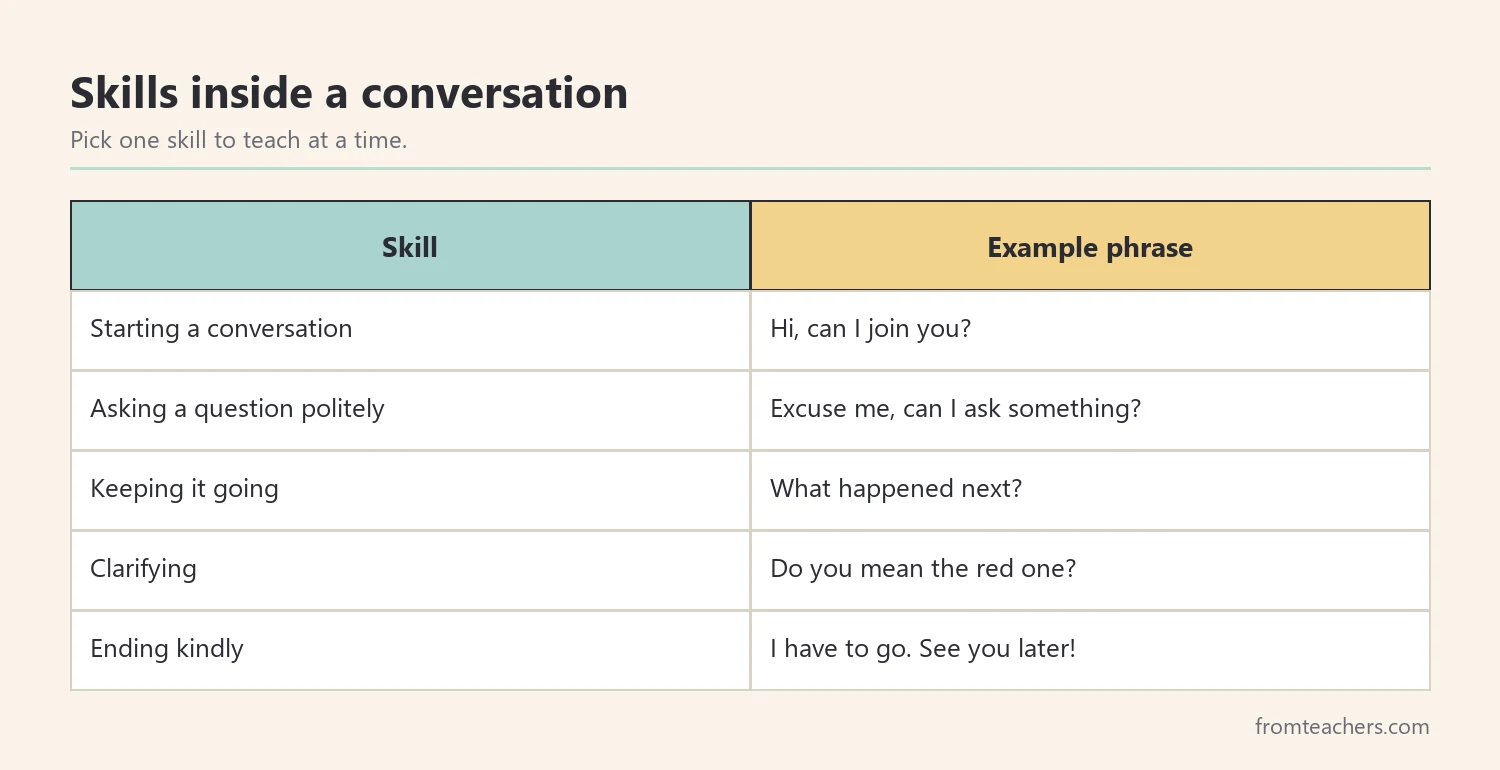
Next, pick the one of the classroom communication skills that would make the biggest difference right now. Watch the student for a few days. Where do conversations break down? Does the student struggle to start, to stay on topic, or to repair confusion? Your observations point to the right first skill.
Also, involve the speech-language pathologist. Many students already have communication goals in an IEP. Choosing classroom communication skills that match those goals means everyone works toward the same target.
In addition, ask the student. Older students often know exactly what feels hard: “I never know how to join in” or “People get annoyed when I talk too long.” Their answer can be the best starting point.
Worked example. Eli is a fictional fifth grader. His teacher, Ms. Brooks, notices that he rarely starts conversations with classmates, though he talks easily with adults. With the speech-language pathologist, she chooses “starting a conversation” as the first skill.
2. Break the skill into clear steps
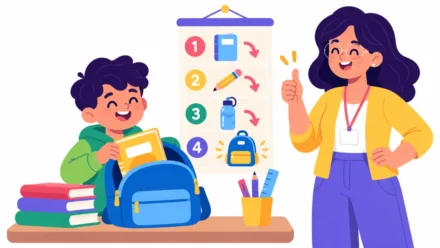
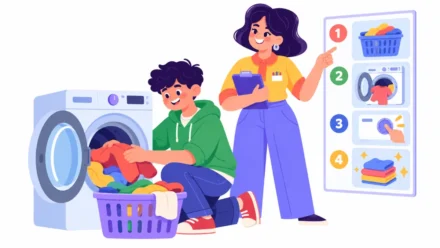
Next, turn the skill into a short list of numbered steps. Steps make an invisible social skill visible. They also give students a checklist they can follow when they feel unsure.
For example, starting a conversation can be five steps: look toward the person, greet them, ask a simple question, listen to the answer, and add something about yourself. Each step is small enough to practice on its own.
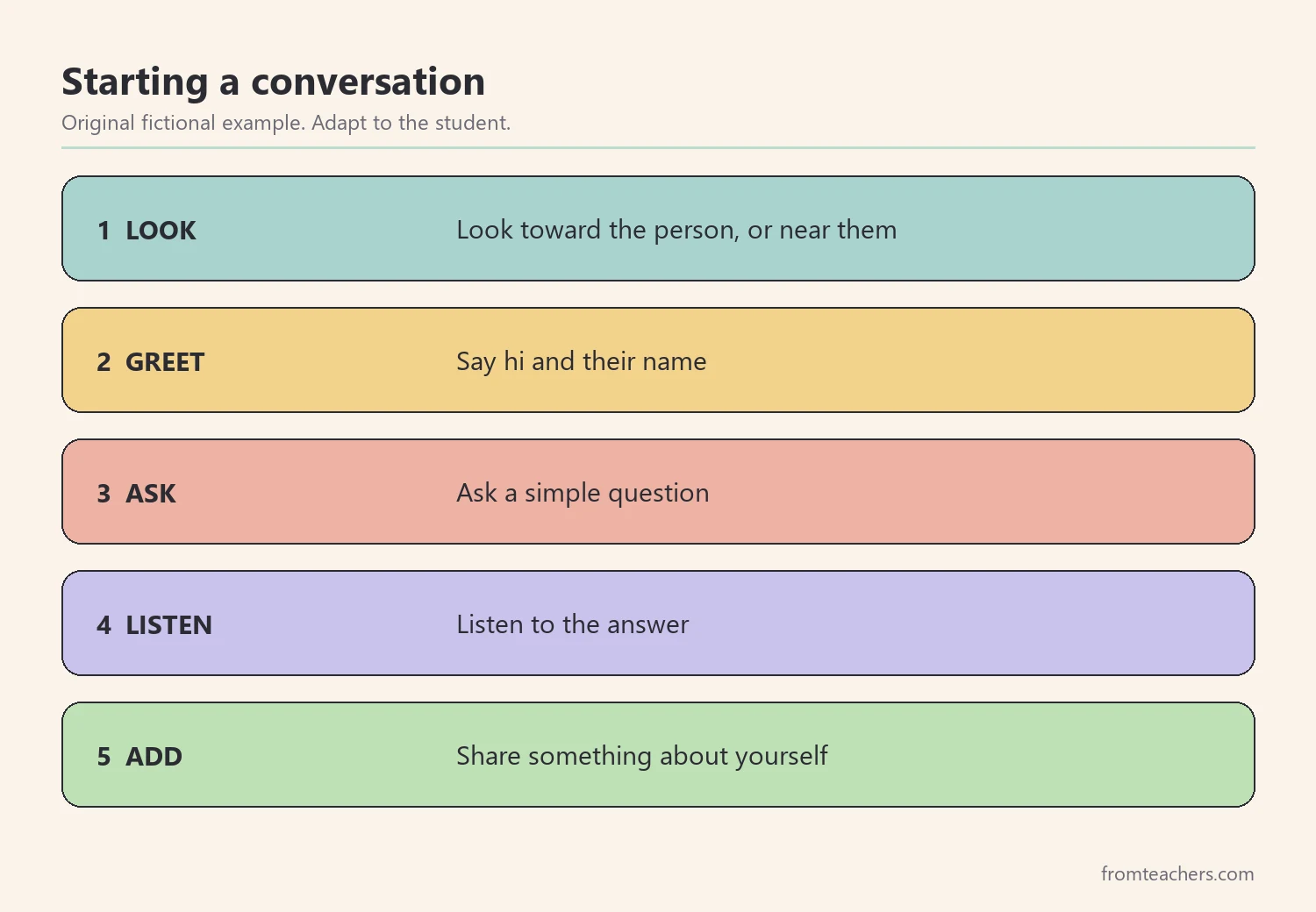
Also, add a few ready phrases for each step. “Hi, Jordan.” “What are you building?” “I like that game too.” Phrases reduce the pressure of finding words in the moment, which helps many diverse learners.
In addition, explain why each step matters. A short “why this matters” line, such as “Greeting someone by name shows you noticed them,” helps students understand the purpose, not just the action.
Then, make the steps visual. A poster or desk card with numbered steps and phrases gives students a reference they can glance at. The communication skills poster set for diverse learners includes ten step-by-step guides with numbered steps and student phrases, which can save a lot of preparation time.
Worked example. Ms. Brooks writes Eli’s five steps on a small card with one phrase for each. She adjusts the first step from “look at the person” to “look toward the person,” because direct eye contact is uncomfortable for Eli.
3. Model classroom communication skills first
Next, show the skill before you ask students to try it. Modeling turns a list of steps into something students can picture. It also gives them a natural tone and pace to copy.
First, act out the skill with another adult or a confident student. Walk through each step slowly, pointing to the poster as you go. Then do it again at normal speed.
Also, show a “not quite” version. For example, walk up and start talking about your own topic without greeting anyone. Ask the class what step was missing. Spotting mistakes in a light, funny way helps students remember the steps.
In addition, think aloud. “I want to join this group. First, I will look toward them. Next, I will say hi.” Thinking aloud shows students the planning that usually happens silently.
Meanwhile, model across communication styles. Show how a student using AAC or a picture card can follow the same steps. This tells every student that their way of communicating is valid.
Then, keep modeling during the day. When you greet a colleague or ask a question politely, mention it briefly: “Did you notice I said excuse me first?” Small, natural examples reinforce classroom communication skills far beyond the lesson.
Worked example. Ms. Brooks and the classroom assistant act out joining a lunch table. First, the assistant sits down silently and starts eating. Then she follows the five steps. Eli notices the difference right away and says, “The second one was friendlier.”
4. Practice classroom communication skills in real talk
Next, give students many short chances to practice. Long lessons are less useful than frequent, brief practice. Five to ten minutes a few times a week builds classroom communication skills steadily.
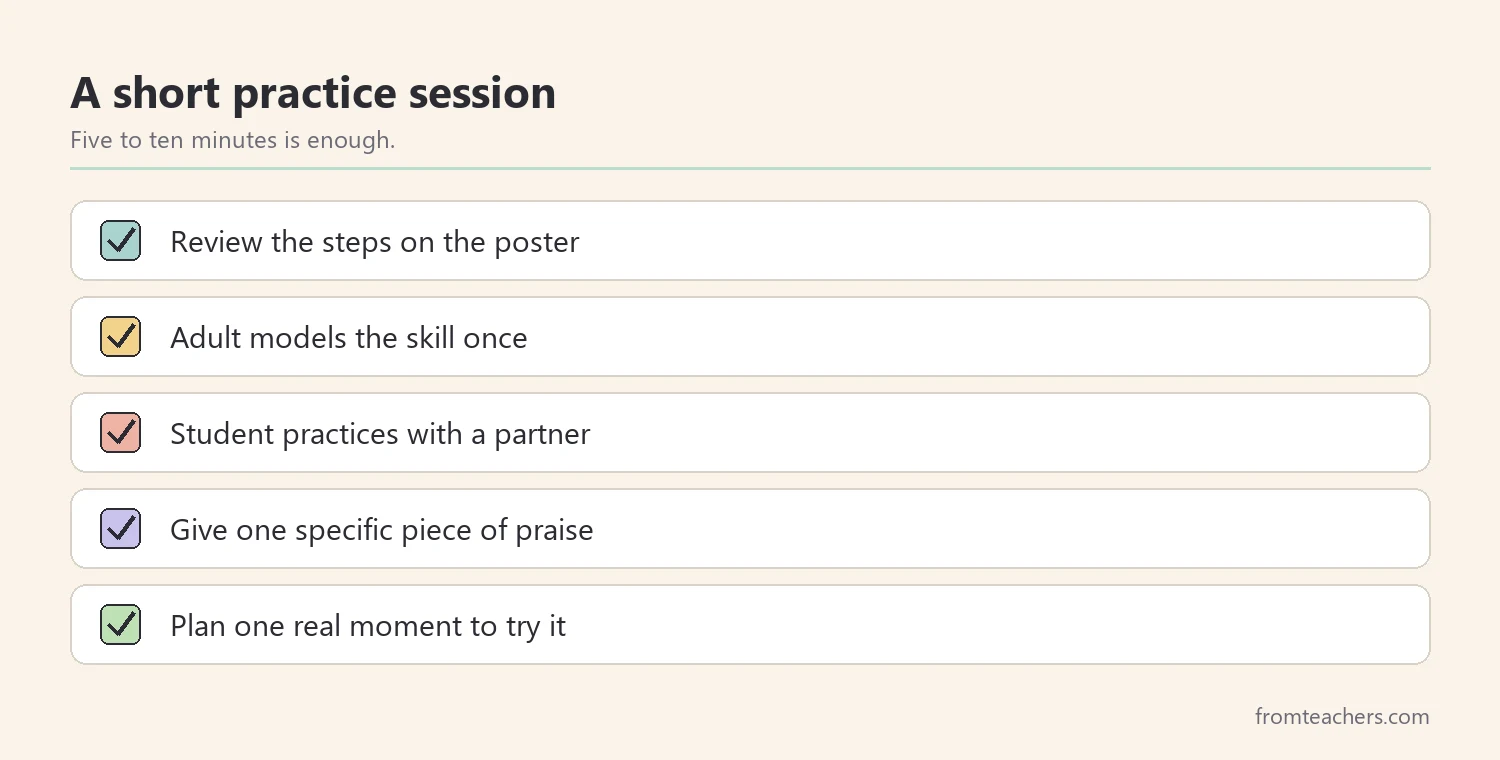
First, start with structured practice. Pair students and give them a simple topic, such as weekend plans or a favorite game. Have them use the poster steps. Keep the setting calm and predictable.
Also, move to real moments as soon as possible. Plan one specific chance each day, such as greeting a classmate at morning arrival or asking a peer a question during group work. Real practice is what makes the skill stick.
In addition, give specific praise. “You greeted Sam by name and asked about his drawing” teaches more than “Good job.” Specific praise tells the student exactly which step worked.
Meanwhile, prepare peers. Classmates can learn the same steps, which makes them better conversation partners. A class that knows the routine is more welcoming to students who are still learning.
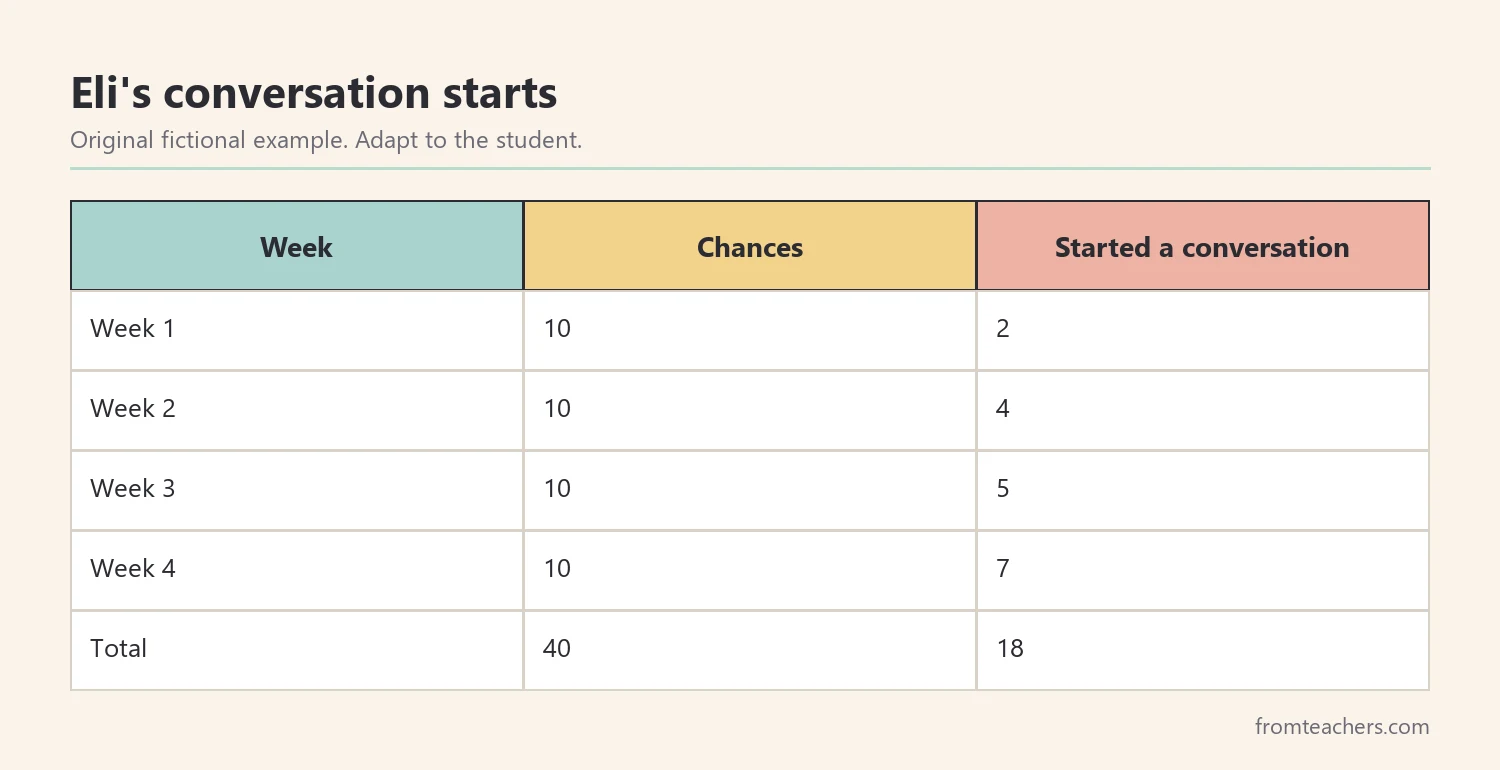
Worked example. Each morning, Ms. Brooks asks Eli to greet one classmate during arrival and ask one question. She tracks 10 chances a week. Eli starts 2 conversations in week 1, 4 in week 2, 5 in week 3, and 7 in week 4. Over four weeks, that is 18 conversations started out of 40 chances.
5. Teach students to repair communication breakdowns
Finally, plan for conversations that go wrong. Misunderstandings happen to everyone. Repair is one of the most useful classroom communication skills, because students who know how to fix a mix-up feel more confident trying again.
First, teach students to notice confusion. Signs include a puzzled look, a long pause, or an answer that does not match the question. Noticing is the first step to fixing.
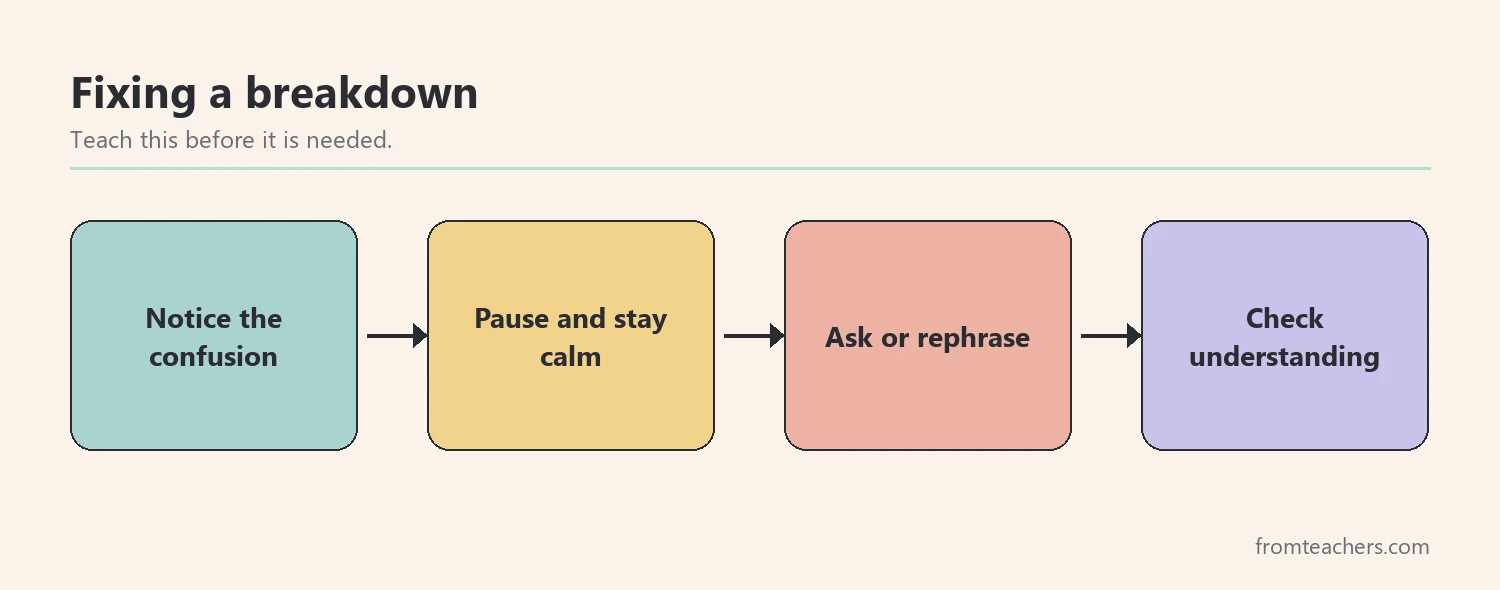
Also, give simple repair phrases. “Sorry, I mean the blue one.” “Can you say that again?” “Do you mean the science project?” Short phrases help students repair without feeling embarrassed.
In addition, teach staying calm. A breakdown can feel frustrating, especially for students who often feel misunderstood. A pause and a slow breath help before trying again.
Then, check understanding at the end. “So we’re meeting at recess, right?” is a simple way to confirm. This habit prevents many small misunderstandings from growing.
Worked example. During group work, a classmate looks confused when Eli talks about “the thing.” Eli remembers the repair step and says, “Sorry, I mean the poster.” The classmate nods, and the group moves on.
Teaching classroom communication skills to the whole class
Classroom communication skills are not only for students with IEP goals. Every class benefits from clear steps for joining a group, asking a question, or fixing a mix-up. Teaching the whole class also means no student feels singled out.
First, add a short weekly slot. Ten minutes on Monday to introduce or review one skill is enough. Then refer back to it during the week whenever a natural moment comes up.
Also, connect skills to academic work. Group projects, partner reading, and class discussions all depend on classroom communication skills. Before a group task, point to the poster: “Today, practice asking questions politely.”
In addition, invite students to coach each other. Peers can notice when a classmate used a step well and say so. Positive peer feedback often motivates students more than adult praise.
Finally, keep the tone warm. Communication is personal, and students may feel exposed when practicing. Mistakes are part of learning classroom communication skills, so treat them lightly and move on.
Building classroom communication skills across the year
Once one skill feels easy, add the next. A natural sequence might be starting a conversation, asking questions politely, keeping a conversation going, and then clarifying and repairing. Each new skill builds on the last.
Also, revisit old skills regularly. A quick review at the start of a new term keeps classroom communication skills fresh. Students who struggled with a skill earlier may find it easier the second time.
In addition, share the steps with families. The same posters and phrases can be used at home, at family events, or in the community. Practice in many places helps students use classroom communication skills anywhere, not just at school.
Finally, celebrate progress in a way the student is comfortable with. Some students enjoy public praise. Others prefer a quiet note or a check on their tracking sheet.
Common mistakes and how to avoid them
- Teaching “communication” as one big skill. Students cannot practice something so broad. Fix: pick one specific skill.
- Explaining without modeling. Students cannot picture the skill. Fix: act it out, including a “not quite” version.
- Requiring eye contact. Some students find it uncomfortable. Fix: teach “look toward the person.”
- Practicing only in lessons. Skills do not transfer. Fix: plan real moments every day.
- Ignoring breakdowns. Students lose confidence. Fix: teach simple repair phrases.
- Valuing only speech. AAC users and others are left out. Fix: accept every communication method.
Questions teachers and parents ask about classroom communication skills
Which communication skill should I teach first?
Start with the skill that causes the most difficulty right now. For many students, that is starting a conversation or asking questions politely. Your observations and the speech-language pathologist’s advice can guide the choice.
Do posters really help with communication?
Visual supports can help many students remember steps and phrases, especially in stressful moments. Posters work best alongside modeling and real practice, not on their own.
How do I support a student who uses AAC?
Use the same steps, and make sure the needed phrases are on the student’s device or board. Model with the device yourself, and give the student time to respond.
What if the student uses scripts?
Many students use scripts or memorized phrases to communicate. Treat them as real communication and build from them. The speech-language pathologist can advise on next steps.
Can these skills be IEP goals?
Social communication skills often appear in IEP goals. The student’s team decides the exact goals. Simple tallies of real conversations make progress easy to measure.
Related reading: Autism Social Skills Development: Practical Strategies for Growth, Boost Access and Independence: An Assistive Technology Toolkit for Special Education, and Spectrum Voices: Essential Strategies for Navigating High-Functioning Autism.
A companion resource for classroom communication skills:
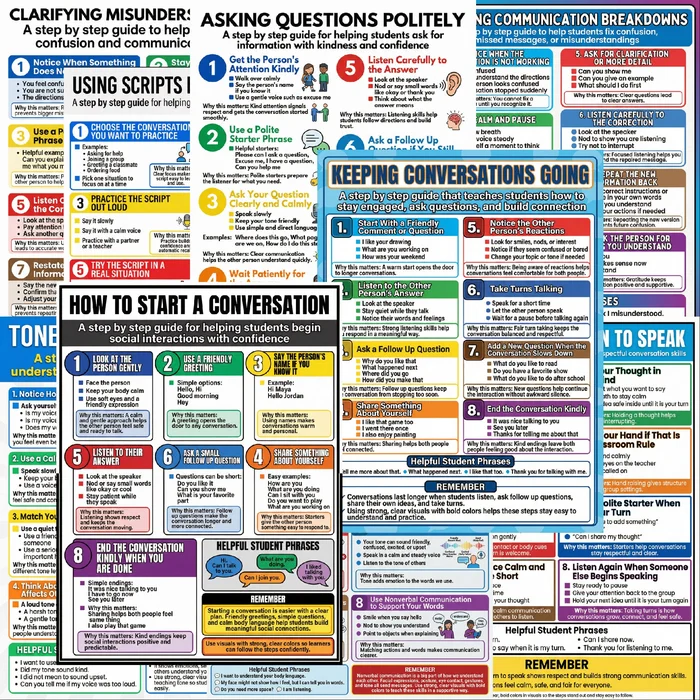
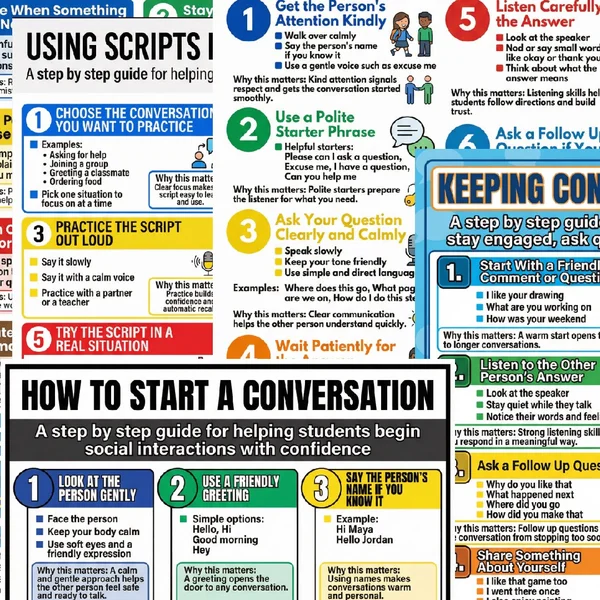
Communication Skills for Diverse Learners: 10 Classroom Posters: a set of ten step-by-step guides for everyday conversation. Each social communication poster breaks a skill into numbered steps with helpful student phrases, for special education and inclusive classrooms.
Sources and scope
- American Speech-Language-Hearing Association (ASHA): professional information on social communication and language development.
- IRIS Center, Vanderbilt University: free modules on autism, communication, and classroom supports.
- CASEL: a framework for social and emotional learning, including relationship skills.
- Understood.org: family-friendly information on learning and thinking differences.
This guide covers everyday classroom teaching of conversation skills. It does not replace speech-language therapy, evaluation, or the decisions of the student’s support team.
Key takeaways
- Teach classroom communication skills one specific skill at a time.
- Break each skill into numbered steps with ready phrases.
- Model the skill, including a “not quite” version.
- Practice briefly and often, then in real moments.
- Teach repair phrases so breakdowns become chances to learn.






Leave a Comment