

A visual bedtime routine can turn the hardest hour of the day into a predictable one. Picture a five-year-old who asks “what now?” after every step, wanders off between the bath and the toothbrush, and starts negotiating the moment lights out is mentioned. Nobody is doing anything wrong. The evening simply has too many invisible steps for a young child to hold in mind.
This guide shows you how to build, teach, and adjust a picture-based bedtime sequence in five steps. By the end, you will have a routine your child can follow with fewer reminders, a simple way to track how it is going, and ideas for keeping it calm when life gets busy.
Examples are fictional. Adapt to the child’s needs and the supports your family has agreed on. This is guidance, not a diagnosis or medical advice.
At a glance
- Write down your real evening steps before you choose any pictures.
- Show one clear picture per step, in the same order every night.
- Teach the routine during calm moments, not only at bedtime.
- Let the child move or check off each card to see progress.
- Review a simple record each week and change one thing at a time.
1. Map Your Family’s Evening Before Making a Visual Bedtime Routine
Many families start by printing cards. However, the cards only help if they match what really happens in your home. So, begin with a plain list of the steps you already do most nights.
First, walk through a normal evening and write each step as a short action: “finish snack,” “bath,” “pajamas,” “brush teeth.” Next, cross out anything that happens only sometimes. Then, combine tiny actions that always go together, such as “wash hands and brush teeth.”
Also, notice where things fall apart. For many children, the hard moments are transitions, such as leaving toys to start the bath or getting out of the tub. Mark those points on your list, because they are where a picture can do the most work.
Consider Maya, a fictional five-year-old in kindergarten. Her parents listed fifteen steps at first. After combining a few, they settled on twelve steps for her visual bedtime routine, starting with a snack and ending with settling into bed. They also noticed that Maya struggled most with tidying toys and with leaving the bathroom.
| Part of evening | Steps | Hard moment? |
|---|---|---|
| Early evening | Snack, tidy toys | Yes, tidying |
| Getting ready | Bath, pajamas | Sometimes |
| Hygiene | Toilet, wash hands, brush teeth | Yes, leaving the sink |
| Wind-down | Warm drink, story with a stuffed animal | No |
| Final steps | Lights off, goodnight, into bed | Sometimes |
Keep the list where every adult can see it. A visual bedtime routine is easier to build when everyone agrees on the steps before any pictures go on the wall.
Finally, set a rough start time. A visual bedtime routine works best when it begins at about the same time each evening, so the first picture becomes a signal that the day is winding down.
2. Choose Clear Pictures and One Steady Format
Once your list is ready, match one picture to each step of the visual bedtime routine. Clear photos or simple illustrations of real actions are easier for young children to read than busy clip art. In addition, a short word label under each picture helps early readers and gives adults the same language to use.
Pick a format that fits your space
There are three common ways to display a visual bedtime routine. A strip on the bedroom wall lets the child see the whole evening at once. A flip chart shows one step at a time, which suits children who feel overwhelmed by too many pictures. Meanwhile, single cards can travel with the child from room to room.
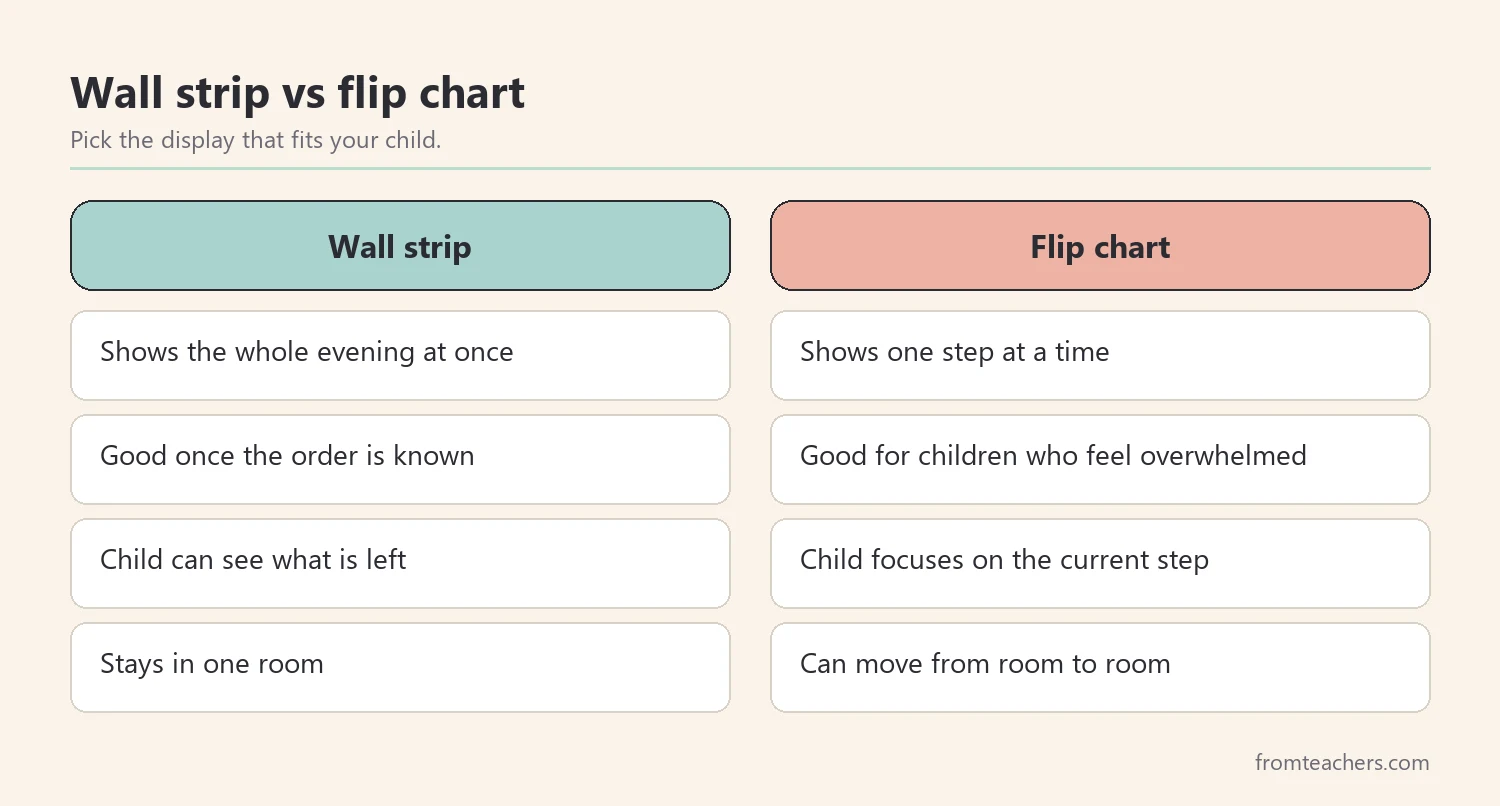
For example, Maya’s parents tried the wall strip first. She liked seeing every step, yet she kept skipping ahead to the story picture. So, they switched to a flip chart for two weeks, then returned to the strip once she knew the order.
If you would rather not photograph every step yourself, the My Bedtime Routine 12-step visual guide uses real photo illustrations with a numbered card for each step, from finishing dinner to settling into bed. You can print it as a flip chart, laminate it as a bedroom schedule, or use one card at a time.
Think about placement too. Put the visual bedtime routine at the child’s eye level, near where most steps happen. If the bath and teeth happen in the bathroom, a second small strip there can save trips back to the bedroom.
Whatever you choose, keep the order fixed. Changing the sequence night to night removes the predictability that makes pictures useful.
3. Teach the Visual Bedtime Routine in Calm Moments
Bedtime is not the best moment to learn something new. Children are tired, and adults are often tired too. Therefore, introduce the visual bedtime routine during the day, when everyone is relaxed.
First, look at the pictures together and name each step. Then, act it out with a stuffed animal or a doll: the bear eats a snack, takes a pretend bath, puts on pajamas, and so on. Play makes the sequence familiar before it carries any pressure.
Next, practice one evening with extra adult support. Point to each picture before the step, say the label, and then praise the child right after they finish. Keep your words short, such as “Bath is done. Next is pajamas.”
For Maya, her parents used a teddy bear named Juno for three afternoons in a row. By the third day, Maya was the one pointing to the next card and telling Juno what came next. That small shift showed her parents she understood the order.
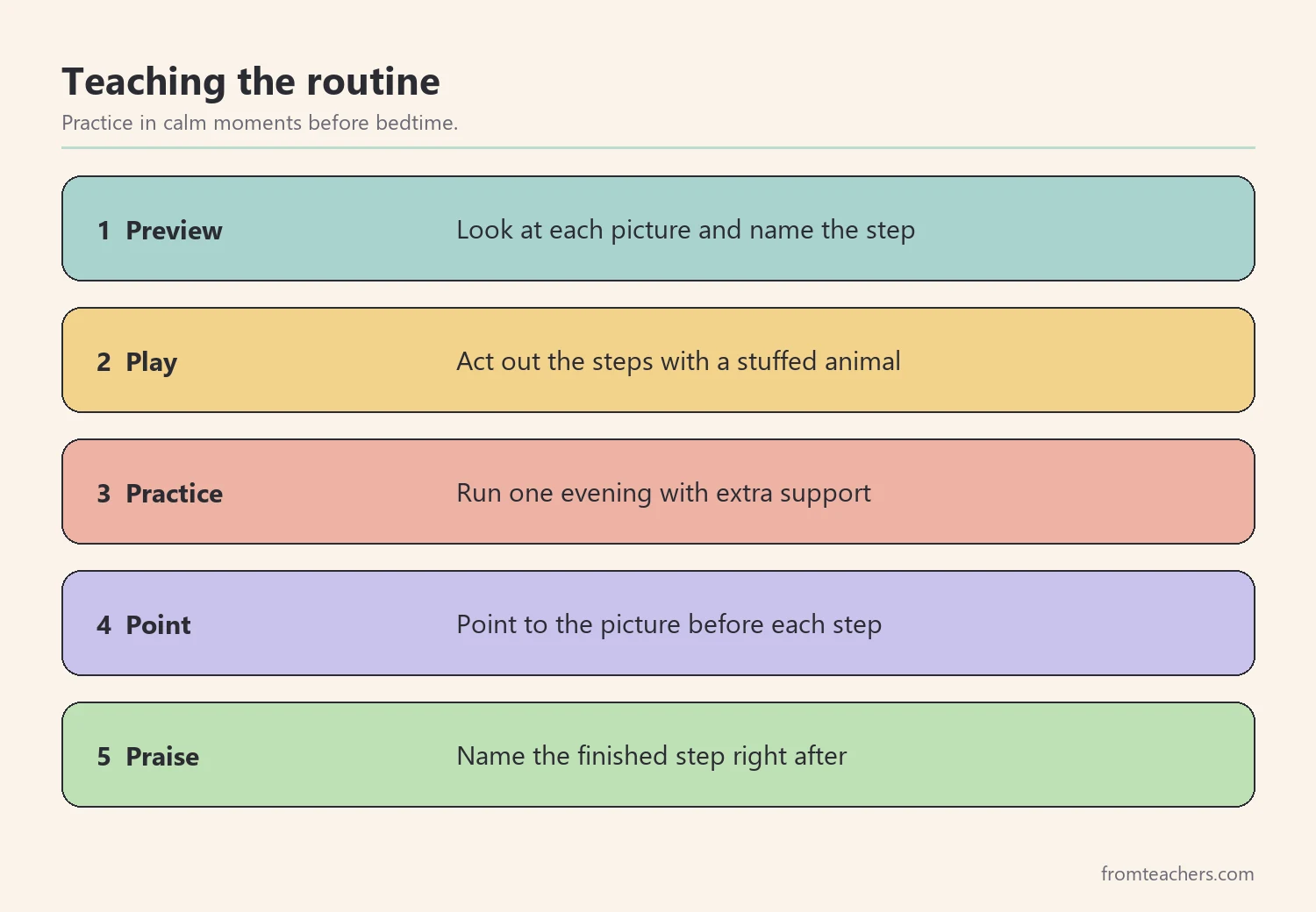
Keep practice short and fun. Two or three minutes of play is enough for most young children. If your child loses interest, stop and try again the next day, because a visual bedtime routine should feel friendly rather than like a lesson.
Also, prepare everyone who puts the child to bed. Grandparents, babysitters, and older siblings should use the same pictures and the same words. When each adult runs the routine differently, the child has to learn several versions.
4. Run the Routine and Let the Child Track Progress
Now the visual bedtime routine moves into real evenings. The main goal here is for the pictures, not the adult, to carry the reminders. As a result, your role shifts from directing to pointing and encouraging.
Give the child a way to mark each step as done. They might flip the card over, move it into a “finished” pocket, or place a small sticker beside it. Seeing the pile of finished steps grow helps many children stay motivated through the last few.
Use first and then language at the hard moments you marked in step 1. For example: “First tidy toys, then bath.” Point to the two pictures as you say it. This keeps the message short and visual instead of turning into a long discussion.
Plan for the tricky transitions
For Maya, leaving the sink was still hard. So, her parents added a short countdown: they held up the next card and counted down from five together. In addition, they let her choose which of two stuffed animals joined her for the story, which gave her a small choice inside a fixed routine.
On busy nights, keep the visual bedtime routine but shorten some steps. A quick wash instead of a full bath still matches the same picture. That way, the order stays familiar even when the evening runs late.
Finally, keep the wind-down part quiet and screen-free where possible. Groups such as the American Academy of Pediatrics share general guidance for families about calm, consistent bedtimes, and a visual bedtime routine is one practical way to put that consistency in place.
5. Review the Visual Bedtime Routine Each Week
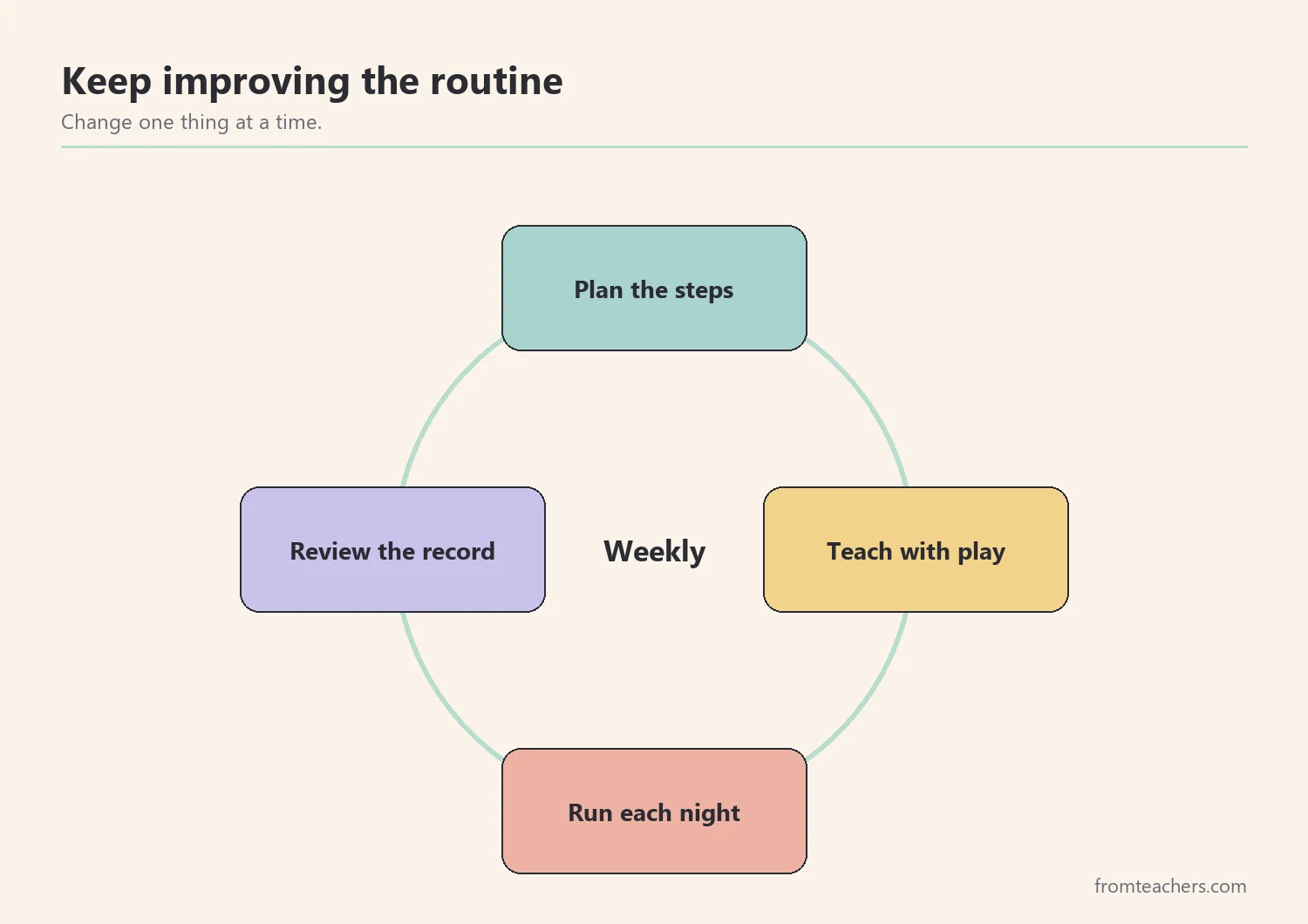
A visual bedtime routine is never finished on the first night. Children grow, schedules change, and some steps turn out to be harder than expected. So, plan a short weekly check.
Keep a very simple record. Each night, note how many steps the child completed with only a picture prompt, and how many needed an extra verbal reminder. Over a few weeks, you will see whether the pictures are taking over the reminding job.
Here is Maya’s record for her first four weeks. Her routine has 12 steps, so in each row the two middle columns add up to 12.
| Week | Steps with picture only | Steps needing a reminder | Note |
|---|---|---|---|
| 1 | 5 | 7 | Flip chart |
| 2 | 7 | 5 | Countdown at sink |
| 3 | 9 | 3 | Back to wall strip |
| 4 | 10 | 2 | Tidying still hard |
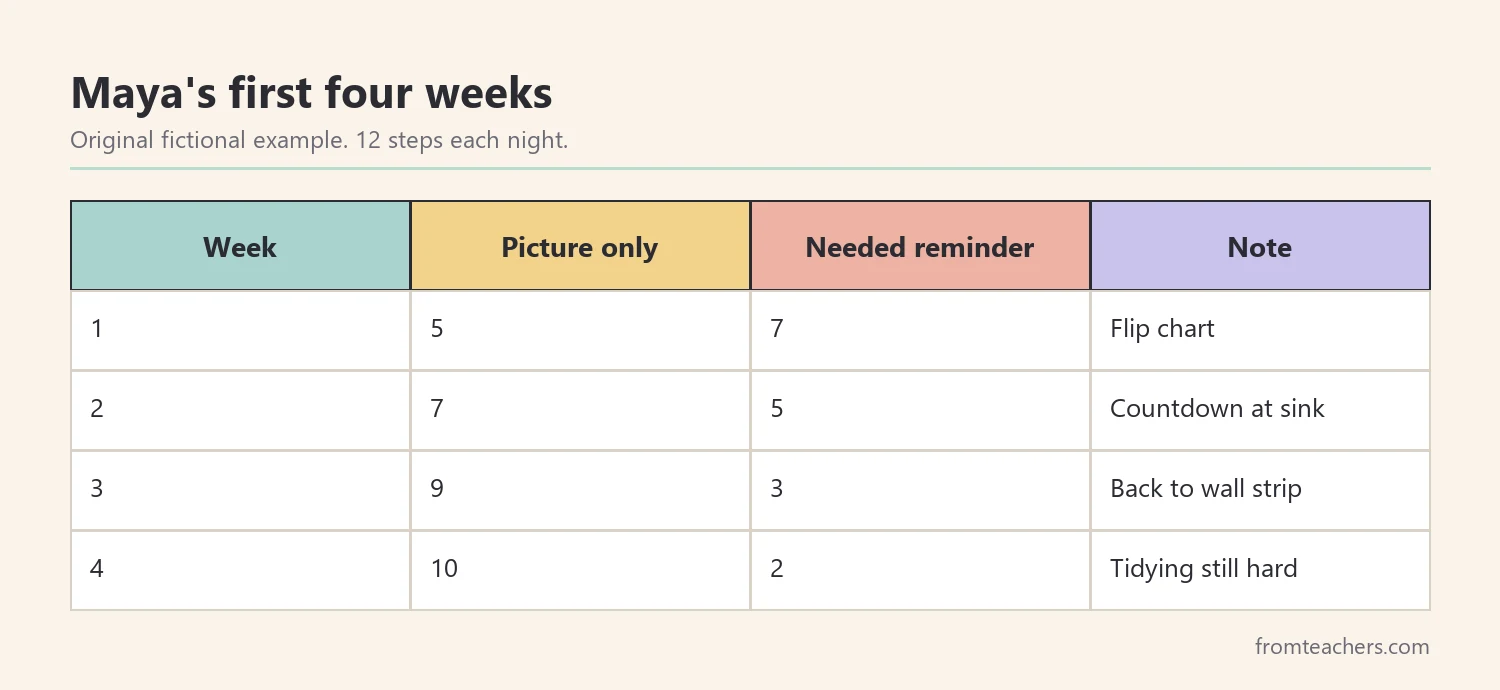
When you review, change one thing at a time. If tidying is still hard, you might shorten it to “three toys in the basket” rather than reworking the whole evening. Then, watch the next week’s record to see whether that single change helped.
Moreover, involve the child in the review when they are old enough. Ask which card is the easiest and which is the hardest. Children often have clear opinions, and their answers can point to a simple fix in the visual bedtime routine.
Also, share what works with your child’s teacher if the child uses visual schedules at school. Similar pictures and words at home and school can make both routines easier to follow.
Common mistakes and how to avoid them
- Treating the visual bedtime routine as a reward chart. Fix: use the pictures to show what comes next, not to earn prizes.
- Too many steps on day one. Fix: start with the steps you already do, and combine tiny actions.
- Changing the order often. Fix: keep the same sequence every night so the pictures stay predictable.
- Teaching only at bedtime. Fix: practice with play during calm parts of the day.
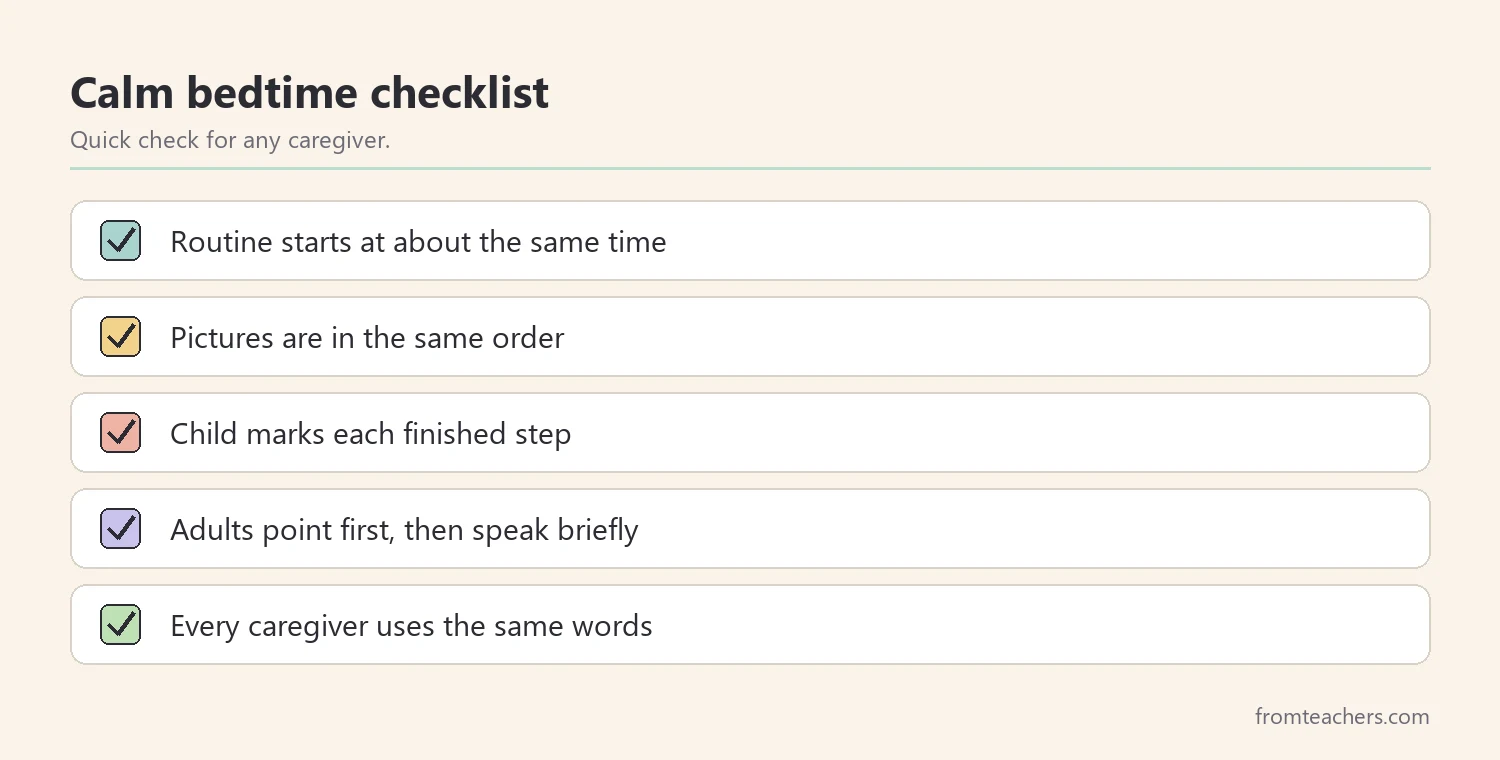
- Adults talking over the pictures. Fix: point first, then use a short phrase.
- Different versions with different caregivers. Fix: share the same cards and words with everyone who helps.
- Changing everything after one bad night. Fix: look at a full week, then adjust one step.
Questions teachers and parents ask about a visual bedtime routine
What age is a visual bedtime routine best for?
Picture routines are often used with toddlers, preschoolers, and early elementary children. Older children who benefit from visual supports may also use them. Adjust the number of steps and the picture style to your child.
How many steps should the routine have?
Give your visual bedtime routine as many steps as your evening really needs, and no more. Some families use six cards, while others use twelve. If the child seems overwhelmed, show fewer at once with a flip chart.
Is a visual bedtime routine helpful for autistic children?
Many autistic children find predictable, step-by-step visuals helpful. Still, every child is different, so watch how your child responds. If they have a therapist or teacher, ask how pictures are used at school and match that style.
What if my child refuses one step every night?
Look closely at that step in the visual bedtime routine. It may be too long, too unpleasant, or placed at a hard transition. Shorten it, add a small choice, or use a first and then prompt.
When can we stop using the pictures?
Some children gradually need the pictures less, and you can fade them slowly. Others keep using them for years. There is no need to rush, because the goal is a calm evening, not independence from the cards.
Related reading: Managing Sensory Overload: Practical Strategies for Autism and ADHD, Meltdowns vs Tantrums: A Guide to Understanding and Responding, and Autism Spectrum Disorder: A Guide to Early Signs, Support, and Effective Strategies.
A companion resource for a visual bedtime routine:
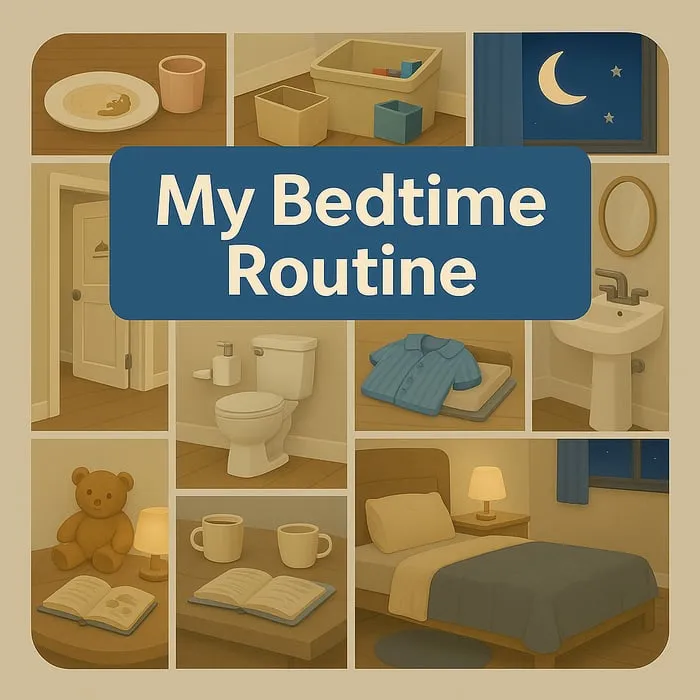
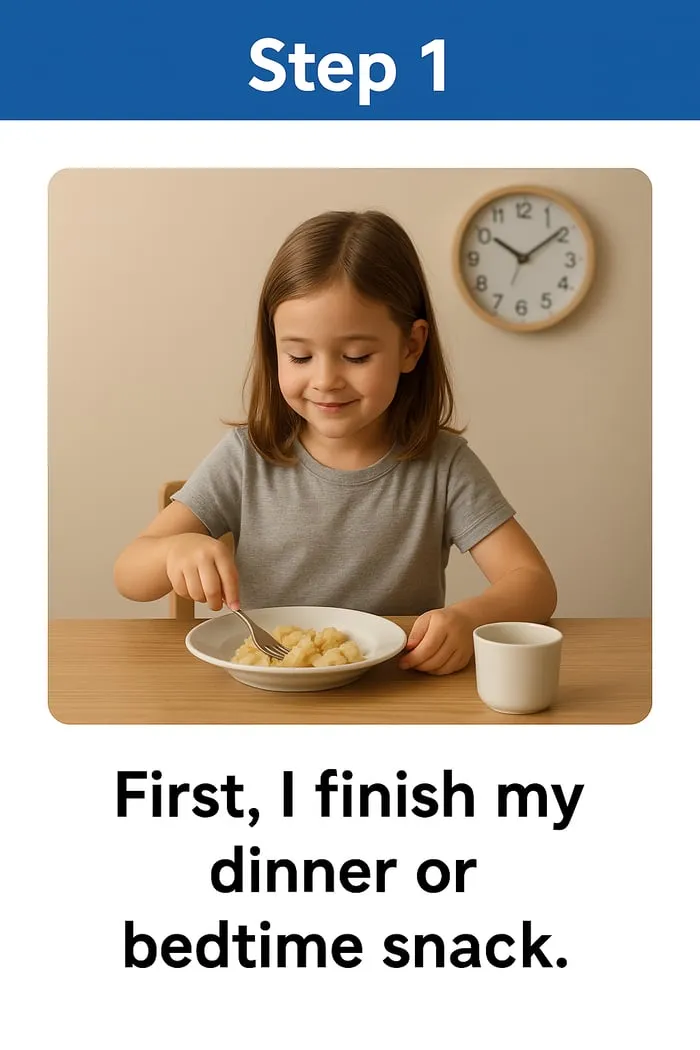
My Bedtime Routine: 12-Step Visual Guide: twelve numbered cards with real photo illustrations that walk children from finishing dinner and tidying up, through bath, pajamas, and brushing teeth, to quiet reading, lights off, and settling into bed.
Sources and scope
- HealthyChildren.org, American Academy of Pediatrics: general parenting information, including sleep and daily routines.
- CDC Sleep: general public information about healthy sleep across ages.
- ZERO TO THREE: resources for families of babies and young children, including routines.
- Understood.org: practical articles for families about learning and thinking differences and visual supports.
This guide covers building and teaching a picture-based bedtime sequence at home. It does not address sleep disorders or medical concerns, which should be discussed with a pediatrician or other qualified professional.
Key takeaways
- Start from your real evening, then match one picture to each step.
- Keep the order and the words the same every night and with every caregiver.
- Teach the visual bedtime routine through play before using it at bedtime.
- Let the child mark finished steps to see progress.
- Track a simple weekly count and change one thing at a time.










Leave a Comment