

A home ecological assessment helps you see a child’s real day before you design a program for it. Picture a therapist arriving for a first home visit with a set of goals from a clinic report. Within ten minutes, she notices that the family eats dinner on the living room floor, that the toddler naps in the car, and that grandma does most of the afternoon care. None of that was in the report, and all of it changes the plan.
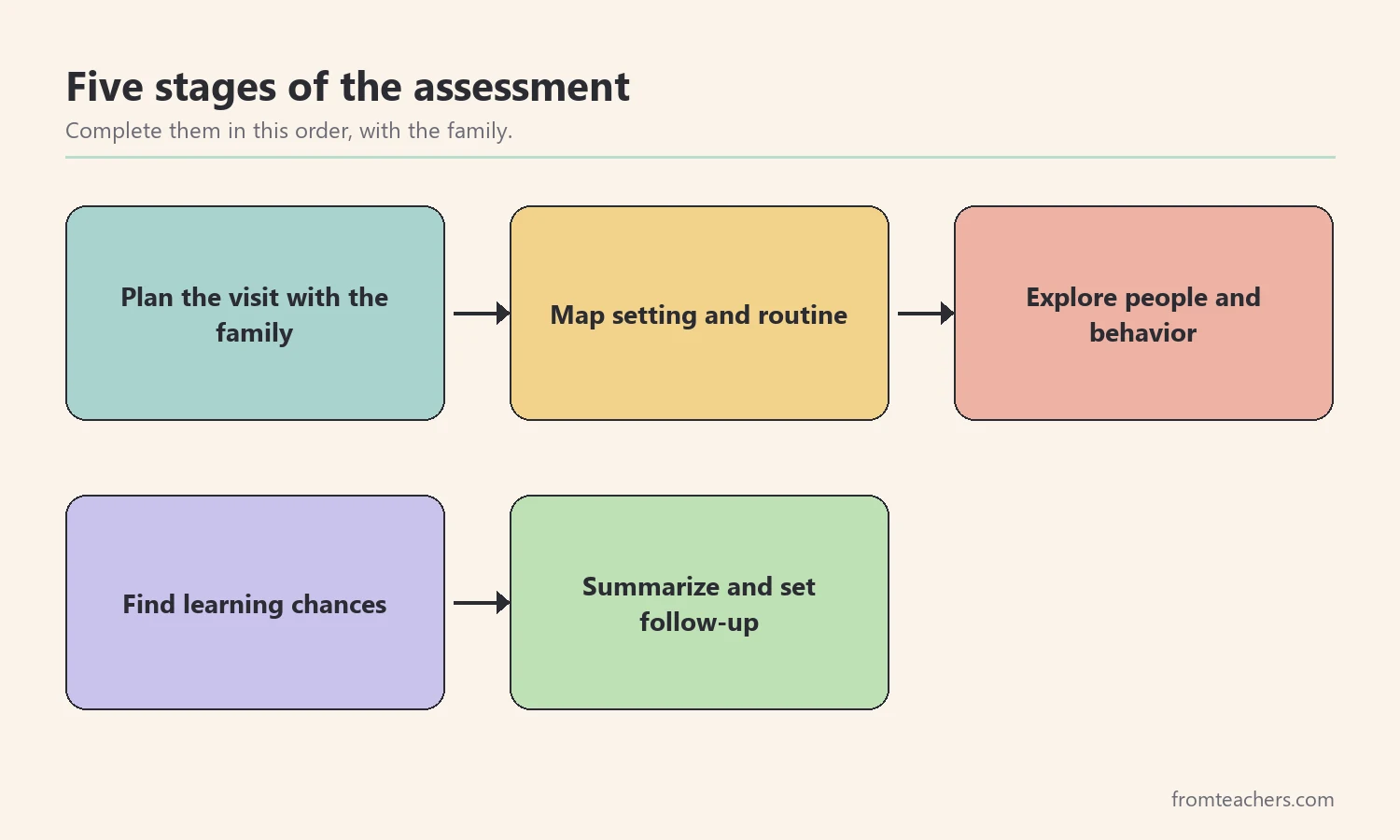
This guide walks you through a practical process for home-based providers, early intervention teams, and special education staff. You will learn how to plan the visit, map the home and daily routine, understand relationships and behavior at home, look for learning opportunities, and turn what you find into clear recommendations. By the end, you will have a program that fits family life instead of competing with it.
Examples are fictional. Adapt to the child’s goals and agreed supports. This is guidance, not a diagnosis.
At a glance
- Treat the family as the expert on their home and routines.
- Look at the setting, the daily schedule, the people, and the learning chances together.
- Write what you see before you decide what it means.
- Build goals inside routines the family already has.
- Set a follow-up date so the assessment keeps guiding the program.
1. Plan the home ecological assessment visit
First, be clear about the purpose. A home ecological assessment is not a test of the family or a home inspection. Instead, it is a structured way to understand where and how a child spends the day, so the program uses real routines, real people, and real materials.
Next, plan the visit with the family, not for them. Ask when the home is most typical. A visit during a calm mid-morning may look very different from the hour before dinner. If possible, schedule at a time that includes a routine the family finds hard, with their agreement.
Then, explain what you will do. Tell the family you will ask about the daily schedule, watch a routine or two, and take short notes. Make sure any consent your agency requires is in place before the visit. Also, ask who should be there. Sometimes the most useful person is a grandparent, an older sibling, or another regular caregiver.
Also, bring only what you need. A clipboard or tablet with your form, a pen, and perhaps a small toy to break the ice are usually enough. Arriving with a large bag of testing materials can make a home ecological assessment feel like an exam, which is the opposite of what you want.
For example, Noah is a fictional four-year-old in a home-based program for communication and play skills. His provider, Ms. Rivera, called his mother, Dana, and asked which part of the day felt hardest. Dana said bath time and getting out the door in the morning. Ms. Rivera scheduled the first visit for a weekday morning so she could see the real rush.
2. Map the home setting and daily routine
Start with the setting. Note where the child plays, eats, sleeps, and spends quiet time. Also notice safety, noise, lighting, and how easy it is for the child to reach toys and materials. Keep your notes factual: “toys stored in a closed bin on a high shelf” is more useful than “not child-friendly.”
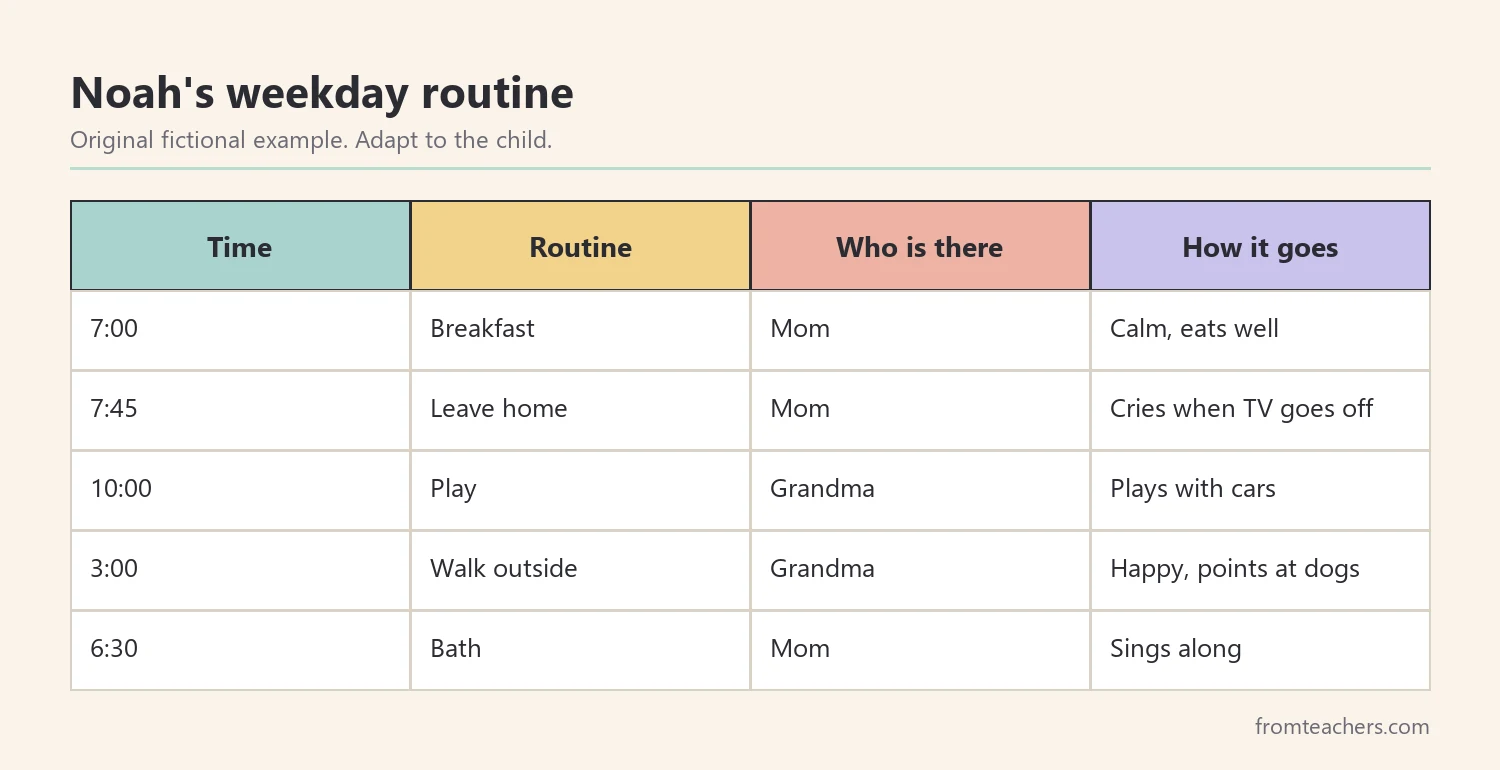
Next, map the daily routine. Ask the family to walk you through a typical weekday from waking up to bedtime. Then, ask about weekends, because many families have very different rhythms. For each part of the day, note who is with the child, what the child does, and how it usually goes.
After that, look at household participation and leisure. Does the child help set the table, feed a pet, or put shoes away? What does the child choose to do when free? These moments often become the best places to teach new skills.
For example, Ms. Rivera mapped Noah’s weekday like this:
Meanwhile, listen for the words families use. If a parent calls the afternoon walk “our outside time,” use the same phrase in your notes and later in the plan. Small details like this make the home ecological assessment feel like the family’s own document rather than a professional report about them.
Finally, mark the routines that happen every day and involve a willing adult. Those are your strongest teaching opportunities. In Noah’s case, breakfast and the afternoon walk were calm and repeated daily, so they became the first places to practice requests and turn-taking.
If you want a structured form for this step, the fillable home ecological assessment form has sections for the child’s environment, daily routine, household participation, and leisure activities, so nothing important is missed during the visit.
3. Understand relationships and behavior at home
A child’s day is shaped by people as much as by places. So, the next part of a home ecological assessment looks at the social and emotional environment. Ask who the child is closest to, how siblings and other children play together, and how the child is comforted when upset.
Next, look at behavior at home with balance. Ask about strengths first. Then, ask about the moments that are hard and what the family already tries. Many families have clever strategies that just need a little more structure.
Then, separate what you see from what you guess. “Noah cries and drops to the floor when the TV is turned off” is an observation. “Noah has trouble with transitions” is a possible explanation. Keep both, but plan from the observation.
| Area | What Dana shared | What Ms. Rivera saw |
|---|---|---|
| Closest adults | Mom and grandma | Seeks grandma when tired |
| Strengths | Loves cars and music | Sings along to two songs |
| Hard moment | TV off before leaving | Cries for about two minutes |
| Current strategy | Warning “five more minutes” | Warning given once, verbally |
For example, Dana already warned Noah before turning off the TV. However, the warning was spoken once from the kitchen. That small detail gave the team a clear starting point: a visual timer and a favorite song to signal the end.
4. Find learning opportunities in home ecological assessment notes
Now that you know the setting, the routine, and the people, look for natural learning chances. A home ecological assessment is most useful when it shows where a skill can be practiced many times a day without extra work for the family.
First, list the materials the child already uses. Cups, shoes, bath toys, and a favorite book can all carry a goal. Next, ask about any specialized support, such as a speech device, adapted seating, or picture cards, and how often it is used at home. Then, ask how the family would like to be involved. Some parents want to lead every practice; others prefer a few short, easy moments.
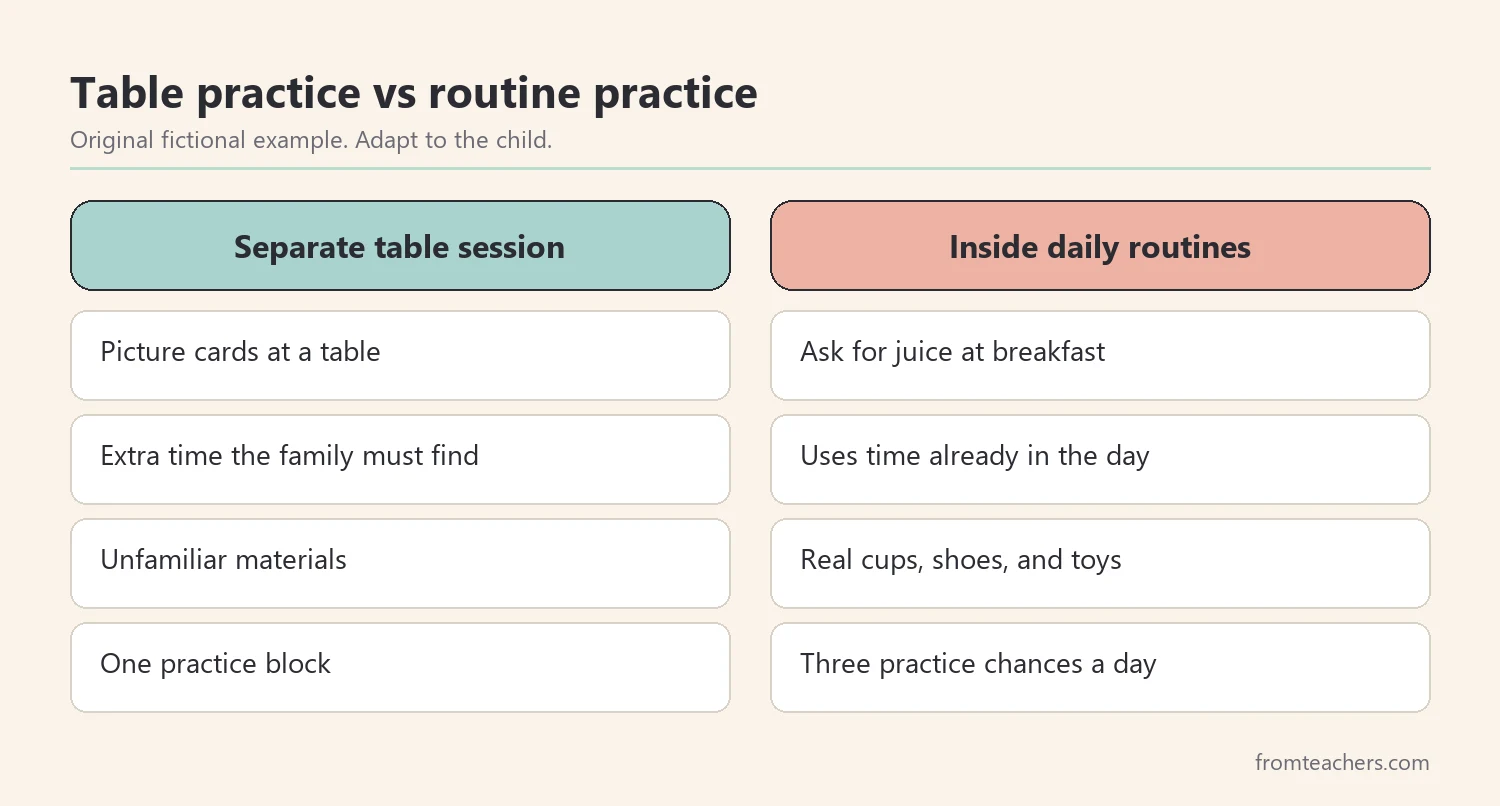
For example, Noah’s team wanted him to request items with a word or picture. Instead of a separate table session, they chose three routines: asking for juice at breakfast, asking for shoes before the walk, and asking for a bath toy. Each happened once a day, so Noah had three planned practice chances daily, or 21 a week, without adding new activities.
Also, check what the family already does well. Dana sang to Noah during bath time. The team used that song as a cue, pausing before the last word so Noah could fill it in. It took no extra time and Dana enjoyed it.
5. Turn the home ecological assessment into a plan
Finally, bring your notes together. A good home ecological assessment ends with a short summary, a few clear environmental modifications, and recommendations the family helped choose. Keep it to one or two pages so it gets read.
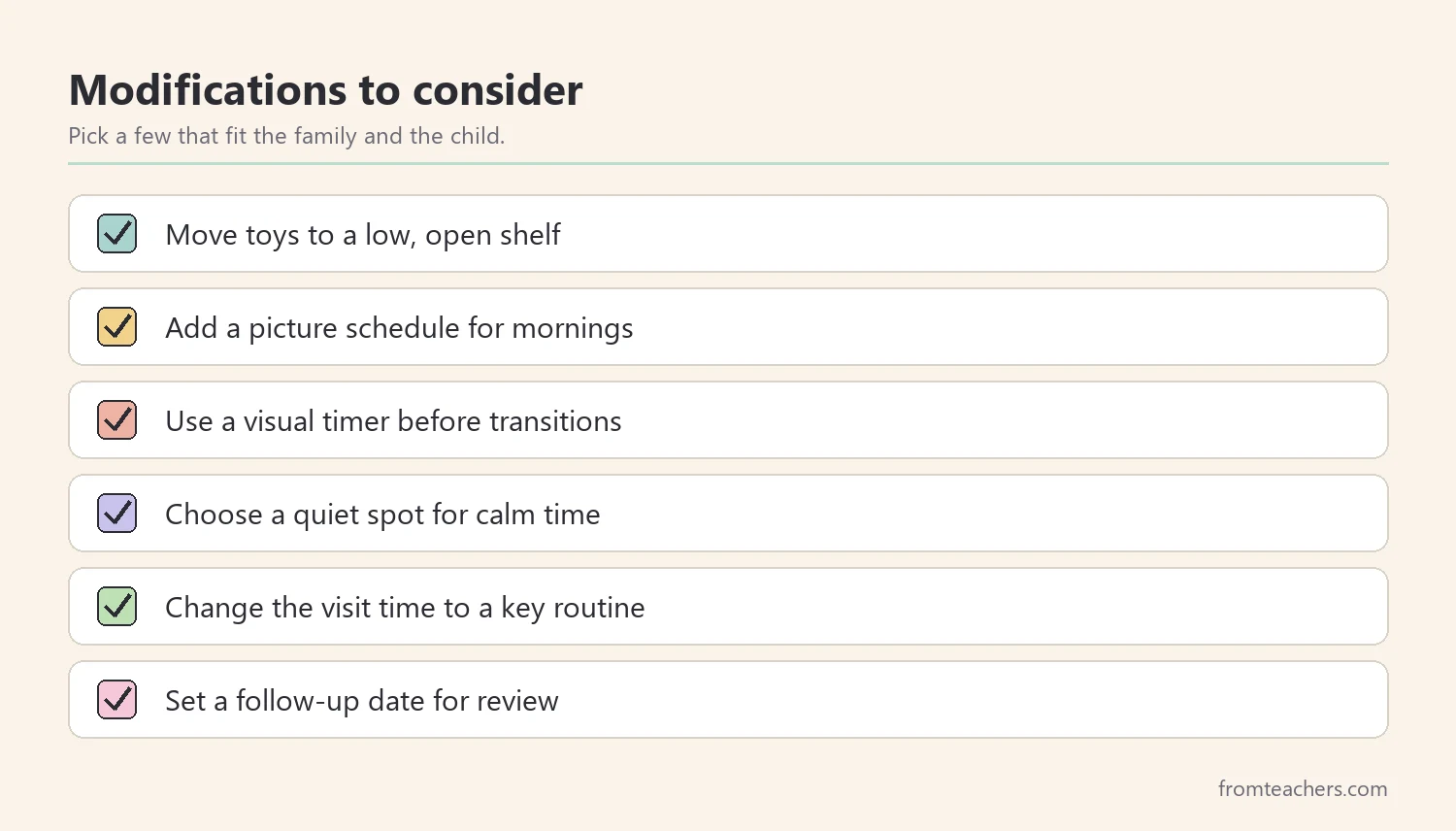
Start with modifications. These are small changes to the home or to the program that make success easier. For instance, moving toys to a low open shelf, adding a picture schedule for the morning, or changing the time of the home visit.
Then, read the summary aloud with the family before you leave or at the next visit. Ask whether anything feels wrong or missing. Families often correct small details, such as who really handles bedtime, that change which routine makes sense to target first.
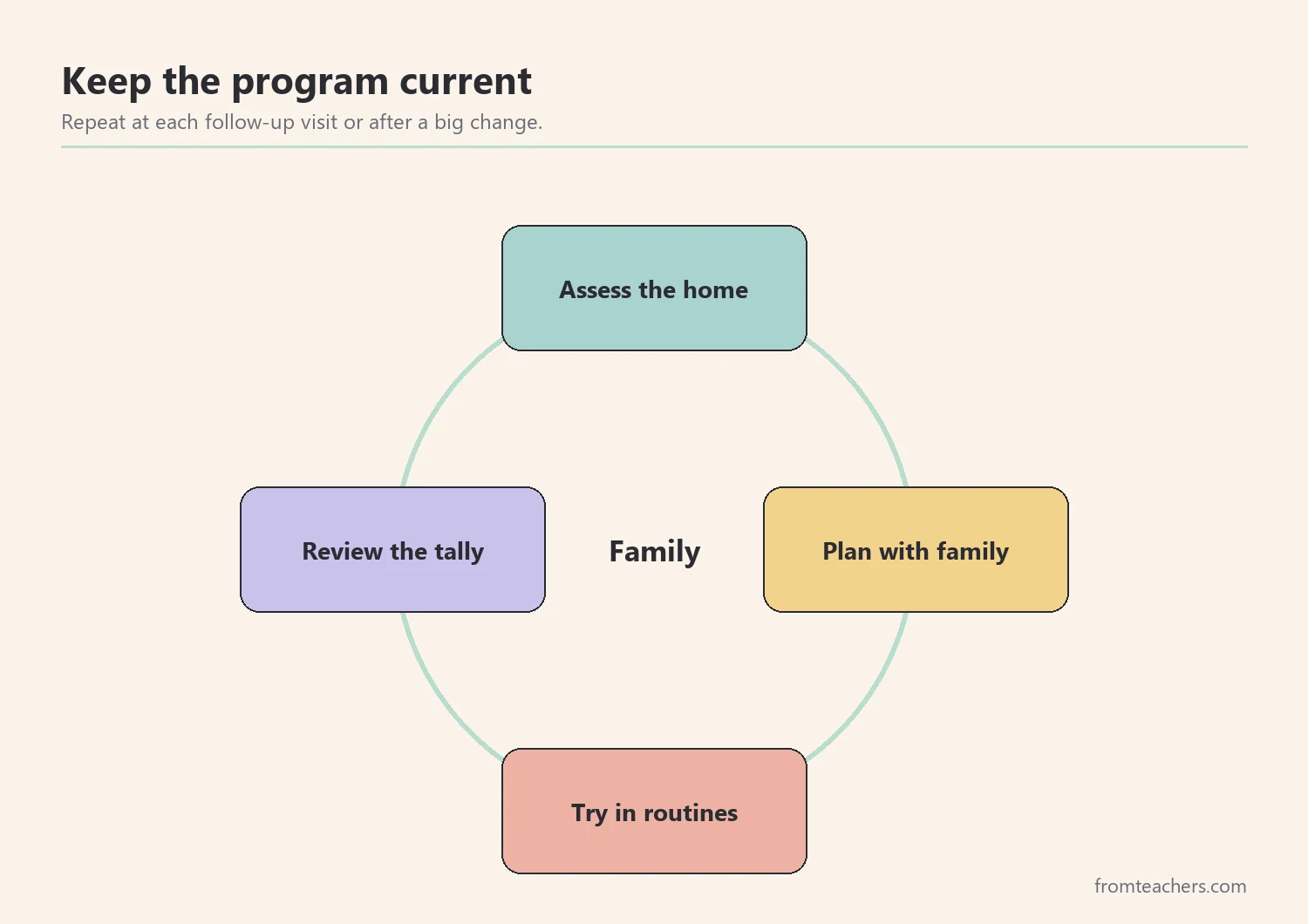
Next, write two or three recommendations linked to routines. Each one should say what skill, which routine, who helps, and how you will know it is working. Then, set a follow-up date. Families change, routines shift with the seasons, and a new baby or a new job can reshape the whole day.
For example, Noah’s summary included three recommendations: picture choices at breakfast, a visual timer and song before leaving home, and a fill-in-the-word song at bath time. Dana agreed to keep a simple tally on the fridge, with one mark each time Noah made a request during a planned routine. That way, the next home ecological assessment visit could start from real information instead of memory. The follow-up visit was set for six weeks later.
Common mistakes and how to avoid them
- Visiting only at the calmest time of day. Fix: with the family’s agreement, see at least one routine they find hard.
- Writing judgments instead of observations. Fix: describe what you saw and heard, then list possible reasons separately.
- Adding new activities to an already full day. Fix: build goals into routines the family already does every day.
- Choosing too many goals at once. Fix: start with two or three recommendations the family feels confident about, then add more at the follow-up.
- Talking only to one parent. Fix: ask who else cares for the child and include them when possible.
- Treating the home ecological assessment as a one-time task. Fix: set a follow-up date and update the summary when life changes.
Questions teachers and parents ask about home ecological assessment
What is a home ecological assessment?
It is a structured look at a child’s home environment, daily routines, relationships, behavior, and learning opportunities. The goal is to design a program that fits the child’s real life. It is not a judgment of the family or the home.
How long does a home ecological assessment take?
It depends on the family and the program. Many teams complete it over one or two visits plus a family interview. A clear form helps keep the visit focused and respectful of the family’s time.
Who should take part?
The family leads, and the provider guides the process. Include any regular caregivers, such as grandparents or a nanny, if the family agrees. Older siblings can also share useful details about play and routines.
What if the family feels uncomfortable with a home visit?
Explain the purpose clearly and let the family choose the time and which rooms you see. You can also start with an interview by phone or at another location. Trust usually grows when families see that the plan respects how they live.
How is this different from a classroom ecological assessment?
The ideas are similar, but the setting and people are different. At home, routines are less fixed, family members are the main teachers, and goals must fit around work, meals, and sleep. That is why family input matters so much.
Related reading: How Parents and Teachers Can Team Up for Special Education Success, The Power of Data Tracking in Special Education, and Autism Spectrum Disorder: A Guide to Early Signs, Support, and Effective Strategies.
A companion resource for home ecological assessment:
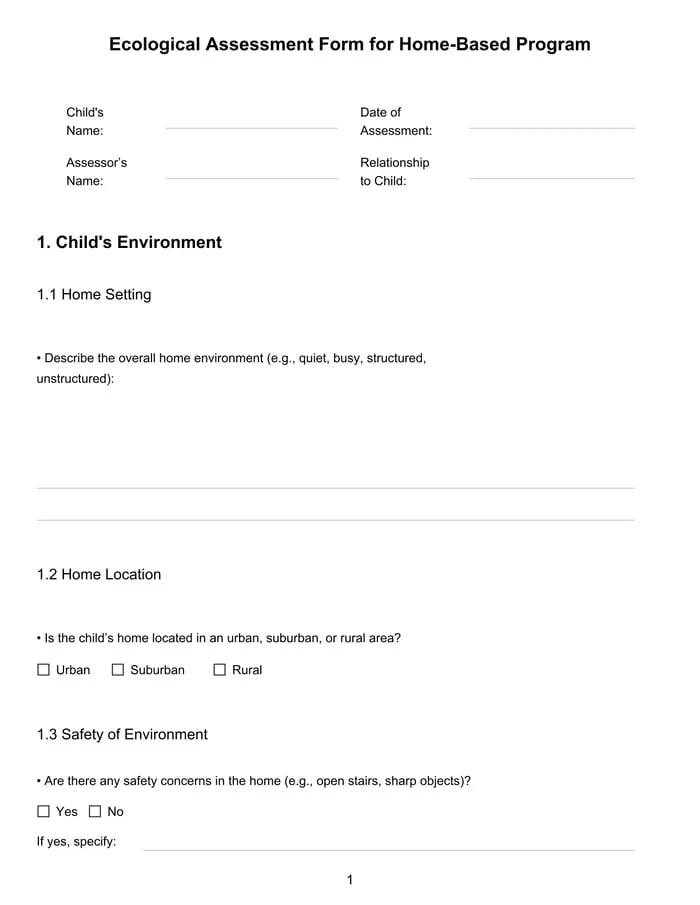
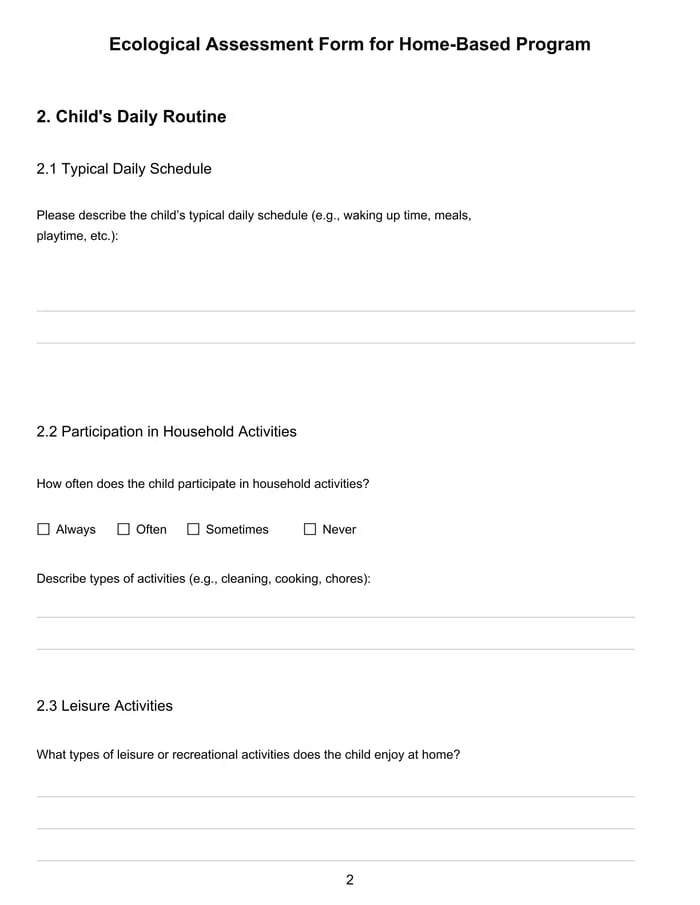
Ecological Assessment Form for Home-Based Program: a fillable PDF with sections for the child’s environment, daily routine, social and emotional environment, behavior at home, learning and development, environmental modifications, and a summary with a follow-up date.
Sources and scope
- Early Childhood Technical Assistance Center (ECTA): resources on early intervention, family-centered practice, and natural environments.
- Division for Early Childhood (DEC): professional organization for early childhood special education and recommended practices.
- IDEA, U.S. Department of Education: the federal law behind early intervention and special education services.
- IRIS Center, Vanderbilt University: free modules on early childhood and family partnership.
This guide explains a practical, family-centered approach to assessing a child’s home environment for program planning. It does not cover formal developmental testing, diagnosis, or child protection procedures, which follow separate professional and legal guidelines.
Key takeaways
- A home ecological assessment maps the setting, routine, people, and learning chances together.
- Plan the visit with the family and see at least one real routine.
- Write observations first and possible reasons second.
- Build goals into daily routines the family already has.
- End with a short summary, a few modifications, and a follow-up date.








Leave a Comment