

An ADHD morning routine is often tested at 7:35, when one shoe is missing, breakfast is half eaten, and a parent is repeating “Hurry up” for the fifth time. The child is not trying to be slow. Mornings simply ask for many quick steps, a sense of time, and a smooth goodbye, all before the brain has fully warmed up.
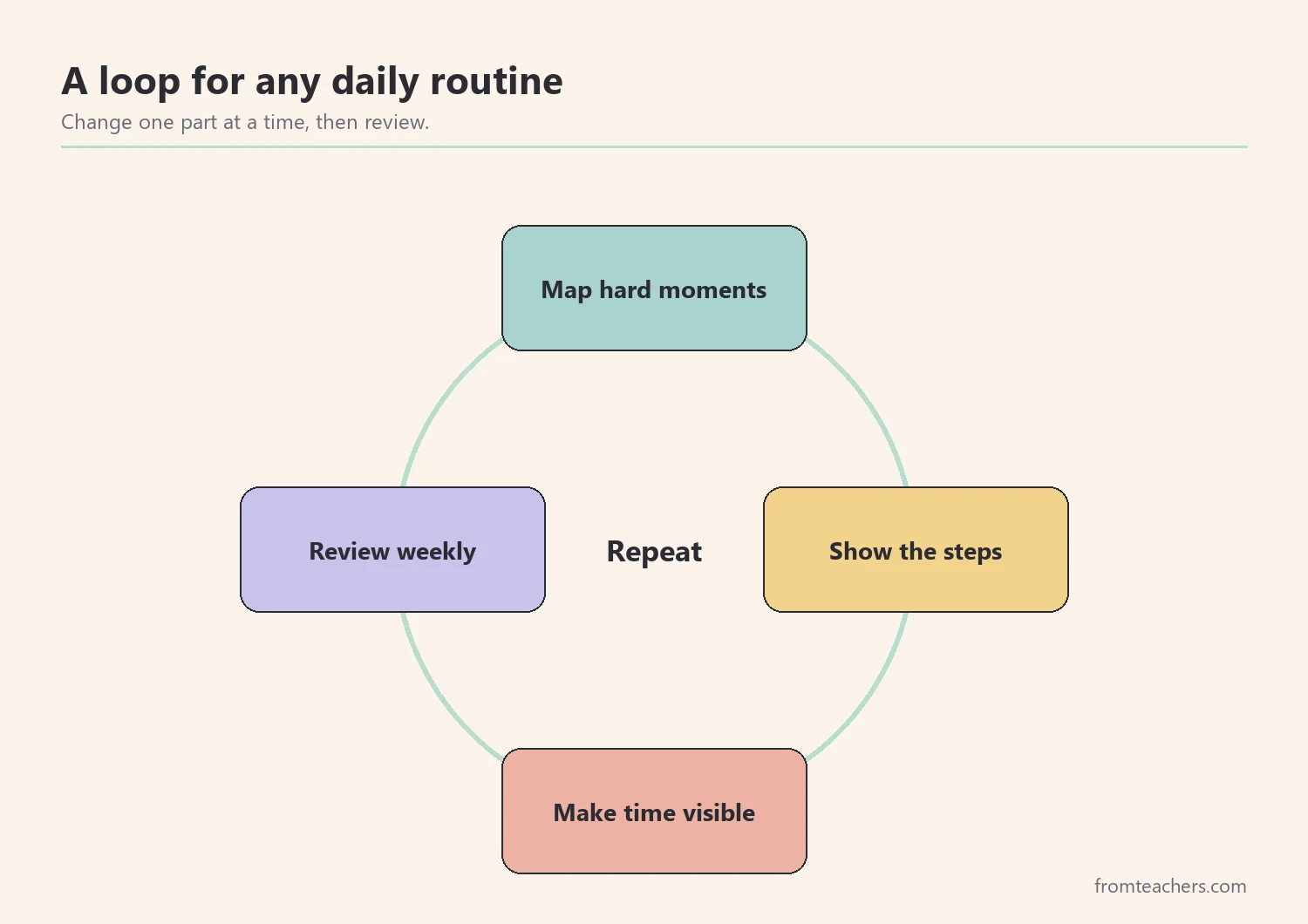
This guide gives you a five-step process for calmer mornings and smoother after-school transitions. You will learn how to map the hardest moments, build a visual sequence, make time visible, plan a calm departure, and handle the switch from school to home. By the end, you will have a short, tested routine instead of a daily rush.
Examples are fictional. Adapt to the child’s goals and agreed supports. This is guidance, not a diagnosis.
At a glance
- Find the one morning moment that breaks down most often.
- Turn the routine into a short picture sequence the child can follow.
- Make time visible with a timer and a clear finish time.
- Plan the departure and goodbye so they look the same every day.
- Give the after-school switch its own calm routine too.
1. Map the hardest moments of the ADHD morning routine
Mornings feel chaotic as a whole, but usually one or two moments cause most of the trouble. Some children stall while getting dressed. Others get pulled into a toy or a screen. Many struggle most at the door. So the first step is finding where the routine actually breaks.
For one week, jot down a quick note each morning. Write what time the child woke up, where things slowed down, and what time you left. Keep it simple, a few words each day. By Friday, a pattern usually stands out. Those notes become the starting map for your ADHD morning routine.
Put this step into practice
For example, meet Sam, a fictional eight-year-old in third grade. His parent noticed that Sam woke up on time and ate breakfast well. However, getting dressed often took twenty minutes because he started playing with toys in his room. Then, the rush at the door led to tears almost every day.
| Moment | What happened most days |
|---|---|
| Wake up | On time, no problem |
| Getting dressed | Pulled into toys, very slow |
| Breakfast | Usually fine |
| Leaving the house | Rushed, upset goodbye |
With that map, Sam’s family knew where to focus. Instead of fixing the whole ADHD morning routine at once, they started with dressing and departure. Small, targeted changes are easier to keep than a complete overhaul.
Also, check the night before. Many morning problems actually start in the evening, when bedtime runs late or nothing is prepared. A good ADHD morning routine often begins at 8 p.m. with laid-out clothes, a packed backpack by the door, and a predictable bedtime.
2. Build a visual ADHD morning routine sequence
Many children with ADHD find it hard to hold a list of steps in their head, especially when they are tired. A visual sequence moves the list out of their memory and onto the wall. As a result, the child can check the next step without waiting for an adult.
In addition, keep the sequence short, with about five steps. Use one picture and a few words for each step. Place it where the routine happens, such as the bedroom door or the fridge. Then, walk through it together a few times on a calm weekend morning before using it on a school day.
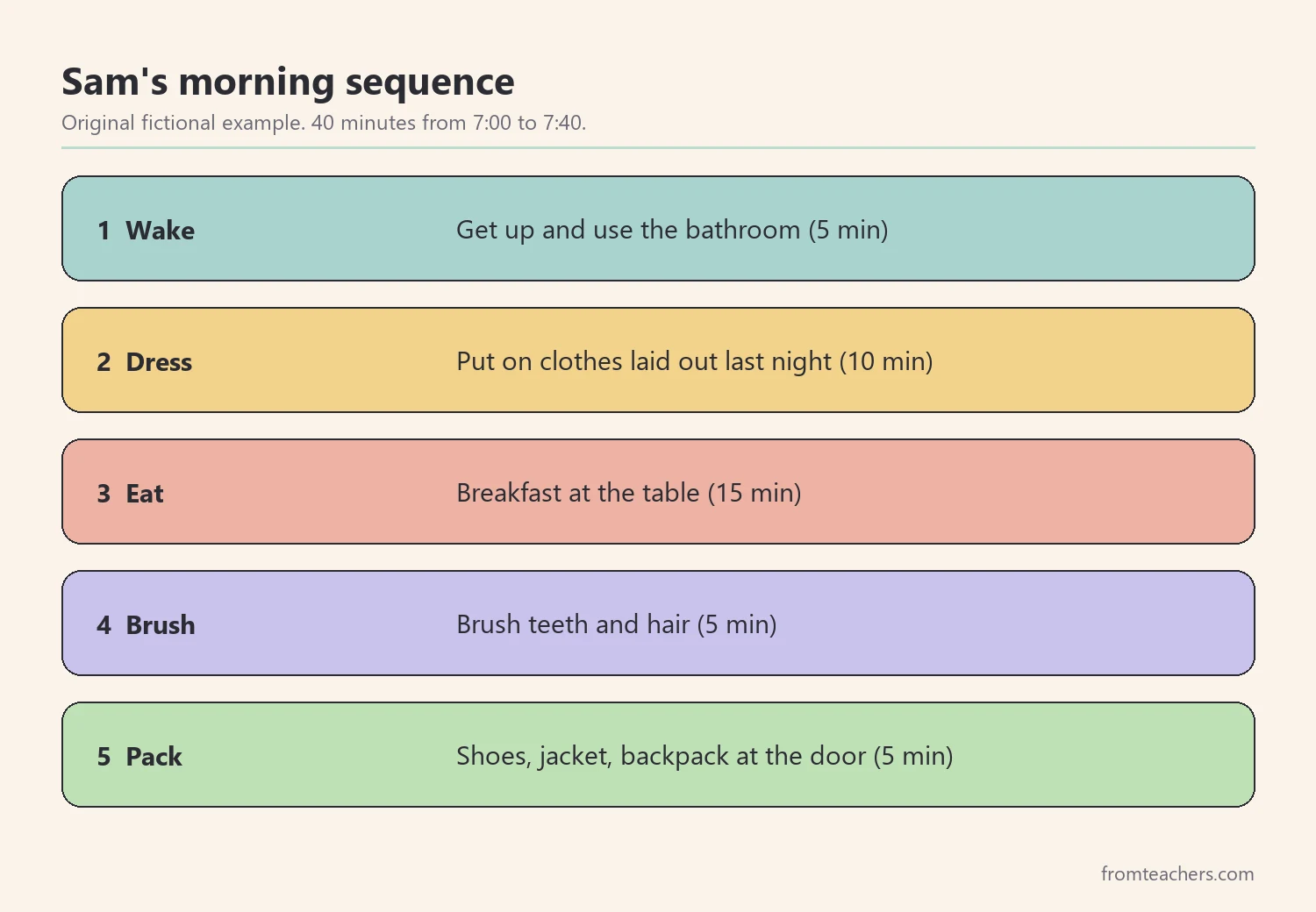
Sam’s sequence had five steps, each with an expected number of minutes. He woke up at 7:00, and the five steps added up to 40 minutes, so the goal was to be at the door by 7:40.
Next, reduce distractions at the hardest step. Sam’s family laid out his clothes the night before and got dressed in the bathroom instead of his toy-filled room. That single change cut out most of the stalling. In other words, the ADHD morning routine worked better once the environment stopped competing with it.
If you want ready-made ideas for each part of the day, the Smooth Transitions morning and after-school toolkit breaks common transition challenges into tables with practical strategies, helpful tools, and the reasoning behind each approach. That makes it easier to pick a fix that fits your child’s hardest moment.
Also, let the child check off each step. A magnet, a clip, or a dry-erase mark gives a small sense of progress. Over time, that visible progress becomes part of the ADHD morning routine itself.
3. Make time visible
Time can feel invisible to many children with ADHD. “Five more minutes” means little if you cannot feel how long five minutes is. Therefore, making time visible is one of the most helpful parts of an ADHD morning routine.
For example, a visual timer shows time shrinking as a colored area or a moving bar. Set it for each step, such as 10 minutes for getting dressed. In addition, place a simple clock card by the door that shows the leave time, like 7:40. Some families also use a song playlist, where each song matches one step.
For Sam, the family used a visual timer in the bathroom while he dressed. When the color disappeared, he moved to the next card. At first, a parent stayed nearby to help him notice the timer. After two weeks, he started the timer himself most mornings.
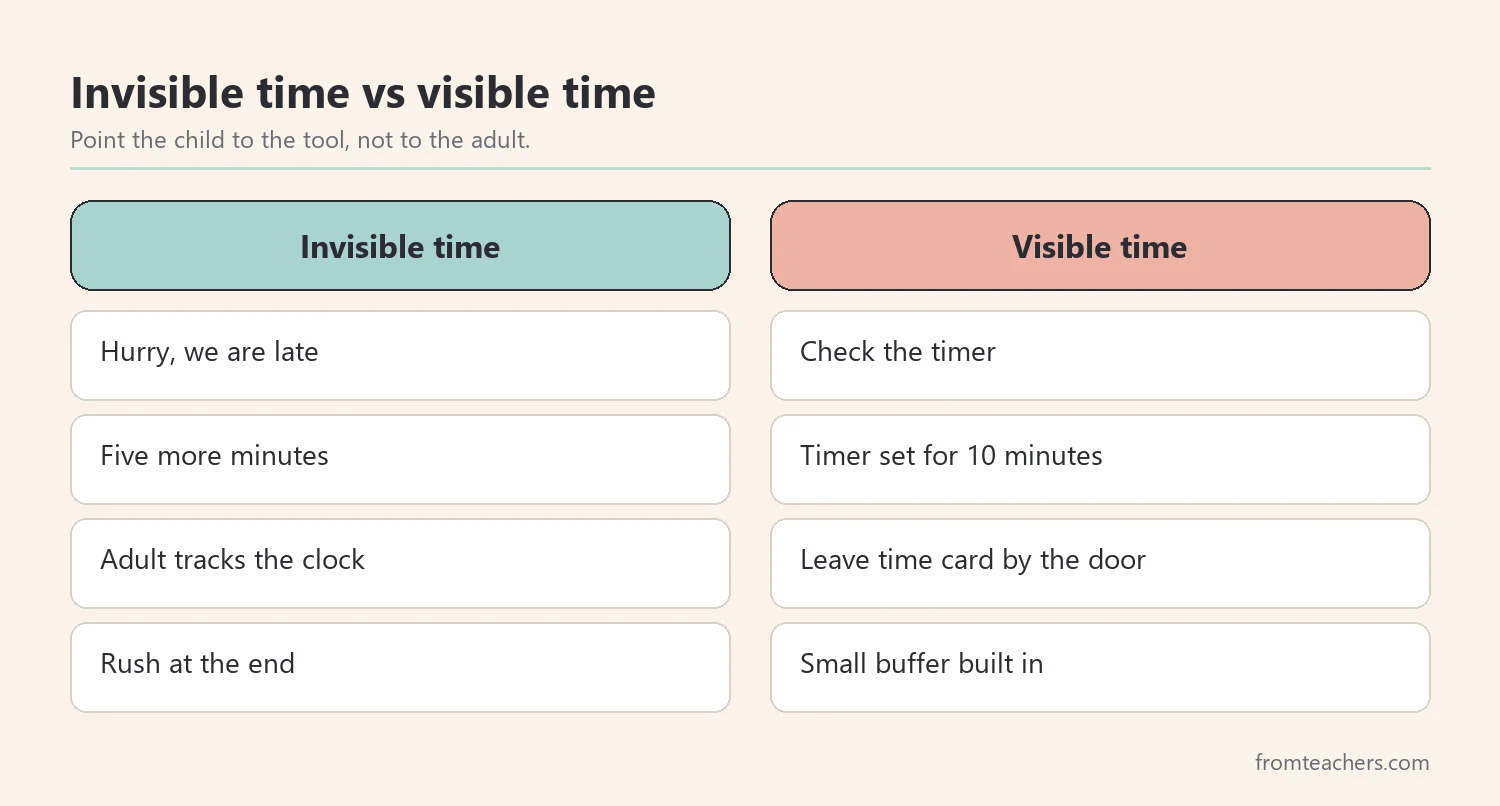
Meanwhile, keep adult reminders short. Instead of “Hurry, we are going to be late,” try “Check the timer.” This points the child back to the tool rather than to the adult. It also lowers the stress in the room, which often helps a child move faster.
Similarly, praise the specific step the child finished on time. Saying “You were dressed before the timer ended” connects the effort with the tool. Over weeks, that kind of feedback helps the ADHD morning routine feel like a game the child can win rather than a daily battle.
Finally, build in a small buffer. If everything takes 40 minutes on a good day, a few extra minutes protect the routine on harder days. A calm ADHD morning routine almost always has some slack built in.
4. Plan the ADHD morning routine departure and goodbye
The door is where many mornings fall apart. The child must stop what they are doing, remember several items, and say goodbye, all at once. A short departure checklist and a predictable goodbye ritual help this moment feel the same every day.
Next, start with a checklist by the door. Keep it to a few items, such as shoes, jacket, backpack, and lunch. Then, practice the order so it becomes automatic. After that, add a simple goodbye ritual, like a special handshake or a short phrase you always say.
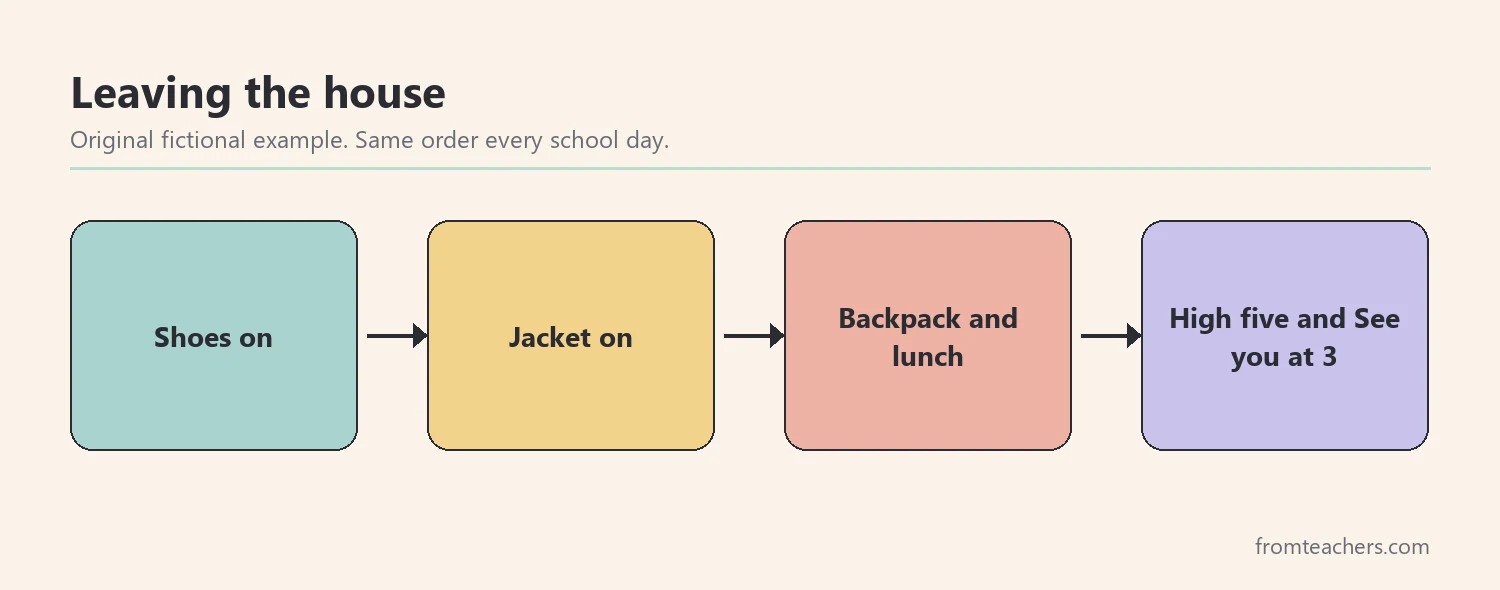
For Sam, the family hung a small picture checklist on the inside of the front door. They also added a quick goodbye: a high five and the words “See you at 3.” Because the goodbye looked the same every day, Sam stopped worrying about it, and the tears at the door became rare.
School can help too. A teacher who greets the child with the same short routine at the classroom door makes the handoff feel safer. Share the home routine with the teacher so both ends of the trip feel connected. When the teacher knows the ADHD morning routine at home, a hard morning can be met with a calm, familiar welcome instead of a rushed start.
Above all, avoid adding new demands at the door. If a form needs signing or a question needs answering, handle it the night before. The door should be the simplest part of the ADHD morning routine, not the most crowded.
5. Smooth the after-school transition and review
Mornings get most of the attention, but the switch from school to home can be just as hard. After a full day of focusing and following rules, many children with ADHD arrive home tired and wound up. Jumping straight into homework often leads to conflict.
Instead, plan a short decompression break first. This might be a snack, some outdoor play, or quiet time. Then, use a visual timer to mark the end of the break and a set workspace for homework. Keeping the order the same each day makes the switch feel predictable.
Sam’s family gave him a 20-minute break with a snack and outdoor play. When the timer ended, he went to the same spot at the kitchen table, where his homework supplies waited in a small box. As a result, homework start time became much calmer.
Next, review progress every couple of weeks. Track two simple things: how many reminders were needed each morning and how many school days the child was ready by the leave time.
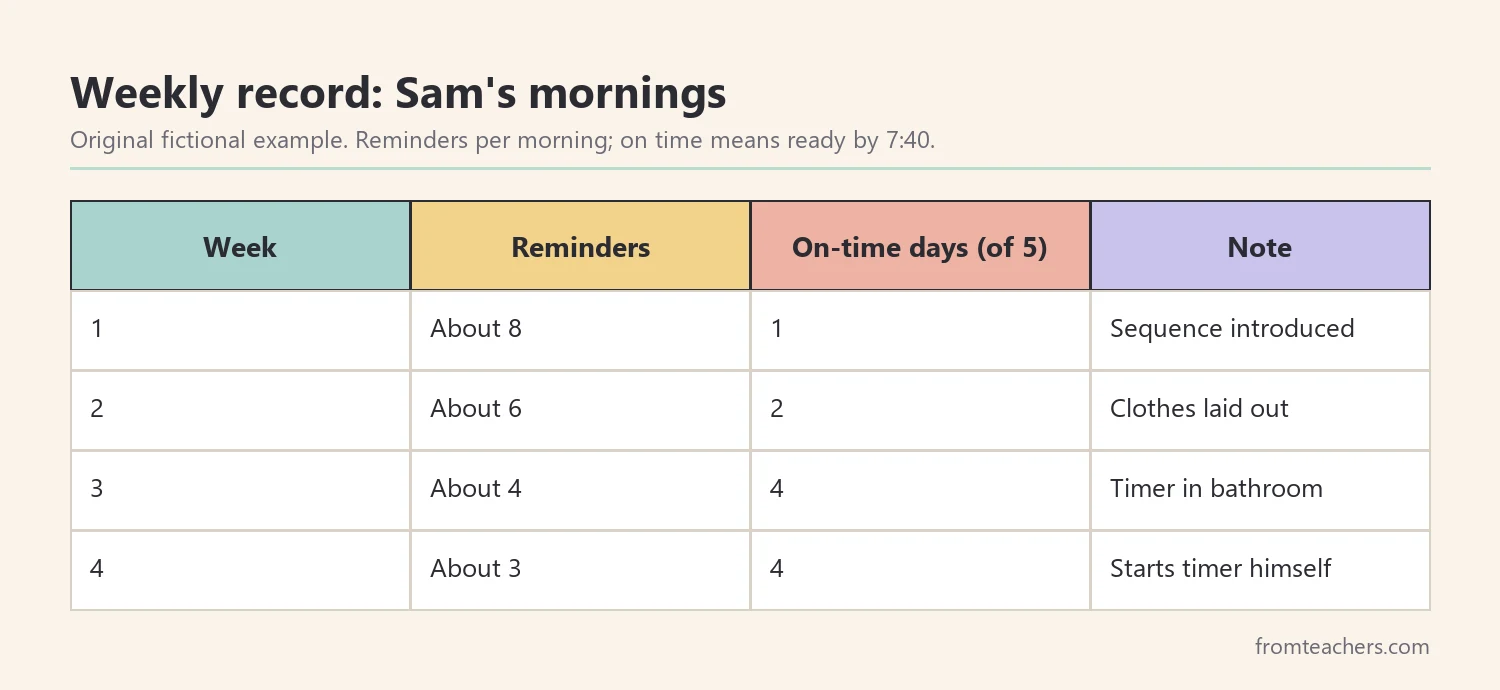
In week 1, Sam needed about 8 reminders each morning and was ready by 7:40 on 1 of 5 school days. By week 2, reminders dropped to about 6, and he was ready on 2 of 5 days after clothes were laid out the night before. In week 3, reminders fell to about 4, and he was ready on 4 of 5 days. By week 4, reminders were down to about 3, and he stayed ready on 4 of 5 days. When progress stalls, change one thing, not everything.
Finally, involve the child in the review. Show the numbers in a simple way and ask what helped most. Children who help shape their ADHD morning routine are often more willing to follow it, and they start to see themselves as capable of handling hard parts of the day.
As the routine settles, step back slowly. Fewer adult reminders and more self-started steps are the real signs that the ADHD morning routine belongs to the child now.
Common mistakes and how to avoid them
- Fixing the whole morning at once. Fix: start with the one or two moments that break down most often.
- Too many steps on the chart. Fix: keep the sequence to about five clear steps.
- Repeating “Hurry up.” Fix: point the child back to the timer or the picture card.
- A crowded departure. Fix: handle forms and questions the night before.
- Homework right after school. Fix: plan a short decompression break with a clear end.
- No record of progress. Fix: track reminders and on-time days for a few weeks.
Questions teachers and parents ask about an ADHD morning routine
How many steps should an ADHD morning routine have?
Most children do well with about five main steps. Each step can include a few small actions, but the chart itself should stay short. Fewer steps are easier to remember and check off.
Are visual timers helpful for every child?
Many children find them helpful because they show time passing. However, some find a ticking or ringing timer stressful. Try a silent visual timer first and adjust based on how the child responds.
What if my child refuses to follow the chart?
Involve the child in making the chart, including choosing pictures and the order where possible. Practice on a calm weekend first. If refusal continues, look at which step is hardest and simplify that one.
How can teachers support the morning routine?
Teachers can greet the child with a consistent arrival routine and share any changes in schedule ahead of time. Simple communication with families helps the two routines fit together. A predictable start at school can reduce worry at home.
How long before the routine feels easier?
It varies by child and family. Many families notice small improvements within a few weeks of using the same routine every day. Tracking reminders and on-time days helps you see progress clearly.
Related reading: ADHD in Children: A Guide to Effective Classroom and Home Support, Effective ADHD Classroom Strategies to Support Student Success, and How Teachers Communicate With Parents in Special Education: Building a Strong Partnership.
A companion resource for an ADHD morning routine:
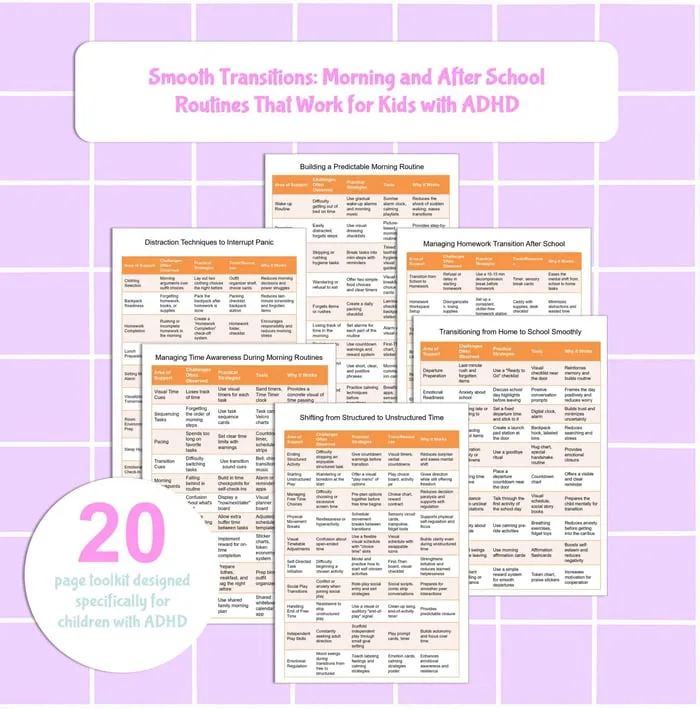
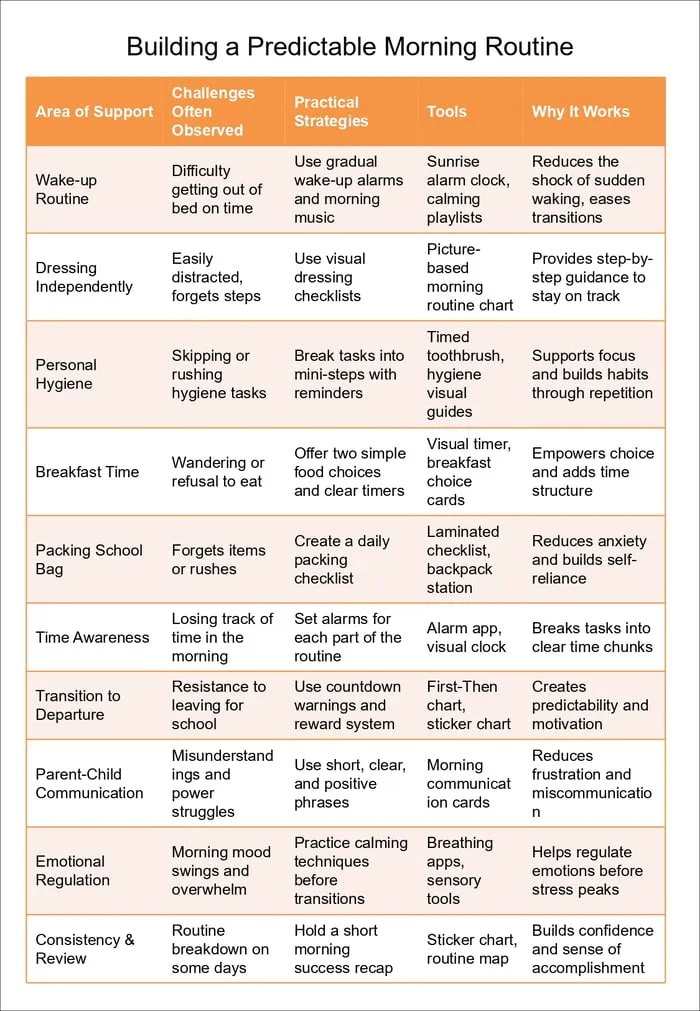
Smooth Transitions: Morning and After-School Routines That Work for Kids with ADHD: a 20-page, table-based toolkit covering morning routines, time awareness with visual timers and sequence cards, home-to-school departures, homework transitions, free time, and bedtime wind-down.
Sources and scope
- CDC ADHD information: general background on ADHD in children, including support at home and school.
- CHADD: information and support for families of children with ADHD.
- HealthyChildren.org, American Academy of Pediatrics: parenting information on child health, sleep, and daily routines.
- Understood.org: practical articles for families and teachers on ADHD and learning differences.
This guide covers everyday routines for mornings and after-school transitions. It does not cover diagnosis, medication, or formal evaluation, which belong to qualified professionals.
Key takeaways
- An ADHD morning routine improves fastest when you fix the hardest moment first.
- Use a short picture sequence and let the child check off each step.
- Make time visible with a timer and a clear leave time.
- Keep the departure and goodbye the same every day.
- Give the after-school switch a break, a timer, and a set workspace.










Leave a Comment