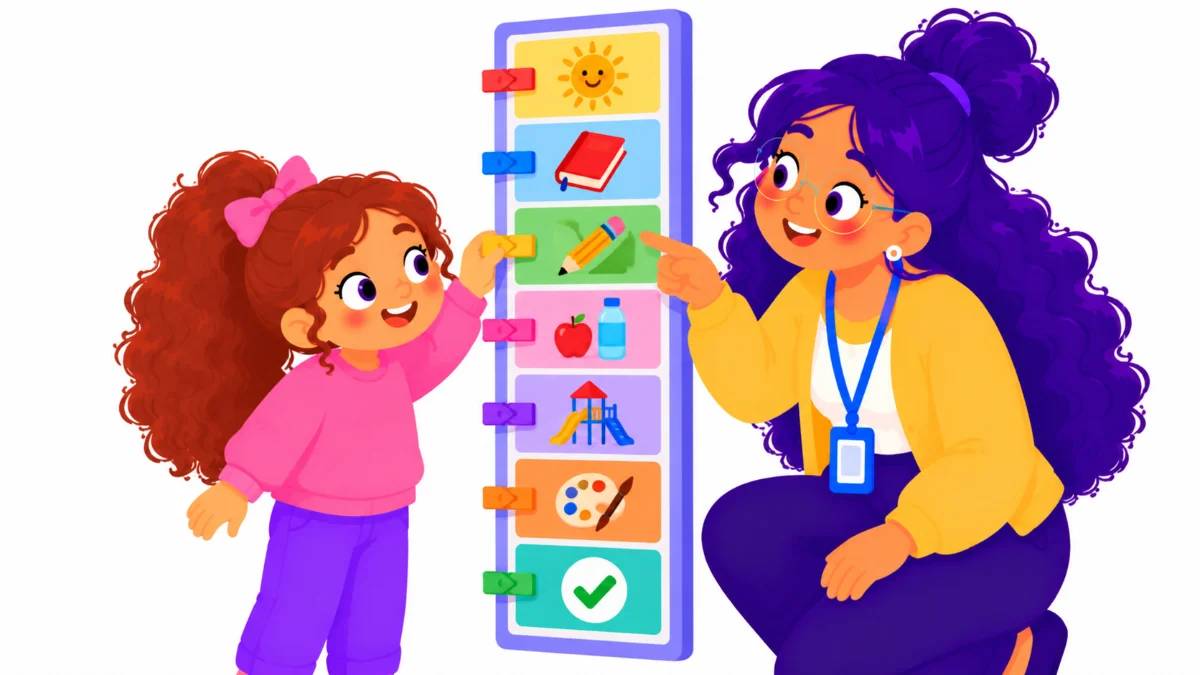

A now next later schedule shows students what is happening right now, what comes next, and what is coming later in the day. Picture a first grader who asks “Is it lunch yet?” every ten minutes and cries when recess ends. She is not being difficult. She simply cannot see the shape of her day, so every change arrives as a surprise.
This guide walks you through five steps: map the school day into clear blocks, set up the now, next, and later display, teach the marker routine, plan for changes and transitions, then track progress and adjust. By the end, you will have a visual schedule students can read on their own, whether they are readers or not.
Examples are fictional. Adapt to the student’s goals and agreed supports. This is guidance, not a diagnosis.
At a glance
- A predictable visual schedule can make the school day easier to follow.
- Three simple headers, now, next, and later, focus attention on what matters.
- Moving a clip and crossing off finished blocks makes time visible.
- Planned change cards help students cope with surprises.
- Track smooth transitions weekly and fade adult prompts.
1. Map the school day into clear routine blocks
First, list the main parts of the day in order. Keep each block broad enough to be stable from day to day. A typical elementary day might include morning arrival, morning meeting, three learning blocks, a movement break, snack time, specials, lunch and recess, the pack-up routine, and dismissal.
Next, describe each block with a few concrete actions. “Morning arrival” might mean hang the backpack, unpack the folder, choose a morning activity, and sit in your spot. These short details help students know what is expected, not only what the block is called.
| Block | What students do |
|---|---|
| Morning arrival | Hang backpack, unpack folder, sit in spot |
| Movement break | Stretch or walk, use sensory tools, breathe |
| Specials | Art, music, PE, or library |
| Pack-up routine | Clean workspace, pack folder, grab backpack |
Then, add pictures for every block. Picture icons help students who do not read yet, and they help readers process the schedule quickly. Use the same picture for the same block every day so students learn to recognize it at a glance.
For specials that change by day, use one block with a swappable icon. That way, the overall schedule stays the same while the detail changes. Students learn that “Specials” always happens after a learning block, even if the activity varies.
Check the order against your real timetable before you print anything. If the schedule shows a movement break before snack but the class actually eats first, the student learns that the board cannot be trusted. Accuracy matters more than decoration.
Keep the number of blocks manageable. Eleven blocks is a full day for many classrooms. For a student who finds that overwhelming, start with half the day and add the afternoon later.
Worked example. Ava, a fictional first grader who finds transitions hard, has eleven blocks in her day. Her teacher starts with a morning-only version of five blocks, then adds the afternoon blocks after two weeks.
2. Set up the now next later schedule display
A full list of eleven items is a lot to read. In contrast, a now next later schedule adds three headers that point the student to what matters most. Now is the current block, next is the one after it, and later is the rest of the day.
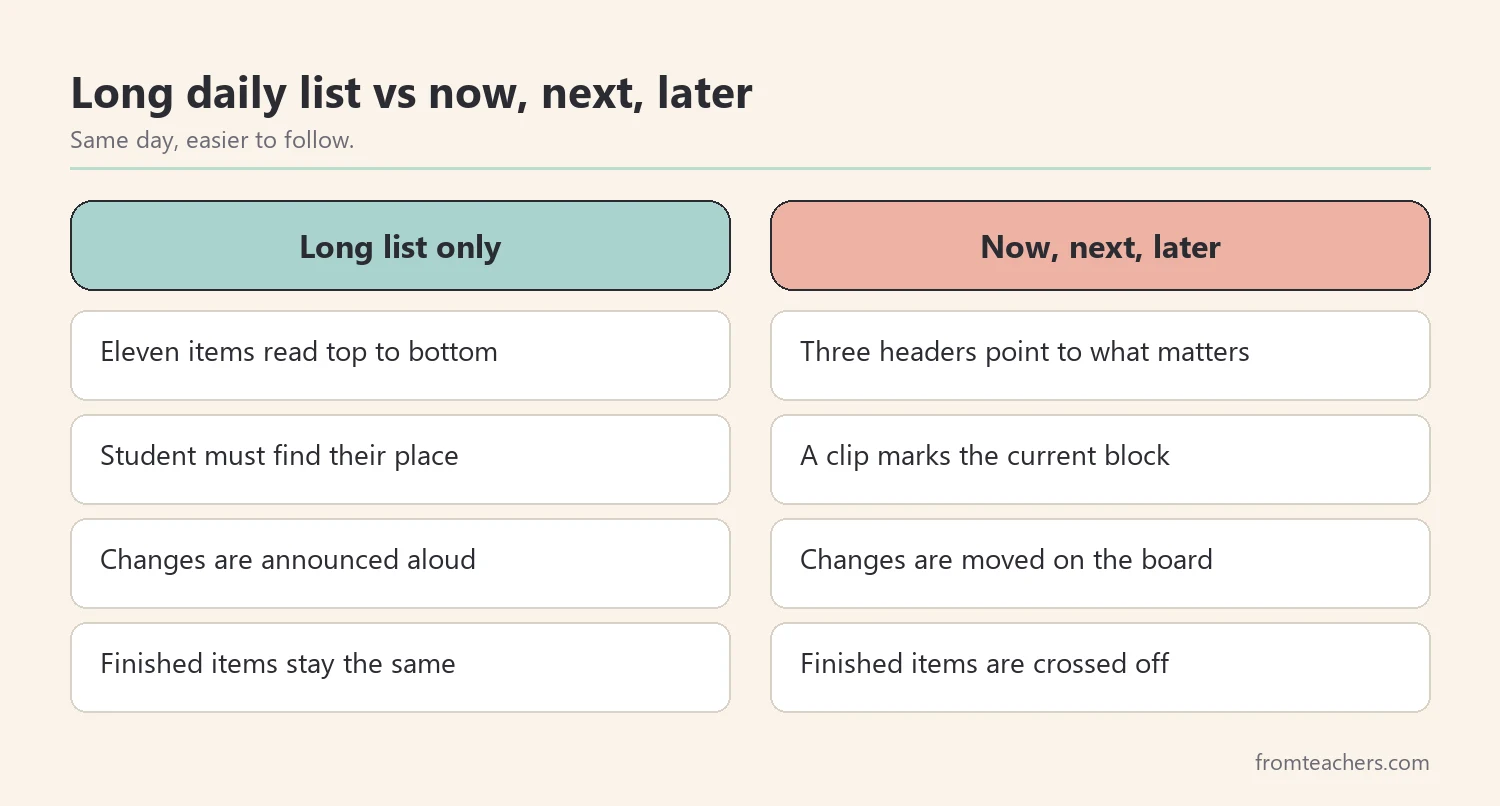
Next, place the schedule in the same accessible spot every day. Eye level near the student’s seat or by the classroom door works well. Students should be able to walk up and check it without asking.
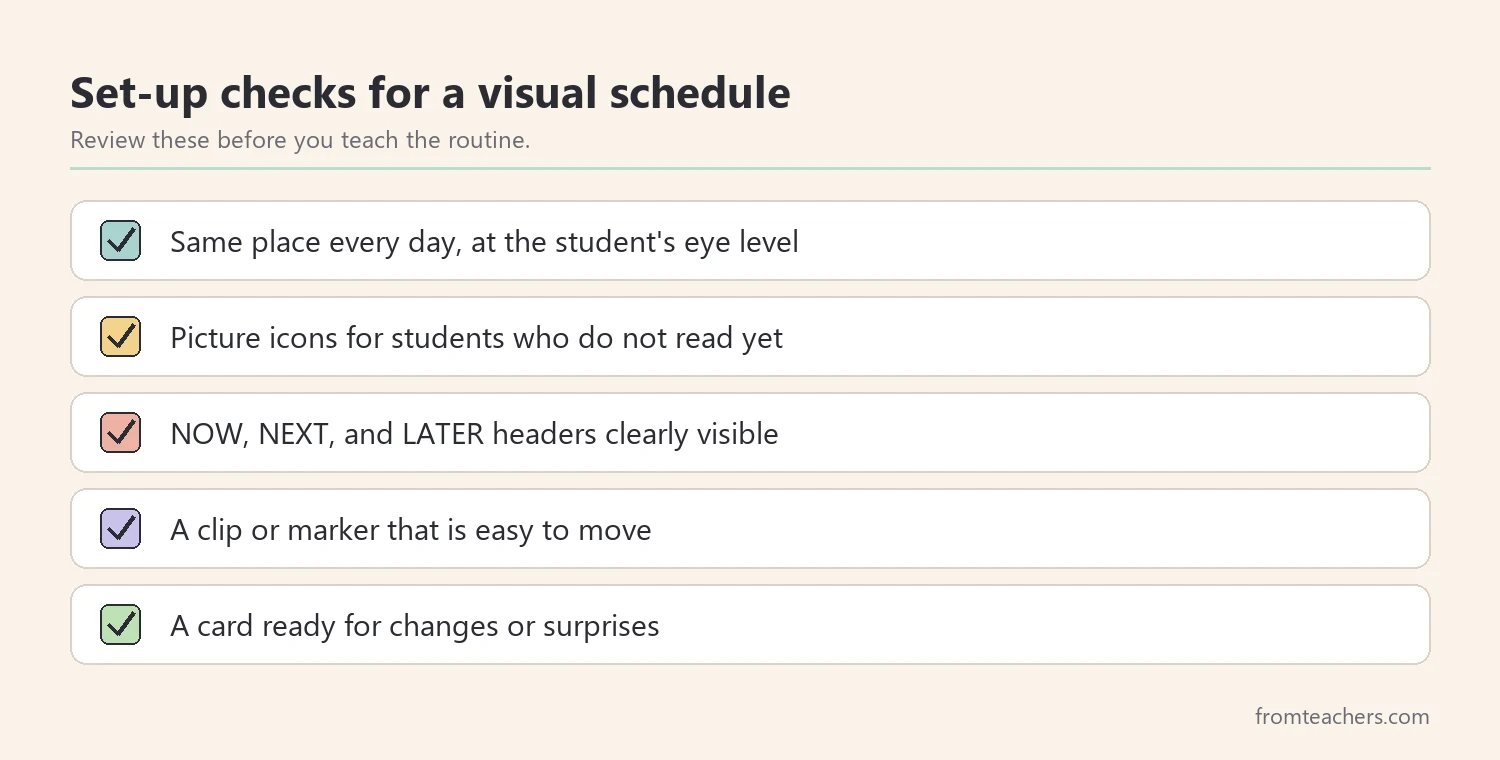
Think about size and contrast, too. Pictures should be large enough to see from the student’s seat, with plenty of space between blocks. Busy backgrounds and tiny text make the schedule harder to read, especially for students with visual or attention needs.
Then, choose how students will mark the current block. A clothespin, a large paper clip, or a movable arrow works. Some teachers use removable cards instead, taking each card down as the block ends.
A ready-made poster saves a lot of preparation time. The Visual Schedule for Students poster with Now, Next, and Later headers includes eleven illustrated routine blocks and short tips for using it, so you can print it and start teaching the routine the same week.
Worked example. Ava’s teacher hangs the schedule at eye level next to Ava’s table. A bright clothespin marks the current block, and Ava’s personal copy sits in a sleeve on her desk.
3. Teach the marker routine at every transition
A schedule only helps if students use it. Therefore, teach a short routine for every transition: finish the current block, cross off or remove it, move the clip to the new now block, look at what comes next, then go.
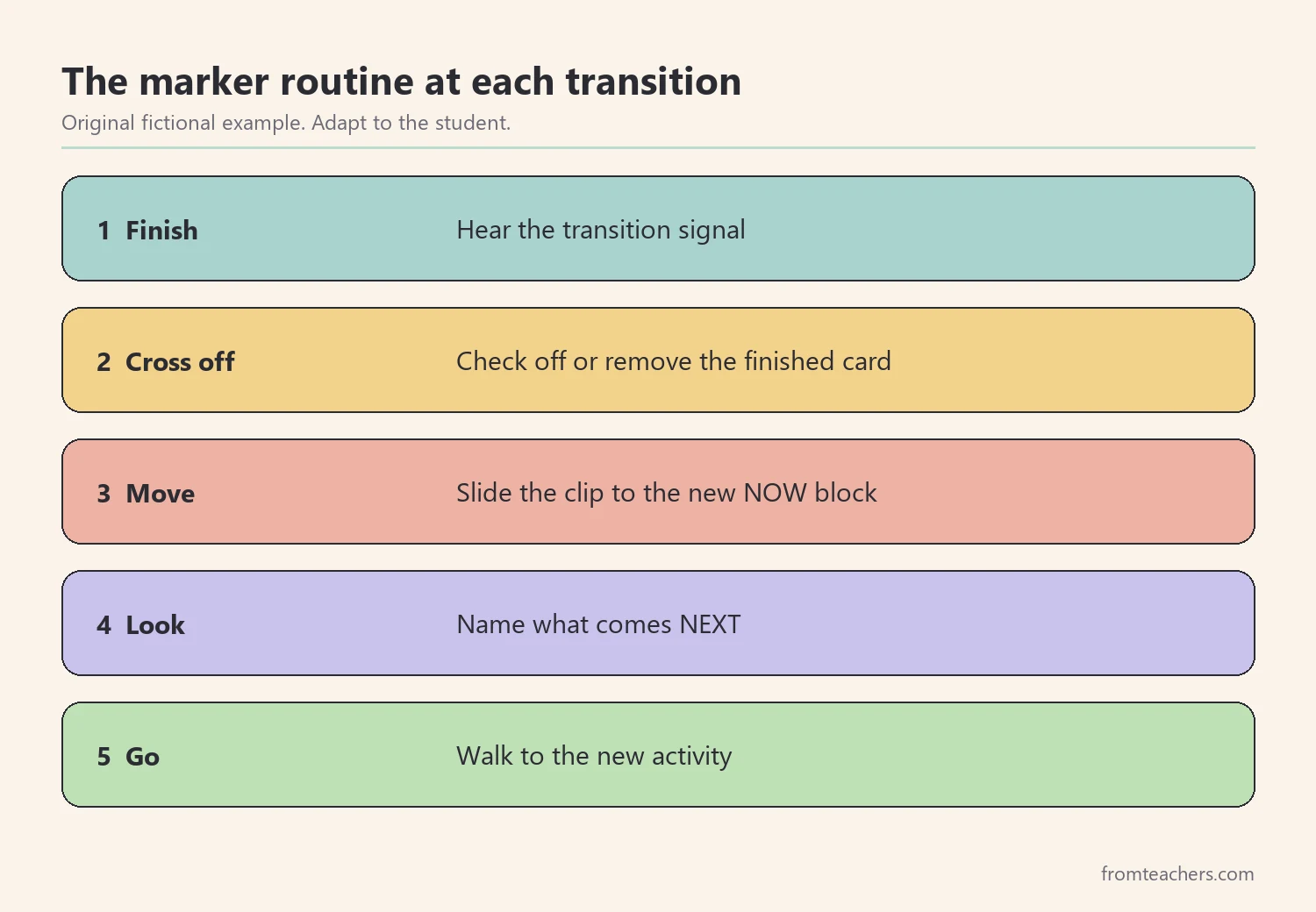
Model the routine several times. Say it out loud: “Morning meeting is finished. I cross it off. The clip moves to learning block 1. Next is the movement break.” Then, let the student do it with you, and finally on their own.
Crossing off finished blocks is powerful. Students can see how much of the day is done and how much is left. A checkmark or removing the card both work; choose what is easiest for the student.
Give the student a job in the routine whenever possible. Some students love being the class schedule helper who moves the clip for everyone. Ownership turns the schedule from something adults use into something the student relies on.
In addition, use a consistent transition signal, such as a chime or a short song. The signal tells the student it is time to check the schedule. Over time, the signal alone may be enough.
Use the now next later schedule at the start of the day, too. Spend one minute previewing the whole day together. Point to each block and name it, then return to now. This preview helps students build a mental map of what is coming.
Worked example. At each chime, Ava walks to the schedule with an adult, crosses off the finished block, and moves the clothespin. She says the next block out loud. After a week, she starts walking over on her own.
4. Plan for changes and tricky transitions
Changes will happen: an assembly, a fire drill, a substitute, or indoor recess. For many students, an unexpected change is harder than any lesson. So, plan for change instead of hoping it will not happen.
First, create a change card. It can show a simple symbol, such as a star or a question mark, with the words “Something different.” Place it on the schedule when a change is coming and explain it calmly.
Next, show the change on the board as early as possible. Move the new activity into place and remove or shift the one it replaces. Seeing the change helps more than hearing about it once in a busy room.
| Type of change | What to do on the schedule |
|---|---|
| Planned event, such as an assembly | Add the event card in the morning preview |
| Substitute teacher | Add a photo or name card, keep blocks the same |
| Indoor recess | Swap the recess icon, keep the time in place |
| Surprise event | Place the change card and talk it through |
Then, look closely at the hardest transitions. For many students, these are leaving a preferred activity, like recess, or starting a demanding one. Add a short warning before these moments, such as “Two more minutes, then the clip moves.”
Practice changes on purpose when things are calm. For example, once a week, swap two small activities and use the change card even though nothing big is happening. Low-stakes practice teaches the student that a change card means “the plan moved,” not “something bad is coming.” When a real surprise arrives, the routine for handling it is already familiar.
Also, pair hard transitions with something predictable. For example, a student might carry a small object to the next activity or know exactly where to sit. Small anchors make transitions feel safer. Over time, many students need these anchors less as the routine itself becomes the thing they trust.
Worked example. On assembly day, Ava’s teacher places the change card during the morning preview. She moves the assembly card into the afternoon and talks it through with Ava. Ava checks the board twice before lunch and transitions calmly.
5. Track transitions and adjust the now next later schedule
Finally, keep a short record. Count the number of transitions in a day, how many went smoothly, and how many adult prompts the student needed to check the schedule. A weekly daily average gives a clear picture.
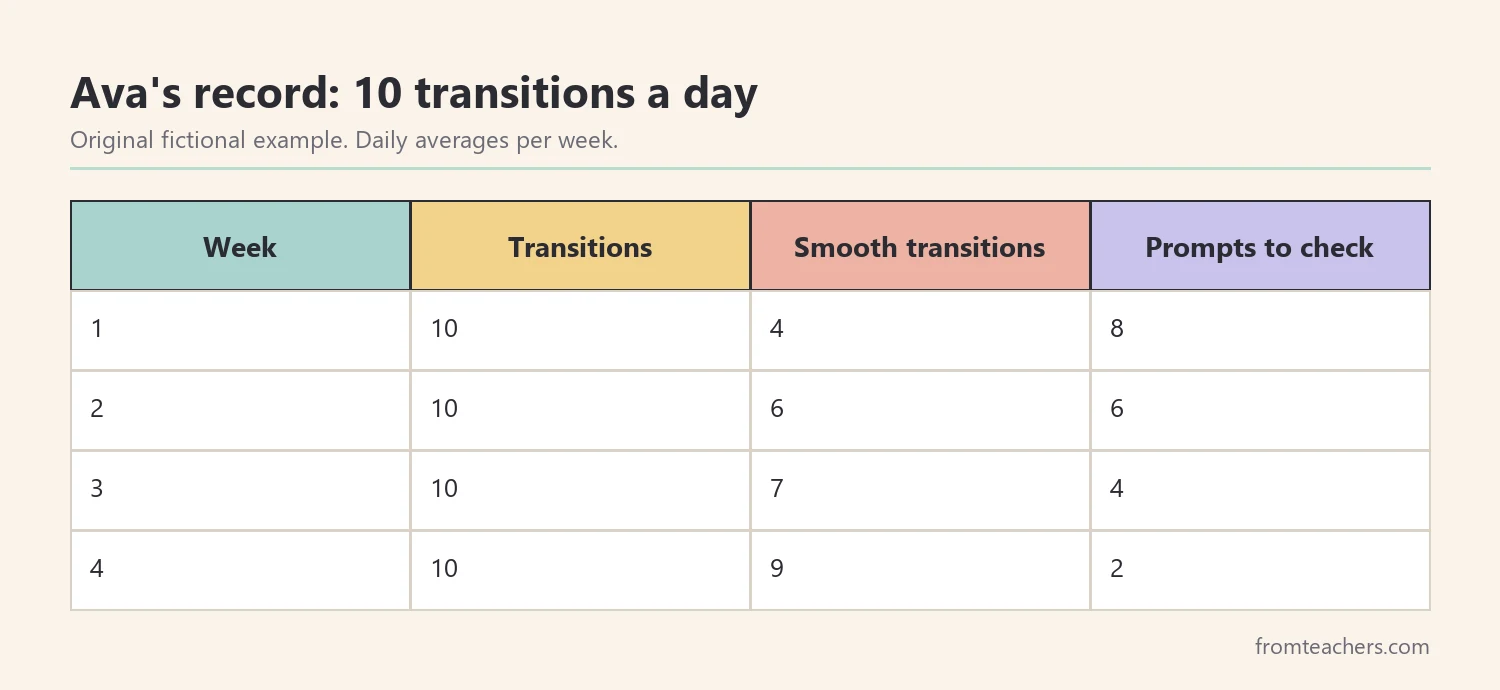
In this example, Ava’s day has 10 transitions between 11 blocks. Her smooth transitions rose from 4 of 10 in week one to 9 of 10 in week four. Meanwhile, adult prompts dropped from 8 to 2 a day.
Notes alongside the numbers make the record more useful. Write down which transitions were hardest and what was happening, such as a loud hallway or a favorite activity ending. Over a few weeks, these notes often point to one or two moments that need extra support.
Use the data to adjust. If one transition stays hard, look at it closely and add one support. If the student checks the schedule independently, start fading prompts. Some students later move from a picture schedule to a written one or a planner.
Share the schedule and the record with the family. Some families make a simple version for weekends or the morning routine at home. In addition, share it with specialists and substitutes so the routine stays the same with every adult.
Worked example. After four weeks, Ava checks the schedule on her own at most transitions. Her team keeps the change card and the two-minute warning for recess, and plans to review again in a month.
Common mistakes and how to avoid them
- Posting the schedule but never teaching it. Fix: model the marker routine at every transition until it is automatic.
- Moving the schedule around the room. Fix: keep it in the same accessible place every day.
- Using words only for nonreaders. Fix: add a clear picture icon to every block.
- Announcing changes only aloud. Fix: show changes on the board with a change card.
- Removing the schedule once things go well. Fix: fade prompts, not the schedule itself.
Questions teachers and parents ask about a now next later schedule
Who benefits from a visual schedule?
Many students do, including autistic students, students with ADHD, students learning English, and young children. A predictable schedule can support any learner who finds transitions or time hard to manage. It also helps the whole class.
Should I use a whole-class or individual schedule?
Often both. A large class schedule supports everyone, while a small personal copy helps students who need to check more often. Keep the pictures and order the same on both.
What is the difference from a first-then board?
A first-then board shows two steps, often a task and a reward. Now, next, and later adds a third view of the rest of the day. Some students start with first-then and move to the larger schedule.
How long until a student uses it alone?
It depends on the student. Many students learn the routine in a few weeks with daily practice. Track prompts so you can see the change and fade support at the right time.
Can families use this at home?
Yes. A home version with morning, after-school, and bedtime blocks works the same way. Use similar pictures so the student recognizes the system.
Related reading: Autism spectrum disorder guide, Managing sensory overload in autism and ADHD, and Special education strategies guide.
A companion resource for a now next later schedule:
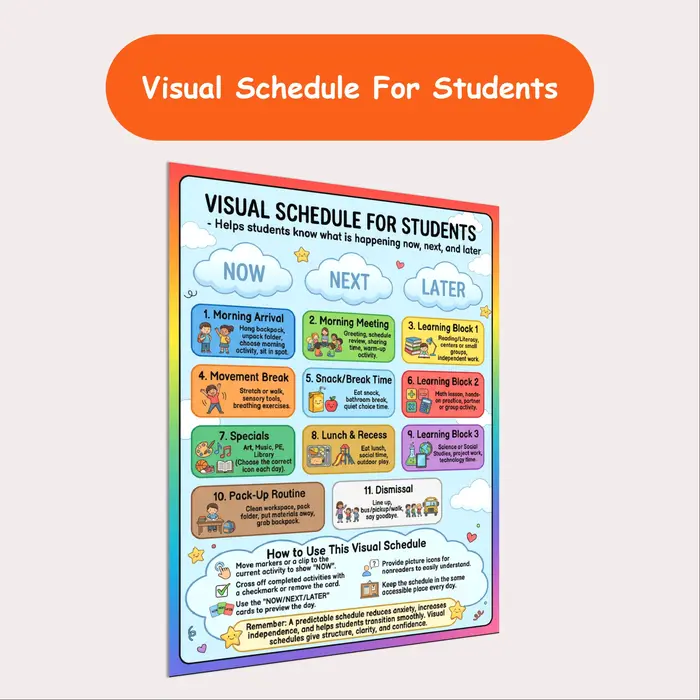
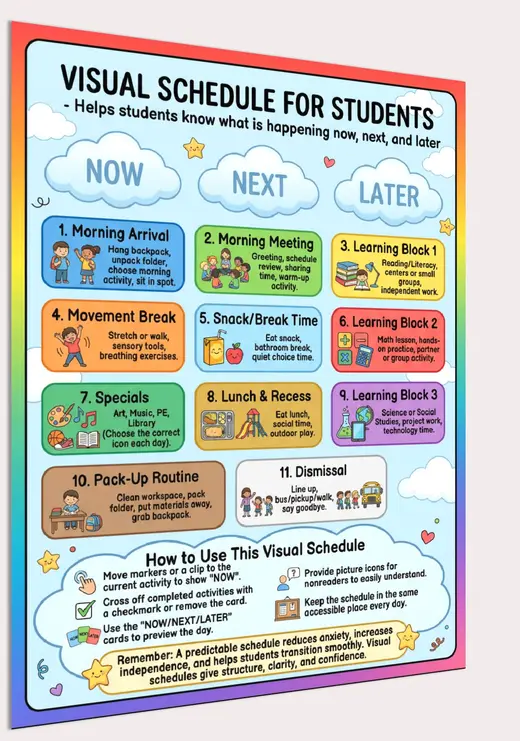
Visual Schedule for Students Poster: a printable daily routine poster with Now, Next, and Later headers and 11 illustrated routine blocks, plus tips for using it. Practical for autism support, special education, and general education classrooms.
Sources and scope
- IRIS Center, Vanderbilt University: free modules on evidence-based practices for autistic students, including visual supports.
- AFIRM, UNC Frank Porter Graham Institute: free learning modules on evidence-based practices for autistic learners.
- Understood.org: practical articles for families and teachers on routines and transitions.
- IDEA, U.S. Department of Education: the law behind special education services and IEPs.
This guide covers everyday classroom and home use of visual schedules. It does not cover diagnosis or formal behavior assessment, which belong to qualified professionals and the student’s team.
Key takeaways
- A now next later schedule makes the day visible and predictable.
- Map the day into stable blocks with clear pictures.
- Teach the marker routine at every transition.
- Show changes on the board with a change card.
- Track smooth transitions and fade prompts, not the schedule.








Leave a Comment