

Task avoidance in students is rarely about laziness, even when it looks that way from the front of the room. Picture a sixth grader who sharpens his pencil three times, asks for water, reorganizes his folder, and then says he “forgot” what the assignment was. Twenty minutes later, the page is still blank, and everyone around him is frustrated.
This guide walks you through five steps: notice the pattern, find the root cause, match a strategy, shrink the first step, and review progress without blame. By the end, you will be able to read avoidance as information and respond with a plan instead of a lecture.
Examples are fictional. Adapt to the student’s goals and agreed supports. This is guidance, not a diagnosis.
At a glance
- Avoidance is a signal that something about the task feels hard, unclear, or overwhelming.
- Different root causes need different strategies, so diagnose before you respond.
- A small, visible first step often does more than a long talk about effort.
- Calm, judgment-free language keeps students willing to try again.
- A short weekly record shows what is working and what to change.
1. Notice the pattern of task avoidance in students
First, watch before you react. Task avoidance in students often follows a pattern: it shows up with certain subjects, certain times of day, or certain kinds of work. A student may start math worksheets easily and still stall on every open writing prompt. That difference is useful evidence.
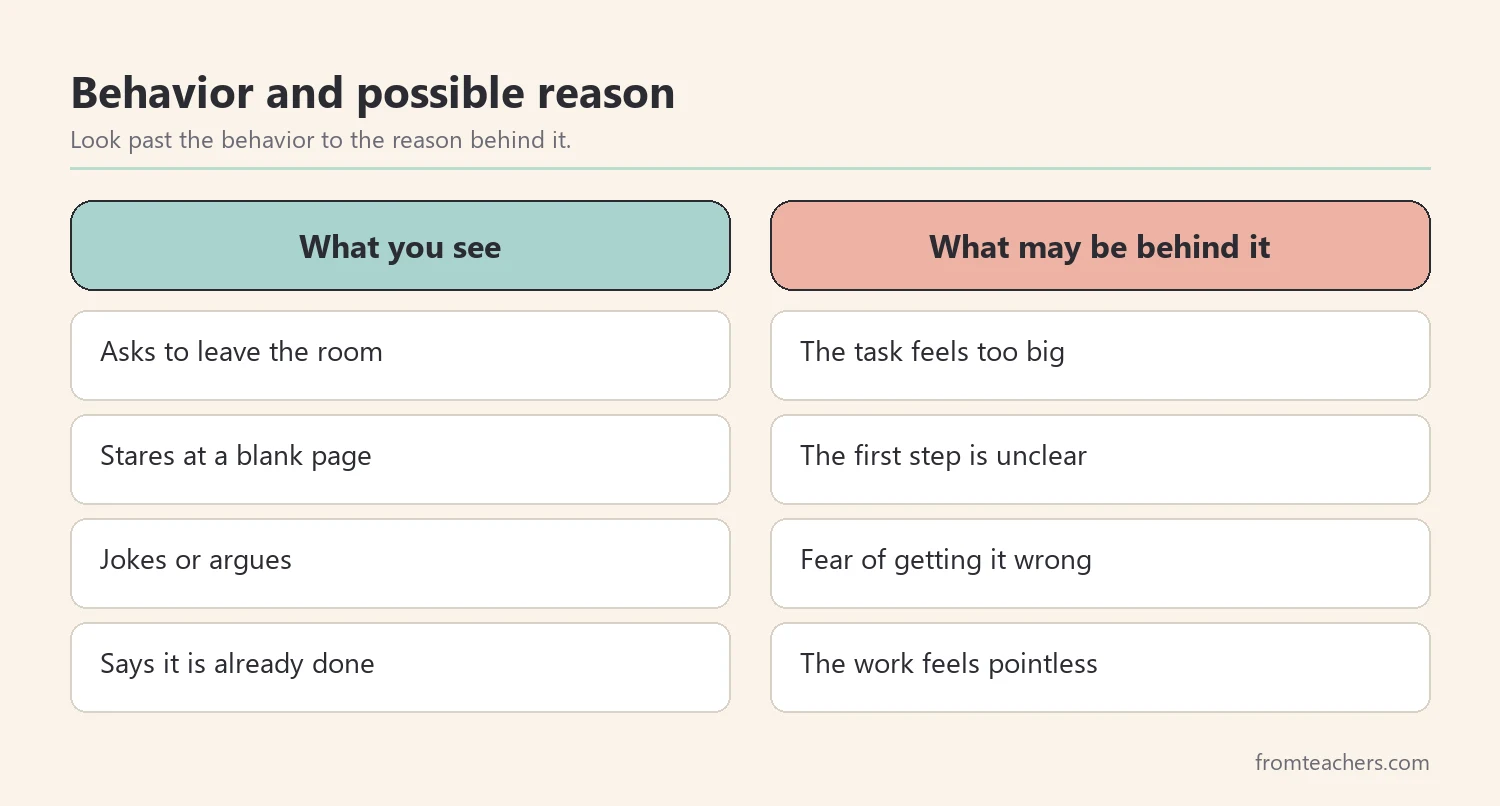
Next, list the behaviors you actually see. Common examples include asking to leave the room, chatting, doodling, saying “I’ll do it later,” starting and restarting, or claiming the work is already done. Some students avoid quietly, by staring at the page. Others avoid loudly, by joking or arguing. Both are forms of delay.
Also, note what happens right before the avoidance starts, because task avoidance in students usually has a trigger. Ask yourself: was the task long, unfamiliar, or handed out with spoken directions only? Was the student tired, hungry, or coming back from a difficult break? These details point toward the cause, which you will explore in step 2.
Write down what happens next
In addition, write down what happens right after. If avoidance leads to the task being removed, shortened, or done by an adult, the student learns that delay works. That is not a moral failing. It is simply how habits form, and it tells you what to change.
Then keep your notes on task avoidance in students short and factual. “Asked for the restroom twice in the first five minutes of writing” is more useful than “did not want to work.” Factual notes help you spot task avoidance in students without labeling them, and they make conversations with families calmer.
Worked example. Leo is a fictional student in grade 6. His teacher, Ms. Ortiz, notices that he starts math right away but delays every writing task. Over one week, she records five writing lessons. In four of them, Leo leaves his seat or chats within the first five minutes. In the fifth, a short fill-in task, he starts right away.
2. Find the root cause behind the delay
Next, ask why. Task avoidance in students usually has a reason the student cannot name in the moment. Some common root causes are: the task feels too big, the first step is unclear, the student fears getting it wrong, the work feels boring or pointless, or the student is already tired or overloaded.
Also, talk with the student at a calm moment, not during the stall. Ask open, curious questions: “What part of this feels hardest?” or “When you look at this page, what do you think first?” Many students will say “I don’t know.” That is fine. Offer two or three options and let them point to the closest one.
Meanwhile, look at the task itself. Long directions, dense pages, and unclear success criteria can make any student freeze. Task avoidance in students with attention, learning, or executive function differences is often stronger, because planning and starting take more effort for them.
Check for skill gaps
In addition, check skills. Sometimes avoidance protects a student from a skill gap. A student who cannot yet organize a paragraph may look unmotivated when the real issue is that they do not know how to begin. In that case, teaching the skill matters more than any motivation strategy.
Finally, choose one main cause to test first. You can always adjust later. Naming a likely cause turns task avoidance in students from a vague frustration into a problem you can work on together.
Worked example. In a short chat, Ms. Ortiz shows Leo four cards: “too big,” “don’t know how to start,” “afraid it will be wrong,” and “boring.” Leo points to “too big” and then to “don’t know how to start.” His teacher also notices that writing prompts are given as a single long paragraph of directions.
3. Match a strategy to the root cause of task avoidance in students
Once you have a likely cause, choose a matching strategy. This is the heart of the process, because one general strategy rarely fits every case of task avoidance in students. A student who fears mistakes needs something different from a student who is simply overwhelmed by length.
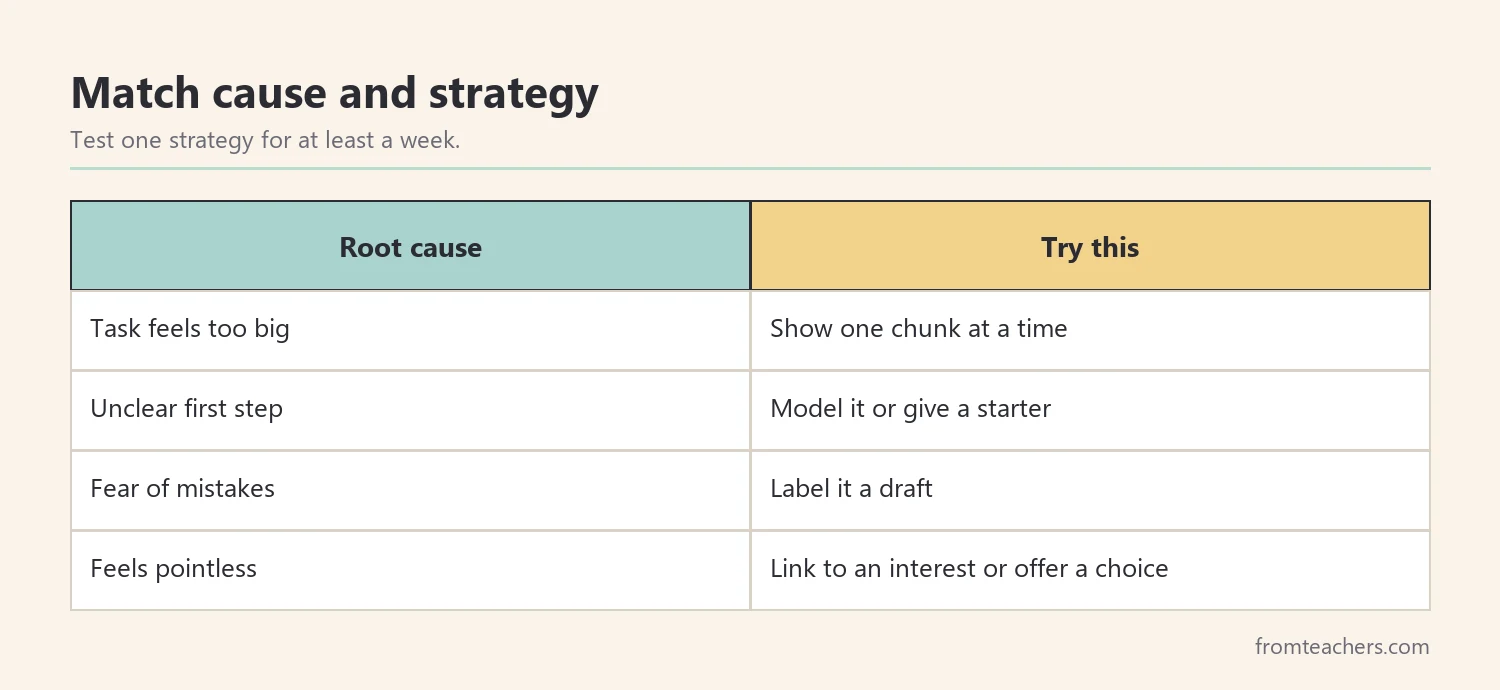
For example, if the task feels too big, break it into chunks and show only one chunk at a time. If the first step is unclear, model it or provide a sentence starter. When the student fears being wrong, lower the stakes with a draft label, a practice round, or permission to make one mistake on purpose. If the task feels pointless, connect it to something the student cares about or offer a small choice.
Teach students to match strategies
Also, teach students to do this matching themselves over time. Older students can learn to ask, “Why am I stuck right now?” and then pick a strategy from a short list. The task avoidance and executive dysfunction strategy tables are designed for this, with 12 tables that pair common situations with practical responses and help students move forward without self-judgment.
Meanwhile, keep the language kind. Phrases like “Let’s find the first small piece” or “This part is tricky for lots of people” lower stress. In contrast, “You just need to try harder” adds shame and usually increases delay.
Then test one strategy for at least a week. Changing strategies every day makes it hard to know what helped. Consistency gives you real information about task avoidance in students and gives the student a predictable routine.
Worked example. Because Leo chose “too big” and “don’t know how to start,” Ms. Ortiz picks two linked strategies. She splits each writing task into three short parts and gives him a sentence starter for the first part. The directions are now written as a numbered list instead of one paragraph.
4. Make the first step small and visible
Next, focus on starting. For many students, starting is the hardest moment. Once they begin, momentum often carries them further. So, make the first step so small that it feels almost silly to avoid it.
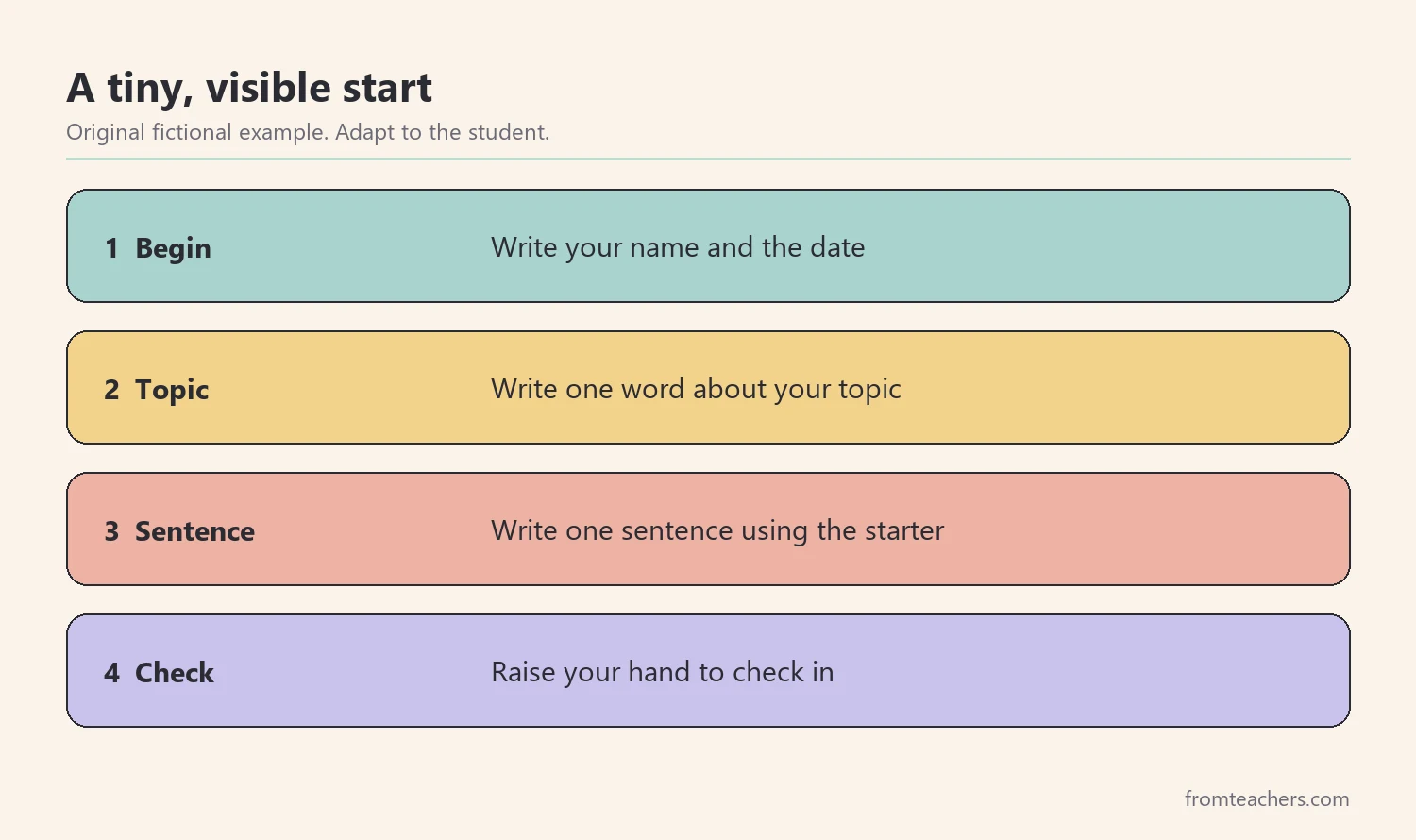
For example, the first step might be “Write your name and the date,” “Write one word about your topic,” or “Read the first question out loud.” A tiny first step lowers the activation barrier. It also gives the student an early win, which builds confidence for the next piece.
Also, make the steps visible, since task avoidance in students drops when the finish line is clear. A short checklist on a sticky note, a numbered list on the board, or a strip of paper with three boxes to tick all help. When students can see the end of the task, it feels less endless.
Use a short timer
In addition, use a short timer when it helps. “Work for five minutes, then check in with me” is easier to accept than “Finish the whole page.” Some students like to stop when the timer rings, and many choose to keep going. Either way, they practiced starting, which is the core skill behind reducing task avoidance in students.
Meanwhile, plan a quick check-in. A brief “Show me your first line” after a few minutes catches students before they drift. Keep it light and positive, and focus on what they did, not on what is missing.
Worked example. Leo’s sticky note reads: “1. Name and date. 2. One word about your topic. 3. One sentence using the starter. 4. Raise your hand to check in.” Ms. Ortiz sets a five-minute timer. On the first day, Leo finishes all four steps and writes two more sentences after the check-in.
5. Review progress without judgment
Finally, review what is happening. A simple weekly record keeps you honest and shows small gains that are easy to miss. Track two things: how quickly the student starts, and how much of the task they finish. You do not need precise data, just a consistent note.
Also, review with the student. Ask, “Which strategy helped this week?” and “What still feels hard?” This builds self-awareness, which is the long-term goal. Over time, students who understand their own patterns of task avoidance can choose strategies without adult prompts.
Next, adjust when needed. Task avoidance in students can change from month to month. If a strategy is not helping after a fair trial, go back to step 2 and check the root cause again. The cause may have changed, or there may be more than one. That is normal, and it is part of good problem-solving around task avoidance in students.
In addition, share progress with families in plain words. “Leo now starts writing within five minutes on most days” is clear and encouraging. Families can then use the same small-first-step language at home with homework.
Then, fade support slowly. Once the student starts reliably, let them write their own sticky note or choose their own first step. The aim is independence, not permanent prompting.
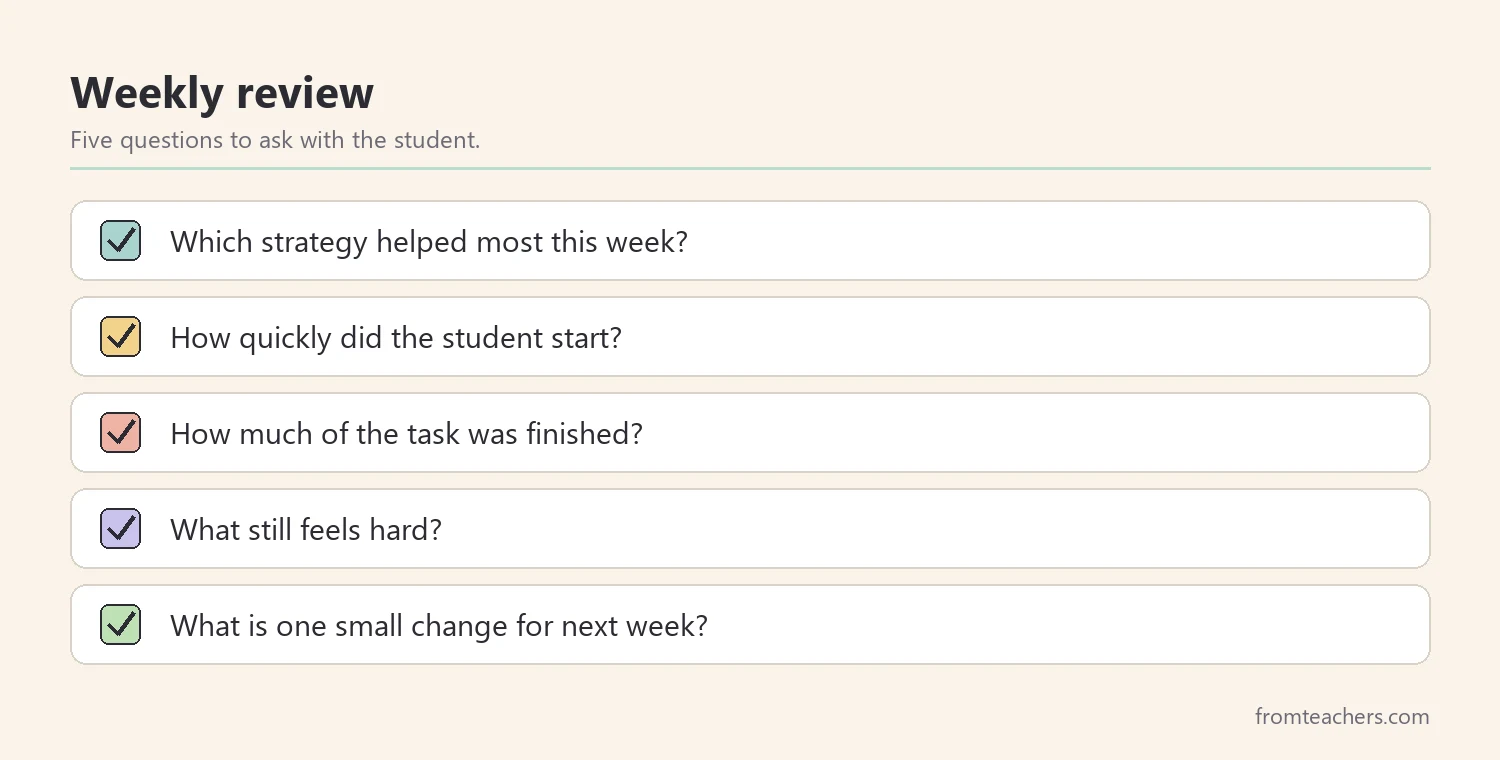
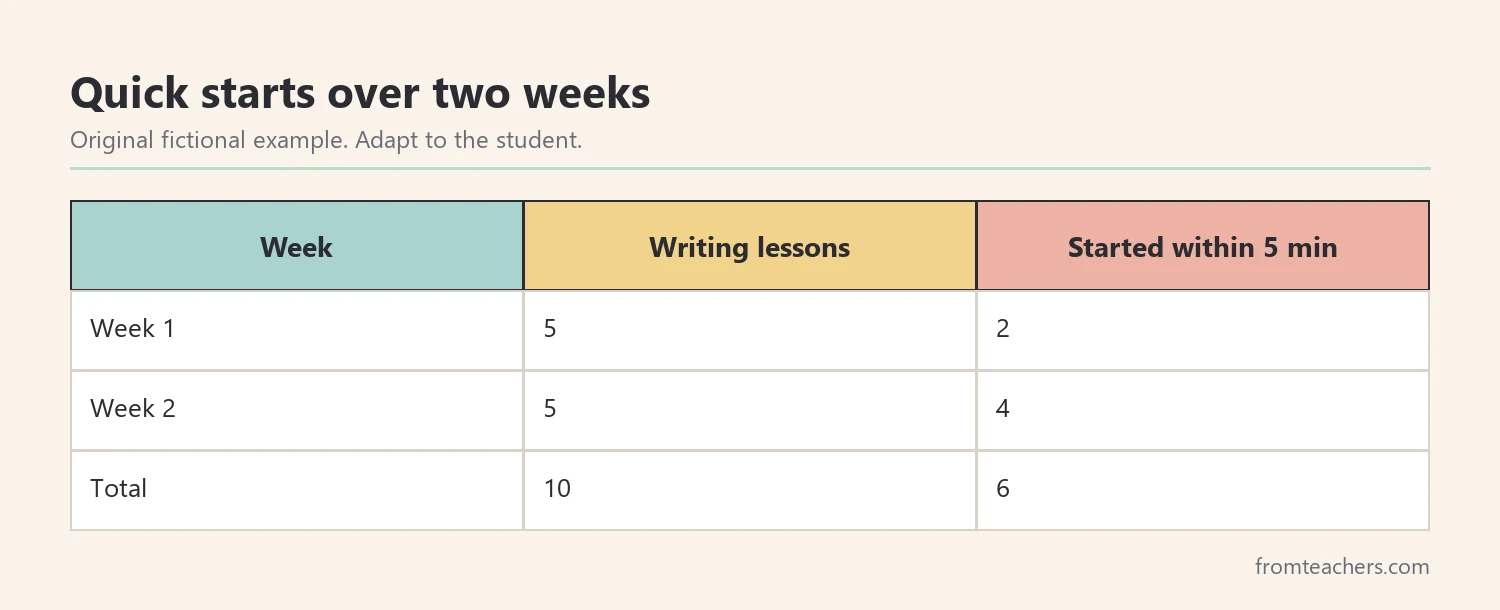
Worked example. Over two weeks, Ms. Ortiz records ten writing lessons. In week 1, before the new plan was fully in place, Leo started within five minutes in 2 of 5 lessons. In week 2, with the chunked task and sticky note, he started within five minutes in 4 of 5 lessons. Across both weeks, that is 6 quick starts out of 10 lessons. Leo says the sentence starter helps most.
When avoidance seems bigger than one task
Sometimes, avoidance spreads across many subjects or comes with strong distress, such as tears, stomachaches, or refusal to come to school. In those cases, task avoidance in students may be linked to anxiety, learning needs, or other concerns that need a wider team.
So, share your notes with the student’s support team and family. Ask whether an evaluation, a school counselor, or a change to the student’s plan might help. Your careful observations are valuable evidence for that conversation.
Also, keep the classroom strategies going while the team looks deeper. Small, kind, predictable routines help almost every student feel safer about trying.
Common mistakes and how to avoid them
- Calling it laziness. The label adds shame and hides the real cause. Fix: describe the behavior and look for the reason.
- Using one strategy for everything. A fear of mistakes and an overwhelming task need different help. Fix: match the strategy to the root cause.
- Making the first step too big. “Start your essay” is not a first step. Fix: make it tiny and concrete.
- Removing the task every time. The student learns that delay works. Fix: shrink the task instead of removing it.
- Changing plans daily. You cannot tell what helped. Fix: test one strategy for at least a week.
- Skipping the student’s view. Adults guess wrong more often than they think. Fix: ask calm, curious questions.
Questions teachers and parents ask about task avoidance in students
Is task avoidance the same as procrastination?
They overlap. Procrastination usually means delaying a task until later, while avoidance can also include escaping the task completely. In both cases, the useful question is the same: what makes this task feel hard to start?
Does task avoidance mean a student has ADHD?
No. Many students avoid tasks for many reasons. Avoidance can be more common for students with attention or executive function differences, but only qualified professionals can make a diagnosis. Your role is to observe and support.
Should I give rewards for starting?
Brief praise or a small agreed reward can help some students build a habit. Still, rewards work best alongside a strategy that removes the real barrier. Without that, the reward may not be enough.
How can parents help with homework avoidance?
Parents can use the same steps: notice the pattern, ask what feels hard, and make the first step tiny. A short timer and a visible checklist often work well at the kitchen table, too.
How long before I see a change?
It varies. Some students respond within days to a clearer first step. Others need several weeks of consistent routines. A simple weekly record helps you see small gains that might otherwise be missed.
Related reading: ADHD in Children: A Guide to Effective Classroom and Home Support, Understanding Demand Avoidance and School Refusal: Strategies for PDA-Style Profiles, and 5 Practical Teaching Tips to Boost Classroom Focus and Learning.
A companion resource for task avoidance in students:
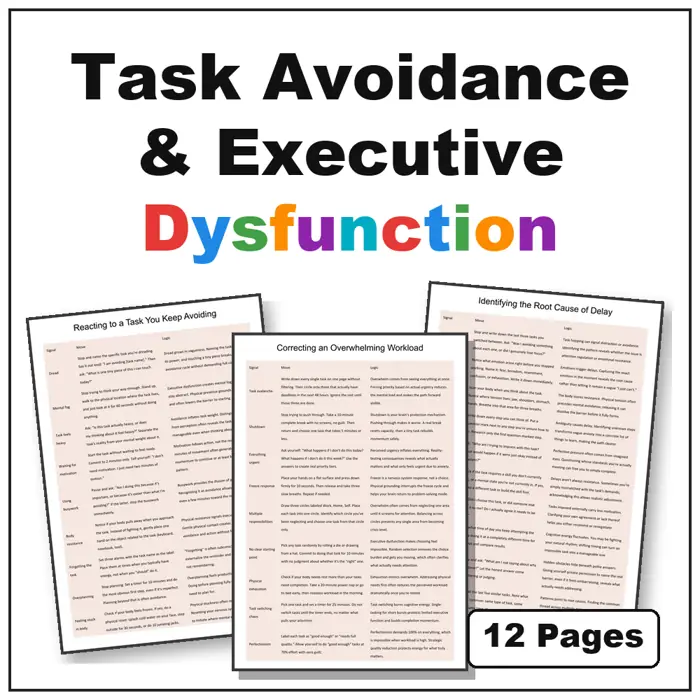
Task Avoidance & Executive Dysfunction: Strategies for Getting Unstuck: 12 strategy tables that help students recognize why they avoid a task, match a strategy to the root issue, and move forward without self-judgment.
Sources and scope
- IRIS Center, Vanderbilt University: free modules on behavior, instruction, and classroom supports.
- CHADD: a national organization with information on ADHD and executive function for families and educators.
- Understood.org: family-friendly information on learning and thinking differences.
- Child Mind Institute: articles for parents and teachers on children’s mental health and learning.
This guide covers practical classroom and home strategies for students who delay or avoid tasks. It does not replace evaluation, diagnosis, or the decisions of the student’s support team.
Key takeaways
- Task avoidance in students is a signal, not a character flaw.
- Reducing task avoidance in students starts with curiosity, not pressure.
- Find the likely root cause before choosing a strategy.
- Make the first step tiny, concrete, and visible.
- Review weekly with the student and adjust as needed.










Leave a Comment