

Fading positive reinforcement is the step most behavior plans forget to write down. Picture a second grader who now raises his hand almost every time, but only because a sticker arrives each time he does. The behavior looks solid, yet nobody on the team knows how to step back without losing it.
This guide shows you how to thin rewards gradually, shift from tangible rewards to natural ones, and use simple records to decide when the next step is safe. By the end, you will have a fading plan you can explain to colleagues and families in two minutes.
Examples are fictional. Adapt to the student’s goals and agreed supports. This is guidance, not a diagnosis.
At a glance
- Plan the fade on the day you start the reward, not months later.
- Wait until the behavior is steady before you thin anything.
- Change one thing at a time: how often, what kind, or who delivers it.
- Pair every reward with specific praise so praise can carry the load later.
- Let your records, not your mood, decide when to move forward or back.
1. Check that the behavior is ready for fading positive reinforcement
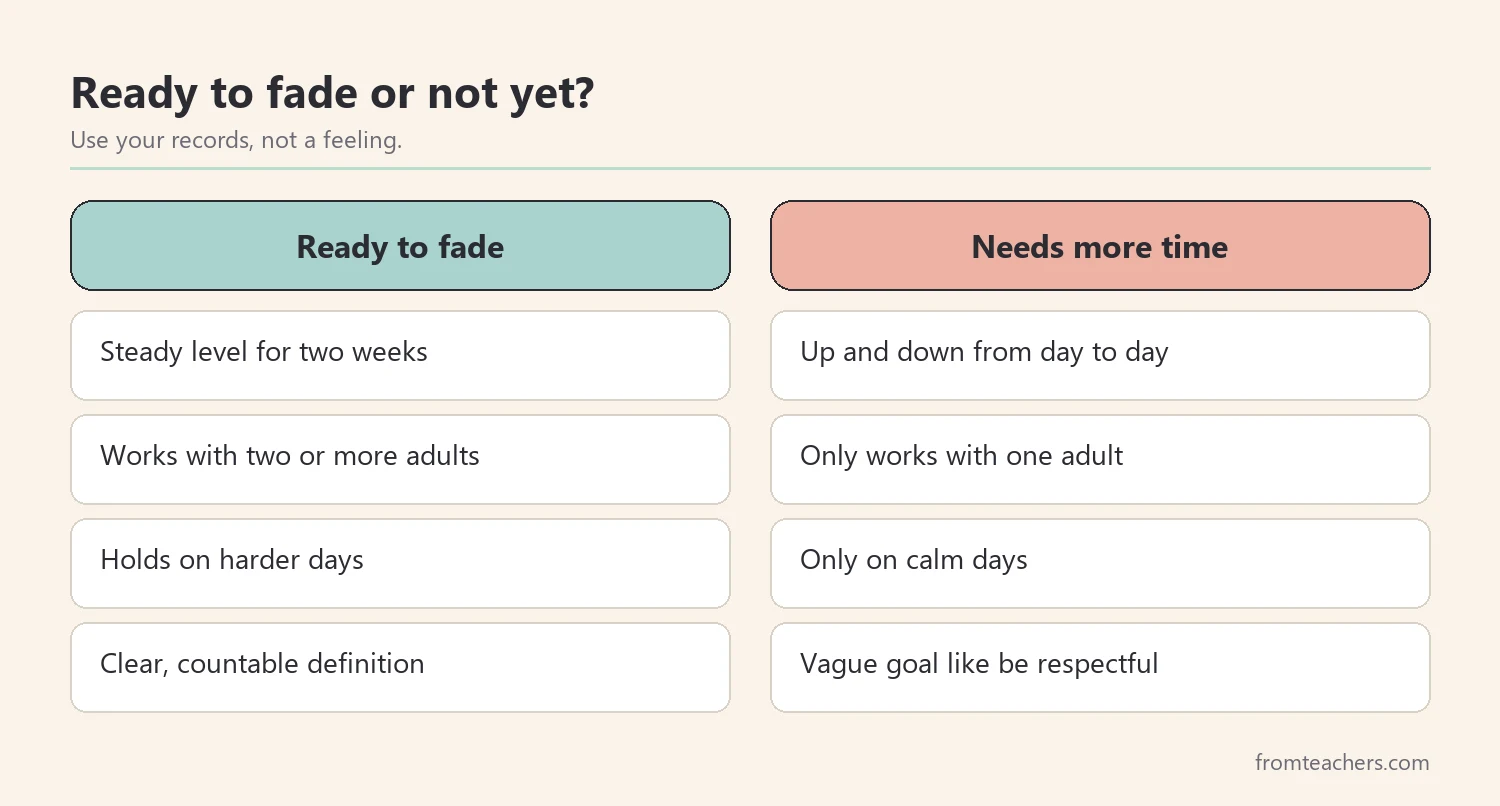
First, confirm that the new behavior is truly established. Fading positive reinforcement too early is the most common reason a skill collapses. Therefore, look for a steady run of success before you change anything.
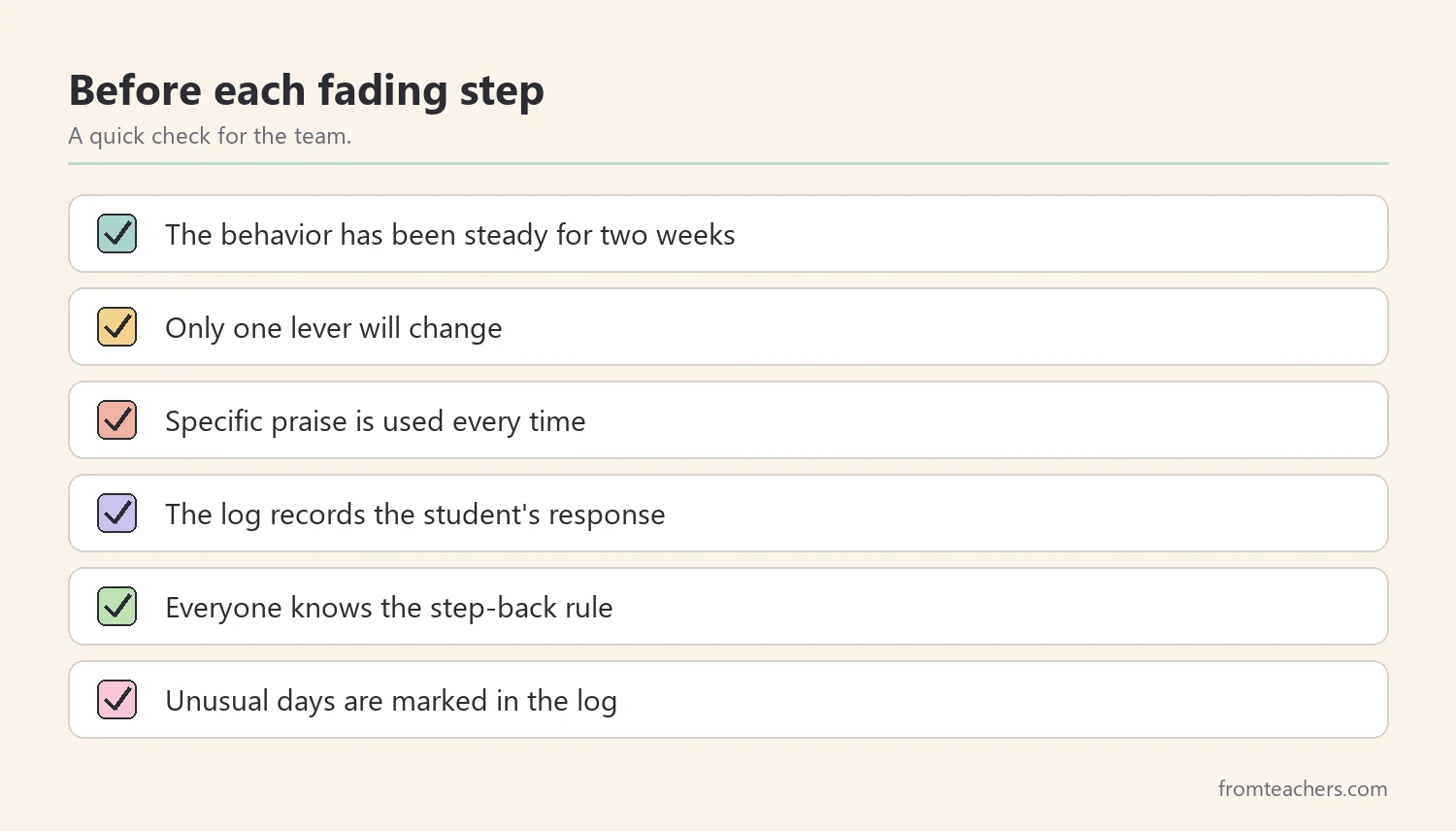
A practical readiness rule is a stable level over at least two weeks of regular records. For example, the student shows the behavior in most opportunities, across more than one adult, and on both easy and harder days. If any of these is missing, keep the current plan and keep recording.
Next, check that the behavior is clearly defined. “Leo raises his hand and waits to be called on before speaking during whole-class lessons” is something two adults can count the same way. In contrast, “Leo is respectful” cannot be faded because nobody can tell when it happened.
Leo (fictional, grade 2) earned a sticker each time he raised his hand and waited. After five weeks, his teacher, Ms. Patel, reviewed her log. He was waiting in most lessons, with two adults, on calm and busy days. As a result, the team agreed he was ready for the first small step.
Use this quick readiness check before every change:
- The behavior has a clear, observable definition.
- Records show a steady level for at least two weeks.
- Success shows up with more than one adult.
- The student can do it on a hard day, not only on good ones.
- The team agrees on what “going back a step” would look like.
2. Choose what to change first when fading positive reinforcement
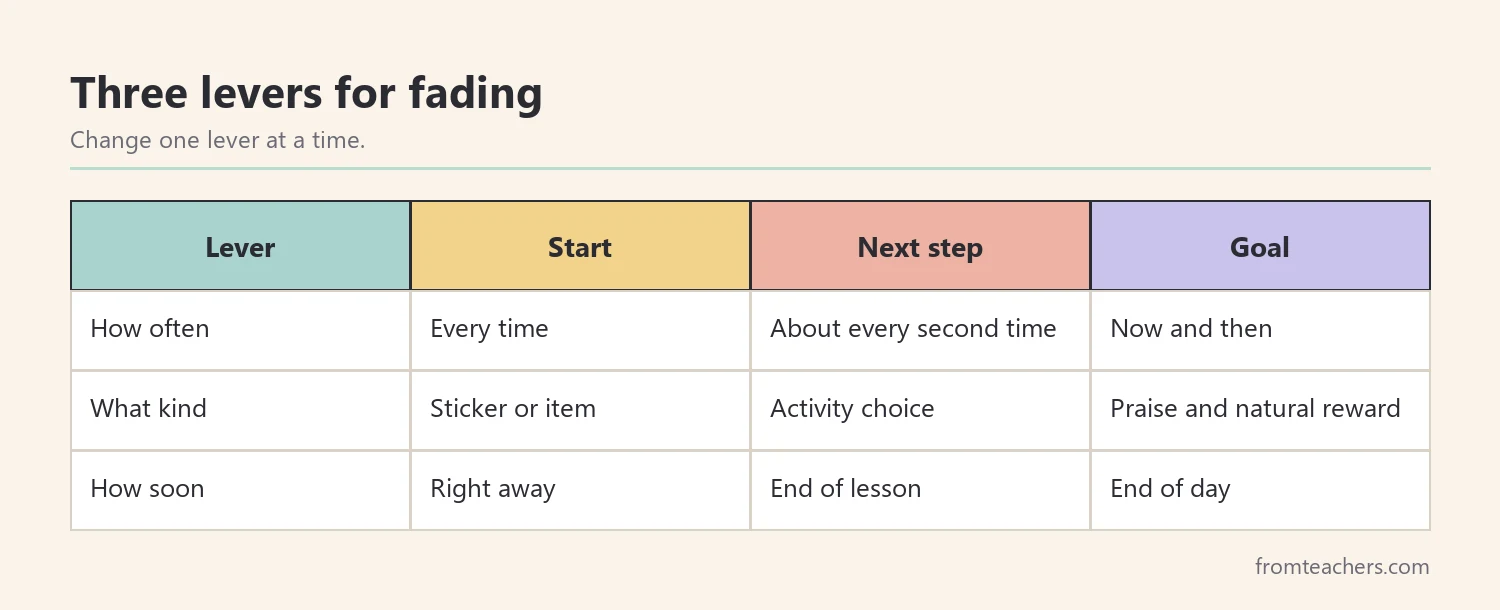
There are three main levers when you fade a reward. You can change how often it comes, what kind of reward it is, or how quickly it follows the behavior. Importantly, change only one lever at a time, so you know which change caused any dip.
The first lever is frequency. Instead of a reward every time, you move to most times, then some times. Many teams find that an unpredictable pattern holds behavior better than a fixed one, because the student keeps trying without counting.
The second lever is the type of reward. Here, you move from tangible items, such as stickers or small toys, toward activity rewards, such as choosing a game. Later, you move toward social and natural rewards, such as praise, a thumbs up, or simply being called on.
The third lever is delay. A reward that arrived right away can arrive at the end of a lesson, then at the end of the day. Similarly, a token board can replace instant rewards so the student waits a little longer for the payoff.
Ms. Patel chose frequency first for Leo. She kept the same sticker, but gave it about every second time he waited. Because only one thing changed, she could read her records clearly the following week. In short, fading positive reinforcement is a series of small, single changes, each one checked before the next.
3. Record every reinforcement while fading positive reinforcement
Next, keep a written log while you fade. Memory tends to remember the hard moments and forget the steady ones. A log shows exactly how often rewards were given and how the student responded.
A useful record has a few fixed columns: the date, the behavior you rewarded, the type of reward, how often it was given, the student’s response, and any adjustment you made. Adding the name of the adult who gave the reward helps when several staff members support the same student.
Ms. Patel used a positive reinforcement tracking sheet with columns for reward type, frequency, and student response. At the top she wrote Leo’s target behavior and the rewards he had chosen. Then, during each lesson, she added a short line whenever she rewarded the behavior.
In addition, the “student’s response” column turned out to be the most useful one. When Leo looked at the sticker chart and smiled, she noted it. When he shrugged at a sticker but grinned at being chosen as line leader, she noted that too. Those small details later guided the next step of fading positive reinforcement.
Also, write down adjustments the moment you make them. A note such as “moved to every second time, Oct 14” lets anyone reading the log connect a change in behavior to a change in the plan.
| Column | Example entry (fictional) |
|---|---|
| Behavior rewarded | Raised hand and waited, reading lesson |
| Type of reward | Sticker plus specific praise |
| Frequency | About every second time |
| Student response | Smiled, kept hand up next time |
4. Pair rewards with praise, then let praise lead
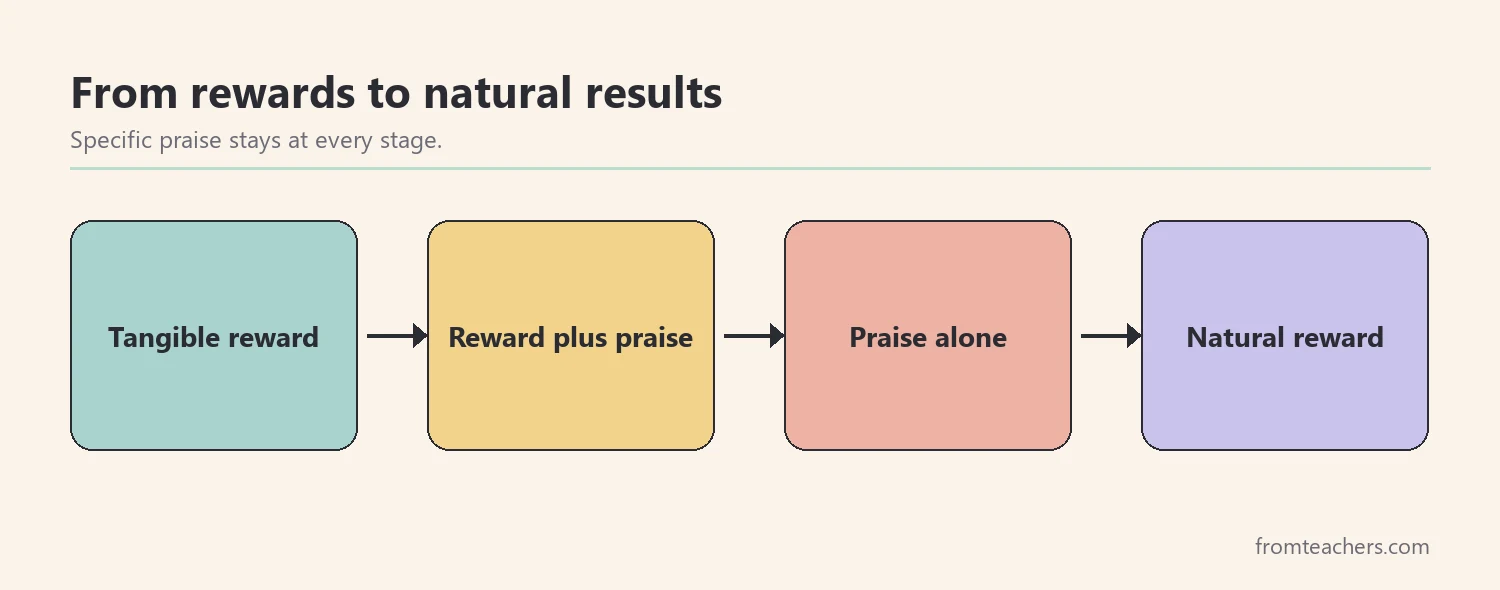
Fading positive reinforcement works best when something else is ready to take over. Specific praise is that something. Every time you deliver a tangible reward, say exactly what the student did well.
For example, “Leo, you waited with your hand up until I called you. That helped everyone hear.” Over many weeks, that sentence becomes rewarding on its own because it has been paired again and again with something the student values. As a result, the praise can stay when the sticker leaves.
Next, add natural rewards that come from the behavior itself. When a student raises a hand, being called on is a natural reward. When a student finishes work, free choice time can follow. These consequences exist in every classroom, so they do not need to be faded later.
Moreover, involve the student. Older students can track their own success on a simple card and decide how to celebrate a good week. Even young students can say which reward they would like to keep and which one they no longer care about. Their answers belong in the response column of your log.
For Leo, Ms. Patel kept the sentence of praise every single time, even on days with no sticker. Within two weeks, her log showed that Leo kept waiting whether or not a sticker arrived. That was her signal to try the next step. Without the praise already in place, fading positive reinforcement would have felt like taking something away rather than moving on.
5. Measure the fade with simple weekly numbers
Once a week, read the log and turn it into two numbers. The first number is how often the behavior happened in the opportunities you observed. The second number is how often a reward was given. Successful fading positive reinforcement shows the second number dropping while the first stays steady.
For example, Leo had about ten hand-raising chances per lesson block that Ms. Patel tracked. She wrote the number of times he waited and the number of stickers she gave. The table below shows how six weeks looked on paper.
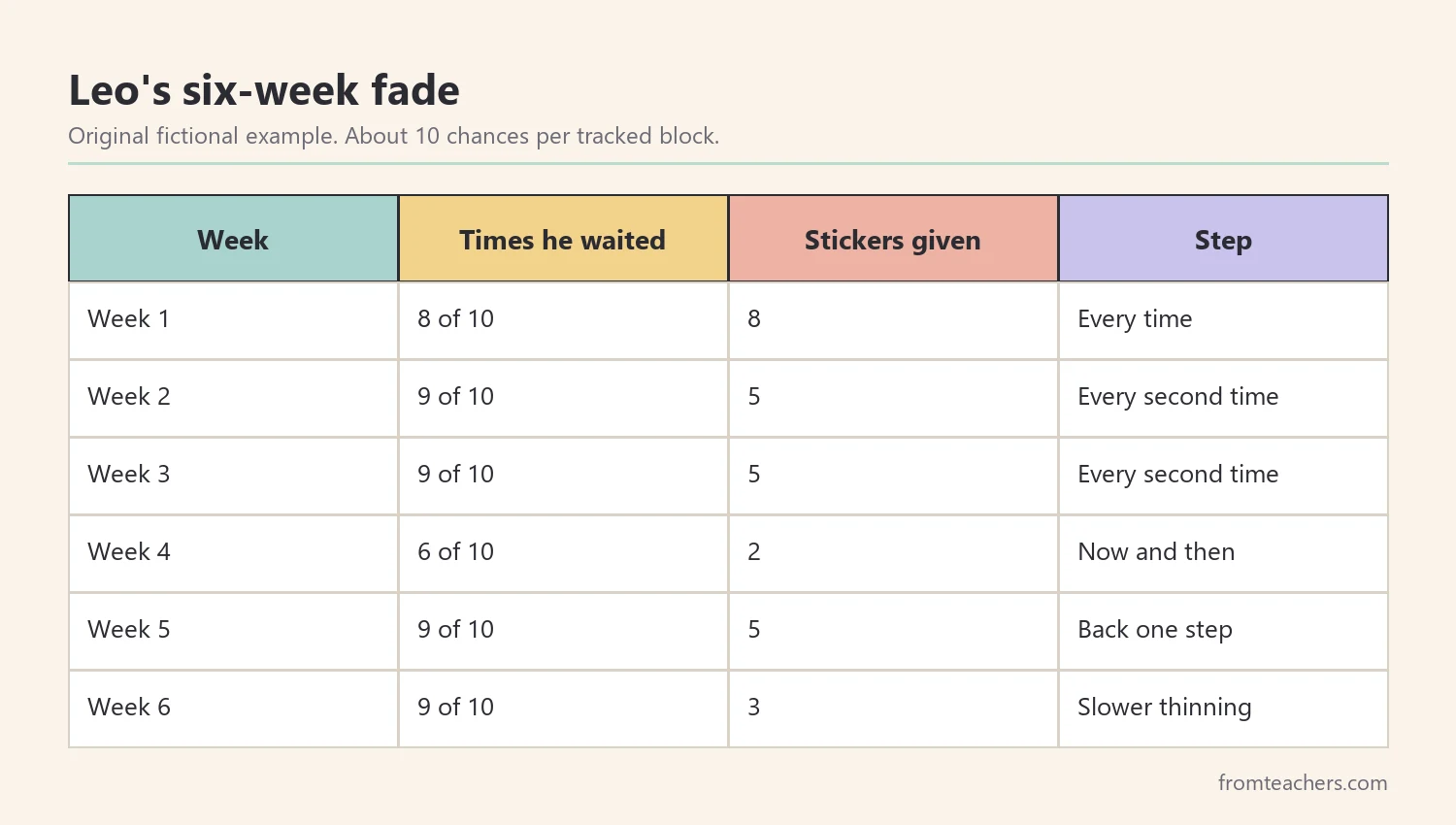
Notice week 4 in Figure 4. When the team moved from about every second time to an occasional reward, Leo’s waiting dipped. Instead of giving up, Ms. Patel stepped back to the previous level for a week. Then, she tried again more slowly, and the behavior held.
Use this weekly decision rule:
- Behavior steady or rising: keep the current step one more week, then thin a little more.
- Small dip for one week: stay at the same step and check for outside causes.
- Clear drop for two weeks: go back one step, then try a smaller change.
Also, mark unusual days. A substitute, a school trip, or a fire drill can change behavior for reasons that have nothing to do with fading. Marking them keeps one odd day from leading to the wrong decision. Consequently, your notes on fading positive reinforcement stay honest about what really changed.
6. Plan maintenance and share the plan
Even after a reward is fully faded, check in occasionally. A quick review every few weeks confirms that the behavior is still strong. Fading positive reinforcement is not over until the behavior lasts in new settings and with new adults.
Next, extend the skill. Ask a specialist teacher or a paraprofessional to watch for the behavior and give the same specific praise. If the behavior also appears in art, music, or the library, you know it has generalized. Moreover, other adults can then continue fading positive reinforcement in their own lessons using the same rules.
Then, share the plan with the family. Families often use rewards at home too, and they appreciate knowing what the school is doing. A short note such as “We have moved from stickers to praise for hand raising, and it is holding well” helps everyone use the same language.
Finally, keep the log in the student’s file. If the behavior slips after a holiday or a move to a new class, the next teacher can see exactly what worked and how quickly the fade happened. In Leo’s case, his grade 3 teacher read the log in September and started with praise and occasional stickers instead of starting from zero.
| Who | What to share | When |
|---|---|---|
| Family | Current step and the praise words used | Each time the step changes |
| Support staff | Behavior definition and reward rules | Before they work with the student |
| Next teacher | The full log and the final step | At the start of the year |
Common mistakes and how to avoid them
- Stopping rewards all at once. A sudden stop often leads to a sharp drop. Fix: thin gradually and keep praise constant.
- Changing several things together. If frequency, type, and timing all change in one week, you cannot tell what caused a dip. Fix: one lever at a time.
- Fading after one good week. One great week can be luck. Fix: wait for a steady run of at least two weeks.
- Not recording the response. Without the student’s response, you miss which rewards still matter. Fix: write one word or phrase for each reward.
- Treating a dip as failure. Short dips are normal during fading positive reinforcement. Fix: step back once, then move forward more slowly.
Questions teachers and parents ask about fading positive reinforcement
How long does fading positive reinforcement usually take?
It depends on the student, the behavior, and how long the reward has been in place. Some behaviors fade in a few weeks, while others need a term or more. Let the weekly records guide the pace rather than a fixed date.
Will the student feel punished when rewards become less frequent?
Not if the change is gradual and praise stays warm and specific. Some students notice and comment, which is fine. You can explain honestly that they are getting so good at the skill that they need less help.
Can parents fade rewards at home in the same way?
Yes. The same steps apply: define the behavior, keep a short log, change one thing at a time, and pair rewards with praise. A simple home version of the log can be kept on the fridge.
What if the behavior drops when we fade?
Go back one step and hold it until the behavior is steady again. Then try a smaller change. A drop is information, not a reason to abandon the plan.
Should every reward eventually be faded?
Not always. Some students benefit from ongoing support, and natural rewards such as praise and recognition never really end. The goal is to reach the least support that keeps the behavior strong.
Related reading: Moving Beyond Shame and Behavior Charts, The Power of Data Tracking in Special Education, and How Teachers Communicate With Parents in Special Education.
You may also need: Weekly Behavior Chart for Kids Editable Printable Reward Chart for Home.
A companion resource for fading positive reinforcement:
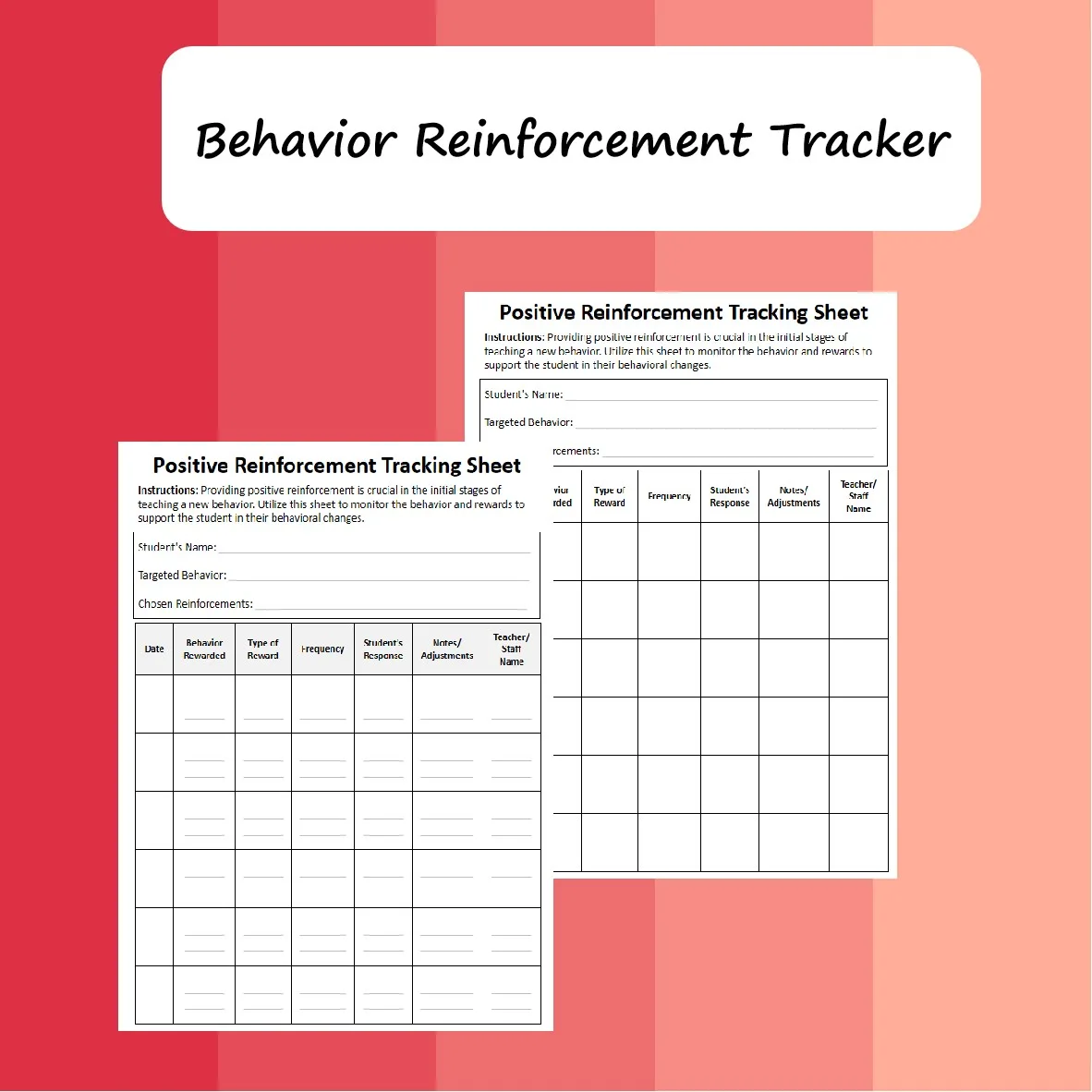
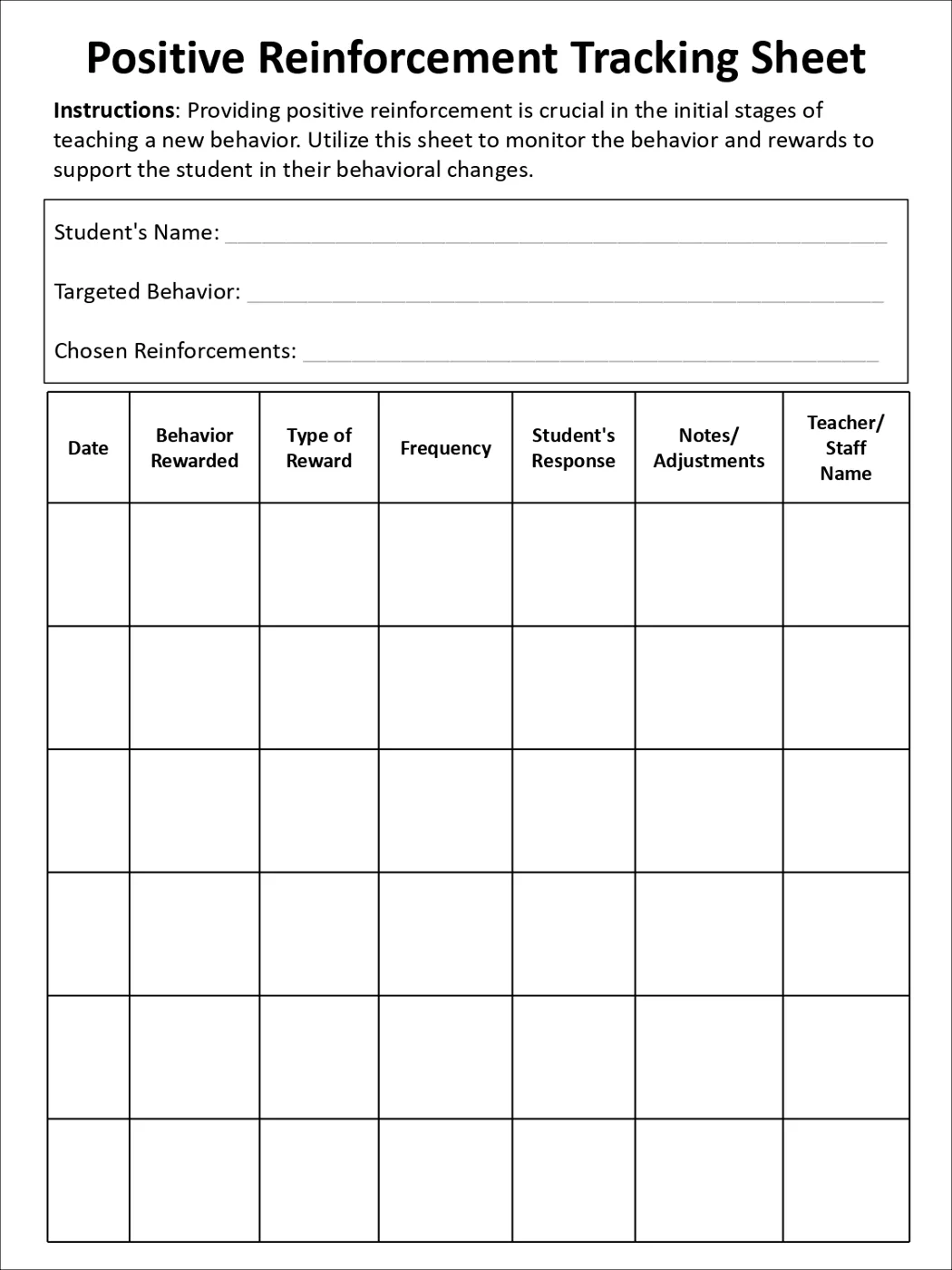
Positive Reinforcement Tracking Sheet: Editable Behavior Data Form: a two-page editable log with space for the target behavior and chosen reinforcements, plus columns for date, behavior rewarded, type of reward, frequency, student response, adjustments, and staff name.
Sources and scope
- IRIS Center, Vanderbilt University: free modules on classroom behavior management and data-based decisions.
- Center on PBIS: guidance on positive behavioral interventions and supports in schools.
- Individuals with Disabilities Education Act (IDEA): federal information on IEPs and positive behavior supports.
- Understood.org: family-friendly explanations of rewards, praise, and behavior at home.
This guide covers everyday classroom and home reward plans. It does not replace a functional behavior assessment or a plan written by a qualified behavior professional for complex or unsafe behaviors.
Key takeaways
- Fading positive reinforcement starts with a steady, clearly defined behavior.
- Change one lever at a time: frequency, type, or delay.
- Specific praise paired with every reward makes the fade possible.
- Two weekly numbers, behavior and rewards given, show whether the fade is working.
- Step back after a clear drop, then move forward more slowly.










Leave a Comment